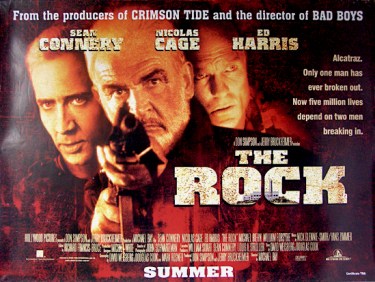
The Rock (1996)

100 Films’ 100 Favourites #75

Alcatraz.
Only one man has ever broken out.
Now five million lives depend on two men breaking in.

Country: USA
Language: English
Runtime: 136 minutes
BBFC: 15 (uncut, 1996) | 15 (cut on video, 1996) | 15 (uncut on video, 2002)
MPAA: R

Original Release: 7th June 1996
UK Release: 21st June 1996
First Seen: TV, c.2000

Stars
Nicolas Cage (Raising Arizona, National Treasure)
Sean Connery (You Only Live Twice, The Untouchables)
Ed Harris (Apollo 13, A Beautiful Mind)

Director
Michael Bay (Bad Boys, Transformers)

Screenwriters
David Weisberg (Payoff, Double Jeopardy)
Douglas S. Cook (Holy Matrimony, Criminal)
Mark Rosner (Blanco, Empire City)

Story by
David Weisberg (Holy Matrimony, Criminal)
Douglas S. Cook (Payoff, Double Jeopardy)

The Story
When a rogue US General and his team of Marines occupy Alcatraz, threatening to launch a gas attack on San Francisco unless their demands are met, a field-inexperienced chemical weapons specialist is paired with the only man to ever escape from the prison to break in and prevent the attack.

Our Heroes
Dr Stanley Goodspeed is a mild-mannered vinyl-loving FBI chemist, as unlikely an action movie leading man as… well, Nicolas Cage once was. His new partner is John Mason, a former SAS Captain who’s been imprisoned without charge by the US for decades. He’s also clearly more skilled than both an entire squad of mutinous Marines and, therefore, the entire team of Navy SEALs who initially fail to stop them. That’s the SAS for you.

Our Villain
Brigadier General Francis X. Hummel, a covert ops commander who is seeking recompense for his men who were killed in action but have gone unacknowledged due to the secretive nature of their missions. Fundamentally a good man, driven to less good methods. A particularly effective villain because he’s relatively sympathetic to the audience. Not all the men on his team are so trustworthy, however…

Memorable Quote
Stanley: “You’ve been around a lot of corpses. Is that normal?”
Mason: “What, the feet thing?”
Stanley: “Yeah, the feet thing.”
Mason: “Yeah, it happens.”
Stanley: “Well I’m having a hard time concentrating. Can you do something about it?”
Mason: “Like what, kill him again?”

Memorable Scene
Flarey goodBelieving the mission lost, the military has launched its back-up plan: an airstrike that will destroy the poison gas but also kill everyone on the island. Naturally our heroes manage to complete their mission nonetheless, and as the jets streak across San Francisco Bay, Stanley attempts to signal abort with two green flares. In slow motion, of course.

Making of
The final screenplay actually has many more authors than credited — not unusual for a Hollywood blockbuster, but the uncredited ones are of considerably higher profile. David Weinberg and Douglas Cook penned the original spec script, but Jonathan Hensleigh worked closely with Michael Bay on the final shooting script. When Writers Guild arbitration awarded the credit elsewhere, Bay wrote an open letter calling the process a “sham” and a “travesty”. Others who worked on the screenplay included Aaron Sorkin and Quentin Tarantino, with British screenwriting team Dick Clement and Ian La Frenais brought in at Connery’s behest to rework his dialogue, though they ended up rewriting everyone else’s too.

Previously on…
There’s a theory that Connery’s character is actually an older James Bond, incarcerated under a pseudonym. Obviously that isn’t actually there in the text, but is kind of a fun idea.

Awards
1 Oscar nomination (Sound)
1 MTV Movie Award (On-Screen Duo (Sean Connery & Nicolas Cage))
2 MTV Movie Award nominations (Movie, Action Sequence (for the yellow Ferrari’s chase through San Francisco))
2 Saturn nominations (Action/Adventure/Thriller Film, Music)

What the Critics Said
“the movie’s best asset is the old-fashioned, buddy-movie interplay between Cage and Connery — Cage as the frantic, white-collar lab technician who doesn’t like guns, Connery as the weathered, resourceful old pro who’s escaped from three maximum-security prisons and has a one-liner ready for every big, scary guy he kills.” — Gary Thompson, Philadelphia Daily News

Score: 66%

What the Public Say
“The screenplay […] does a sneaky thing on the way to Alcatraz. The two heroes are developed, or at least as much as one can expect for a standard action film. The action is diverted to the streets of San Francisco and a first-rate car chase. After an hour into the running time, the focus switches to the site in the movie’s title. These things are important in that they keep the film from stretching out the time spent on Alcatraz and becoming bloated on unnecessary action scenes. The audience has invested its interest in the heroes and can enjoy the shootouts now that more is on the line.” — Mark Pfeiffer, Reel Times: Reflections on Cinema

Verdict

Michael Bay has become a bit of a joke, thanks to his tendency to let his movies get distracted by explosions, special effects, and young women, while not paying enough attention to the screenplay. However, earlier in his career — and sometimes in later years, too — he’s produced enough quality work to suggest he does know what he’s doing… or maybe he’s just lucked out a couple of times. Either way, this is probably the pinnacle of his oeuvre. While it functions well in Bay’s familiar wheelhouse of adrenaline-pumping action-thriller, it’s elevated by a screenplay that offers dialogue which, at times, can be witty and/or intelligent; and, most importantly, which creates sympathetic characters on both sides of the conflict. There aren’t many actioners where you can say “the writing’s the best bit”, are there?

#76 will be… just a jump to the left…
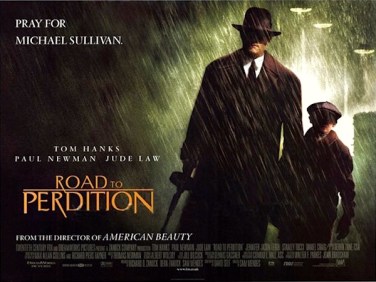
Road to Perdition (2002)

100 Films’ 100 Favourites #74

Pray for Michael Sullivan.

Country: USA
Language: English
Runtime: 117 minutes
BBFC: 15
MPAA: R

Original Release: 12th July 2002 (USA)
UK Release: 20th September 2002
First Seen: DVD, March 2003

Stars
Tom Hanks (Forrest Gump, Bridge of Spies)
Paul Newman (Cool Hand Luke, Butch Cassidy and the Sundance Kid)
Daniel Craig (Lara Croft: Tomb Raider, Casino Royale)
Jude Law (Gattaca, Closer)
Tyler Hoechlin (Everybody Wants Some!!, Fifty Shades Darker)

Director
Sam Mendes (American Beauty, Skyfall)

Screenwriter
David Self (Thirteen Days, The Wolfman)

Based on
Road to Perdition, a graphic novel by Max Allan Collins and Richard Piers Rayner.

The Story
1931: Michael Sullivan is an enforcer for mob boss John Rooney, who thinks of him like a son. When Sullivan escorts Rooney’s unstable real son, Connor, to a meeting, the guy snaps and the other side are murdered — an event witnessed by Sullivan’s own son, Michael Jr. In an attempt to cover it up, Connor kills Sullivan’s wife and other son, while Michaels Sr and Jr escape, and begin a journey to take revenge.

Our Heroes
Michael Sullivan Sr is, on paper, not much of a hero: a mob hitman, his trade is death. But when half his family is murdered, he’ll do what’s necessary to protect his surviving son and get justice — his kind of justice, anyway. In the process, he bonds with Michael Jr, finally developing the relationship they never had before. Perpetual nice guy Tom Hanks tones that way down to give what I think must be one of his best performances, which brings out the heart in Sullivan without tipping over into regular Hanks territory, in the process allowing the viewer to empathise with a man who in lesser hands would just be a cold-blooded murderer.

Our Villains
Connor Rooney is a liability, a deranged coward and crook who wishes he was a hard man. But he’s no threat — his father, mob boss John Rooney, is the one with the power and means. At heart he’s no villain to Michael Sullivan — he’s essentially his father — but after Connor murders Sullivan’s family, Rooney feels he must protect his own blood, despite caring for him less than Sullivan. With an actor of Paul Newman’s quality in the role, every nuance of Rooney’s complex emotional position is subtly explored.

Best Supporting Character
To try to stop Sullivan, the mob set hitman Maguire on his trail. He’s a crime scene photographer who uses his job to cover his crimes, and is a nasty, rat-like creep. Jude Law rejects his frequent pretty-boy-ness to really inhabit that part. (Basically, everyone is fantastic in this film.)

Memorable Quote
John Rooney: “This is the life we chose, the life we lead. And there is only one guarantee: none of us will see heaven.”
Michael Sullivan: “Michael could.”

Memorable Scene
Heavy rain falls as Rooney and his men cross an empty street to his car. When they reach it, the driver inside is dead, the door locked. They spread out across the street, guns ready, but there’s no one to be seen… Then a muzzle flashes and the men are slowly cut down — leaving only Rooney standing. As the shooter emerges from the shadows, the camera tracks in on Paul Newman, his posture and expression saying it all: he knows who it is, he knows his time has come, and he’s resigned to it. All of this set to just the sound of Thomas Newman’s mournful piano-and-strings soundtrack. Only when Rooney turns around does the rain begin to bleed onto the soundtrack, and we see the man is (of course) Michael Sullivan. “I’m glad it’s you.” With tears in his eyes, Sullivan finishes his job.

Technical Wizardry
There are several reasons the above scene works so well — the pace of the editing, the sparse sound design, the music, the performances — but one of the biggest is the cinematography. The work of Conrad L. Hall, this is just one of the most obviously beautiful sequences in a film full of gorgeous imagery. He won a well-deserved posthumous Oscar for his work, his third from a career that garnered ten nominations.

Making of
One of the locations found was considered physically perfect but the wrong way round, with room only to shoot from right to left and not vice versa. Rather than, say, find somewhere else, production designer Dennis Gassner and his team dressed the location to be flipped, not only reversing street signs and car number plates, but even changing the side of the steering wheels on all the vehicles.

Awards
1 Oscar (Cinematography)
5 Oscar nominations (Supporting Actor (Paul Newman), Score, Art Direction-Set Decoration, Sound, Sound Editing)
2 BAFTAs (Cinematography, Production Design)
1 BAFTA nomination (Supporting Actor (Paul Newman))
2 Saturn nominations (Action/Adventure/Thriller Film, Performance by a Younger Actor (Tyler Hoechlin))

Despite some initial build-up, Road to Perdition wound up an awards season also-ran, losing out to that well-remembered classic Chicago and everyone’s desire to try to give Martin Scorsese an Oscar for Gangs of New York.

What the Critics Said
“The greatest gangster film since The Godfather.” — News of the World

“To call this the greatest gangster film since The Godfather would be an overstatement, though not by much. It is, however, the most brilliant work in this genre since the 1984 uncut version of Sergio Leone’s flawed but staggering Once Upon a Time in America. Road to Perdition, a less sprawlingly ambitious movie, is without major flaws.” — Eric Harrison, Las Vegas Sun

Score: 81%

What the Public Say
“In a film about the mob and hitmen, the violence is generally kept to a minimum. And when it is done, it’s either very quick, or it’s shown partially offscreen or via a reflection. […] Throughout the film, the violence is never glorified as something heroic. But instead, it’s something that’s done only when it is necessary, and the weight of it is always felt. During the first killing in the film, the first one that Michael sees through a crack in the wall, it’s done unexpectedly and the victim falls to the ground in slow motion. When Mike brings out his Tommy Gun, it’s not something he does with glee, it’s something very deliberate as he solemnly takes the pieces out of the briefcase to assemble it.” — Bubbawheat, Flights, Tights, & Movie Nights

Verdict

Road to Perdition feels like a film that didn’t get its due at the time, and has become almost something of a cult favourite since. Not “cult” in the traditional “gaudy fun B-movie” sense, but in that it has a dedicated following of people who realise its power. On the surface it’s a revenge thriller, replete with ’30s mob style and Tommy Gun massacres, but under that is a more emotive tale about masculinity as it pertains to the father/son dynamic. It’s all handled with sensitive artistry by director Sam Mendes, supported by first-rate technical merits across the board (the design and music are particularly noteworthy, in addition to the cinematography I already mentioned), and career-best-level performances from a strong cast. It lacks the sheer scale and scope to go toe-to-toe with The Godfathers as the definitive gangster movie, but as a smaller, personal tale, it’s exceptional.

#75 will be… Bayhem.

Return of the Jedi (1983)

100 Films’ 100 Favourites #73

Return to a galaxy far, far away.

Also Known As: Star Wars: Episode VI – Return of the Jedi

Country: USA
Language: English
Runtime: 132 minutes | 135 minutes (special edition)
BBFC: U
MPAA: PG

Original Release: 25th May 1983 (USA)
UK Release: 2nd June 1983
First Seen: VHS, c.1990

Stars
Mark Hamill (The Empire Strikes Back, The Guyver)
Harrison Ford (Indiana Jones and the Last Crusade, Patriot Games)
Carrie Fisher (The Empire Strikes Back, The ‘Burbs)
Anthony Daniels (The Lord of the Rings, Star Wars: Episode I – The Phantom Menace)
Peter Mayhew (Star Wars, Comic Book: The Movie)

Director
Richard Marquand (Eye of the Needle, Jagged Edge)

Screenwriters
Lawrence Kasdan (Raiders of the Lost Ark, Silverado)
George Lucas (American Graffiti, Star Wars: Episode III – Revenge of the Sith)

Story by
George Lucas (Indiana Jones and the Temple of Doom, Radioland Murders)

The Story
As the Galactic Empire construct a new Death Star, Jedi-in-training Luke Skywalker — the Rebel Alliance’s best hope of defeating the evil Darth Vader — is busy rescuing his friend Han Solo from the clutches of crime lord Jabba the Hutt. Meanwhile, the powerful Emperor waits, intending to convert the young Jedi to the Dark Side…

Our Heroes
Luke Skywalker: Jedi Knight.
Han Solo: defrosted resistance captain.
Princess Leia: sister, love interest, bikini-wearer. Is it just me or does Leia get a pretty poor deal as the trilogy goes on?

Our Villains
Quite possibly the greatest villain ever created for the movies, Darth Vader. Here he’s on an arc of redemption, so there’s also the Emperor, who has the appearance of a wizened old man but is strong in the Force. As Vader himself puts it, “the Emperor is not as forgiving as I am.” Uh-oh!

Best Supporting Character
R2-D2 is the best supporting character in every Star Wars film, but in this one we are introduced to Jabba the Hutt (well, unless you watched Episode I or the New Hope Special Edition first). A giant, fat, slug-like crime lord who is impervious to Jedi mind tricks and apparently has a fondness for metal bikinis, he’s as physically repulsive as are his methods and mores.

Memorable Quote
“Many Bothans died to bring us this information.” — Mon Mothma

Quote Most Likely To Be Used in Everyday Conversation
“It’s a trap!” — Admiral Ackbar

Memorable Scene
The speeder bike chase — arguably the best action sequence in the entire original trilogy. Considering this is a series of films that include three or four duels with frickin’ laser swords, that’s some feat.

Memorable Music
John Williams’ music is an essential part of the Star Wars experience. While no single tune in Jedi is as iconic as the Main Theme from A New Hope or the Imperial March from Empire, the overall score is as good as ever.

Technical Wizardry
The background plates for the speeder bike chase were captured by having a Steadicam (operated by the system’s creator, Garrett Brown) walked through a forest while filming less than one frame per second. When played back at regular 24fps, this 5mph stroll came out more like a 120mph hurtle. They spent three days filming to get enough footage for the whole sequence.

Truly Special Effects
These days, the answer to the question “how did they do that?” is “CGI”. Back in the ’80s, however, they had to be a bit more creative — leaving an abundance of achievements worthy of inclusion here. For example, the shot where the Imperial fleet spring their trap on the Rebels was the most complex matte shot ever attempted, with dozens of separate model elements having to be printed in. Or there’s the puppet work. Jabba was full-size, of course, and the 2,000lb costume was operated by four puppeteers: one for his right arm and jaw, another for his left arm and tongue, both of whom moved his body; another had a cable control to move the mouth and nostrils, using his feet to work bellows to simulate breathing; and the fourth moved his tail. Plus the smoke for when Jabba uses his pipe was apparently created by someone smoking a cigar and blowing it up a tube. For the Rancor, on the other hand, Lucas wanted to use a Godzilla-style man in a suit, but the tests didn’t work very well. The final result is not stop-motion, as you might expect, but an 18-inch rod puppet. Filming it was treated as a live-action shoot, though various techniques were used to conceal the methodology, like slow-motion or running the film backwards — anything they could think of to help remove the sense of “Muppet-ness”.

Letting the Side Down
When it comes to Lucas’ Special Edition fiddling, most people focus on the “Han shot first” complaint. Personally, I find the change at the end of Jedi — where Hayden Christensen has been pasted over Sebastian Shaw as Anakin’s Force ghost — more egregious. That said, the stupid song & dance number in Jabba the Hutt’s palace runs it a close second. On the bright side, the added shots of planets around the Empire celebrating the destruction of the Death Star helps aggrandise an otherwise low-key post-climax celebration.

Making of
So, that metal bikini, eh? What a blatant bit of fan service by that dirty old George Lucas! Well, apparently it actually came about because Carrie Fisher herself complained about her all-covering costumes in the first two films meaning you couldn’t tell she was a woman. Costumer Aggie Guerard Rodgers’ design was inspired by the work of famed fantasy artist Frank Frazetta, but whoever decided it should be made as such a rigid piece wasn’t thinking ahead: the solidness of the top meant it didn’t move with Fisher’s body, and she refused to use double-sided tape, so before each take someone from wardrobe had to (to quote IMDb) “ensure that her breasts were still snug inside the costume”. Nice work if you can get it. Nonetheless, several scenes had to be reshot due to what we now call “wardrobe malfunctions”.

The Ewok Line
To quote from the How I Met Your Mother Wiki, “The Ewok Line correlates the birth year of a person and the subsequent appreciation of Ewoks […] Those born on or before May 25, 1973 have a low appreciation of the film’s creatures, while those born after this date have an affinity for them. This is because those who saw the Ewoks in Return of the Jedi, which was released theatrically on May 25, 1983, who were 10 or under still loved their teddy bears, giving them an increased appreciation for the Ewoks.” I was born in 1986 and, yes, I love Ewoks. I mean, how can you not enjoy their silly mix of teddybear cuteness, gobbledegook language, and Empire-beating military competence?

Previously on…
Return of the Jedi picks up on the cliffhanger from The Empire Strikes Back, which of course continued the story of Star Wars. Many, many other films, TV series, novels, comic books, computer games, and whatever other media you can think of, take place before and around these movies.

Next time…
Ooh boy… Well, primarily: 16 years later, George Lucas returned to the world he created for the infamous Prequel Trilogy, finally filling in those missing first three Episodes. Chronologically, the saga picks up after Jedi with last year’s Episode VII: The Force Awakens, and will continue in Episodes VIII and IX. Aside from those main tenets, there’s an unimaginable mass of stuff in what’s known as the Star Wars Expanded Universe: TV series, novels, comic books, computer games, and anything else you can imagine — and it’s only going to continue growing in the future. Most of what was generated before Disney bought Lucasfilm may have been wiped out by whoever’s in charge now, but that doesn’t mean people don’t care about what went on in it. Of particular note is Timothy Zahn’s Thrawn trilogy of novels, which kickstarted the prominence of the Expanded Universe, and which many fans used to view as effectively being Episodes VII, VIII and IX.

Awards
1 Oscar (Special Achievement in Visual Effects)
4 Oscar nominations (Score, Art Direction-Set Decoration, Sound, Sound Effects Editing)
1 BAFTA (Visual Effects)
3 BAFTA nominations (Make Up Artist, Production Design/Art Direction, Sound)
5 Saturn Awards (Science Fiction Film, Actor (Mark Hamill), Costumes, Make-Up, Special Effects)
5 Saturn nominations (Actress (Carrie Fisher), Supporting Actor (Billy Dee Williams), Director, Writing, Music)
Won the Hugo for Best Dramatic Presentation

What the Critics Said
“The characters and dialogue get lost somewhere between the bug-eyed monsters and the exploding spaceships, but it is all so much fun it probably really does not matter a whole lot. […] Because so much of Return of the Jedi concentrates on makeup and special effects, and perhaps also because much of the dialogue (and acting) is so bad, it is pretty hard to get too involved with the characters, who came across with much more human interest in The Empire Strikes Back, the second of the movies. In a sense, the extraterrestrials are a lot more human than the people.” — Harper Barnes, St. Louis Post-Dispatch

Score: 80%

What the Public Say
“[A] thing I like about the scene in Jabba’s palace is the teamwork between all of the heroes in their mission to rescue Han Solo. It reminds me of a heist in way, since you got the droids, Chewbacca, Lando, Leia and Luke all working together and serving different purposes in rescuing Han. I also love the fact that the reason they are all working together is because they all care about Han. It just goes to prove that Star Wars isn’t just a huge spectacle but a story about family and friendship, which makes it a lot more personable.” — Jacob Bartley, Apocaflix! Movies

Elsewhere on 100 Films
I’ve written about the original Star Wars trilogy twice before, both times back in 2007. Of Return of the Jedi’s modified DVD version, I said that “there seem to be only minor differences or effects improvements here — it does make you wonder what the fans were kicking up such a fuss about”, and noted that “the speederbike chase is one of the trilogy’s greatest action sequences. And Ewoks are cute.” Then, treating the film as the sixth part of the saga, I wrote that it had “the biggest failing of the films as a single series: the prequel trilogy is endlessly obsessed with the prophecy about Anakin bringing balance to the Force; it isn’t mentioned once here. A dubbed line or added shot with Yoda saying something would’ve been nice.”

Verdict

Once upon a time I decided Return of the Jedi was actually my favourite Star Wars movie. I watched them again last year and changed my mind again, and wondered quite what I’d been thinking before. Jedi does have a lot to commend it, from multiple memorable set pieces to some effective character work with most of the principals, but it’s certainly not without its flaws, which have only been exacerbated by the prequel trilogy — as the climax to a mythic six-film saga, the finale of Jedi lacks some heft. Arguably it only reaches towards classic status by association with its two predecessors, but on its own merits it’s still an exciting space adventure.

#74 will be… six weeks on the road in the winter of 1931.

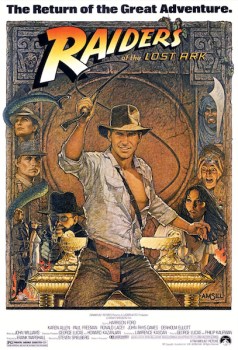
Raiders of the Lost Ark (1981)

100 Films’ 100 Favourites #72

The Return of the Great Adventure.

Also Known As: Indiana Jones and the Raiders of the Lost Ark

Country: USA
Language: English (and German, Hebrew, Spanish, Arabic & Nepali)
Runtime: 115 minutes
BBFC: A (1981) | PG (1987)
MPAA: PG

Original Release: 12th June 1981
UK Release: 30th July 1981
First Seen: VHS, c.1991

Stars
Harrison Ford (Star Wars, Witness)
Karen Allen (Animal House, Starman)
Paul Freeman (The Long Good Friday, Mighty Morphin Power Rangers: The Movie)
Ronald Lacey (Take a Girl Like You, Red Sonja)
John Rhys-Davies (The Naked Civil Servant, The Lord of the Rings)

Director
Steven Spielberg (E.T. the Extra-Terrestrial, The Adventures of Tintin: The Secret of the Unicorn)

Screenwriter
Lawrence Kasdan (The Empire Strikes Back, The Bodyguard)

Story by
George Lucas (THX 1138, Return of the Jedi)
Philip Kaufman (The Outlaw Josey Wales, The Right Stuff)

The Story
1936: adventurer Indiana Jones is hired by the US Army to retrieve the mythical Ark of the Covenant, which they believe is on the verge of being uncovered in Egypt, before the Nazis can get their grubby mitts on it.

Our Hero
Professor of archeology, expert on the occult, and obtainer of rare antiquities, Indiana Jones. Good with a whip; not good with snakes.

Our Villains
Dr. René Belloq, essentially the evil Indy: a fellow archeologist with fewer scruples, who often takes credit for Indy’s hard work and is now in bed with the Nazis. They’re most memorably represented by creepy Gestapo agent Toht, played by Ronald Lacey, who was cast because he reminded Spielberg of Peter Lorre.

Best Supporting Character
The daughter of Indy’s mentor, and his one-time love, Marion Ravenwood, who’s roped in because she happens to possess an artefact with a clue to the Ark’s location. Feisty and capable of holding her own (some of the time, anyway), it’s a shame she didn’t appear in the initial sequels — at Lucas’ insistence, apparently (he also kept her out of the spin-off novels). She eventually returns in Kingdom of the Crystal Skull, the only character from the first three films to be brought back for that adventure (besides Indy, obv.)

Memorable Quote
Sallah: “Indy, why does the floor move?”
Indiana: “Give me your torch… Snakes. Why’d it have to be snakes?”

Memorable Scene
Goodness, where do we start? Well, how about the start! Having made his way safely through a boobytrapped cave, Indy switches a bag of sand for the idol he’s come to retrieve. Unfortunately the trap is not fooled, and Indy has to run out as the place collapses around him and all the traps are triggered — including, most famously, a giant rolling boulder.

Write the Theme Tune…
It’s only one of the greatest movie main themes of all time. Composed by John Williams (of course) it’s technically called The Raiders March, and is a combination of two ideas Williams wrote for Jones’ theme that Spielberg suggested be put together to make one piece.

Technical Wizardry
The film is naturally packed with stunts, one of the most memorable being when Indy is dragged under and out behind a moving truck. To achieve it safely, more clearance was created under the truck by constructing one that was higher than normal and digging out the centre of the road. The shot was filmed at 20fps, lower than the standard 24, so that when played back the truck appeared to be moving faster. The feat was performed by stuntman Terry Leonard, but Harrison Ford was actually dragged behind the truck for some shots. When asked if he was worried, Ford replied, “No. If it really was dangerous, they would have filmed more of the movie first.”

Truly Special Effect
The climax, when the Ark is opened, was a field day for ILM. Techniques used include “animation, a woman to portray a beautiful spirit’s face, rod puppet spirits moved through water to convey a sense of floating, a matte painting of the island, and cloud tank effects to portray clouds.” Plus the villains’ heads melt (a gelatine and plaster model exposed to a heat lamp), collapse (a hollow model with the air sucked out), and explode (which nearly landed the film with an R rating).

Making of
Have you heard the one about the scheduled sword fight and everyone being ill? You have? Oh, okay then.

Next time…
The film was a massive success, so has spawned tonnes of media. Primarily, three direct sequel films, with a fifth set for 2019. Then there’s the three-season TV series The Young Indiana Jones Chronicles, 13 adult novels, 33 Young Indiana Jones novels, 11 “choose your own adventure”-style books, eight German novels (which have never been translated into English), numerous comic books, and 19 computer games, including nine with original storylines and two Lego Indiana Jones games. Also, a stunt show at Walt Disney World in Florida based on Raiders that has been running for 27 years. Whew!

Awards
5 Oscars (Editing, Art Direction-Set Decoration, Sound, Visual Effects, Special Achievement in Sound Effects Editing)
4 Oscar nominations (Picture, Director, Cinematography, Score)
1 BAFTA (Production Design/Art Direction)
6 BAFTA nominations (Film, Supporting Artist (Denholm Elliott), Cinematography, Editing, Music, Sound)
7 Saturn Awards (Fantasy Film, Actor (Harrison Ford), Actress (Karen Allen), Director, Writing, Music, Special Effects)
2 Saturn nominations (Supporting Actor (Paul Freeman), Costumes)
Won the Hugo for Best Dramatic Presentation

What the Critics Said
“Yes, it’s as entertaining as you have heard. Maybe more so. Raiders of the Lost Ark is, in fact, about as entertaining as a commercial movie can be. What is it? An adventure film that plays like an old-time 12-part serial that you see all at once, instead of Saturday-to-Saturday. It’s a modern Thief of Baghdad. It’s the kind of movie that first got you excited about movies when you were a kid. (Translation for today’s children: It’s better than anything on TV.)” — Gene Siskel, Chicago Tribune

Score: 94%

What the Public Say
“Spielberg and George Lucas had, in the same year, rewritten the rules of the science fiction genre; Lucas with Star Wars and Spielberg with Close Encounters of the Third Kind, but what could they do together? Greatness, it turns out. Their contribution: Raiders of the Lost Ark, one of the best, most exciting, most brilliantly written action movies of all time. It’s fun, it has a great sense of wonder and adventure. It’s scary, it’s bloody, it’s violent but you never come away feeling unclean. It has a hero, Indiana Jones, who is fallible but not a wimp. […] I can talk all day about Raiders of the Lost Ark, but I must simply conclude that the movie is just plain fun” — Jerry, armchaircinema

Verdict

George Lucas and Steven Spielberg teamed up for the first time here, recycled elements from movies beloved in their youth, and produced something new and exciting that is still a reference point for blockbusters 35 years later. (We’re getting homages to homages now, aren’t we? Weird.) It’s pretty much a perfect adventure movie: relentlessly paced, packed with action, lightened with humour, full of likeable heroes, who are brave and competent but also a little bit flawed, and hissable villains, with scene after scene of imaginative situations and fabulously staged derring-do. It’s perfectly distilled pulp adventure, and pure cinematic entertainment.

Many Bothans… died to bring us #73.

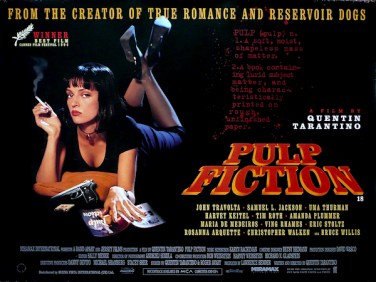
Pulp Fiction (1994)

100 Films’ 100 Favourites #71

You won’t know the facts
until you see the fiction.

Country: USA
Language: English
Runtime: 154 minutes
BBFC: 18 (uncut, 1994) | 18 (cut on video, 1995) | 18 (uncut on video, 2011)
MPAA: R

Original Release: 10th September 1994 (South Korea)
US Release: 14th October 1994
UK Release: 21st October 1994
First Seen: TV, 18th December 1999 (probably)
(I would’ve guessed several years later than that, but I definitely watched it on BBC Two and I definitely wasn’t 18, so (with reference to the BBC Genome Project) this is the only plausible option. That’s thrown all of my “first seen” guesses into doubt now…)

Stars
John Travolta (Grease, Face/Off)
Samuel L. Jackson (Loaded Weapon 1, Unbreakable)
Uma Thurman (Dangerous Liaisons, Gattaca)
Ving Rhames (Dave, Mission: Impossible)
Bruce Willis (Die Hard, The Fifth Element)

Director
Quentin Tarantino (Reservoir Dogs, Kill Bill)

Screenwriter
Quentin Tarantino (From Dusk Till Dawn, Jackie Brown)

Story by
Quentin Tarantino (Natural Born Killers, The Hateful Eight)
Roger Avary (Killing Zoe, The Rules of Attraction)

The Story
A chronologically-shuffled collection of interconnected short crime stories, including a hitman who has to take his boss’ wife for a nice night out, a boxer who refuses to throw a fight, the clean-up after a misfire, and a diner hold-up gone sideways.

Our Heroes & Villains
Most films can be divvied up into heroes and villains one way or another — I’ve certainly managed it for the previous 70 films in this list. Pulp Fiction muddies its waters considerably, with criminals for heroes at the best of times, and the “short story collection” style meaning there’s an abundance of characters anyway, some of whom arguably change sides from one tale to the next. Nonetheless, you’d have to point to hitmen Vincent Vega and Jules Winnfield, and their ever-so-Tarantino rambling conversations about nothing and everything, as the film’s primary duo.

Best Supporting Character
Christopher Walken’s cameo turn as an army vet passing down a watch with an… unusual history. (You might argue for Harvey Keitel’s character, but his Direct Line adverts have rather soured that.)

Memorable Quote
Vincent: “You know what they call a Quarter Pounder with Cheese in Paris?”
Jules: “They don’t call it a Quarter Pounder with Cheese?”
Vincent: “No man, they got the metric system. They wouldn’t know what the fuck a Quarter Pounder is.”
Jules: “Then what do they call it?”
Vincent: “They call it a Royale with Cheese.”
Jules: “Royale with Cheese. What do they call a Big Mac?”
Vincent: “Big Mac’s a Big Mac, but they call it Le Big Mac.”
Jules: “Le Big Mac. What do they call a Whopper?”
Vincent: “I don’t know, I didn’t go into Burger King.”

Quote Most Likely To Be Used in Everyday Conversation
“You mind if I have some of your tasty beverage to wash this down?” — Jules

Memorable Scene
Uma Thurman and John Travolta dancing — about as memorable a movie moment as there is.

Memorable Music
Famously, Tarantino never used to use original music (that’s now changed with his Ennio Morricone collaborations, of course), instead selecting tracks from his record collection — but his choices were so eclectic, obscure, and personal that many of them are now most associated with the films he put them in. Stand outs in Pulp Fiction include the title credits track, Dick Dale’s version of Misirlou; the song Mia and Vincent dance to, You Never Can Tell by Chuck Berry; and Urge Overkill’s cover of Girl, You’ll Be a Woman Soon.

Making of
The famous Bible passage memorised by Jules is mostly fictional. While one line is similar to text from the book, apparently the speech is almost word-for-word identical to the opening scene of the Sonny Chiba movie Karate Kiba.

Next time…
Travolta’s character, Vincent Vega, is supposedly the brother of Michael Madsen’s character from Reservoir Dogs, and at one time Tarantino was planning a movie starring the pair. It never materialised, obviously. There’s also the theory that all of Tarantino’s films take place in the same universe, which the director himself has confirmed.

Awards
Won the Palme d’Or
1 Oscar (Original Screenplay)
6 Oscar nominations (Picture, Actor (John Travolta), Supporting Actor (Samuel L. Jackson), Supporting Actress (Uma Thurman), Director, Editing)
2 BAFTAs (Supporting Actor (Samuel L. Jackson), Original Screenplay)
7 BAFTA nominations (Film, Actor (John Travolta), Actress (Uma Thurman), Director, Cinematography, Editing, Sound)
1 Saturn Award (Action/Adventure/Thriller Film)
2 MTV Movie Awards (Movie, Dance Sequence)
4 MTV Movie Awards nominations (including On-Screen Duo (Samuel L. Jackson & John Travolta) and Movie Song (Girl, You’ll Be a Woman Soon))
1 American Comedy Awards nomination (Funniest Supporting Actress (Amanda Plummer))

What the Critics Said
“this dizzily convoluted noir epic — one of the year’s best and most wildly inventive American movies — plunges us into a kind of retro-nightmare fantasy land. In Pulp Fiction, time keeps looping back on itself and we’re trapped in a cul-de-sac of double-crosses, absurdity, arousal and danger, never completely sure of where anyone’s going or why. [It] is shockingly violent, provocatively obscene and profane. It won’t just offend some audiences; it will offend the living hell out of them. Tarantino intends to rile people up. But it doesn’t feel like the usual high-tech, nasty blood-and-guts movie thriller […] This movie gets its charge not from action pyrotechnics but from its electric barrage of language, wisecracks and dialogue, from the mordant ’70s classicism of its long-take camera style and its smart, offbeat, strangely sexy cast.” — Michael Wilmington, Chicago Tribune

Score: 94%

What the Public Say
Pulp Fiction begins at its end. It is cyclical but we don’t realise this until we come to its final moments. Like many of Tarantino’s films, it is episodic and split into sections that overlap in both time and plot. It is far from linear; several threads occurring simultaneously, woven together by chance meetings, coincidence and common acquaintances. Travolta’s Vincent Vega is both alive and dead at the end of the film, such is the genius of the script. [It] is a film that demands a viewer’s attention, engagement and use of their brain to put the pieces of the puzzle together.” — Behind the Seens

Verdict

A defining movie for the American indie/auteur boom of the late ’80s and early ’90s, and consequently one of the most influential films of the ’90s… but it is itself heavily influenced by and recreated from styles and genres of the past… and yet, despite those two reflective sides, it’s not quite like anything else — Pulp Fiction is a rule unto itself. In only his second feature, Tarantino’s direction is remarkably self-assured; rarely flashy or showy, but not simplistic or uninteresting either. It’s a film where the famed dialogue is as vital as the characters’ actions, but it’s not one that’s solely driven by people talking to each other. Events interrupt them shooting the breeze, but it’s also them shooting the breeze that drives the action. It’s a film of many opposing facets, then, which is quite possibly what keeps it fascinating — almost as an incidental addition to the humour and style that keep it entertaining.

#72 will have snakes… why did it have to have snakes?

Pirates of the Caribbean: The Curse of the Black Pearl (2003)

100 Films’ 100 Favourites #70

Prepare to be blown out of the water.

Country: USA
Language: English
Runtime: 143 minutes
BBFC: 12A
MPAA: PG-13

Original Release: 9th July 2003 (USA)
UK Release: 8th August 2003
First Seen: cinema, August 2003

Stars
Johnny Depp (Edward Scissorhands, Finding Neverland)
Orlando Bloom (The Lord of the Rings, Troy)
Keira Knightley (Bend It Like Beckham, Pride & Prejudice)
Geoffrey Rush (Quills, The King’s Speech)

Director
Gore Verbinski (The Ring, The Lone Ranger)

Screenwriters
Ted Elliott (Aladdin, Pirates of the Caribbean: On Stranger Tides)
Terry Rossio (Small Soldiers, Pirates of the Caribbean: Dead Man’s Chest)

Story by
Ted Elliott (Treasure Planet, National Treasure: Book of Secrets)
Terry Rossio (The Mask of Zorro, The Lone Ranger)
Stuart Beattie (Collateral, 30 Days of Night)
Jay Wolpert (The Count of Monte Cristo)

Based on
Pirates of the Caribbean, a theme park ride at Disneyland.

The Story
When feared pirate ship the Black Pearl lays siege to the British outpost Port Royal and kidnaps the governor’s daughter, Elizabeth Swann, her childhood friend (and secret admirer) Will Turner teams up with notorious pirate Captain Jack Sparrow to rescue her. Jack has his own axe to grind with the crew of the Pearl, who are afflicted by a supernatural curse that they believe Elizabeth may be the key to breaking.

Our Heroes
Will Turner, a humble blacksmith and self-taught expert swordsman. Doesn’t like pirates, but is forced to team up with one. That would be self-proclaimed captain Jack Sparrow, who is apparently a bumbling buffoon prone to wild exaggeration about his exploits, but is actually strangely competent and honourable. Not to forget Elizabeth Swann, the governor’s daughter who is more strong-minded and capable than women of her time are supposed to be. Hates corsets, too.

Our Villains
Captain Barbossa (a villain of Rickman-esque likeability) and his undead pirate crew just want to lift their terrible curse, but, being pirates, tend to go about that mission with excessive violence.

Best Supporting Character
Two of Barbossa’s crew, Ragetti (Mackenzie Crook) and Pintel (Lee Arenberg), who make a comedy double act. Or maybe triple act, with Ragetti’s wooden eye.

Memorable Quote
“You best start believing in ghost stories, Miss Turner… you’re in one!” — Barbossa

Memorable Scene
Barbossa orders his crew to attack a British Navy ship from underwater. As the moon emerges from behind a cloud to reveal the true skeletal form of the undead crew, they march along the seabed to their target…

Memorable Music
Originally set to be scored by Alan Silvestri, who’d worked with director Gore Verbinski on a couple of previous movies, the composer fell out with producer Jerry Bruckheimer and it was decided to go with Hans Zimmer instead. Unfortunately Zimmer was busy, but he pointed them in the direction of newer composer Klaus Badelt, one of Zimmer’s mentees at his company Media Ventures. Presumably Badelt struggled, because Zimmer ended up drafting several of the score’s main themes in one night, and a team of additional composers (anywhere from seven to fifteen, depending which source you listen to) was brought in to help finish it off. (One of them, incidentally, was Ramin Djawadi, who has since gone on to be noticed for Game of Thrones.) The final score is credited to Badelt, but the soundtrack’s most famous cue — He’s a Pirate — is actually a development of a piece Zimmer wrote for forgotten Wesley Snipes action-thriller Drop Zone. You can’t really argue a score created like that has any artistic integrity, but it’s fun and exciting, and He’s a Pirate is a really, really good piratical action theme.

Truly Special Effect
All of the CGI was strikingly photo-real at the time, the main showcase being the skeletal pirates, especially as they switched from being normal humans to skeletons (and back again) as they moved in and out of the moonlight. I guess it’s aged a little now, but, to be fair, it is 13 years old. Couple this with the even-better work featured in the sequels and it shows ILM are still at the forefront of the industry.

Making of
There’s always been something of a tonal similarity between the Pirates films and the Monkey Island series of computer games, which turned out to be more than coincidence when it eventually emerged that, just a couple of years before Pirates, screenwriter Ted Elliott had been working on a Monkey Island film for Steven Spielberg which never came to fruition. As if to compound the point, Monkey Island creator Ron Gilbert revealed in 2004 that the original game was inspired by the novel On Stranger Tides, and in 2007 Disney bought the rights to the novel and used its title and bits of its plot for the fourth Pirates film.

Next time…
Initially followed by a pair of shot-back-to-back trilogy-forming sequels, their cumulative success turned it into a franchise: a fourth movie followed in 2011, with a fifth shot last year for release next summer. Also inspired a host of piratical TV series, and Disney to attempt various other ride adaptations and genre mash-ups (see: The Lone Ranger).

Awards
5 Oscar nominations (Actor (Johnny Depp), Makeup, Sound Mixing, Sound Editing, Visual Effects)
1 BAFTA (Make Up/Hair)
4 BAFTA nominations (Actor (Johnny Depp), Costume Design, Sound, Visual Effects)
1 Saturn Award (Costumes)
10 Saturn nominations (Fantasy Film, Actor (Johnny Depp), Supporting Actor (Geoffrey Rush), Supporting Actress (Keira Knightley), Director, Music, Make Up, Special Effects, DVD Special Edition, Genre Face of the Future (Keira Knightley))
2 MTV Movie Awards Mexico (Sexiest Hero (Orlando Bloom), Best Look (Johnny Depp))
1 World Stunt Award (Best Fight for the blacksmith shop sword fight)
Nominated for the Hugo for Best Dramatic Presentation Long Form

What the Critics Said
“it’s Johnny Depp’s inspired turn as Captain Jack Sparrow that really marks the spot. Depp, arguing that pirates were the rock stars of their day, models his entire performance on Keith Richards of the Rolling Stones: it’s there in every slurred vowel and every drug-fried wiggle of the head. There’s an endearing dignity to Sparrow’s hunger for fame. “You are, without doubt, the worst pirate I’ve heard of,” says one British officer. “Yes,” replies Jack, “but you have heard of me.” Gloriously over-the-top, this performance is pitched only as high as the film’s fun factor itself. In terms of physical precision and verbal delivery, it’s a masterclass in comedy acting.” — Alan Morrison, Empire

Score: 79%

What the Public Say
“manages the weird assignment of capturing the sensibility of a theme park boat ride inside a Spielbergian adventure romp. This is all the things popcorn movies should be: fun, energetic, simple enough to quickly grasp but full enough to not seem stupid, anchored by strong personalities among all the side characters (Geoffrey Rush’s florid villain is a great bit of acting in its own right, unfairly overshadowed by Depp), and a cohesive world with a sense of history and depth.” — Tim Brayton, Antagony & Ecstasy

Verdict

It seemed like such a terrible idea when it was first announced: films based on Disney theme park rides? What the hell were they thinking?! The other movies produced by this initiative turned out to be as terrible as everyone expected, but somehow Pirates of the Caribbean — which also had to contend with the fact that cinematic pirates were deeply unpopular after the studio-killing disaster of CutThroat Island eight years before — wasn’t. Not just “not bad”, either, but an exciting, humorous, creepy, fun movie. That the sequels haven’t lived up to it is disappointing, but the first still stands as a near-perfect example of big-budget swashbuckling entertainment — it’s basically the dictionary definition of a summer blockbuster.

#71 goes to show… you never can tell.

Phone Booth (2002)

100 Films’ 100 Favourites #69

Your life is on the line.

Country: USA
Language: English
Runtime: 81 minutes
BBFC: 15
MPAA: R

Original Release: 4th April 2003 (USA)
UK Release: 18th April 2003
First Seen: cinema, 2003

Stars
Colin Farrell (The Recruit, Total Recall)
Kiefer Sutherland (Flatliners, Dark City)
Forest Whitaker (Ghost Dog: The Way of the Samurai, The Last King of Scotland)
Radha Mitchell (Pitch Black, Silent Hill)
Katie Holmes (Wonder Boys, Batman Begins)

Director
Joel Schumacher (The Lost Boys, Batman & Robin)

Screenwriter
Larry Cohen (Maniac Cop, Cellular)

The Story
Slick, smarmy Stu uses the last remaining phone booth in New York City to call the young woman he’s trying to cheat on his wife with. Then the phone rings: there’s a sniper rifle trained on him, and if Stu doesn’t follow the caller’s instructions, he’ll die.

Our Hero
Stuart “Stu” Shepard, a slimy publicist who’s trying to cheat on his wife, strings along a kid with hopes of getting in the game, wears Italian clothes to make himself look better than he is, and is generally a dick to everyone. So not a very nice guy, really… but does he deserve to be shot by a sniper, hm?

Our Villain
A mysterious voice on the other end of the phone, The Caller has some kind of moral code, has demands of Stu to fit that code, and also has a high-powered sniper rifle that he’s not afraid to use on just about anybody. Surprisingly witty, too.

Best Supporting Character
Captain Ramey, the cop in charge of the situation once the police get involved, who is at least bright enough to realise there’s more going on than meets the eye.

Memorable Quote
(After cocking his gun) “Now doesn’t that just torque your jaws? I love that. You know like in the movies just as the good guy is about to kill the bad guy, he cocks his gun. Now why didn’t he have it cocked? Because that sound is scary. It’s cool, isn’t it?” — The Caller

Memorable Scene
With both his wife and mistress on the scene, and surrounded by police and news cameras, Stu finally makes his confession. A heartfelt monologue that is definitely a showpiece for Farrell.

Making of
The whole film was shot in just 12 days: ten days inside the phone booth and two to shoot the surroundings. To do this the crew worked “French hours”, which involves not shutting down the entire production for lunch (which just sounds logical to me), and was aided further by Farrell nailing some big scenes in one take.

Awards
1 MTV Movie Awards Mexico nomination (Best Colin Farrell in a Movie — see also: Daredevil)

What the Critics Said
“The triumph of director Joel Schumacher and screenwriter Larry Cohen in Phone Booth is not just that they pull off the central gimmick but also that they fashion from it a creditable thriller. The result is a movie that combines a seriousness of purpose with a delight in craft in a way Hitchcock would have appreciated.” — Mick LaSalle, San Francisco Chronicle

Score: 71%

What the Public Say
“It’s the kind of pulpy potboiler that is often wrecked by unnecessary padding, but the brisk no-nonsense approach here combines with its short length to make quite an entertaining off-beat thriller. Kiefer Sutherland’s vengeful psychopath who is only represented by a voice-over and a red dot for the majority of the film is the stand-out performance, but everyone involved acquits themselves admirably.” — Gary Anthony Cross, Film Noird

Verdict

Regular readers will know of my fondness for the single-location thriller, and this is one of the films that helped define that love. And events occur in real-time, which is just a bonus. Colin Farrell and Kiefer Sutherland are both on excellent form as the hostage who maybe has it coming and the hostage taker who maybe has a point. Larry Cohen’s screenplay takes a simple setup and follows it through, keeping it engrossing but still relatively plausible (something other such films struggle with in order to extend their concept), with some killer dialogue to boot. It all adds up to an immensely effective thriller.

Next time… yo-ho, yo-ho, a pirate’s life for #70.

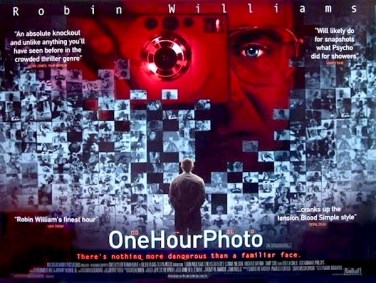
One Hour Photo (2002)

100 Films’ 100 Favourites #68

There’s nothing more dangerous
than a familiar face.

Country: USA
Language: English
Runtime: 96 minutes
BBFC: 15
MPAA: R

Original Release: 21st August 2002 (USA)
UK Release: 4th October 2002
First Seen: DVD, c.2003

Stars
Robin Williams (Mrs. Doubtfire, Jumanji)
Connie Nielsen (Gladiator, Basic)
Michael Vartan (Never Been Kissed, Colombiana)
Gary Cole (Office Space, Talladega Nights: The Ballad of Ricky Bobby)

Director
Mark Romanek (Never Let Me Go, a lot of music videos)

Screenwriter
Mark Romanek (Static, Inside Out IV)

The Story
Sy Parrish is the lead technician at SavMart’s one-hour photo developing clinic. A lonely guy, he invests all his energy in doing a great job for his customers. He’s particular fond of the Yorkins, a young family whose seemingly perfect life has become his obsession. When Sy loses his job at the same time as discovering a secret about one of the Yorkins, his quiet obsession threatens to become something darker…

Our Hero
Sy Parrish, the socially awkward but fundamentally nice department store photo technician.

Our Villain
Sy Parrish, when he snaps — though from his point of view, it’s the member of the Yorkin family that shatters his illusions of their perfect life.

Best Supporting Character
Although the film is very much focused on Robin Williams’ tour de force performance as Sy (more on that later), the cast is filled out by good turns in smaller roles. Ones that have always particularly stuck in my mind include Eriq La Salle as a detective who becomes involved as Sy goes off the rails, and Dylan Smith as the Yorkins’ sympathetic young son, who identifies Sy’s lonely sadness before anyone else. Not so hot on his Evangelion, though.

Memorable Quote
“Family photos depict smiling faces… births, weddings, holidays, children’s birthday parties. People take pictures of the happy moments in their lives. Someone looking through our photo album would conclude that we had led a joyous, leisurely existence free of tragedy. No one ever takes a photograph of something they want to forget.” — Sy Parrish

Memorable Scene
When the Yorkins are out, Sy wanders around their home, admiring the photos on the fridge, including one of himself, using the facilities, having a beer, hanging out with their dog watching TV. Then, suddenly, they come home… but it’s okay because he’s their friend. And this is all in Sy’s imagination.

Technical Wizardry
Writer-director Mark Romanek’s background is as a very successful music video director, and, as you might expect from someone with that history, his first proper feature is visually assured. In particular Sy’s workplace, SavMart, created by production designer Tom Foden as a consumerist heaven-cum-hell: a huge, white, slick place, but ultimately sterile, cold, and colourless, especially under glaring fluorescent light in the typically skilful cinematography of David Fincher’s frequent DP, Jeff Cronenweth.

Making of
In keeping with the film’s photographic theme, many of the characters are named after real-life photographers. These include: Sy’s assistant, Yoshi Araki (Nobuyoshi Araki); Sy’s boss, Bill Owens (Bill Owens); detectives Van Der Zee (James Van Der Zee) and Outerbridge (Paul Outerbridge); Officer Dan Lyon (Danny Lyon); Maya Burson (Nancy Burson); customers Mrs. von Unwerth (Ellen von Unwerth) and Mr. Siskind (Aaron Siskind); and the hotel at the end, the Edgerton (Harold Eugene Edgerton).

Awards
1 Saturn Award (Actor (Robin Williams))
4 Saturn nominations (Action/Adventure/Thriller Film, Supporting Actress (Connie Nielsen), Writing, Music)
1 Fangoria Chainsaw Award (Actor (Robin Williams) — it’s not that kind of film, is it?)

What the Critics Said
“It’s a credit to Romanek and Williams that Sy commands much sympathy; for most of the film he’s convincingly played and treated as being odd and quirky but not necessarily threatening. That Williams has come to develop a warm-‘n-fuzzy screen persona over the years works wonders for the character; not only does it make his loneliness palpable and relatable, it makes his inevitable eruption all the more shocking to behold. What makes the turn all the more disturbing, however, is no matter how unhinged he becomes, Sy never becomes nor comes off as a completely despicable character. His actions may veer off into a negative direction, but the motivation comes from a genuinely good place, though to a selfishly obsessive extreme.” — Michael Dequina, TheMovieReport.com

Score: 81%

What the Public Say
“It’s a film that over the years I’ve come to appreciate far more than my initial viewing due to the brilliant, unforgettable effort by Robin Williams who gives one of his most haunting performances. […] It’s a testament to Williams’ talent that you can be both repulsed and sympathetic to Sy. He unnerves you with his calculated obsession and creepy smile, yet it’s hard not to feel bad for a guy who simply just wants a friend or a family to call his own as he enters the twilight of his life.” — Jeffrey Lyles, Lyles Movie Files

Verdict

Part psychological thriller, part character study, One Hour Photo has some interesting things to say about how we record our memories — or how we used to, considering that digital photography and social media have since transformed that aspect of our lives. Whether or not that element of the film is past it, Robin Williams’ performance endures. It wasn’t the first time he’d played a non-comedic role, of course, but he’s so throughly subsumed in the role of the awkward, creepy Sy Parrish that it’s possible to forget it’s Williams at all. It may well be the finest acting performance from an extraordinary talent.

In #69 a ringing phone has to be answered.

Once Upon a Time in the West (1968)

100 Films’ 100 Favourites #67

There were three men in her life.
One to take her…
one to love her…
and one to kill her.

Original Title: C’era una volta il West

Country: Italy, USA, Spain & Mexico
Language: English and/or Italian
Runtime: 166 minutes (international) | 145 minutes (US theatrical) | 175 minutes (Italy)
BBFC: A (cut, 1969) | 15 (1989) | 12 (2011)
MPAA: PG (1969) | PG-13 (2003)

Original Release: 21st December 1968 (Italy)
UK Release: 14th August 1969
First Seen: DVD, c.2003

Stars
Claudia Cardinale (, Fitzcarraldo)
Henry Fonda (My Darling Clementine, 12 Angry Men)
Jason Robards (Hour of the Gun, Tora! Tora! Tora!)
Charles Bronson (The Magnificent Seven, Death Wish)

Director
Sergio Leone (A Fistful of Dollars, Once Upon a Time in America)

Screenwriters
Sergio Donati (Face to Face, A Fistful of Dynamite)
Sergio Leone (The Good, the Bad and the Ugly, A Fistful of Dynamite)

Story by
Dario Argento (Deep Red, Suspiria)
Bernardo Bertolucci (The Conformist, The Last Emperor)
Sergio Leone (The Last Days of Pompeii, For a Few Dollars More)

The Story
The mysterious Harmonica arrives in the town of Flagstone, out for revenge against Frank. Frank, working for a railroad baron, is busy murdering Brett McBain for his land and blaming the crime on the bandit Cheyenne. Cheyenne teams up with Harmonica to help McBain’s newly-arrived widow, and therefore owner of his land, Jill. Jill finds herself caught in the crossfire between the three men pursuing their own interests…

Our Heroes
Jill McBain, a former prostitute who’s still subject to the will and whims of men. Harmonica, a formidable gunslinger known only by the instrument he plays. Even Cheyenne, a bandit leader, is a good buy when they’re all arranged against…

Our Villain
Frank, the meanest sonuvabitch in the West. What did he do to Harmonica in the past? What will he do to Jill to get his way? Nothing good…

Best Supporting Character
Crippled railroad tycoon Morton only wants to intimidate the McBains to relinquish their land, which I guess makes him a nice guy when compared to his murderous handyman, Frank, who he clearly can’t control.

Memorable Quote
Harmonica: “Did you bring a horse for me?”
Snaky: “Well, looks like we’re… looks like we’re shy one horse.”
Harmonica: “You brought two too many.”

Memorable Scene
In one of the most iconic opening sequences in cinema history, three gunmen arrive at a train station and… wait for a train. For ten minutes. Ten real-time minutes, accompanied only by sounds like a squeaky windmill, a dripping water tower, and distant bird cries. Then the train arrives… and then the train leaves… and then a harmonica plays. And the action… threatens to start. Ah, Leone.

Memorable Music
It’s a Sergio Leone film, of course there’s an Ennio Morricone score — and it’s one of his best. It was composed before shooting began so Leone could play it on set, so it fits like a glove. The best bits include the striking leitmotifs: a haunting one for Jill, with wordless vocals by Edda Dell’Orso, and a dramatic one for Harmonica, threatening guitar combined with a melody played on a… well, you know.

Technical Wizardry
The entire picture looks fantastic thanks to the work of cinematographer Tonino Delli Colli. It displays all the framing and composition Leone is famous for, but also evokes an oppressive hot, sweaty feeling, and the light and texture of the image have pure cinematic quality. They don’t make ’em like this anymore.

Letting the Side Down
Leone’s original plan was for the three gunmen in the opening scene to be cameos for the stars of The Good, the Bad and the Ugly — Clint Eastwood, Lee Van Cleef and Eli Wallach — but Eastwood (who’d already turned down the role of Harmonica) was unavailable. Shame.

Next time…
Considered by some to be the first part of a thematic “Once Upon a Time” trilogy, which continues with A Fistful of Dynamite (released in some regions as Once Upon a Time… the Revolution) and Once Upon a Time in America.

What the Critics Said
“The world of a Leone Western is just as enchanted as it was in the films the director saw as a child, but the values have become confused. Heroes as well as villains are apt to be motivated by greed and revenge, and the environments in which they operate are desolate and godless, though very beautiful. The Leone Westerns are twice removed from reality, being based on myths that were originally conceived in Hollywood studios in the nineteen-thirties. […] Once Upon the Time in the West thus is a movie either for the undiscriminating patron or for the buff. If you fall somewhere in between those categories, you had better stay home” — Vincent Canby, The New York Times (Just so we’re clear, I think this is a terrible review.)

Score: 98%

What the Public Say
“The clue’s in the title: Once Upon a Time in the West is a fairy story, a mythologised version of the American West, peopled with immediately recognisable archetypes. It’s also a commentary on the Western genre itself, and a celebration in the form of a kind of “greatest hits”, full of references to other films and filmmakers: John Ford, George Stevens, Anthony Mann, Shane, The Searchers, High Noon, and so on. […] So the game isn’t originality, but Everything More Iconic Than Everyone Else. Westerns – even great Westerns – would follow, directed by the likes of Sam Peckinpah, Walter Hill, and Eastwood himself, but [this] still feels like the genre’s final word.” — Owen Williams

Verdict

America didn’t ‘get’ Once Upon a Time in the West when it first came out (hence the retrospectively laughable reviews, like the one above). The French did, though: it played for literally years in Paris cinemas, even inspiring fashion trends (the long duster coats). I confess, my initial reaction was a little more akin to the Americans’ — OUaTitW can be quite a slow film, and the plot is deceptively obscured until quite late on. But it certainly rewards repeat viewings, because it’s a film of rich content and, perhaps even more importantly, supreme style and technical achievement. The French were right (but don’t tell them that).

#68 will be… completed while you shop.

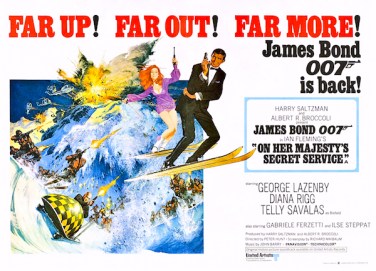
On Her Majesty’s Secret Service (1969)

100 Films’ 100 Favourites #66

Far up! Far out! Far more!
James Bond 007 is back!

Country: UK & USA
Language: English, German & French
Runtime: 142 minutes
BBFC: A (cut, 1969) | PG (1987)
MPAA: M (1969) | PG (1994)

Original Release: 13th December 1969 (Japan)
UK Release: 18th December 1969
US Release: 18th December 1969
First Seen: TV, c.1995

Stars
George Lazenby (Who Saw Her Die?, Gettysburg)
Diana Rigg (The Assassination Bureau, Theatre of Blood)
Telly Savalas (The Dirty Dozen, Kelly’s Heroes)

Director
Peter Hunt (Shout at the Devil, Death Hunt)

Screenwriter
Richard Maibaum (From Russia with Love, The Spy Who Loved Me)

Additional dialogue by
Simon Raven (Unman, Wittering and Zigo, The Pallisers)

Based on
On Her Majesty’s Secret Service, the tenth James Bond novel by Ian Fleming.

The Story
After James Bond saves the life of Teresa DiVincenzo, her mob boss father offers him information on the location of Ernst Stavro Blofeld, who Bond has been unsuccessfully tracking for years. Operating against orders to drop his investigation, Bond goes undercover in Blofeld’s Swiss research facility to find out what nefarious scheme he’s plotting now…

Our Hero
Bond, James Bond, agent 007 of the British secret service. On this mission, he falls in love and gets married — that never happened to the other fella!

Our Villain
Bond’s second face-to-face confrontation with the head of S.P.E.C.T.R.E., evil mastermind and archetypal uber-villain Ernst Stavro Blofeld, now played by Telly Savalas. It’s a very good villainous performance, though possibly suffers by coming after Donald Pleasance’s iconic turn in You Only Live Twice.

Best Supporting Character
Contessa Teresa Draco DiVincenzo — aka Tracy, the only woman headstrong, intelligent, and bold enough to tie down international playboy James Bond.

Memorable Quote
“It’s all right. It’s quite all right, really. She’s having a rest. We’ll be going on soon. There’s no hurry, you see. We have all the time in the world.” — James Bond

Quote No One’s Going to Use in Everyday Conversation Anymore, That’s For Sure
Bond: “I find her fascinating, but she needs a psychiatrist, not me.”
Draco: “What [my daughter] needs is a man… to dominate her! To make love to her enough to make her love him! A man like you!”

Memorable Scene
As M, Q, and Moneypenny sit around wondering where the devil 007 is, a shadowy man drives an Aston Martin accompanied by the Bond theme. (As in we hear it — he’s not got it on the stereo.) To his surprise, he’s overtaken by a woman. A few miles down the road, he sees her car stopped by the beach, and she’s walking out to sea. He runs after her, scoops her up and carries her back to the shore. As she wakes up, we see his face for the first time — and it’s not Sean Connery! But he does say, “My name’s Bond. James Bond.” Then he has a punch-up. A tradition (keeping the new Bond’s face a ‘secret’ until some kind of reveal*) is instantly born.

* Not that this happens in Live and Let Die. Or Casino Royale, really. Oh well.

Write the Theme Tune…
Regular series composer John Barry aimed to help cover for the absence of Connery by making the score “Bondian beyond Bondian”, and this certainly applies to the main title theme: an instrumental number (of which there are only three in the entire series) which is surely second only to the main James Bond theme in its Bondianness. It’s a fantastic action number that sits just as well over the ski sequences as it does the opening titles. (There’s also a great cover version by the Propellerheads on David Arnold’s Shaken Not Stirred album, by-the-by.)

Sing the Theme Tune…
Nonetheless, the film does contain an original song, composed by Barry with lyrics by Hal David, and — most famously — sung by Louis Armstrong in his final recording: We Have All the Time in the World. Considering the 1967 Casino Royale also produced The Look of Love, it was clearly an unusually fertile time for Bond films to produce songs that transcended their origins.

Technical Wizardry
Various methods were used to capture the Alpine action scenes, including camera operators skiing alongside the stuntmen (backwards while holding a camera!), and using Swiss Olympic athletes for the bobsled chase (with the sequence rewritten to incorporate their accidents). Most remarkable, though, was the aerial photography achieved by cameraman Johnny Jordon. To get flexibility to shoot scenes on the move from any angle, he developed a system where he was dangled 18 feet below a helicopter in a parachute harness. Mad.

Looking good, Lazenby!Letting the Side Down
There’s little doubt that George Lazenby is the worst big-screen Bond (though all of those who came after have their detractors), but he’s not actually that bad — he certainly sells the film’s emotional ending in a way I can’t quite picture Connery managing. If he’d stuck around for a few more movies I imagine he’d be better regarded. What really lets him down is his costuming — that frilly-shirt-and-kilt outfit is half the reason people who dislike the film dislike it so much, I swear. (Here it is bigger, if you want a good look.)

Making of
Various stars of The Avengers (the classic British TV series, not the Marvel superheroes) have appeared in the Bond series — Honor Blackman in Goldfinger, Patrick Macnee in A View to a Kill (plus narrating loads of the DVD documentaries), and of course Diana Rigg here — all after they appeared on the TV show. The exception is Joanna Lumley, who appears in a small part here a few years before joining The New Avengers. Despite the diminutive size of her role, Lumley spent two months on the production, dubbing the voices of Blofeld’s whole cadre of women using German, Chinese, and Norwegian accents. She also taught the other actresses to crochet, so that was nice.

Previously on…
Five James Bond films starring Sean Connery.

Next time…
After Lazenby pulled out of his contract, Connery returned for Bond’s next adventure. There have been 17 Bond adventures on the silver screen since that, and the series continues indefinitely, with a 25th entry due in 2018 or so. On Her Majesty’s Secret Service was adapted for radio in 2014, the fourth of (to date) five Bond radio adaptations starring Toby Stephens as 007.

Awards
1 Golden Globe nomination (Most Promising Male Newcomer (George Lazenby))

How OHMSS Got a Bad Reputation
“I suspect the average filmgoer still believes Lazenby was fired because the movie flopped. Wrong on both counts. OHMSS was not a blockbuster on the scale as Connery’s previous two films, but it was a solid hit. Box-office returns were no reason to fire Lazenby, and he wasn’t fired. He quit. […] OHMSS would go over schedule and over budget and [director Peter Hunt] would continually clash with his producers as well as his star. When OHMSS didn’t prove to be a runaway success, the public would blame Lazenby, but Saltzman and Broccoli and United Artists privately blamed Hunt along with his insistence on creating a tense, serious action film faithful to Fleming. Perversely, the finest film in Broccoli and Saltzman’s series became the model of everything they wanted to avoid in the future. In their desire to run from all that OHMSS represented, they turned the next film, Diamond Are Forever, into the dumbest, sloppiest mess in the series’ history. But Connery had returned so it was another substantial box-office hit, and the producers felt vindicated in their artistically disastrous decisions. The success of Diamonds Are Forever dealt a hit to OHMSS’s reputation. Thankfully, quality cannot go ignored for long and as more people discovered Hunt’s neglected masterpiece, the more admired it has become.” — Jeffrey Westhoff, Culture Spy (that whole piece is excellent, by-the-by)

What the Critics Said
“it is nothing short of miraculous to see a movie which dares to go backward, a technological artefact which has nobly deteriorated into a human being. I speak of the new and obsolete James Bond, played by a man named George Lazenby, who seems more comfortable in a wet tuxedo than a dry martini, more at ease as a donnish genealogist than reading (or playing) Playboy, and who actually dares to think that one woman who is his equal is better than a thousand part-time playmates. […] The love between Bond and his Tracy begins as a payment and ends as a sacrament. After ostensibly getting rid of the bad guys, they are married. They drive off to a shocking, stunning ending. Their love, being too real, is killed by the conventions it defied. But they win the final victory by calling, unexpectedly, upon feeling. Some of the audience hissed, I was shattered.” — Molly Haskell, The Village Voice

Score: 82%

What the Public Say
“Not everybody is wrong about this film, of course. Steven Soderbergh and Christopher Nolan are both fond of this film. As am I. There are problems with this film, to be certain, and the problems do lie (mostly) with Lazenby. […] Having gone with the amateur Bond, they upped the ante for the girl. Diana Rigg was already a star from The Avengers and was perfectly suited to be a Bond girl. [She] is the answer, of course, as to why this film ranks as high as it does on the list of Bond films when Lazenby is so lackluster a Bond. Yes, there are good things in the film beside her – the ski scenes, the bobsled scene (you can tell the close-ups are rear projection but the longshots are real and exciting), the tragedy of the ending. But, for the first 40 years of the series she was the height of the Bond girls and she pulls this film higher than we had any right to originally expect.” — Erik, News from the Boston Becks

Verdict

The history of opinion on OHMSS is a fascinating one: written off as a failure, the series’ black sheep thanks to Lazenby and the less fantastical tone than the films that surround it; then gradually rehabilitated precisely because of that tone, to the point where it’s now almost “the Bond fan’s Bond film” (it certainly still has its detractors, who are either baffled by or in denial of its acclaim in other quarters). The ways it subverts the Bond formula are part of what makes it so memorable, but so are the ways it plays up to it, like Blofeld’s mountaintop base: considerably more plausible than the hollowed-out volcano (it’s a real place, for one thing), but no less incredible. Similarly, there’s an atypical plot, but also incredible action sequences — all done for real, too (well, aside from some iffy back projection). It does have faults that hold it back from being the best Bond movie in my estimation, but it’s up with the series’ best nonetheless.

#67 will be… a Western fairytale.