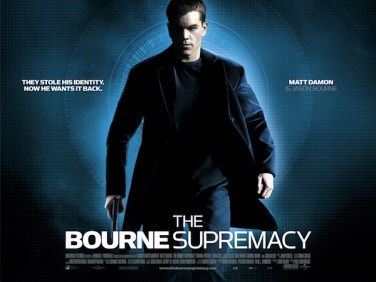
The Bourne Supremacy (2004)

100 Films’ 100 Favourites #16

They should have left him alone.

Country: USA & Germany
Language: English, Russian, German & Italian
Runtime: 108 minutes
BBFC: 12A
MPAA: PG-13

Original Release: 23rd July 2004 (USA)
UK Release: 13th August 2004
First Seen: cinema, August 2004

Stars
Matt Damon (The Talented Mr. Ripley, The Departed)
Franka Potente (Blow, Romulus, My Father)
Brian Cox (Manhunter, X2)
Joan Allen (The Ice Storm, Death Race)
Karl Urban (The Lord of the Rings: The Two Towers, Dredd)

Director
Paul Greengrass (The Bourne Ultimatum, Green Zone)

Screenwriter
Tony Gilroy (Proof of Life, The Bourne Legacy)

Based on
The character of Jason Bourne, created by Robert Ludlum. Not so much based on The Bourne Supremacy, the novel by Robert Ludlum.

The Story
Bourne and Marie are living a quiet life in India, until he’s framed for the murder of two CIA agents and the theft of files they were acquiring. After the actual culprit tries to kill Bourne, he believes the CIA have tracked him down, and makes good on his promise to bring the fight to them…

Our Hero
Living a life of seclusion with Marie, but still struggling with resurfacing memories from his time as a CIA operative, Jason Bourne has no intention of going anywhere near his former life… until they come for him, and the gloves are off. Bryan Mills ain’t got nothing on Bourne’s particular set of skills.

Our Villains
A whole host of interests are aligned against Bourne this time. From within the CIA, corrupt director Ward Abbott is still trying to cover his ass. A more physical threat comes in the form of Russian operative Kirill, referred to in early drafts of the screenplay as “Mock-Bourne” because he, a) frames our hero, and b) is his equal — well, almost.

Best Supporting Character
Pamela Landy brings some complication to the CIA side of the story: she’s out to get Bourne, same as the fellas from the first film, but that’s because she’s been conned too. Will she see the light and side with our hero?

Memorable Quote
Nicky: “It’s not a mistake. They don’t make mistakes. They don’t do random. There’s always an objective. Always a target.”
Landy: “The objectives and targets always came from us. Who’s giving them to him now?”
Nicky: “Scary version? He is.”

Memorable Scene
In Munich, Bourne visits the one remaining Treadstone operative. They fight, using household items as weapons (see “making of”, below). Then a team of soldiers arrive. Bourne turns on the gas, shoves a magazine in the toaster, and… well, the result was disproved by MythBusters, but it’s still cool.

Technical Wizardry
The cinematography and editing, according to some.

Letting the Side Down
The cinematography and editing, according to some.

Making of
The film famously features Bourne using a rolled-up magazine as a weapon in a fight with another Treadstone operative. Fight coordinator Jeff Imada looked over the set after it had been dressed to get an idea of what would be lying around that could be used as a weapon, and had the idea of a rolled up magazine. He had to demonstrate to sceptical crew members that it would indeed be a functional weapon, but was helped by actors Matt Damon and Marton Csokas giving each other bruises from practising with it.

Previously on…
The Bourne Identity left enough hanging to help fuel this movie.

Next time…
Although Supremacy was designed to wrap up the mysteries left dangling from Identity, they found plenty to drive a third film, which completes the trilogy by answering those remaining questions. A fourth film was essentially a spin-off. This summer’s fifth film will be about… something…

Awards
2 Saturn nominations (Action/Adventure/Thriller Film, Actor (Matt Damon))
2 World Stunt Awards (Best Work with a Vehicle, Best Stunt Coordinator and/or 2nd Unit Director)
1 World Stunt Award nomination (Best Fight)
2 MTV Movie Awards nominations (including Best Action Sequence (the Moscow car chase))

What the Critics Said
“Greengrass keeps you off-balance throughout. When the fight scenes and car chases arrive, there’s no telling, from shot to shot, what we will see next or how we’ll see it. […] Working with cinematographer Oliver Wood, Greengrass shoots the fight scenes and chases so close in that we see some moments almost as a blur. The editors, Richard Pearson and Christopher Rouse, break those sequences up into quick jagged shots that key us up and keep us hyper-alert. The world is being broken into bits of information, and we look hard at the screen to take it in. The approach could have resulted in the usual visual gibberish that defines contemporary action moviemaking [but] you can always tell what’s going on” — Charles Taylor, Salon

Score: 81%

What the Public Say
“I thought the movie was shot well, though at times I felt that the shaky cam effect was overused, as instead of pulling you into the action, it just gives you a headache and a dizzy spell” — Zoë, The Sporadic Chronicles of a Beginner Blogger

Verdict

Debate used to rage about whether Identity or Supremacy was the better film, centred on their very differing directorial styles. Fans of Greengrass’ sequel seem to have settled on Ultimatum as their preferred Bourne instalment now, though, leaving Supremacy to be generally regarded as the least-best of the first three Bournes. That does it something of a disservice: it’s an exciting, twisty, complicated thriller, and its groundbreaking visuals can’t be ignored for their contribution to the action genre — for good or ill.

#17 will… always have Paris.


The Bourne Identity (2002)

100 Films’ 100 Favourites #15

Danger is Bourne

Country: USA, Germany & Czech Republic
Language: English, French, German, Dutch & Italian
Runtime: 119 minutes
BBFC: 12A
MPAA: PG-13

Original Release: 14th June 2002
UK Release: 6th September 2002
First Seen: DVD, 2003

Stars
Matt Damon (Good Will Hunting, The Martian)
Franka Potente (Run Lola Run, Creep)
Chris Cooper (Lone Star, Adaptation.)
Clive Owen (Croupier, Children of Men)
Julia Stiles (10 Things I Hate About You, The Omen)

Director
Doug Liman (Swingers, Mr. & Mrs. Smith)

Screenwriters
Tony Gilroy (The Devil’s Advocate, Michael Clayton)
William Blake Herron (A Texas Funeral, Ripley Under Ground)

Based on
The Bourne Identity, a novel by Robert Ludlum.

The Story
Pulled wounded from the sea, Jason Bourne can’t remember anything about his life, but is a highly-trained combatant. That comes in handy when assassins begin to hunt him down, as he races across Europe with the aid of Marie, a German woman he bumped into, trying to establish the facts about his identity.

Our Hero
A man found floating in the ocean with two gunshot wounds in his back, who can’t remember his own name but can speak several languages and has knowledge of advanced combat skills. A laser projector implanted under his skin leads him to a safety deposit box in Zurich that contains thousands of dollars in cash, a gun, and an array of passports, from which he chooses a name: Jason Bourne.

Our Villains
The CIA’s Operation Treadstone, led by Alexander Conklin, who have an interest in Bourne — an interest that may primarily involve killing him.

Best Supporting Character
Marie, a German woman in the right place at the right time when a chap offers her $20,000 to drive him from Zurich to Paris… and in the wrong place at the wrong time when it turns out a bunch of people want to kill him, and she’s acceptable collateral damage.

Memorable Quote
Bourne: “Who has a safety deposit box full of money and six passports and a gun? Who has a bank account number in their hip? I come in here, and the first thing I’m doing is I’m catching the sightlines and looking for an exit.”
Marie: “I see the exit sign, too. I’m not worried. I mean, you were shot. People do all kinds of weird and amazing stuff when they are scared.”
Bourne: “I can tell you the license plate numbers of all six cars outside. I can tell you that our waitress is left-handed and the guy sitting up at the counter weighs 215lbs and knows how to handle himself. I know the best place to look for a gun is the cab of the grey truck outside, and at this altitude, I can run flat out for a half mile before my hands start shaking. Now why would I know that? How can I know that and not know who I am?”

Memorable Scene
Bourne arrives at the US consulate in Zurich, unaware his presence has been flagged after visiting that safety deposit box. As security guards surround him, Bourne demonstrates just what he’s capable of…

Making of
One of the most fraught productions of recent times, the behind-the-scenes woes of The Bourne Identity are too numerous to recount here, but too interesting (if you’re interested in that kind of thing) to overlook. Check out #4 here for more, like this: “It’s very rare that a movie comes out a year late, has four rounds of reshoots, and it’s good.”

Previously on…
Adapted as a TV miniseries in 1988 starring Richard Chamberlain, which is reportedly much more faithful to the novel.

Next time…
Three sequels to date, with a fourth out this summer. 2008 video game The Bourne Conspiracy takes place in and around the first film, though doesn’t use Matt Damon’s likeness. The film series also revived interest in Ludlum’s books, and consequently nine continuation novels have been penned by Eric Van Lustbader since 2004, with a tenth planned.

Awards
1 Saturn nomination (Action/Adventure/Thriller Film)
1 World Stunt Award (Best Work with a Vehicle)

What the Critics Said
“With a two-year shooting schedule, a script that was redrafted more times than the cast care to remember, and Matt Damon making at least two movies (Ocean’s 11 and Spirit) in the middle of all that mess, this thriller comes to the cinemas as much a marked man as its central character. Some of the joins do show, especially towards the end of the film, when a couple of minor characters disappear completely, but by then it has been too much fun to start picking holes.” — Emma Cochrane, Empire

Score: 83%

What the Public Say
“a point of departure from the action/spy genre, further making The Bourne Identity an anti-genre-genre film, is the cat like reflexes of Jason Bourne. Our first vision of him in action (remember, we’ve never seen Matt Damon like this before) is when he is laying on a park bench in Switzerland, approached by two policemen who are about to accuse him of loitering. Within the conversation, Bourne discovers he can effectively speak Swiss-German, and then as soon as one of the officers reaches to touch him, he responds with breathtaking speed and accuracy and before we know it, there is a little pile of police at his feet. […] nice guy Jason can’t really help it. Posit this against the casual cold blooded and calculated moves of the relaxed and suave Bond” — Lisa Thatcher

Verdict

The name’s Bourne, Jason Bourne… Maybe it was just me, but this Matt Damon action-thriller seemed to arrive under the radar back in the early ’00s (I don’t think I even heard of it until it was on DVD), but quickly established itself as the influential new kid on the block. Perhaps the Paul Greengrass-helmed sequels have been even more influential (they can be credited with bringing the much-derided ShakyCam style of filming action into the mainstream), but for me this first film is still the best of the bunch: an engaging mystery-thriller adrenalised by excellent action sequences.

#16 will be… Bourne again.

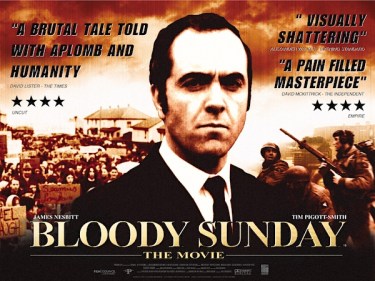
Bloody Sunday (2002)

100 Films’ 100 Favourites #14

January 30, 1972
a day written in history
a day when innocence died
when truth was sacrificed
and lives were changed forever

Country: UK & Ireland
Language: English
Runtime: 110 minutes
BBFC: 15
MPAA: R

Original Release: 20th January 2002 (UK)
First Seen: TV, 20th January 2002

Stars
James Nesbitt (Millions, The Hobbit: An Unexpected Journey)
Tim Pigott-Smith (The Remains of the Day, V for Vendetta)
Nicholas Farrell (Chariots of Fire, Hamlet)
Kathy Kiera Clarke (The Most Fertile Man in Ireland, Cherrybomb)

Director
Paul Greengrass (United 93, Captain Phillips)

Screenwriter
Paul Greengrass (The Murder of Stephen Lawrence, United 93)

The Story
Derry, Northern Ireland, 30th January 1972: MP Ivan Cooper leads a peaceful march to protest internment. British paratroopers observing the march, geed up after previous conflicts, respond to minor rioting by shooting into the unarmed crowd and at fleeing civilians.

Our Hero
James Nesbitt stars as MP and civil rights activist Ivan Cooper, a Protestant who was elected in a mostly Catholic constituency, and the organiser of what was supposed to be a peaceful protest march.

Our Villains
The British Army don’t come across in the best light, with Tim Piggot-Smith’s Major General Robert Ford issuing hostile orders, and the troops eager for a fight. The depiction is tempered by Nicholas Farrell as Brigadier Patrick MacLellan, battling his conscious even as he must carry out his orders.

Memorable Quote
“I just want to say this to the British Government. You know what you’ve just done, don’t you? You’ve destroyed the civil rights movement, and you’ve given the IRA the biggest victory it will ever have. All over this city tonight, young men — boys — will be joining the IRA, and you will reap a whirlwind.” — Ivan Cooper

Memorable Scene
After the day is done, Ivan Cooper delivers the above statement at a press conference. Intercut, at inconspicuous locations and under the cover of dark, young men queue up to join the IRA.

Technical Wizardry
Shot handheld on 16mm by cinematographer Ivan Strasburg, Bloody Sunday looks like news footage. It’s not trying to pass itself off as documentary, but rather it places the viewer in the heart of events. Clever shot selection and Clare Douglas’ editing mean that, even though a sense of confusion is evoked, the chronology and geography of events is maintained.

Making of
“Making the film Bloody Sunday was important for me, not only as an actor but for my understanding of myself as an Ulsterman. It helped me realise that this episode was the watershed, and that the ensuing 30 years of conflict in Northern Ireland were in large part due to what happened that day in 1972. For it was on that night that young men all over the country joined up with the IRA in a sense of rage and injustice at what had happened.” — James Nesbitt, The Independent

Awards
1 BAFTA TV Award (Photography and Lighting)
4 BAFTA TV Award nominations (Actor (James Nesbitt), Single Drama, Editing, Sound)
2 British Independent Film Awards (Actor (James Nesbitt), Director)
3 British Independent Film Award nominations (Best British Independent Film, Screenplay, Technical Achievement (Cinematography))
4 Irish Film and Television Awards (Feature Film, Director, Script, Sound)
4 Irish Film and Television Award nominations (Actor (James Nesbitt), Actress (Kathy Kiera Clarke), Photography, Editing)
Won the Golden Bear at the Berlin International Film Festival (tied with Spirited Away).

What the Critics Said
“you have to remind yourself at moments that you’re not looking at a documentary. […] Filmed in 16mm, with a hand-held camera that seems to be breathlessly attempting to keep up with the chaotic events, the movie has a stunning immediacy. It doesn’t feel as if Greengrass has staged the events, but that his camera (in the expert hands of cinematographer Ivan Strasburg) happened to be there when the tragedy occurred, a witness to the British officers’ planning, to the marchers’ anger and panic, to the soldiers’ gung-ho macho and to the cover-up that followed.” — David Ansen, Newsweek

Score: 92%

What the Public Say
“The film has been criticized by some as focusing too much on the Cooper character, encouraging a “great man” view of history. This criticism seems overblown when one considers the breadth of Bloody Sunday, but Greengrass does acknowledge an interest in placing Cooper at the fore as a kind of “man between worlds,” being a Protestant politician campaigning for peace across Northern Ireland and for civil rights denied to his Catholic countrymen.” — spinenumbered, Make Mine Criterion!
(Be advised, the Criterion Collection edition of the film described in this article is wishful thinking rather than a genuine release.)

Verdict

Bloody Sunday is a tough film to write about in a somewhat frivolous format like this one. It’s a film about a terrible moment in history, a shameful day for the British Army and a tragic one for the people of Northern Ireland, which it presents with documentary realism and an objective perspective, more concerned with presenting the facts as best it can than with apportioning blame. Even given that, it’s an inescapably emotional and affecting film. Powerful moviemaking.

#15 will be… extreme ways.

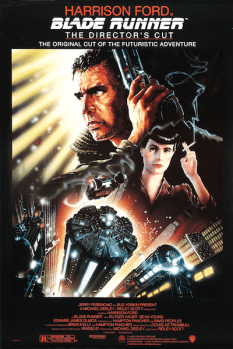
Blade Runner: The Director’s Cut (1982/1992)

100 Films’ 100 Favourites #13

The original cut of the futuristic adventure.


For clarification: as I didn’t see The Final Cut until after 100 Films started, and I’ve still not seen the theatrical cut, it’s only the 1992 Director’s Cut that is eligible for this list.

Country: USA, UK & Hong Kong
Language: English
Runtime: 116 minutes
BBFC: 15
MPAA: R

Original Release: 25th June 1982 (USA)
UK Release: 9th September 1982
Director’s Cut Release: 11th September 1992 (USA) | 27th November 1992 (UK)
First Seen: DVD, c.2001

Stars
Harrison Ford (Star Wars, Raiders of the Lost Ark)
Rutger Hauer (Soldier of Orange, The Hitcher)
Sean Young (No Way Out, Dr. Jekyll and Ms. Hyde)
Edward James Olmos (Wolfen, Battlestar Galactica)
Daryl Hannah (Splash, Kill Bill)

Director
Ridley Scott (Alien, The Martian)

Screenwriters
Hampton Fancher (The Mighty Quinn, The Minus Man)
David Peoples (Unforgiven, Twelve Monkeys)

Based on
Do Androids Dream of Electric Sheep?, a novel by Philip K. Dick.

The Story
L.A., 2019: cop Rick Deckard is dragged out of retirement to hunt and ‘retire’ a gang of Replicants — genetically-engineered androids, almost indistinguishable from humans, used for menial work off-world — who have come to Earth to extend their lives. As Deckard investigates, he comes to question what it means to be human…

Our Hero
Rick Deckard, former blade runner — which means nothing but does sound fairly cool. May or may not be a Replicant. (“He is!” “He isn’t!” “He is!” “He isn’t!”)

Our Villain
Roy Batty, definitely a Replicant. Committed the crime of wanting to live.

Best Supporting Character
Rachael — secretary, love interest, Replicant but believes herself to be human. Do we see a theme developing here?

Memorable Quote
“I’ve seen things you people wouldn’t believe. Attack ships on fire off the shoulder of Orion. I watched C-beams glitter in the dark near the Tannhauser gate. All those moments will be lost in time, like tears in rain.” — Roy Batty

Memorable Scene
At the imposing headquarters of the Tyrell Corporation, blade runner Holden sits employee Leon in front of a strange machine. He begins to administer a Voight-Kampff test, a series of questions designed to provoke a response that the machine analyses. “You’re in a desert, walking along in the sand, when all of a sudden you look down…” “What one?” “What?” “What desert?” Leon’s test isn’t going to go according to plan…

Memorable Music
The synthesised score by Vangelis should by all rights sound terribly dated and oh-so-’80s by now, yet it’s somehow timelessly futuristic.

Technical Wizardry
Visually, Blade Runner is a non-stop marvel: the noir cinematography, the vehicle and set design, the lived-in world, the believable effects… The entire thing is imaginatively conceived and magnificently realised with unwavering plausibility.

Truly Special Effect
The realisation of future-L.A. airspace — packed with giant skyscrapers, videoscreen adverts, flying cars, at night and in the rain — is literally faultless, and only gains impact for being achieved for real with models.

Making of
The Director’s Cut came about after a 70mm print was discovered in storage and an LA cinema got permission to screen it at a film festival in 1990. Only then did anyone realise the print was the workprint version of the film. Warner Bros organised more screenings, advertising them as a “Director’s Cut”. Ridley Scott wasn’t best pleased, which led to some screenings being cancelled. The rest sold out, however, and so Warner decided to create a genuine Director’s Cut. With Scott busy on other projects, film preservationist and restorer Michael Arick was put in charge, using notes and suggestion from Scott to do the best he could. Although Scott considered it better than the theatrical cut, he was never wholly happy with the ’92 version, which ultimately led to the creation of The Final Cut another 15 years later.

Next time…
Between 1995 and 2000, Philip K. Dick’s friend K.W. Jeter continued Deckard’s story in three novels, which apparently attempt to resolve the differences between Blade Runner and Do Androids Dream of Electric Sheep? In 1997, Westwood Studios and Virgin Interactive released a “sidequel” point-and-click adventure game, where you play as another blade runner in a storyline that takes place alongside the movie (it’s excellent, by the way, though I imagine you’d have a nightmare making it run today due to its age, which is a shame). Finally, a long-mooted sequel is in development for a January 2018 release.

Awards
2 Oscar nominations (Art Direction-Set Decoration, Visual Effects)
3 BAFTAs (Cinematography, Costume Design, Production Design)
5 BAFTA nominations (Editing, Make Up Artist, Score, Sound, Visual Effects)
4 Saturn nominations (Science Fiction Film, Supporting Actor (Rutger Hauer), Director, Special Effects)
Won the Hugo for Best Dramatic Presentation.

What the Critics Said
“This is, [Scott] says, the version he would have released in 1982 if he could have. The Ford narration was added because the studio feared audiences would not understand his story of a futuristic Los Angeles. The new ending, which is ironic and inconclusive and gives Ford an existentialist exit line, was of course dropped by studio executives for a more standard violent outcome. I watched the original Blade Runner on video a few years ago, and now, watching the director’s cut, I am left with the same over-all opinion of the movie: It looks fabulous, it uses special effects to create a new world of its own, but it is thin in its human story.” — Roger Ebert

Score: 89%

What the Public Say
“Its such a dark movie, but such a sad movie too. The sadness threatens to overpower everything. A character has her whole life undermined when she learns she isn’t real, not even her memories or experiences. It’s all a lie, a fabrication, as she is herself. Rick Deckard may not even be real. He might be just the same as Rachael. It’s not an idea I subscribe to, but it’s there, a possibility hanging over everything, underlined by the origami unicorn that he finds at the close of the film.” — ghost of 82

Elsewhere on 100 Films
I reviewed The Final Cut in 2009, noting that it was “undeniably one of the most significant films of the last quarter-century thanks to its enduring influence. […] its dystopian future — all constant night-and-rain, busy streets, neon advertising, canyon-like decrepit skyscrapers towering over dirty streets, high technology rubbing with the everyday detritus of humanity — has been copied everywhere. Without this there’d probably be no Ghost in the Shell, no Dark City, no Matrix, no re-imagined Battlestar Galactica, no thousand other things that have nothing close to the brains but do have the look, the style, the feel.”

Verdict

Blade Runner remains something of a divisive film: its thoughtful pace is not to everyone’s taste, especially if they’re expecting a sci-fi action-thriller starring Future Indiana Jones. Instead, it’s a philosophical sci-fi noir, as concerned with issues of what it means to be human as with chases or punch-ups. Remixing sci-fi and film noir influences in a fresh style, realised with some of the greatest design, set-building, and special effects of all time, it’s been inestimably influential on swathes of sci-fi that followed in its wake — and yet, almost 35 years on, it still looks futuristic and feels unique.

#14 will be… Troubled.

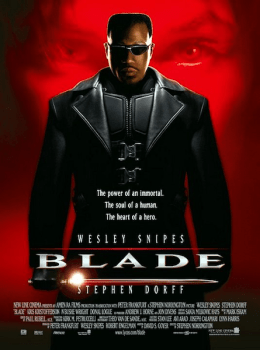
Blade (1998)

100 Films’ 100 Favourites #12

The power of an immortal.
The soul of a human.
The heart of a hero.

Country: USA
Language: English
Runtime: 120 minutes
BBFC: 18
MPAA: R

Original Release: 21st August 1998 (USA)
UK Release: 13th November 1998
First Seen: TV, c.2001

Stars
Wesley Snipes (White Men Can’t Jump, Demolition Man)
Stephen Dorff (Backbeat, Immortals)
Kris Kristofferson (Pat Garrett & Billy the Kid, Heaven’s Gate)
N’Bushe Wright (Zebrahead, Dead Presidents)

Director
Stephen Norrington (Death Machine, The League of Extraordinary Gentlemen)

Screenwriter
David S. Goyer (Dark City, Batman Begins)

Based on
Blade, a Marvel comic book character created by Marv Wolfman & Gene Colan.

The Story
When hospital haematologist Dr. Karen Jenson is bitten by a living corpse — actually a vampire — she encounters Blade, leather-clad badass vampire hunter. He mercifully takes her to his lair, where she hopes to create a cure for her impending vampirism. Meanwhile, mid-ranking vampire Deacon Frost aims to take over the world, for which he needs Blade’s unique blood…

Our Hero
The Daywalker — half-human half-vampire Blade, who can go out in sunlight (hence the nickname) and controls his bloodlust with injections. Passes his time helpfully killing vampires.

Our Villain
Being born human, turned vampire, and consequently looked down on by the purebred elders, probably gave Deacon Frost a chip on his shoulder, which may be why he believes vampires should enslave humanity. Which, despite his betters’ disapproval, he sets about doing.

Best Supporting Character
Blade’s mentor and Q-like gadgetmaster, Whistler. According to Wikipedia he was created for the film, but made his debut two years earlier in the Spider-Man animated series (voiced by Malcolm McDowell, no less). 20 years hence, apparently he still hasn’t appeared in any comics, which is very unlike Marvel.

Memorable Quote
Blade: “There are worse things out tonight than vampires.”
Karen: “Like what?”
Blade: “Like me.”

Memorable Scene
The opening action sequence sets the tone: a vampire nightclub, where the music pounds and blood pours from sprinklers, as the Daywalker slaughters everyone inside in a display of gleeful ultra-violence. Hard R indeed.

Letting the Side Down
Computer-generated liquid is still hard to do, so in 1998 it must’ve been a nightmare. Some CGI blood plays a key role in the climax — it looked terrible then, and I bet it looks worse now.

Next time…
Two direct sequels, the first directed by Guillermo del Toro, the second designed to launch a spin-off (it failed). A semi-related live-action TV series lasted one season in 2006, and an unconnected animated series was part of the Marvel Anime project in 2011. The rights have since reverted to Marvel, so there’s talk (largely from fans) of Blade joining their Cinematic Universe, with or without Snipes and possibly on the Netflix side of things.

Awards
2 Saturn nominations (Horror Film, Make-Up)
1 MTV Movie Award (Best Villain, tied with… There’s Something About Mary.)
1 MTV Movie Awards nomination (Best Fight, for “the fight against vampires”. Oh, that one!)

What the Critics Said
“Sure, the story is pretty standard, and the dialogue is laughable or worse. But creative cinematography and non-stop, decently choreographed gratuitous violence make watching this comic-book movie — Blade is a minor, almost-forgotten Marvel comic — entertaining. In fact, it’s arguably the best comic-book movie of the year” — John Krewson, A.V. Club

Score: 54%

What the Public Say
“Stephen Norrington’s direction is superb here, and he handles most of the action scenes very well, mixing some beautiful establishing shot with tighter, jumpier shots during the film’s immersive fight scenes. Fight scenes are well-choreographed and never feel like they are going on for too long, and thanks to the superb stunt work, feel thoroughly brutal.” — thatfilmbloguk

Verdict

Before comic book movies were the all-conquering box office behemoth they are today, Blade was a Marvel Comics adaptation in technicality only. A violent, dark, appropriately bloody (’cause, y’know, vampires) horror-tinged late-’90s actioner, Blade isn’t big or clever, but it has style and a glorious commitment to its extremeness. Some say the Guillermo del Toro-directed sequel is even better, but for me that came a little too far into the era of CGI dominance and comic book movie popularity — the original has a kind of analogue purity that can’t be beat.

#13 will have… moments lost in time, like tears in rain.

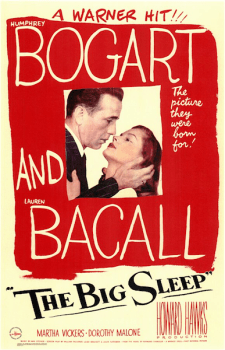
The Big Sleep (1946)

100 Films’ 100 Favourites #11

The Violence-Screen’s
All-Time Rocker-Shocker!

(Yes, that is a real tagline.)

Country: USA
Language: English
Runtime: 114 minutes
BBFC: A (pre-release, 1945) | A (1946) | PG (1988)

Original Release: 31st August 1946 (USA)
UK Release: June 1946 (BBFC)
First Seen: DVD (maybe), c.2004 (possibly)

Stars
Humphrey Bogart (Casablanca, The Treasure of the Sierra Madre)
Lauren Bacall (To Have and Have Not, North West Frontier)
Martha Vickers (The Falcon in Mexico, The Big Bluff)
Dorothy Malone (The Fast and the Furious (not that one), Basic Instinct (yes, that one))

Director
Howard Hawks (His Girl Friday, Gentlemen Prefer Blondes)

Screenwriters
Leigh Brackett (Rio Bravo, The Empire Strikes Back)
Jules Furthman (The Outlaw, Nightmare Alley)
William Faulkner (To Have and Have Not, Land of the Pharaohs)

Based on
The Big Sleep, a novel by Raymond Chandler.

The Story
Private detective Philip Marlowe is hired by General Sternwood to settle the gambling debts his daughter, Carmen, owes to a man named Geiger. Sternwood’s other daughter, Vivian, suspects Marlowe has actually been hired to find Sean Reagan, the General’s friend who has disappeared. Arriving at Geiger’s home, Marlowe hears a shot, and inside finds Geiger dead, Carmen drugged, and a hidden camera with the film gone. So begins a complex web of blackmail and murder. Very complex. Very, very complex.

Our Hero
The archetypal downtrodden PI, Philip Marlowe makes up what he lacks in good fortune with a fast mouth and sharp mind. Has bad manners though, which he grieves over on long winter evenings.

Our Villain
It’s a mystery, let’s not give it away. The film certainly does its best not to.

Best Supporting Character
Lauren Bacall as headstrong Vivian Sternwood, a character who benefitted from the behind-the-scenes situation at the time: Bogie and Bacall’s chemistry in To Have and Have Not led the studio to want more of the same, and her agent was only too keen after the poor reviews of Confidential Agent threatened to sink her career before it had really begun. New sparky dialogue scenes took the place of exposition ones in the final cut, essentially creating the film’s reputation for confusion.

Memorable Quote
“She tried to sit in my lap while I was standing up.” — Philip Marlowe

Memorable Scene
Bogie and Bacall discuss horse racing.
— “I like to see them work out a little first… You like to get out in front, open up a lead, take a little breather in the back stretch, and then come home free.”
Just horse racing.
— “I don’t know how far you can go.” “A lot depends on who’s in the saddle.”
Just horse racing.

Making of
Another part in the Bacall situation described above was supposedly played by original author Raymond Chandler. He reportedly observed that Martha Vickers was so good as Carmen that she overshadowed Bacall, and consequently much of Vickers’ material was removed.

Previously on…
The Big Sleep is the fourth screen adaptation of a Philip Marlowe story, though only the second to star the detective: 1942’s Time to Kill adapted The High Window into the Michael Shayne series, and the same year Farewell My Lovely was filmed as The Falcon Takes Over. The same novel was adapted again in 1944 as Murder, My Sweet (though, famously, retained the novel’s title for its UK release), starring Dick Powell as Marlowe.

Next time…
Bogart never played Marlowe again, but multiple film, TV and radio adaptations of Chandler’s novels have followed, with the lead role being occupied by the likes of James Garner, Elliott Gould, Robert Mitchum, Powers Boothe, Danny Glover, James Caan, and Toby Stephens. A remake of The Big Sleep, relocated to ’70s London and directed by Michael “calm down dear” Winner, was Marlowe’s final big screen outing to date.

Awards
Not a sausage.

What the Critics Said
“one of those pictures in which so many cryptic things occur amid so much involved and devious plotting that the mind becomes utterly confused. And, to make it more aggravating, the brilliant detective in the case is continuously making shrewd deductions which he stubbornly keeps to himself. What with two interlocking mysteries and a great many characters involved, the complex of blackmail and murder soon becomes a web of utter bafflement. Unfortunately, the cunning script-writers have done little to clear it at the end.” — Bosley Crowther, The New York Times

Score: 96%

What the Public Say
“you don’t watch The Big Sleep just to find out who did what to whom, when and for what reason. This is truly one of those movies where the journey is far more important than the destination. As we follow Marlowe around a moody and threatening Los Angeles, we go on a tour of the seedy underbelly of the city. Even though the time is spent in the company of high rollers and the glamorous set, it’s all merely a glittering veneer for a world of pornography, drugs, deviance, betrayal and violence.” — Colin, Riding the High Country

Verdict

Famed for having a plot so complicated even author Raymond Chandler doesn’t know who committed at least one of its murders, I’ve always found The Big Sleep very followable if you pay attention… just don’t expect me to be able to explain it after it’s finished. The film’s popularity in spite of its impenetrability confirmed director Howard Hawks’ theory that audiences didn’t care if a plot made sense as long as they had a good time, and he’s kinda right — the joys here are Bogie and Bacall’s verbal sparring, the exposure of LA’s seedy underbelly (albeit in a Production Code-friendly way), and the film’s whole noir-ish atmosphere.

The Big Sleep is finally released on US Blu-ray on Tuesday 23rd February.

#12 will be… a Marvellous vampire.

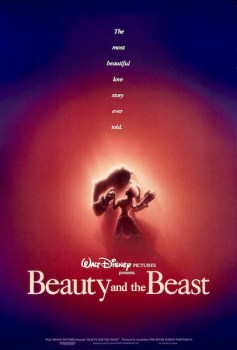
Beauty and the Beast (1991)

100 Films’ 100 Favourites #10

The most beautiful love story ever told.

Country: USA
Language: English
Runtime: 84 minutes | 92 minutes (special edition)
BBFC: U
MPAA: G

Original Release: 15th November 1991 (USA)
UK Release: 9th October 1992
First Seen: VHS, c.1993

Stars
Paige O’Hara (Beauty and the Beast: The Enchanted Christmas, Enchanted)
Robby Benson (Ice Castles, Dragonheart: A New Beginning)
Angela Lansbury (The Manchurian Candidate, Bedknobs and Broomsticks)

Directors
Gary Trousdale (The Hunchback of Notre Dame, Atlantis: The Lost Empire)
Kirk Wise (The Hunchback of Notre Dame, Atlantis: The Lost Empire)

Screenwriter
Linda Woolverton (Alice in Wonderland, Maleficent)

Story by
Deep breath… Roger Allers, Brenda Chapman, Burny Mattinson, Brian Pimental, Joe Ranft, Kelly Asbury, Christopher Sanders, Kevin Harkey, Bruce Woodside & Robert Lence.

Based on
La Belle et la Bête, a French fairy tale originally by Gabrielle-Suzanne Barbot de Villeneuve, but in this case (and most others) adapted from the retelling by Jeanne-Marie Leprince de Beaumont.

Music
Alan Menken (Aladdin, Hercules)

Lyrics
Howard Ashman (Little Shop of Horrors, Aladdin)

The Story
An arrogant prince is transformed into a beast, with one hope of redemption: someone must fall in love with him before his 21st birthday; if not, the curse’s effects become permanent. When elderly inventor Maurice is imprisoned by this Beast, his bookworm daughter Belle offers to take his place. Spying a chance to alleviate the curse, the Beast agrees. With only a short time until his 21st birthday, could a girl ever learn to love a beast?

Our Hero
A girl who’s strange but special — a most peculiar mademoiselle. With a dreamy far-off look, and her nose stuck in a book, she really is a funny girl, a beauty but a funny girl, that Belle.

Our Villain?
The Beast’s got fangs, razor sharp ones; massive paws, killer claws, for the feast. He was mean and he was coarse and unrefined, but now he’s dear and so unsure. Perhaps there’s something there that wasn’t there before…

Our Villain!
No one’s slick as Gaston, no one’s quick as Gaston, no one’s got a swell cleft in his chin like Gaston. Uses antlers in all of his decorating, my what a guy, that Gaston.

Best Supporting Character
The comedy double act of French candlestick Lumiere and English clock Cogsworth, voiced (respectively) by Law & Order’s Jerry Orbach and M*A*S*H’s David Ogden Stiers. Funny old business, acting.

Memorable Quote
“Try the grey stuff, it’s delicious / Don’t believe me? Ask the dishes / They can sing, they can dance / After all, miss, this is France / And a dinner here is never second best.” — Be Our Guest

Quote Most Likely To Be Used in Everyday Conversation
“It’s not right for a woman to read. Soon she starts getting ideas, and thinking…” — Gaston. (I didn’t say it should be used.)

Memorable Scene
The film’s prologue tells the story of how the Prince became the Beast through the medium of stained glass windows. It’s a beautifully realised fairy tale within a fairy tale.

Best Song
Titular Beauty and the Beast may’ve won the Oscar (“Tale as old as time, song as old as rhyme” — that one), but the actual best song is clearly Be Our Guest. A toe-tapping tune married with fun lyrics, fantastic choreography and superb animation combine to make it, for me, one of the greatest numbers in any musical, animated or otherwise.

Making of
Be Our Guest was originally to be sung to Belle’s father, Maurice, when he’s trapped in the castle. It was writer Bruce Woodside who pointed out that it was in the wrong place because such a key song shouldn’t be performed to a secondary character, so it was moved later to be sung to Belle. This is why you should always listen to writers.

Previously on…
Beauty and the Beast is Disney’s 30th Animated Classic, their official canon of animated movies. It’s the third film in the “Disney Renaissance”, the decade-long period (starting with The Little Mermaid and ending with Tarzan) when the studio enjoyed revived creative and financial success. In terms of this particular retelling of the tale, it owes a clear debt to Jean Cocteau’s La Belle et la Bête.

Next time…
Two direct-to-video animated sequels and a spin-off educational live-action TV series. In 1994, it was the first Disney animated film to become a Broadway musical. In 2002, it was extended with a new song, and in 2012 was re-released in 3D. An all-star live-action remake is out next year.

Awards
2 Oscars (Original Song (Beauty and the Beast), Original Score)
4 Oscar nominations (Picture, Sound, Original Song (both Belle and Be Our Guest))
2 BAFTA nominations (Original Score, Special Effects)
2 Saturn nominations (Fantasy Film, Music)
2 Annie Awards (Animated Feature, Individual Achievement in the Field of Animation)
Nominated for the Hugo for Best Dramatic Presentation.

What the Critics Said
“A lovely film that ranks with the best of Disney’s animated classics, Beauty and the Beast is a tale freshly retold. Darker-hued than the usual animated feature, with a predominant brownish-gray color scheme balanced by Belle’s blue dress and radiant features, Beauty engages the emotions with an unabashed sincerity.” — Variety

Score: 93%

What the Public Say
“The voice cast are perfectly suited to their roles and imbue them with dexterity and flair. Paige O’Hara splendidly combines strength and touching bravery as Belle. Her singing voice is a marvel as well, singing with clarity and loving kindness. Robby Benson’s deep but engaging voice is ideally suited to the Beast, and gives him depth and mournful sorrow that subsides into happiness as he develops feelings for Belle.” — vinnieh

Elsewhere on 100 Films
Back in 2010 I reviewed The Special Edition of Beauty and the Beast (to give its full on-screen title), describing it as “impossible to fault in any significant way. The design and animation are beautiful, the voice acting spot-on, the score exquisite, the story fast-paced and enthralling […] It’s hilariously funny, remarkably exciting, surprisingly scary, relentlessly romantic […] Every [song] bursts with memorable tunes, witty rhymes, genuine emotion — even the Soppy Girly Song is a good one!” Beat that, verdict section…

Verdict

Beauty and the Beast was, famously, the first (and, for a long time, only) animated movie to be nominated for Best Picture at the Oscars, and you could hardly think of a more deserving candidate. Every element of it displays artistry, from the the witty dialogue and lyrics, to the likeable and engaging characters, to the fluid and detailed animation, to the songs which help the film to run the gamut of emotions. In the field of Broadway-style Disney musicals, Beauty and the Beast is animation perfection.

#11 will be… a long nap.

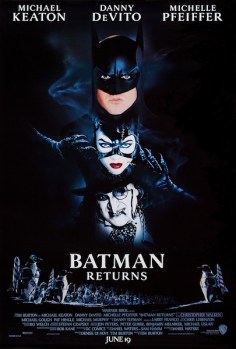
Batman Returns (1992)

100 Films’ 100 Favourites #9

The Bat
The Cat
The Penguin

Country: USA & UK
Language: English
Runtime: 126 minutes
BBFC: 12 (cut, 1992) | 15 (cut, 1992) | 15 (uncut, 2009)
MPAA: PG-13 for “brooding, dark violence”

Original Release: 19th June 1992 (USA)
UK Release: 10th July 1992
First Seen: VHS, c,1993

Stars
Michael Keaton (Beetlejuice, Birdman)
Danny DeVito (Twins, The Rainmaker)
Michelle Pfeiffer (Ladyhawke, Hairspray)
Christopher Walken (The Dead Zone, Seven Psychopaths)

Director
Tim Burton (Edward Scissorhands, Dark Shadows)

Screenwriters
Daniel Waters (Heathers, Demolition Man)

Story by
Daniel Waters (see above)
Sam Hamm (Batman, Monkeybone)

Based on
Batman, a comic book superhero created by Bob Kane and Bill Finger.

The Story
Batman has a lot on his hands when abandoned Oswald Cobblepot, aka the Penguin, emerges from the shadows seeking acceptance by running for mayor, backed by corrupt businessman Max Shreck. Meanwhile, a newly-created Catwoman has an axe to grind with Shreck, and won’t let Batman stand in her way…

Our Hero
Nana-nana-nana-nana nana-nana-nana-nana Batman! But, y’know, with a kind of ’30s Gothic edge.

Our Villains
A triumvirate of terror! Danny DeVito is the Penguin, deformed, abandoned as a child, and out for revenge against the city. Michelle Pfeiffer is Catwoman, PVC-clad, kinky, and also out for revenge. Christopher Walken is Max Shreck, a morally corrupt businessman with political needs, who clashes with Bruce Wayne as much as Batman.

Best Supporting Character
The one significant constant through the four ’80s/’90s Bat-movies, Michael Gough is a near-peerless Alfred.

Memorable Quote
Batman: “Mistletoe can be deadly if you eat it.”
Catwoman: “But a kiss can be even deadlier if you mean it.”

Memorable Scene
Batman and the Penguin are having an argument. Suddenly, a figure comes backflipping towards them — Catwoman. They stare. “Meow.” The building behind her explodes. It’s not actually her first appearance, but it’s quite an introduction.

Technical Wizardry
The whole design of the film, and Gotham City in particular, is fantastic; a kind of ’30s-but-also-modern art deco style. It’s all quite Burtonesque too, though not too much so for my taste.

Truly Special Effect
The Penguin’s army of penguins, an effective mix of real birds, animatronics, and actors in suits.

Making of
The first draft of the screenplay was intended to be more of a direct sequel to Batman: subplots included gift shops selling fragments of the destroyed Bat-Wing, revelations about the past of the Joker, and Bruce Wayne proposing to Vicki Vale by the end of the film. However, Tim Burton was uncomfortable with making a direct sequel, so the script was rewritten. Ah, the days when people wanted sequels to be less connected…

Previously on…
Tim Burton’s first Batman film brought the dark ‘n’ gritty ’70s/’80s evolution of the character from the comic books to the big screen for the first time. It was a huge success, though I think it feels notably more dated today than Returns does.

Next time…
Two semi-direct sequels — though with Burton and Keaton both abandoning the series, they took a distinct downward turn in quality. The 2005 reboot has so far led to three more Bat-movies, and now another new series dawns starring Ben Affleck.

Awards
2 Oscar nominations (Visual Effects, Makeup)
2 BAFTA nominations (Special Effects, Make Up Artist)
1 Saturn Award (Make-Up)
4 Saturn nominations (Fantasy Film, Supporting Actor (Danny DeVito), Director, Costumes)
1 Razzie nomination (Worst Supporting Actor (Danny DeVito))
3 MTV Movie Awards nominations (including Most Desirable Female (Michelle Pfeiffer))
Nominated for the Hugo for Best Dramatic Presentation.

What the Critics Said
“Burton couldn’t play it safe if he wanted to, and he doesn’t want to. Entrusted with one of the most valuable franchises in movie history, he’s made a moody, grotesque, perversely funny $50 million art film. […] Something about the filmmaker’s eccentric, surreal, childlike images seems to strike a deep chord in the mass psyche: he makes nightmares that taste like candy.” — David Ansen, Newsweek

Score: 80%

What the Public Say
“unmissable in Batman Returns, Burton tends to employ the film noir style in his movies. […] a visual sensation from start to finish, nearly all to the credit of Tim Burton, and all of the other elements of the film noir style come together quite brilliantly to reintroduce Batman, as flawed antihero, back into popular culture.” — Kate Bellmore, Reel Club

Elsewhere on 100 Films
Just before the release of The Dark Knight Rises I went back over all the live-action Bat-films of the ‘modern era’. Of Returns, I wrote that “Tim Burton’s first Batman film is great, no doubt, but Returns is a much better film in so many ways. The direction, writing, acting, action and effects are all slicker. They spent over twice as much money on it and it really shows.”

Verdict

Controversial on release — and since — but for me, Batman Returns holds up best out of the four ’80s/’90s Batman movies. Tim Burton brings his own stamp to the Bat-universe, crafting a darkly Gothic fantasy world that’s both striking and effective, populated by grotesques (in different senses) like the Penguin, Catwoman, Shreck, and perhaps even Batman himself. There’s chemistry between the entire cast, memorable scenes and set pieces, and the sense of an entire artistic vision that the Bat-series wouldn’t have again for over a decade.

#10 will be… a tale as old as time.

Batman Begins (2005)

100 Films’ 100 Favourites #8

Evil fears the knight.

Country: USA & UK
Language: English, Urdu & Mandarin
Runtime: 140 minutes
BBFC: 12A
MPAA: PG-13

Original Release: 10th June 2005 (Russia)
US Release: 15th June 2005
UK Release: 16th June 2005
First Seen: cinema, June 2005

Stars
Christian Bale (American Psycho, The Fighter)
Michael Caine (Alfie, Harry Brown)
Liam Neeson (Schindler’s List, Taken)
Katie Holmes (Go, Woman in Gold)
Gary Oldman (Léon, Tinker Tailor Soldier Spy)

Director
Christopher Nolan (Memento, Interstellar)

Screenwriters
David S. Goyer (Blade, Man of Steel)
Christopher Nolan (The Prestige, Inception)

Based on
Batman, a comic book superhero created by Bob Kane and Bill Finger. In part inspired by Batman: Year One by Frank Miller and David Mazzucchelli.

The Story
After Bruce Wayne’s philanthropic millionaire parents are murdered when he’s a kid, he dedicates his life to fighting crime, travelling the world to learn combat skills, then deciding the best way to scare the Mafia-esque scum of his home city is to dress as a bat. As you do.

Our Hero
Nana-nana-nana-nana nana-nana-nana-nana Batman! But, y’know, serious. Important crimefighting jobs include getting hold of cool gadgets your company developed, messing around in restaurant fountains with models, and perfecting a ludicrously gruff voice to use when in costume.

Our Villains
Batman really has his work cut out for him this time: there’s crime boss Carmine Falcone (Tom Wilkinson), mad scientist Dr Jonathan Crane, aka Scarecrow (Cillian Murphy), commander of a league of assassins Ra’s al Ghul (Ken Watanabe), his subordinate — and Bruce’s one-time mentor — Ducard (Liam Neeson). That’s not to mention the bloke doing something dodgy with his family company (Rutger Hauer).

Best Supporting Character
It’s a toss up between two British thesps: there’s Michael Caine as the most involved and caring version of the Waynes’ butler Alfred that we’ve yet seen, and the ever-excellent Gary Oldman as Gotham’s only honourable cop, Jim Gordon. Both are a world away from previous screen incarnations of their characters.

Memorable Quote
“Well, a guy who dresses up like a bat clearly has issues.” — Bruce Wayne

Memorable Scene
Trapped in Arkham Asylum, surrounded by police and with SWAT officers storming the building, Batman activates a device on his boot for “backup”. Moments later, hundreds of bats flood the building, allowing him to make a dramatic escape.

Technical Wizardry
Previously, the Batmobile was a sleek and desirable supercar-type vehicle. Taking inspiration from some of the comics, Begins reinvents the vehicle entirely, rendering it essentially a road-ready tank. A massive change in the very concept, but one that now seems only natural.

Letting the Side Down
Hardly a major point for the viewer, but the design of the Bat-costume meant the actor in it couldn’t turn his neck — a problem also in the previous post-’89 Bat-films. Christian Bale’s frustration with this led to it being redesigned for the sequels (and explicitly referenced on screen, too).

Making of
According to some trivia on IMDb, before shooting began Nolan treated the crew to a private screening of Blade Runner, after which he told them, “this is how we’re going to make Batman.” For more on how exactly Ridley Scott’s seminal sci-fi thriller influenced Begins, check out these interview excerpts.

Previously on…
Batman’s big-screen popularity was kicked off by Tim Burton’s 1989 Batman, but that goodwill was gradually squandered, ending with 1997’s Batman & Robin, which many regard as one of the worst films ever made. It killed a once-profitable franchise, therefore paving the way for an eventual reboot.

Next time…
The Bat-world shaped by Nolan and co reached its apotheosis in the first sequel, The Dark Knight. The trilogy-forming second sequel, The Dark Knight Rises, did that rarest of things: it gave a superhero a definitive, final ending.

Awards
1 Oscar nomination (Cinematography)
3 BAFTA nominations (Production Design, Sound, Visual Effects)
1 Razzie nomination (Worst Supporting Actress (Katie Holmes))
3 Saturn Awards (Fantasy Film, Actor (Christian Bale), Writing)
4 Saturn nominations (Supporting Actor (Liam Neeson), Supporting Actress (Katie Holmes), Director, Music, Costume, Special Effects)
Nominated for the Hugo for Best Dramatic Presentation, Long Form.

What the Critics Said
“If there is one Batman film anyone should see, this is it. It’s a superhero film with a dark tone that’s very well-written with nothing but incredible actors involved. In a world where most movies these days are usually either remakes or films that are made as quickly as possible to cash in on the latest trend in Hollywood, a reboot that is not only worthy of your time but tends to make you forget about every other version that came before it says quite a bit.” — Chris Sawin, examiner.com

Score: 85%

What the Public Say
“One of the best things about Nolan’s Batman is that he grasps the idea of the three personas of Bruce Wayne. There’s Bruce when he’s playing the billionaire playboy, Bruce when he’s alone in the cave or with Alfred, and Bruce when he’s wearing the cowl. This movie truly delved into this in a way that no Batman movie had before it and was performed flawlessly by Christian Bale — whether you like the voice or hate it, Bale did a great job at playing three distinct personas.” — Blue Fish Comics

Elsewhere on 100 Films
Just before the release of The Dark Knight Rises I went back over all the live-action Bat-films of the ‘modern era’, i.e. since Tim Burton’s Batman. Of Begins, I wrote that “Nolan’s first foray into Bat-world really is a stunning piece of work… The monumental achievement of The Dark Knight has come to overshadow Begins, which is now rendered as a functionary prequel to the next film’s majesty. Don’t let that reputation fool you: on its own merits, this is very much a film at the forefront of the action-adventure, blockbuster and superhero genres.”

Verdict

If there was one thing the Burton and Schumacher Batman films were collectively notorious for, it was focusing on their villains more than their hero (not least because they cast bigger name actors in the villain roles). Personally, I don’t think that’s wholly true, but there’s no doubting that Christopher Nolan’s much-needed reboot of the franchise focuses on Bruce Wayne, his reasoning and his psychology, more than ever before. In the process, Nolan and co made us believe a man might reasonably choose to fight crime and corruption by dressing up as a bat. No small feat, that.

For #9 Burton’s Bat’s back.

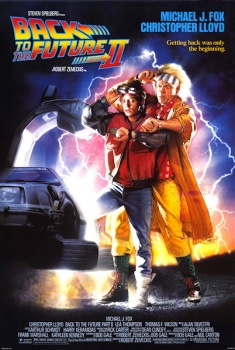
Back to the Future Part II (1989)

100 Films’ 100 Favourites #6

Getting back was only the beginning.

Country: USA
Language: English
Runtime: 108 minutes
BBFC: PG
MPAA: PG

Original Release: 22nd November 1989 (USA)
UK Release: 24th November 1989
First Seen: VHS, c.1991

Stars
Michael J. Fox (Doc Hollywood, The Frighteners)
Christopher Lloyd (Clue, The Pagemaster)
Lea Thompson (Red Dawn, Casual Sex?)
Thomas F. Wilson (Back to the Future, High Strung)
Elisabeth Shue (Adventures in Babysitting, Leaving Las Vegas)

Director
Robert Zemeckis (Who Framed Roger Rabbit, Cast Away)

Screenwriter
Bob Gale (1941, Interstate 60: Episodes of the Road)

The Story
Marty and Doc travel forward to 2015 to save Marty’s son from imprisonment, but this allows future-Biff to steal the DeLorean, taking it back to 1955 to allows his younger self to profit from future knowledge. Faced with a nightmare version of 1985, Marty must travel back into the events of the first movie to fix things.

Our Heroes
Michael J. Fox is not only Marty McFly, but older Marty McFly, and his son, Marty McFly Jr., and also… his daughter, Marlene McFly. Just in case you’d forgotten these were comedy movies, I guess. Christopher Lloyd, meanwhile, is the one and only Doc.

Our Villain
It’s Thomas F. Wilson’s Biff again, but this time he’s not just a bully, but someone who — thanks to his meddling in time — represents a threat to Marty’s whole lifestyle. And he’s a right nasty piece of work in the dystopian variant of 1985, too. Still gets covered in excrement, mind.

Best Supporting Character
Spare a thought for Marty’s girlfriend, Jennifer. The end of the first film has her getting in the DeLorean with Doc and Marty, because she was there and the ending was never intended to lead to anything (yes, kids, once upon a time movies weren’t made with the assumption there’d be sequels). Come the second film, Zemeckis and Gale were stuck having to integrate her into the story, which they did by… knocking her out early on and leaving her out of it.

Memorable Quote
“The time-traveling is just too dangerous. Better that I devote myself to study the other great mystery of the universe: women!” — Doc

Memorable Scene
30 years in the future, they’re still making crappy Jaws sequels. (The irony now is, in the real 2015 we were still getting often-crappy sequels to pretty much every major ’70s/’80s franchise except for Jaws.)

Technical Wizardry
You’ll believe a board can hover. Well, you probably won’t, but some people did. That’s just testament to how well made the sequence is.

Truly Special Effect
Quite apart from the hoverboard, the sequence where they first arrive in 2015 — a ‘road’ of flying cars in a rainy nighttime sky — is a triumph of model work.

Making of
For various reasons (possibly moral, possibly financial) Crispin Glover refused to return as Marty’s father, George McFly. Instead, the filmmakers used outtakes from the first film, as well as an actor wearing prosthetics made from casts of Glover taken for the first film. Glover objected to his likeness being used without permission, sued, and Universal settled out of court. More than that, it led to a change in contract rules at the Screen Actors Guild to stop the same thing happening again. (See also: The Four Musketeers.)

Previously on…
Not only does Part II pick up exactly where the first film ended, it goes back into its events and interacts with them.

Next time…
Part II ends with a huge cliffhanger, leading directly into the series’ final trilogy-forming instalment.

Awards
1 Oscar nomination (Visual Effects)
1 BAFTA (Special Effects)
1 Saturn Award (Special Effects)
3 Saturn nominations (Science Fiction Film, Costumes, Make-Up)

What the Critics Said
“Like its predecessor, Back to the Future Part II does not merely warp time; it twists it, shakes it and stands it on its ear. But as before, the film’s technical brilliance is the least of its appeals. Satirically acute, intricately structured and deftly paced, it is at heart stout, good and untainted by easy sentiment.” — Richard Schickel, TIME

Score: 63%

What the Public Say
“the biggest prediction the film nails is not any one piece of technology, but our reaction to it: indifference met with annoyance of its imperfections. The movie focuses not on what the technology can do, but on what it can’t. The skyway’s jammed. Marty’s hover board doesn’t work on water. The voice-activated home-entrance lights don’t turn on when Jennifer enters. […] What we get is “the future” as “the present.” None of the doom, destruction and dystopia of Blade Runner or The Time Machine. 2015 Hill Valley and 2015 Chicago are just like 1985 Hill Valley and 1985 Chicago, only with cooler stuff.” — Jack M Silverstein, ReadJack.com

Verdict

There are some who consider Back to the Future an all-time classic and think the two sequels are meritless wastes of space. There are others who see them as a complete trilogy of more-or-less equal quality. Considering that ever since I’ve seen them all three parts have existed, it isn’t much surprise I’m one of the latter. Part II may not have the elegant simplicity of the first film, but it still has plenty of original and exciting ideas, not least using the time travel conceit to go back into the first movie. It may not be as good, but it’s a fine adventure in its own right.

#7 will be… wicky wicky wild wild West.