
Roland Emmerich | 154 mins | Blu-ray | 2.39:1 | USA / English | 12 / PG-13
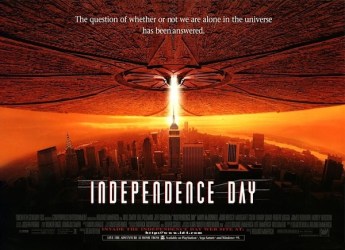 I’m not sure when I last watched ID4 (as it was so often branded and marketed, for only semi-clear reasons — sure, US Independence Day is July 4th, but other than that the “4” has nothing to do with anything), but it’s been a damn long time — my DVD copy, which I know I never watched (I have the shiny new remastered Blu-ray now), has a postcard inside advertising the forthcoming Planet of the Apes remake, in cinemas Summer 2001. The time I best remember seeing it was in cinemas on its initial release. Independence Day was a phenomenally huge deal back in 1996: it felt like that shot of the White House being destroyed was on TV on loop; there were making-of TV specials (I remember the behind-the-scenes footage of how they did those incredible, much-discussed effects as clearly as I remember anything from the film itself); I listened to the Radio 1 Independence Day UK audio drama on tape (it was… so-so), read the tie-in comic book adaptation, and also the tie-in novelisation — which was the first book I ever gave up on without finishing because I thought it was so badly written. Ten-year-old badblokebob, literary critic. The film itself was also the first 12-rated movie I went to see in the cinema, so it was even more of a big deal for me.
Revisiting it 20 years later, with a sequel imminent, ID4 obviously no longer has that attendant hype, but it does hold up pretty well in its own right as a blockbuster disaster epic. At least, it did for me — I read a review on Letterboxd from someone who watched it for the first time this January, saying that, in the age of the modern spectacle-based blockbuster, Independence Day doesn’t compete. Which feels weird, 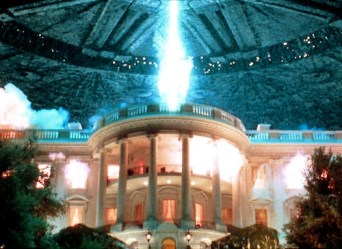 because it was all about the spectacle when it came out; but of course, things date, and what counted as sheer cinematic spectacle in 1996 is (it would seem) underwhelmingly run-of-the-mill in 2016. It’s fair to say that not all of the model effects still hold up, but there’s a physicality to them that really works. The best ones are still among the best movie effects ever.
The film’s first half is superior to its second. Co-writer/director Roland Emmerich and co-writer/producer Dean Devlin conceived the film off the idea of 14-mile-wide spaceships just appearing one morning, and the realisation of that concept (and the ensuing destruction) is where the film really shines. That’s not to say there’s not good stuff after the aliens unleash their devastating destructive power — the famous presidential speech comes just before the climax, for one — but it’s from the midpoint on that some things begin to get a tad muddled, some subplots are rushed along, and other events get needlessly elongated. That said, it’s all relative: the 2016 version of this story with this many characters would surely run for five hours as it endeavoured to give them all a starring-role-level storyline and turn every effects-fuelled alien encounter into a 20-minute action sequence.
One area it really succeeds is humour. It doesn’t lose the scale or seriousness of the events, but it keeps the tone entertaining. That feels like a skill a lot of blockbusters used to have that’s gone awry in recent years, though you could use the tone of Marvel Studios’ movies to counterpoint that. Those Marvel films are definitely subject to a different criticism of modern blockbusters, however, which is their mindless destruction of whole cities. It’s a just criticism, 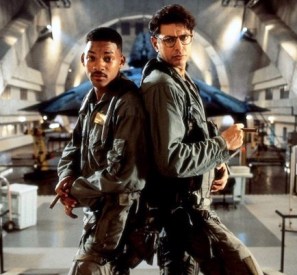 and some of the blame for it can surely be traced back to the popularity of ID4. However, here the destruction isn’t so unfeeling: the morning after the aliens’ famous landmark obliteration, President Whitmore mulls over how many people died and how many didn’t have to if he’d made different choices. Both Marvel and DC have had to make that kind of reflection a plot point in sequels to retrospectively justify it happening in the first place.
This was the first time I’d watched Independence Day’s extended Special Edition cut, and I’d advise not bothering. It adds around 8½ minutes of new material, but the scenes don’t add all that much, and some of them are so awkwardly rammed in that it’s almost irritating — for instance, several are inserted in the middle of an existing music cue by merely fading out the score immediately before the new scene, then fading it back in afterwards! They’re deleted scenes that have been shoved into the movie, with the score often fudged to make room and stuff like that, rather than it being a genuine “extended cut”. People seem to love extended cuts on disc, but sometimes a nice deleted scenes section is preferable.
With the way things are nowadays — every hit sequelised; old IPs regularly dragged up for new moneymaking opportunities — it was kind of inevitable we’d get ID4 2 eventually. I’m looking forward to it, but not insanely hyped up. It probably benefits from the 20-year wait story-wise,  allowing for a drastically new status quo on Earth when the aliens return, but with blockbusters released all year round now, and CGI meaning every one is overloaded with effects shots that are far more epic than ID4 had, there’s little doubt that the sequel won’t have the same enduring impact on the blockbuster firmament. For its faults, you can’t deny ID4 that.

Independence Day: Resurgence is in UK cinemas now, and is released in the US tomorrow.

 Score:



 Comedy-drama starring George Clooney as a Hawaiian with family issues: his wife’s in a coma and may’ve been cheating; his daughters are unruly; and his extended family is considering a massive land sale that’s the talk of the islands.
 The problem with watching so many Shaw Brothers movies so close together, as I have this year, is they begin to blur into one. There’s definitely a house style to the stories, the photography, the sets — everything, really. Even the particularly good ones can fail to lodge in the memory as discrete units.
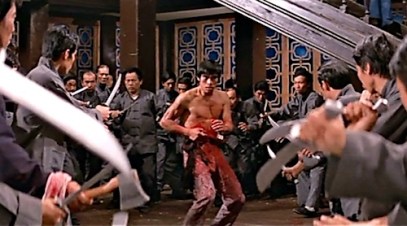 At the end of the day, tightly choreographed and expertly performed action sequences such as this are why we come to these movies; and, at the end of the day, The Boxer from Shantung doesn’t disappoint.


 Donnie Yen returns as the eponymous kung fu master, who’s most famous for training Bruce Lee, to complete a trilogy of biographically-dubious but broadly entertaining actioners.
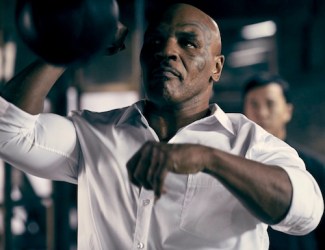 the less said about the film’s attitude to foreigners the better (though I guess Hong Kong’s British occupiers weren’t exactly above reproach).
 After an awkward first half, Ip Man 3 gradually transitions into a rewarding set of circumstances, on both the action and emotional fronts. The lack of consistency may mean it doesn’t satisfy fans as much as the first film did, but I’d say it’s a step up from the second, and definitely worth a look for fans of the old punching-and-kicking-and-hitting-each-other-with-poles-and-knives.
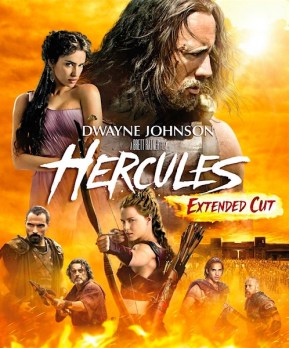 The answer to the question, “Hey, remember Brett Ratner? Whatever happened to him?”,
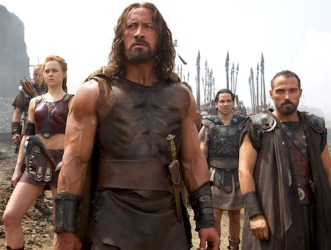 This extended cut wasn’t included on the UK Blu-ray, so no BBFC rating (it’s about a 15), but it is available on Netflix over here (it’s not listed as the extended cut, but it is). It’s no great shakes, though, adding only a couple of minutes. That’s made up of three short scenes, another half-a-dozen additional lines of dialogue, a couple of extra seconds of action, and some blink-and-you’ll-miss-it CG blood (full details
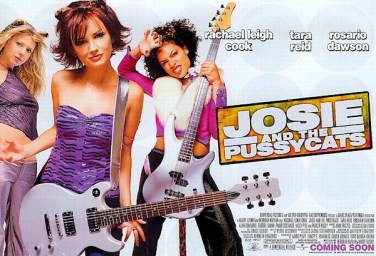


 Regular readers will surely remember
 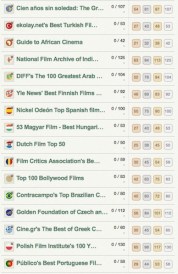 There are pretty obvious reasons why I’ve never seen any films on many of those lists — quite a lot are country or continent specific, and as Western film viewers we’re notoriously poor at having seen movies from, say, Africa. The lack of acclaimed films I’ve seen from the likes of Belgium, Finland, Holland, Hungary, Norway, Poland, Portugal, and Spain is my own fault though, I guess. Anyway, this is something I intend to rectify in the coming days / weeks / months / years / decades — however obscure some of my missing lists may seem, there’s at least one film I’ve heard of on all but one or two of them, so there’s that.
 Why is this film notable? In fact, is it notable? Well, it was voted in to The 50 Greatest Cartoons by some of 1,000 animation professionals, so there’s clearly something there. It was created by animator Marv Newland while he was a film student in L.A., after a live-action project he’d been planning to submit was scuppered (according to
  In the US Deadpool was, famously, rated R — which (for those not up on their international film certificates) ostensibly means you have to be over 17 to see it. In the UK it was rated 15, which is much more appropriate, because if Deadpool had a mind it would be that of a 15-year-old boy. Of course, plenty of grown men also have the mind of a 15-year-old boy, and that’s why it’s the highest-grossing R-rated movie (worldwide) ever. And I guess I must still have the mind of someone half my age too, because I loved it.
 It depends what you’re looking for. I think Deadpool’s makers set out to make a superhero film that was genre-aware and prepared to take the piss out of that, but I don’t think they were aiming to deconstruct superhero narratives. It might make Deadpool a less ‘intelligent’ movie than Kick-Ass, but it doesn’t stop it being entertaining.
 The film handles this really well: it’s not a non-stop commentary, but it’s also not isolated off in little clumps, like, “this had to be here but it’s kinda awkward to have him always talking to the audience”. It’s often used for irreverence, and I like a bit of irreverence. There are clearly some rules and/or considered choices with this fourth-wall breaking, though. In his commentary on the deleted scenes, Miller says that Reynolds kept wanting to pull the boom mic down from out of frame and use it to batter one of the villains, or something along those lines, but Miller thought this would be breaking the film’s rules. That’s a pretty fine line to tread — knowing he’s in a film, but not, like, using the fact he’s in a film… I guess it’s more of a “what feels right” set of choices than a little rulebook.
 One of the film’s best bits comes courtesy of that X-connection: stroppy teenage goth mutant Negasonic Teenage Warhead (excellent newcomer Brianna Hildebrand), and her immensely comic-faithful costume. Ironically, it’s not at all faithful to how NTW is portrayed in the comics (and you can find dozens of think-pieces about how the film changed her character and how that’s more than OK, if you’re so inclined), but it is generally like X-Men comic costumes, certainly ones that cropped up in the early ’00s. (I swear there was a Frank Quitely New X-Men cover showing a bald female in a costume really like NTW’s yellow-and-black X-Men uniform, but I can’t find it now. Maybe I imagined it.) Comic-faithful costumes are very much the MO of Marvel movies nowadays, but because the X-Men film franchise sprung from the “how do we make superheroes acceptable in movies?” period of the genre, the X-movies have never really done that before (though they do sort of, in passing, at the end of Apocalypse — I’m beginning to think we’re one day going to look back at that as a transition movie, assuming the next one goes super comic-book-y). I mean, this doesn’t really signify anything about Deadpool, I’ve just gone off on a geeky tangent.
 Speaking of which, I do feel like I should be mature enough to have grown out of loving Deadpool… buuuut tough. It’s fantastic fun. Though, it’ll be interesting to see how it holds up to re-watches. I’ve read reviews which point out it doesn’t have the substance underneath the jokes that Kick-Ass does (did I mention that already? I didn’t steal that point from someone else, nope, noooo sir), so while Matthew Vaughn’s film is completely enjoyable on multiple go-rounds, any enjoyment to be found in Deadpool will ultimately fade once the novelty has gone. I mean, that’s possible — literally, only time will tell — but there’s not necessarily anything wrong with a “first time is definitely the best” movie, if that first time is good enough. Heck,


