Saw II (2005)

2009 #60
Darren Lynn Bousman | 89 mins | TV (HD) | 18 / R

Saw IIThe games-playing slaughterfest returns in what I’m told is many fans’ favourite entry in the series. Maybe they’ve never seen Cube

Saw II is a horror sequel, which means it can’t help but take the same basic premise as its originator: serial killer Jigsaw locks a number of people in a room with a series of games/traps, which they can escape only if they can work out the clues to defeat them; and if not, they’ll be brutally murdered and/or disfigured. Where Saw II comes into its own is that it dares to do something a bit different with this premise, usually the hallmark of a worthwhile sequel.

Instead of two victims locked in a dingy bathroom we have too many to reasonably count locked in a whole house. Instead of the killer being largely unseen he’s a constant presence, in conversation with a police detective while events in the house unfold on monitors nearby. The film’s raison d’être is the same — people get injured/killed in nastily inventive ways — but someone (co-writer/director Bousman, in fact) actually bothered to come up with a story that’s more than superficially different.

Despite the terror and gore — and there’s a healthy (a word I use very, very loosely) dose of each — Saw II is arguably even more like a thriller than its predecessor. The police are more heavily involved this time, actually catching up with Jigsaw, and as much time is devoted to Detective Matthews’ negotiation/chat as it is to the predicament of the victims. Here we get a chance to see what a great villain Tobin Bell makes — subtly so, not the typically OTT psychopath killer designed to show off an actor’s ‘skill’. He’s not quite Spacey’s John Doe, but his quiet, determined, reasoned killer is a cut above the average. That he’s afforded a moderately reasonable motive and some character development is certainly more in line with thrillers than horror movies.

Meanwhile, in the house, Bousman seems to be going for a Cube-like atmosphere: a disparate group of people wake up together and must find a way out of a strange, booby-trapped location. This starts out well enough, unravelling both questions and answers at a pleasing speed, but unfortunately is unable to sustain it convincingly. Few of the victims achieve the level of distinct characterisation that Cube managed, suggesting there are more people locked in the house than the writers could comfortably handle or the story could really support.

Indeed, even the primary selling point is abandoned surprisingly quickly — it seems the writers don’t have enough ways to kill people. At least one just drops dead from the virus-that’s-there-from-the-start, which feels unsatisfactory, while another happens to wander into a trap when it’s time to dispatch someone else. Considering the amount of planning we know Jigsaw gives to his games, we should at least see that there are enough ways to kill everyone, even if some are then subverted through escape or avoidance.

There’s some redemption to be found at the climax, which produces a final round of twists that are almost equal to the first film’s triumphant reveal. Again I won’t give it away, but I’m sure some have called the biggest twist a cheat, on a par with “and they woke up and it was all a dream”. If they have, they’re wrong: it’s entirely in keeping with both the games Jigsaw might play and the flashback-driven style of the first film, not to mention that — as the insistent concluding recap shows — there are clues seeded all the way along. If it’s not as audaciously memorable as the twist in Saw, that’s through no fault of it’s own.

Saw II doesn’t just rehash the original, which is something to be thankful for in a horror sequel. There’s something close to character development, a nice opening setup, and an enjoyably twist-stacked ending. Unfortunately it can’t quite connect that opening to that ending, in spite of its brief running time, which means it fails to equal its predecessor’s overall quality. Fair effort though.

3 out of 5

Saw III premieres on Channel 4 tomorrow. Saw VI is in cinemas from Friday.

Saw (2004)

2009 #59
James Wan | 99 mins | DVD | 18 / R

SawWith Saw VI about to subject cinema screens and captured audiences to another round of gruesome brutalisation, Channel 4 have seen fit to treat viewers to a similar experience in their own home, screening the first three films in the now-annual cinematic occurrence this week. Except I’ve had the original Saw sat in my DVD collection for years, so I watched that instead.

Despite being credited with birthing the entirely risible ‘gorno’ genre (for those blissfully unaware, ‘gorno’ is an amalgamation of “gore” and “porno”; its other common name, “torture porn”, is a thoroughly descriptive moniker), Saw isn’t really a good example of it. There are nasty, vicious murders — or, technically, deaths — but there’s no serious sexual element and it’s all underpinned by a half-decent plot.

In fact, I’ve heard it called “a thriller with sadism” rather than a horror movie. There’s a point to that, and the Guardian’s comparison with Se7en (as misquoted on the DVD cover) isn’t misplaced (in certain surface elements anyway). The killer has a motive that’s not supernatural, there’s an intricate array of flashbacks as well as the unfolding events, with a gradual unravelling of the truth via investigation, complete with a thriller-sized collection of twists.

But just because it’s not a slasher movie doesn’t mean it’s not horror. The sheer vileness of the killings — their tortuous methods, graphic results, and tense build-ups — put paid to any notion that this is just a nasty-minded thriller. The setup is more thriller-like, with Dr Gordon’s recollection of a police investigation, but once underway it’s all played as a horror movie — the sequence leading up to Adam’s capture, for instance, where he stalks his darkened apartment with only a camera’s flash for illumination, is pure horror — and the overriding impression is of a movie primarily attempting to scare you, not engage your mind with a mystery-fuelled plot.

Not that the story should be ignored, because it’s this that raises Saw above its gorno compatriots and makes it a worthwhile film. Wan and screenwriter Leigh Whannell juggle flashbacks and multiple timelines with consummate ease, using them to uncover backstory that advances the tale they’re telling rather than provide padding to an otherwise slight conceit. It’s not as intricate as, say, The Prestige, but is complex enough that in lesser hands they could’ve been the film’s undoing. Wan and Whannell never lose sight of what purpose every scene serves, where they occur in the film’s chronology, and where the story’s going. Consequently it all flows seamlessly.

It all contributes to a final twist that is truly wonderful. Even if you know it’s coming (as I unfortunately did), it’s so beautifully executed in every respect that it’s awesome to behold. It wouldn’t be enough to overcome the horrors of the film that precede it for those of a squeamish nature, but it’s certainly the best bit. I wouldn’t dream of giving it away here (though have probably oversold it).

It isn’t perfect. The dialogue is frequently awkward, the acting occasionally variable, but those things are hardly the point in this genre and here are never so bad as to interrupt proceedings (unless you’re looking to pick holes, in which case they’re ripe for it). The low budget occasionally shows through too, but that’s not necessarily a barrier to success — do we need to see a car chase on roads when a black backdrop and smoke can convey the same information adequately for the story? I think not. (Unless you happen to have Garth Marenghi’s Darkplace pop into your head at the time…)

The annual sequels apparently conform to the law of diminishing returns, but it’s plain to see what sparked the craze in the first place. Sickly inventive, well constructed and rarely less than gripping — and with a killer sting in its tale — if you haven’t already, and think you can stomach it, you really ought to see Saw.

(Sorry.)

4 out of 5

There seem to be three versions of Saw doing the rounds, though the difference between the longest and shortest is little more than 30 seconds, apparently due to the odd extended shot and different opening logos. If anyone cares, the version I watched ran 1:38:31 (PAL).

Saw II is on Channel 4 and 4HD tonight, while Saw III premieres there on Thursday. Saw VI is in cinemas from Friday.

Alien vs Predator – Part 3

Having already published my thoughts on the two franchise starters and the remaining films in the Alien series (crikey, has it really been three months since that?), this is the concluding entry in my coverage of the Alien, Predator and Alien vs Predator franchises.

This time, I’ve covered the sole Predator sequel (to date [2015 note: times change]), and how the franchises fared as they came together to move into the new millennium. Be warned: things only get worse. Much, much worse.

2009 #17
Predator 2

“I’ve talked about the Alien sequels dramatically switching genres, but Predator 2 leaves them looking as if they couldn’t be more alike. Where Predator is a behind-enemy-lines/covert mission/jungle/war actioner, Predator 2 is an urban drugs crime police, erm, actioner… though both with a sci-fi twist, obviously.” Read more…

2009 #18
AVP: Alien vs. Predator
(Extended Version)

“Anderson manages to amalgamate a popular and acclaimed film franchise, its almost-as-beloved stablemate, and an equally popular and acclaimed comics & video game series, and then decimate all three in one 85-minute (without credits) swoop.” Read more…

2009 #19
AVPR – Aliens vs Predator: Requiem

“By not withholding the monsters, the characters’ dull lives become even duller. One of the Alien series’ strengths was in making the extraordinary (space travel!) seem mundane (space truckers), but AVPR makes the ordinary seem mundane, and that’s no achievement at all; in fact, that’s a great big failure.” Read more…


And that’s it.

Except not for long, because at some point I’ll surely share another three-film entry covering the various extended versions of the three Alien sequels. And then, of course, Robert Rodriguez is working on a Predator continuation/reboot, supposedly still called Predators, not to mention the much-discussed Ridley Scott reboot/remake/prequel of Alien. Each project has good people involved, but it remains to be seen if any of them can pull it off.

Still, you can’t get worse than AVPR, right?

Though, they said that about AVP

AVPR – Aliens vs Predator: Requiem (2007)

2009 #19
The Brothers Strause | 97 mins* | DVD | 15 / R

AVPRAliens vs Public Relations? Sadly not. And when a joke plot like that sounds more appealing than a rematch between two of sci-fi’s greatest monsters, you know you’re in trouble.

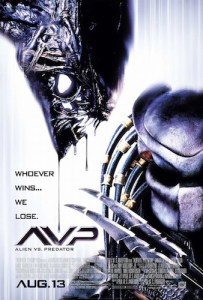
In my last Alien/Predator review, I made sure to attack director Paul W.S. Anderson a bit. As well as being renowned for making rubbish films, Anderson is also quite well known for being sequel-shy… and so it is with the AVP franchise, here handing the reins to the less-than-capable special effects-creating Brothers Strause. They supposedly set out with a fan-pleasing remit: primarily an R-rating, but they even make sure to use familiar fonts and sound effects right from the title card. Though said title card is blurry and unclear, obscuring the film’s very name — a sign of things to come, because their ability to please fans extends no further than some vague surface essentials.

To be fair, it can’t be easy to marshal all the familiar tropes of two different franchises into a single film that does something original with them. But that’s no excuse — things like facehuggers and skinned humans are present as if simply ticked off a list, having neither the surprise and mystery of the original appearance (obviously) nor anything new to make them worthwhile. They’re there because they ‘need’ to be, and while it makes some kind of sense to not play them as surprises, there’s nothing remotely new or different to hold our attention instead. Much of it is so poorly done that it’s not even set pieces strung together, it’s ideas for set pieces strung together.

If you thought AVP spent too much time focusing on the Predators rather than the humans (and I did), you’ll find AVPR even worse. It again tries to emulate the build-the-characters-first approach of the best Alien and Predator films, but intercuts their mundane lives with what the Predators and Aliens are up to. No, no, no. Part of the point of the character-based slow-build is to create tension — there’s none of that here. And by not withholding the monsters, the dull lives become even duller. One of the Alien series’ strengths was in making the extraordinary (space travel!) seem mundane (space truckers), but AVPR makes the ordinary seem mundane, and that’s no achievement at all; in fact, that’s a great big failure.

Even the action sequences are a mixed bag. There’s a nice line in harsh and surprising deaths — major characters are suddenly picked off, and with a cast so full of minor actors you can never be certain who’ll make it; and among them are a young boy, pregnant mums, and most of the town gets nuked by the army because the townsfolk trusted them. The final fight makes admirable use of suits and animatronics over CGI, but it’s so dark you can barely tell what’s happening. Similarly, the PredAlien may be great or it may be rubbish — you never see it well enough to tell. It’s not only the climax: over-dark cinematography and typically choppy editing obscure every action sequence. Why is it that in an age where special effects are so improved and there’s a preference for real actors over stunt doubles, action sequences have become harder to follow?

The overall feel is of a horror B-movie — a direct-to-DVD one. It may be a stock phrase for reviewers, but in this case it’s actually true: AVPR genuinely makes AVP look good. It’s a new low even for the Predator series, and it drags the Alien franchise from once lofty heights right down into the gutter with all the other too-long-running horror franchises. However permissable parts of AVPR might be (when judged on its own terms) (with a kindly eye), the inconceivably thorough degradation of a once-great franchise is its greatest crime.

Alien³ was a charming mess. This is just a mess. An irredeemable one.

1 out of 5

* AVPR on DVD is 7 minutes longer than in cinemas. This seems to be the only cut available (outside of Germany) and isn’t specially labelled, hence the lack of qualifying “Director’s Cut” or “Extended Cut” or “DVD Cut” in my title.

AVPR featured on my list of The Five Worst Films I Saw in 2009, which can be read in full here.

AVP: Alien vs. Predator – Extended Version (2004)

2009 #18
Paul W.S. Anderson | 98 mins | DVD | 15 / PG-13

This review contains minor spoilers.

AVPOnce upon a time — around the late ’90s, when he was only known for Event Horizon (and that video game thing no one wanted to mention) — director Paul W.S. Anderson was seriously and vocally attached to a film adaptation of Doctor Who. At the time it was such a good idea, a bright new hope for Who’s revival, with a Hollywood-level — yet, pleasingly, British — director at the helm. When it didn’t come together it was quite disappointing. In retrospect, I think we can breathe a collective sigh of relief.

Anderson’s films always come in for a critical drubbing and AvP was no exception. Sadly, it was well deserved. The main problems are a weak script, including an abundance of prologues in place of genuine character development, and poor performances, not helped by what sounds like a regular use of bad ADR. Characters make leaps of logic that would be reasonable if they’d seen the preceding six films, but make no sense whatsoever given what they know in context. The story begins moderately well, even pushing to the slow build in the franchises’ best entries (though without as much tension), until just 13 minutes in, when there’s a pointless scene on a Predator ship. Of course we know they’re coming — they’re in the title — but it’s a reveal too soon and ruins any mood Anderson’s managed to create. Constant updates on their progress exacerbate the problem.

There are actually some very inventive ideas scattered throughout — like the captured, frozen Alien Queen — but, in storytelling terms, their reveals are poorly handled, occuring too early and too far from the protagonists. However much time Anderson wants to spend getting his humans into position (a lot, just like the other six filmmakers before him), he clearly doesn’t trust the audience to go along with it without some hints of the creatures (unlike the best of the filmmakers before him). It’s not his only directorial misstep. He makes the fatal mistake of letting his monsters out into the light too much, though the choppy editing almost obscures them again. While effects can now withstand this level of scrutiny, the effect of the creatures can’t — they belong half-hidden in shadow, especially the Alien.

Elsewhere, every facehugger is treated to a graphic slow-mo shot. Once might’ve been cool, but it quickly becomes overkill — especially when the first instance features three, immediately rendering every solo example that follows unremarkable. And then there’s the ending nabbed from Predator 2. And the final beat that, though the groundwork is laid earlier in the film, still doesn’t really make sense (considering how fast chestbursters came out of the humans, or how long the Predator had been dead by the time it popped). When the director doesn’t know how to handle the titular monsters correctly, you know you’re in trouble.

That said, Anderson certainly delivers on the title’s Aliens-fighting-Predators promise. Most of the film’s limited imagination is lavished on these battles, but as with most monster-on-monster bouts we have no stake in either side, leaving them mostly heartless and only engaging on the level of “cool!” The human characters are left by the wayside at these moments, disappearing out of the way — and taking what little plot there is with them — for a few minutes. When they do appear there are some attempts at character development (yes, beyond those prologues) which are well-intentioned but painful. All things considered, Anderson has taken two horror franchises with an action-adventure tinge and turned them into an action-adventure film with a horror tinge.

This ‘extended version’ is a whopping 79 seconds longer than the theatrical cut, adding a whaling station prologue. This exacerbates the issue of revealing the monsters too early, but it does go some way to justifying the otherwise random glimpses of the Predator ship. Nonetheless, to be truly effective we shouldn’t know more about what the aliens are up to than the human characters do and it’s all a mistake. (An unrated version of the film is also available in some territories. It runs eight minutes longer, but the additions seem to just be the deleted scenes included on other releases.)

Flash forward however many years since that mooted Who movie, and Anderson’s career has mostly reverted to video game adaptations and trashing as many franchises as he can. AvP is surely the culmination of his efforts: here he manages to amalgamate a popular and acclaimed film franchise, its almost-as-beloved stablemate, and an equally popular and acclaimed comics & video game series, and then decimate all three in one 85-minute (without credits) swoop. Well done Mr Anderson, your efficiency knows no bounds.

2 out of 5

Tomorrow, AVPR – Aliens vs Predator: Requiem.

Predator 2 (1990)

2009 #17
Stephen Hopkins | 104 mins | DVD | 15 / R

Predator 2I’ve been looking forward to Predator 2 for a number of years after a friend told me that, despite its poor critical standing, it’s actually a jolly good film. (“A number of years” is the average time it takes me to act on such a recommendation; and, knowing this particular friend, “jolly” was probably not the word he used.)

Here, action director extraordinaire John McTiernan hands the reigns over to Brit Stephen Hopkins (probably best to be remembered for helming half of 24’s phenomenal first season, though you can recall the Lost in Space film and A Nightmare on Elm Street 5 instead if you like) and the action is moved from a jungle to the concrete jungle (see what they did there?) of LA, in the near-future year of 1997. Made in 1990, Predator 2 is set in the future for no good reason — sure, there’s a big gang problem, but this is fiction, you can set it now and still make up things like a huge city-affecting change in the status quo; and that way you don’t have to have silly semi-sci-fi guns either. Not to mention the fact that before too long it seems like they’d rather forget this is the ‘future’ and just get on with things. In the end, all it does is seriously date the film: in almost every facet, from screenplay to costumes to direction, it feels more like 1987 than 1997.

Sadly, this isn’t where the problems end. Out of four Aliens and two Predators, this has to be the only one that doesn’t bother in the slightest with a slow build up of tension. Sure, Alien Resurrection gives us the actual aliens much earlier than the others, but they’re not really in force for a fair old while. Predator 2, on the other hand, opens in the middle of a gunfight that lasts for the next ten minutes, and there’s a second before the half hour. This isn’t necessarily a problem in itself but there’s nothing inspired about any of it, especially the gang drug war plot that provides most of the focus.

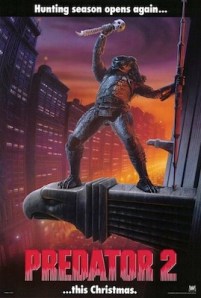
It’s a shame this fails so miserably, because the franchise re-location is actually a commendable thing. I’ve talked a few times about the Alien sequels dramatically switching genres, but Predator 2 leaves them looking as if they couldn’t be more alike. Where Predator is a behind-enemy-lines/covert mission/jungle/war actioner, Predator 2 is an urban drugs crime police, erm, actioner… though both with a sci-fi twist, obviously. But the vastly different settings and setups mean that, even with the involvement of the same sneaky alien hunter, the films have a vastly different feel too. It’s just a shame Predator 2’s “urban jungle” concept is so poorly executed… for a while anyway, because when it finally reaches the 30-minute climax things suddenly get quite good.

It’s a bit like all the time, effort and money went on creating a good lengthy climax, then any-old hour-long urban crime movie was bolted on the front to create something feature-length. In fairness there are some good bits earlier on, but the final half-hour (or so) feel like it’s from a slightly different, slightly better movie. The dialogue improves, suddenly filled with some decent lines, and it centres on a mano-a-mano (or mano-a-alien, really) fight that’s nicely reminiscent of the first film while being totally different, sprawling through locations and using lots of high technology. There are still flaws — it nicks the government agents’ motivation from Alien wholesale (they want to capture the alien for its weapons technology, which they admire it for) — but they’re largely forgivable.

Perhaps best of all is that throughout the climax it expands what we know of the Predator, rather than just rehashing what we learnt in the previous film, as in so many weaker sequels. There’s more of its weaponry and its medical kit, what amounts to a tour of its ship, hints of its society and culture, and it’s given a nice balance of fallibility — not so indestructible that it’s stupid when the hero wins, but not so weak as to be undramatic or inconsistent. There’s one especially good moment where the Predator discovers a character is pregnant and so spares her, a nice touch both in terms of how it reveals the previously-unknown pregnancy (through the Predator’s heat vision) and in revealing the creature’s morals. It’s this sense of honour and a heightened mental capacity that marks the Predator out from other such creature movies, especially the Aliens, who are essentially animals (it would seem), albeit cunning ones.

Predator 2 is a dire film rescued by an excellent finale. As well as a decent chase and fight, it also builds on the first film’s mythology, revealing a decent amount about the Predators and hinting at more, without going too far or spelling it out too bluntly. If only such qualities could have extended into the opening hour, this could have been a sequel on par with the original.

3 out of 5

Tomorrow, AVP: Alien vs. Predator.

High Society (1956)

2009 #54
Charles Walters | 107 mins | DVD | U

High SocietyCole Porter-scored musical remake of The Philadelphia Story, which is probably most famous for featuring Who Wants to Be a Millionaire? and being star Grace Kelly’s final film before becoming a princess.

Despite rarely singing, Kelly is by far the film’s standout element — it’s easy to believe three different men would be vying for her affection, but she also gets the chance to show the greatest range of any cast member. Admittedly it’s shades of comedy rather than a full awards-worthy display of ability, but she carries the film beautifully. It’s no wonder her husband-to-be, Prince Rainier of Monaco, objected to her appearing in movies when she played roles such as this: a divorcee who at one point allegedly sleeps with another man on the eve of her wedding to a third is surely no role for a princess. (Turns out she didn’t sleep with him, mind.)

Bing Crosby and Frank Sinatra are more-or-less themselves as the male leads, though the sole song they perform together, Well, Did You Evah!, is one of the film’s best — despite being a late addition from a previous Cole Porter musical after it was realised Crosby and Sinatra didn’t have a number together. Louis Armstrong also plays himself, literally, and brightens up the screen whenever he appears. His band’s duet with Crosby, Now You Has Jazz, is another of the film’s highlights.

Despite being adapted from an acclaimed play and film, the plot feels like a relatively slight contrivance to link together a couple of songs — alternately of the Romantic and Comedic variety — and some farcical humour with a romance-based thread. That the right people end up together is no surprise — so little surprise, in fact, that the story doesn’t even bother with such trivial things as making the final entanglements come together believably.

No matter. It’s the journey to the inevitable conclusion, through a few comical scenes and a few decent tunes, that makes High Society a perfectly pleasant dose of entertainment.

4 out of 5

High Society is on TCM UK today, Saturday 4th April 2015, at 4:15pm, and on Sunday at 9:35am.

For All Mankind (1989)

2009 #42
Al Reinert | 77 mins | TV (HD)

For All MankindFor All Mankind tells the story of NASA’s Apollo missions to the Moon using only NASA’s own footage of the real missions.
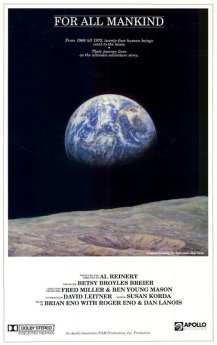
It’s not a documentary in the sense that most people perceive the form — i.e. a highly realistic presentation of the facts — but instead something a little more interpretive, aiming to recreate the feeling and experience of travelling to the moon, not the hard facts of who went when and how it was done. As such it is both beautiful and artistic, featuring stunning photography that has been sensitively edited and scored.

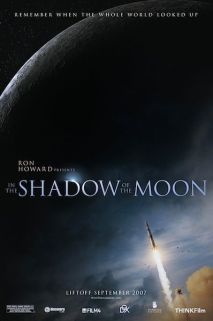
In this regard, it makes In the Shadow of the Moon look like a Hollywood remake. While they follow the same tack — telling the tale of the Moon missions with just the testimony of the astronauts, treating it as one big mission rather than taking them all in strict chronological order — For All Mankind does it with a greater sense of artistry. Where Shadow feels like a typical documentary, with talking heads and onscreen identification of who’s speaking, Mankind just uses original footage and astronaut’s narration, never bothering to identify the speaker. Both styles have their place, and Shadow adds a great deal to the story with its retrospective comments by the astronauts, but the glorious footage and skilled editing of Mankind — and the added wonder of seeing it in HD, it must be said — leaves one with a sense of awe that isn’t as present in the more informative Shadow.

These two films make an excellent pair then, but For All Mankind’s beauty provides the superior experience.

5 out of 5

For All Mankind placed 5th on my list of The Ten Best Films I Saw For the First Time in 2009, which can be read in full here.

In the Shadow of the Moon (2007)

2009 #40
David Sington | 96 mins | TV | U / PG

In the Shadow of the MoonIn the Shadow of the Moon tells the story of NASA’s Apollo missions using only contemporary footage and the words of the men who actually walked on the Moon.
The telling is dominated by the words of the actual astronauts, describing their personal experiences and feelings. Rather than following a mission-by-mission chronology it mixes all their stories together, thereby telling the tale of a journey to the Moon and exploring its surface only once. It’s a neat way of editing it, albeit essentially borrowed from For All Mankind, because it avoids repetition while also covering a variety of perspectives. The typically reticent Neil Armstrong is conspicuous by his unsurprising absence, but this allows the personalities of some of the others to come out more (Buzz Aldrin features relatively little too, for example), perhaps none more so than Mike Collins, the man ‘left behind’ while Armstrong and Aldrin stepped into the history books. He comes across as thoroughly likable and it’s a pleasure whenever he’s on screen.

Narration is limited to a couple of brief intertitles and that contained on archive footage, culled not only from NASA archives but also newsreels, adverts, speeches and so forth. In this it manages to avoid using some of the more obvious and over-played clips, such as Kennedy’s famous “not because it is easy, but because it is hard” speech, while unearthing some interesting bits of its own, like Armstrong’s parents on a game show the day he became an astronaut, being asked how they’d feel should he happen to be the first man on the Moon. Such found footage is often used to put the missions in the context of wider events at appropriate junctures, such as Vietnam and the Civil Rights movement during the time Apollo 8 led the first men to orbit the Moon, or showing the whole world watching the TV broadcast of Armstrong stepping on to the Moon for the first time.

Although this external perspective is welcome, while being kept to an appropriate minimum, it’s difficult not to note that this is exactly what the HBO dramatisation, From the Earth to the Moon, did at these points. Other points of emphasis feel similarly culled, such as the way Apollo 13 is almost glossed over, but there are only so many ways of telling the significant elements of the same story and any accusations of plagiarism, from either HBO’s series or For All Mankind, aren’t seriously justified.

A closing perspective treads the fine line that leads toward sentiment and preachiness, but errs on the right side of awe and significance. Some have criticised the end for having too much religion and spirituality and not presenting a conflicting, ‘accurate’ scientific perspective. As a staunch atheist, I found no such problem: beliefs are there to an extent, but they’re not overpowering and there’s no apparent religious agenda, as some critics might have you believe.

In the Shadow of the Moon may not offer the plain facts and figures of how we went to the Moon and who did it when, but it does present the reflections of the men who risked their lives to further the knowledge and reach of our species. Their thoughts on this are invaluable.

4 out of 5

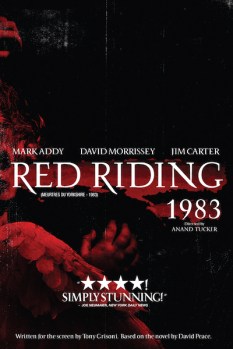
Red Riding: 1983 (2009)

aka Red Riding: In the Year of Our Lord 1983

2009 #52
Anand Tucker | 100 mins | TV (HD) | 15

Red Riding: 1983The Red Riding Trilogy draws to a close with its finest instalment, a superior work in just about every respect.

From the off, 1983 returns to the story of the previous films, showing events from different perspectives. It’s dominated by a new story — the search for a child kidnapper in the titular year — but even this harks back to the past, the actual kidnapping closely resembling the one that kick-started 1974. Indeed, it’s 1974 that’s primarily drawn upon, confirming 1980 as little more than an aside in the scope of the trilogy.

1983 doesn’t just reiterate, however, but builds on previously-seen events and characters, both overtly — showing the police investigation into Clare Kemplay, which was the story of 1974 — and more subtly — Hunter’s apparent sidekick being present at secret meetings of the Evil Policemen in 1974. Despite clear links to the past, 1983 may also work well enough on its own. It’s undeniable that there’s more depth when viewed in light of the first two films, but most (perhaps all) of it would be comprehensible simply from what’s presented here.

Tucker’s film bests its predecessors in almost every assessable value. The story and characters have more genuine surprises and suspense than ever, while the performances are at the very least the equal of what’s gone before. Unlike the other two films, where the corrupt cops were little more than cartoon villains despite claims to the contrary, 1983 makes their brutality really felt; here, for the first time in the trilogy, their disregard for the law and their vicious methods made me feel sickened and angry, just as they should.

But best of all is the stunning sepia-tinged cinematography, which uses the popular RED cameras to amazing effect. The instances of beauty are too numerous to mention, from obvious moments such as the final scenes of white feathers drifting in slow motion through shards of sunlight as part of a heroic closing image (even if one finds it tonally incongruous, which some surely will, it looks gorgeous), to low-key scenes like Jobson lost in contemplation, the sepia-toned foreground standing out from the blues of the background. The omnipresence of lens flare, an idea that was so annoying when liberally sprinkled across Star Trek, seems to work perfectly here. Perhaps it’s due to consistency: every light source seems to cast streaks across the frame, not just the occasional flourish. The trilogy isn’t yet available on Blu-ray, but for some of the images in this film alone it really should be.

Sadly, 1983 still isn’t perfect. Many plot threads are tied off, or we can infer our own explanations for the missing bits, but significant others are left hanging, not least what happened to the numerous corrupt police officers. We don’t necessarily need to see them come to justice — though that might be nice, obviously — or even a summary of the rest of their life, but some nod of a conclusion to their stories would be appreciated. Elsewhere, BJ’s narration is slightly twee, which is a shame because his story is both compelling and one of very few that is actually told across all three films, even though he’s barely noticed at first, rather than just starring in one and cameoing in the others.

I enjoyed 1983 immensely, much more so than either of the preceding films, so it’s only minor flaws like these that hold it back from full marks.

4 out of 5