
John Singleton | 103 mins | TV | 2.35:1 | Germany & USA / English | 12 / PG-13
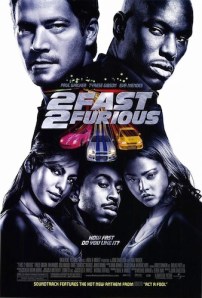 I never thought I’d watch, and certainly not enjoy, the Fast and the Furious series, but a few years ago (after the second film hit cinemas, I think — which would be almost a decade!) the first seemed to pick up a bit of praise from movie magazines and/or websites that were generally to my taste, so I gave it a go. I quite liked it, in the mode it was intended — a brain-off good-time action-y movie. I thought I was done there though, thanks to the much-maligned sequel — mainly because of its ridiculous title, which is still great fodder for a quick joke whenever a sequel is announced and people speculate on what it might be called. But sometimes, something compels you to give something a go…
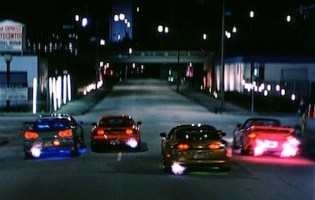
Here, then, we find poor acting, a plot done by the numbers, and a style that sometimes feels like a rap video writ into a film. Oh dear. Yet the chases and other car-based action sequences are pretty coolly done, and there’s more of them than I remember there being in the first film. That’s a definite plus — really, it’s all you want from a film like this.
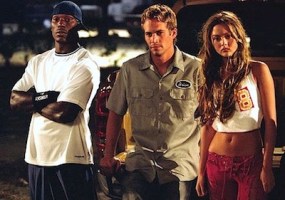
The drivers do a lot of trash talking… usually when they’re in cars by themselves. Oh dear. Then again, I regularly talk to myself when I’m driving alone, so either the film’s fine or I’m appearing in a trashy B-movie. Or just think I am. In a way, these poorer qualities — the dialogue, the acting, and so on — are part of the experience of the film, and somehow manage to endear it. So bad it’s good? At points, yes.
 It’s worth noting it was directed by John Singleton, who started out with the acclaimed social drama Boyz n the Hood. How he’s fallen: via stuff you’ve never heard of to the Shaft remake, this, and most recently the poorly-reviewed Taylor Lautner From Twilight-starring Abduction. Well, each to their own.
Talking of crew, the music (well, the score) is by David Arnold, the recently-deposed Bond maestro. It was somewhat pleasing to see his name appear in the credits because I thought I could hear Bondian bits creeping in; I thought they’d just nabbed bits of the score from Die Another Day or something (such borrowing is not unheard of these days: I didn’t mention it in my review in the end, but I noticed during the credits that Unstoppable borrowed three cues from AVP, of all things).
In the UK, the film was cut by 11 seconds to reduce some violence and get a 12 certificate; later, it was re-rated uncut at 15. This is the kind of thing that really bugs some people — cue rants about the controlling nature of the BBFC — but, in instances like this, I couldn’t care less. For one thing it’s the distributor’s choice, not the BBFC’s. That’s not always wholly placating — see Casino Royale — but, sometimes, why care? So we lose “3 kicks, a stamp and a spit, all delivered to a prone man” — so what? The scene’s still in the film, there’s just less of it. I agree with people’s frustration when cuts are major, but in cases like this, perspective is needed.
 Ultimately, 2 Fast 2 Furious is like cheap fast food: you know it’s made of trash, high in fat and sugar, liable to rot something in your head — and just really bad for you fullstop… yet it’s an enjoyable guilty pleasure once in a while. If you don’t identify with that feeling then you’re a better man than me, and you’ll probably never like this film.
By rights I should give 2F2F 2 stars — it would even provide the opportunity for some kind of gag connected to its title. But, no. I don’t know if it just caught me in the right mood or if it has something surprising under the hood, but I wound up rather enjoying it. It’s junk food, but sometimes that hits the spot.

2 Fast 2 Furious is on ITV2 tonight at 10:50pm, and again on Friday 7th at 10pm, and probably regularly after that too.
This review is part of the 100 Films Advent Calendar 2012. Read more here.
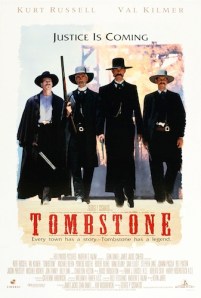 The story of the OK Corral is one I know by name only; I haven’t even seen the
  That may be down to historical accuracy. There’s a distinct feeling of veracity to proceedings, and as I understand it a concerted effort was made in that regard. The Movies perhaps shouldn’t worry about sticking too closely to fact (if you want an accurate lesson, read a textbook), but when they can manage to be both factually accurate and entertaining, it’s all the better. Cosmatos & co appear to balance this well.
 Mainstream US superhero comics underwent something of a revolution — or an evolution, if you prefer — in the ’80s, moving from simplistic good vs evil tales-of-the-week to deeper, thematic- and character-driven stories that in some cases took months or even years to relate in full. It’s a change that’s still felt today (some would contend that they’ve been stuck for decades in a rut these developments ultimately led to). It’s generally considered that there were three works at the forefront of this wave of more adult-orientated comics, all of which still rotationally top Best Graphic Novel Ever polls today: Alan Moore and Dave Gibson’s
  Like Year One before it, the team behind these direct-to-DVD DC animated movies have taken a reverent route to bringing DKR to the screen. It’s in two parts because the original story is too long to faithfully adapt in their limited-length movies (it’ll work out at about two-and-a-half hours all told, which isn’t commercially viable for a direct-to-disc animation), but that also works out OK from a storytelling point of view: this first half ends with a major threat wrapped up and a great cliffhanger to kick off the second half. Those with less appreciation for the economics of film production have slated DC/Warner for splitting the film in two like this, but in some ways it works to its benefit artistically as well as commercially.
 Stylistically, the film retains Miller’s designs, albeit a bit smartened up to work consistently as animation. Some will bemoan that homogenising but others may delight in it — Miller’s art is generally a bit on the scruffy side, I think. Is it an appropriate mark of respect that they’ve translated it so literally from page to screen, or would it have been more interesting for the filmmakers to have taken Miller’s plot and situated it in a world drawn from their own designs? I’m not going to argue that they could have improved on Miller’s work, but it might have been interesting to see the story given a spin in a different artistic style.
 Voice work — the other major addition of an animated re-telling, of course — ranges from solid to very good. I wasn’t convinced by the casting of former RoboCop Peter Weller as Bruce Wayne/Batman, but he’s pretty darn good, carrying exactly the right kind of aged gruffness. It’s unique, I think, to see an active Batman this old on screen — sure, Nolan forwarded things eight years for Rises, but he’s still played by a relatively young and fit Christian Bale, whereas this Batman is grey, in his mid 50s and looking even older. I don’t recall a significant weak link in the rest of the cast, with
 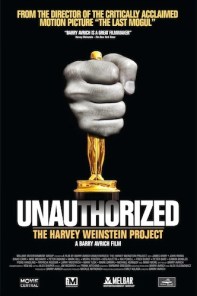 The documentary that Weinstein reportedly tried to stop existing, including discouraging people from participating in interviews. Either he needn’t have worried or really is a complete megalomaniac, because while there is a certain warts-and-all aspect to Avrich’s cinematic biography, it can’t help but admire all that Weinstein has achieved.
 Even for those who were following film culture through this era, and in spite of Harvey’s apparent efforts, there are numerous interviewees who were there — former Miramax employees, for instance — to offer insight. Thanks to archive footage we get even more opinions, including a fair few comments from Harvey himself. How much of this was available at the time, I obviously don’t know. Even if it is mostly recap, it’s a concise and well-constructed one.
 Bill Cunningham is 80. He lives in a small rent-controlled apartment in New York City that is filled with filing cabinets. His bed is little more than a mattress on some boxes. Each day, he dresses in the same distinctively simple blue smock and sets out on his bicycle. He eats at the same places each day; simple cheap food, cheap coffee. He doesn’t have a partner or kids; he may never have had a romantic relationship. He doesn’t watch TV or listen to music. It sounds like some kind of life of poverty or religious devotion. It’s neither, although you could make an argument for the latter, because all Bill does all day is photograph what people wear.
 Bill is, technically, a fashion and society photographer. His real passion, however, is clothes. Real clothes. The clothes people actually wear and how they wear them. His newspaper column — a collection of photos from the streets — is essential reading as far up the chain as Anna Wintour. He doesn’t set trends, he observes them. Exposes them, you might say, because in the past he’s used his work to call fashion designers on where they’ve copied (consciously or not) the work of another from years before, and that has sparked arguments.
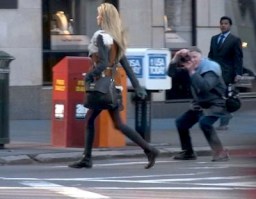 What he actually is, more than a “fashion photographer”, is a documentarian, recording how people choose to present themselves to the world, both as individuals and how that translates en masse. Fashion may seem like a meaningless, arbitrary, frivolous thing to afford such time to, and I’d have no argument against Fashion being called exactly that. But fashion — the actual clothes we wear in our actual lives — is something a good many people spend a good amount of time obsessing over; it’s how they choose to represent themselves in the world, how they indicate what they’re like as a person, how they show which groups or types of people they align with. We all do it, even if it’s not a conscious choice. Surely that’s worth recording?
 But that’s all an aside, probably because it’s so well done. What might be worth picking up on is that there’s no specific story. There are stories in there — like how Carnegie Hall is kicking out its handful of 80- and 90-something resident artists to make way for more office space — but the film doesn’t have an overarching tale. It’s a portrait; one of a fascinating, unusual, but likeable, and certainly unique, individual.
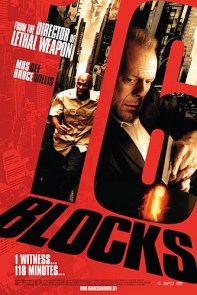 A Bruce Willis action movie? You know what you’re in for here, don’t you? Well, not quite. 16 Blocks casts Willis as less John McClane and more John McCane: old, fat, drunk, limping. He’s a copper still, but the kind of detective whose primary duties are being left to watch over an apartment full of bodies until uniform can show up.
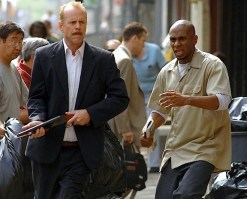 For me, it really lost its way just over an hour in, when our heroes (spoilers!) end up in a hostage situation on a bus. It’s not bad, but it feels like writer Richard Wenk (who’s gone on to co-write heights of culture like
 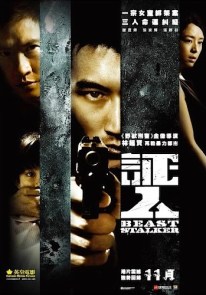 While in pursuit of an accused murderer, a cop (Nicholas Tse) accidentally kills the daughter of said murderer’s prosecutor (Jingchu Zhang). Three months later, just days before his trial, the accused has the prosecutor’s other daughter kidnapped, to persuade her to destroy the evidence proving his guilt. Despite having spent the intervening time in reclusive self doubt, the cop sets out to rescue the kidnapped little girl.
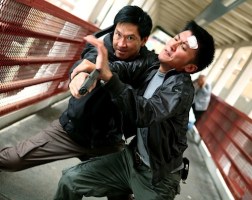 making them a little perfunctory — the real meat actually lies in the plot’s twists and turns. This is more one for fans of thrillers than beat-’em-ups.
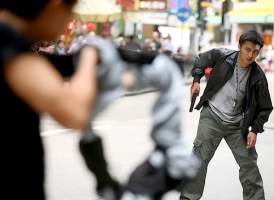 The top performance comes from Nick Cheung as a for-hire kidnapper with the Bondian trait of being blinded in one eye while the other only has black-and-white vision. He gets added complexity thanks to an invalided wife he tenderly cares for — he’s only in this life of crime to pay off his debts and medical bills, y’know. Cheung’s largely silent turn manages a fine balance of menace and sympathy. He won a couple of HK awards for it,
  A brief couple of scenes with a bullied colleague play out nicely, though unfortunately they contrast with a painfully written bit in which another colleague tells Tse’s character what people think of him. “They said you were horrible, but I like working for you,” she tells him (I paraphrase), for no discernible reason. It doesn’t even matter that we’re told that, because we’ve already seen it. I just don’t get it.



 Before
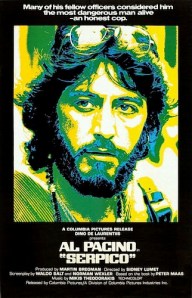
  As the titular copper, it’s a typically strong performance from Al Pacino. Not his best work — I don’t think the part really gives him enough to deliver that — but he’s more often than not the most engaging element of the film. This was his fifth film; considering
 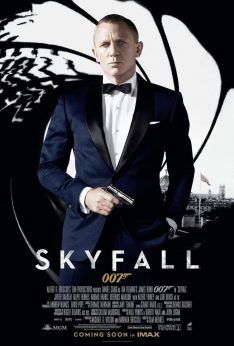 Bond is back, and you’ve surely seen the torrent of 4- and 5-star reviews (and the insignificant handful of dissenting voices). I’m pleased to report that the consensus is correct: Skyfall is Bond at his best.
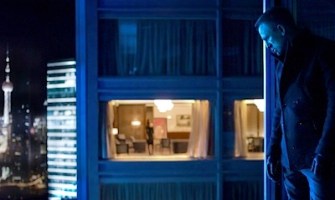 Technically speaking, the film looks gorgeous thanks to Roger Deakins’ cinematography. Best looking Bond ever? There’s little I can think of to dispute that. Obviously it could be said to lack some of that ’60s glamour, but from a purely photographic perspective, it shines. (Incidentally, this shot isn’t actually in the film.) I’m less sold on Thomas Newman’s score. While in no way bad, and with undoubted sparing but precise use of the Bond theme, it didn’t always click for me. The fact I at times felt like I was listening to cues from
 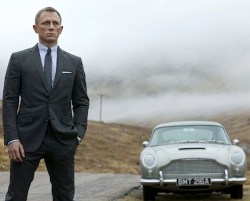 honestly, there perhaps aren’t as many twists as you might expect in that department, but the ways they’ve nodded to the franchise’s history are sublime.
  100Films.co.uk