
William Powell and Myrna Loy starred in 14 films together between 1934 and 1947, and the most famous of these are a series of detective films that started life as a B-movie adaptation of a Dashiell Hammett novel, before earning multiple Oscar nominations and enough popularity to inspire multiple sequels, a spin-off TV series, and more. That film, of course, is The Thin Man.
Powell and Loy play Nick and Nora Charles, a retired detective and his well-to-do wife, who are trying to enjoy the high life but are regularly dragged in to investigating murders, mainly thanks to her curiosity and his crime-solving genius. Special mention must also be made for the couple’s dog, Asta, a wire fox terrier who was so popular he was paid many times more than your average movie dog, and whose role only increases as the series continues — he even has a romantic subplot in the second film.
The films on the whole are more concerned with the screwball-ish relationship between the leads than they are with the mysteries, which are so speedily intricate as to barely be worth following — just accepting what Nick tells you and going along with it may be the order of the day. They all have the air of Agatha Christie-esque parlour games more than genuine criminal undertakings, which of course means they make for splendid entertainment.
Six films were produced in all, over the course of 13 years — rather the opposite to most of these ’30s/’40s detective series, which were more likely to churn out 13 movies in six years. Anyway, it’s the perfect number to allow every Thursday between now and the end of February to be Thin Man Thursday here at 100 Films. Below you’ll find links to all the reviews as and when they’re available, starting today with (naturally) the first:






 Produced as a B-movie, but eventually nominated for four of the biggest Oscars (Picture, Actor, Director, Screenplay
 like a Christmas party which is regularly interrupted by victims and suspects. Even the final scene, a rambling and none-more-Christie-like “gather all the suspects and reveal the answers” dinner party, seems natural because of the characterisation throughout the rest of the film. Loy’s part may not be quite as showy — as demonstrated by its failure to gain an Oscar nomination — but she’s an invaluable half of the double act.
 Liam Neeson shoots wolves for an arctic drilling company, but when his flight home crashes, he must attempt to lead the small band of survivors across an icy wilderness to the mere hope of safety — pursued all the way by murderous wolves…
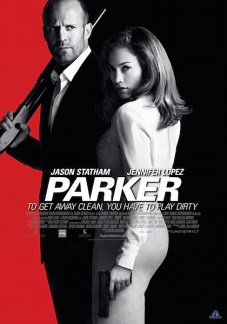 Parker trailed well — funny lines, promising action, solid setup — but doesn’t deliver.
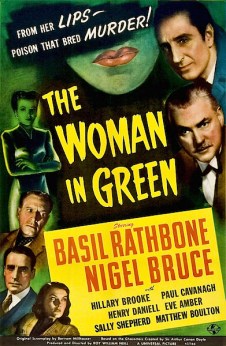 Basil Rathbone’s Sherlock Holmes starred in films which, although they typically involve murder, are best described as “adventures”. The series’ 11th film, The Woman in Green, is one of the few — perhaps the only one — that could genuinely be described as dark and grim.
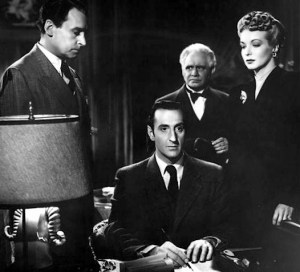 The evil is carried off with aplomb by Daniell. Reportedly a cold actor to work with, he chills on the screen too. This is a man you can believe would carry out such a scheme without a single twang to his conscience. His comeuppance, even with its surprising finality, is welcomed. The titular woman, played by Hillary Brooke, is one of Moriarty’s cohorts, posing as the ‘girlfriend’ of the aforementioned widower in order to set him up. The film is of course in black & white, so we can’t see what colour she’s wearing, and no one ever refers to it — even when they’re hunting for her based on looks alone. I guess someone thought it was an evocative title nonetheless.
 Released the same year as
  Even with the undercurrents of grief and the difficulties of moving on, this is fundamentally a light, amiable romance.
 Jackie Chan’s breakout hit sees him as Chien Fu, the floor-scrubber-cum-punch-bag at a martial arts school where he bumps into Pai Cheng Tien (Yuen Siu Tien), one of the last two proponents of the Snake Fist style after its other students were murdered by their old enemies, the Eagle Claw clan. The old man trains Chan so he can overcome his bullying schoolmasters, while the Eagle Claw grand master (Hwang Jang Lee) hunts for his last remaining rival…
 Also striking is the music score, a strange mix of weird, cheap, dated, electronic stuff… and yet, it’s so odd I kind of warmed to it. It’s all poached from elsewhere, which was apparently the way things were done in Hong Kong at the time. Stand-out tracks are Magic Fly by Space and Oxygene Part II by Jean Michel Jarre, though bits of famous scores are in there too, most recognisably (for me)
  A behind-the-scenes making-of with a difference, American Movie: The Making of Northwestern (to give its full title) is a documentary about wannabe-filmmaker Mark Borchardt attempting to produce a horror feature film with little more than some mates and good intentions, battling against a lack of money, interest, and dedication. It descends, quickly, into the kind of farcicality that leads some to assume it’s a
  Whatever you take away from it, American Movie feels like a must-see for certain sections of film fandom, particularly anyone who wants to make a movie themselves. Its appeal is broader than that though, an everyday story of adversity that isn’t so much overcome as temporarily averted. It’s not bleak or sad, but it is melancholic. And, whatever the morals of it, often laugh-out-loud funny.
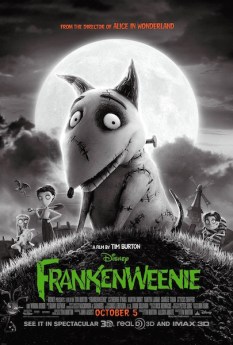 Inspired by two of Burton’s early-’80s shorts (which are most commonly found on
  Some say it doesn’t have enough of an edge. Well, maybe; but I thought it was surprisingly dark in places. Not so considering it’s a Tim Burton film based on resurrecting the dead, but for a Disney-branded animation, yes. Those edgier bits are here and there rather than consistent, but still, I’m not sure what those critics were expecting from a PG-rated Disney animation. I guess there’s an argument that Burton should have pushed it further and aimed for an adult audience, but can you imagine an American studio agreeing to finance an animation primarily targeted at anyone who’s entered their teens? Because I can’t.
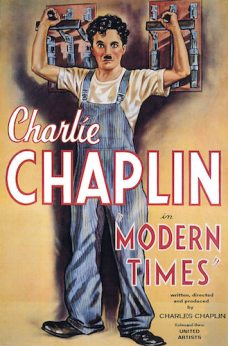 Charlie Chaplin satirises technology and modernisation in arguably
  100Films.co.uk