
Jon Favreau | 125 mins | Blu-ray | 12 / PG-13
With Thor out a couple of weeks ago and Pirates of the Caribbean 4 just hitting cinemas, 2011’s blockbuster season is well and truly underway. While you all head out to the cinema and enjoy this year’s delights (or disasters), I intend to do some catching up on the tonne of stuff I’ve missed from the last year or two (or three, or more).
Starting, naturally, here…
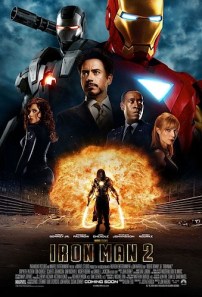 I’ve always contended that the first Iron Man film was overrated. That’s not to say it was a bad film — I gave it four stars and, having re-watched recently, I liked it even more — but I think it took critics and audiences by surprise and that led to a level of praise from both sets that was unduly high. It’s not unreasonable: who would’ve expected anything special from the movie adaptation of a B-list superhero, helmed by a low-recognition director, starring a one-time leading man just about on his comeback? When it turned out to be both fun and funny, I think people overreacted. I saw it later, after hearing all that praise, so I think (without wishing to sound immodest) my view was slightly more tempered.
It’s for similar reasons I think Iron Man 2 has been underrated — I would contend that it is, more or less, as good as the first film. That didn’t seem to be the consensus at the time of release, which ranged from mediocre to rubbish. I don’t agree at all — and, again, I think this is in part due to viewers’ expectations. When one thinks a first film is better than it is, expectations for the sequel are heightened; when said sequel is only as good as the first film really was, it looks a lot worse by comparison — it fails to reach the audience’s over-raised expectations.
That’s my take, anyway. This being a review, I shall now offer more thoughts on why I think it’s a good action-adventure flick.
 For starters, it relies on the story rather than the action. There are certainly some good sequences of the latter (more about those later), but there’s also a lot of story in between them — it’s not wall-to-wall explosions and punch-ups. Neither was the first, if you remember, and so it fits in that respect. It’s helped along by the ending of the first film, in which Tony Stark revealed he was Iron Man. That’s not something you do in superhero movies, which immediately lends this one a few new plot devices to play around with. Considering the burgeoning critical assessment that all superhero movies ever only tell the same two or three stories (an argument I think has a lot of validity), it’s nice to see anything to challenge the norm.
So does the reliance on technology. Yes, Batman uses kit rather than powers gifted via supernatural or ‘scientific’ means, but even Christopher Nolan’s real-world version of that character takes the tech as read and gets on with some moral-based superhero antics. Iron Man does less of the hero stuff (see again: fewer action sequences; also, Stark’s self-centred character) and indulges a little more in arms-race tech-development, a very plausible side effect of this superset being unveiled to the world. The development of the technology is as much part of this story as the genre-typical mental anguish of the hero(es) and/or villain(s), which, again, makes it a little different.
This time, Iron Man faces two enemies. A recipe for disaster, some would say — look at Batman & Robin or Spider-Man 3. That conveniently ignores Batman Returns or The Dark Knight though, doesn’t it. Here it works because they’re two notably different characters and they complement each other — 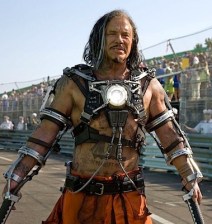 it’s the Penguin and whover-Christopher-Walken’s-character-was rather than Mr Freeze and Poison Ivy, if you will. They play to different sides of the hero: one is fighting Stark, one Iron Man (though there is naturally crossover); though they’re both intelligent, one functions as the brains and the other as the brawn. Mickey Rourke may go slightly underused, but it’s also part of the character, a quiet, thoughtful, intelligent hulk partnered with Sam Rockwell’s jabbering wannabe-Stark.
Turning to the action sequences, I think they’re better all round than the first film’s efforts. Iron Man comes up against things that are his match, rather than just the occasional virtually-unopposed rescue of a third-world village or what have you. The climax is certainly better than that in the original. Iron Man 1‘s climax was a brief encounter lacking punch, literally; here we have a more advanced villain with some variety in his weapons — it makes for a more visually interesting affair. Both films have been criticised for being just robot-on-robot fights, the same fault that riddled Transformers. I disagree. In Transformers you couldn’t tell who was who; in both Iron Mans, you can — that’s kinda important. Sure, a non-robot-suited villain would make even more of a change, but I don’t think it hampers this finale too much.
I also wonder if some negative reaction stemmed from being shown too much in the trailers. I distinctly remember how underwhelming I found Wanted at the cinema because I felt like I’d seen it all; 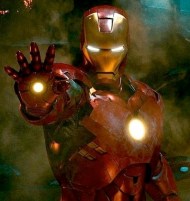 watched again later on Blu-ray, I enjoyed it a lot more. With Iron Man 2 I’m obviously distanced from trailers by a good year or so, and though one of their best moments is missing from the final cut, and the suitcase-suit is unavoidably spoilt by being so thoroughly screened during the promotion, watching now doesn’t have all the trailer-generated expectation to live up to. That famous Onion spoof about the first film’s trailer is, perhaps, even more applicable to the sequel.
Despite that cut I mentioned (the whole little sequence where Pepper throws Iron Man’s helmet out of the plane, for the interested; which, actually, would make a nice counterpoint to one of the final scenes — maybe that cut is a fail after all), other nice moments abound — Rhodey’s opening line, for instance, which acknowledges the change in cast member without harping on about it. Admittedly, however, there’s no comic highlight quite as memorable as the best bits from the first film, though I did laugh out loud plenty often throughout (when I was meant to, I hasten to add).
The greatest negative reaction, however, seemed to be reserved for one subplot: some called the film little more than a two-hour trailer for The Avengers. That’s unfair.  Aside from one unnecessary scene featuring Captain America’s shield and Agent Coulson leaving for New Mexico, and the fact that the film assumes everyone will know who Nick Fury is despite him being introduced fleetingly after the credits of the last film, the whole S.H.I.E.L.D./Avengers Initiative thing is worked into the plot well. If we didn’t know it was the beginning of the build-up to The Avengers, I think it would have sat much better with viewers. Even if it does end up blatantly laying the foundation for further stories, that’s hardly uncommon in franchise films of all kinds these days — at least we know this series will definitely pay it off, unlike so many franchise-wannabes that don’t make it past their first film. Plus, the film’s primary plot has its own villains and comes complete with a resolution; Fury, S.H.I.E.L.D. and co are a subplot that feed other subplots.
Naturally the film isn’t perfect — it’s a bit slow in the middle and some bits could stand to be chopped — but overall I think it stands up much better than the critical and audience consensus implied. While watching I kept waiting for it to turn sour; to suddenly see what everyone had moaned about. Halfway through the screen fades to black, then fades back up to introduce Nick Fury — “oh, here we go,” I thought, “everyone moaned about the Avengers stuff; this must be where the whole film goes south; and handily marked by that fade too” — but no, I kept on enjoying it. The clock kept ticking, it kept not getting bad.
I enjoyed Iron Man 2 more or less as much as I enjoyed Iron Man, and that’s rather a lot.

Iron Man 2 begins on Sky Movies Premiere today at 3:45pm and 8pm, and is on every day at various times until Thursday 26th May.
 The first sequel (I say that in the hope there’ll be more) to
  there’s a perhaps surprising undercurrent of genuine emotion and serious issues. This is one of the things that marks these two films out from the overcrowded kids’ film genre: they’re prepared to tackle things in an appropriate way, never allowing them to overwhelm and make an Issue Film but not sanitising them because It’s For Kids. The ending to a lovely picnic may well bring a tear to your eye.
 CGI is also used again to magical effect. And, even more than that, to very cute effect. It feels like a bunch of scampering CG piglets, or a cuddly CG baby elephant, should be a little disturbing and wrong, but they’re not — they’re all incredibly cute, in fact. Aww. And they get up to plenty of funny and entertaining things. As with most of the enjoyment in both Nanny McPhees, it may be aimed at children, but I think it’s done in a way that appropriately-hearted adults can enjoy too.
 I loved the first Nanny McPhee, which always sets a sequel up for failure. However, Thompson (though she’s not in the director’s chair I think we can be certain she’s in charge of this series) doesn’t disappoint. She’s taken a brave route by setting the film in a completely different era with an all-new supporting cast (except for one lovely last-minute surprise for the attentive), but it’s paid off handsomely. This is at least as magical as the first, perhaps even more so.
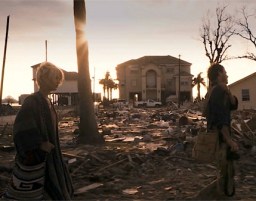
 So begins Monsters. Expecting an epic SF-action movie where soldiers kitted out with futuristic weaponry battle an alien menace? You might be disappointed. Indeed, the relatively low
 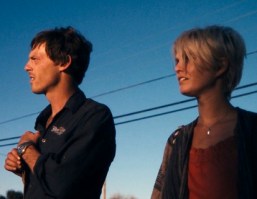 Only without being as worthy or on-the-nose as that makes it sound, I promise. As writer-director, Edwards has made a film that’s relatively Arty (for want of a better word), with lingering shots and wordless scenes. It tells the story visually quite often, letting the Infected Zone signposts or candlelit shrines to dead children or stunning scenery do the talking when dialogue isn’t necessary.
 The CGI is virtually faultless, which is doubly impressive as the vast majority of it is on shaky handheld shots, not nice clean plates. And Edwards created it all by himself I believe. Writer, director, cinematographer, single-handed visual effects unit — it’s no wonder much of the focus on Monsters has been on the clearly considerable skill of its creator. Much of the CGI would, I imagine, pass the casual viewer by: everyone knows the aliens are CG, but the film is littered with signposts and other such set and scenery extensions. It’s the kind of thing a bigger budgeted film would simply have created physically, but, working with next-to-no money, Edwards has managed to paint flawless versions of everything from simple road signs up to border checkpoints with his computer (and even bigger things, but they’d be CG’d in a big-budget movie too, so… well, hopefully you see my point). There’s the odd thing that doesn’t sit with complete realism, but even that depends how hard you’re looking. I’d say they’re the exception rather than the rule and very easy to forgive — nothing ruins its own shot, never mind the whole film.
 it’s easy to think what we saw in the night-vision sequence has led to this. But it hasn’t, because the military were Americans and we’re in Mexico. I’d wager this passes some viewers by, and perhaps it’s meant to, but there’s another clue: one of the soldiers whistling the Ride of the Valkyries; and when we get to the end of the film, as a pair of humvees trundle out to retrieve our heroes (by this point stranded in an evacuation zone just inside the US border), we hear the same soldier whistling again. And here’s where the change comes: rather than reaching the bit we’ve already seen and going beyond it, Edwards cuts off before he even reaches it. To put it another way, the chronological end of events is only at the beginning. It’s quite clever, and it also obscures what happens to the characters (how I shan’t say). That’ll irritate some, especially as even when you piece it back together it’s inconclusive. I’ll leave it to others to argue whether that’s the point and whether it matters. The final shot is clever though: instead of closing on the characters’ finally kissing, it ends on them being pulled apart. Technically their separation is only temporary — they’re both going with the military after all — but, as we saw at the beginning, one of them might not survive the journey home; a more permanent pulling apart. Nice metaphorical linking, Edwards.
 Another review I read somewhere commented that it’s a shame
  emerging with their low-budget, story/concept-driven genre films, not to mention Chris Nolan being allowed to do more or less what he likes in the big budget sphere, it’s easy to see why this is a very exciting time to be a lover of proper science-fiction. If they all continue to make films like this, we can look forward to an astounding future.
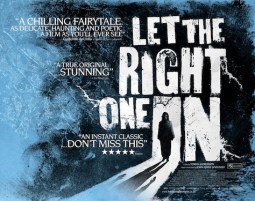 The most recent example of this speedy-remake phenomenon is Swedish vampire drama

 in fact, the director is keen to point out (in a surprisingly unpretentious fashion) that he doesn’t aim his work to slot into any particular genre — while Reeves set out to make a horror movie first and a young-love drama second. Though don’t go expecting out-and-out vampire thrills and gore from Let Me In, because it retains enough of the original’s DNA to make it still a pleasantly unusual genre entry.
 Owen is a 12-year-old loner in New Mexico in 1983, spending his days at school being bullied and filling his evenings spying on his neighbours. Then a girl, Abby, and her father move in next door and it looks like he might finally make a friend.
 The nighttime scenes are bathed in the orange glow of street-lighting, a nice choice of colour scheme as it’s evocative of the real world, especially as it’s not unnaturally overdone: the colour is abundant where there is such lighting, but more natural tones are used in forests, etc. It also provides a very different feel to the original, where a more white, snow-emphasising light was adopted throughout. Despite its realism, though, such a solidly orange palette does make the US one feel more visually stylised. Ironic.
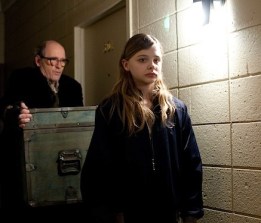 Despite it being easier to spot omissions than additions, Reeves’ film runs the same length as the original and feels faster moving. This may just be because I knew the story well, watching both versions just 24 hours apart, but some things are quantifiable: as well as far fewer scenes with the neighbours — in the original, characters; here, victim-extras — there’s also fewer arty shots of scenery, which helped give the original its sedate arthouse tone. What’s taken the place of all these things? Scenes from the novel, you might think, but from what I’ve read it’s faithful to the film more than novel — stuff I’ve read about being in the novel but not the Swedish film hasn’t been reinstated here either.
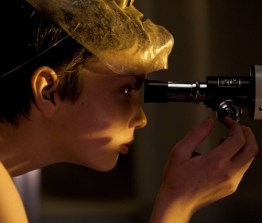 It seems he isn’t innocent in the same way Oskar was, that Reeves is building up his awareness of sexuality… but then he asks Abby to go steady and he still considers it to mean you don’t “do anything special”. What? Also, if she says “I’m not a girl”, surely the logical response is “you’re a boy?!”, not “what are you?” — especially if the only answer she’ll give is “I’m nothing”. But she’s not a boy — probably. It’s not explicit, but she seems much girlier, and of course it would remove any dangerous homosexual element. Or possibly they just wanted to make damn sure they didn’t need to include The Crotch Shot. Considering they’ve changed the bully’s teasing of Owen from “piggy” to “little girl”, it seems even more obvious a shame to have stripped Abby of her androgyny. Unless that’s the point? They tease Owen about being a little girl, before getting their asses kicked — or, rather, bodies ripped apart — by one.
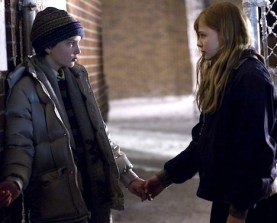 Similarly, the CGI is overdone throughout. It’s not bad per se, just used too overtly. Whereas the original remained grounded and (perhaps surprisingly) plausible, Reeves occasionally indulges in more stereotypical horror movie excess — take Abby’s first attack in the underpass, for instance: superficially similar, but in this version a computer-aided Abby flies all over the place. It draws attention to its has-to-be-fakery and is therefore a less effective sequence.
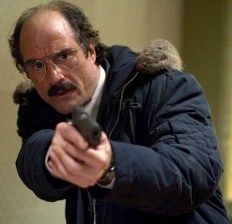 It’s probably unfair to judge Let Me In by watching it so close to the Swedish version. I expect it benefits from a bit of distance. It’s still a well-made film, still an unusual take on a familiar genre. But it is — obviously — not as original or innovative. It’s also not as well acted, not as nuanced, not as beautifully made — the images Reeves conjures up do not burn themselves into your mind in the way so many from the original do.
 Fresh from winning three BAFTAs (out of six nominations), the Aaron Sorkin-written David Fincher-directed telling of the birth of Facebook arrives on DVD and Blu-ray in the UK today. Notice that Sorkin and Fincher have equal-sized billing on
 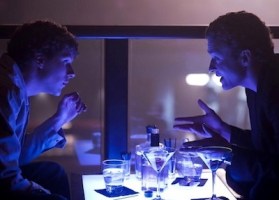 Conversely, look at all the film’s conversations. Let’s draw on one that’s discussed in the making-of material, the scene between Mark Zuckerberg and Sean Parker in the club: as Fincher says, he could’ve had a Steadicam endlessly circling them or something similar to make it seem Fast and Hip, but in reality you need to see the conversation, and especially Mark’s reactions, so instead it’s just a good old fashioned shot-reverse-shot. For all his visual prowess, it’s understanding this need for simplicity and (g)old standard techniques when appropriate that Fincher has had a handle on throughout his career.
 Also, that it’s going to be funny and exciting. That style colours the film: fast talk, complex talk, but funny. As people admit in the special features, this is a very dialogue-driven film. Don’t misunderstand me, though: the dialogue scenes are not one-note by any means — there are slow scenes, and even scenes without any dialogue — but anyone anticipating the full implications of “Screenplay by Aaron Sorkin” will not be disappointed.
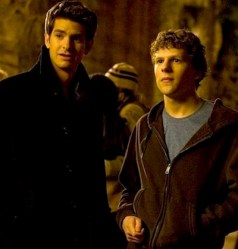 Nominated but unvictorious were stars Jesse Eisenberg and Andrew Garfield, for Best Actor and Best Supporting Actor respectively. They’re not the only ones deserving praise though, because every performance is bang on. Eisenberg manages the enviable feat of making Mark a plausible genius, an entertaining friend and an absolute bastard, not in different scenes but, often, all within the same line of dialogue. There are lines that made me laugh out loud while at the same time thinking “what a [four-letter name of choice]”. That’s Sorkin’s writing too, of course, but Eisenberg nails it.
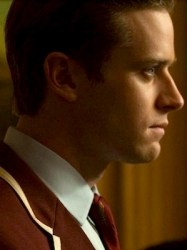 Then there’s Justin Timberlake. I can understand why people would be wary of such casting, and playing the bad boy/playboy part of Napster creator — and destructor — Sean Parker might not seem too much of a stretch. Actually, there are moments that require a little more than that, and Timberlake’s up to the task. Armie Hammer tackles the dual role of the Winklevoss twins. You can’t tell which is which, beyond that in any given scene one will be hotheaded and one calmer. I expect it’s always the same one that’s whichever, but as they both look exactly the same…
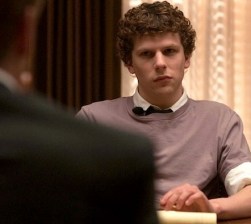 it’s set to an addictive electronic rendition of In the Hall of the Mountain King, and though the whole sequence is a showpiece, that’s as much thanks to the music as the visuals. These are just two specific examples — throughout, the music excels.
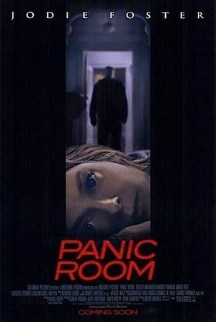 Panic Room stands out as (arguably) Fincher’s most atypical film. Whereas his others are all epic, in one way or another, this is the exact opposite. It’s very contained, virtually the entire running time spent on one night in one house, alleviated only by brief outside bookends and a guided tour of the house at the start. Fortunately, it’s still an outstanding little thriller.
 all the way squeezing the camera through banisters, coffee pots, and other assorted obstacles. There are several such shots, the majority early on (though not exclusively — witness the Hitchcockian transparent floor, for instance). This is presumably to help enliven the relatively slow build-up; later, the story’s inherent tension largely takes over.
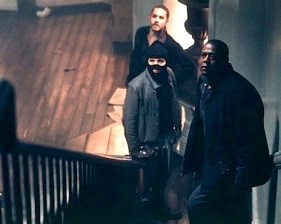 perfectly well staged and suitably tense or exciting as required, but Foster’s slow-mo dash for her mobile, and back into the panic room as the three burglars come pounding up the stairs, is one of those sequences that transcends the film it’s in to become a stand-out example of the form. Any skilled action director could have produced a good sequence at full-speed from that setup, but by switching to slow-motion Fincher stretches out the tension like an elastic band ready to snap, putting us on the edge of our collective seat as we urge Foster on through air that seems as thick as treacle.
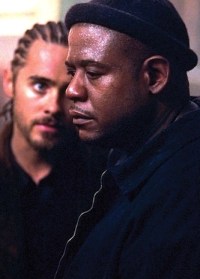 One other particularly interesting element is how we feel about Forest Whitaker’s character. This isn’t
  Much was written about Toy Story 3 when it was released this summer, so I’m not sure how much I have to add, but here we go. It’s no surprise either — that’s what happens when a preeminent and popular studio releases a sequel to a beloved and acclaimed film franchise 11 years after the last instalment. High expectations abounded. For once, they weren’t necessarily unrealistic: if anyone could pull off such a feat, it’s Pixar.
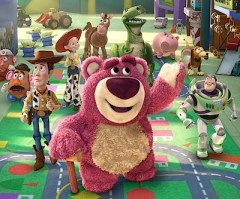 who’ve grown up with these films and these characters and, in a way, are letting them go along with Andy; and for adults, who may have left childish things behind but can hopefully still appreciate the thematic sentiment.
 even more emotional seeing them go through what they do here. Similarly, it pays to be aware of events and jokes in the preceding films. You don’t need to know intricate plot details, but there are plenty of pleasing references to catchphrases and moments.
 There’s probably a worthwhile biopic to be made about Verity Lambert. In 1963, she became not only the youngest-ever producer of a BBC television programme, but the first female one too; the programme she was charged with launching was
  Before I set off really critiquing the film, let’s just remember this: it’s a student effort. In that context, I’ve seen far worse — heck, I’ve been involved in the production of worse. Cowell and Guy have set themselves an almost Herculean task by choosing a period tale, which obviously necessitates all sorts of extra effort in terms of costumes, locations, dialogue… And to make it worse, they’ve chosen the ’60s, evoked so faultlessly in almost 40 hours (and counting) of
  which he accepts with merely a muttered “damn” when she leaves. Sorry, what? There’s nothing believable in that scene, never mind accurate.
 Technically, the piece is just as much a mixed bag. Stephen Cheung’s direction picks out some decent angles, avoiding the flat point-and-shoot trap some student filmmakers are apt to fall into, while the sepia-ish wash helps the period tone and adds a small amount of welcome gloss. The editing is a little rough around the edges, particularly at scene changes and toward the end. YouTube claims it’s viewable in 1080p — whether something went wrong in shooting, editing or at YouTube’s end I don’t know, but it isn’t that high quality. (This last point doesn’t impact on my score at all, it’s just an observation.)
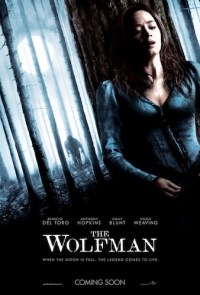 The “extended director’s cut” (as the Blu-ray blurb describes it) of The Wolfman begins with a new CG’d version of Universal’s classic ’30s/’40s logo, the one that I’m sure opened many/most/all of their beloved classic horror movies. As well as being a self consciously cool opening shot, it’s a succinct way for director Joe Johnston to signal his intentions: this is not your modern whizzbang horror movie, but something more classically inspired.
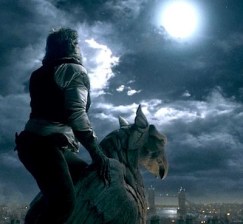 — perhaps even the totality — or plot developments and, particularly, twists are guessable far in advance. Trying to lose 16 minutes for the theatrical cut was probably a good idea, though some of my favourite moments lie amongst what was excised.
 feels like something I saw in some 12A blockbuster in the last half decade.
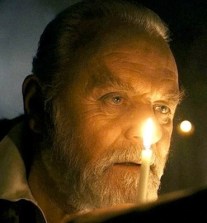 Max Von Sydow’s cameo-sized role (only found in the extended cut) is possibly the film’s best bit. Aside from the fact he’s usually good value, the relevance of the scene itself is unclear. That might sound like a problem, but I choose to see it as making the sequence — and the character — rather intriguing. The rest of the supporting cast are largely British faces recognisable from TV and similarly-sized film roles, playing the parts you’d expect them to and existing primarily as monster ready-meals. Equally, Danny Elfman’s score is disappointingly generic and clichéd, particularly so whenever the film is being the same.
 100Films.co.uk