Before Midnight (2013)

2018 #205
Richard Linklater | 109 mins | Blu-ray | 1.85:1 | USA & Greece / English | 15 / R

Before Midnight

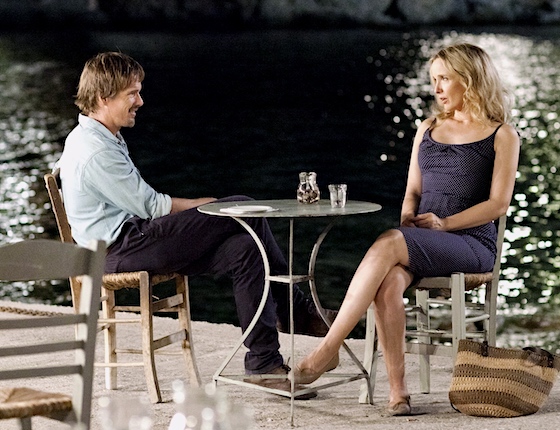
The third film in co-writer/director Richard Linklater’s Before trilogy catches up with couple Celine (Julie Delpy, also a co-writer) and Jesse (Ethan Hawke, the third co-writer) in middle age, after years of being together, with two kids (plus his kid from a previous relationship) and a host of problems bubbling under the surface.

Linklater got a lot of attention for shooting coming-of-age drama Boyhood in real-time over 12 years, but for my money he’s used a similar technique to much better effect in this trilogy. It’s a different way of handling it, of course: Boyhood was filmed across all 12 of those years, following the characters closely as they grow and change; whereas the Before films drop us in for a crucial few hours once every nine years, thereby offering a more concentrated experience of time on screen, but covering so much more in what’s discussed and implied about the time in between our visits.

The first two films — 1995’s Before Sunrise and 2004’s Before Sunset — are marked by an unreserved romanticism. Midnight is notably different, abandoning that lovey-dovey-ness and replacing it with a powerful examination of the tension in a long-term relationship. In some respects, it’s all the better for it. That’s in no way a criticism of the previous films (I still think Sunrise is first among equals), but it’s realistic that, as time goes on, people change. They can’t be young-spirited and full of the joys of first love forever. Well, they could, but it wouldn’t be life and relationships as most of us know it.

Jesse and Celine

Their interpersonal turmoil is all the more affecting because we’ve connected with these characters on and off in real-time for a couple of decades. Consequently, I can’t remember the last time I went on such an emotional rollercoaster. It’s not just realistic, but brave, to choose to swing the film in such a quarrelsome direction, rather than just show them rekindle old passions (again). It leads to an entirely different effect: the first two leave you feeling warm and fuzzy; this is more like being punched in the gut. And yet I wouldn’t have it any other way. Rather than feeling out of place when put next to its forebears, Midnight feels like a necessary addition.

My original reviews of Sunrise and Sunset from 2007 (linked earlier) are both marked as 4 out of 5, but I don’t stand by that. I watched them again before Midnight and would unequivocally give them each 5 stars. I wouldn’t want anyone to read all three reviews and think I’m rating Midnight as better than its predecessors. As a trilogy, they’re all almost equally good. I say “almost” because the hard-hitting emotional realism of this one is kinda depressing, while the unabashed romanticism of the first two is lovely. Maybe how you are as a person dictates which of those ends of the spectrum you prefer, because the dramatic shift in tone does not presage a shift in quality. Put another way, on a qualitative level I think they’re all 5s, but I love the first two that bit more because they’re nicer… but perhaps less real. Either way, together they are one of the greatest trilogies ever made.

I really hope they do a fourth one, though. Maybe it’s just because I want to spend more time with these characters, but I also feel a little that the series might need balance. As I’ve said, the first two are so of a piece, the third isn’t, so perhaps there’s room for one more ‘act’ to even that up. Or, hey, why not just make another one every nine years until the inevitable? (Now I’m just getting greedy.) Ethan Hawke has observed that Sunrise begins with Celine and Jesse watching a couple in their 40s arguing and Midnight is about Celine and Jesse as a couple in their 40s arguing, so maybe it’s an apt place to stop. But he also says that all it takes is for one of them to have an idea that excites the other two and they’d do it again, so perhaps we can look forward to Before Midday in 2022 after all.

5 out of 5

Before Midnight placed 2nd on my list of The 26 Best Films I Saw in 2018.

Love on a Leash (2011)

2020 #173
Fen Tian | 86 mins | digital (SD) | 16:9 | USA / English

Love on a Leash

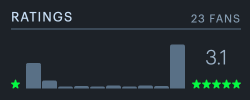
Love on a Leash first gained a degree of notoriety when some YouTuber happened upon it on Amazon Prime and made a video about it, in which he instructed his followers to rate it 10-out-of-10 on IMDb. Enough of them did that it apparently resulted in his account being banned. (At time of writing, it has a score of 9.2 from almost 6,500 ratings.) I came across it more recently on Letterboxd, where it was featured on a list of divisive films. You only have to look at its ratings spread to see why:

Love on a Leash Letterboxd ratings

Are the 1,504 people who’ve rated it 5 stars in on the same joke as those YouTuber’s fans who rated it 10 on IMDb? Or is there in fact something to this movie that makes some people think “this is worth full marks”? You might be surprised to learn that, actually, I think it’s the latter.

The film tells the story of Prince, a golden retriever who is actually a man turned into a dog (and whose human name may have been Alvin Flang. Or maybe not — I feel like the dog is an unreliable narrator). How has this happened? Why? Who knows? Who cares? (The film has a lot of random shots of ducks for no obvious reason (it’s almost Lynchian), so my guess is they did it to him. Still don’t know why, though.) Prince learns (from a magic rock-pool) that he can only return to human form by finding the true love of a woman. Enter unlucky-in-love shopgirl Lisa (Jana Camp), who meets Prince in a park and eventually takes him home. What unfolds is not as straightforward as the Beauty and the Beast narrative you might imagine, but to describe any more of the craziness would be to ruin half the fun. The plot’s constant twists and developments beggar belief — it’s genuinely imaginative, in its own way. By which I mean I don’t think you’ll have ever seen anything else quite like this.

Pizza-faced cinder block and Alvin Flang

I give full credit to Love on a Leash for just going for it. It’s hard to pigeonhole what genre it was even aiming for. The poster and basic concept suggest a cheesy kids’ film or Hallmark movie; the way it initially plays, you kinda assume it wants to be a romcom; but then it gets so fucking dark (suicide attempt! abusive coworkers! dead dog!), and there’s so much fantastical strange stuff… it’s so much weirder, wilder, and more unique than you can imagine. That’s without even mentioning the bizarre production quirks, like the fact Lisa only wears green clothes and lives in a green house with a green phone and green mugs and green plates… Or that it’s shot with a kind of documentary realism… um, maybe; or maybe it was just done quickly on digital video. There’s definitely no music, though. Like, at all. Even though there’s a composer credited.

Well, except for a couple of songs the dog sings. Prince is constantly chatting away to himself in voiceover, and sometimes sings little childish ditties too (I suspect they weren’t actually composed by anyone). He can be a right snarky little bugger (he describes the love of his life as a “pizza-faced cinder block”), to the point that I suspect it may all have been improvised by the voice actor in post-production — he seems to be taking the piss out of what’s going on as often as we are.

Love on a Leash was written and directed by Fen Tian, a 64-year-old Chinese woman who came to America in her 40s “with fifty dollars in her pocket, and not one word of English in her possession,” according to her production bio. It asserts that the screenplay won an award and funding from the Taiwan government, and at one point she took an American cast and crew to China to shoot it but funding fell through. After decades of trying, the film was eventually produced “with barely enough money to cover craft services”, and during post-production she “slept on the couches of her editors, dragging around her blanket, toothbrush, pillow and thirty-nine DV cam reels” and “spoiled” her team by “cooking up huge feasts of homemade Chinese food, and fixing her crew’s love lives with a motherly heart and some Chinese wisdom.” I feel like this deserves a Disaster Artist-type biopic…

What people get up to in the privacy of their own homes...

So, we come to the issue I touched on at the start: how do you rate a film like this? As an exercise in moviemaking, it’s a 1. The storyline is borderline nonsensical; it’s shot like an amateur using a camcorder for the first time; the sound mix is so unfinished I’m not sure it was ever started… And yet it’s constantly enjoyable, partly through a “so bad it’s good” hilarity (see the aforementioned terrible filmmaking), but also for the barminess with which it conducts itself, the relentless forward momentum of the storyline leading us in unpredictable narrative directions. Like famous cult favourite The Room, it transcends its amateur awfulness to be an artistic experience all of its own. In fact, it achieves a higher level of genuine artistry than The Room for me, because Wisseau’s film sometimes mires itself in wannabe-seriousness and runs out of stuff to laugh at, whereas Love on a Leash is restless in its creativity and consequently almost non-stop entertaining. It transcends its obvious awfulness through a kind of perverse innovation; a commitment to not hewing to any recognisable conventions. And it’s really funny — sometimes deliberately, often not.

With reservations duly noted, then, I honestly and unequivocally give Love on a Leash full marks.

5 out of 5

The 100-Week Roundup X

These 100-week roundups are a clearing house for reviews I haven’t got round to writing up 100 weeks (i.e. almost two years) after I actually watched the films in question. As I mentioned in my August review, I’ve recently fallen behind even on that, so the 100-week moniker isn’t technically accurate right now. Hopefully I’ll catch up soon.

This time, we have a motley bunch from September 2018: two one-star films that made my “worst of year” list; and two four-star films, one of which made my “best of year” list. They are…

  • Lost in Space (1998)
  • Skyline (2010)
  • April and the Extraordinary World (2015)
  • I Kill Giants (2018)


    Lost in Space
    (1998)

    2018 #189
    Stephen Hopkins | 125 mins | digital (HD) | 2.39:1 | USA / English | PG / PG-13

    Lost in Space

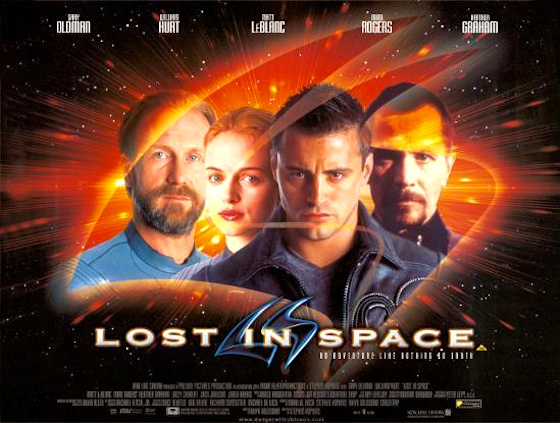
    I remember this reboot of the classic ’60s sci-fi series being received very poorly indeed when it came out in 1998; and so, even though I was a young sci-fi nut at the time, I didn’t bother to see it — and then spent the next 20 years not bothering to see it. But with the recent re-reboot on Netflix going down rather well, I thought maybe it was time to see for myself. I shouldn’t have bothered — it’s truly terrible.

    It gets off on the wrong foot, starting with a load of over-ambitious CGI, and that continues unabated throughout the entire movie. Anyone who moans about the quality of CGI in modern blockbusters should be made to watch this so they can understand what they’re complaining about. Maybe it looked ok back in ’98, I can’t remember (I suspect not), but watched now it looks like an old computer game, never mind an old movie.

    Poor effects can be forgiven if the film itself is any good, but the opening action scene is both fundamentally needless and stuffed to bursting with cliches, and the rest of the film is no better — just nonstop bad designs, bad dialogue, bad ideas, more bad CGI… Even the end credits are painful, playing like a spoof of the worst excesses of the ’90s, from the trippy “look what our computer graphics program can do” visuals to the dance-remix-with-dialogue-samples version of the theme.

    So, it turns out the critics at the time were right. I have seen even worse movies in my time, but there aren’t many merits here — there’s one effect that is well realised, at least. But that doesn’t come close to justifying the film, or for anyone to waste their time watching it. It really is very, very bad.

    1 out of 5

    Lost in Space featured on my list of The Five Worst Films I Saw For the First Time in 2018.

    Skyline
    (2010)

    2018 #190
    The Brothers Strause | 93 mins | digital (HD) | 2.35:1 | USA / English | 15 / PG-13

    Skyline

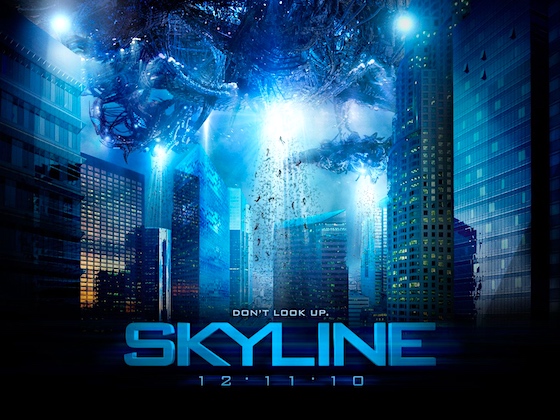
    In a Cloverfield-esque setup, a bunch of young people awaken from a boozy party to discover an Independence Day-esque alien invasion happening outside their window. What follows just feels like familiar parts from even more movies Frankensteined together in a failed attempt to produce something original.

    In terms of overall quality, it’s like a direct-to-Syfy movie granted a minor-blockbuster effects budget. Goodness knows how it landed a cinema release. The directors were visual effects artists who, based on their IMDb credits, moved into directing music videos before springboarding into film directing with Aliens vs Predator: Requiem, the sequel to the much maligned AVP that, shockingly, managed to be even worse. Skyline was their second feature — and, in a seemingly-rare bit of justice for directors making shitty blockbusters, their last (they’ve gone back to effects, where they continue to have a long list of high-profile credits). They completely financed Skyline themselves, forking out just $500,000 for the shoot before spending $10 million on the effects. It couldn’t be any clearer where their priorities were…

    And it feels like a film made by VFX artists. For one thing, one of the main characters is a VFX artist. He lives in a swanky apartment, with a hot wife and a hot mistress, drives a Ferrari and owns a yacht. Either this is extremely obvious wish fulfilment, or at one point VFX guys were doing very well indeed. (Considering there was that whole thing a few years back about major VFX companies shutting down, either this was made before the bubble burst, or some were able to weather the storm to a sickening degree. Or, like I said, it’s wish fulfilment.) Aside from that, it’s like a CGI showcase. Everything’s shot handheld, all the better to show off how realistically the CGI’s been integrated. The screenplay puts in no effort, with thinly sketched characters and a flat, uninspired storyline that rips off other movies with abandon, runs on a shortage of logic, features weak world-building with inconsistent rules, and seems to just… keep… going… until, after you think it’s definitely over this time, there’s yet another scene: a mind-bendingly gross and laughable finale.

    And yet, years later, someone made a sequel! I’ve even heard it recommended (though it has a lowly 5.3 on IMDb). Someday, I’ll have to see…

    1 out of 5

    Skyline featured on my list of The Five Worst Films I Saw For the First Time in 2018.

    April and the Extraordinary World
    (2015)

    aka Avril et le monde truqué

    2018 #191
    Christian Desmares & Franck Ekinci | 102 mins | digital (HD) | 1.85:1 | France, Belgium & Canada / French | PG / PG

    April and the Extraordinary World

    This French animation is an alternate-history steampunk adventure that follows orphan April (voiced by Marion Cotillard in the original audio) as she investigates a decades-long spate of missing scientists, including her own parents.

    The tone is one of pulp adventure, which is right up my street, and consequently I found the film a lot of fun. It’s a great adventure, abundant with imaginative sci-fi/fantasy ideas, engaging characters, and laced with humour. The independent French production means it’s not beholden to Hollywood homogenisation — there’s some very dark stuff in the world-building details, which contrasts somewhat with the light adventure tone of the actual plot, and some viewers may find this spread of tones problematic. More of an issue for me came when, a while in, the plot heads off into barmy sci-fi territory. No spoilers, but it wasn’t quite what I was expecting from the original premise. But this is perhaps more an issue of expectation than actuality — it wasn’t severe enough to lose me, just take the shine off something that was otherwise headed for perfection; and, as I adjusted to where the story was going, I enjoyed it more again.

    Resolutely unproblematic is the visual style. The design and animation, inspired by the works of comic book artist Jacques Tardi, are absolutely gorgeous — like a ligne claire comic sprung to life. When US animations try to ape an artist’s style, it often winds up as a movie-ised imitation — at best you can recognise the inspiration, but it’s still been filtered and reinterpreted (cf. Batman: The Dark Knight Returns). But this is like the panels just started moving, with full fluidity (none of the “jerkily moving between static poses” you sometimes get with cheaply-done modern animation). That applies to character animation as much as anything, but the wildly imaginative steampunk alternate history allows the designers and animators to really cut loose, with a fabulously invented world.

    Put alongside the likes of Long Way North and The Secret of Kells, it’s a reminder that we should look further afield than the US and Japan for great animation.

    4 out of 5

    April and the Extraordinary World placed 26th on my list of The Best Films I Saw in 2018.

    I Kill Giants
    (2018)

    2018 #193
    Anders Walter | 106 mins | digital (HD) | 2.39:1 | Belgium, UK, USA & China / English | 12 / PG-13

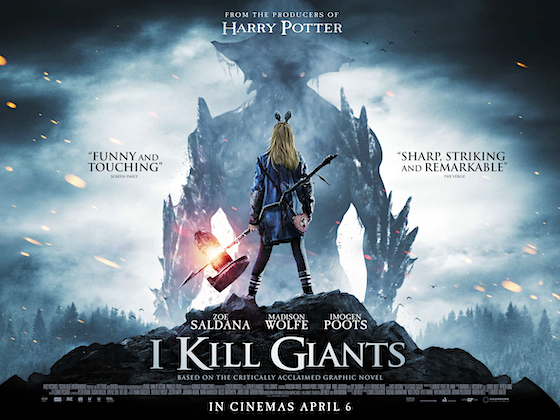
    I Kill Giants

    The past few years have seen a random, unexpected mini-genre pop up: dramas about Serious Issues where the protagonists also have something to do with giant monsters. I’m not talking about Pacific Rim or Godzilla, but movies where the monsters are either imaginary or in some other way analogous to the very real problems experienced by the characters. Films like A Monster Calls, about a teenage boy coping with impending bereavement, or Colossal, in which Anne Hathaway discovers she’s controlling a giant monster that keeps appearing (and which kept its big issue a secret in the marketing, so I will too). I don’t know if there’s really enough of these to call it a “genre”, but three films in as many years that fit roughly in that very specific bucket strikes me as a lot; and I watched all three in the span of a few months, just to emphasise the point.

    Anyway, the latest entry in this genre I may’ve just invented is I Kill Giants. Based on a graphic novel by Joe Kelly (who also penned this adaptation) and J.M. Ken Niimura, it’s about American schoolgirl Barbara (Madison Wolfe) who believes giants are coming to attack her hometown and she’s the only one prepared to fight them. Whether these giants are real or just an outward expression of an inner conflict is, of course, why this ties in with the other films I mentioned.

    There’s plenty of stuff I liked a lot in I Kill Giants. The female focus. The power of friendship, and of small acts of kindness. The acceptance of being a bit different and an outsider, within reason. The magical realism in its handling of the giants. Unfortunately, it takes a bit too long to get to its conclusion — it’s not exactly repetitive, but there is some running on the spot. When the finale comes, it’s an effective twist. I’d guessed many of the reveals, and I think the film definitely expects you to guess at least one (which it then wrong-foots you about). But narrative trickery isn’t really the point. It’s impossible to discuss which other film it’s most similar to without spoilers, but the other one dealt with certain stuff better due to being upfront about it, rather than lacking it all into the final ten minutes. That’s the ending’s biggest flaw: that another film did fundamentally the same thing recently and, overall, better. That’s not the film’s fault.

    Not a perfect film, then, but it has a lot to commend it. Just be aware it’s one where the journey is more rewarding than the destination.

    4 out of 5

  • Ready or Not (2019)

    2020 #90
    Matt Bettinelli-Olpin & Tyler Gillett | 95 mins | streaming (HD) | 2.39:1 | USA & Canada / English | 18 / R

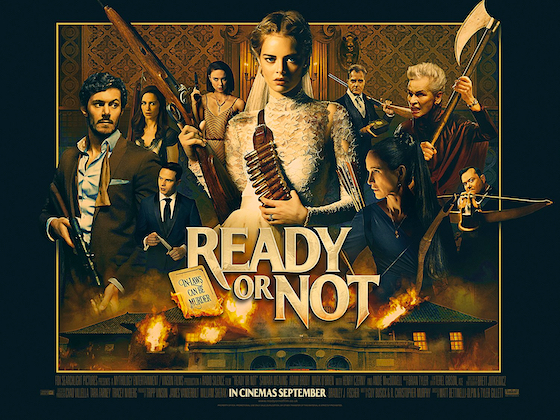
    Ready or Not

    In my review of Get Out, I took issue with the fact that some people labelled it a “comedy horror”, because it wasn’t particularly funny. I mention that because Ready or Not takes a broadly similar premise to Get Out (albeit with white people and no commentary on racial issues) but does take things in a comedic direction.

    The similarity comes in that it’s about bride-to-be Grace (Samara Weaving) meeting her fiancé’s family for the first time at their wedding. On the wedding night, she’s introduced to an odd family ritual: she must select a card from a puzzle box and they play whatever game is on the card. Unfortunately for her, Grace gets “hide and seek”, which in this case is not just regular hide and seek: while she hides, the family arm themselves to hunt and kill her. Hilarity ensues.

    Badass bride

    Well, okay, maybe not hilarity per se, but this is definitely a comedy-horror, with more laughs than scares and an appropriate amount of gore. It obviously owes a debt to other movies, or at least has points of similarity (You’re Next particularly comes to mind), but it also has a few nice subversions and doesn’t always go the way you’d think — and when it subverts things that have already been subverted, like some kind of triple-cross of subversion, then you know it’s not as dumb a movie as some people think. Its biggest failing for me was the photography, too much of which is caked in over-graded green. The final shot is fab, though; indeed, the whole climax is an all-timer.

    There were times I wanted a bit more from Ready or Not to push it over into classic status, but even without that final extra something, if you enjoy your horror-thrillers laced with laughs, it’s an exceptionally fun time.

    4 out of 5

    Ready or Not is available on Sky Cinema and Now TV from today.

    Venom (2018)

    2020 #181
    Ruben Fleischer | 112 mins | Blu-ray (UHD) | 2.40:1 | USA & China / English | 15 / PG-13

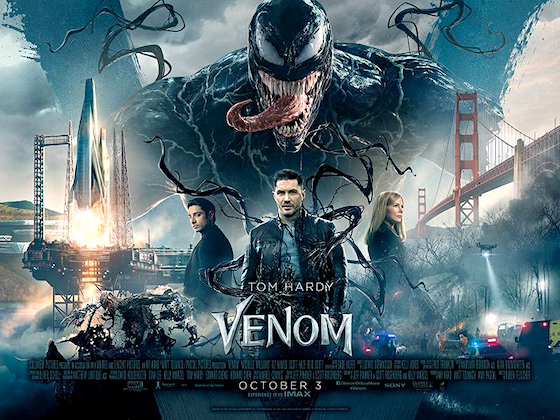
    Venom

    The fad for shared universes, provoked by the success of the MCU, seems to be dying off: the Dark Universe, the DC Extended Universe, Fox’s X-Men films, the MonsterVerse, sundry others most of us can’t even remember — they all either died a quick, brutal death, or circumstances have wiped them out. Even those that are ongoing have either abandoned close interconnectedness (like the DCEU) or don’t have long-term plans (the MonsterVerse, which has nothing announced beyond Godzilla vs. Kong). The MCU still seems to be going strong (although we haven’t actually had a new MCU movie in over a year now, so who knows what the future will hold?), but other than that? Everyone seems to have realised the formula is impossible (or too much hard work) to replicate.

    The exception lies in Sony’s desire to launch a superhero universe out of the one character whose rights they own: Spider-Man. It started when they abandoned Spider-Man 4 to go the reboot route with The Amazing Spider-Man, the sequel to which teased all sorts of stuff to come, some of which was announced. Those movies’ failure to live up to their titles (i.e. they were not amazing, in any respect) saw such plans cancelled, but it seems Sony don’t give up so easily — even after they loaned out Spider-Man himself to the MCU, moves to form their own universe have continued.

    Which is what brings us to Venom. For those not in the know, he started life as a Spider-Man villain (if you’re not a comic book reader, you’re most likely to know him from his appearance in Spider-Man 3, a move forced by the studio that contributed to the film’s relative failure), but he later became an anti-hero in his own right, which positions him quite nicely for Sony’s first actually-filmed-and-released foray into a shared Spidey universe. (A lot of the other Spider-Man characters they own the rights to are villains, though after the success of Joker I guess they’ll feel emboldened to attempt villain-centred films.) And, to the surprise of some, Venom earnt over $850 million at the global box office, making it the 7th highest grossing film of 2018. Sony’s Spider-Man-universe-without-Spider-Man is definitely underway (there’s a sequel due next year, alongside other Spidey-related films both ready for release and in active development).

    Venomous

    But enough about future plans, because perhaps one reason Venom has been such a success at launching a new universe is that it didn’t try too hard. Unlike The Mummy or Batman v Superman, this isn’t a film bogged down with characters and references designed to tee-up future spin-offs. It’s an entirely standalone adventure, in which struggling journalist Eddie Brock (Tom Hardy) bonds with an alien symbiote that can take over his body and do powerful things. The alien is one of several brought to Earth by the explorations of Elon Musk-esque tech billionaire Carlton Drake (Riz Ahmed). In the mould of many an overconfident movie scientist before him, Drake hasn’t bargained on the aliens having their own agenda — to invade Earth and eat the populace, i.e. us. But for some reason Brock’s alien, Venom, takes a liking to the planet and vows to protect it.

    It takes the movie quite a while to get to that point, mind. Sorry if you were wary of spoilers, but, I mean, it’s hardly a surprise that (a) a race of aliens that look like Venom are going to turn out to have vicious motives, and (b) the titular character is going to turn out to be a good guy who wants to save us. There’s certainly a place for slow-burn movies that take their time to get to the point or to reveal the monster, but I’m not sure a summer superhero blockbuster is one of them. While Venom isn’t exactly boring until Venom turns up, it does feel like we’re going through motions until we get to what we’ve come for, i.e. a crazy powerful alien kicking ass and biting off heads.

    It feels further unbalanced because Venom is actually quite short. You might’ve clocked the 112 minute (aka 1 hour 52 minutes) running time and thought that sounded pretty reasonable (even if nowadays most blockbusters are well over 2 hours), but the actual content of the movie runs only a little over an hour-and-a-half, topped up by a long credits scroll and a lengthy post-credit promo clip for Into the Spider-Verse. (I can see why they included that in cinemas, but leaving it in the home release feels unnecessary. Apparently it’s cut from some digital versions.) According to IMDb, Hardy has said that half-an-hour or so was cut from the film, including his favourite sequences. Why those cuts were made and what exactly went, I don’t know, but even in the released version it feels like they could’ve slimmed down the first 50 minutes and put in more of Venom himself.

    Note the lack of Venom

    Partly this is the plot suffering from having to be an origin story, with all the usual issues that brings: a lot of time spent on setup; a villain who’s sidelined for the bigger point of Eddie and Venom finally coming together. Once it reaches that point, it’s allowed to indulge in the barminess of the character and the situation a little. All while playing safely within a PG-13 box, of course. Venom is kind of a ’90s teenager’s idea of what it means to be edgy and dark, and by staying faithful to that the film version consequently feels quite like an early-’00s superhero movie. There’s even an Eminem theme song. It reminds you how far superhero movies have come, though. I mean, they were hardly held in the highest esteem back then (aside from breakout examples, like the first couple of X-Men and Spider-Man movies), and it’s not just time that has changed attitudes but also developments in how they present themselves. But now, that it’s a bit of a throwback is part of Venom‘s charm — or another reason to dismiss it, if there’s no nostalgia in that for you.

    Certainly, the cast are all better than this. Sometimes that elevates it — Hardy is having a ball talking to himself and doing random shit like climbing in lobster tanks — but other times it feels like people are here for a payday. Riz Ahmed’s character arc is gradually whittled down to nothing, replaced by a CGI monster. And what made four-time Oscar nominee Michelle Williams decide this was a part worth her time? (Turns out the answer is “the chance to work with Tom Hardy.” But I’m sure the cheque didn’t hurt either.) Hardy has spoken a few times about how he wanted to make a movie his son could actually see. A superhero movie seems a good shout for that but I don’t know that Venom was the right pick. The film is clearly aiming for a PG-13 (there’s only one “fuck”; it’s not particularly gory), but the horror sequences and violence were enough to push it up to a 15 over here. And that’s probably fair — there are twisted and broken bodies (even if they then fix themselves), and several instances of biting off heads (it’s not shown in graphic detail, but we’re fully aware that’s what’s happening).

    Real mature

    All things considered, I wasn’t sure what I thought of Venom. It’s kind of fun, in a juvenile way (juvenile like teenagers who think violence and edgy dialogue is “grown up”). But it’s also kind of rubbish in places, in part because it can be so juvenile (juvenile like… yeah, same again). There’s a chance it’ll tee-up a superior sequel — with the origin stuff out of the way, hopefully we can expect a more original storyline; and, as it was such a hit, maybe that’ll allow the filmmakers leeway to go even barmier. For one thing, a brief sequel tease suggests Woody Harrelson is all ready to Woody Harrelson it up. Until then, I guess this’ll do as a crazy placeholder.

    3 out of 5

    Venom is available on Netflix in the UK from today.

    Yes, God, Yes (2019)

    2020 #191
    Karen Maine | 78 mins | digital (HD) | 1.85:1 | USA / English | 15 / R

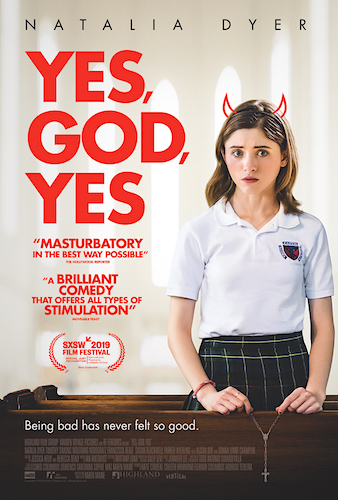
    Yes, God, Yes

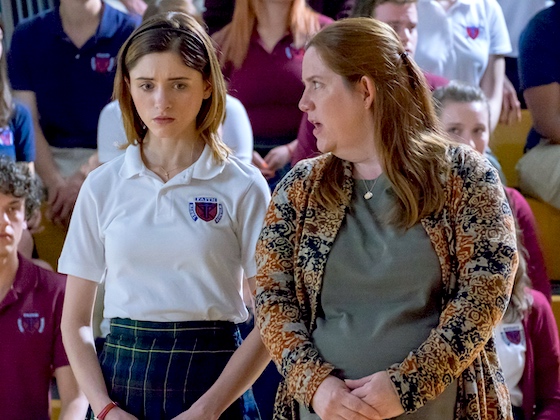
    It’s the early 2000s, and Alice (Stranger Things’ Natalia Dyer) is a pupil at an ultra-Christian high school (“in America” goes without saying there, right?) But Alice is feeling conflicted. In morality class, she’s being taught about the wrongs of sex, while at home she likes to rewind the Titanic VHS to rewatch the sex scene. One day, a chat on AOL turns naughty, and Alice finds herself putting her hand down her skirt and… well… Of course, for a good indoctrinated little Christian girl, access to pleasure is not an instant revelation, and soon she’s off to her school’s weekend camp to learn to connect with Jesus, or something. Instead, she’ll learn a little something about the hypocrisy of those around her.

    It would be easy to label Yes, God, Yes a “cumming of age movie” (such a pun is certainly not below my level of humour), but it would feel slightly inaccurate. Put another way, if you’ve come to see Nancy Wheeler cum, you’ll be disappointed. There is, perhaps, a whole analysis of the film to be written from the starting point that Alice doesn’t seem to reach orgasm — I mean, the film already (comically) touches on the difference between men and women in this regard; but also, Alice only needs to touch herself to feel sinful and transgressive, so how would she feel if she got ‘all the way’? But I am not necessarily best placed to write such an analysis of the depiction of female self-pleasure. It could be as simple as the fact the film has a female writer-director and didn’t want to show that moment on screen, for any number of reasons.

    A touching moment

    Indeed, despite it providing the plot hook and title, wanking is only one part of the film’s exposure of religious hypocrisy when it comes to sex. Alice’s desire to go to camp is as much provoked by a nasty rumour doing the rounds at school as it is by her personal discoveries. Said rumour is that, at a party, Alice “tossed the salad” of a classmate. She has no idea what this means; everyone else seems to know (if you don’t know either, don’t worry, the film has a dictionary definition at the start). Alice may go to an ultra-conservative school that teaches repressive values, but it’s clear her classmates are still learning about the wider world from elsewhere, while she believes everything she’s being taught and remains naïve. Ironically, the camp does teach her something about herself, just not what was intended. It’s the realisation of Christianity’s hypocrisy, more so than of the power of touching herself, that prompts Alice’s personal development by the end of the film.

    Throughout all this personal revelation, the film leans heavily on Natalia Dyer’s ability to convey confused inner thoughts with just her face, and fortunately she’s up to the task. Indeed, it feels like overkill on the handful of occasions when it resorts to underlining a point via a kind of flashback-audio. We get what Alice is thinking when she looks at a microwave, we don’t need the soundtrack to repeat the Father’s microwave/oven analogy. Nonetheless, such moments are relatively rare, and instead we’re left to identify with the shy, wary, quiet Alice — something I’m sure a lot of us can relate to from our own adolescence. And if your own adolescence occurred around the turn of the millennium, boy does this film have you pinned down: playing Snake on a Nokia phone; AOL chatrooms… Small incidental details that very much specify the time (and place — AOL wasn’t such a thing here in the UK, but we had our alternatives).

    Christian 'teaching'

    I’m surprised I’ve managed to get this far in the review without calling up Saved!, a film to which Yes, God, Yes bears more than a passing resemblance. For those who’ve not seen it (why not? It was on my list of 100 Favourites over four years ago!), Saved is about a girl at an ultra-Christian high school in the early ’00s who discovers religious hypocrisy after a sex-related revelation. Both films criticise that hypocrisy through humour and satire. The main difference is that Saved is an outright comedy, whereas Yes, God, Yes is a comedy-drama, where its laughs come more from wry observations grounded in real-life rather than outright comedic bits, which is perhaps the result of it being semi-autobiographical by writer-director Karen Maine. Others have compared it to Lady Bird, another semi-autobiographical early-’00s-set coming-of-age drama about a girl at a Christian high school, including her first experiences with sex.
    But let’s not lean too heavily on the fact there have been other films a bit like this, because Yes, God, Yes is still its own beast — more grounded than Saved; hornier than Lady Bird. If it seems more focused, or even niche, than some other coming-of-age movies, is that a bad thing? Part of the point about recent calls to enable more women and people of colour to make films is that we get to hear new stories and different perspectives, and Yes, God, Yes is an example of exactly that.

    4 out of 5

    Yes, God, Yes is available to rent and buy digitally in the UK as of yesterday.

    Jumanji: The Next Level (2019)

    2020 #78
    Jake Kasdan | 123 mins | digital (UHD) | 2.39:1 | USA / English | 12 / PG-13

    Jumanji: The Next Level

    The previous Jumanji movie, Welcome to the Jungle, was officially a sequel to the 1995 original. In practice, however, that amounted to little more than a brief nod / tribute to original star Robin Williams, and maybe a few Easter eggs scattered about. The Next Level, on the other hand, is much more in the traditional “direct followup” mould.

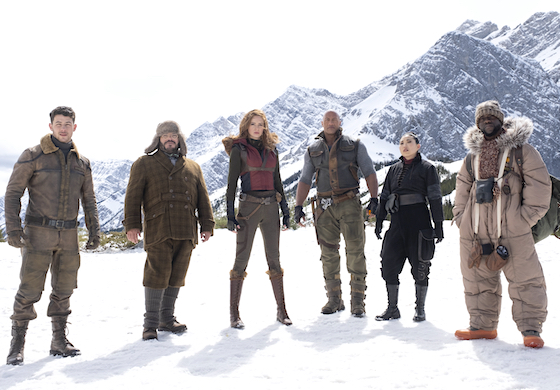
    Despite our quartet of heroes having destroyed the eponymous game at the end of the last movie, one of them rescued and repaired it, and when he goes back in (for old times’ sake or something) the others must follow to rescue him. But he’s not repaired it properly, and so his septuagenarian grandfather and his chum are sucked in too, and everyone’s inhabiting a different character. And so The Next Level plays with a lot of the same comedic ideas as its predecessor — i.e. the mismatch between real-life person and in-game persona — but mixes up who’s imitating who. Primarily, this means The Rock gets to do an impression of Danny DeVito, Kevin Hart is being Danny Glover, and Jack Black is a black American football player. Karen Gillan doesn’t immediately get to join in the fun, but the film has some tricks up its sleeve. Anyway, once in the game, they head off on an Indiana Jones-type adventure — again, much like the first movie.

    For many, this repetition of ideas has been a stumbling block. “The same but slightly different” doesn’t really cut it for a sequel nowadays, when you can easily rewatch the thing it’s repeating. However, I don’t think The Next Level is actually such a slavish clone. The “mismatched identities” schtick arguably worked better the first time, when it was a shiny new gag, but the fact most of the cast get to play at being someone else keeps it at least a bit fresh. There are also several new characters in the mix, with an especially entertaining performance from Awkwafina. More importantly, the adventure itself is considerably different. In my review of Welcome to the Jungle I noted that its locales were “jungle, jungle, and jungle”. Here, we get snowy mountains, vast desert, plus towns and castles. To me, it feels like they took what worked in the first movie and polished it. It’s still fundamentally the same kind of comedy action-adventure — if you disliked the first movie, there’s no reason this should appeal to you more — but refined.

    Snow wonder it's better

    That said, there’s still ideas left on the table. That game malfunctioning only affects who gets zapped in and which characters they play, but what if it kept glitching throughout? It’s arguably a tricky conceit to manage — if you’re going to do it, you’ve got to integrate it; but you can’t really have our heroes winning (or losing) thanks to random mistakes. But this is why Hollywood filmmakers get paid the big bucks, right? To solve these kind of things. Do it right and the glitches could’ve added an extra zing, either to the humour or as an obstacle to winning or, ideally, both. (Also, on a slightly more personal level, I think it’s a shame they didn’t release it on 3D Blu-ray this time. It was released theatrically in 3D, so a conversion exists, but they didn’t bother to put it on disc anywhere in the world. Adventure movies like this can look great in the format, and there’s a sequence with rope bridges that could’ve been really special.)

    I was surprised how much I liked Welcome to the Jungle, but I held back somewhat on the sequel because of the reactions I’d seen. As it is, I was surprised again, because I think The Next Level is an even more enjoyable adventure.

    There’s now a third (aka fourth, or you could even say fifth, depending what you count) Jumanji in development, which a credit scene here teases might go off in a new direction; plus cast and crew interviews have hinted at some other intriguing additions to the mythology that spin out of this movie. There’s no guarantee it’ll be a success, of course, but, nonetheless, next time I won’t be so reticent.

    4 out of 5

    Jumanji: The Next Level is available on Sky Cinema and Now TV from today.

    The 100-Week Roundup IX

    I’ve not been doing too well with reviews lately — this is my first for over a fortnight, having missed self-imposed deadlines for the likes of Knives Out (on Amazon Prime), The Peanut Butter Falcon (on Netflix), Joker (on Sky Cinema), and Spaceship Earth (on DVD & Blu-ray). I’ve also slipped on these 100-week updates — this one should really have been at the end of July, and there should’ve already been another in August, with a third due soon. Oh dear.

    So, it’s catchup time, and it begins with my final reviews from August 2018

  • The Most Unknown (2018)
  • Zorro (1975)


    The Most Unknown
    (2018)

    2018 #185
    Ian Cheney | 92 mins | digital (HD) | 2.35:1 | USA / English

    The Most Unknown

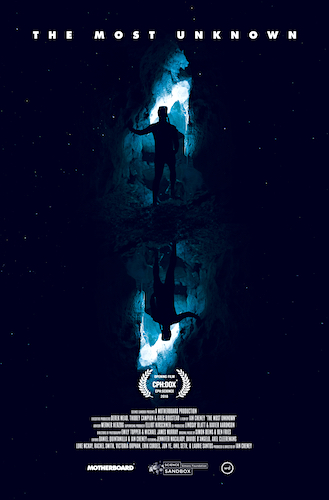
    This film is an experiment. Nine scientists meet for the first time in a chain of encounters around the world. It begins under a mountain, and ends on a monkey island.

    In this documentary, nine scientists working on some of the hardest problems across all fields (the “most unknowns”) meet each other in a daisy chain of one-on-one interviews / lab tours. It not only touches on the basics of what the unknowns they’re investigating are, but also how they go about investigating or discovering these things — the day-to-day realities of actually “doing” Science. Alongside that, it reveals the scientific mindset; what motivates them. The nine individuals are very different people working on very different problems in very different fields, but the film draws out the similarities in their natures that drive them to explore the unknown.

    If you’re concerned it might be all a bit “inside baseball” if you’re not a science geek, don’t be. These people work in vastly different fields — to us laypeople they’re all “scientists”, but to each other their specialities make them as different from one another as we are from them. This, arguably, is an insight in itself. It feels kind of obvious — of course a physicist and a microbiologist are completely different types of scientist — but I do think we have a tendency to lump all scientists together. Think of news reports: it’s not “chemists have discovered” or “psychologists have discovered”, it’s “scientists have discovered”.

    Science, innit

    It also reminds you that scientists are humans too, via little incidental details. For example, the equipment that vibrates samples to sheer out the DNA is labelled, “My name is Bond, James Bond. I like things shaken, not stirred.” Or the woman who plays Pokémon Go on her remote research island, because the lack of visitors means you find really good Pokémon there.

    You might also learn something about movies. The last scientist, a cognitive psychologist, talks about how people assess the quality of movies. Turns out, rather than considering their overall experience, they tend to focus on two points: the peak of how good it was, and how it ended. Pleasantly, this kinda confirms my long-held theory that an awful lot of movies are judged primarily on the quality of their third act. (My exception to this “rule” has always been films that lose you early on and put themselves on a hiding to nothing. Well, science can’t explain everything, I guess.)

    Plus, as a film, it’s beautifully shot. A lot of this science is taking place in extreme locations, which bring with them a beauty and wonder of their own.

    4 out of 5

    The Most Unknown is currently available on YouTube from its production company, split into nine instalments. (It used to be on Netflix, but was removed just the other day. If I’d published this review on time…)

    Zorro
    (1975)

    2018 #186
    Duccio Tessari | 118 mins | digital (HD) | 1.85:1 | Italy & France / English | PG / G

    Zorro

    This Italian-French version of the adventures of the famous masked vigilante (played by the great Alain Delon) is tonally similar to Richard Lester’s The Three Musketeers: genuine swashbuckling (including some elaborate stunt-filled sequences) mixed with plenty of humour and daftness. Plus, being set in 19th century California but filmed in Spain, it also has more than a dash of the Spaghetti Western in its DNA. The whole mix makes it a lot of fun.

    Of particular note is the final sword fight, an epic duel for the ages. It sees Zorro and chief villain Colonel Huerta pursue each other around the castle, clashing blades at every turn, at first accompanied by a crowd of spectators but, as their fight moves higher and higher, ending atop the bell tower, each with a rapier in one hand and a flaming torch in the other, thrashing their weapons at each other with all the vigour and vitriol of men who really, really want to kill each other.

    Another highlight is, arguably, the cheesy main theme. On the one hand it’s slathered all over the film inappropriately; on the other, it underlines the light, silly, comic tone. Plus it’s sung by someone called Oliver Onions. Can’t beat that.

    4 out of 5

  • Searching (2018)

    2019 #51
    Aneesh Chaganty | 102 mins | digital (HD) | 16:9 | USA & Russia / English |
    12 / PG-13

    Searching

    When his 16-year-old daughter Margot goes missing, David Kim (John Cho) does the most logical thing in this day and age: he turns to her computer and social media to try to work out where she’s gone. What Searching does to really sell this concept is place us inside the tech: everything we see takes place on the screen of computers, be it searching the internet, chasing leads via video chat, or compiling evidence in spreadsheets.

    It’s a conceit that is clearly innovative, but also feels like it has the potential to grow old fast. After all, it’s inherently limiting, and if the filmmakers tried to coast on the novelty factor, you’d probably grow bored within the first half-hour. Fortunately, Searching has more to offer. Indeed, long before you’ve had a chance to become fed up with the unique storytelling method, you’re absorbed in the narrative.

    It works on two fronts. There’s a degree of commentary on modern society and parent/child relationships, as David begins to discover all the things Margot has been hiding from him, realising he didn’t know his daughter as well as he thought he did. In some respects this is nothing new — we’ve had decades of films and TV dramas where parents discover their perfect little darling isn’t who they thought — but here it’s cannily updated for the social media era.

    Searching the web

    Secondly, it’s an engrossing mystery. Director Aneesh Chaganty uses the visual concept perfectly to help craft a storyline with compelling characters that keeps us thoroughly engaged. Pleasingly, the film never breaks its own rules, instead finding new ways to use the limitations to tell the story. The only possible misstep comes in the final act, when some developments begin to succumb to Movie Logic and get a bit grandiose for the previously-grounded film. But the array of twists here actually had me on the edge of my seat, and, really, what more do you want from a thriller than that?

    Searching is the kind of film you come to thanks to its USP, your interest piqued by seeing how they can tell a story under such limitations; but what makes you stay, and want to come back, is how well it tells that story. It’s not unconventional for the sake of it, but a new and very timely way of viewing a narrative.

    5 out of 5

    Searching is available on Netflix in the UK from today.

    It placed 6th on my list of The 15 Best Films I Saw For the First Time in 2019.

    The Last Black Man in San Francisco (2019)

    2020 #133
    Joe Talbot | 121 mins | digital (HD) | 1.66:1 | USA / English | 15 / R

    The Last Black Man in San Francisco

    The opening few minutes of The Last Black Man in San Francisco are some of the most visually extraordinary I remember seeing from a film in a while. Well, it begins with two men waiting at a bus stop, but when the bus doesn’t arrive… cinema happens. If the rest of the film had been terrible, I’d have been ok with watching it just to have seen that.

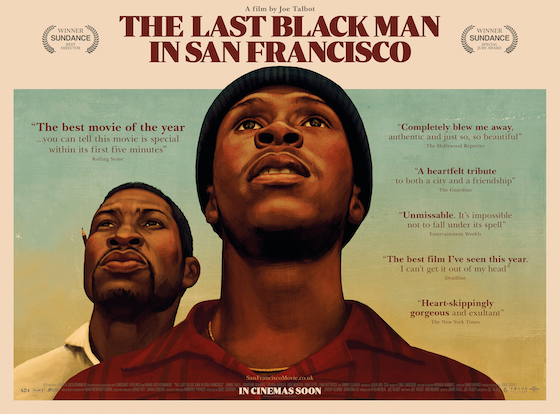
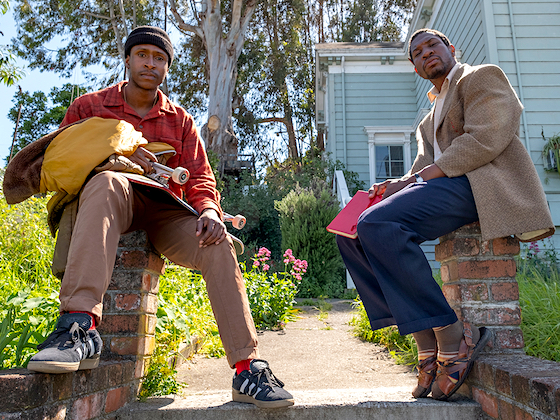
    Those two men at the bus stop are Jimmie Fails (played by Jimmie Fails, also co-writer, in a role I assume can’t be entirely autobiographical, but who knows) and his best friend Montgomery Allen (Jonathan Majors), an artist and writer who always has a pencil behind his ear, who’s always sketching or jotting. Every day, Jimmie and Mont visit the same old house in a gentrified neighbourhood of San Francisco, which Jimmie is obsessed with maintaining and restoring because he doesn’t think the current owners do a good enough job.

    Of course, the reason for Jimmie’s monomania is more complicated than “it’s a nice house”, but oh my, is it a nice house. In terms of “significant houses in 2019 movies”, a fair few people seemed to be in love with the one from Parasite, but give me this beautiful old mansion-like home any day. It even has a built-in organ! I mean, a built-in organ isn’t exactly high on my list of ‘wants’ in a house, but it’s kinda cool. (To be fair, based on the amount of upkeep Jimmie feels the house needs and that its owners shirk, I doubt I’d be up to the task of looking after such a place. But I’m not going to be buying one anyway, so it’s a nice little fantasy.)

    On the outside looking in

    But this isn’t property porn, and deep down Jimmie’s really looking for more than just this particular building. Other characters seem similarly at a loss. It’s likely important to note that writer-director Joe Talbot and Fails, who came up with the story together, are native San Franciscans who grew up together and discussed making the movie since they were teenagers. The film is not just about the changing face of San Francisco, but that’s definitely part of the mix. Indeed, I’m sure there are several readings of what Last Black Man is ‘about’. Another, related part of it is the black experience (I mean, there’s a clue in the title), including a street preacher bemoaning a hazardous cleanup operation; an acquaintance who lives in his car; Jimmie’s absentee father (played by the reliably excellent Rob Morgan, who you may recognise from all of Netflix’s Marvel series, and who has another small but key role in the just-released Greyhound); and a group of men who hang around outside Mont’s house, apparently with nothing better to do than argue with each other. The latter, in particular, have a key role to play in where the story ultimately goes.

    Another aspect is to do with the stories we tell ourselves about ourselves. Our past isn’t just a series of indisputable facts, but a mix of memories — which themselves are self-selected narratives — and stories we’ve been told by others and assumed into our identities, possibly giving them more significance than was intended. It’s this kind of mythologising that drives Jimmie, and it clashing with reality is part of the catalyst for the film’s resolution. As I said, events involving that group of guys outside Mont’s place (no spoilers!) also have a major part to play, but it again come round to the way our lives, and others’, are dictated by how we choose to tell our and their stories.

    Who tells your story?

    How this story is told is one of its strongest aspects. The cinematography by Adam Newport-Berra is extraordinary; not in a glaringly obvious “pretty colours” way, but exhibiting superb depth of field, framing, composition, movement… My knowledge is inadequate to convey the rich quality and wonder of the imagery he creates. It, literally, has to be seen. Several distinctive sequences are carved by his work combined with David Marks’ editing and Emile Mosseri’s score, which includes some well-aimed needle drops and remixes (it’s always great to hear Jefferson Airplane’s Somebody to Love, which is here rendered in a strikingly stripped-back form remixed by Mosseri).

    If I have one criticism it’s that it felt a little long, with some scenes seemingly superfluous, but I’m fully prepared to accept I may have just missed their point. And even with that, the total effect is enough to overcome any perceived longueurs. My score rounds up, then, because even if it’s not perfect (what is?), it’s very good overall, and several parts are truly exceptional.

    5 out of 5

    The Last Black Man in San Francisco is on Sky Cinema and Now TV from today. It placed 22nd on my list of The Best Films I Saw in 2020.