
Steven Spielberg | 107 mins | Blu-ray | 2.35:1 | USA & New Zealand / English | PG / PG
 1981: Steven Spielberg reads a French review of his movie Raiders of the Lost Ark. His high-school-level French serves him well enough, although there’s repeated use of one word he doesn’t know: Tintin.
25 years later: Spielberg has been struggling to make a film version of Hergé’s character for quarter of a century. While developing a live-action version that would feature actors under heavy prosthetics so as to resemble their comic book counterparts, he realises Tintin’s famous dog, Snowy, will need to be computer generated. He reaches out to Peter Jackson and Weta, fresh off their ground-breaking work on The Lord of the Rings. Their test footage is so successful, it gives Spielberg another idea…
2011: after 30 years, Spielberg finally brings the boy reporter to the big screen as a motion-captured animation. Reviews and public reception are mixed, particularly in the US, but they’re all daft because The Adventures of Tintin: The Secret of the Unicorn is bloody brilliant.
Combining events from three of Hergé’s original albums, the story sees Tintin (Jamie Bell) purchase a model ship that is highly desired by the mysterious Sakharine (Daniel Craig). A riddle hidden inside the model sets the ever-inquisitive reporter on a quest to find out what nefarious deeds Sakharine is planning, along the way bumping into drunkard Captain Haddock (Andy Serkis), who holds the key to the entire mystery. Cue a globetrotting adventure that, yes, is very much in the Indiana Jones mould.
 Apparently some Tintin purists weren’t so keen on the actual adaptation — elements of The Crab with the Golden Claws have been mixed in to a plot primarily taken from The Secret of the Unicorn, the sequel/second half of which, Red Rackham’s Treasure, is reportedly used sparingly. Plus, in the original tale Sakharine is a minor character who wasn’t responsible for much, apparently. As someone who’s only read one of those three volumes, and even then not since I was young, such things didn’t trouble me. What superstar screenwriters Steven “Doctor Who” Moffat, Edgar “Cornetto trilogy” Wright and Joe “Attack the Block” Cornish have captured is the spirit of Tintin: an engrossing mystery-adventure, laced with gentle satire and smidgens of slapstick comedy, but with real stakes and peril too.
A talented cast are up to the task. Bell adopts a posh-ish accent for the titular hero, and while some of the accusations of blandness aren’t wholly misplaced, he’s plucky and determined enough to make for an appealing lead. The king of mo-cap, Serkis, is able support as Haddock, while Craig makes for a very effective villain — I hope his post-Bond career, whenever that arrives, sees him playing villainous roles more often. Interestingly, it was his mannerisms that have survived the animation process the most. I mean it in an entirely non-critical way when I say every other character could have any actor behind the mo-cap baubles, but Sakharine’s face and body move with all the recognisable movements and expressions of his actor.
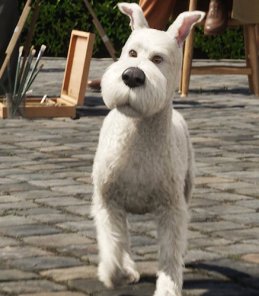 The slapstick is mainly hoisted by Simon Pegg and Nick Frost as the physically-identical Thomson and Thompson — a true advantage of animation, that. I imagine some find their parts tiresome because of their inherently comic role, but they’re likeable versions of the characters. Even more joyous is Snowy, though. Well, I would like him, wouldn’t I? His internal monologue, such a memorable part of Hergé’s books, is omitted (as it is from every film version to date, I believe), but he’s full of character nonetheless. Some of the best sequences involve Snowy running in to save the day. I don’t think they quite got the animation model right (the one glimpsed in test footage included in behind-the-scenes featurettes looks better, for my money), but his characterisation overcomes that.
Bit of an aside, but I think there’s something notable about almost everyone mentioned so far: Moffat, Wright, Cornish, Bell, Serkis, Craig, Pegg, Frost… All British. I know that’s because we’re awesome ‘n’ all, but I think it’s also indicative of Tintin’s status in the English-speaking world — which more or less boils down to “unknown in America”, but also “pretty darn popular in Britain”. At least Spielberg, the man who wanted to cast an American as Harry Potter, seems to know this (further evidence: they’ve hired another British screenwriter for the sequel). For whatever reason, Tintin has never clicked in America, while the books remain very popular over here. It therefore feels like there’s a better chance for the films’ fidelity by using Brits (who have the correct tone and style almost ingrained) than by using people coming to the stories entirely for the first time, and perhaps bringing a more generic blockbuster sensibility. On the other hand, this might just be a horribly xenophobic way of interpreting a coincidental appearance by so many Brits in key roles — after all, Tintin’s Belgian, so it’s not like using Brits is “true to source”.
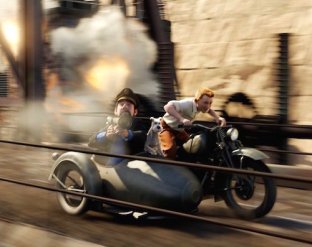 Of course, one very important person is neither British nor Belgian: Spielberg. The screenplay’s balance between peril and comedy is spotlessly enhanced by his peerless direction. In a world stuffed to the gills with lesser blockbusters that palely imitate the groundwork Spielberg and co laid in the ’70s and ’80s, work like this should remind people why he’s still the master of the form. The film is shot with an eye for realism (so much so that some viewers have been convinced it was filmed on real locations with real actors, with some CG augmentation for the cartoonish faces, of course), which helps lend a sense of plausibility and also genuine jeopardy. It’s easy to get carried away when working in CG animation, but often the most impressive works are ones that behave as if they’ve been shot largely within the limitations of real-world filmmaking technology.
That said, Spielberg isn’t afraid to make use of the freedom afforded by working in a computer-generated realm when appropriate: there are some spectacular individual shots, the most obvious being a single-take chase sequence down a hillside through a town. Even better are some of the transitions, which would be literally impossible to realise in live-action — without resorting to effects work, anyway. They’re hard to accurately describe, especially without ruining them, in part because each instance is different; but they do all look incredible, and, again, serve the story rather than being flashy for the sake of it.
 The tone on the whole is resolutely PG — actually, like many an action-adventure blockbuster used to be before everything went slightly darker and PG-13. So, for example, Tintin wields a gun on occasion, but never at another human being. The focus is on the story, which happens to lead to some adrenaline-pumping sequences, rather than a lightweight excuse to link together a bunch of punch-ups and chases. Ironically (though, for anyone who knows what they’re talking about, entirely expectedly) this makes the action all the more exciting. It also mean there’s a lighter touch than many current blockbusters offer; a greater presence for humour, including among the action. I guess that’s not fashionable these days, when everyone’s become so po-faced about their big-budget entertainment. However, with the likes of Iron Man and Guardians of the Galaxy proving immensely popular, perhaps the tide is turning, and maybe the still-on-the-cards Jackson-helmed sequel will find itself better received because of that.
I genuinely don’t understand the muted reaction to this first Tintin, though. It perhaps shows where blockbusters have gone awry in the last decade or two, and perhaps the incidental disdain animation is viewed with among some — I wonder: if the same movie had been produced in live-action, would some of those critics have been better disposed to it? I don’t think it would have actually been a better film, and perhaps it would even have been slightly worse (some of the visual impact would be lost),  but some viewers would have seen it (even subconsciously) as more of a “real movie”.
As I said at the start, those people are Wrong. The Adventures of Tintin is a fantastic adventure movie, and should prove to anyone who doubted Spielberg after Kingdom of the Crystal Skull that, when it comes to globetrotting action-adventures, he’s still the man to beat.

The UK network TV premiere of The Adventures of Tintin: The Secret of the Unicorn is on BBC One today at 4:25pm.
It placed 2nd on my list of The Ten Best Films I Saw For the First Time in 2014, which can be read in full here.
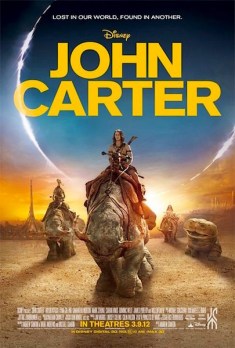 A box office flop (it made a once-astonishing $284 million worldwide, but that was off a $250 million production budget and a ginormous bungled marketing campaign), John Carter has gained something of a following among those who did enjoy it or caught it later — see
  not because it’s so famous (among Normal People, I don’t think it is), but because its influence means its imagery and concepts have already been plundered (
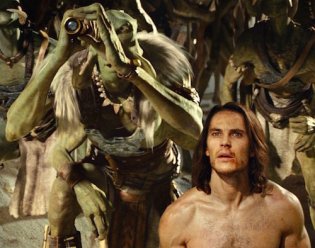 It doesn’t help that the film is structurally muddled at the offset. It begins on Mars, a voiceover detailing the conflict — an instant bombardment of names and concepts. I don’t mind things that challenge you to keep up, but it still feels a bit much. Then we jump to New York in the 1880s, where Carter is running away from someone in the streets. Then to his house, where his nephew has just turned up to be told he’s dead. You what? We just saw him in the telegraph office! And then we jump back to the 1860s, where he’s searching for gold and getting arrested (or something) by Bryan Cranston in a wig as some form of army officer. Then it gets a bit more straightforward. If being transported to Mars and meeting four-armed CG aliens who speak in subtitles is what you call “straightforward”, anyway.
 It feels a bit facile to criticise the quality of CGI these days, but that doesn’t stop John Carter from being over-ambitious in this regard. In fact, it’s not really the sometimes-half-assed green screen or occasional plastic-ness that’s the problem, but the design: those four-armed aliens are just a little too cartoony. Perhaps it’s a hangover from Stanton’s Pixar days, perhaps something just went a little awry during the process, but their design doesn’t look quite ‘real’ enough; a little like someone’s taken a real-life creature and then lightly caricatured it. I think it’s the eyes, which are perhaps a little too big and round and ‘cute’, but there’s something else indefinable there, or not there. These aliens aren’t just set dressing but proper motion-captured characters, played by the likes of Samantha Morton, Willem Dafoe, Thomas Haden Church and Polly Walker, so the lack of connection is regrettable.
 I was expecting, or perhaps hoping, to like it; to find a misunderstood old-style adventure full of entertainment value. It may be an old-style adventure, but that’s beside the point, because whatever it is, I just felt it wasn’t particularly well made: poorly constructed, weakly performed, lazily (and wrongly) assumptive of the audience’s familiarity with the material. Disappointing.
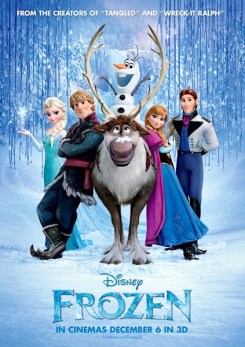 Frozen is a grim single-location thriller about three college kids trapped on a ski-lift overnight, battling hypothermia and worse over a hundred-foot drop. Or at least it was until last year, when Disney went and released its all-consuming mega-musical.
  Unlike the best Disneys, however, I think its appeal resides firmly with little girls — you don’t actually have to go very far on the internet to find people baffled by its success. Plenty of people think the music is bland, the characters underdeveloped, the moral and emotional arcs not fully thought-through, the visual style a rip-off from
 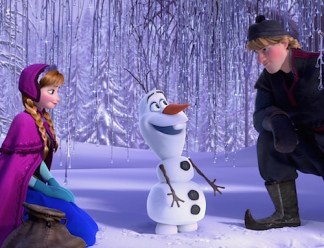 The lack of villain’s song is attributable to the fact that, for nearly the entire film, there are no nasty characters. A villain emerges right at the end to give us a climax, but for once that works — a genuine twist! It’s almost a shame it has to resort to that, but how else do you end a Hollywood movie other than a big dramatic confrontation? Plus, aforementioned snowman Olaf confounded my expectations, pulling off the quite remarkable feat of not being the most irritating CGI character since Jar Jar Binks. (I don’t know who is the most irritating CGI character since Jar Jar Binks, but Olaf is alright.)
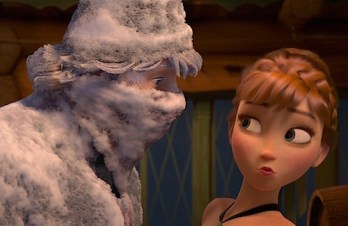 It’s not bad — it’s adequately cartoony — and actually the ice and snow effects are very, very good. It’s the character animation that I felt let it down, especially some of the more minor roles — there were points where their style and movement looked little better than you’d find in a video game cut scene.
 Frozen is by no means a bad Disney movie, and it does have a lot of favourable aspects. Whether the internet’s right and it’s not as good as Tangled, I wouldn’t care to say (I enjoyed Tangled, but at this point have largely forgotten it); conversely, the sometimes-rabid fan base are perhaps being a little over-enthusiastic. There’s nothing wrong with a kids’ movie being beloved by kids, though; and with all the dreadful things the media churns out for little girls to obsess over and centre their life values around, this is undoubtedly one of the most positive.
 Marvel Studios takes its boldest step yet, moving away from the present-day superhero milieu of its previous movies to a galaxy far, far away for a space opera epic. Its success, both critically and commercially, has cemented the Marvel Cinematic Universe as an infallible force in the current movie world. But, really, how good is it?
 The worst offender is the pod chase through Knowhere, a several-minutes-long sequence that registers as little more than a blur. There’s a shocking lack of clarity to its images, even by today’s standards. Maybe it’s better in 3D, when I guess the backgrounds would sink into the distance and important elements would be foregrounded; but in 2D, you can’t see what’s meant to be going on for all the fast-moving colour and split-second cuts. Almost as bad, though for different reasons, is the climax. It takes up an overlong chunk of the movie and at times feels repetitive of too many other Marvel climaxes — oh look, a giant spaceship crashing into a city! If anything, the film gets ‘worse’ as it goes on. Perhaps not in a very literal sense, but as the blustering action climax takes over, it moves further away from the stuff that makes it unique and interesting.
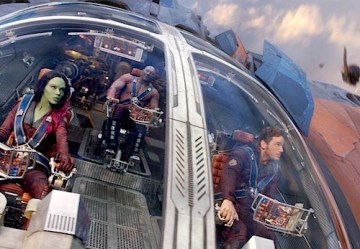 It isn’t even called Nova City, but I don’t have the foggiest what it is called because the film didn’t make me feel I should be learning it. Some more effort making sure we knew why that place mattered, even if it was just a clearer depiction of all the planning for its defence, might have sold the entire climax better.
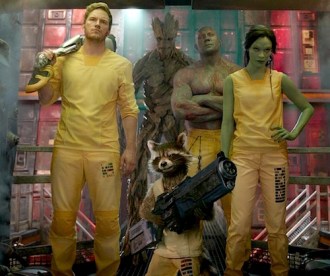 especially the overlong climax. Joss Whedon commented of his own Avengers film (as I quoted in
 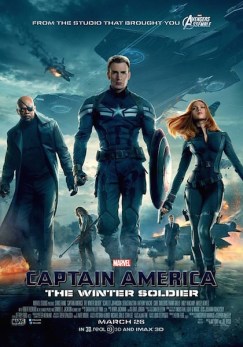 After the
 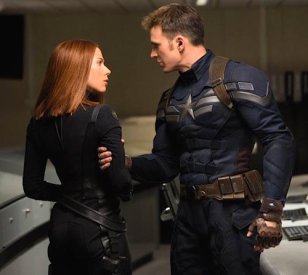 everybody moved on to being more excited about Marvel’s end-of-summer new-franchise-launcher,
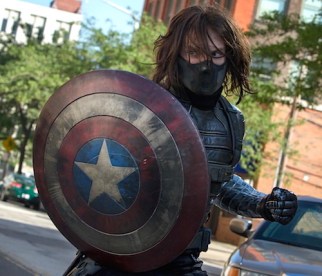
 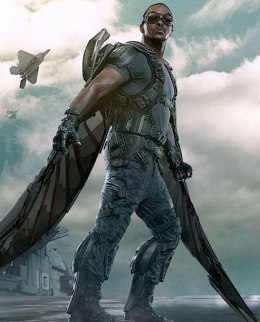 Also introduced is sidekick hero the Falcon (Anthony Mackie), who I have little to say about directly. He’s a sidekick who’s introduced fully-formed — he’s been using his ‘superpower’ for years as just part of the military; it’s not new or exciting to him, which lessens some of its power for the viewer too. “Origin story” may be the most over-used of all the superhero stock stories, but there’s a reason for that. If you skip it then you cut to the chase, that’s true, but does it also lessen the impact of characters to not see how they started? Maybe storytellers just need to come up with fresh ways of giving origins, rather than skipping them altogether.
 and then it refuses to wrap everything up, putting certain things in place ready for
 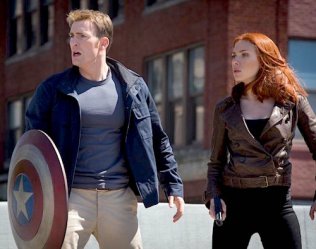 what’s left? There is strong action, albeit undermined by muddled character investment; and there is an interesting thriller/conspiracy story, albeit undermined by a feeling of “once you know it, you know it” — it’s not all that complicated or all that surprising, including the revelation that the one character significant enough to be behind it all is behind it all (gasp!)
 Belated sequels can be a
 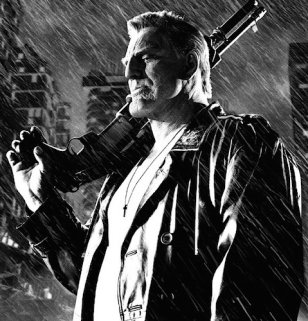 But the comic-book-ness of the first film — moments of almost metaphorical visual representation rather than literal reality, including physically-impossible action beats — has been ramped up. The value of the first film was never in its action, so the sequel’s lengthy punch-ups, crossbow-based guard-slaying, and all the rest, get boring fast. When it slips into this needless excess, A Dame to Kill For loses its way. When it sticks to what it does best — hard-boiled fatalistic crime tales with striking comic book-inspired cinematography — it does as well as the concept ever did.
 The intervening decade has lessened the impact of the first film’s sick ultra-violence, but there’s nothing even that extreme here, aside perhaps from one eyeball-related moment. On the other hand, nearly a decade of tech development means it looks better than the last one, both in terms of the CGI’s quality and the camerawork more generally — it’s less flatly shot; more filmic than the first one’s sometimes-webseries-y composition.
 its predecessor, and that’s exactly what it delivers. I suspect the first benefits from nostalgia because, watching them virtually back to back, I found I liked Sin City less than I remembered, but enjoyed A Dame to Kill For just as much. It’s flawed in several aspects, but for honest-to-themselves fans of the first movie, I think it’s a “more of what you liked”-style success.
 I think I’ve previously discussed my life-long love of the X-Men franchise, so I shan’t go into detail again, but suffice to say Days of Future Past has been one of my most-anticipated movies ever since the title (which is that of a classic and influential story from the comics) was announced. Thank goodness, then, that the final result doesn’t disappoint.
 Beyond that, there’s the characters: the younger versions are having to deal with the fall-out from
  Not everyone gets to shine in a cast this big, although pretty much everyone gets a moment. The future-set cast have the least to do, people like Halle Berry turning up to do little more than show their face, though Stewart and McKellen get a moment or two worthy of their talents. After he was the focus of the last film, Fassbender is slightly shortchanged here; but after McAvoy gave him essential support in First Class, Fassbender plays the same service here, informing Charles’ journey. Of the new additions, Evan Peters as Quicksilver (that’s the one who’ll also be played by Aaron Taylor-Johnson in
  Later, there’s the aforementioned ‘slow-mo’ sequence, and the grand climax, which offers more “fly something big around” antics a la First Class’ submarine, only considerably grander. Yet for all the spectacle, the final moments once again come down to character: what is Magneto prepared to do? What is Mystique prepared to do? Will anyone listen to Charles? And so on. Even the much-vaunted Marvel Studios movies tend to base their climaxes in slabs of ‘epic’ CGI crashing into each other; Days of Future Past does that for a bit, then brings the characters back into focus for the real final beats.
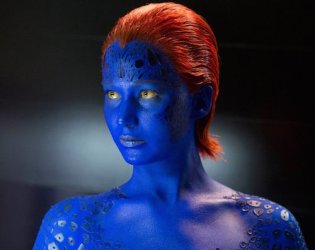 (Jennifer Lawrence being the third pillar of the past triumvirate, as they’ve already focused on Xavier and Magneto). While Days of Future Past does wrap up the majority of its threads (the open-ended ones are answered by previous films, if you want them to be), there’s plenty there to play with in the next film (and, perhaps, ones beyond that) if they want to… which they do.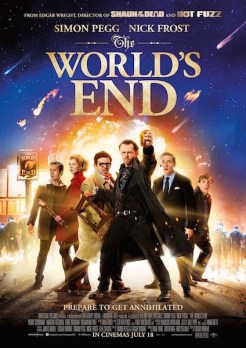
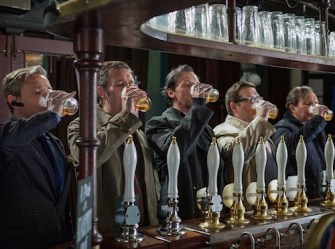 “zombie movie” or “Hollywood action movie”, and occasionally co-writers Pegg and Wright have substituted character development and thematic points for send-up. It may not play to the genre-loving fan-audience that the trio’s previous work has accumulated (demonstrably so, based on many a viewer review), but it does make for a more grown-up film.
 It will definitely reward multiple viewings: it’s littered with signs, omens and portents (in fairness, a good few can be grasped on an attentive first go). There’s a featurette on the BD (but not the DVD) which helps point out any major ones you may’ve missed; though I have to say, even at seven minutes long, and even with it pointing out some that felt too obvious to be worth mentioning, I swear it left some stuff out. That could be a deliberate decision of course, to leave some things for people to just spot.
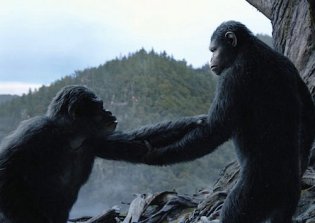 A heady mix of solid writing from Mark Bomback, Rick Jaffa and Amanda Silver, peerless motion-captured performances from the likes of Serkis and Toby Kebbell, and first-rate CG magic from Weta, brings us a set of characters who are compelling and believable. Here is a society trying to define what it wants to be, battling old prejudices in the hope of a peaceful, secure, happy future. If you want to draw analogies to almost any real-world political situation, I’m sure you could.
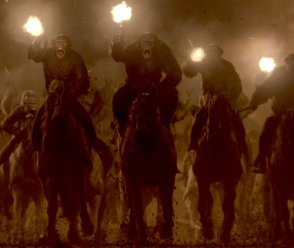 Lest you get the wrong impression, the film isn’t all talk. For various spoiler-y reasons, the fragile relationship between Man and Ape breaks down, and the apes stage an attack on humanity. Here we get perhaps one of the best siege action sequences I can think of, with mankind holed up in a half-constructed skyscraper that sits conveniently at the end of a long street for the apes to charge down. Reeves’ direction is virtuosic here, crafting an epic and exciting sequence even when most of the film’s major players are busy elsewhere. And it’s not even the climax.
 thanks to some surprisingly small-scale narrative choices (the whole thing with the dam doesn’t feel nearly as vital as it should) and Reeves’ direction sometimes being a little straightforward and almost TV-ish. I know I’ve said I hate when people use that as a derogatory comment nowadays, but some repeated locations and shot choices make the film feel cheaper than it was.
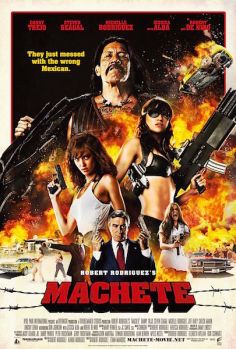 Multi-hyphenate Robert Rodriguez takes his
  to fleetingly include something that ‘needs’ to be there purely because it was in that trailer.
 100Films.co.uk