Patrick (2019)

aka De Patrick

2020 #221
Tim Mielants | 96 mins | digital (HD) | 2.39:1 | Belgium & Netherlands / Flemish, Dutch, French, English & German

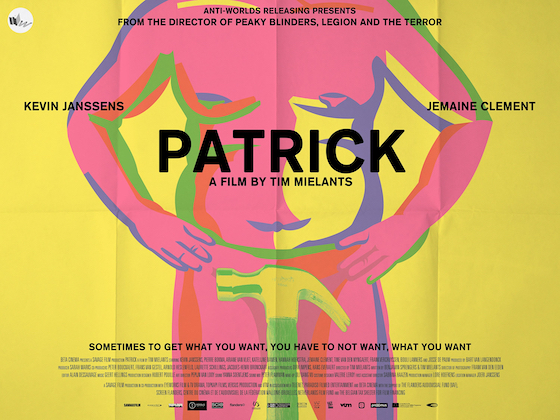
Patrick

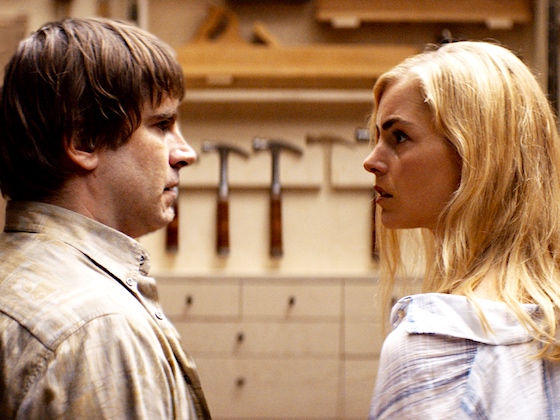
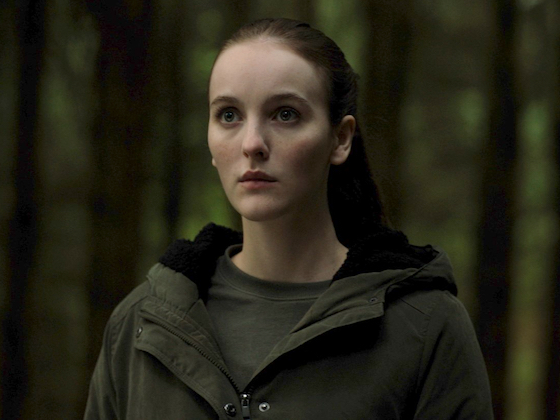
Patrick’s hammer is missing. More accurately, one of Patrick’s hammers is missing — he has seven, of different sizes, arranged in a neat row on a bespoke wall mount, and the middle one is no longer there. Patrick is the handyman at a nudist campsite run by his father, who is old and sick. The head of the residents’ council is a busybody; his wife is secretly sleeping with Patrick, not that Patrick seems to care. A famous musician Patrick has never heard of arrives to stay, followed by his pretty but frustrated girlfriend. Then Patrick’s father dies. But, most importantly, Patrick’s hammer is still missing. Fortunately, a former police officer friend turns up to pay his respects, and gives Patrick advice on how to find his hammer — so Patrick launches his investigation.

To sum Patrick up as “Agatha Christie meets the Coen brothers in a nudist camp” doesn’t feel too wide of the mark. Okay, there’s no murder, so perhaps mystery-genre fans could think of a better (though, unavoidably, less famous) author than Christie to sub in. But the fact remains that the missing hammer isn’t just a story hook to hang something else on: it’s a solid mystery narrative, with clues and red herrings and twists. Conversely, it’s not just a mystery, which is where the second comparison comes in. The overall quirky, just-left-of-reality, slightly-heightened tone evokes the Coens’ work, without (thank goodness) being a rip-off. It’s very much a comedy-drama, in that it’s not out-and-out seeking to provoke laughs, but it’s frequently absurd to the point of being laughable — although, with What We Do in the Shadows’ Jemaine Clement among the supporting cast, you can be assured of some genuinely humorous moments too.

One element that isn’t mined for amusement, to the film’s credit, is the nudity. Equally, if you’re the kind of person who hears “set in a nudist camp” and thinks “wah-hey!”, don’t get your hopes up. These are real nudists, not pretty movie ones: middle-aged to older, with lumpy flesh wobbling around all over the place. The one conventionally attractive member of the cast (Hannah Hoekstra as the musician’s girlfriend, Nathalie) remains clothed. Indeed, the positive aspect of how the film treats nudity is that… it doesn’t really treat it at all. It’s doesn’t use the nudity for laughs, nor does it sexualise it, nor does it linger on it, nor does it avoid it. It’s just there; a fact of life. This story takes place in a nudist camp, so people are naked — that’s that. Even if all sorts of bits flopping about strikes you as giggle-worthy at first, before too long you stop even noticing.

Anyone could have taken it

What is often visually appealing is Frank van den Eeden’s cinematography. There are some beautiful shots and scenes, from your obvious screen-cap-able pretty lensing (like a funeral where the whole camp are scattered around a smoke-filled forest), but the way the camera moves, with slow pans (like the one when Nathalie first visits Patrick’s workshop), or clever angles (like when Patrick has to climb out of a tipped-over caravan).

The combination of all of the above made me rather love Patrick. While the limits of a five-star rating system mean I’m only going to give it a 4 for now, it’s sort of a 4+, thanks to a litany of great shots and moments that spike above the overall quality of the film (which, I should make clear, is still high). It’s a movie that appeals to my taste: unmistakably absurd, but without revelling in that absurdity to the point where the wheels of momentum come off and it all falls apart. It satisfies as a mystery; as a pillorying of the politicking that goes on in small organisations; and as a character study of a man who just wants to find his hammer.

4 out of 5

Patrick is streaming on AMPLIFY! from today until 17th November. It’s on general UK release from 20th November.

It placed 16th on my list of The Best Films I Saw in 2020.

Disclosure: I’m working for AMPLIFY! as part of FilmBath. However, all opinions are my own, and I benefit in no way (financial or otherwise) from you following the links in this post or making purchases.

Rose Plays Julie (2019)

2020 #239
Joe Lawlor & Christine Molloy | 101 mins | digital (HD) | 2.39:1 | Ireland & UK / English

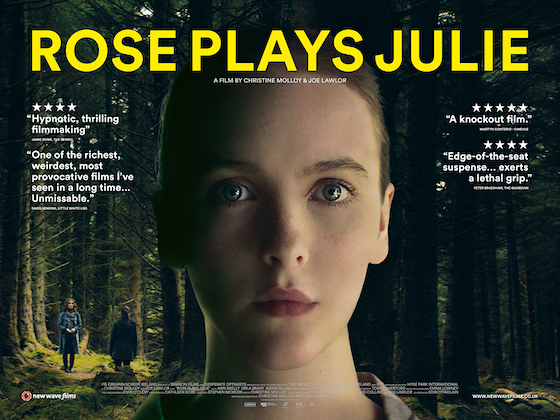
Rose Plays Julie

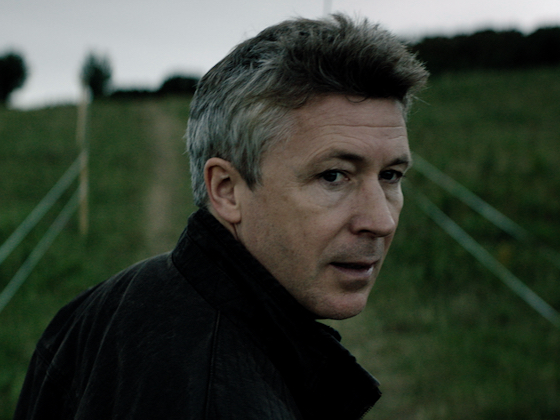
Long Lost Family meets rape revenge thriller in this Irish drama about a veterinary student, Rose (Ann Skelly), who was adopted as a baby and now decides to finally meet her birth mother, Ellen (Orla Brady), only to uncover a dark secret about their shared past. Well, I’ve kinda given away the ‘secret’ in my opening ten words, haven’t I? My apologies if you’re a total spoilerphobe, but here’s the thing: some blurbs and whatnot try to conceal that reveal (and when it comes in the film, it is played as a revelation; more on that in a bit), but, frankly, even if you haven’t already had it spelled out (and most reviews don’t try to hide it), it’s pretty easy to guess where things are going — perhaps even from reading one of those oh-so-oblique blurbs (that’s when I figured it out).

But this isn’t your standard rape revenge movie. The act itself is historical, with only its aftermath shown in a couple of fuzzy flashbacks — this isn’t one of those trashy flicks that has its cake and eats it by ickily revelling in the assault before also enjoying the violent vengeance. And instead of the avenger being a dismayed husband/partner, or the (attractive, young) wronged woman who’s suddenly an expert assassin, it’s the daughter who came of it. If you’re after the visceral thrills of the aforementioned kind of rape revenge movies, you won’t find them in this slow-burn, introspective drama; but if you’re open to that style, the mother-daughter angle of how it approaches its subject matter is a unique element.

This is where the Long Lost Family part remains relevant, because the tentative new relationship between Rose and the mother who gave her up two decades ago is almost a big a part of the film as her seeking out and confronting her biological father. This rides a lot on Skelly and Brady as actors, because writer-directors Joe Lawlor & Christine Molloy aren’t the sort of filmmakers who write big speeches where their characters explain their feelings — quite the opposite. Instead, we study their passive faces in extended closeups, trying to discern what’s going on as they think things over. One of the most outwardly expressive moments comes when Ellen reveals their shared past to Rose, in a blunt statement just hours after they’ve first met. It’s probably not the best way to go about telling someone that was how they were conceived, but it makes for a slap-in-the-face moment of drama, and Skelly’s reaction is powerful: she doesn’t ‘do’ anything, but her face changes entirely.

The secret comes out

The film’s quiet, subtle mode must be challenging for an actor — no grand emotive speeches to show off with — but this cast are up to the challenge. Skelly is obviously the standout, letting through just glimmers of reaction that allow us to understand how much she’s struggling with all this troubling new information. Brady is very good also, even though I feel like some of her character arc has been left offscreen, between scenes. Rose’s father, Peter, is played by Aidan Gillen, who always excels at embodying smarmy bastards, and that extra-textual awareness helps him to, again, keep his performance mostly subdued and realistic. He’s not some overt monster stomping across everyone’s lives, but an outwardly nice guy with an evil core.

The film’s biggest detriment is that it perhaps takes its serious subject matter a bit too seriously. It’s a very portentous film, in which the restrained performances, gloomy photography, slow-burn pace, and ominous music combine to create an intensely fateful atmosphere. Something is, inevitably, going to happen… eventually… On the one hand, it means that, as Rose gets in deeper, the tension steadily begins to grow. On the other, I’m aware some viewers think it’s so self-serious that it tips over into being laughable. There’s something to be said for varying your tone.

Conversely, I can see why Lawlor & Molloy weren’t in the mood for levity: this is a film about two women, damaged in different ways, who need to come to terms with what has happened to them; both searching for something, even if they don’t know it. You could argue, even, that applies to three people, because Gillen’s character also comes to realise he’s broken — though, in his case, how much sympathy we can feel for him is a whole other discussion. And mixed into all that are major ethical dilemmas: reaching out to birth parents who requested no contact; euthanising healthy animals (if you’re squeamish about injured and dying animals, do not apply); and, by extension, the question of what is appropriate restitution for transgressive behaviour by humans.

Peter the rapist

The latter leads to an ending that I’m not sure how I feel about (massive spoilers follow!) Peter is killed by Ellen, but only because he acquiesces — he accepts what’s happening and allows Ellen to finish it. It’s not exactly suicide (he wouldn’t have done it if Ellen hadn’t turned up and stabbed him with a syringe full of poison), but, by the end, he’s also not protesting. He accepts his guilt and punishment; almost seems to welcome the relief, in fact. If only all rapists were so helpful… and the fact they wouldn’t be is what makes this such a grey area. But then, maybe that’s the point: the film isn’t arguing that this is how things should be done, but asking the question: is this ok? If not, what would be? On another level, from a story structure perspective, it feels somewhat unsatisfying that Rose isn’t involved, after the rest of the film was primarily about her. That might be morally correct (it’s really Ellen’s trauma to deal with), but it feels wrong dramatically to end the film with resolution for Ellen more than for Rose.

Between its heavy issues and unwaveringly doom-laden tone, Rose Plays Julie is not a light viewing experience. If you like the idea of slow-burn dramatic thriller that spends a lot of time focused on people’s still faces as they process information silently and internally, and leaves you with a lot to chew over when it’s done, this is a film for you. If you think that sounds inscrutable or dull, steer clear.

4 out of 5

Rose Plays Julie is streaming on AMPLIFY! until Thursday 12th November. It includes a half-hour Q&A with the directors, actor Orla Brady, and composer Stephen McKeon.

Disclosure: I’m working for AMPLIFY! as part of FilmBath. However, all opinions are my own, and I benefit in no way (financial or otherwise) from you following the links in this post or making purchases.

Vampires Suck (2010)

2020 #233
Jason Friedberg & Aaron Seltzer | 82 mins | digital (HD) | 1.85:1 | USA / English |
15* / PG-13

Vampires Suck

Since 2015, I’ve been marking Halloween by reviewing the Twilight movies. Last year, I finished them. Or did I?!

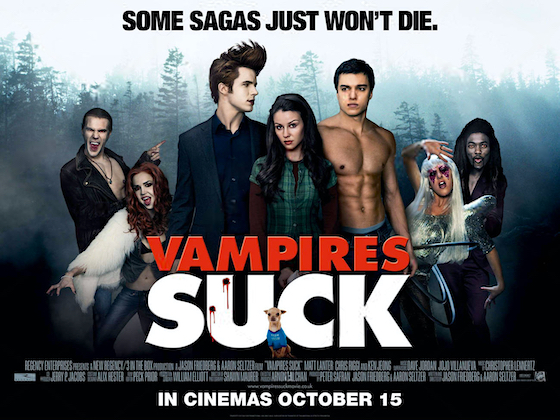
…well, yes, I did. But here’s something of a coda: a spoof of the series, produced in 2010 when Twilight was still at (more or less) the height of its popularity. At the time, making a Twilight spoof must have seemed a great idea — it was popular, but also widely lampooned. The only problem is, isn’t Twilight already so fundamentally ridiculous as to be unspoofable? Maybe; maybe not… but when you put Jason Friedberg and Aaron Seltzer in charge, you’re not likely to get great results.

There’s a fair chance you won’t recognise Friedberg & Seltzer’s names, but you might know their body of work. They started out as co-writers of the Leslie Nielsen-starring spoof Spy Hard, but more significant is their second movie: Scary Movie, the 2000 horror spoof that provoked a whole string of similar genre-centric spoofs over the next 15 years. They graduated to directing with 2006’s Date Movie, which IMDb voters think is the 23rd worst movie ever made, and they followed that with spoofs Epic Movie (the 12th worst movie ever made), Meet the Spartans (the 22nd worst movie ever made), Disaster Movie (living up to its name, the #1 worst movie ever made), The Starving Games (the 45th worst movie ever made), and Superfast! (by this point, too few people are watching their movies to even get the score low enough to appear on that ranking — I don’t know about you, but I hadn’t even heard of Superfast until today, and it came out in 2015).

Black Eyed Peas

In the middle of all that sits Vampires Suck, only the 46th worst movie ever made — by Friedberg & Seltzer’s standards, a success! Now, I’m not about to mount a full-blown defence of the movie, but I will say it’s certainly not one of the worst things I’ve ever seen. Indeed, just within the subgenre of 21st-century genre spoofs, I’d say Superhero Movie is much worse (though, re-reading my review, it sounds pretty similar to my thoughts on Vampires Suck). Sure, there are plenty of cheap, uninspired, crass, and rip-off gags, but some of it also made me laugh, so it’s not a total washout. It’s never as funny as the real thing at it’s funniest (Face Punch forever!), but it wasn’t as uninspired as I expected.

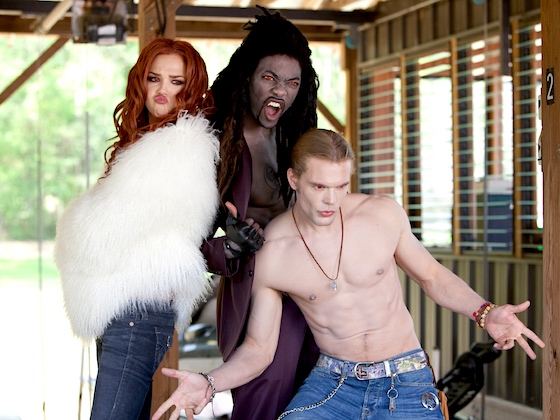
I keep calling these “genre spoofs” but, as with Superhero Movie (and so, I extrapolate, all the other Movie movies), it’s not truly a spoof of an entire genre, but instead sticks closely to one film; or, in this case, two films (only the first two Twilights had been released at the time, so it bundles them both in). Every scene is a recreation of one from the original, but with a comedic twist. As such, I’m not sure whether it works better if you have seen the original (so you know exactly what’s being referenced) or if you haven’t (so you don’t realise just how simplistic all its ideas are). I guess it’s aimed at the former kind of viewer, though. I mean, some parts are barely more than repeats of stuff from the real film framed in such a way as to say “isn’t this stupid?” Some of the pop culture references in gags are painfully dated, too. That’s always a risk with this kind of comedy, but then I guess they’re not expecting longevity — if they were, they might put more effort in.

Team Body Hair

On the other hand, highlights include Jenn Proske doing a very good job of imitating Kristen Stewart’s acting style. It’s unmistakable, but a relatively subtle and consistent bit of humour; or, at any rate, not as overblown a gag as… everything else the film is doing. And if you listen, the lyrics in some of the music tracks are decent parodies of the kind of songs Twilight was soundtracked with (“I feel so lonely / Nobody gets me”). Other times, you’re left to provide your own punchline. “We’re just like any other normal American family,” the head vampire comments; “except, of course, we have no souls and we walk the Earth trying to satisfy an unquenchable thirst for blood.” That’s it for the film, but you’ll probably be thinking, “sounds like a normal American to me.” Arguably the best joke is in the title — and whether you think it’s moderately amusing or an obvious and tired pun, I’d argue my assessment holds true.

At the end of my review of Breaking Dawn Part 2, I pondered if I’d wasted my time watching the Twilight Saga — I mainly engaged with it because of its prominent place in pop culture, but that seems to have quickly faded. The same thought, then, is even more true of a middle-of-the-road spoof of the series. If you’re a dyed-in-the-wool Twilight fan, I guess a pisstake is not going to agree with you; but if you despise the main series, this kind of close parody is as bad as the real thing. It did tickle me at times, but I won’t be watching it again.

2 out of 5

* For its theatrical release, the BBFC suggested cuts to five scenes to earn the film a 12A. That cut was also released on DVD and Blu-ray, but it’s uncut and a 15 on streaming. In the US, there’s an unrated “Extended Bite Me Edition”, but it’s only 96 seconds longer. ^

The 100-Week Roundup XIV

I love deadlines. I like the whooshing sound they make as they fly by.

While I’ve been busy with FilmBath and AMPLIFY!, a lot of review dates I intended to hit have flown by, which naturally brought to mind the Douglas Adams quote above. All those reviews that would’ve tied in to something now won’t, but they’ll find a home here someday.

In the meantime, I’m far behind on my 100-week roundups, which is why I’ve put some energy into this little lot. They finish up my reviews from October 2018, as well as dipping a toe into the waters of November 2018. It’s a mixed bag in every sense: very different genres; very different styles; very different ratings…

The films in question are…

  • It’s Such a Beautiful Day (2012)
  • The Lives of Others (2006)
  • Jennifer’s Body (2009)
  • Going for Golden Eye (2017)


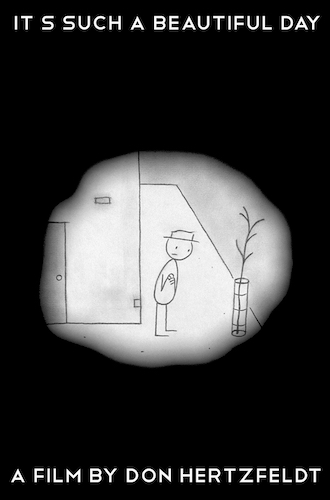
    It’s Such a Beautiful Day
    (2012)

    2018 #218
    Don Hertzfeldt | 62 mins | Blu-ray | 1.33:1 | USA / English

    It's Such a Beautiful Day

    In 2014, when Time Out New York ranked It’s Such a Beautiful Day 16th on their list of the 100 Best Animated Movies Ever Made, critic Tom Huddleston described it as “one of the great outsider artworks of the modern era, at once sympathetic and shocking, beautiful and horrifying, angry and hilarious, uplifting and almost unbearably sad.” That’s a description I’m about to singularly fail to better.

    Animator Don Hertzfeldt enjoys a cult following — you might never have heard of him (though chances you heard about his Simpsons couch gag, if nothing else), but if you have, well, you have. After releasing numerous shorts, It’s Such a Beautiful Day was his first feature — and, indeed, it was first released as a trilogy of short films between 2006 and 2011. Hence my notes break down into three parts, which I shall now share unedited…

    Part 1, Everything Will Be OK. Okay, so, this is weird. Interesting depiction of some kind of mental collapse (I guess we’re meant to infer it’s a brain tumour). Odd everyday events — what does it mean? Maybe that’s the point — Bill [the central character] is pondering what it all means too, after all.

    Part 2, I Am So Proud of You, is like, “you thought that was weird? Get a load of this!” A lot of it seems to be weird — what some people would describe as “disturbed — just for the sake of it. But at other times, it’s almost casually profound. There’s something interesting about its relationship to time and the order of events, or at least the presentation of the order of events.

    Part 3, It’s Such a Beautiful Day. See above. It’s interesting that it was three short films, made over a period of six years, because it really does feel of a piece. Maybe it was just easier to fund/produce shorts rather than a feature, and this was always the end goal.

    Well, there you go. This is not an animated movie for everyone (if you think “animated movie” means “Disney musical”… hahaha), but it’s certainly something unique and special.

    4 out of 5

    The Lives of Others
    (2006)

    aka Das Leben der Anderen

    2018 #220
    Florian Henckel von Donnersmarck | 137 mins | digital (HD) | 2.35:1 | Germany / German | 15 / R

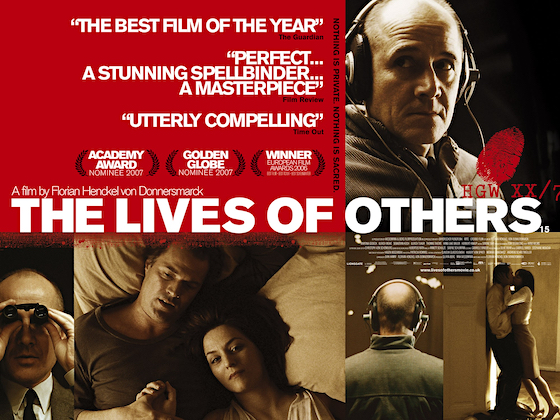
    The Lives of Others

    In 1984 East Berlin, an agent of the secret police, conducting surveillance on a writer and his lover, finds himself becoming increasingly absorbed by their lives.IMDb

    This German movie won the Best Foreign Language Film Oscar and BAFTA (as well as a host of other similar awards), and is currently ranked as the 59th best film of all time on IMDb. It lives up to its accolades. It’s tense and thrilling like a spy movie; emotionally and politically loaded like an art house drama.

    Of particular note is Ulrich Mühe, superb as the increasingly-conflicted Stasi agent. He conveys so much with so little — the character’s massive ideological change is all portrayed as inner conflict. I was wondering why we hadn’t seen a lot more of him since, but sadly he passed away the year after the film came out, aged just 54.

    As the film focuses so much on him, it might be easy to underrate the technical merits, especially because they’re unobtrusive; but it’s perfectly shot by Hagen Bogdanski, with crisp, cold, precise photography. As for writer-director Florian Henckel von Donnersmarck, his followup was infamous Johnny Depp / Angelina Jolie vehicle The Tourst, a film so maligned it seems to have derailed his career. Shame.

    5 out of 5

    The Lives of Others placed 24th on my list of The Best Films I Saw in 2018. It was viewed as part of What Do You Mean You Haven’t Seen…? 2018.

    Jennifer’s Body
    (2009)

    2018 #222
    Karyn Kusama | 102 mins | digital (HD) | 1.85:1 | USA / English | 15 / R

    Jennifer's Body

    Jennifer’s Body didn’t go down well on its original release, but the past few years have seen it develop a cult following, with people regularly recommending it on social media as an under-appreciated horror flick. I didn’t dislike it, but I’m not ready to join their ranks.

    You can see what they were going for, in some respects — it’s trying to be a very feminist horror movie, with the female friendship at the core and so on. And yet, despite the female writer and female director and female stars, chunks of it feel so very male fantasy. I mean, Megan Fox goes skinny dipping for no reason. We don’t see anything explicit, but I’d wager that has more to do with Fox’s contract than authorial intent. Later, there’s a lingering kiss between the two girls that looks like it’s trying its hardest to best the famous one from Cruel Intentions. And talking of references, the whole film sounds like it’s trying really, really hard to be Heathers, with an overload of slang ‘n’ shit. It’s a bit, well, try-hard.

    Megan Fox is surprisingly good though, and there are some neat bits of direction, like the intercut murder/virginity-losing scene. It’s just a shame the whole film doesn’t show that kind of consistency. It did grow on me as it went on (I’m not sure if it took me time to settle into its rhythm or if it just had a clunky start), though exactly how much is debatable: it ends up being a moderately entertaining comedy-horror, but one that’s never really scary and rarely that funny.

    3 out of 5

    Going for Golden Eye
    (2017)

    2018 #224
    Jim Miskell | 60 mins | digital (HD) | 16:9 | UK / English

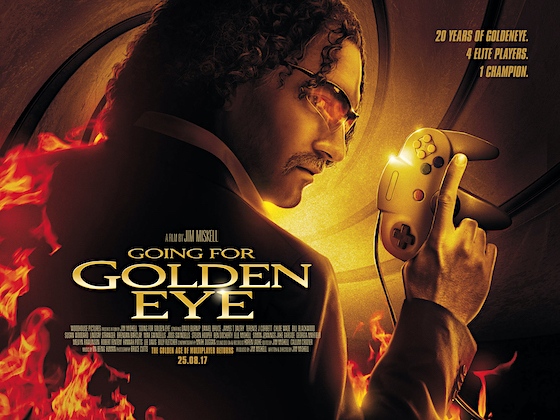
    Going for Golden Eye

    According to IMDb trivia, this is “the first video game mockumentary”. Well, you’re not going to mistake it for a real documentary — the acting is uniformly amateurish, which is one of the film’s biggest hindrances (it certainly gets in the way of selling the documentary conceit).

    Making allowances for such amateur roots, the film does manage some decently amusing bits, although just as many that don’t land. Very little about it will surprise or delight, but more forgiving or nostalgic viewers may be tickled at times. Plus, you have to have a certain amount of admiration for zero-budget filmmakers who managed to produce and get distribution for their film. Even if there’s an occasional for-friends-and-family feel to parts of it, they’ve still completed something many wannabes only dream of.

    Outside of aforementioned relatives, this is only really going to appeal to people with nostalgia for playing GoldenEye on N64 back in the day. In a way, the best part of the whole film is the opening montage about how GoldenEye was unexpectedly great, bucking expectations of both movie tie-in games and first-person shooters. A genuine well-made documentary about the game — why it was so important; what made it so popular — would be interesting…

    2 out of 5

  • A Beautiful Day in the Neighborhood (2019)

    2020 #195
    Marielle Heller | 109 mins | digital (UHD) | 1.85:1 + 1.33:1 | USA & China / English | PG / PG

    A Beautiful Day in the Neighborhood

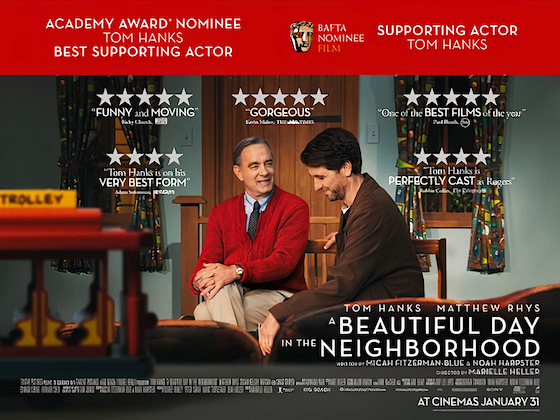
    Thanks to the ubiquity of their films and television programmes, American culture permeates the world. Even if something isn’t directly exported, there are enough references to it in other media that we all get to know it by osmosis. (If you think I’m exaggerating, here’s one example: there are many documented cases of people trying to “plead the fifth” when being interviewed by law enforcement in countries where the fifth amendment to their constitution has nothing to do with criminal procedure.) So, it’s all the more unusual that Mr Rogers is apparently an influential part of American childhoods, but he wasn’t (as far as I’m aware) widely known outside of the US until a couple of years ago. That was thanks to the acclaim garnered by documentary Won’t You Be My Neighbor? As these things often go, that was followed by a biopic — which is this.

    However, rather than try to tell Mr Rogers’ whole life story, A Beautiful Day in the Neighborhood (a reference to the fictional land in his TV series, which is presumably why the US spelling was retained even for the UK release (except on DVD covers, etc)) focuses on one man’s encounter with Rogers. That man is Lloyd Vogel (Matthew Rhys), a cynical journalist with familial problems aplenty. He’s assigned to write a puff piece on Rogers — a couple of hundred words for a magazine issue about “heroes”. The pair seem an ill fit, but that’s the point — it’s basically a punishment from his long-suffering, usually-indulgent editor. Lloyd is initially reluctant, then sceptical — surely the whole “Mr Rogers” thing is a persona; an act? But as he spends more time with the man, it begins to change his view on the world too.

    Okay, it probably takes a while for the film to get to that point, exactly, but I’m not spoiling anything — you know that’s where it’s going. “I met this guy whose world view was so much more positive and optimistic than mine… and it didn’t affect me at all, I’m still a grumpy bastard.” That’s not a story Hollywood’s going to tell, is it? Heck, that’s not even a story. So, yeah, of course Mr Rogers’ fundamentally decent and kindly nature is going to have an impact on Lloyd.

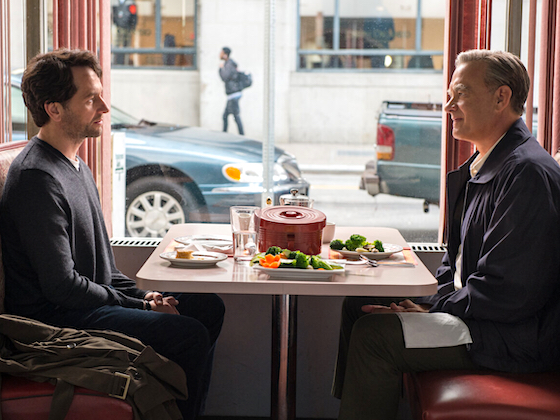
    A beautiful lunch in the neighbourhood

    Despite Mr Rogers being the focal point, then, the film is really more about Lloyd’s personal journey. But that journey is instigated and facilitated by Mr Rogers, so his “supporting character” part is vital. And who better to portray the very embodiment of decency than Tom Hanks? Rogers’ widow has said that Hanks was the perfect actor to play her husband; for his part, he’s said taking the role was “terrifying” due to the cultural significance. Hanks is as accomplished in the role as you’d expect, and it deservedly earnt his sixth acting Oscar nomination (his first in almost 20 years, and long overdue, I think).

    If it all sounds a bit predictable, director Marielle Heller dodges that with some indie-movie-esque flourishes. There’s a touch of Wes Anderson to how she uses Mr Rogers’ TV show, switching into Academy ratio to demarcate us entering a different ‘world’ — not just literally clips from the show, but bookend narration, dream sequences, location transitions, and so on. IMDb lists the 1.33:1 ratio as just being used for “TV scenes”, but I think that undersells its use and effectiveness, which is more comparable to (say) how Anderson used three different ratios in The Grand Budapest Hotel.

    Its those kind of inescapable but well-considered flourishes — plus the believable transition in Lloyd’s character, which is more grounded in reality than the “slightly unlikeable guy becomes super positive” cliché — that elevate A Beautiful Day in the Neighborhood out of the predictable or twee, and into being a genuinely heartwarming kinda film.

    4 out of 5

    A Beautiful Day in the Neighbourhood is available on Sky Cinema and Now TV from today.

    Terminator: Dark Fate (2019)

    2020 #29
    Tim Miller | 128 mins | Blu-ray (UHD) | 2.35:1 | USA, China, Spain & Hungary / English & Spanish | 15 / R

    Terminator: Dark Fate

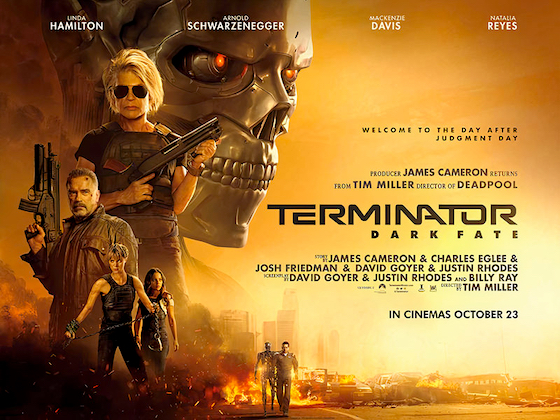
    “I’ll be back,” the Terminator famously said in The Terminator, and he has been proven right — again and again. And again. This may be a franchise about time travel, but it’s us who seem to be stuck in some kind of time loop, because this is now the third attempt at creating a direct sequel to Terminator 2. For those keeping score, the first was literally titled Terminator 3; then there was TV series The Sarah Connor Chronicles, which picked up from T2 (pretending T3 didn’t exist); and now this ignores them both. It also ignores the other attempts to keep the Terminator franchise alive: Salvation, which actually continued the storyline on from T3 (albeit with an entirely new cast); and Genisys, which attempted to be both a sequel and a reboot.

    As well as being the third Terminator 3, Dark Fate is also the third attempt to start a new trilogy (Salvation and Genisys both arrived with such lofty plans), and is now the third to see those plans aborted after poor box office. Salvation made just $125.3 million at the US box office and $371.4 million worldwide — big numbers, but not when your movie cost $200 million. Hence starting again with Genisys — but that was an even bigger flop at the US box office, taking just $89.8 million. Worldwide, it took a respectable $440.6 million (more than Terminator 3, even), which, off a lower budget of $155 million, is pretty good. But US studios continue to struggle to see beyond their own borders, and so that trilogy was abandoned too.

    Both of those movies tried something new for the franchise. Salvation took us into the Skynet-ruled future, something the previous movies had only had as a threat to be averted. Genisys played more with the idea of time travel, taking us back into the timeline of the first movie, but different. Now, Dark Fate explicitly wipes out previous continuity, beginning with a flashback that directly follows on from T2 but sets us on a new path, introducing new heroes and villains, alongside the return of the original Sarah Connor, Linda Hamilton (who was written out of T3 and recast in Chronicles and Genisys). Surely that would solve the box office problem? No: it took $62.3 million in the US and just $261.1 million worldwide, the worst yet by any measure.

    She be back

    Box office is not indicative of quality, of course, but audience reception of Dark Fate hasn’t been any better than previous attempts to continue Terminating: if you look at IMDb scores, Dark Fate has 6.2 to Genisys’s 6.3, while Salvation has 6.5. None of them are stellar, but all are solid; and, with hindsight, suggest the producers should’ve just stuck it out with one of the previous versions. Indeed, I think trying to sell Dark Fate as “another restart” probably just put more people off. The Terminator franchise has become such a tangle of forgettable messes, aborted plans, and “this is a sequel to X but not Y”-type ventures that, for your average cinema-goer, it’s easier to just ignore it than engage with what counts and what doesn’t.

    All of which is to review the film’s box office performance rather than the movie itself. But I’m more or less with IMDb voters on this one: the behind-the-scenes story is almost more interesting than the film itself. Not that it’s a bad movie, but it’s little more than a serviceable sci-fi action-adventure flick, hobbled somewhat by a palpable sense of desperation to emulate the cultural impact and success of Terminator 2. That’s the real reason none of these continuations have been allowed to stick: because none of them equalled T2. Such a goal is a hiding to nothing; a fight you stand almost no chance of winning. T2 is regarded as a Great Movie; a seminal entry in the sci-fi and action genres; influential and beloved. Thinking you can equal that is like making a gangster movie with the view that “if this isn’t regarded as at least equal to The Godfather, I have failed.” You’re setting yourself up to lose. In Terminator’s case, they’ve had that loss three times in a row, with ever-diminishing financial returns, to the point where anyone setting out to make Terminator 7 is going to be looked on as mad. What do you do with it now? You can’t reboot it again! But nor can you reasonably make a sequel to any previous version. They have, literally, killed the franchise. (Well, they probably haven’t — someone will almost inevitably continue it someday — but it’s going to be harder than ever to persuade anyone to finance that.)

    He be back

    Perhaps some form of spin-off will be seen as the next thing to try, but — spoilers! — that’s basically what Dark Fate tries to kickstart. Sure, Schwarzenegger and Hamilton are here, and the events of T2 are directly referenced and continued; but Skynet is no more and there’s a new war to fight. On the bright side, with a new future, a new threat, and an apparent aim to transition from old characters to new ones, it doesn’t feel stuck on the merry-go-round like the previous sequels did. It’s at least trying to move on in a (slightly) new direction, rather than just rehash the familiar. The problem (and it has been a big problem for some fans) is that by abandoning certain key tenets of the franchise (John Connor being the ‘Chosen One’; Skynet), it doesn’t feel so much like Terminator 3 as Terminator: The Next Generation. But, hey, that worked for Star Trek! After so many sequels that tried to find new angles to rework familiar bits and bobs, isn’t it about time someone tried something new, even if it’s in a very similar mould to what came before?

    Well, it’s a moot point now, because Dark Fate Part 2 ain’t happening. We can only take some small measure of solace in the fact that it isn’t as open-ended as Genisys was; and that, whatever any other filmmaker tries and fails to achieve with this franchise, we’ll always have Terminator and T2.

    3 out of 5

    Terminator: Dark Fate is available on Sky Cinema and Now TV from this weekend.

    Bait (2019)

    2020 #9
    Mark Jenkin | 89 mins | Blu-ray | 1.33:1 | UK / English | 15

    Bait

    The past and the present — the old ways and the new — clash head-on in Mark Jenkin’s Bait, both in its storyline and its production.

    The former is the tale of a fisherman without a fishing boat: Martin (Edward Rowe) is a Cornishman through-and-through, a lover of his community and resistant to change; but his brother, Steve (Giles King) has turned their boat into a tourist vehicle, and they’ve had to sell their childhood home to well-to-do city-dwellers (played by Simon Shepherd and Mary Woodvine, as the very embodiment of upper-middle-class London-types with the money for a rural second home). As the summer season arrives, and upcountry tourists descend on the small town, flashing their cash, Martin struggles to get by; and the clash between two different worlds comes to a head.

    As to the latter (the production method), Jenkin has steeped his film in both older filmmaking methods and the place it was made. It was shot on 16mm black-and-white stock with a wind-up camera, with all the sound post-synced because the camera was too noisy to record on set. All 130 rolls of film were hand-developed by Jenkin in his Cornish studio, with a deliberate degree of what some might call “carelessness” to add authenticity: scratches come from washing the film under a running tap; exposure varies because the film was wound manually, therefore at an inconsistent speed; a “strange sparkle” on one bit of film was caused by leaving the studio door open and pollen blowing onto the drying film (there’s more about tall that in an interview with Jenkin by British Cinematographer). It’s a defiantly hand-crafted and old-fashioned method for making a movie; a way that’s becoming ever rarer thanks to the appealing ease of digital, both to blockbuster and low-budget productions. It’s funny that the only people ‘allowed’ to use film are either your Christopher Nolans — big-name auteurs who make tonnes of money for the studios, so they can do what they want — or your Mark Jenkins — tiny independent artists producing films for a pittance, so they can do it how they want.

    Beautiful black and white

    Some might consider Jenkin’s method to be unnecessarily pretentious — self-consciously Arty — but it’s actually a wonderful marriage of form and content; the earthy, hand-hewn visuals reflect the film’s themes. It’s not just an exercise in style, either. This would be a worthwhile narrative if told in a more conventional manner, but it would feel less striking and authentic with a glossy digital sheen. Of course, all filmmaking is “technology”, but there’s something about using such old cameras and film stock, developing the footage by hand, post-dubbing the sound, that all feels like The Old Ways, like it’s traditional and handmade, in a way that matches up with Martin’s desires and goals.

    Some reviews have compared the end result to silent film, which doesn’t wash for me. The damaged visual quality might initially call to mind a poorly-preserved and unrestored print, which, if one has encountered such a thing at all, is likely to be from a silent film. But the actual feel is more 1950s location-shot social realism, with the themes of everyday rural working life, naturalistic acting and lighting, and post-dubbed dialogue (there’s none of that on your average silent movie, is there?)

    Lest you think Jenkin is a one-note polemical storyteller, different points of view are allowed to exist: the upcountry folk aren’t all ‘evil’ (Martin may feel they’re a thorn in his side, but sometimes they’re actually on his side), and not all the locals long for the past (some are happy, or at least resigned, to fitting in and making their way with how things are). These are issues Cornwall has been dealing with for decades — it’s one of the poorest regions of the UK, thanks in part to so much property being bought as holiday homes and only occupied for a few weeks a year. But now is the right time to tell a story like that, because those problems are coming to a head: Brexit is set to be a disaster for Cornwall, because they’re going to lose a lot of EU funding. Will the British government replace it? The Cornish people, who did vote for Brexit, presumably assume so. I think they’ll be lucky.

    This is a local pub for local people

    Not that Jenkin is directly engaging in the Brexit debate here. In one scene we can overhear it being discussed on the radio, leaving us in no doubt when we are, but this isn’t a commentary on political upheaval. This is a story of normal people and how their lives have been altered by changing times. It may be unquestionably set now, but, as the filmmaking style underlines, the story is fairly timeless; it’s grounded and everyday.

    Well, until a shocking event near the end, anyhow. No spoilers, but I have mixed feelings about that plot development. In one sense, it takes away from the feeling that this is an everyday situation that plays out across modern Cornwall; but, in another way, it’s a realisation of all the tensions that have been brewing throughout the film, like it’s almost inevitable that some tragedy would occur. Fortunately, how the film then deals with the aftermath is typically coolheaded and understated. We don’t get to see the immediate fallout (there are some characters we don’t even see again), just what ultimately happens later. In some ways that’s almost too little (for example, we’re not shown how it affects the locals’ relationship with the upcountry folk), but it also lands its overall point.

    Bait has mostly been a regional success; regional not just to the UK, but to specific parts of the UK: according to figures published in Sight & Sound (and repeated in the BFI’s booklet accompanying the film’s Blu-ray), a typical movie makes 4.9% of its UK box office in the southwest, but for Bait that’s up at 35%. Hopefully time will see it break out further, because it’s a compelling story, both timely and timeless, uniquely told.

    5 out of 5

    The UK TV premiere of Bait is on Film4 tonight at 11:20pm.

    Bait placed 5th on my list of The Best Films I Saw in 2020.

    The 100-Week Roundup XII

    In the interests of catching up, this roundup combines two separate weeks.

    The first contains two of the most acclaimed films of all time (both feature on numerous “greatest ever” lists, including those from IMDb, Letterboxd, TSPDT, and Empire), which happen to be my final reviews from September 2018.

    The second is a pair of movies I watched back-to-back in October 2018 that share an obvious pregnancy theme — but, oh, they could hardly handle it more differently.

    This week’s films are…

  • Network (1976)
  • Ran (1985)
  • Prevenge (2016)
  • Bridget Jones’s Baby (2016)


    Network
    (1976)

    2018 #201
    Sidney Lumet | 121 mins | digital (HD) | 1.85:1 | USA / English | 15 / R

    Network

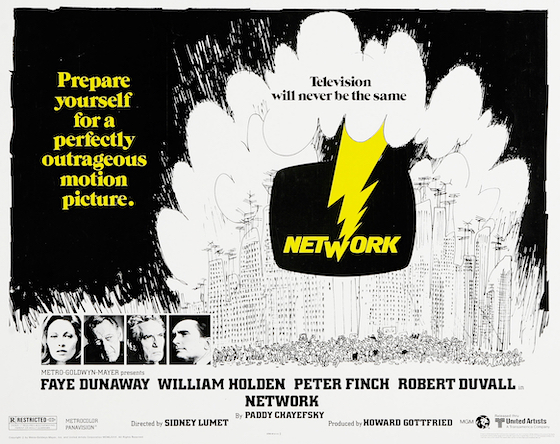
    no predictor of the future — not even Orwell — has ever been as right as Chayefsky was when he wrote Network.

    So wrote Aaron Sorkin, who has cited Network’s screenwriter Paddy Chayefsky as a major inspiration on his own writing; he even cited the man when accepting his Oscar for The Social Network; and Sorkin’s TV series The Newsroom feels like it could’ve been called Network: The Series.

    Well, maybe not. The first half-hour or so of Network feels like The Newsroom (which was a series very much aimed at being realistic, to the extent that it was set in the recent past and mostly used real news stories for its plots), whereas Network spirals off into its own level of satirical craziness, far beyond what Sorkin’s series attempted.

    But whereas The Newsroom looked to the recent past and real events, Network is as indicative of the future as Sorkin said in that opening quote. The film may be 44 years old, but I’m pretty sure you could Chayefsky’s this screenplay, change only a couple of minor specific words, and film it as being set today. It forecasts the future of TV news as angry men ranting as if they were prophets (this was 20 years before Fox News launched), as well as commentating on the place of terrorism in driving TV ratings.

    It’s cynical and ultimately bleak, but, worst of all, it’s entirely accurate.

    5 out of 5

    Network placed 21st on my list of The 26 Best Films I Saw For the First Time in 2018.

    Ran
    (1985)

    2018 #203
    Akira Kurosawa | 161 mins | Blu-ray | 1.85:1 | Japan & France / Japanese | 12 / R

    Ran

    Akira Kurosawa returns to Shakespeare (after Throne of Blood quite closely adapted Macbeth and The Bad Sleep Well may or may not have been based on Hamlet) for an adaptation of King Lear, relocated to feudal Japan. At the time, it was speculated to be his final film. It wasn’t — he made three more — but this was his last large-scale work.

    The title translates roughly as “chaos”, “pandemonium”, or “turmoil” — I guess they didn’t bother retitling it for the West because the original is a nice, simple word we can understand. But the original meaning is clearly apt, because the film depicts the mayhem that ensues when a warlord abdicates and tries to divide his kingdom between his three sons.

    It’s testament to Kurosawa’s greatness that he can make a movie this magnificent and I wouldn’t even put it in his top five. That might be my failing, though — this is a longer and more complex work than, say, Throne of Blood or Sanjuro. I need to revisit all of Kurosawa’s movies, but none more so than this.

    5 out of 5

    Ran was viewed as part of What Do You Mean You Haven’t Seen…? 2018.

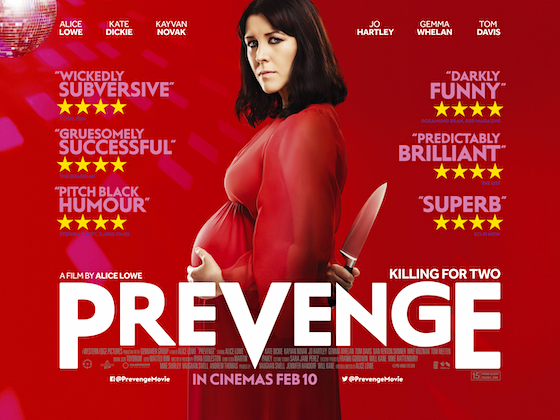
    Prevenge
    (2016)

    2018 #208
    Alice Lowe | 88 mins | TV (HD) | 2.35:1 | UK / English | 15

    Prevenge

    Seven-months-pregnant Ruth (played by Alice Lowe, who also writes and directs) believes she can hear the voice of her unborn baby, and it’s telling her to kill people. Why is a mystery… unless you read the Wikipedia entry, which just tells you upfront. (Don’t read the Wikipedia entry.)

    The behind-the-scenes story of Prevenge is impressive: it was made while Lowe herself was pregnant; she wrote it in just four days, and shot it in just 11. Speed is no indicator of quality, either positively nor negatively, but Prevenge is very good. The premise is obviously absurd, but it leans into that by being darkly funny. As a horror movie, it’s not scary, more kind of creepy, although not even quite that — it’s not playing on those kind of thrills.

    Perhaps this means it fails to satisfy “horror fans”, thus explaining its fairly low score on IMDb, which I think is unwarranted. But it’s also not what people have started to call “elevated horror” (i.e. horror that is acceptable as a Quality Movie too), because it’s too transgressive for that. Perhaps it is best taken as an exceptionally black comedy.

    4 out of 5

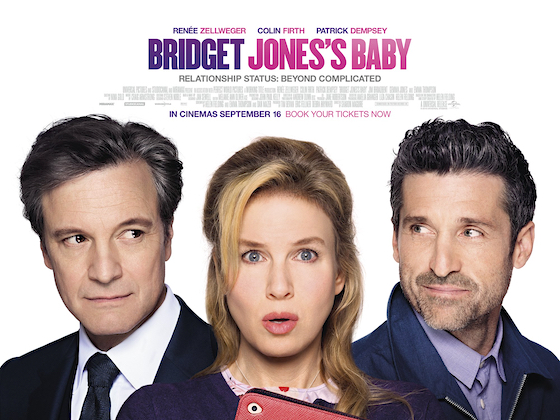
    Bridget Jones’s Baby
    (2016)

    2018 #209
    Sharon Maguire | 123 mins | digital (HD) | 2.39:1 | UK, USA, France & China / English | 15 / R

    Bridget Jones's Baby

    I first and last watched the original Bridget Jones’s Diary and its sequel, The Edge of Reason, many years ago (probably close to when they were originally released, in 2001 and 2004 respectively; certainly well before this blog existed). I didn’t dislike them, but all I can really remember about them is broad-sweep stuff, including barely anything from the second one. So I didn’t come to this belated third movie as an all-read-up fan; but, just like the first two, I didn’t dislike it… and, 100 weeks later, can barely remember any details about it. (I read the detailed plot description on Wikipedia and some of it came back to me.)

    The storyline is mostly pretty obvious — it’s a recycle of the previous films’ love triangle thing, now with the added complexity of a pregnancy — which means the over-two-hours running time feels somewhat excessive (I continue to believe all comedies should be about 90 minutes). In spite of that, it’s often pretty funny. Some of the riffs on modern media and whatnot are a bit tired (“those young people, just posting photos of their food on Instagram!”), but other gags land well enough.

    In the earlier movies, Renée Zellweger attracted praise for her ability to inhabit a British lass. It feels like she’s forgotten how to do the accent in the 12 year gap; or maybe it’s just thanks to the work she’s obviously had done on her face… At least she’s helped by a supporting cast so stuffed with quality performers from UK comedies that some literally just appear in the back of shot (presumably there were deleted scenes).

    Reasonably successful at what it sets out to do, then; enough so that there’s been talk of a fourth one.

    3 out of 5

  • Le Mans ’66 (2019)

    aka Ford v Ferrari

    2020 #177
    James Mangold | 153 mins | Blu-ray (UHD) | 2.39:1 | USA / English & Italian |
    12 / PG-13

    Le Mans '66

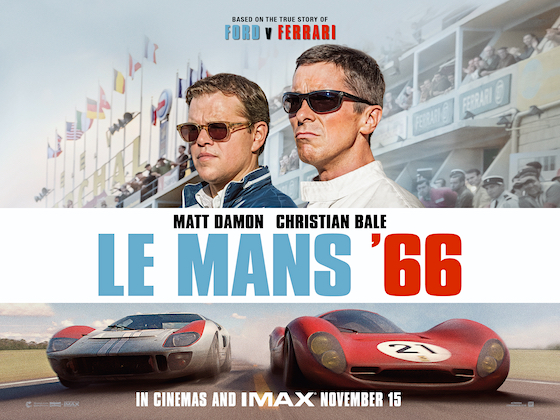
    Did you know that Ford tried to buy Ferrari in the ’60s? I didn’t. As per this film, Ford were desperate to appeal to a younger market and an association with motor racing seemed the way to do that. Ferrari were the regular winners of the Le Mans 24-hour race but were struggling financially, so Ford made an offer; but Ferrari played them, merely using Ford’s interest to get a better deal from Fiat. Pissed off, Ford set about making a racing car by themselves to beat Ferrari at their own game. Enter former Le Mans-winning driver turned race-car designer Carroll Shelby (Matt Damon), a smooth-talking American who’s as adept at charming higher-ups as he is at making fast cars; and his favoured mechanic and driver, Ken Miles (Christian Bale), a quick-tempered Brit who rubs the Ford execs up the wrong way. With Ford’s money behind them, but also management watching over them, can Shelby and Miles engineer a car good enough to beat Ferrari at Le Mans?

    That the film goes by one of two different titles depending where you live might seem like an incidental point of trivia — it’s not the first time this has happened (Avengers Assemble is probably the most famous recent example), and it wasn’t an artistic decision, nor even a marketing one, apparently, but instead legal necessity (according to director James Mangold, you can’t use brand names in a title in the UK and/or Europe) — but it’s also a lens through which we can consider the film’s focus. To wit, is it more about the rivalry between Ford and Ferrari (as in the original title) or winning the 1966 Le Mans race (as in the UK title)? The consensus seems to be that the original title sounds more dynamic, but I think the international one is more accurate. The head of Ford has it in for Ferrari, but our two heroes are more interested in winning the race, rivalry or not.

    Winner!

    To some extent the story has been streamlined in that direction. The original screenplay was an ensemble about the entire team building the Le Mans car — more historically accurate, I’m sure, but I’d wager less dramatic and personal. That’s what’s gained by focusing on Shelby and Miles, the two key figures. To the film’s credit, it still doesn’t pretend they did it alone. The role attributed to other mechanics may not be as large as it was in real life, but nor does the film try to pass it off as the achievement of just two men. What it primarily adds is relatable drama. This isn’t just a movie about building and/or racing a car, but about these two particular men — what motivates them; how their ego gets in the way, especially in Miles’s case.

    The film plays to the lead actors’ strengths in this respect, with Damon turning on the easy charm and Bale, who famously stays in character throughout a shoot, embodying someone who is superb at their job but can be belligerent. The standout from a quality supporting cast is Caitriona Balfe. She may just have the typical Wife role, but she’s made to be a bit more badass than that usually allows… before getting relegated it to the sidelines for the finale, naturally.

    Said finale is the eponymous Le Mans event, of course. It’s not the only race sequence in the film, but it’s by far the longest. Nonetheless, they’re all suitably thrilling in how they’re shot and edited. One of the film’s genres on IMDb is “Action”, and though it doesn’t really conform to my idea of what an Action movie is — not least in the fact that there are only three or four of these “action sequence” race scenes throughout the two-and-a-half-hour movie — I can see where they’re coming from.

    We are golden

    That runtime is quite long, but it doesn’t drag… once it gets going, anyway. The slowest part is early on, getting the story up and running, which I feel could have been streamlined. Ford’s attempt to buy Ferrari initially seems like an aside, but obviously it comes to frame the whole rivalry; but Miles’s woes with the IRS barely have anything to do with the rest of the movie, and, other than providing an extended introduction to the man, I don’t think you’d lose much by losing them. The film was clearly trimmed a fair bit, though, because there are loads of little bits you can spot in the making-of that aren’t in the finished film. Said making-of also highlights the choices behind the cinematography. The visuals are very golden — that kind of “wasn’t the past pretty” atmosphere — but the behind-the-scenes footage shows the shooting conditions to be much duller and greyer, revealing how much the orange/gold light comes from the camerawork and grading.

    Le Mans ’66 might look like a film for car nuts, and I’m sure they’ll get a lot out of it — alongside the likes of Rush, I guess this kind of thing would be their favourite movie (both those films currently sit in the IMDb Top 250). But the rest of us are by no means left out, thanks to involving characters and exciting race scenes, even if some plot beats border on clichéd. Le Mans ’66 may not reinvent the wheel, but it works hard at refining it.

    4 out of 5

    Le Mans ’66 is available on Sky Cinema and Now TV from midnight tonight.

    Jodorowsky’s Dune (2013)

    2018 #228
    Frank Pavich | 90 mins | Blu-ray | 1.78:1 | France & USA / English, French, German & Spanish | 12A / PG-13

    Jodorowsky's Dune

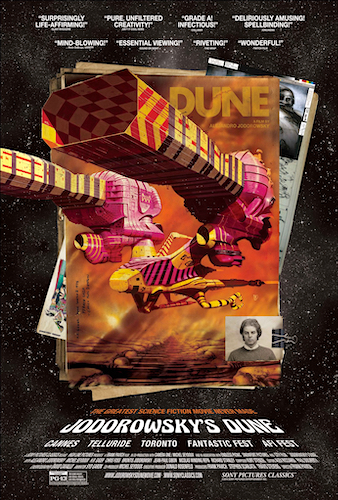
    In 1974, director Alejandro Jodorowsky was hot off a pair of psychedelic projects — “acid Western” El Topo and surrealist fantasy The Holy Mountain — that had brought some cult attention and success (El Topo was the original “midnight movie”, while The Holy Mountain was apparently second only to that year’s Bond film at the Italian box office). Consequently, his French distributor, Michel Seydoux, offered to produce whatever he wanted to do next. Jodorowsky’s answer was Dune. He’d never read it, but he had a friend who said it was fantastic.

    So begins the crazy story of how a director of surrealist Mexican art-films came this close to making an epic space opera out of one of the most acclaimed science-fiction novels ever written, but, in his failure, accidentally helped give birth to Star Wars (sort of), Alien (indirectly), and possibly the entire history of screen science-fiction that did actually get made in the ensuing 40 years. Sounds like a bit of a stretch? Um, well, yeah… but that doesn’t stop some of this documentary’s contributors from asserting it, and they do kind of have evidence.

    Mind you, Jodorowsky’s Dune is full of interviewees making grand assertions, not least the eponymous filmmaker himself. He unironically describes his Dune as “the most important picture in the history of humanity”. He pitches himself as a prophet, thinks of his crew as spiritual warriors, and is convinced the film was going to be a great message for humanity; that it would literally change the world. The lack of self-awareness when he considers Douglas Trumbull to be full of his own importance is palpable. Jodorowsky’s regard for himself and the project may seem deluded, but at least he was committed. They spent two-and-a-half years developing this movie, including storyboarding every shot and getting exactly the right kind of people for the cast and crew — he pursued Dalí literally around the world to persuade him to play the Emperor; he rejected Trumbull, not because of an ego clash, but because he felt he was a technician rather than a spiritual person. He’s a bit barmy, but Jodorowsky definitely believed what he was doing was some grand transcendent enterprise.

    A Chris Foss spaceship design for Dune

    Such an attitude might get you far with arty types, but it doesn’t wash with the moneymen of Hollywood. The film had a projected budget of $15 million, and they went to the Hollywood studios seeking the last $5 million. In hand they had a giant tome containing all the storyboards, the costume and production designs, and so on. The book convinced them — it was well planned out and reasonably costed — but this barmy director — whose only previous films were weird psychedelic experiences; whose response to “make it under two hours” was, “why? If it needs be, it’ll be 12 hours, or 20!” — he didn’t fill them with confidence. And so they didn’t get the money, and the film fell through. Well, duh. Surely they could see how that was going to go? Maybe people just weren’t as savvy in the ’70s, especially these optimistic, committed artists.

    All the documentary’s interviewees act like this was a problem with Hollywood moneymen having no vision, but c’mon, it’s easy to see where they were coming from. Plus, the fact that “the book convinced them” is just the word of Seydoux. Maybe Jodorowsky’s history and attitude was just a convenient excuse, because a lot of the stuff that was designed and planned is quite out there, especially to the mind of a ’70s Hollywood suit. It brings us back to how everyone’s making grand assertions: they all act like the film was going to be an unquestionable masterpiece, but it seems to me there’s a much higher chance it would’ve been terrible. For one thing, there’s doubt over if they even could have made it. It was an insanely ambitious project, with plans to do things George Lucas wouldn’t even attempt in the prequel trilogy, never mind what he struggled to get done in 1977. But there’s a first time for everything — 2001 still holds up, after all, and that was made seven years earlier. Still, I don’t know how successful Jodorowsky’s surrealist mindset would’ve made it as a movie — it probably would’ve been even less palatable to a mainstream audience than the Lynch version.

    Dune storyboards

    That said, there seems little doubt Jodorowsky was ahead of his time here. For starters, the idea of making a 12-hour film isn’t so ludicrous anymore. In the deleted scenes (there’s a hefty 46 minutes of them on the Blu-ray), he acknowledges people wouldn’t sit through that, saying he was prepared to release it in chunks if necessary — so, just like Lord of the Rings would do to huge success 25 years later? Jump forward another 20 years, and it’s even how they’re doing Dune, in two parts! Of course, it was unprecedented in 1975; and, decades later, Rings was still seen as a gamble, but it paid off and Hollywood is now littered with franchises where instalments connect up as closely as TV series. And what of TV series, where you’re also seeing 12-hour (or longer) single narratives.

    Aside from general questions of form, when you look at some of Dune’s storyboards and plans you can see mirrors to stuff that wouldn’t be done until later. This is where the claim that Jodorowsky’s work on Dune led to Star Wars, Alien, et al, comes from, because you can see parallels between what he did and what would come after. His film was never made, but they produced 20 copies of that book I mentioned, and only two are known to exist (one with Jodorowsky, one with Seydoux). The rest were left with Hollywood studios. Were they passed around behind-the-scenes? Did the likes of Lucas and Spielberg and Ridley Scott and Mike Hodges and James Cameron really see them and pilfer ideas? Or is it just coincidence — Jodorowsky thought of them first but couldn’t execute them, then others thought of them independently and pulled it off. Pick your own side.

    However, the claim that Dune led almost directly to Alien is less dubious. After he rejected Trumbull, Jodorowsky saw John Carpenter’s Dark Star and was impressed enough to hunt down its visual effects guy, Dan O’Bannon. Concept artists he hired included Chris Foss (painter of sci-fi book covers, mainly spaceships); Moebius (French comic book artist, for costume designs and storyboards); and H.R. Giger (German artist, who designed the dark and twisted world of the film’s villains). Those who know their Alien history might recognise all of those names: after Dune fell through, O’Bannon went on to write Alien, and all three of those designers followed on to the project. Maybe Alien would have come together just as well without the lead-in from Dune, we’ll never know, but those connections are pretty striking.

    Giger at work on Dune

    Lest you feel bad for everyone just ripping Jodorowsky off, he was able to recycle some of the ideas himself. His vision for Dune was only broadly faithful (one of the better deleted scenes is about his attitude to adaptation, which it seems Frank Herbert agreed with; i.e. that it’s not about being faithful, but reimagining something as a new, different work of art), and so he had plenty of fresh ideas that, presumably, weren’t tied up in the rights to Dune. Jodorowsky and Moebius piled some of these directly into later comic book collaborations, like The Incal and The Metabarons. A good idea never dies, I guess. Well, whether they were good ideas or just good in Jodorowsky’s mind, I don’t know. It does make me interested to read those books, though.

    Jodorowsky’s Dune is an interesting “what if” in the history of science-fiction cinema, and this documentary does a good job of being a making-of for a movie that was never made. (If you think this review reads like I’ve just regurgitated the entire story, I promise, there’s a lot more in the film; not to mention the unique benefits of hearing it from the horses’ mouths, rather than my abridgement for the sake of appending my own opinions.) Some critics assert the documentary does more than just recount interesting anecdotes; that it offers some kind of transcendent viewpoint about the creation of art. Maybe if you’re of a similarly spiritual disposition to Jodorowsky himself, that’s what you’ll take from it. For me, it’s most interesting as a window into what might have been. If it had been made, would Jodorowsky’s Dune occupy the place of Star Wars in our culture? Its devotees think so. I don’t, to be honest. But it’s fun to think about.

    4 out of 5

    The trailer for Denis Villeneuve’s new adaptation of Dune will be released later today.