
Christopher McQuarrie | 132 mins | Blu-ray | 2.39:1 | USA, Hong Kong & China / English, Swedish & German | 12 / PG-13
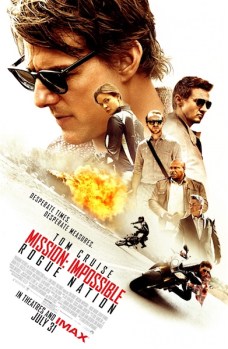 It’s an overcrowded year for spies on the big screen (as previously discussed), so I imagine Paramount were very glad they were able to make the last-minute decision to pull this fifth Mission: Impossible movie forward from its original post-Spectre release date to a summer debut, before audiences perhaps felt the genre was played out. Maybe it wouldn’t have mattered anyway: for my money, Rogue Nation is the best James Bond movie released in 2015.
Beginning a year or two on from the last Mission, we find IMF’s star agent Ethan Hunt (Tom Cruise) investigating the Syndicate, a shadowy terrorist organisation that may not even exist. Hunt finds proof when he’s kidnapped by the Syndicate, escaping with the help of one of their operatives, Ilsa Faust (Rebecca Ferguson). Unfortunately, this is the moment when Washington politicking by CIA director Hunley (Alec Baldwin) sees the IMF shut down. So, naturally, Hunt goes on the run, determined to find and eliminate the Syndicate.
Rogue Nation has a nicely straightforward yet nuanced espionage-y plot, though its hard to accurately summarise its inciting incidents without giving too much away. Suffice to say, it’s not long before Hunt is reuniting with former IMF teammates Benji (Simon Pegg), Brandt (Jeremy Renner), and Luther (Ving Rhames), as well as forming an off-and-on alliance with double (or triple?) agent Faust. They’re aligned against the Syndicate, led by the excellently named Solomon Lane. He’s played by Sean Harris, on fine form as a very still, very quiet, very bespectacled villain. Even though you know the heroes are going to win, it becomes hard to see how they’re going to manage it, so powerful and threatening is Lane.
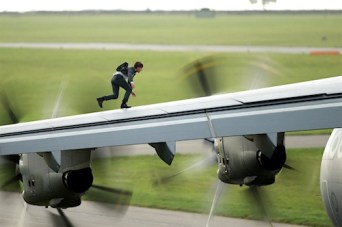 Obviously this uncertainty is also thanks to the story constructed by writer-director Christopher McQuarrie. Some automatically dismiss the plots of the Mission films, saying they’re just an excuse to link some death-defying stunts performed by Mr Cruise. Although there may be an element of truth to that, I don’t think this is a bad storyline by any means. As I said, it’s fairly straightforward (there’s no mole in IMF! Hurrah!), but the intricacies keep it engrossing and keep you guessing. And anyway, the action sequences it ties together are first-rate. You’ve pretty much seen the opening plane stunt in the trailer — heck, you’ve seen it on the poster — but it’s still a thrilling opener. Then there’s the opera sequence, a massive logistical challenge for the filmmakers that they’ve crafted to perfection, making one of the most effective and memorable spy sequences for a long time; arguably, ever. There’s a rich pedigree of such scenes set in theatrical spaces, be they by Hitchcock or even in otherwise-poorly-regarded Bond films, but Rogue Nation’s sits proudly alongside them.
Unsatiated by creating two iconic scenes, McQuarrie and co set about offering even more: there’s an underwater sequence where Hunt has to hold his breath for fully three minutes while diving, replacing an underwater computer chip, and escaping; there’s a crazy car-vs.-bike chase through the backstreets of Casablanca; that’s followed by an equally manic bike chase along the motorways and windy cliff roads of Morocco… If the climax — a runaround through the foggy streets of London — feels a little underwhelming by comparison, it’s through no fault of its own. In my Ghost Protocol review I discussed the Mission films’ consistently lower-key finales, and Rogue Nation is no exception, although I’d contend the sequence works well enough that it’s still one of the franchise’s most effective climaxes.
 As alluded to above, this is probably the most globetrotting Mission film yet: it starts in Belarus, before taking in Washington D.C., Cuba, Paris, Vienna, Casablanca, and London. It’s things like this that lead me to describe it as a James Bond film. There’s also the balance of a serious plot line with plenty of humour, the use of outlandish just-ahead-of-reality gadgets, and the fact that the series can’t retain a female cast member for more than one film (though that last one isn’t a positive). For all the effort Spectre made to bring classical Bond elements back into the fold, Rogue Nation arguably feels more like a classically-styled Bond movie. It’s not a faultless like-for-like comparison — one of Rogue Nation’s best points as a Mission movie is that the whole team are necessary to complete the mission, a defining factor of the TV series that many felt went awry in the movies, with their focus on Cruise — but the almost-indefinable sensation of this experience is Bondian. It’s not stealing that style, though: considering Ghost Protocol had it too, and Craig-era Bond has abandoned it for a ‘classier’ action-thriller mode, it’s something the M:I series has come to own.
Indeed, of late the Mission films have come to feel more like a series than they did previously. It’s now quite well known that every Mission film has a different director, a conscious choice on the part of star/producer Tom Cruise to give each film a unique flavour. To be honest, I’m not sure how well that’s worked. M:I-2 drips with John Woo’s personal style (to the distaste of many, as it turned out), and I suppose the first film is pretty Brian De Palma-y, but since M:i:III things have got distinctly less distinctive. That was helmed by J.J. Abrams, whose only stylistic point is “lens flare”; and it was his first feature, so he didn’t even have that yet. The fourth film was by Pixar’s Brad Bird, making his live-action debut. This fifth isn’t McQuarrie’s first film, at least, but it is only his third, and the first was 15 years ago and I’m pretty sure no one remembers it. Now, none of these chaps did a bad job — far from it, as Ghost Protocol and Rogue Nation are among the series’ best instalments, perhaps even the two very best — but I think you’d be hard pushed to tell the last three films came from different creative brains.
 So on the one hand the recent news that McQ (as current regular collaborator Cruise calls him) is returning to write and direct the sixth Mission is a shame, because it breaks a twenty-year rule; but on the other, I’m not sure it matters. Plus, by taking on the dual role of sole writer and director, you could argue McQ’s Missions are the most auteur-y of the lot, even in spite of the lack of a terribly unique visual style. Which is all a very long-winded way of saying that I was a little disappointed when it was announced there wouldn’t be a sixth director for the sixth film, because I always thought that was a neat idea; but as the idea hasn’t actually had much effect, who better to ask back than the man who wrote and directed arguably the best Mission: Impossible film of them all?
Perhaps that’s because (according to Abrams in one of the special features) McQuarrie wanted this to be a sort of “greatest hits” for the M:I franchise. He’s done that pretty subtly — you don’t feel like you’re watching a string of ripoffs from the first four — but he has done it, with sequences and locations that recall the previous films, and some nice hidden Easter eggs for the hardcore, too. Technical attributes are equally up to scratch, with some lovely lensing by Robert Elswit. He shot most of it on 35mm film and it pays off, with an indefinable classy quality. The score is by Joe Kraemer, who I’d not heard of before, probably because the main thing he’s done is score both of McQ’s previous films. No matter, because his work here is top-notch, and certainly the most memorable Mission score I can, er, remember. Wisely, he’s taken the iconic main theme as his starting point, also used Lalo Schifrin’s other beloved M:I piece, The Plot, and mixed recognisable motifs and elements from these throughout his own compositions. It works marvellously, and helps contribute to not one but two of the best title sequences the Mission films have yet had. Yes, two, in one film. It feels kinda greedy, but I enjoyed it — when you’ve got a theme that good, why not highlight it twice?
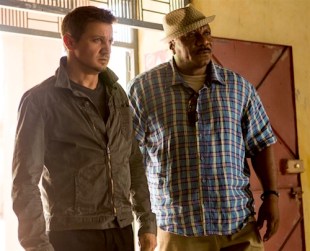
 The cast are liable to get lost among all the grandiose goings-on in a film like this, so its a testament to the skilled team that’s been assembled over the past few movies that they absolutely do not. Cruise is Cruise — surely by now you know whether you like him or not. I always feel like I should dislike him, especially given his crazy real-life religious views, but on screen I find him very entertaining. Rogue Nation is no different. Hunt is on the back foot for a lot of the film, and Cruise is at his best when he’s playing someone who’s almost the underdog. He’s also a more talented comic actor than he’s normally given credit for, and that glimpses through here too. Most of the time comedic duty is handled by Pegg, of course, who provides a good foil as Hunt’s sidekick for much of the film. More surprising, perhaps, is the amount of humour Jeremy Renner brings. It’s much less obvious, dryer and more sarcastic, so the contrasting tone is fun. He’s paired with Ving Rhames for a long stretch, who returns wholesale after sitting out Ghost Protocol but for a cameo. The pairing may come up just short of feeling inspired, but nonetheless makes for an entertaining change. Elsewhere, Baldwin offers a neat, not-too-clichéd turn as the CIA ‘villain’, while Tom Hollander pops in for a funny cameo-level turn as the British Prime Minister.
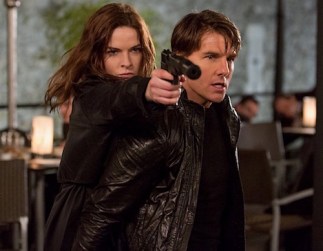
But the real star of the film is Rebecca Ferguson, marking the second male-led action franchise this year where the movie has been stolen from the male hero by the female ‘support’. (The other, of course, is the much-discussed Furiosa in Fury Road.) Ilsa Faust is a fantastic character, whose allegiances are regularly questioned — every time you think you have her pinned down, something changes. She’s an immensely capable agent, but Ferguson also finds her vulnerable side when needed. She’s no damsel in distress — far from it — but she’s not just a cold man-but-with-boobs action heroine either. (Incidentally, it would’ve been very easy to illustrate this review with half a dozen pictures of Ferguson being awesome. But I resisted. Though I should’ve made room for this.) As an action movie leading man, and a producer who can shape the film how he wants, it’s to Cruise’s credit that he allows everyone else to share so much screen time — and to save him on more than one occasion too — and especially so when one of those characters is pretty much stealing the limelight out from under him.
 As the fifth film in a franchise that has always carried a slight “pretender to the throne” air, Rogue Nation should feel played out and tired. Instead it seems fresh and invigorated, with a spot-on tone, likeable and fun characters, a real sense of jeopardy and menace (missing in so many modern action films), and some of 2015’s very best action scenes — and in the year of Fury Road, that’s really saying something. McQuarrie has already spoken about learning lessons from this so he can make the next one even better. I find that hard to imagine, but that’s his mission, and I choose to accept it.

Mission: Impossible – Rogue Nation placed 1st on my list of The Ten Best Films I Saw For the First Time in 2015, which can be read in full here.
This review is part of the 100 Films Advent Calendar 2015. Read more here.
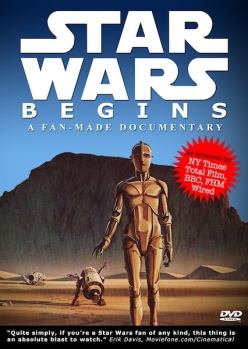 This year, I finally got round to watching the Star Wars Blu-rays I bought back whenever they came out, so I thought what better time to also finally watch Jamie Benning’s trilogy of “filmumentaries”. What’s a filmumentary, you ask? Well, here’s the opening text of the film itself:
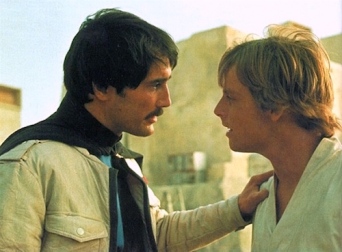 (i.e. before we even meet Luke in the finished film), the sequences were removed en masse due to execs’ fears they made the movie feel like “
 Star Wars Begins may not be the first port of call for anyone looking for an overview of the making of Star Wars, but it’s a goldmine of behind-the-scenes titbits and occasional candid revelations for anyone with a strong enough interest.
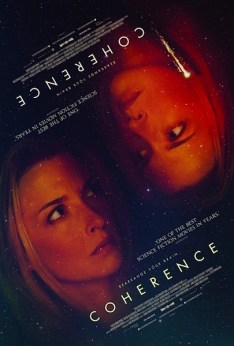 This isn’t something I normally do, but certain factors made me want to review these two films together. They’re both low-budget single-location sci-fi thrillers, but they’re also both more about humanity than ideas — they use sci-fi high concepts as a way to expose, examine, and comment on human behaviour. That I happened to watch them back to back only highlighted the similarities.
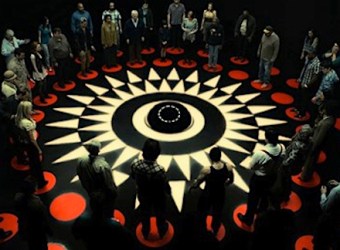
 Circle, on the other hand, must’ve been very tightly constructed. A group of fifty people wake up stood in two circles in a black space, with an array of arrows on the floor in front of them. Every couple of minutes, a klaxon blares out a countdown and one of them is killed. They soon realise they have some control over this, so together they try to work out what’s going on and how to escape, whilst constantly having to select who’s next. Broadly speaking, this is a high-concept thriller in the vein of
  However, it’s clear Byrkit’s focus lay elsewhere. Thematically, it’s about our fear of others, but, as Byrkit explains in
  With fewer to illuminate they’re less quickly-sketched than Circle’s mass of ‘contestants’, and so feel more like rounded humans. By the end, they’re doing things that might initially seem out of character, but actually aren’t at all. (If you can take it, dear reader, there’s a crazy-detailed explanation of the ending (one reading of it, anyway) to be found
  This neo-noir revenge drama with a twist has received such acclaim from critics and bloggers alike that it’s practically set up to fail.
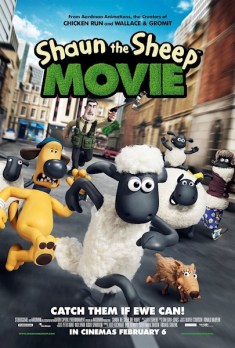 Shaun the Sheep started life in the 1995 Wallace & Gromit short
  (that US PG is thanks to a couple of oh-so-rude fart jokes), but there’s a sophistication to the way that simplicity is handled that adults can enjoy. There are also references and in-jokes for the grown-ups; not hidden dirty jokes that’ll put you in the awkward position of having to explain to the kids why you were laughing, but neat puns (note the towns that the Big City is twinned with) and references to other films (like
  Essie Davis is best known for playing the sassy title role in
 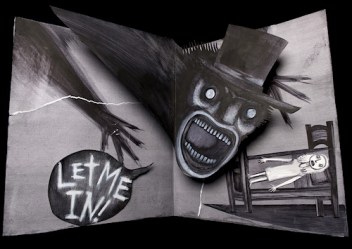 a horror film for people who think about what they’re watching, rather than just waiting for something to be thrown at the screen to make them jump. The slow burn tension will bore those content with the latter, who I suspect don’t tend to think a great deal (for one thing, they’d spot most of the jumps coming if they did).
 There is little in The Babadook that will make you jump, and even less that will make your stomach turn in disgust, but that’s absolutely fine. What it will do is chill your blood, make your hair stand on end, make you worry about every little creak or thump you hear elsewhere in the house after dark, and make you want to sleep with the lights on. Not just the bedroom lights, all the lights. Because once you’ve seen it, you can’t get rid of the Babadook.
 From the makers of
 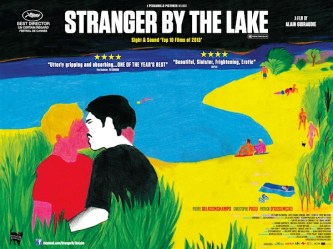 Iiiiiit’s the arthouse gay sex thriller!
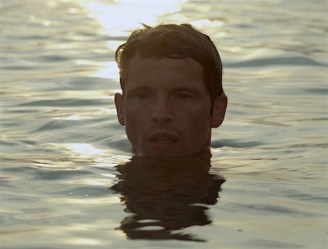 In this regard it has a very particular speed and style — even if there was a version without copious full-frontal male nudity and explicit sex, it still wouldn’t be for everyone. It helps to evoke both a certain time and place (lazy summer days on holiday) and a particular lifestyle (that of gay cruising — which, much to the (presumably straight) policeman’s bafflement, continues virtually unabated even after one of their number is murdered in unexplained circumstances). This is further emphasised by the gorgeous cinematography. Claire Mathon apparently shot it using only natural light, and it looks fantastic — understated (this isn’t a heavily-graded hyper-real kind of beauty), but sumptuous.
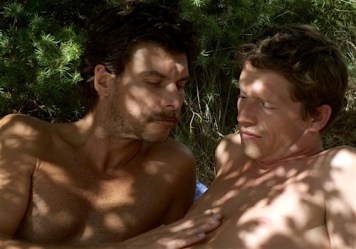 The style is supported by strong performances. I suppose some would say “brave”, by which they’d mean “they’re naked a lot and having gay sex”… so, I mean, maybe it is brave, but, still, that’d be a euphemistic description. What I mean is that they’re strong because they’re calm, understated, realistic, and believable without tipping over into amateurish. You feel Franck’s complex mix of fear and excitement, his lust overpowering common sense; there’s a certain timidity, maybe even naïvety, present in his eyes. Conversely, his lover Michel is unreadable; a closed book, where you never know what he’s thinking, feeling… plotting. Franck’s new friend Henri is similarly tricky to get an accurate handle on, but he’s the yin to Michel’s yang (or vice versa). He’s not plotting, he just is. Or maybe he was plotting all along…?
 This melancholic apocalyptic comedy wasn’t too well received, which is a shame because I thought it was absolutely brilliant.
 is an overwhelming sense of melancholy. It’s a hard feeling for films to evoke, I think — more complex than happiness or sadness, or excitement, or even fear. It comes to a head in an ending that actually brought a tear to my eye, a rare enough feat that it cemented a five-star rating.
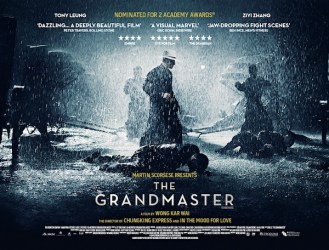 As a Western viewer, if you know anything about Ip Man beyond “he’s the chap who trained Bruce Lee”, it’s probably thanks to the
  It helps that it’s gorgeously shot. Ultra-crisp blue-black rain-soaked night time duels; rich golden hues in pre-occupation Foshan; cold bright-white snowy landscapes; a train platform fight that’s almost sepia-like. Between the photography and the ever-excellent action choreography of Yuen Woo-ping (
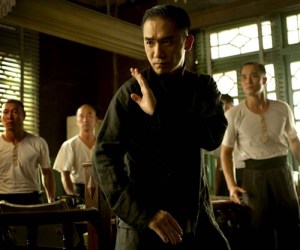 However you look at it, the other Ip Man films are undoubtedly more palatable to a mainstream audience. Does that mean they’re worse? No. Better? Not necessarily. But I don’t think The Grandmaster is all it could’ve been. It seems to run out of story and lose its way as it gets towards the end. The focus shifts entirely to Gong Er, and it feels less clear what it’s meant to about as a whole film. It becomes a movie of great moments, and maybe even scenes, but an unsatisfying whole. But oh, the images…
 100Films.co.uk