2016 #185
Paul Greengrass | 123 mins | Blu-ray | 2.40:1 | UK, USA & China / English & German | 12 / PG-13
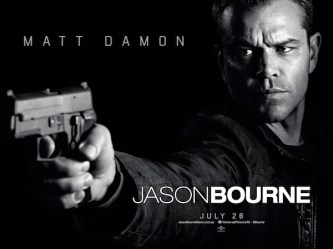 Much like the Bond films to which they’re so often compared, the Bourne movies have their devotees while only fitfully pleasing the critical establishment. This fifth movie — which is notable for marking the return of star Matt Damon and director Paul Greengrass after the semi-reboot of The Bourne Legacy — certainly met with mixed reviews when it came out at the end of this summer. Mixed erring towards negative, anyhow, though it does have its supporters. I’d love to say I’m among them, but my take was more… well, mixed.
The story picks up a decade-ish since the last Damon movie, Ultimatum (I don’t recall if the time gap is specified on screen, but we’re led to believe it’s been roughly real-time). Bourne is still living off the grid, participating in underground bare-knuckle fights in Greece for money and/or something to do. When his former associate Nicky Parsons (Julia Stiles) hacks into the CIA to retrieve documents on the black ops missions she and Bourne used to be a part of, she discovers something about Bourne’s past that leads her to meet up with him. In Langley, hotshot young tech-head Heather Lee (Alicia Vikander) and her boss Director Dewey (Tommy Lee Jones) are on to Nicky and presume Bourne is involved in her plot, dispatching The Asset (Vincent Cassel) to rub them out — but he has his own history with Bourne.
 Action sequences ensue, shot with all the ShakyCam you’d expect from Greengrass. By now I imagine you have your own view on whether his style works or not. Personally, I think it’s considerably less bamboozling than when it made its debut in Supremacy 12 years ago — it’s been so copied that we’re more used to seeing it. I think Greengrass has a better handle on the purpose of the style than many of his imitators, however. I’d also argue that the cinematography in Jason Bourne is a smidgen more stable, with shots held a few frames longer, so that it’s even less seasickness-inducing than before. In fact, some shots — even in the quick-cut action montages — are downright pretty. The film was shot by Barry Ackroyd, who hasn’t lensed a Bourne before but has done most of Greengrass’ other movies, so maybe that has something to do with it.
It’s in the big set pieces that Jason Bourne functions best. One in London in the middle of the film is just people walking around a lot looking over their shoulders, but Greengrass still invests it with some tension. Better is the climax, a kind of drag race down the Las Vegas strip… in the middle of traffic, of course. It’s largely implausible (I’ve been to Vegas — I remember the strip as being permanently gridlocked), but it’s certainly adrenaline-pumping. However, the highlight is probably the first: a chase through a smoky nighttime riot in Athens, with Bourne and Nicky on foot and then a motorbike as they’re pursued by the local police, an undercover CIA team, and the Asset, the latter two directed by Lee, Dewey, and their Langley lot via satellite imagery, CCTV, and… social media.
 Frankly, Jason Bourne is at pains to mix in hyper-current iconography; the reasoning for Damon and Greengrass’ return now being that the world has changed and how does Bourne fit into that? So as well as social media and Greek riots we’ve got references to and riffs on hacking, Edward Snowden, government surveillance of its own citizens, the prevalence of Facebook/Twitter-esque tech companies, and so on. Sadly, I’m not sure the film’s actually got anything to say about any of these things. Greengrass and his co-writer, editor Christopher Rouse, have appropriated all these zeitgeisty concepts to make the film feel very Now, but that surface sheen is more or less where it ends. I mean, there’s a whole subplot starring Riz Ahmed as the Zuckerberg-like CEO of a social media company that I didn’t even mention in my plot summary because it’s kind of an aside. It’s kind of ironic, really, that it always seemed as if Greengrass’ more natural stomping ground was his documentary-ish real-world-exposé type movies, with his contributions to the Bourne series an unusual sideline; yet when he finally marries the two halves of his filmmaking career, it’s the action rather than current-affairs commentary that takes precedence.
Even leaving that aside, the plot is no great shakes. It’s too slight, serving primarily to string together the three or four big set pieces; and it’s too simplistic — Greengrass’ Bourne movies used to be entertainingly baffling, a web of crosses and double-crosses and historical connections and hidden plans. Jason Bourne re-appropriates many of the series’ familiar beats — all of them, in fact — but it feels like Greengrass and Rouse just analysed the previous movies for repeated elements and copied them, rather than having anything fresh to do with the constituent parts. So while few of these building blocks are poorly handled, there’s little remarkable about them either. Some are at least elevated by quality performances: Vikander tries to inject complexity into her character, with some success thanks to final-act kinda-twists, while Tommy Lee Jones brings natural class.
 The end result is that Jason Bourne does thrill as an action movie, which seems to have been the primary goal of its makers, at the end of the day. As an action-thriller, however, the rinsed-and-repeated plot is a slightly faded imitation of former successes; a through-the-motions way to provide those impressively staged chases and punch-ups. It’s not the definitive Bourne movie one might’ve expected from the returning star/director combo (why else come back if not to perfect, or at least add to, the formula?), but instead means the film ends on an odd note: even though it wasn’t a wholly satisfying experience, and even though it doesn’t end with questions still blatantly hanging (as every Bourne movie bar Ultimatum has done), I want Damon and Greengrass to come back and do it all again, please. Only do it properly next time, yeah guys?
Jason Bourne is released on DVD and Blu-ray in the UK today and the US next week.

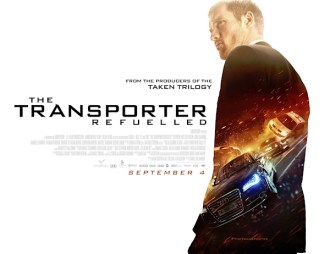 I kind of knew The Transporter Refuelled was going to be bad before I even began, but I watched it anyway because, well, I watched the first three Transporter movies and I really liked one of them, so… It’s just the completist in me, really; though why I was able to ditch Transformers when they semi-rebooted after three films and not this I don’t know. Possibly because the Transporter films have never been good, just entertaining trash, and even though Refuelled’s acting looked terrible and I can’t even remember if the trailer gave any indication of the plot, if it had half-decent action scenes then I’d be passingly happy for 90 minutes of entertainment (unlike Transformers 4, which runs the best part of 3 hours).
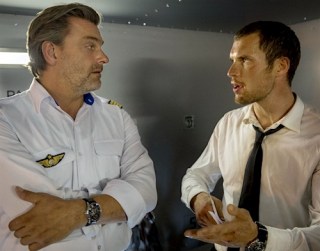 Unfortunately I wasn’t wrong about the acting, which is indeed pretty shit. Ed Skrein was truly dreadful in Game of Thrones (until he was thankfully recast) but was passable as the villain in Deadpool. As this film’s Statham-replacement hero he charts a course somewhere between those two stools. The supporting cast aren’t much better, with the notable exception of Ray Stevenson as Skrein’s dad, who brings much fun whenever he’s on screen. If anything makes Refuelled work as entertainment away from the violence, it’s the father-son dynamic. I want a sequel just to get another dose of that.
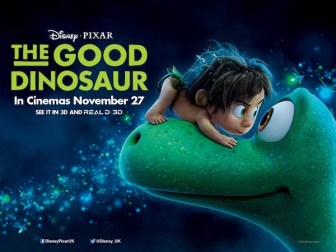 Once upon a time, Pixar could do no wrong. Then
  Pixar have on several occasions produced films with an innovative opening act that descends into derivative kids’ animation runaround territory.
 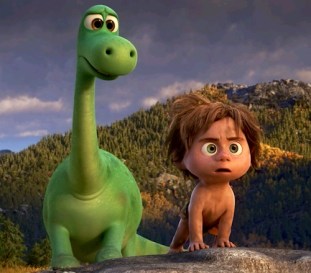 Perhaps most powerful of all is the relationship it creates between Arlo and a young human child he befriends, Spot. With humanity in a much earlier state of evolution, Spot is basically characterised as a dog — the way he moves, comes to his name, follows scents, shakes, scratches and enjoys being scratched, and so on — so of course I warmed to him. Nonetheless, though the building blocks used to create their friendship are very familiar, the way the film sells its emotional arc is ultimately immensely effective. Its resolution may even bring a tear to the eye.
 Between his popular English-language debut
 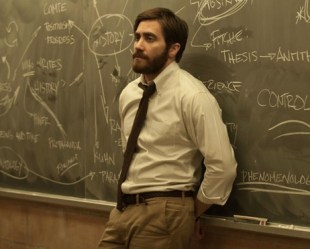 While looking up those various explanations, I read at least one review that asserted it’s a good thing that the film doesn’t provide a clear answer at the end. Well, I think that’s a debatable point. I mean, there is an answer — Villeneuve & co clearly know what they’re doing, to the point where they made the actors sign contracts that forbade them from revealing too much to the press. So why is it “a good thing” that they choose to not explain that answer in the film? This isn’t just a point about Enemy, it’s one we can apply more widely. There’s a certain kind of film critic/fan who seems to look down on any movie that ends with an explanation for all the mysteries you’ve seen, but if you give them a movie where those mysteries do have a definite answer but it’s not actually provided as part of the film, they’re in seventh heaven. (And no one likes a movie where there are mysteries but no one has an answer for them, do they? That’d just be being mysterious for precisely no purpose.) But why is this a good thing? Why is it good for there to be answers but not to give them, and bad for there to be answers and to provide them too? If the answers the filmmakers intended are too simplistic or too pat or too well-worn or too familiar, then they’re poor for that reason, and surely they’re still just as poor if you don’t readily provide them? I rather like films that have mysteries and also give me the answers to those mysteries. Is that laziness on my part? Could be. But I come back to this: if, as a filmmaker (or novelist or whatever) you have an answer for your mystery and you don’t give it in the text itself, what is your reason for not giving it in the text? Because I think perhaps you need one.
 Fortunately, Enemy has much to commend aside from its confounding plot. Gyllenhaal’s dual performance is great, making Adam and Anthony distinct in more ways than just their clothing (which is a help for the viewer, but not for the whole film), and conveying the pair’s mental unease really well. It would seem he errs towards this kind of role, from his name-making turn in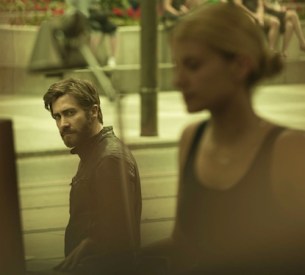
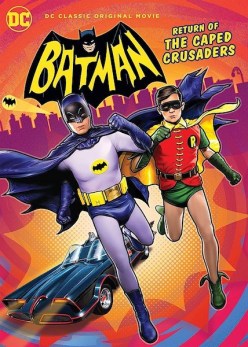 Holy nostalgia hit, Batman! This animated movie reunites the surviving stars of the enduringly popular
 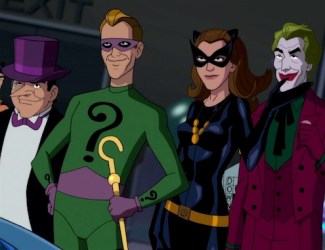 fundamentally, a comedy. Conversely, Ward still sounds pretty spry, and is gifted plenty of those “Holy [insert something here], Batman!” catchphrases that never cease to be fun. Unfortunately, Newmar also sounds her age, but doesn’t seem to quite have the liveliness that West retains. In the behind-the-scenes featurettes she seems a delightfully kooky old bird (at the recording she’s wearing cat ears, for one thing), so it’s hard to resent her, but the portrayal of Catwoman as slinky and sexy feels a little… odd. On the bright side, it means you don’t get the uncomfortableness of West flirting with a much younger actress, even in animated form.
 On the whole, Return of the Caped Crusaders is a resounding success. It’s a fun return to a beloved incarnation of arguably the most popular superhero; a version who’d been somewhat left out in the cold for a couple of decades by a world that grew up a bit too much, but is now being re-embraced and held in deserved esteem. And, even better, there’s already a follow-up in the works. Holy must-see sequel, Batman!
 After a sidestep into big-budget director-for-hire movies that brought him even less acclaim than his last couple of self-penned efforts, once-fêted director M. Night Shyamalan goes back to basics with this low-key found-footage horror.
 Of course, there’s a big reveal to explain everything that’s been going. People call it a “twist” because it’s a Shyamalan movie, but it’s more of an explanation. I mean, what was going on had to be explained somehow, and the explanation comes at the point where you’d expect the explanation to be. I’m not saying it’s not a twist, because it does change what you think you’ve been seeing, but it’s also not a be-all-and-end-all kind of failed-rug-pull, which Shyamalan’s worst twist-obsessed efforts have been. This one works. Or, it did for me.
 ’70s self-sufficiency sitcom
 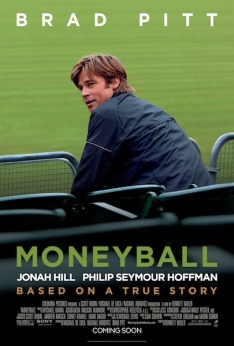 Based on a true story, Moneyball concerns the management of baseball team Oakland Athletics during the 2002 season. General manager Billy Beane (Brad Pitt) struggles to put a squad together due to a comparatively low budget for players, which has seen all his best ones drift off to richer contracts elsewhere. Fed up with the traditional scouting system, he recruits Peter Brand (Jonah Hill) to use statistical analysis to select a cheap team of quality players. The rest of his staff despair, including coach Art Howe (Philip Seymour Hoffman), who refuses to play the team as Beane and Brand suggest, which unsurprisingly leads to self-vindicating failure — until they force his hand…
 Problems extend beyond the sporting specifics. It’s quite some way into the movie before it gets stuck into the meat of the plan working, and before that it often throws in asides that meander around through Beane’s earlier playing career and current family life. The former has some bearing on the plot, though feels inadequately integrated — as one flashback it might work, but as a series of them it’s not enough to constitute a parallel story. The latter, his family life, provides character texture, but it’s slight, uninformative, and ultimately unnecessary. You could cut it and the film would lose nothing.
 and didn’t need any work, which probably explains why it’s not so Sorkin-y. Zaillian is not a bad writer — his credits include
 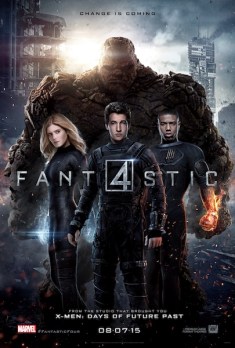 Sometimes you just have to see what all the fuss is about, even if that fuss is overwhelmingly negative. Obviously that’s the case with the most recent attempt to bring Marvel’s popular “first family” to the big screen. The behind-the-scenes stories are already the stuff of movieland legend, so I won’t repeat them here, but what of the film itself? Or the version that ended up available for public consumption, anyway.
 and serve as new pieces — like a shattered mug that’s been reassembled with lashings of superglue and using a handle from another vessel, which has inexplicably wound up a slightly different size and shape to how it used to be. Considering the studio got cold feet and insisted on massive reshoots, this is quite possibly exactly what happened.
 Fox like to keep their superhero movies Serious and Dark — and why not? Before this, it had worked pretty well for them across seven X-Men movies, while their colourful-and-cheery
  What could have been a comfortable 3-star movie, maybe even 4 if it followed through well enough, is dragged down to 2 by studio meddling. Will they never learn? Nonetheless, I actually enjoyed enough of Fantastic Four that, while it won’t be going on the long-list of contenders for the best movies I’ve seen this year, I won’t be putting it on the list for the worst either.
 You wouldn’t think the 2008 financial crisis would make good fodder for a comedy-drama — it’s both too complicated and too grim — but
  The narrative is laden with concepts that are so complicated even people within the industry don’t properly understand all of them (however did the market fail?!), but the movie nonetheless attempts to explain them in an accessible way. It’s half successful: you kind of understand them at the time, about enough to follow along, but the chances of remembering them later are next to naught. One of McKay’s tricks to engage us with these explanations is to wheel in random celebrities to deliver analogies. It’s a fun idea, though it’s success is debatable — I mean, I’ve just about heard of Selena Gomez, and I guess the “famous chef” that turns up must have a TV show in America, or something, maybe? Yeah, the ‘names’ he’s chosen are going to date this movie far more than its 2008 setting ever will.
 Though the conceptual explanations may fade almost as soon as you’ve heard them, what does stick with you is how it all ends. Essentially, the financial industry that destroyed peoples’ lives in pursuit of never-ending profit not only got away with it, but they actually started doing the same stuff all over again, just with new acronyms. What’s even more sickening is that people are clearly aware it’s going on — I mean, we’ve been told as much in an Oscar-winning movie — but they’re still doing nothing about it.
 100Films.co.uk