Serenity (2019)

2019 #27
Steven Knight | 106 mins | download (HD) | 2.40:1 | USA / English | 15 / R
Serenity

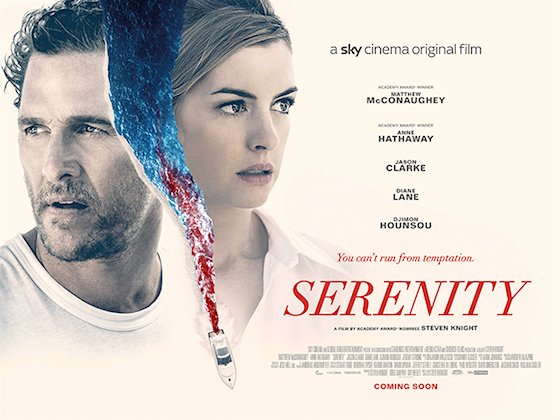
Sorry, Browncoats — this has nothing to do with Joss Whedon’s sci-fi classic. But if you’re instead worried this might supplant that in the general consciousness, never fear: despite coming with the pedigree of a cast headlined by Oscar winners Matthew McConaughey and Anne Hathaway (plus Jason Clarke, Djimon Hounsou, and Diane Lane), and a quality writer-director in Steven Knight (the man behind Locke and Peaky Blinders), this Serenity is a dud of epic proportions. I mean, the fact that, even with those names involved, it’s being dumped in the UK as a Sky Cinema Original should tell you something…

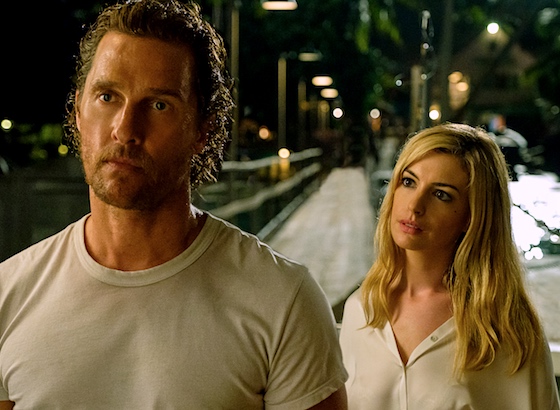
On the remote tropical paradise of Plymouth Island, Baker Dill (McConaughey) is a fisherman mostly taking tourists out on his boat, but eager to catch that one tuna that eludes him (a tuna isn’t quite as romantic a nemesis as a white whale, but I guess we’ll have to go with it). One day, his ex (Hathaway) turns up on the island with a proposition: she’ll pay him $10 million to drop her abusive husband (Clarke) in the ocean for the sharks. She has extra leverage in that hubby is beginning to get abusive towards the son Baker left behind, but who he still cares about. If that wasn’t enough of a moral quandary, there’s more to Plymouth Island than meets the eye, including a fishing equipment company rep who’s desperate to meet with Baker, but keeps just missing him…
An indecent proposal?

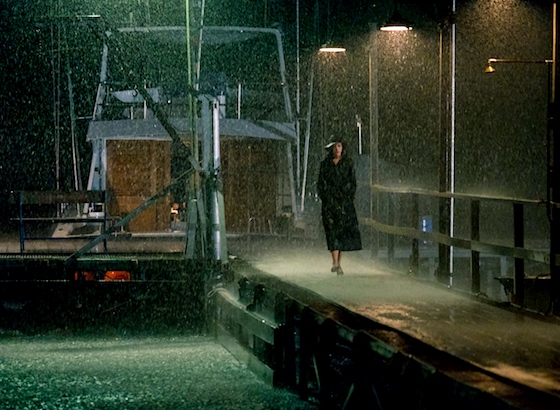
Serenity pitches itself as an island noir, and on the surface it ticks many of the right boxes, especially once Hathaway turns up, looking every inch the part of a classic femme fatale. You can tell she’s hamming it up a little too, playing into the role (with McConaughey, it’s harder to be sure…) It’s also beautifully lensed by DP Jess Hall, capturing both attractive sunny climes and a more overtly noir-ish vibe once a dramatic storm rolls in. But concurrent to that it’s clear some other mystery is going on, and here things get a bit more awkward, the film fumbling not to give too much away too soon. Personally, I think it fails — I guessed the twist pretty early, which I’m pretty sure was not intended, but if you don’t then it’s not cleverly built up to, it’s just muddled.

Once the twist is confirmed — and I say “confirmed” rather than “revealed” because, even though I guessed it, it seemed so loopy that I thought I must be wrong — the whole affair takes on a different light. But it’s not a well thought-through one. It’s the kind of twist that changes your perspective on everything you’ve seen, which is usually a neat development, but here it raises way more questions than it answers. To go into them would be spoilery… so, spoilers follow throughout the next paragraph.

So, we’re supposed to believe this kid has programmed a fishing game starring his dad — not wholly implausible. But it’s one where his dad frequently gets his kit off and shags around for money? I guess we could excuse this as the kid’s been playing too much stuff like Grand Theft Auto and thinks that’s what happens in games, if we’re being kind. But one day he decides to rewrite this game to make it about his dad committing murder, which the character in the game then objects to, and the game turns its own existing rules into an NPC to fight back? What, did this kid accidentally just program a full blown AI? Or several AIs? Or are we going with a Toy Story-esque notion where video game characters are actually sentient? And then somehow his dad actually doing it in-game encourages the kid to murder his real-life stepdad, which we learn thanks to some cheap news voiceover?
So far so noir

Serenity is such a ridiculous mess of a movie that it almost swings back round to being entertaining in its audacity. For me, though, it would need to be better constructed to pull that about-turn off. If it had fully considered the twist and its implications, thought it all through and played by all the necessary rules, some of the people who are laughing at it would still be laughing at it just for the basic concept, but I’d admire it at the very least for committing to its bit. Because it doesn’t, the only reason to consider watching is to marvel at its bizarre eccentricity.

2 out of 5

Serenity will be available on Sky Cinema from midnight tonight, with a limited UK theatrical release from tomorrow.

Green Book (2018)

2019 #26
Peter Farrelly | 130 mins | download (HD) | 2.00:1 | USA / English, Italian & Russian | 12 / PG-13

Green Book

Oscar statue2019 Academy Awards
5 nominations — 3 wins

Won: Best Picture, Best Supporting Actor (Mahershala Ali), Best Original Screenplay.
Nominated: Best Actor (Viggo Mortensen), Best Editing.

White people tell black people all about racism (again) in this year’s surprise Best Picture victor. Well, a surprise to some people — Roma was considered the frontrunner, but some of those with their finger on the pulse of Hollywood had already predicted Green Book’s success. One such pundit was Deadline’s Pete Hammond, a very pro-Green Book voice, although his post-show analysis seems to suggest it only won because of efforts by some Academy members to rig the vote against Netflix…

The reaction to Green Book has been an odd one. It was initially well received, winning the People’s Choice Award after its premiere at TIFF, and racking up acclaim from both critics (a Certified Fresh 79% on Rotten Tomatoes) and audiences (8.3 on IMDb, which places it 128th on their Top 250 list). But the more widely it’s been seen and discussed, the more the tide has turned, especially as a more diverse audience has come to it. On its surface, the film is about overcoming racism — it’s the true story of a bigoted Italian American (Viggo Mortensen) serving as a driver for talented African American pianist Dr Don Shirley (Mahershala Ali) as he goes on a concert tour of the Deep South during segregation — but it’s told entirely from the white guy’s perspective.

Coming at it from the perspective of a white guy also, I can see why people have liked the movie. It’s decently entertaining, with likeable performances from Mortensen and Ali, who have good chemistry. Their chalk-and-cheese relationship is funny without tipping over into outright comedy; and, naturally, the way they come to get along is Heartwarming. But it’s also a completely unchallenging movie. There’s just enough racism that you get to go “ooh, weren’t things unpleasant back then!” and be joyed when the characters overcome it in various ways, but not so much as to convey the actual outrage and horror of the era — or, indeed, the way it continues today. You’d think racism was more or less solved by this pair getting along back in ’62.

Admire the white guy

And that is a big part of the problem with the film. If you’d made this 20 or 30 years ago, that level of discussion might be alright — beginning to make old white men face up to what happened by softening it a little, by letting them see themselves in the white guy. Now, it all looks kinda naïve and simplistic. The more you dig into it, the more you realise Green Book has some casually racist elements of its own. I mean, the white guy even helps the black guy to become a better black guy! That’d be offensive in a fiction, but when these were real people it seems distasteful. I guess the counterargument might be that the black guy helps make the white guy better too, improving his ability to write love letters, as if that was some kind of mutual beneficial exchange. But it’s not equal, is it? Plus it’s again all from the white guy’s perspective: he’s fundamentally fine but, hey, a bit of a polish wouldn’t hurt, whereas the black guy needs a character overhaul that apparently only this straight-talking white guy can give him.

But hey, don’t just take it from this white guy. For instance, check out this piece by Justin Chang at the L.A. Times about the film and its reception in the wake of its big win. It digs into the film’s negatives and controversies better than I ever could.

A side note regarding the film’s title: it’s taken from The Negro Motorist Green Book, a guidebook to help African Americans travel in the segregated South by listing establishments that would accept them. They do use it in the film… briefly, about three times total. You feel like a movie depicting how and why the volume came into existence might’ve made for a more novel story.

Write this instead...

In the end, I find Green Book a little difficult to rate. Coming to it as a white viewer, it’s an enjoyably safe trip into history, with charming characters on enough of a personal journey to give it a story arc, but not so much of one as to ever make it challenging. Similarly, it has a simplistic but not fundamentally negative theme (“racism is bad, yo”). In that mindset, it’s a pleasant, feel-good two hours. But, considering it’s 2019 not 1989, I can certainly see why some are clamouring for more nuanced engagement with these issues. I wouldn’t call it a bad movie, but it is an old fashioned one, and certainly not the best of what 2018 had to offer.

3 out of 5

Roma (2018)

2019 #25
Alfonso Cuarón | 135 mins | streaming (UHD) | 2.39:1 | Mexico & USA / Spanish & Mixtec | 15 / R

Roma

Oscar statue2019 Academy Awards
10 nominations

Nominated: Best Picture, Best Foreign Language Film, Best Director, Best Actress (Yalitza Aparicio), Best Supporting Actress (Marina de Tavira), Best Original Screenplay, Best Cinematography, Best Production Design, Best Sound Editing, Best Sound Mixing.

Drawn from writer-director Alfonso Cuarón’s memories of growing up in the Colonia Roma neighbourhood of Mexico City, Roma is the story of what happens to a middle-class family’s housemaid, Cleo (played by newcomer Yalitza Aparicio), over the course of ten months in 1970 and 1971. It’s also one of the best-reviewed films of the year, winner of BAFTA’s Best Film award (amongst others), and a frontrunner for the same at tonight’s Oscars. No pressure, then.

Roma has already attracted a reputation for being slow and difficult to engage with for ordinary viewers — the very definition of an arthouse movie; and it’s in black and white with subtitles, just to compound the stereotype. There’s no doubting it has a measured pace, and the viewer needs to be prepared for that. It sets its stall with the opening credits, which fade in and out slowly over a static shot of paved flooring being washed by soapy water that flows across it like waves on a shore — and that’s all we see, for several minutes. From there, much of the move unfurls in wide shots, with slow pans or no movement at all, inviting the viewer to search the frame for details and significance. Note that it’s not nominated for Best Editing…

Cleo the maid

At first it’s difficult to see the point of all this, which is where accusations of it being boring stem from. Nothing seems to be happening, just people going about their lives and jobs; a “slice of life” narrative taken to the extreme. What’s missing from that view is context, and as the film goes on we get that — looking back at earlier scenes with the knowledge of what happens later, it’s more possible to see what Cuarón was going for. For example, there are two scenes side-by-side which are barely notable in themselves and certainly have no immediate connection — the father of the family going away on a business trip, and Cleo going to the cinema with the guy she’s been seeing — but when you know what happens later, these scenes are clearly back-to-back for a reason, with a clear connection. One might say juxtaposed, but they’re less being contrasted, more mirrored. There’s quite a lot of that kind of subtle, often exclusively visual mirroring throughout the film — it’s no coincidence the opening shot looks like waves.

This is a film that rewards perseverance, then. It doesn’t work for everyone, but for some the way it slowly inducts us into this family’s life builds to great emotional payoffs come the events of the final act. After a whole lot of very little, it suddenly gets very dramatic and heart-wrenching. You’d have to be pretty cold not to feel anything for the characters given some of the things that transpire, but how much of a connection is developed between them and the viewer is, I think, very much a matter of personal experience. Based on online comments, some find the finale emotionally cathartic, and end up sobbing their heart out; others find Cleo’s silence to be distancing, making her true character and feelings inaccessible, and by turn neutering the film. I find myself sympathetic to both points of view. The film, and the characters, are certainly understated, but I don’t think they’re wholly shut off. Put another way, I wasn’t in tears by the end, but I felt I understood something of these people and their reactions to what had occurred.

Departures

One thing I wasn’t prepared for by anything else I’ve read about the film (which, admittedly, wasn’t much) was how much… slightly odd stuff there was. Not full-blown Lynchian weirdness, just things you don’t really expect to see. A surprising focus on dog shit, for example. A martial arts display with some very, er, jiggly full frontal male nudity. A Norwegian New Year’s Eve song performed in front of a blazing forest fire. Walls of pet dogs’ heads mounted like hunting trophies in a macabre display of affection, but with the sheer disturbingness of that seeming to go uncommented on. Cuarón has said 90% of the movie comes from his own childhood memories, so I guess he had an interesting time of it…

At the very least, Roma is a technical masterpiece. Shot by Cuarón himself (because Chivo was unavailable), it looks thoroughly gorgeous — crisp, textured, always perfectly lit, be that by the nighttime glow of a city or misty morning air, with some shots that look like molten silver caressing the screen. Cuarón is the frontrunner for the cinematography Oscar, marking the first time it will have gone to a director lensing his own film (assuming he does win, of course), and it seems to be very much deserved (in fairness, I’ve not yet seen any of the other nominees to compare).

But while everyone talks about the photography, very few people seem to mention the immersive sound design, and I think that’s just as worthy of attention. Roma is also nominated tonight for Sound Mixing and Sound Editing, categories that are often dominated by blockbuster-type films due to their energetic soundscapes — its competitors include the likes of Black Panther, Bohemian Rhapsody, First Man, and (somewhat ironically) A Quiet Place. I doubt Roma will overcome their bombast, but in its own way it’s just as effective, generating a world around you with its enveloping audio. I guess this is partly the problem of it going direct to Netflix, though — most people who see the film will listen to it through TV speakers, or, at best, a stereo sound bar. However, it’s proof that surround sound isn’t just for action movies, and that it’s worth having a system in your home, if you can.

Journeys

On the whole, Roma exudes the feel of a quality piece of Art, with a capital ‘A’ — it’s beautiful to look at, slow and heavy and opaque in its storytelling, with (perhaps) some deep message about human experience that’s left for the viewer to discern. Is it the best picture of 2018? Well, I mean, if you like that kind of thing… Should it win tonight? That depends what you think the Oscars should be rewarding, I guess. It’s not an unworthy champion in an artistic sense, but is something else — something artistic in a different way, and also more accessible — even more deserving of being crowned The Best? That’s always the tug-of-war when it comes to Best Picture, I suppose. It’s certainly not my favourite movie from last year (and I wouldn’t necessarily expect it to make 2019’s list either), but I still admire much of it.

5 out of 5

The 91st Academy Awards are handed out this evening. In the UK, they’re on Sky Cinema Oscars from 12:30am, with highlights on Sky One tomorrow at 9pm.
Ocean’s Eight (2018)

2019 #23
Gary Ross | 110 mins | download (HD) | 2.39:1 | USA / English, German, French & Hindi | 12 / PG-13

Ocean's Eight

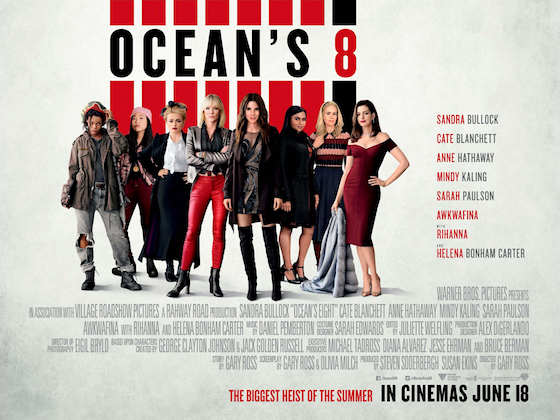
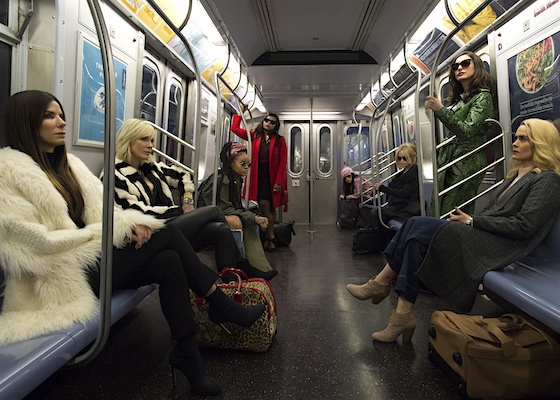
This somewhat belated spin-off from the Ocean’s trilogy of all-star heist movies (it came eleven years after the last one) introduces us to Debbie Ocean (Sandra Bullock), the sister of George Clooney’s eponymous character from the trilogy, and also an experienced con artist. Recently released from prison, she sets about assembling a crew for an audacious heist: to lift a near-priceless necklace during the prestigious Met Gala.

Said crew is all female — well, the crews in the previous trilogy were almost exclusively male, so why not? And just as those casts were full of big-name stars, so too is this. If Bullock’s in the Clooney role then Cate Blanchett takes over the part of Brad Pitt: the cool, in-control ‘sidekick’ who really makes Ocean’s grand plan happen. Fortunately, the film doesn’t slavishly map everyone else onto roles from the previous movies. One of the key parts is a fashion designer, played by Helena Bonham Carter — not a job that’s normally required for a heist, I don’t think. Here, it’s their way to access the mark who’ll be wearing the necklace, played by Anne Hathaway. The rest of the titular crew is rounded out by names of varying degrees of famousness, depending on your exposure to their previous work: Rihanna, Sarah Paulson, Mindy Kaling, and Awkwafina.

As a gang, they’re quite likeable, fun to hang around with, and the cast seem to be having a good time. They’re somewhat hampered by a screenplay that rarely gives them the sparky material the previous bunch had to work with, though, so I’d suggest if there’s a Nine they get someone to punch up the dialogue and give this lot the text they deserve.

One, two, three, four, five, six, seven... yep, eight. There's eight of them.

Having said it doesn’t wholly map onto the previous movies, Eight massively lifts one plot thread from Eleven, which is that Debbie’s plan is secretly a way to get back at an ex boyfriend (Richard Armitage). Okay, in Eleven Danny Ocean is trying to win back his old lover and/or punish her new boyfriend, whereas here those characters are kinda combined as Debbie Ocean is trying to punish her old lover, but, well, the basic conceit is the same, right? The film does nothing to acknowledge that fact, just leaving it hanging there — awkwardly, if you’re au fait with the first movie. Conversely, whereas Danny was obsessed with his revenge to the point it risked derailing the main heist, for Debbie it seems to be a side benefit.

That isn’t necessarily better, mind: it lowers the stakes of both the subplot (because she doesn’t seem that bothered) and the main plot (because she’s not in danger of getting sidetracked), so why include something so familiar? Indeed, the whole plot is relatively light on stakes, with the team carrying off everything with nary a hitch — barely any need to improvise or change the plan here, they’ve just got it covered. The one potential problem that does arrive is solved instantly, even before the heist begins, with such a straightforward fix that they don’t even need to modify the plan to incorporate it. It’s not even fake jeopardy, it’s just non-jeopardy.

The whole film veers dangerously close to blandness in this fashion. Director Gary Ross may be a friend and colleague of Steven Soderbergh, but he doesn’t seem to have picked up the trilogy director’s inventiveness. There’s some mildly flashy editing scattered about, and maybe one creative shot / bit of sound design (when the camera follows the necklace underwater, the non-diegetic music gets muffled like, you know, we’re underwater), but it lacks the sophistication and verve Soderbergh brings. It feels like it needs a kick up the arse, basically.

“Could you just give it a bit of a kick up the arse?”

I even began to worry it was going to end with no attempt at genuine twists or surprises whatsoever, aside from a few minor but not terribly exciting reveals, which is not good for a heist movie — part of the point, surely, is that they also pull off a kind of narrative heist on the viewer. Fortunately, Eight does have a trick up its sleeve, which is quite fun. But even then, the big plan is still a pretty simple heist, which the film tries to pretend is complicated by showing Heist 101 stuff in excruciating detail (there’s a whole scene devoted to Rihanna slightly changing the position of two security cameras, one… click… at… a… time…)

Yet for these faults, Eight still works as breezy entertainment. It’s not as perfectly slick and polished as Eleven — but then, that would’ve been asking a lot (as pure-entertainment capers go, Eleven is virtually flawless). It’s not as boundary-pushing as Twelve (a seemingly muddled film that gets interesting the more you think/read about it), but nor is it as aimless and derivative as I found Thirteen. It lacks the creative spark behind the scenes (either in the screenplay or directing departments) that could’ve elevated it, but it’s an easy way to spend a diverting couple of hours.

3 out of 5

Ocean’s Eight is available on Sky Cinema from today.

Attack the Block (2011)

2018 #231
Joe Cornish | 88 mins | Blu-ray | 2.40:1 | UK & France / English | 15 / R

Attack the Block

The directorial debut of comedian Joe Cornish seemed to become an instant cult classic on its release back in 2011 — I distinctly remember US geek websites urging people to see it and even arranging screenings, leaning hard into the kind of word-of-mouth promotion that is often how these small but dedicated fan bases are born. It has the kind of online scores that back up that status: as much as everyone who talks about it seems to love it, it only rates 6.6 on IMDb. I guess you’re either in a cult or you’re not. While I did enjoy it on the whole, I couldn’t quite see what all the fuss was about.

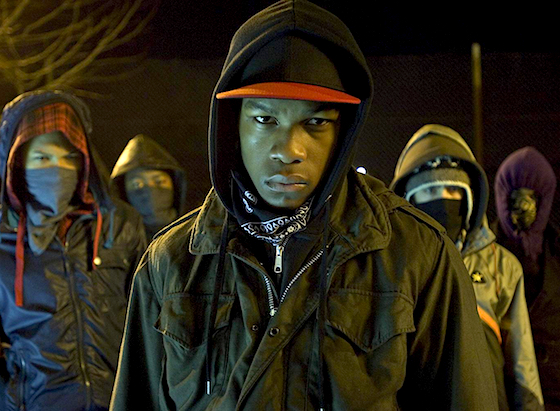
The film centres on a gang of teenage lads, led by John Boyega in what it turns out was a star-making performance. They roam their inner city London tower block and its surrounding streets, and we first meet them mugging a young nurse (Jodie Whittaker); and, when an alien creature falls from the sky, they savagely beat it to death. Hardly E.T., is it? Of course, murdering the little thing turns out to have been a bad idea, because soon more of the bastards are falling from the sky, and they seem to be particularly targeting our “heroes”.

I’ve bunged heroes in quotation marks there because this gaggle of protagonists are a right bunch of little so-and-sos (to be polite about it). The film sets itself a hurdle by making them so initially unlikeable, and then struggles to overcome it — frankly, I was cheering on the aliens to give the little chavs what for. You could certainly make a movie where the protagonists are unlikeable and the thrill comes from waiting for them to be slaughtered by the ostensible villains (I feel like someone has, probably something incredibly high-profile, but I can’t remember what it is right now), but I don’t think that was Cornish’s aim.

Thugs'r'us

On the brighter side, the boys eventually come across Whittaker’s nurse again, because she lives in the same block as them, and so we have her to root for. Her earlier experience makes her as non-disposed to the gang as I was, and it’s her connecting with them somewhat that comes to rehabilitate them. There’s also Luke Treadaway (that’s the one from Clash of the Titans and A Street Cat Named Bob and Ordeal by Innocence and so on, not to be confused with his brother Harry, who’s appeared in The Lone Ranger and Cockneys vs Zombies and Penny Dreadful and so on; although they’re twins, so, y’know, good luck) as a posh kid trying to score some drugs, and Nick Frost as the dealer he’s trying to get them off, to bring some comic relief. Not that the rest of the film is super serious (it’s about teenage chavs battling ferocious alien bears, c’mon), but their more direct humour is welcome too.

Despite my reservations about the characters, the film is a great calling card for writer-director Joe Cornish. Although tonal similarities between the movies invite comparisons to what Shaun of the Dead did for Edgar Wright (especially as he’s friends with Cornish and an executive producer here), I feel like Wright’s breakout film was even more assured. Instead I think of something like Guy Ritchie and Lock Stock: an imperfect film in itself, but which suggests a lot of potential from the man behind the camera. Quite why it’s taken eight years for Cornish’s second feature to come around is a mystery.

4 out of 5

Attack the Block was viewed as part of my Blindspot 2018 project.

Joe Cornish’s second feature, The Kid Who Would Be King, is in UK cinemas from tomorrow.

Hereditary (2018)

2019 #19
Ari Aster | 127 mins | streaming (HD) | 2.00:1 | USA / English | 15 / R

Hereditary

Unless I’m forgetting something, I think Hereditary was the most-discussed, most must-see horror movie of 2018, so if, like me, you’re only watching it now, you’re late to the party. Still, as with most horror films, the less you know the better for its effectiveness (not to mention there are so significant unexpected developments in the story, which even the marketing managed to hide for a change), so I’ll keep this review spoiler-free.

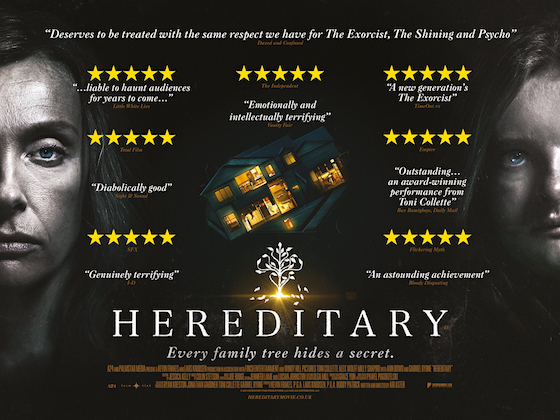
The film centres around a family living in a remote-looking part of Utah: mother Annie (Toni Collette), her husband Steve (Gabriel Byrne), her 16-year-old son Peter (Alex Wolff), and 13-year-old daughter Charlie (Milly Shapiro). After Annie’s sometimes-estranged mother dies, various family members begin to see and experience odd things, and… well, like I said, the less you know the better. Hereditary is the kind of horror movie that relies on the mood it builds up to unnerve you, so if you have too much of a head-start on the plot it’s like crippling the film’s ability to suck you in.

I do think it’s perhaps important to understand what kind of movie this is, though, because many of the negative reactions I’ve read seem to stem from misaligned expectations. Hereditary plays almost more like a family drama than a horror movie for a good while, albeit one with some scary moments and a general air of unease; of something about to go very wrong. You’ve likely heard how good Collette is in the film, how many people wanted her to get an Oscar nom, and this is really why. The storyline gives her a plausible character in a state of extreme emotional strain, and she plays this conflicted, broken woman with just the right balance of subtlety and explosive emotion. Credit, too, to the rest of the lead cast, who are more understated, but in a way that brings necessary balance. They may be less showy, but their contribution is vital. First-time writer-director Ari Aster has been hailed as a great new voice in horror filmmaking, but I’d wager if he went on to do straight dramas we’d be just as fortunate.

Toni Collette

As things go on, naturally the background creepiness increasingly edges into the foreground. There are even jump scares that got me, and I can’t remember the last time a horror movie managed to get me with a jump scare — and one of them was purely auditory. This movie made me begin to hate my surround sound system. If you watch without one, you are losing some of the impact, frankly. But even worse than the jumps are the things you see coming, or gradually come to notice are there; the stuff you see but then have to wait for what’s going to happen. There are situations and images here that will haunt your memories after viewing. It’s this overall unsettling atmosphere that will keep you on the edge of your seat for much of the runtime; more like, say, The Shining than a blood-and-guts fairground ghost ride.

If there’s one place it missteps, it’s perhaps the final act. Some people have accused it of a tonal shift here, or even of being “goofy”. I agree that it spirals quite quickly from “family drama with a bit of the supernatural” to bringing everything to a head, and many of the most outright “horror” bits are in this final act, but it still kept me uncomfortably on edge. (I know I said I’d keep this spoiler free, but, fair warning, I’m going to allude to the ending now. Jump to the final paragraph to avoid all that.) The only time that tension dissipated was in the very last scene, which I don’t think was the intention — it’s not meant to come as a relief, but by finally answering some questions and putting some things out in the light, it kind of lets you come to terms with them. It’s also a little, for want of a better word, daft; or, as that other person said, goofy. Most of Hereditary is truly unsettling, even when it’s not being outright scary, so it’s kind of a shame it didn’t have a final moment that maintained that unease.

Milly Shapiro

I say it “answers some questions”, but it’s not an exposition-fest that explains everything that’s been going on. That may well lead you to start interrogating the plot afterwards to fill in some of the gaps, and I’m not sure it all hangs together. I’m all for films that leave audiences to use their imagination and intelligent thought to fill in holes themselves (and by “holes” I don’t mean “plot holes”, just things the film hasn’t explicitly explained), but when you start trying to plug gaps and find it doesn’t add up, maybe the film should’ve explained something more. Or maybe it’s a movie about the unknowable and so, of course, we can’t know it all. An individual’s own taste will vary on how much this matters: some people won’t spend any time turning the story over after the film ends, in which case it’s conclusive enough as it is; others can write it off as, as I said, the unknowableness of the supernatural; others still might find the apparent gaps undermine the whole experience. I sit somewhere between the latter two stools, because I don’t think you notice the gaps until you begin to think back over the logic of what must’ve occurred, and I don’t think the lingering questions retrospectively undermine the potency of the movie-watching experience, but it is a shame it doesn’t seem to all add up.

It’s these questions that were going to hold me back from giving Hereditary full marks, but I’m not sure that’s fair. Sometimes the journey is more important than the destination. Even then Hereditary’s destination isn’t bad, it’s just not perfect. And the journey to get there… As a horror movie, it’s one of the most genuinely unsettling I’ve seen for some time, with imagery that makes my hair stand on end just remembering it. It’s all the more effective for the way it grounds itself in real-life tragedy, with a powerhouse performance from Collette that, yes, if it were in a straightforward indie drama would surely be a frontrunner this awards season.

5 out of 5

Hereditary is available on Amazon Prime Video in the UK from today.

It placed 13th on my list of The 15 Best Films I Saw For the First Time in 2019.

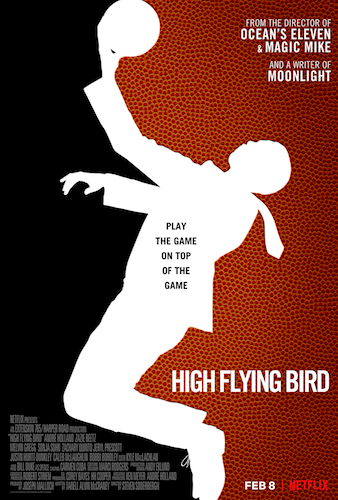
High Flying Bird (2019)

2019 #14
Steven Soderbergh | 90 mins | streaming (UHD) | 2.35:1 | USA / English | 15

High Flying Bird

Steven Soderbergh’s ‘retirement’ continues with another shot-on-iPhone movie (following last year’s psychological thriller Unsane), this time going direct to Netflix. Whereas Unsane made a virtue of its iPhone cinematography to heighten a disquieting, untrustworthy atmosphere, High Flying Bird forges ahead with no such baked-in excuse for its visual quality. However, similarly to Unsane, the fact it was shot on an iPhone is almost incidental, noteworthy mainly just because it’s unusual. But more on that later.

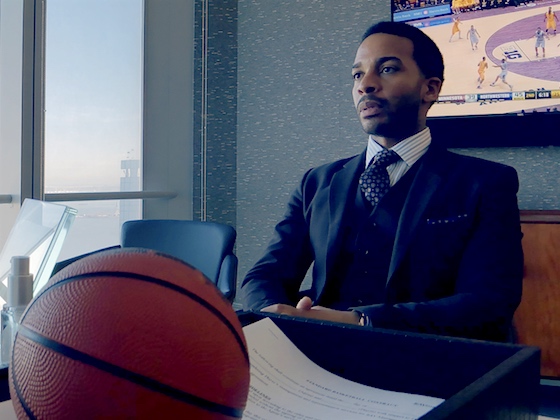
The movie is about Ray (André Holland), a basketball agent struggling to keep his players in check during a lockout… and already you’ve lost me, movie: I had to look up what a lockout is. I’m not much of a sports person, and I’m pretty sure we don’t have lockouts in British sports. Basically, best I can tell, it’s some kind of disagreement between the players (through their union) and the team owners, which results in games not being played when they should be, and people not being paid because nothing’s happening. So, it’s a bad thing, and it’s putting Ray in a bad situation — so he sets about trying to launch an “intriguing and controversial business opportunity”, to quote an IMDb plot summary.

Something like that, anyway. Frankly, it took less than two minutes for High Flying Bird to leave me feeling lost and confused, as it dives into an “inside baseball” (as the saying goes) depiction of basketball right from the off. It felt like watching a French movie without subtitles, except here the language isn’t French, it’s basketball. In fairness, I did eventually get a handle on what the overall plot was, but mostly with hindsight and not ’til quite far in — my analogy still stands for what the viewing experience was like until that point.

Lost and confused

For fans of basketball, or at least those with some kind of knowledge of the workings of the business side of American sport, it might all be more palatable. I think there’s some good stuff in the plot and characters, but I can only say “think” because I made such a lousy fist of following what was meant to be going on half the time. The story culminates in a final twist/reveal about Ray’s actual plan. Fortunately, by that point I’d worked out (more or less) what events had happened, so I followed it — indeed, I got there ahead of it. Well, that’s because before viewing I read a comment which implied this was a heist movie (like Soderbergh’s previous work on the Oceans films or Logan Lucky), so I’d already been on the lookout for what the real con was. Nonetheless, I’m torn between whether the reveal was quite clever, or the film thinks it’s cleverer than it actually is. If I hadn’t had that heads up, maybe I would’ve been as mind-blowingly impressed as Ray’s boss seems to be when Ray reveals the real plan to him. Or maybe I wouldn’t’ve, who can say.

Unsane suggested you couldn’t make a good-looking film on an iPhone. High Flying Bird says, actually, you can. It doesn’t all look great (especially when, for example, the shot literally wobbles from something as simple as someone putting a drinks bottle down on a table), but there are some beautiful shots in here too. Unsane almost had to make a virtue of its odd look, the weirdass visuals chiming with the story of a possibly unstable mind. High Flying Bird has no such excuses, and most of the time it doesn’t need them; though some parts do still look like a first-effort student film, which is very odd coming from a director as experienced as Soderbergh (this is the 56-year-old’s 29th feature, not to mention his 39 episodes of TV).

Looking to the future

While researching the film’s production I came across this interesting article at The Ringer, which uses High Flying Bird as a jumping off point to examine the history, increase, and future of using iPhones for professional projects. It basically contends that phone-shot films are the future for everything, and makes that sound reasonable. It’s reminiscent of the emergence of digital photography for movies: it was a big story back when Soderbergh shot Che with digital cameras (Criterion’s Blu-ray release has a half-hour documentary dedicated to it), but it was only a couple of years later that became standard for all major movies, and a few years after that it’s now noteworthy when something is actually shot on film. It seems inconceivable that one day they’ll be shooting an Avengers movie on a phone, but then it once seemed inconceivable you’d shoot a movie that big on digital video…

It’s quite hard for me to give a concise opinion of High Flying Bird. I struggled through much of it, which made for an unpleasant viewing experience. But I acknowledge some of that lies with me knowing less about basketball than the film does. But then again, is it the film’s responsibility to explain to me the things I don’t know? I did get a handle on events by the end, and if I watched the film again I expect I’d follow it better, but I also don’t feel there’s much luring me back for a second viewing.

3 out of 5

High Flying Bird is available on Netflix now.

The Ragtag Review Roundup

My review backlog has got a bit silly: there are currently 128 unposted reviews on it, dating back to stuff I watched in January 2018. I was hoping to really get stuck into that as 2019 began, but I’ve been busier than expected. Anyway, I’ll keep trying — and here’s a start, with a real mixed back of films that have basically nothing in common.

In today’s roundup:

  • American Psycho (2000)
  • Logan Lucky (2017)
  • A Nightmare on Elm Street (1984)
  • The Treasure of the Sierra Madre (1948)


    American Psycho
    (2000)

    2018 #66
    Mary Harron | 102 mins | streaming (HD) | 2.35:1 | USA & Canada / English | 18 / R

    American Psycho

    The film that made Christian Bale’s name sees him play Patrick Bateman, a high-flying New York banker with psychopathic tendencies — well, that just sounds like all those Wall Street types, right? Except hopefully they’re not actually engaging in literal killing sprees, unlike Bateman.

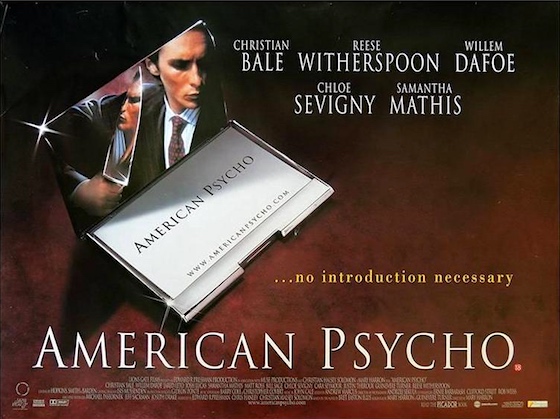
    While the murdering stuff may look like the draw, American Psycho is more interesting as an examination of the corporate mentality. It manages to be remarkably insightful, satirical, and terrifying all at once. Take the scene where they compare business cards, for instance: it’s ridiculous how much interest and importance these guys are placing in little cardboard rectangles with their name and number on, and yet you can believe such business-wankers would care about it. The anger Bateman feels when other people’s cards are considered classier than his is palpable.

    It’s a great performance by Bale across the board — so well judged, despite being barmy. It’s also interesting to observe the links between this and his version of Bruce Wayne, which is a wholly appropriately connection. I mean, who’s more of an American psycho than a guy who spends his days pretending to be a playboy businessman and his nights dressing up as a bat to beat up bad guys? I’m sure someone must’ve already developed a theory / amusing trailer mashup connecting the two films…

    The only thing that really let the film down for me was its final act. No detailed spoilers, but while I thought the rest of the film was engagingly made, the ultimate lack of resolution felt empty. To me, it seemed like it didn’t know how to end.

    4 out of 5

    Logan Lucky
    (2017)

    2018 #65
    Steven Soderbergh | 119 mins | Blu-ray | 2.39:1 | USA / English | 12 / PG-13

    Logan Lucky

    Two brothers, whose family has a historical proclivity for bad luck, decide to rob one of the US’s largest sporting venues, the Charlotte Motor Speedway, during one of its quieter events. But when the situation changes, they end up having to pull the job off during the biggest race of the year.

    Director Steven Soderbergh’s return to the heist genre a decade after Ocean’s Thirteen is something to be noted; and while Logan Lucky is a very different kind of heist movie (there’s none of that trilogy’s Hollywood glamour to be found here), it’s a more successfully entertaining movie than either of the Ocean’s sequels.

    Like them, it’s not terribly serious, instead ticking along as generally quite good fun — though there’s a scene with Take Me Home, Country Roads that’s quite affecting. Between this and Kingsman 2, I’m left to wonder how that wound up becoming just about the most emotional song ever recorded…

    Anyway, the showpiece heist is clever, in its own way, and rolls around sooner than I expected — it’s funny to read some people criticise how long it takes to get to, because I assumed it would be Act Three. Instead, the film constructs a post-heist third act that was the only time it really got too slow for me, though it does eventually reveal a purpose that was kinda worth the wait. That said, the whole thing might benefit from being a little bit tighter and shorter — ten minutes trimmed across the pre- and post-heist acts might make it zing just that bit more.

    4 out of 5

    A Nightmare on Elm Street
    (1984)

    2018 #71
    Wes Craven | 87 mins | TV (HD) | 16:9 | USA / English | 18 / R

    A Nightmare on Elm Street

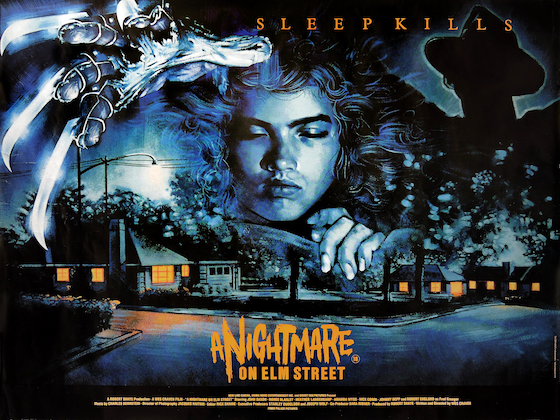
    It may be regarded as a horror classic, but I have to admit that I found A Nightmare on Elm Street to be a crushing disappointment. To me, it seemed to be a pretty poor movie (all weak: the acting, the dialogue, the music, the timescale events supposedly occur in) with some fantastic imagery. Director Wes Craven was a master, of course, and he manages to construct some truly great shots and moments amid a dirge of mediocrity. There’s a lot of nonsensical stuff too. I guess “dream logic” is meant to excuse it, but… eh.

    I do really like that poster, though.

    3 out of 5

    The Treasure of the Sierra Madre
    (1948)

    2018 #6
    John Huston | 121 mins | TV (HD) | 4:3 | USA / English | PG

    The Treasure of the Sierra Madre

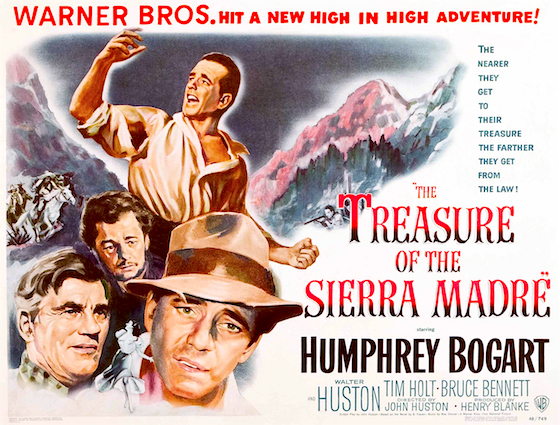
    Set in the mid ’20s, two American drifters in Mexico (Humphrey Bogart and Tim Holt) team up with an old and experienced prospector (Walter Huston, director John Huston’s father) to hunt for gold in them thar hills. Along the way they have to contend with rival prospectors, violent bandits, and — most dangerous of all — their own suspicions and greed.

    The Treasure of the Sierra Madre blends genres like there’s no tomorrow: it’s been described as a plain drama, an adventure movie, a neo-western, it’s included on film noir lists… Of course, depending which angle you look at it, it’s all of the above. It’s both an exciting adventure movie and a character-centric exploration of the effects of greed. In depicting that, Bogart’s performance is excellent, though Huston Sr threatens to steal the show. Poor Tim Holt is overshadowed by them both, even though he gives a likeable turn.

    5 out of 5

  • Velvet Buzzsaw (2019)

    2019 #11
    Dan Gilroy | 112 mins | streaming (UHD) | 1.85:1 | USA / English | 15 / R

    Velvet Buzzsaw

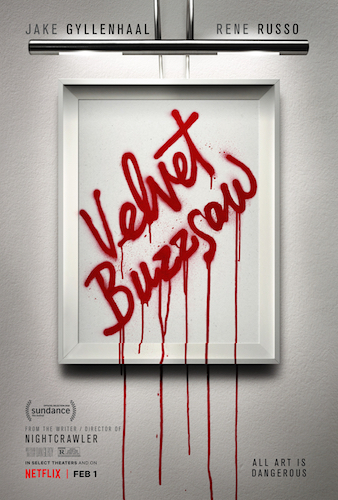
    The team behind neo-noir modern classic Nightcrawler (writer-director Dan Gilroy, stars Jake Gyllenhaal and Rene Russo, cinematographer Robert Elswit, among others) reunite for this direct-to-Netflix genre mash-up — it’s part art-world satire, part mystery-thriller, part horror. The Verge described it as “Robert Altman’s Final Destination”, and that so succinctly articulates what the film reminded me of that I decided to just lift it. Well, just pilfering someone else’s work is in-keeping with the film’s themes, at least.

    Set in the world of high art, it stars Gyllenhaal as all-powerful critic Morf Vandewalt, whose reviews can make or break sales worth millions of dollars, plus the careers that go along with that. One person his tastes always align with is prominent dealer Rhodora Haze (Rene Russo), whose assistant Josephina (Zawe Ashton) is falling out of favour due to relationship woes. But when her reclusive neighbour dies, she finds his apartment full of striking and original artwork, which she promptly steals. Mort is bowled over by their quality, Rhodora muscles in on the sales, and soon the deceased artist is a sensation. But there’s more to his disturbing work than meets the eye, and soon people start dying…

    So far so Final Destination, but not very Robert Altman, I know. The latter comes more in the execution than the subject matter, in particular that this is really an ensemble piece — the marketing pitched Gyllenhaal as the lead, I guess because he’s the biggest and most marketable name, but Ashton’s role is at least as large and central, if not more so, for example. Plus, as well as those two and Russo that I’ve already mentioned, there are significant roles for Toni Collette (as an art buyer for a museum), John Malkovich (as an uninspired elder-statesman artist), Natalia Dyer (as an intern struggling to break in), Billy Magnussen (as a handyman who wants to be an artist), Tom Sturridge (as a rival dealer), and Daveed Diggs (as an up-and-coming artist everyone wants to sign). Before the thriller and horror elements come into play, this spread of characters makes the film seem much more like a portrait of the art world from multiple different perspectives.

    Critique is so limiting and emotionally draining

    Gilroy has specifically cited Altman’s Hollywood satire The Player as an influence on how he approached things. By complete coincidence, I watched The Player just a few days before this, and so that similarity was very clear to me. That said, Gilroy’s lack of experience relative to Altman perhaps shows through. Where The Player was very pointed and effective in its satire, Velvet Buzzsaw takes more of a vague, scattershot view of the contemporary art scene. Gilroy does have a specific theme in mind — the disjunct between art and commerce, and their negative effects on each other — which manifests in various ways (it’s part of the film’s horrors as well as its satire), but that seems slightly disconnected from the Altman-esque “different perspectives” approach. Having so many key characters does lend a slightly different feel from what you might expect, but it doesn’t lead to the same kind of forensic dissection that Altman was capable of.

    It’s just one aspect of the film that seems somewhat muddled. It’s not fatally flawed, but there are things about it here and there that just don’t seem to add up. It’s almost as if scenes had been arbitrarily removed; not ones that particularly affect the plot, but maybe ones that affect the details. For example, at one point Mort exclaims that he’s been seeing strange things recently, but the only evidence we’ve seen of that came with the thing that prompted his exclamation. These kind of vague, not-quite-right bits pop up now and then. You’d almost wonder if it had something to do with the film’s horror side, like it was trying to be disquieting, but it doesn’t correlate or connect up to the actual horror bits.

    About to connect with the film's horror bits

    And yet, despite that, it’s so good in places. In particular, it looks gorgeous, especially in UHD. That’s how Elswit has shot it, of course, but also some of the striking visual ideas Gilroy throws into the mix. His screenplay definitely has its moments also. One of Mort’s first reactions to the startling work Josephina has unearthed is that “critique is so limiting and emotionally draining,” which is just begging to be quoted in reviews. That line was in the trailer, so it’s already threatened to take on a life of its own outside the film, but it’s certainly not the only meme-in-waiting that’s thrown up. “The admiration I had for your work has completely evaporated” is another choice example. Heck, about half the rest of the dialogue is as well, never mind some reaction shots.

    Sometimes, star ratings really aren’t nuanced enough to represent one’s reaction to a film. There are bits of Velvet Buzzsaw I adored — performances, scenes, individual lines, the cinematography — at a level normally found in a five-star film. But there are other things it fumbles, like the way the story sometimes jumps as if scenes have been deleted, or the way it doesn’t seem to have an answer for some of its mysteries, or the way the trailer spoilt pretty much everything (not a fault of the film itself, I know, but still a grievance). Some of those err down towards a three-star experience. It’s quite frustrating in that respect. Overall, there’s enough I liked that I’m going to give it a four, albeit a cautious one.

    4 out of 5

    Velvet Buzzsaw is available on Netflix now.

    Unsane (2018)

    2018 #219
    Steven Soderbergh | 98 mins | streaming (HD) | 1.56:1 | USA / English | 15 / R

    Unsane

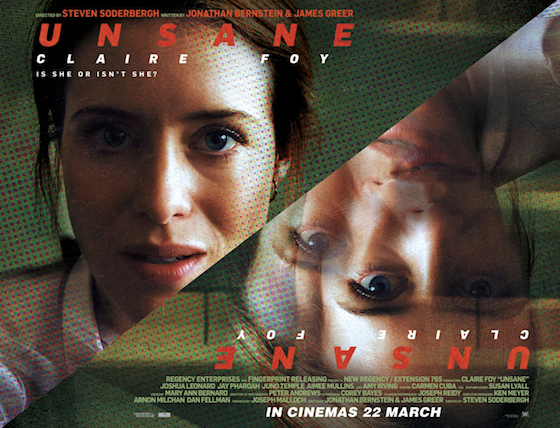
    Probably the best-known thing about Unsane is that Steven Soderbergh shot it on an iPhone. Well, he’s not the first person to shoot a feature on a phone, nor will he be the last, but I guess he must’ve been the most high-profile. It’s a shame that’s all people seemed to talk about, though, because the content of the film is worth a look too.

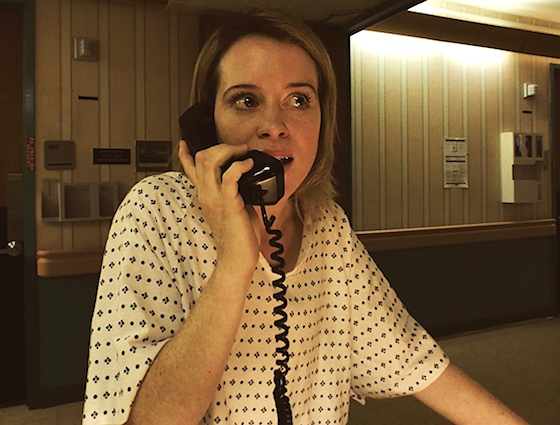
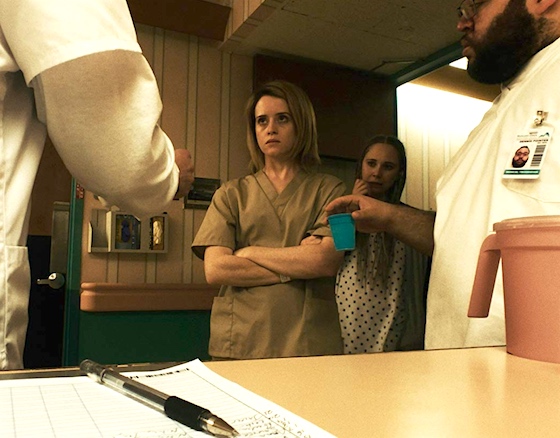
    It’s a psychological horror-thriller starring Claire Foy as Sawyer, a young professional woman struggling with a past trauma, who tries to simply get an appointment with a counsellor but ends up accidentally committing herself to a mental hospital. Although initially only in for a 24-hour assessment, her attempts to get out are only seen as further proof she has problems, and her ‘voluntary’ stay is extended against her will.

    This early part of the film plays more like a drama than a horror movie, in that it’s fairly grounded in plausible reality — it doesn’t seem to be some nefarious scheme that gets Foy incarcerated, but rather bureaucracy and misunderstanding. Later the film takes a swing into outright horror territory, and I’ll discuss that in a moment, but it’s the first act that is most genuinely frightening. Events move inexorably forward in such a way that you can imagine yourself in Sawyer’s shoes, imagine yourself making the same unwitting mistakes that she does, imagine what you might try in that situation to get out of it, and imagine how you’d fail just as badly as she does. The film doesn’t gloss over any “if only she’d done this it would’ve been fine” moments — she tries everything rational, and it still goes wrong.

    Hello, Domino's?

    But, as I said, later things change a bit: Sawyer claims that one of the men working at the hospital is actually her stalker. Obviously this just contributes to the staff thinking she’s deranged, because of course a mental health institution wouldn’t employ a convicted stalker, but it makes us wonder: is it the stress of the situation getting to Sawyer, making her see things? It would certainly be ironic — the place that’s meant to ‘make’ her sane actually driving her insane. Or maybe the staff are right, and Sawyer is an unreliable narrator?

    From there the film only becomes further immersed in genre-ness. It loses that “what would you do?” aspect, but I was engaged enough by then to just go with the story; others have found the tonal shift jarring, however. It definitely keeps you guessing — even after a mid-way reveal, you’re still unsure what further twists it may or may not pull. But it’s a funny old movie, in a way, because the shift from believable real-life horrors to inhabiting a more overt Horror mode means it sits at a hitherto unimagined crossroads between schlocky madhouse B-thriller and arthouse psychological drama. Well, I guess that’s the kind of thing we should expect from Soderbergh by now: a genre movie reimagined with auteurist sensibilities. Even when it takes the shape of a B-movie thrill-ride, there remains some psychological truth to the trauma Sawyer’s suffered and how it affects her. It’s also casually damning of things like the US healthcare/insurance infrastructure, which is, of course, a real-life problem. It’s always nice to sneak a valid real-world point into what is essentially a thrills-and-chills flick.

    Just say no

    The sense of unease is further emphasised by the shooting style, because it looks… odd. Odd how? It’s hard to say, exactly. It’s partly the aspect ratio, which for some reason is 1.56:1. I’m perfectly used to watching films in 4:3 or 1.66:1, so pillarboxing doesn’t bother me, but it being a nonstandard shape is surprisingly disconcerting. It also seems that Soderbergh hasn’t just used the iPhone camera as-is, but has attached at least one different lens. I suppose some might argue that’s cheating, but it’s normal to add lenses to the basic camera in other modes of filmmaking, so why not? I’m no expert on lenses so can’t quantify what he’s done exactly, but there’s a sort of wide-angle, sometimes even fish-eye, effect that is, again, strange. Combine all that with an even-less-definable quality that seems to wash over the whole image, like it’s lacking resolution or definition or something, and I’m not sure if the film’s visual style is down to the limitations of the tech or if it’s a deliberate emphasis of them. Whatever the reason, it kinda makes me hope no one ever chooses to shoot a film on an iPhone again, because while it can be done, the results aren’t great.

    And yet those results really do fit the mood of this film. I kinda hope no one copies that tech choice ever again, but, nonetheless, Soderbergh’s made it work for the story he’s telling. That story — with its ups and downs, its whiplash tonal changes, its very imaginable horrors and its only-in-a-movie ones — means the fact Unsane was shot on an iPhone is probably the least interesting thing about it.

    4 out of 5

    Unsane is available on Sky Cinema as of yesterday.

    Steven Soderbergh’s next film, High Flying Bird, was also shot on an iPhone. It’s released on Netflix on 8th February.