Wanted (2008)

2008 #46
Timur Bekmambetov | 110 mins | cinema | 18 / R

WantedDid you see the trailer for Wanted? Did you think the loopy, somewhat Matrix-y stunts — like bending bullets, driving cars into trains, and numerous others — looked cool? Did you want to see more? If the answer to these questions is “yes”, watch the trailer on loop a few times, because 85% of the film’s cool bits are in there.

The trailer is Wanted’s biggest problem by far. Those expecting to suspend their disbelief and be treated to an onslaught of ridiculous-but-cool CGI-aided action trickery may be disappointed, not because it’s not there but because they’ll have already seen all the best bits. Of course, two minutes of trailer can’t cover all of the action present in the film, but it certainly managed to contain most of the flagship moments. Wanted’s other major problem is its pacing. The “Wesley is an ordinary guy with a dull life” opening is stretched thin, the traditional “training montage” is actually most of the second act, and, by the time it’s remembered there was a proper plot too, all you’re left with are a few more recycled plot beats (most notably from a certain popular late-’70s sci-fi sequel). Those points aside, there’s nothing really wrong with the plot — it’s an above-average way of linking the action together.

It’s hard not to recycle in this genre, of course, but the only other place you’re likely to have seen most of the stunts is… the trailer! Ahem — or, Bekmambetov’s pair of Russian fantasy films, Night Watch and Day Watch. The prologue explaining about an organisation that has existed for thousands of years is certainly reminiscent of those films, though here Bekmambetov is stuck with text rather than a full-blooded flashback. Throughout the rest of the film he displays a noteworthy visual flair, and while I’m sure some prefer their action to be done ‘for real’ and not boosted by computers, there’s no way the crazy things he’s imagined could be achieved that way. I have no problem with the use of CGI personally, especially as the ludicrousness of its use here doesn’t pretend to be something it isn’t.

The cast are all better than the material — not that anyone seems particularly bored or underachieving, just that the screenplay doesn’t tax them. Marc Warren is especially underused, with barely a line of dialogue to his name, though he is awarded a particularly gruesome death. While there’s nothing wrong with most of the elements that make up Wanted, then, it’s hard to escape the feeling that you’ve been cheated into paying to see all the stuff you already saw in the trailer with a few other bits slotted in. I spent much of the film presuming it would finish on an open-ended note, as the structure reminded me of films like X-Men and Iron Man: all set-up and origin story, with a perfunctory climax-providing enemy, done with an eye (or, indeed, both eyes) on a sequel. Wanted doesn’t really end that way, which in an age where the franchise is everything is admirable… apart from that the film leading to that ending still feels franchise-friendly.

If you don’t mind your action being computer-aided and as realistic as… well, a comic book… then there’s much to enjoy in Wanted. Except, you already enjoyed most of it in the trailer. Perhaps things will look brighter with a few years’ distance.

3 out of 5

The Incredible Hulk (2008)

2008 #45
Louis Leterrier | 114 mins | cinema | 12A / PG-13

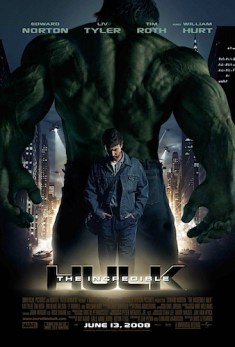
The Incredible HulkNow here’s something I didn’t think we’d see: a sequel to Ang Lee’s disappointing 2003 version of the Hulk, Marvel’s big green superhero-monster-thing. It’s not precisely a sequel though — for those who’ve somehow missed the behind-the-scenes goings on, this one has an all-new cast and crew, led by Hulk-fan Edward Norton on both leading man and (uncredited) writing duties. But does that mean it’s any better?

I think you’d be hard pushed to deny that this version is more entertaining. From the off it strikes a good balance between plot, character development and action. It doesn’t try to dig as far into the hero’s psychology as Lee’s film, but as that crippled the earlier attempt it’s for the best. Norton is a more appropriate Banner than Eric Bana was, achieving drama, humour and action with aplomb. In fact, even though there’s notably less of it, it seems Leterrier and his cast are as adept at crafting dramatic scenes as Lee and his lot were. They’re certainly better at action sequences, of which there are a good number and all well executed. Attempting an athletic chase over rooftops and through small streets so soon after Casino Royale and The Bourne Ultimatum did similar things to such acclaim seems a bold move, and while Hulk‘s version isn’t as memorable it doesn’t suffer unduly from comparison. The final monster-on-monster punch-up is immeasurably better than the first film’s bizarre climax, but the real stand out for me was the battle on the university campus. All of this is helped by vastly improved CGI. No longer is the Hulk an oversized action figure, but instead has weight and grit, and is altogether more believable. You’re never going to be convinced he’s real, obviously, but this time round they’ve made him more than close enough.

In terms of being a sequel, The Incredible Hulk pretty much has its cake and eats it. It makes good use of all the benefits of being Film 2 — it’s not an origin story, it doesn’t waste too much time introducing the characters — but without a dependence on the poor first film — new actors and a modified origin story distance it, so the main plot grows out of the basic ‘facts’ of Hulk’s origin rather than specific incidences from the first film. In fact, those who were lucky enough not to see Lee’s Hulk may well assume the opening credits’ origin story recap is just a retelling of the first film — and there’s no need to inform them otherwise. As well as dispensing with all the first film’s “evil dad” stuff, the version of the origin story here is apparently highly in debt to the ’70s live action Hulk TV series. In fact, there are also numerous nods and cameos to that version throughout (check out the IMDb trivia page for more).

Considering I did as much for Marvel’s other 2008 blockbuster, Iron Man, I feel I should make some comment on the brief franchise-building coda. Unlike Iron Man, however, Hulk doesn’t bury its scene after 10 minutes of credits, much to my joy. For those who don’t know, the brief scene sees Tony Stark — yes, Iron Man himself, naturally played by Robert Downey Jr — have a brief chat with General Ross about the problem of the Hulk. It’s initially immensely fanboy-pleasing, but is allying such a cool, likable hero as Stark with the despicable General Ross such a good idea? Of course, we’ll find out just what the Marvel planning bods have in mind come 2011.

In the end, this sequel is unquestionably superior to Hulk — who’d’ve thought a near-unknown director, whose major previous credit was the fairly risible Transporter 2, could best Ang Lee? The Incredible Hulk is a good blockbuster in its own right, requiring no need to have suffered the previous film, and there’s even room for a sequel. Now there’s something I didn’t think last time.

4 out of 5

The Happening (2008)

2008 #44
M. Night Shyamalan | 90 mins | cinema | 15 / R

This review contains spoilers.

The HappeningWhile others have been lamenting the slide in quality of Shyamalan’s work since his breakthrough 1999 hit The Sixth Sense, I’ve been quietly enjoying most of his films since then. I liked Sixth Sense and appreciated its ingenious twist, but it was the fantastic real-world-superhero tale Unbreakable that did the most to cement him in my affections. Signs was another strong effort, an unusual perspective on alien invasion backed by decent family drama and a few good laughs, helped by the always-watchable Joaquin Phoenix and a sweet kid. On the other hand, it suffered from a stretch of a resolution, and that it starred Mel Gibson. His next was the The Village, in my opinion his biggest misfire thanks to a story disappointingly reliant on an easily-guessed twist, further undermined by a third act structure that bent over backwards to hide the reveal for as long as possible. Most reviewers seem to disagree slightly though, as Lady in the Water was widely panned. Personally I liked it, at least on the level at which it was intended, as a modern fairytale.

This, his latest effort, falls mostly in the middle of the road — a bit like a few of its extras, then. You see, the plot concerns the release of a toxin (from where, no one knows) that causes people to begin committing suicide en masse, by jumping off buildings, or shooting themselves, or a variety of other, more gruesome ideas. It’s in these sequences that The Happening is at its best — Shyamalan can still craft chilling scenes and effective jumps, even if their onset is obvious to a moderately seasoned film viewer. Unfortunately, the rest of the film is a tad weak. Mark Wahlberg’s performance is flat, John Leguizamo struggles to do much better, and Zooey Deschanel gets by in a kooky role that is by turns endearing and slightly irritating. The script is mostly passable, though occasionally heavy-handed, repetitive and clunky — one moment especially jarred for me, when in a middle-of-nowhere diner it seems one person’s dialogue has been split between two actors.

Shyamalan nicely keeps the cause of the toxin up in the air — though the most probable cause is first suggested fairly early on, other theories continue to float around — but with no last-minute revelation such juggling feels unwarranted. Instead there’s just a “it could happen again” final scene, that might be chilling if it weren’t so predictable. Part of the problem with the film’s central conceit is that it’s not very believable. Now, I know, being able to see dead people, developing superpowers or finding a mermaid-like girl in your pool are hardly realistic plot points either, but here it strays too close to the realm of “I expect you to believe this is possible” pseudoscience and so, unlike Princeton gardeners, my belief struggled to be fully suspended.

Ultimately, I’d rank The Happening as Shyamalan’s worst film to date. While it’s pleasing that he doesn’t force everything to rely on a final twist, the overall quality is variable — at least The Village had something going for it before the poor climax. The cod-science explanation feels like a big excuse for a topical eco-message, otherwise just being a basis to string together a collection of well-executed creepy sequences. Perhaps Shyamalan should stop trying so hard to come up with amazing new ideas and just concentrate on telling a good story. There are things to like though, enough to scrape the film into the middle of the road. Sort of the opposite to those suicidal extras then.

3 out of 5

They’ve just watched the film…

They've just watched the film...

Almost Famous (2000)

2008 #41
Cameron Crowe | 118 mins | DVD | 15 / R

Almost FamousSometimes I find I have quite a lot to say about a film when it comes to writing my review for this blog — recently, witness Cloverfield, Transformers, or Indiana Jones 4 (of course, using Indy 4’s full title more than once guarantees a long review). Other times it’s a struggle to come up with anything at all — try the relatively brief comments on The Fountain, The Adventures of Sherlock Holmes or Field of Dreams. Almost Famous falls into the latter camp. Not because it’s no good, or because it’s middle-of-the-road, but because there’s nothing I’m dying to praise or slate about it.

Everything about it is solidly done. Patrick Fugit is an engaging and relatable lead, ably supported in the acting stakes by a good ensemble, especially Philip Seymour Hoffman (unsurprisingly) and fellow top-billers Billy Crudup, Frances McDormand and Kate Hudson. And there’s Zooey Deschanel, who doesn’t have many scenes, but, y’know, still…

Crowe’s autobiographical screenplay is a good one, with plenty of amusing and dramatic moments to keep it ticking over — the most memorable, on a crashing plane, manages both with aplomb. Likewise, his direction is rarely flashy but always works. The music, costumes, design and cinematography evoke the period well (to me, at least, who didn’t live anywhere near the ’70s). There’s probably some life lessons in here — it’s a coming-of-age film after all (as well as a rock & roll road movie, of course) — but they’re not over-laboured.

In short, I really liked Almost Famous. It’s the sort of film that might creep in at the lower end of a (relatively long) list of favourites, not because there’s anything exemplary about it, but because the cumulative effect makes for an enjoyable experience.

4 out of 5

Almost Famous is on Movie Mix (aka more>movies) tonight, Sunday 31st May 2015, at 1:15am.

Cloverfield (2008)

2008 #40
Matt Reeves | 81 mins | DVD | 15 / PG-13

This review contains major spoilers.

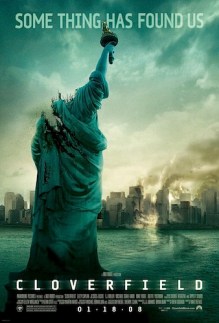
CloverfieldAh, Cloverfield — probably the most hyped “film no one knew was coming” since The Blair Witch Project, if not even longer, and the most widely-discussed marketing campaign since Snakes on a Plane (all of two years earlier). And then, in what can only be described as a surprise, it got good reviews. Less surprisingly, it did pretty well at the box office. Even less surprisingly, they announced a sequel. So far more Blair Witch than Snakes on a Plane, then. Of course, not all reviews were good, and with all this in mind I finally come to see it myself.

Cloverfield works. It has flaws, but overall it works. The opening 20 minutes set up the characters fairly well, though it does take its time. One would hope the idea is to increase the tension by delaying the monster’s appearance, but I can’t help feeling it’s probably just because they think they’re providing a great emotional background. Those who compare these bits to Hollyoaks clearly haven’t seen that risible C4 pile of tosh — Cloverfield’s performances (largely improvised, at least in the early scenes) and direction are much better than that, even if the plot would probably fit snuggly on the teeny soap. I found the opening held my attention well enough, so one has to wonder about the attention span of those who switched off during it. The characters and their relationships may be archetypes, and consequently rather one-dimensional, but at least they show an attempt to make it more than a Big Monster Go Smashy Smashy movie.

That said, it’s when the monster turns up that things kick off. From then the film does a great job of creating an unrelenting chase/escape, drawing the viewer in with its first-person/eyewitness style. You’re never going to be fooled into thinking it’s a real thing that really happened, obviously, but it comes as close as it’s likely to. This is partly thanks to the camerawork, which I’ll get into later. The deliberate drip-feed of information about the monster is well handled also. Those expecting lots of exposition and answers have clearly come to the wrong film, and should perhaps stick to a more straightforward blockbuster. Those who complain that the monster doesn’t make sense, or the bug-parasite-things that drop off it make even less sense, are clearly missing the point — the characters don’t know what this is or what’s going on, so we don’t either; and it’s a sci-fi movie, so any number of explanations you care to put forward could explain things. There are a couple of misfires in this respect — the military’s willingness to explain their plan is unbelievable, and a shot of the monster towering over Hud is a step too far — but mostly it succeeds.

Talking of Hud, he’s come in for criticism, it seems to me for two main reasons: he’s not a great character, and he can’t hold the camera steady. Have the latter viewers ever watched home movie footage? Cloverfield does a spot-on replication of it, which naturally looks odd if you think of it as ‘professional film’ (where even handheld is only slightly wobbly). I challenge anyone to take a normal home video camera and put it through the same things Hud does and come out with any steadier a shot. Sometimes credibility is pushed by having Hud film other characters instead of the more interesting monster (surely where any normal person would point the camera), but it’s only an occasional and minor point. As for his character, he may be dopey, dull, and occasionally even irritating, but his purpose is to be the cameraman — if he were notably likable or, well, notable then you’d want him in front of the camera too. For the sake of the style, someone has to be behind the camera, and Hud’s a perfect fit. You get so used to him as the almost-unobtrusive cameraman that when he’s killed it’s very nearly an audacious shock, though it’s such an obviously audacious move that it’s predictable to most film-literate viewers.

Unsurprisingly, there’s not a huge deal of originality in Cloverfield. The monster itself may look different to the norm, but it stomps through the streets like Godzilla, the attack of its minions/parasites/whatever in a dark tunnel is a sequence we’ve all seen before (nonetheless, it’s effectively done here), and their chestbursting-like birth is obviously straight out of Alien (even if it’s toned down to a PG-13-friendly silhouette). Even the (in)famous handheld style has, of course, been done before. But in marrying all these elements Cloverfield creates something that feels fresh enough (pasting the first-person/handheld/eyewitness style onto almost any genre would give it a new angle, I’d imagine), and, for the most part, it both entertains and intrigues. It may not be quite Empire’s 5-star wunderkind, but it pushes close.

4 out of 5

Cloverfield placed 9th on my list of The Ten Best Films I Saw For the First Time in 2008, which can be read in full here.

The Fountain (2006)

2008 #37
Darren Aronofsky | 93 mins | DVD | 12 / PG-13

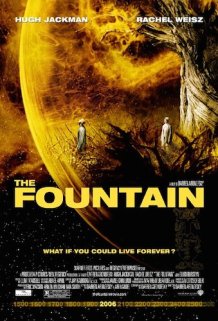
The FountainThe Fountain was one of the more critically divisive films of recent years, eliciting genuine “love it or hate it” reviews all round. I find myself leaning more towards the former. While I can’t claim to fully understand (let alone explain) much of what it means, and while I usually dislike things that can pretentiously be described as “film as poetry” (or similar), there’s something in the qualities of The Fountain that engaged me.

For one thing it looks gorgeous. While the whole film is beautifully shot, it’s hard not to single out the future segments, in which Aronofsky chose to create space with “micro-photography of chemical reactions” rather than the usual CGI. However it was achieved, the important thing is it looks great. Clint Mansell’s score is equally beautiful, both dramatically exciting and romantically tender — sometimes at the same time. Performance-wise, Hugh Jackman is undoubtedly at the centre and is as likeable as ever. It’s only the present-day segments where he really has much to do, in the arguably-clichéd story of a scientist so desperate to find a cure for his wife’s disease he misses out on spending time with her. Rachel Weisz is good as ever as the wife, even if her American accent is occasionally distracting.

Meanwhile, the past segments are essentially an historical adventure movie with some of the plot scenes cut, and the future segments offer near-2001 levels of silent obscurity. By a similar token, the film has an apparently ambiguous finale that, unusually, I’m quite happy to let wash over me. I’m sure there are multiple conclusions a viewer can reach for what it’s ‘about’ — the eternity of love, the repetition of life, or simply a sci-fi/fantasy quest for immortality — but I find myself happy to accept that it may mean one, all, or none of those things and just leave it be. It’s an odd way to feel at the end of a film — not caring about what it meant, but in a good way.

I can only apologise that, a bit like the film, this review is relatively brief, a tad dreamy, and somewhat inconclusive. I can see why some dislike this film, and I think I’d normally be one of them, but in this case something about it captured me. I look forward to seeing it again and, maybe, getting a better idea what it was.

4 out of 5

Hulk (2003)

2008 #36
Ang Lee | 132 mins | DVD | 12 / PG-13

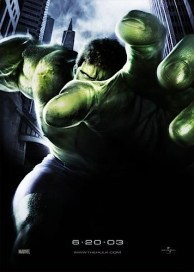
HulkWith the Edward Norton-starring (and -penned), Louis Leterrier-directed sequel/re-imagining of the Hulk coming this summer, I decided it was finally time to watch Ang Lee’s much derided 2003 attempt at bringing Marvel’s green monster-hero-thing to the big screen. Much like the lead character — in a Jekyll & Hyde-style, he’s mild-mannered scientist Bruce Banner by day, but the big green monstrous Hulk when angry — this is very much a film of two vastly different sides.

Indeed, the most striking thing about Lee’s interpretation of the Hulk is what a mish-mash of styles it is. On the one hand, it wants to be a drama/thriller, focussed on father-child issues and military cover-ups. On the other, it has comic book action sequences and a bizarre editing style inspired by comics — a compilation of unusual techniques that look like a Media Studies teacher’s wet dream. Not even Spider-Man was that kooky. In the end, it just means the cutting style feel out of place, firstly because for much of the film (at least the first 45 minutes) it’s the only reminder of the film’s comic roots, but especially because Lee’s use of the tricksy techniques is inconsistent — sometimes confusingly overused, sometimes apparently forgotten. Other technical elements also detract. Danny Elfman’s score is blandly uninspired, a carbon copy of his work on similar films. Worst of all is the CGI Hulk — it looks like they used an action figure he’s so plasticky. It gets by OK in early appearances, swathed in moody shadows, but in the glaring desert sunlight he doesn’t stand a chance.

The big, destructive sequences starring the Hulk himself are too little too late. There’s nothing wrong with sneaking drama into blockbusters, but this feels like a blockbuster snuck into a drama. There are fights because there have to be, not because anyone involved in making the film seems to want them. They’re badly placed thanks to the plot structure and the film’s pace topples under their weight. Even the climax wants to be a battle of wills between father and son, but turns into a nonsensical messy CGI splurge. That said, the dramatic moments don’t fare much better. Usually so watchable, Eric Bana can do little with the material offered here. The rest of the cast don’t suffer as much, and there are times when it almost works, but neither the dramatic nor blockbuster sides fully function in themselves, and certainly not when slammed together.

Hulk is not a film anyone could love — even the weakest comic adaptations usually have their fans — and, for a film aimed at a devoted fan base, this is perhaps its biggest flaw. Equally, it retains too much of the superhero genre for anyone to consider admiring it as a purely dramatic film. Hopefully Hulk-fan Norton’s film can marry the two halves better… or if not, at least create some cool destruction-filled action.

2 out of 5

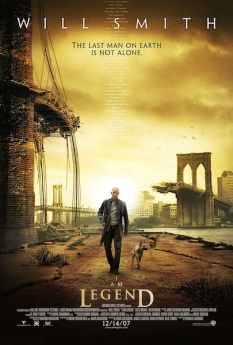
I Am Legend (2007)

2008 #35
Francis Lawrence | 96 mins | DVD | 15 / PG-13

This review contains major spoilers.

I Am LegendWill Smith stars in this adaptation of Richard Matheson’s classic sci-fi novel from the director of Constantine. The latter is a film I personally enjoyed (and which features a relatively early appearance of the currently prolific Shia LaBeouf) but received some mixed reactions on the whole. By a broadly similar token, I Am Legend has received a fair share of negative reviews, though my opinion is a little more divided.

Things go very well for the first half. It’s nicely paced, concentrating on a depiction of one man’s loneliness taken to the extreme. The script, and Smith’s acting, handle the material well. The deserted and destroyed New York looks as stunning as the trailers promised, while the CGI animals that roam it are as good as any. The flashbacks that punctuate the film are well executed too, drip-feeding clues to what happened while maintaining some mysteries of their own. There are some other good sequences: Neville’s exploration of a pitch-black Dark Seeker-infested building is tense, and the death of his pet dog — his one remaining companion — is moving, even if it was given away in the trailer. That scene is effectively played and shot, showing only Neville’s face as he is forced to euthanize the diseased animal by suffocation.

Sadly, this is where things begin to go down hill. The Dark Seekers — the film’s vampires/zombies/whatever — are crafted with pretty good CGI, but they’re still not life-like enough to work. If it were a mindless blockbuster they would’ve been more at home, but as it’s managed to be an effective drama they feel entirely out of place. It’s true that real actors couldn’t have managed the physical feats the creatures are made to pull off, but do they really need to do those things? I suspect not. The film also leaves several holes in the Dark Seeker’s actions — for example, they copy Neville’s trap, a move apparently beyond their intelligence, but the film neglects to explore why or how they did this.

Instead it moves on to the arrival of some more survivors. Quite where they came from, or how they got into the supposedly isolated Manhattan, is another inadequately explained set of circumstances. After they arrive, the film’s climax comes out of nowhere. It’s as if the screenwriters ran out of ways to keep things going so just bunged on a big climactic action sequence. And what happens in it is pretty silly too, especially Neville’s self sacrifice — why not get in the Magic Safe Hole too and then chuck the grenade out? Perhaps he just has a death wish by that point. It would seem most of the audience did. There’s also a pathetic epilogue, and an even worse final line that attempts to make sense of the title.

I Am Legend is something of a disappointment. The considered and effective first half gives way to an increasingly nonsensical second, marred by numerous flaws that stack up til a near-laughable conclusion comes from nowhere. I’ve been told that the ‘alternate theatrical cut’, with a handful of additional scenes and a new ending, is marginally more effective. I’m sure I’ll watch it someday and share my thoughts. For now, I Am Legend’s two halves of differing quality just leave it in the middle of the road.

3 out of 5

I Am Legend is on Watch tonight, Saturday 11th October 2014, at 9pm. It’s on again on Tuesday, when I’ll (re-)share my thoughts on the so-called “Alternate Theatrical Version”.

Transformers (2007)

2008 #34
Michael Bay | 138 mins | DVD | 12 / PG-13

TransformersAs I’m sure you know, Transformers is a live action adaptation of the ’80s cartoon inspired by a toy line, which managed to become the highest grossing non-sequel of 2007 (though, of course, it’s still very much part of a franchise. But taking that into account places it 5th, which doesn’t sound as impressive. If anyone’s interested, the highest-grossing non-franchise movie was Ratatouille… though you could argue that’s basically in the Pixar franchise, so the honour would then slide to I Am Legend… which you could argue is in the Will Smith franchise, but that would be pushing it).

Firstly, I have to admit that I’m inadvertently something of a Michael Bay fan; or, at least, a fan of his films. He’s hardly the world’s greatest director — certainly not in an award-winning sense — but his movies set out to be big and fun and, more often than not, they achieve it. I always think I’ve seen very few of them, but I’ve actually been fairly comprehensive: Bad Boys and, especially, The Rock are both entertaining action flicks; Armageddon I half-watched once and it seemed a bit crap; the only bits of Pearl Harbor I’ve happened across have been even more laughable than reviews led me to believe; Bad Boys II was overlong and overrated, but had its moments; conversely, The Island was cruelly slated — I could write a whole review of my thoughts on that, but this isn’t the place. So I’ve actually taken in all of his films (one way or another), bar this latest — another huge-budgeted, action-packed, CGI-heavy extravaganza. Same old same old?

Not quite. Thanks to its kid-friendly basis, and in spite of much slaughter and gags about masturbation, Transformers is probably Bay’s most family-friendly offering. That said, it’s still very much a Boys’ Film, packed with soldiers, fights, explosions, and female characters who are either hot teens with a surprising knowledge of mechanics or hot twenty-somethings with a surprising knowledge of computers. Or comedy mothers. But most of all, there’s a serious technology fetish — the film nearly bursts with so many cars, planes, guns, army vehicles… Of course, if there’s one film where a tech fetish is acceptable, it has to be one about giant robots who can reshape themselves into everyday items. In these moments the CGI is frequently astounding, as thousands of parts move and rearrange to change a plane/car/hi-fi into a robot being. It happens so fast that, unbelievably, it’s rarely even the focus of the scene. It’s also mostly photo-real, though it becomes hard to judge just how real because the physical impossibility means the viewer reasons it has to be CGI. That doesn’t stand in the way of the achievement though, and how the effects team lost out to The Golden Compass at the Oscars is beyond me (to be fair, I haven’t seen that Pullman adaptation, but the CGI looked decidedly under-impressive in the trailers).

It’s not all so good. The music is indistinguishable from that in every other Bay film, which means it usually serves its purpose but is beginning to sound a tad tired. The opening is a little dry, with too much focus on faceless soldiers and not enough on the infinitely more entertaining story of Sam Witwicky, who’s played with charm by Shia LaBeouf, rising (risen?) star du jour. Once the Autobots (they’re the good robots) turn up en masse halfway through the film really hits its stride, suddenly becoming funny, exciting, and even stirring on occasion. The finale’s a bit of a muddle however, with no clear idea of which robot is which and who’s fighting who, or what the strategy/point actually is. It’s disappointingly anticlimactic in some respects, especially the duel between Optimus Prime (head Autobot) and Megatron (head Decepticon — they’re the bad robots), which amounts to little more than a couple of clashes. Why can no one seem to manage a good final battle these days? Megatron is underused in the film as a whole, only coming to life very late on and affording Hugo Weaving about five lines. It seems a waste.

Despite these flaws, I really enjoyed Transformers, certainly more than I expected to. It may be clichéd in places, with too much of a tech fetish, shallow female characters, too many faceless soldiers, bouts of weak dialogue, a muddled climax… But it’s still fun, with enough likeable moments and characters to carry it through. Hopefully they can focus in on what worked — or, at least, maintain the same level of quality — in next year’s sequel.

4 out of 5

Indiana Jones and the Kingdom of the Crystal Skull (2008)

2008 #32
Steven Spielberg | 122 mins | cinema | 12A / PG-13

This review contains major spoilers.
For a spoiler-free view, see my initial thoughts.

Indiana Jones and the Kingdom of the Crystal SkullI’ve grown up with Indiana Jones around. Not in the way Harry Knowles may have (apparently if you weren’t old enough to see the original trilogy in the cinema, at precisely the right age, then this film isn’t for you), but they’ve always been there. I was so young when I first saw Last Crusade (on video) that, even though it can only have been two years old at most, it was a film that had Always Existed as far as I was concerned (much like Ghostbusters and Back to the Future, or so many other ’80s movies that I love). I remember directing a recreation of Last Crusade in the playground (with me as Indy, of course, and one of my best friends hating me for days because he’d been Brody and I’d melted him at the end, my 6-year-old memory having confused the character with Donovan); loving Young Indiana Jones whenever they showed it on BBC Two; visiting the absolutely fantastic stunt show at DisneyWorld Florida; churning through a couple of the tie-in novels (carefully selected from the gift shop based on their blurbs); having the Raiders poster on my door for at least a decade; running around with my Indy hat and Nazi cap gun (wow, we must’ve bought a lot in that gift shop); wishing there were action figures for me to play with (and appropriating an Alan Grant from Jurassic Park for the task, because he had a vaguely similar hat)… There are many more Indy memories locked away in my head, but I think those examples will more than suffice.

And so, about 17 years or so since I first encountered Dr Henry Jones Jr, I finally get to see him in the cinema. I don’t think I’m one to be easily suckered in by that thrill factor, however. I wasn’t one of the people who came out of Phantom Menace extolling it’s virtues only to later realise how disappointing it was; heck, I came out of Two Towers not with the feeling that after a whole year (wow!) of waiting Lord of the Rings was back and wasn’t it great — I thought it dragged for at least the first half and found Helm’s Deep somehow anticlimactic. I say this in defence of the fact that I enjoyed Crystal Skull and think it’s a good film, an opinion that seems oddly rare at the minute. I suspect this will change with time.

That’s not to say the film isn’t flawed, mind. The opening’s a bit slow for my liking, there are few lines that are as funny or as quotable as in the other films, and some moments push things a bit too far — I’m thinking specifically of Indy escaping a nuclear test in a lead-lined fridge. It’s not as bad as Bond surfing the wave from a melting ice shelf in Die Another Day, but it’s not really in-keeping either. Another oft-cited problem is the amount of material the film awards to some of its starry cast members. Actors of the calibre of John Hurt, Jim Broadbent and… well, most people say Ray Winstone, but I think he’s overrated as an actor… still, they don’t get a great deal to do. The problem here is that they’re John Hurt, Jim Broadbent and Ray Winstone — replace them with unknowns and far fewer people would whinge about the size and point of their roles. Quite why an actor like John Hurt would accept such a small, almost one-note role (while there may be more depth to the character, it’s all revealed in Mutt’s memories rather than Hurt’s performance) is a different issue, but he does play the part well.

The rest of the cast fare better: Shia LaBeouf continues to be a star on the rise, here blessed with a teen rebel who isn’t also incredibly irritating. Mutt has a heart, and we don’t have to suffer a two-hour ‘emotional journey’ to find it. He pairs well with Harrison Ford too, and one can see why George Lucas suggests a future for the franchise that emulates the father-son dynamic from Last Crusade. That said, Ford gets his best partner in Karen Allen’s Marion. She was always the best ‘Indy girl’, and while her return may be as surprising as Indy wearing that hat and carrying a whip (not just because we’ve seen her in all the trailers, but who else is it going to be when Mutt first mentions a Marion in the diner?) she plays a vital role in injecting some verbal humour and banter into proceedings. The only other noteworthy female cast member is Cate Blanchett as a villainous Russian psychic (maybe). She’s clearly having bags of fun with the part, and is rewarded primarily with a death scene that is pleasingly in line with those in the rest of the series. This is another moment some reviewers have whined about, saying we’ve seen it before, but personally I’d’ve been disappointed with anything less from an Indy film.

Of course, this is all without really mentioning the man himself. Make no mistake, Harrison Ford is still Indiana Jones. The hair may be grey, the face covered in more lines, but the attitude and humour is still there. This is an older Indy, of course — he’s not only aged nearly two decades since we last encountered him, he’s also lived through the Second World War. The snippets of dialogue that explain what he’s been up to since we last saw him are all very nice for fans too, I think, but are pleasingly not dwelt upon for too long — this is a film that will work just fine for anyone who somehow hasn’t seen the first three. Ford can still hold his own in the action stakes too, running, swinging and punching his way through a variety of thrilling sequences. The screenplay could have used his age as a crutch, leaving him with some comedy running away while the much younger Mutt got stuck in; this isn’t the case, and that’s great.

As for those action sequences, they’re a lot of fun. The best by far is an extended chase through the jungle, including a fantastically conceived sword fight on the back of two moving vehicles. There’s a good deal of silliness in it — Mutt’s Tarzan-like vine swinging, or Marion’s use of a handily-placed tree to get their car into a river — but this is a franchise explicitly inspired by the B-movie thrills of the ’30s, ’40s and ’50s, in which context these things are more than acceptable. It’s a little daft, but it’s all such fun that if you’re worrying about the realism you’re not entering into the spirit of things. More disappointing is some lacklustre CGI, which is used far more often than Spielberg might have liked us to believe. There’s also a bit with some large ants that may be a little too close to the use of beetles in The Mummy, but as that’s basically an Indiana Jones rip-off it seems only fair to return the favour.

Finally, there’s the MacGuffin: the eponymous Crystal Skull (the “Kingdom of the” prefix isn’t really needed). It’s alien, as long-rumoured, which has undoubtedly angered some fans. Personally, I don’t find it any sillier than the Ark of the Covenant or the Holy Grail, equally unreal items (in fact, less real — maybe the aliens are too likely to be true for some viewers?) with equally fantastical powers. It also fits with the mid-50s setting, post-Roswell and heading into the Space Race. The design of the aliens and their saucer is pleasingly retro, though obviously achieved with CGI, and it does tie to theories that ancient monuments and civilisations had contact with aliens (again, true or not, they’re no worse than the religious artefacts of the other films). Like everything else about the film, the MacGuffin may not be quite as good as the equivalent elements in Raiders and Last Crusade, but it pushes close enough.

Speaking of which, it’s worth quickly mentioning the UK rating. For some reason, Crystal Skull is a 12A while Raiders and Last Crusade are both only PG. I swear there’s nothing worse in this film than those; in fact, I’m sure there’s nothing here that’s as likely to be traumatising for youngsters as Donovan melting at the end of the third film. I expect it says more about our variable rating system than it does about the films themselves, but in the unlikely event anyone reading this is wondering about its suitability for a younger audience, there’s my thoughts.

As I mentioned earlier, reaction to the film, both from critics and the general viewing audience, has been somewhat mixed. It seems plenty of fans have left their rose-tinted glasses with their DVD box set and viewed Crystal Skull with the all-too-critical eye of one who isn’t aware they don said goggles to watch the older films. Crystal Skull is a suitable return to the Indiana Jones series — full of fun and excitement, and a good chance to be reacquainted with old friends. It can’t beat Raiders because that came first, automatically embedding itself as the best in the minds of many; and it can’t beat Last Crusade, partly because it lacks the wonderful dynamic between Harrison Ford and Sean Connery, and partly because I just love that film. But, crucially, it is in the same league as them, and that’s fine by me.

4 out of 5

My initial reactions to Kingdom of the Crystal Skull can be read here.