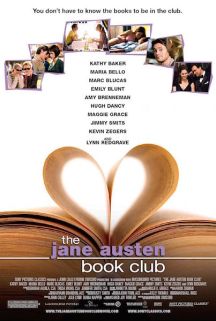
The Jane Austen Book Club (2007)

2008 #54
Robin Swicord | 101 mins | DVD | 12 / PG-13

The Jane Austen Book ClubI like to think I have a fairly high tolerance for ‘chick flicks’ — over the years I’ve rather enjoyed films such as Love Actually or Bring It On, and not just because of the male-friendly porn-stand-in scenes or cheerleader costumes — but even I was a bit uncertain about this one at first. However, as it progressed, gradually revealing more about the characters, their lives, and how they cope with what the world throws at them, I found myself increasingly enjoying it. By the time we had to pause it twenty minutes from the end, I found myself itching to continue to find out what would happen.

Inevitably, it’s not flawless. At times it feels like a collection of subplots linked only by the monthly book group meetings, with whichever plot thread is the focus of a scene becoming the de facto main story… until the next scene begins, of course. A working knowledge of Austen’s novels is helpful too. I presumed the film (and book on which it is based) merely invoked Austen’s perennially popular name to boost sales, but there’s actually a fair bit of analysis of the books thrown in, which often reflects what’s happening to the characters. You can get by without an Austen familiarity, but I found the Pride & Prejudice segments made more sense than the others thanks to my (marginally) increased understanding of that particular text.

It would be very easy to pigeonhole The Jane Austen Book Club as a ‘film for women’… and, to be honest, that wouldn’t be at all unfair: it’s as squarely aimed at a female audience as Die Hard is aimed at blokes. It’s also ultimately disposable, apparently with nothing new or revelatory to say about womankind. In spite of all that, I enjoyed it more than I probably had any reason to — and not just because of the male-friendly lesbian character.

4 out of 5

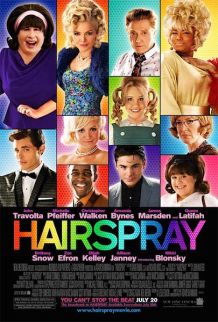
Hairspray (2007)

2008 #53
Adam Shankman | 111 mins | DVD | PG / PG

HairsprayWho’d’ve thought a John Waters film could become a bright and breezy musical? It’s a bit of a surprise but, thanks to a successful Broadway version, that’s exactly what’s happened. But while the key to Hairspray’s success may be its positive attitude and memorable songs, perhaps the key to its quality — and the eventual score of this review — are the issues it tackles around those.

It’s the latter that I found must surprising while watching the film. Everything about its advertising campaign, largely young cast and candy-coloured design suggested Hairspray was a light-as-air feel-good flick — no bad thing, but nothing more than a couple of hours of disposable fun. Pleasantly that’s not the case, as the film tackles head-on issues of racism and other such discrimination, with the ‘beautiful people’ — led by a deliciously bitchy Michelle Pfeiffer — doing their best to keep down those who are in any way different, be they black or, in the case of lead character Tracy Turnblad, fat. The apparently fluffy style of the film in many ways makes it perfect to tackle such issues, showing how they can permeate every area of life, not just Serious Social Dramas, and forces those who would normally avoid the latter type of drama to face up to them. Its ultimately happy ending may be more in keeping with the film’s overriding optimism than with reality, but equally it’s wholly appropriate: the crusade against oppression has to end well here, because if it didn’t the concluding message would be “don’t bother fighting, things won’t change”.

The film’s unwavering optimism is perfectly encapsulated by newcomer Nikki Blonsky, leading the cast as Tracy. She’s instantly and constantly likeable, irrepressibly chirpy and yet not annoying — an impressive feat. Equally remarkably, she’s never overshadowed by the heavyweights who round out the cast; instead, they provide able support. Even John Travolta, disturbingly convincing as a housewife (under a ton of makeup), doesn’t steal the show — he comes close, but Blonsky’s performance holds sway. Elsewhere, Christopher Walken, Queen Latifah, James Marsden and Zac Efron all get catchy songs and have a whale of a time — and, unlike the Ocean’s… sequels, the fun the cast is having is infectious.

The first credit at the close is an unusual one: “Directed and Choreographed by Adam Shankman”. Rather than shirking in either department, the rare combination seems to have helped proceedings: the numbers are all exemplarily executed and the direction doesn’t suffer elsewhere. It’s an indication of the music’s quality that even the three cut songs, which play over the end credits, are pretty good and wouldn’t’ve been out of place in the film itself. The first of these is clearly the actual closing number, though the decision to bump it to the end credits, thereby leaving You Can’t Stop the Beat as the final song of the film proper, was a wise one — it makes for a stronger, catchier, more upbeat finale.

Hairspray is a deft mix of issue-driven drama and colourful musical levity. Catchy, optimistic, uplifting, funny and fun, it may just surprise you.

5 out of 5

Hairspray is on Film4 today, Tuesday 11th November 2014, at 6:45pm.

Hairspray placed 6th on my list of The Ten Best Films I Saw For the First Time in 2008, which can be read in full here.

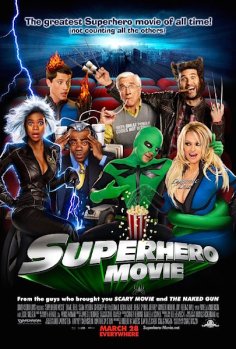
Superhero Movie (2008)

2008 #52
Craig Mazin | 85 mins | in-flight | 12A / PG-13

Superhero MovieYears ago, I saw Scary Movie. I don’t really know what I thought of it anymore, but I never expected I’d find myself watching another entry in the critically-derided …Movie series. But then I found myself on a plane, half asleep and with a choice of films I’d mostly rather watch on a decent-sized screen, and decided that maybe Superhero Movie wouldn’t be so bad after all…

As anyone who saw a trailer will have guessed, Superhero Movie is mainly a spoof of Spider-Man… a film that is now six years old. Unfortunately, this means that most of the best jokes have already been done in numerous other sketch-length spoofs, amongst them one at the MTV Movie Awards and one during Comic Relief 2005. The latter even did the green costume thing, though the hero was ‘Spider-Plant Man’ rather than the (less funny) Dragonfly employed here. Superhero Movie takes all this sketchery to the next level, however, crafting its story simply by reworking the first Spider-Man film almost scene by scene, inserting jokes (and, more often, ‘jokes’) where it can — which is about once per scene.

There are also asides that spoof X-Men, Fantastic Four and Batman, but they barely warrant a mention. They’re certainly not any funnier. In fact, the climax is the only wholly original plot point — or, at least, plot point not directly lifted from Spider-Man, as it may well come from some other comic source. This incessant copying makes the film feel like an over-extended sketch, and so it becomes clear that something like Mystery Men, with its genuinely original plot, makes for a much better superhero comedy movie.

As for the gags themselves, they’re childish, lewd, offensive (“isn’t Stephen Hawking funny!”), too specific to American culture, too topical (they’ll be dated within six months), already dated (“isn’t the Windows paperclip annoying!”), too obvious… It’s very much a movie made for now, not for posterity. Actually, to be fair, it’s very much a movie made for six years ago. In this respect I suppose it’s just like the rest of the …Movie series, which I’ve always felt looked like cheap TV specials owing to their specificity and, well, rubbishness. Still, believe it or not, some bits are actually amusing. Or amusing enough while they’re on. Perhaps I was just laughing out of desperation. I certainly can’t remember any of the jokes now.

Intriguingly (a word I use loosely here), there are a bunch of deleted scenes and gags during the end credits — not bloopers, but genuine deleted bits. It’s a mystery as to why these aren’t either in the film itself or relegated to DVD extras — it’s not like running time is an issue, and clearly pacing isn’t. In fact, some of the deletions are much funnier than gags that were left in. They’re probably the only reason to keep watching Superhero Movie to the end, though they’re not reason enough to start it in the first place.

2 out of 5

Superhero Movie featured on my list of The Five Worst Films I Saw in 2008, which can be read in full here.

The Golden Compass (2007)

2008 #51
Chris Weitz | 113 mins | Blu-ray | PG / PG-13

The Golden CompassThis adaptation of the first novel in Philip Pullman’s His Dark Materals trilogy (known as Northern Lights in the UK, but adopting the US title for the film — unlike Sorcerer’s Stone, it’s actually more appropriate) received quite the critical drubbing on its cinematic release, and wasn’t a huge success at the US box office either, which has cast doubt on the prospects of the following two instalments ever being produced. Which is a shame, because this is actually a fine family fantasy film.

The requisite elements are present and correct: a well-realised alternate world, engaging heroes, slightly camp villains, mysterious items, mysterious backstories, a globe-trotting quest, talking non-human characters, a couple of action sequences and casual doses of spectacle. The latter was something that worried me going into the film, in fact, as the CGI looked dreadful in the trailer. When it won the Oscar I really couldn’t understand how, but now having seen the film — and in high definition to boot — it was, to my surprise, mostly exemplary. There are weak patches, of course (Mrs Coulter’s monkey being the main one), but the majority is either appropriately realistic or in a suitable style enough that it didn’t matter. “Don’t judge a book by it’s cover,” as they say; or indeed a film by its trailer.

Another key sticking point for me was the discarding of the books’ religious elements, which is far too atheistical for most Americans (not that I’ve actually read the books yet, but I always enjoy a good bit of Christian baiting). The filmmakers have found an appropriate way around this however: there’s a subtext, blatant to the intelligent viewer, which carries such views. It will like whoosh over the heads of those who would’ve been offended by it, which is surely the point. Nonetheless, the lack of commercial success suggests that the stir it had already caused served to cement it as “the anti-Christian film” in too many people’s minds. Or perhaps it was merely that too few had heard of the books? Or there’s always those variable reviews…

Leading the cast as Lyra, Dakota Blue Richard’s accent seems forced and occasionally grates, but really speaking she’s pretty good (pun retrospectively intended). The rest of the cast make a good account of themselves, though the likes of Daniel Craig, Derek Jacobi and Christopher Lee were clearly cast in readiness for the intended sequels. Ian McKellen is as good value as ever and the rest of the voice-only actors offer able support. Nicole Kidman never really gets the chance to unleash her full evil potential however.

In fact, therein lies probably the film’s primary weakness. While Golden Compass does work in its own right, it’s as much Part One of a trilogy as Fellowship of the Ring: at the end you feel curiously fulfilled, even though there’s clearly a lot of tale left to tell. I can only hope that the muted success it achieved is enough to get the continuing and concluding parts made, though that seems increasingly, disappointingly, unlikely.

4 out of 5

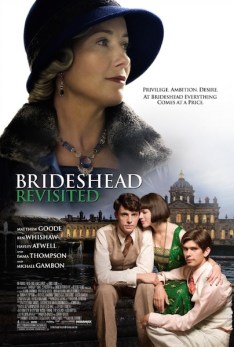
Brideshead Revisited (2008)

2008 #49
Julian Jarrold | 133 mins | cinema | 12A / PG-13

Brideshead RevisitedI’ve not seen the miniseries and I’ve not read the book, but I do know that both are considerably longer than Jarrold’s two-and-a-quarter hours film. So why does it feel so slow? Perhaps it’s the pair of opening flashforwards (easier to refer to them as that than to the majority of the film as one great big flashback), an overused technique these days that here serves no purpose whatsoever: there’s no additional insight on events that follow (or, rather, precede) by placing these snippets at the start, and there’s no new perspective on the snippets when we reach them chronologically (except that, second time round, we actually know who the characters are). It’s the most niggling fault in a film that, like my just-reviewed WALL-E, is of two halves.

The first is very good. It’s entertainingly written and performed, firmly in the tradition of the ‘heritage’ films and TV series that Britain churned out through the ’80s and ’90s — it’s the natural successor to the work of Merchant-Ivory, who of course produced the tonally-similar (at least at first) A Room With a View, which makes this all seem very appropriate. As Sebastian, Ben Whishaw is, perhaps unsurprisingly, the best of the three leads. When he’s off screen you miss him, and the point at which Sebastian leaves the story is arguably when things go off the boil. As Charles, Matthew Goode by and large holds his own — handy really, as he is definitely the centre of the film. Emma Thompson is as you’d expect her to be, which is to say she’s pretty good but ultimately it’s all rather familiar from her other performances.

The second half is where the film falls apart. The focus shifts from Charles and Sebastian’s friendship/possible homosexuality, to Charles and Julia’s love affair. The latter seems to come from nowhere and never takes off, consequently making it hard to accept the lengths they’re prepared to stretch to in order to make it work when they’re finally reunited years later. The plot slowly slides into darker and bleaker territory, needlessly dragging small characters back into proceedings to kill them off and finally pushing towards an Atonement-esque World War II epilogue. Some or all of this is obviously derived from the source, but considering the praise garnered by the novel and miniseries I presume it’s made to work there. Here it doesn’t.

An hour-and-a-half in I couldn’t understand what story there was left to tell, and I continued to be bemused by the sudden import of Charles and Julia’s relationship as the next hour dragged by. It’s a shame, because Brideshead starts out so promisingly and enjoyably, but once it begins to slide it never recovers.

3 out of 5

WALL-E (2008)

2008 #48
Andrew Stanton | 98 mins | cinema | U / G

“Pixar films” seem to have become a bit of a genre unto themselves — yes, they fit into “animation” (always dubious as a genre), “family” (almost as bad), “comedy”, and occasionally a few others, but, much as the Bond films have their own rules and expectations outside the “action” and “spy thriller” conventions, the work of Pixar always achieves special and particular attention. WALL-E subverts some of these expectations (it’s not a buddy comedy, mainly) and has received huge amounts of praise — “consequently”, some might add. It is indeed a very good film, but you’ll surely have heard all that elsewhere; instead, I’m going to draw attention to a couple of things that bothered me.

Most of these issues can be attributed to the fact that WALL-E is a film of two halves. They’re not exactly poorly linked, as elements from each feed into the other, but they are notably different. The first presents a realistically-rendered future Earth, deserted by humans (who are nonetheless represented on hologram screens by live-action actors) and now only inhabited by insects and a trash-collecting robot called WALL-E. Silent but for R2D2-like bleeps, WALL-E quickly endears himself to the audience through his actions. He’s cute, funny and likable, and the early scenes cement him in the audience’s sympathies, which is certainly handy for later. When EVE — a futuristic, iPod-alike ‘female’ robot — turns up, the film becomes a sweet love story, as WALL-E tries to instill the human-like emotions he’s developed into the cold new robot. A very funny and surprisingly touching love story, this is the film’s better half.

The second travels out into space, taking us to meet cartoon humans on a cartoony spaceship. It jars painfully with the realism that pervades the Earth-bound scenes, and the continued use of real actors in holograms highlights the cartoonish style of the future humans. There’s nothing wrong with a cartoon style, I hasten to add — certainly, it works better in films like The Incredibles and Ratatouille than the attempts at realism do in the Toy Story films — but it’s the contrast that’s uncomfortable. The story itself also takes a weak turn here: it becomes a light kiddy-adventure runaround, which is fun and still has flashes of humour and heart, but is nowhere near as daring or as effective as the first half. This is where the sympathies engaged earlier become important, because it’s the audience’s affection for WALL-E that provides most of the genuine quality in this half.

If I were to broadly characterise the two halves, I’d say the first is everything you’d hoped for after the advance hype, while the second is something you could have feared. It’s not bad — it’s still a superior light kiddy-adventure runaround, with exciting-enough sequences and a largely interesting (if unoriginal and preachy) plot — but it’s not as groundbreaking or engaging as the first half. Worst of all is when the cartoon humans land on the realistic Earth, however — it brings to mind films like Who Framed Roger Rabbit, where cartoon characters are placed in the real world. In this instance, that’s not a positive comparison.

WALL-E is a good film. The bits that work do so perfectly, keeping the overall quality high, and the weaker sections are ultimately only poor by comparison. If the whole film were like the second half I’d probably merrily accept it as a cartoon runaround but, coming after that beautiful beginning, it only served to gradually erode the fifth star from my rating. It’s a shame, in that respect. On the other hand, this is still one of Pixar’s very best films — I’d certainly rate it above the even-more-over-praised Ratatouille, and probably slot it close behind The Incredibles or Toy Story 2 at the top of the scale. Being pipped by films of that level — and then only just — is nothing to be ashamed of.

4 out of 5

The Dark Knight: The IMAX Experience (2008)

2008 #48a
Christopher Nolan | 152 mins | IMAX | 12A / PG-13

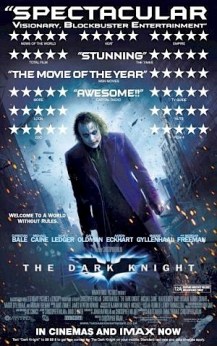
The Dark Knight: The IMAX ExperienceOne of the joys of spending five weeks of this summer in New York is that I have the opportunity to see anything that’s out in the US before the UK early. I haven’t entirely used this to my advantage (no trip to Hellboy II, for example, which has almost left theatres here but is still a few weeks off at home), but I have been to the much-anticipated new Batman movie, The Dark Knight… twice. Unlike in the UK, I have relatively easy access to an IMAX here, and, as any good Bat-fan will know, this means I was not only able to see TDK one week early, but also on the screen it (or, at least, parts of it) were specially shot for. Of course, despite the film virtually being on loop at Manhattan’s sole IMAX screen, the high demand for tickets means I had to wait til the second Saturday to see it writ so large — and even then I was fairly lucky, as some showings sold out inside of two hours.

As I’ve reviewed the film before, and my feelings on it have barely changed with a second viewing just one week later, it seems sensible to focus on the IMAX aspect. For those who somehow missed the news, The Dark Knight is the first Hollywood blockbuster to be specially shot for IMAX — not all of it, but six key sequences… or so they say. From what I could tell, while some whole sequences were indeed shot on IMAX film, often it was used just for bits of scenes, or now and then for the more dramatic establishing shots. For example, every aerial shot in the film — and, as those who’ve seen it will know, there are a fair few — appears to have been shot with IMAX cameras. The choice of sequences to shoot on IMAX is also intriguing. Some reviewers asserted it was “obvious” scenes were IMAXed even on a 35mm print, but I think they might be in for a surprise. Yes, the bank robbery opening, the car chase, and elements of the climax all receive the IMAX treatment, but elsewhere smaller scale action sequences and even some dramatic scenes are awarded the vision-filling honour.

It all looks stunning, of course: the resolution is visibly increased whenever the IMAX film kicks in (the rest of the film, blown-up from 35mm, is blurry and grainy by comparison but still doesn’t come out too badly) and the added size and scope of the format serve to underline the scenes for which it’s employed. While most of them are worthy, if sometimes unexpected, there are times when one wonders if scenes were picked just to make up the numbers with something not especially challenging. That said, it’s always nice to see, so one can’t complain too much. I didn’t find IMAX to be an especially viewer-friendly format for a two-and-a-half-hour feature though — it’s designed to fill your vision, an aim it achieves admirably, but when trying to watch a regular movie it entails an unusual amount of head turning, as well as trying very hard to notice everything right into the depths of your peripheral vision. It was certainly an experience, as the advertising subtitle suggests, but it won’t be for everyone and I’m not sure I’d bother again without some notable incentive (such as the one Dark Knight offers — none of these new-fangled 3D films have been interesting enough to tempt me yet). In some respects, what interests me most is what debates and opinions the use of IMAX will provoke about the film’s correct aspect ratio when it comes to DVD/Blu-ray time. I don’t care to predict what people will say, but I suspect it will be amusing to observe.

One final note: watching this just one week after I first saw it in a normal cinema (one week & one hour, to be exact!), it seemed to me that the odd shot was trimmed slightly or actually missing. Quite why this would be I don’t know, and it may just be my memory playing tricks, especially as the running time listed on the BBFC is actually slightly longer for the IMAX version (as seems to be standard, from a quick look at a few other IMAXed films — I’m sure someone knows why). The differences — if indeed there are any — are minor, but I felt I should mention it.

There’s no questioning The Dark Knight‘s brilliance in its own right, in my mind — it may be questionable whether it’s the Best Film Ever (surprisingly, it still sits at #1 on the IMDb Top 250), but at the same time I genuinely enjoyed this more than any other film I’ve seen from that top ten (and probably beyond). Whatever size screen you see it on, this film is an amazing experience — but some of it was shot especially for IMAX and those bits do look spectacular on the extra-huge screen. If you have the chance, this is really how Dark Knight should be seen — especially as it’s always possible that you won’t have the chance again.

5 out of 5

As if two reviews wasn’t enough, I shared more of my thoughts on The Dark Knight (this time when considered next to Batman Begins) here.

On the off chance anyone’s wondering what happened to #48, it’s WALL-E and the review’s on its way. But I’ve been sat on this one for a week (and not got round to the WALL-E one for over a week!), so I thought I’d just get on and post this, sequence be damned.

Presto (2008)

2008 #47b
Doug Sweetland | 5 mins | cinema | U / G

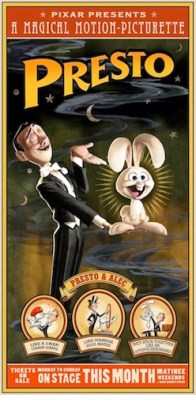
PrestoThe last Pixar film I bothered to head to the cinema for was 1999’s Toy Story 2, back in the days before “it’s made by Pixar” was reason enough to see a film (remember those times? They seem so long ago…) Their only other releases had been the first Toy Story (my enjoyment of which being the motivation to see the sequel) and the unappealing A Bug’s Life. Since then I haven’t had enough desire to expend the effort — or the money — to catch any of their films on the big screen. I explain this because, I’m reliably informed, all Pixar films are preceded by a short while in cinemas… but, because I’ve only seen most of them on DVD, I forgot this, so was initially surprised to see a caged rabbit when I was expecting an adorable little robot.

This rabbit, it turns out, is called Alec, and he’s a bit of a bastard. I think we’re supposed to root for him, and I’m sure kids (and many adults too) will, but while his owner (the titular magician) isn’t especially nice to our starring bunny (the plot is concerned with Alec trying to get a carrot that Presto won’t give him, yet), Presto doesn’t treat Alec quite as badly as Alec treats Presto. On the other hand, the overload of OTT physical violence is all in the name of humour, so that’s OK. It’s not as satirically extreme as The SimpsonsItchy & Scratchy though, which will ironically lead some to declare it promotes violence as comical. But then such ludicrousness is political correctness for you — in fact, Presto‘s brand of violence is very funny indeed. Completely dialogue free, it quickly becomes a breakneck feast of visual, mostly slapstick, humour. It may be violent, but it’s also highly witty, marvelously inventive, and wholly entertaining… even if the hero is morally dubious. But then, Roadrunner was a total wanker and he always won.

You can’t judge shorts on the same level as features, because they’re a different form — that’s why I don’t include them in the main numbering on this blog, and why I once felt the need to go on about that. So while awarding Presto a full five stars doesn’t mean it’s likely to be vying with The Dark Knight or… well, The Dark Knight… for my Film of the Year, it is thoroughly deserved. It’s a perfectly entertaining piece of short comedy, and it’s great that Pixar continues to facilitate wide exposure for such work.

5 out of 5

I Am Legend: Alternate Theatrical Version (2007/2008)

2008 #47a
Francis Lawrence | 104 mins | Blu-ray | 15

This review contains spoilers.

I Am Legend: Alternate Theatrical VersionI only watched the theatrical version of I Am Legend earlier this year (it’s #35), but, for reasons I won’t elaborate on for once, I’ve found myself watching this alternate version already.

Most of the comments in my original review still apply, as this cut only has minimal differences: there are a couple of very short new scenes in the third act, which were presumably excised because they primarily feed into the different ending, the main attraction of this version. Personally, I prefer it. The whole butterfly thing is too God-messagey, recalling the weakest elements of Signs, but if one can put that aside then the new content fits in much better with several threads that develop in the rest of the film (in both versions — in the original cut they’re just ignored). It feels like this was the intended conclusion but, for whatever reason, someone decided it needed changing. Perhaps it wasn’t explosive enough; or, indeed, conclusive enough, as it dispenses with the safe-haven epilogue and its pathetic attempt at justifying the title — another pleasurable loss as far as I’m concerned.

One other element I’ve reconsidered thanks to this repeat viewing are the CGI humans. They’re good enough in and of themselves, and would make more than passable foes in another action film, but here they ruin the ambiance that’s so carefully built up before their first appearance. Yes, the CGI lions are also clearly fake, but with limited methods to create such scenes they seem more acceptable. The arrival of the Dark Seekers, on the other hand, barges the film from thoughtful sci-fi drama into horror action blockbuster stylistically, in a way that using real actors simply wouldn’t. The not-real Dark Seekers may have superhuman jumping abilities, but the film doesn’t need those either, and could easily have crafted a similarly action-packed climax with real performers.

I Am Legend is still as middle-of-the-road as before, with very little to choose between the two versions. However, thanks to a less irritating final few minutes, this version just has the edge — if you ever intend to watch I Am Legend, be it a repeat viewing or your first, I recommend you plump for the alternate cut.

3 out of 5

The theatrical version of I Am Legend is on Watch tonight, Tuesday 14th October 2014, at 10pm.

The Dark Knight (2008)

2008 #47
Christopher Nolan | 152 mins | cinema | 12A / PG-13
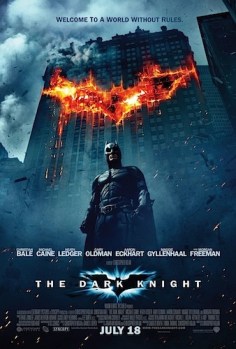
The Dark KnightThe Dark Knight — the sixth film in the modern Batman series (though not connected to the first four) — comes with a heavy weight of expectation on its back. It’s the sequel to the last film, Batman Begins, which relaunched the flailing series in style and is one of the best comic book movies ever — so Nolan and co had to top that. There was Heath Ledger’s death, a sad accident that has heaped extra focus on his penultimate performance here (his final one, in The Imaginarium of Doctor Parnassus, is currently in post-production with no release date) — especially as some sources cited his appropriation of the Joker’s mindset as related to his death. And then there were the trailers too, which caused ridiculous levels of excitement among some — personally, I found them a tad lacking. But I was fairly confident that, a bit like Begins, The Dark Knight would turn out to be the sort of film that doesn’t necessarily trail all that well but is excellent when seen.

And I was right. In this respect, it’s because the action sequences aren’t the point of the film. They occur when required by the story, while still being well-spaced and appropriately exciting, rather than serving as check-boxes for a plot designed primarily to link them together — the latter being what most blockbusters seem to settle for these days. Many are pleasantly old-school in style, the stunts performed largely for real, and at least one major example is even left without music. On the odd occasion when effects must have been used, they’re seamlessly achieved. The most obvious use of CGI — which I won’t describe for the sake of spoilers, though many will already know about — is incredibly well done. All of this helps ground the film in a perhaps-surprising (for some) degree of reality, one that goes far beyond what other ‘realistic’ superhero movies have strived for.

In fact, this realism is probably The Dark Knight‘s main strength. Obviously there’s never going to be a real city where a billionaire dressed in bat-inspired armour protects the populace from a deranged man in clown make-up, but if there were then this is how it would be. Where Burton’s two Bat-films were “dark”, and Schumacher’s were “gaudy” (or “crap”), Nolan’s pair are “real”. It’s an excellent thriller as well as everything else. The focus of the plot — at least at first — is on the mob and their control over Gotham, and it’s from their criminal desires — plus the very existence of Batman — that the Joker grows. Ledger’s performance is as outstanding as you’ll have heard said elsewhere, and while it still feels like a supporting role it receives more attention than the psychology of Bruce Wayne/Batman — which, considering that’s what Batman Begins focused on, seems fair enough. Every other performance is equally as flawless (I’ll name names in a moment), but it’s Ledger’s disturbing, engrossing turn that will stay with you. He is the Joker, in a way Jack Nicholson certainly never was, and — among obviously more upsetting effects of his premature death — the fact we’ll never see him in a rematch is a huge shame.

As Harvey Dent, Aaron Eckhart’s role is much larger than I was expecting. The floating-head posters that seemed to divide the film between him, the Joker and Batman are spot on — they’re the three central characters, everything revolves around them, their actions, choices, and emotions. While Ledger may dominate with his (appropriate) theatricality, Eckhart is more the heart of the film, with a genuinely tragic story. Viewed in this light, the order of the film’s final scenes — which I think some may see as incorrectly balanced, perhaps even anticlimactic — make all the more sense. However, I don’t mean to undersell the rest of the cast by highlighting Ledger and Eckhart — in their supporting parts, Michael Caine, Maggie Gyllenhaal, and especially Gary Oldman and Morgan Freeman, all do brilliant work. The talented Christian Bale manages to hold his own as the ambiguously heroic crimefighter, even against the more obviously attention-grabbing performances of Ledger and Eckhart.

As with other superior superhero sequels like X2 or Spider-Man 2, The Dark Knight uses the groundwork of its successful predecessor to craft an experience that’s even greater. In fact, there’s an awful lot more that could be said about the qualities of The Dark Knight. At two-and-a-half hours, it’s a packed epic of a movie — which makes Nolan’s confident juggling of plot threads, character development, several large performances, action sequences, and more, all the more impressive. I certainly enjoyed seeing it with a large, American (importantly), opening-weekend crowd — several moments produced whoops and sustained applause from the audience, as well as a good number of well-deserved laughs.

The Dark Knight is great entertainment, with a good deal of meat on its bones too — the performances and emotional stories are as engrossing as the thriller-ish plot and impressive action. When all is considered, it’s possibly as perfect a thriller/blockbuster as they come. In fact, as I publish this, The Dark Knight sits at #1 — the best film of all time ever — on IMDb. It will drop, of course, because that’s opening-weekend fan-led gut reaction for you… but, even when time’s passed, I’m certain it deserves to remain high on the list.

5 out of 5

Sadly (though not surprisingly) the Manhattan IMAX was booked solid all through opening weekend (and most of next week, at least). As soon as I manage to see it on the extra-big screen, I’ll share my thoughts here. You can also read even more of my thoughts on the film (this time when considered next to Batman Begins) here.

The Dark Knight placed 1st on my list of The Ten Best Films I Saw For the First Time in 2008, which can be read in full here.