The Quay Brothers in 35mm (2015)

2016 #159
Quay Brothers + Christopher Nolan | 68 mins | Blu-ray | 2.35:1 + 1.85:1 + 1.33:1 | UK & USA / English | 12*
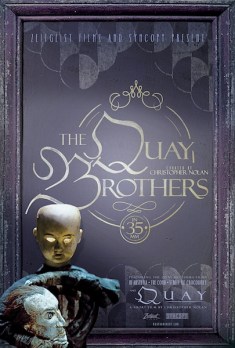
The Quay Brothers in 35mmChristopher Nolan made a few headlines last year when his first post-Interstellar film was announced for near-immediate release. Not Dunkirk, of course, but an eight-minute short documentary, Quay, about British-based American-born identical-twin animators the Quay brothers. The short was screened theatrically as part of a programme of animated shorts directed by the brothers, curated by Nolan to accompany his documentary, all from 35mm prints — because it’s Nolan, so of course. One critic reckoned it “will always be one of [Nolan]’s most important contributions to cinema.”

Today, the BFI release a Blu-ray set of the Quay brothers’ short animations, containing 24 of their works plus special features, among which is Nolan’s short. As a complete neophyte to the Quays’ work, I thought the best way to begin approaching it might be via the selection Nolan programmed, which was at least partly minded as an introduction to the brothers’ oeuvre. (Now, obviously I’m not watching this on 35mm, nor in its intended form (i.e. in a cinema), and it’s technically a selection of short films, so can I really count it towards my list? We’ll leave that to my conscience.)

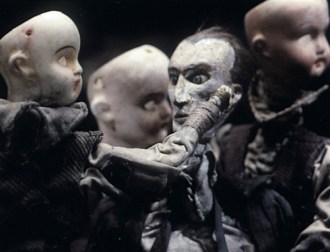
Though if it is a beginner’s course, it’s the kind that throws you in at the deep end. In Absentia (2000) was, remarkably, made for the BBC as part of a season about sound on film — you can’t imagine them commissioning anything like this today. Maybe for BBC Four. Maybe. It’s an inscrutable 20-minute nightmare of a film, with sci-fi landscapes, a demonic puppet, sentient pencil leads, and the graphite-stained fingers of too many hands. It’s clear from the outset that these are films more about mood, atmosphere, and feeling than they are strictly concerned with plot or character, and to an extent one needs to be open to just going along with it in the hope that meaning or significance reveals itself.
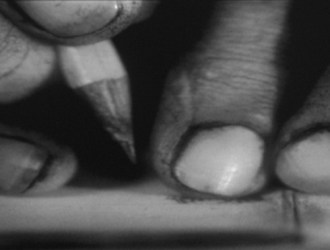
In AbsentiaFor all that In Absentia initially feels like flailing in deep water without armbands, accompanied with “what have I got myself into?!” thoughts, in retrospect I found it to be the most accessible of the three animations. It’s abstract and confusing for most of its running time, but by the end you can decipher some meaning; you can understand the relevance of the feelings it aims to generate — and if you haven’t got there yourself, or if you’re unsure, there’s a dedication to point you in the right direction. I didn’t get that with the next two; not so easily, anyway, which is why I say they’re less accessible rather than less good per se.

Nolan follows this opening salvo with his documentary, Quay. It provides a sliver of insight into the brothers’ methods and thought processes; the merest glimpse into how they do what they do, with little or no explanation for why or what it means. I suppose Nolan wasn’t aiming for enlightenment or explanation, but to instead acknowledge the craftsmanship of the animators. Rather than the kooky outré bohemians you might imagine from their bizarre films, the brothers seem quiet, calm, and, for want of a better word, ordinary. By placing his documentary here, Nolan gives you an idea of the people whose hands you’re in, before diving back inside their imagination…

The Comb (1990) professes to be adapted from something and has immediately obvious characters, both human and puppet. “Ah,” you may think, “a clearer narrative.” No chance! I came away with even less of an idea what this was about than I did In Absentia, and certainly no clue what a comb has to do with most of it — the exception being the bits where there is a comb, because then there is a comb there. In a piece on the film at BFI Screenonline, The CombMichael Brooke notes that it is “setting out to wrong-foot the viewer at every turn, and the result wilfully defies verbal analysis.” What can be easily discerned is that it’s about a dream, and it probably shouldn’t be a surprise that there’s some dream-logic involved. As to what else is to be gleaned, your guess is as good as mine.

Last up is the film that’s reckoned to be the Quays’ masterpiece, Street of Crocodiles (1986) — Terry Gilliam picked it as one of the ten best animated films ever, while critic Jonathan Romney has twice nominated it in Sight & Sound’s famous “greatest films of all time” poll. Once again, I was left initially floundering for significance. There’s some fascinating imagery, and the implication again that parts function though dream-logic, but as to an overall story or message… Reading various sources before writing this, a theme emerges: that to search a Quay Brothers film for direct meaning is futile; it’s more about somehow accessing the same otherworldly psychological and/or emotional space that’s peculiar to these filmmakers. Even when the Quays themselves describe what’s going on in Street of Crocodiles, you’ll notice there’s nary a nod to meaning — though even an outline of the plot as they conceived it is illuminating, unlocking something you sort of already knew, but providing a kind of clarity that felt absent before. A bit like that title card at the end of In Absentia, I suppose.

It’s true what they say: watching Quay Brothers shorts is like being given a glimpse into another world, connected to our own but also other to it — hiding in the cracks or around the corner, perhaps; or only in our dreams and nightmares; on the other side of the mirror, were we able to pass though it. Their work is our conduit to this otherness, which is Street of Crocodilessometimes informative about the world the rest of us live in (In Absentia), sometimes a twisted analogy for it (Street of Crocodiles), and sometimes just fascinatingly unknowable (The Comb). All the films are teasingly oblique, and by all rights that should make them frustrating to the point of irritation, even abandonment… yet they’re kind of compelling nonetheless.
Oh, and do I need to throw in a “they’re not for everyone” at this point? I imagine that’s implicit.

4 out of 5

The aforementioned Blu-ray collection, Inner Sanctums – Quay Brothers: The Collected Animation Films 1979-2013, is released by the BFI today. The genuine Quay Brothers in 35mm is screening at London’s Prince Charles Cinema in November.

Further Reading

* Although this particular presentation hasn’t been certified by the BBFC, a collection of Quays shorts featuring these is rated 12, and Nolan’s short is classified U. ^
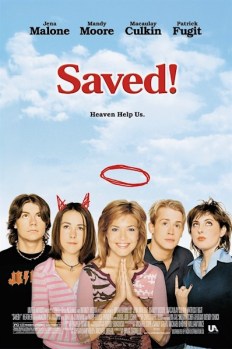
Saved! (2004)

100 Films’ 100 Favourites #78

Heaven Help Us.

Country: USA & Canada
Language: English
Runtime: 92 minutes
BBFC: 12A
MPAA: PG-13

Original Release: 11th June 2004 (USA)
UK Release: 29th October 2004
First Seen: DVD, 2005

Stars
Jena Malone (Donnie Darko, The Hunger Games: Catching Fire)
Mandy Moore (A Walk to Remember, Tangled)
Macaulay Culkin (Home Alone, My Girl)
Patrick Fugit (Almost Famous, Wristcutters: A Love Story)
Eva Amurri (The Banger Sisters, The Life Before Her Eyes)

Director
Brian Dannelly (Struck by Lightning, Scream: The TV Series)

Screenwriters
Brian Dannelly (He Bop)
Michael Urban (Who’s Afraid of Vagina Wolf?)

The Story
When teen Mary learns her boyfriend is gay, a vision of Jesus leads her to attempt to cure him through sex. Unfortunately for her, the only result is she gets pregnant, which she decides to keep secret from friends and teachers at her ultra-Christian high school. As Mary questions her beliefs, she falls in with the school’s misfits, while her former friends endeavour to aggressively restore her faith.

Our Hero
Mary has “been born again her whole life”, but has her eyes opened a bit when her attempts to cure her homosexual boyfriend don’t go as Jesus promised.

Our Villain
Hilary Faye, the ‘perfect’ Christian who mainly uses her devotion to God to be the school’s queen bitch.

Best Supporting Characters
Hilary’s wheelchair-bound brother, Roland, and the school’s only “Jewish”, Cassandra, who come together with shared cynicism, but at heart better embody Christian values than some of their more militant schoolmates.

Memorable Quote
“Why would God make us so different if he wanted us to be the same?” — Mary

Memorable Scene
At the first assembly of the school year, cool headmaster Pastor Skip flips onto stage (“Give it up to the Lord, Jesus is in the house! Let’s get our Christ on, let’s kick it Jesus style! … Who’s down with G-O-D? Alright! Jesus rules! Jesus rules!”), before prayer time gives an insight into what everyone’s thinking (“thank you for sparing me from the eternal hell fires of damnation, I’m sorry I let that Promise Maker guy touch me in the rectory”), and then Cassandra starts ‘speaking in tongues’ (“mah puhsah issa hot puhsow”), though Hilary Faye sees through it (“she’s saying she’s got a hot p—!”)

Awards
2 Teen Choice Awards nominations (Movie Hissy Fit (Mandy Moore), Movie Sleazebag (Mandy Moore))

What the Critics Said
“Dannelly and Urban, first-time filmmakers, don’t have the ruthlessness of dedicated satirists like the writer-director team of Jim Taylor and Alexander Payne, whose movies Citizen Ruth and Election are modern classics. But satire can sting without being ruthless. Saved! is a minor work, yet it has a teasing lilt to it, and to make it at all took courage and originality. […] Saved! is not an attack on Christianity; if anything, the movie wants to reassert the Christian spirit. But it goes after pious hypocrites, the kind of people who never stop speaking of love yet find an unaccountably large number of folks to hate.” — David Denby, The New Yorker

Score: 61%

What the Public Say
“many moments [are] screamingly funny but also sad in Brian Dannelly’s incisive, but not entirely irreverent, send-up of Christian fundamentalism. The title’s exclamation point isn’t for show, but questions Christianity’s constant urgency: Is salvation really unattainable for these kids if they’re not seeking it this second, every second, 24/7? […] Dannelly and Michael Urban’s script could’ve settled for empty-calorie satirical slapdowns, but instead posed thoughtful, challenging questions about the relative worthlessness of forced value systems.” — Nick Rogers, The Film Yap

Verdict

Mixing “mean girl” high school comedy with religious satire, which initially seems more cutting than it perhaps is, Saved! triumphs by having something to say but saying it very amusingly. Some criticise it for pulling its punches, not going all out in its damnation of religious types, but — conversely — that quality of mercy arguably makes it a better, more intelligent movie. It’s not saying having religious faith or sharing those values makes you inherently bad, but applying those beliefs hypocritically kinda does. Whatever your position on that matter, the screenplay’s gentle irreverence and the cast’s quality comic performances make it an often hilarious delight.

#79 will be… a lot of bother to rescue Matt Damon.

Road to Perdition (2002)

100 Films’ 100 Favourites #74

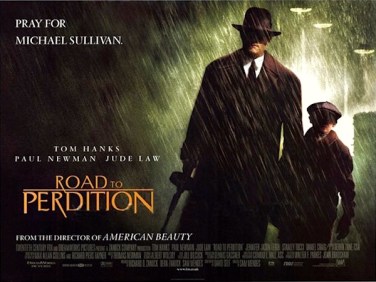
Pray for Michael Sullivan.

Country: USA
Language: English
Runtime: 117 minutes
BBFC: 15
MPAA: R

Original Release: 12th July 2002 (USA)
UK Release: 20th September 2002
First Seen: DVD, March 2003

Stars
Tom Hanks (Forrest Gump, Bridge of Spies)
Paul Newman (Cool Hand Luke, Butch Cassidy and the Sundance Kid)
Daniel Craig (Lara Croft: Tomb Raider, Casino Royale)
Jude Law (Gattaca, Closer)
Tyler Hoechlin (Everybody Wants Some!!, Fifty Shades Darker)

Director
Sam Mendes (American Beauty, Skyfall)

Screenwriter
David Self (Thirteen Days, The Wolfman)

Based on
Road to Perdition, a graphic novel by Max Allan Collins and Richard Piers Rayner.

The Story
1931: Michael Sullivan is an enforcer for mob boss John Rooney, who thinks of him like a son. When Sullivan escorts Rooney’s unstable real son, Connor, to a meeting, the guy snaps and the other side are murdered — an event witnessed by Sullivan’s own son, Michael Jr. In an attempt to cover it up, Connor kills Sullivan’s wife and other son, while Michaels Sr and Jr escape, and begin a journey to take revenge.

Our Heroes
Michael Sullivan Sr is, on paper, not much of a hero: a mob hitman, his trade is death. But when half his family is murdered, he’ll do what’s necessary to protect his surviving son and get justice — his kind of justice, anyway. In the process, he bonds with Michael Jr, finally developing the relationship they never had before. Perpetual nice guy Tom Hanks tones that way down to give what I think must be one of his best performances, which brings out the heart in Sullivan without tipping over into regular Hanks territory, in the process allowing the viewer to empathise with a man who in lesser hands would just be a cold-blooded murderer.

Our Villains
Connor Rooney is a liability, a deranged coward and crook who wishes he was a hard man. But he’s no threat — his father, mob boss John Rooney, is the one with the power and means. At heart he’s no villain to Michael Sullivan — he’s essentially his father — but after Connor murders Sullivan’s family, Rooney feels he must protect his own blood, despite caring for him less than Sullivan. With an actor of Paul Newman’s quality in the role, every nuance of Rooney’s complex emotional position is subtly explored.

Best Supporting Character
To try to stop Sullivan, the mob set hitman Maguire on his trail. He’s a crime scene photographer who uses his job to cover his crimes, and is a nasty, rat-like creep. Jude Law rejects his frequent pretty-boy-ness to really inhabit that part. (Basically, everyone is fantastic in this film.)

Memorable Quote
John Rooney: “This is the life we chose, the life we lead. And there is only one guarantee: none of us will see heaven.”
Michael Sullivan: “Michael could.”

Memorable Scene
Heavy rain falls as Rooney and his men cross an empty street to his car. When they reach it, the driver inside is dead, the door locked. They spread out across the street, guns ready, but there’s no one to be seen… Then a muzzle flashes and the men are slowly cut down — leaving only Rooney standing. As the shooter emerges from the shadows, the camera tracks in on Paul Newman, his posture and expression saying it all: he knows who it is, he knows his time has come, and he’s resigned to it. All of this set to just the sound of Thomas Newman’s mournful piano-and-strings soundtrack. Only when Rooney turns around does the rain begin to bleed onto the soundtrack, and we see the man is (of course) Michael Sullivan. “I’m glad it’s you.” With tears in his eyes, Sullivan finishes his job.

Technical Wizardry
There are several reasons the above scene works so well — the pace of the editing, the sparse sound design, the music, the performances — but one of the biggest is the cinematography. The work of Conrad L. Hall, this is just one of the most obviously beautiful sequences in a film full of gorgeous imagery. He won a well-deserved posthumous Oscar for his work, his third from a career that garnered ten nominations.

Making of
One of the locations found was considered physically perfect but the wrong way round, with room only to shoot from right to left and not vice versa. Rather than, say, find somewhere else, production designer Dennis Gassner and his team dressed the location to be flipped, not only reversing street signs and car number plates, but even changing the side of the steering wheels on all the vehicles.

Awards
1 Oscar (Cinematography)
5 Oscar nominations (Supporting Actor (Paul Newman), Score, Art Direction-Set Decoration, Sound, Sound Editing)
2 BAFTAs (Cinematography, Production Design)
1 BAFTA nomination (Supporting Actor (Paul Newman))
2 Saturn nominations (Action/Adventure/Thriller Film, Performance by a Younger Actor (Tyler Hoechlin))

Despite some initial build-up, Road to Perdition wound up an awards season also-ran, losing out to that well-remembered classic Chicago and everyone’s desire to try to give Martin Scorsese an Oscar for Gangs of New York.

What the Critics Said
“The greatest gangster film since The Godfather.” — News of the World

“To call this the greatest gangster film since The Godfather would be an overstatement, though not by much. It is, however, the most brilliant work in this genre since the 1984 uncut version of Sergio Leone’s flawed but staggering Once Upon a Time in America. Road to Perdition, a less sprawlingly ambitious movie, is without major flaws.” — Eric Harrison, Las Vegas Sun

Score: 81%

What the Public Say
“In a film about the mob and hitmen, the violence is generally kept to a minimum. And when it is done, it’s either very quick, or it’s shown partially offscreen or via a reflection. […] Throughout the film, the violence is never glorified as something heroic. But instead, it’s something that’s done only when it is necessary, and the weight of it is always felt. During the first killing in the film, the first one that Michael sees through a crack in the wall, it’s done unexpectedly and the victim falls to the ground in slow motion. When Mike brings out his Tommy Gun, it’s not something he does with glee, it’s something very deliberate as he solemnly takes the pieces out of the briefcase to assemble it.” — Bubbawheat, Flights, Tights, & Movie Nights

Verdict

Road to Perdition feels like a film that didn’t get its due at the time, and has become almost something of a cult favourite since. Not “cult” in the traditional “gaudy fun B-movie” sense, but in that it has a dedicated following of people who realise its power. On the surface it’s a revenge thriller, replete with ’30s mob style and Tommy Gun massacres, but under that is a more emotive tale about masculinity as it pertains to the father/son dynamic. It’s all handled with sensitive artistry by director Sam Mendes, supported by first-rate technical merits across the board (the design and music are particularly noteworthy, in addition to the cinematography I already mentioned), and career-best-level performances from a strong cast. It lacks the sheer scale and scope to go toe-to-toe with The Godfathers as the definitive gangster movie, but as a smaller, personal tale, it’s exceptional.

#75 will be… Bayhem.

Pirates of the Caribbean: The Curse of the Black Pearl (2003)

100 Films’ 100 Favourites #70

Prepare to be blown out of the water.

Country: USA
Language: English
Runtime: 143 minutes
BBFC: 12A
MPAA: PG-13

Original Release: 9th July 2003 (USA)
UK Release: 8th August 2003
First Seen: cinema, August 2003

Stars
Johnny Depp (Edward Scissorhands, Finding Neverland)
Orlando Bloom (The Lord of the Rings, Troy)
Keira Knightley (Bend It Like Beckham, Pride & Prejudice)
Geoffrey Rush (Quills, The King’s Speech)

Director
Gore Verbinski (The Ring, The Lone Ranger)

Screenwriters
Ted Elliott (Aladdin, Pirates of the Caribbean: On Stranger Tides)
Terry Rossio (Small Soldiers, Pirates of the Caribbean: Dead Man’s Chest)

Story by
Ted Elliott (Treasure Planet, National Treasure: Book of Secrets)
Terry Rossio (The Mask of Zorro, The Lone Ranger)
Stuart Beattie (Collateral, 30 Days of Night)
Jay Wolpert (The Count of Monte Cristo)

Based on
Pirates of the Caribbean, a theme park ride at Disneyland.

The Story
When feared pirate ship the Black Pearl lays siege to the British outpost Port Royal and kidnaps the governor’s daughter, Elizabeth Swann, her childhood friend (and secret admirer) Will Turner teams up with notorious pirate Captain Jack Sparrow to rescue her. Jack has his own axe to grind with the crew of the Pearl, who are afflicted by a supernatural curse that they believe Elizabeth may be the key to breaking.

Our Heroes
Will Turner, a humble blacksmith and self-taught expert swordsman. Doesn’t like pirates, but is forced to team up with one. That would be self-proclaimed captain Jack Sparrow, who is apparently a bumbling buffoon prone to wild exaggeration about his exploits, but is actually strangely competent and honourable. Not to forget Elizabeth Swann, the governor’s daughter who is more strong-minded and capable than women of her time are supposed to be. Hates corsets, too.

Our Villains
Captain Barbossa (a villain of Rickman-esque likeability) and his undead pirate crew just want to lift their terrible curse, but, being pirates, tend to go about that mission with excessive violence.

Best Supporting Character
Two of Barbossa’s crew, Ragetti (Mackenzie Crook) and Pintel (Lee Arenberg), who make a comedy double act. Or maybe triple act, with Ragetti’s wooden eye.

Memorable Quote
“You best start believing in ghost stories, Miss Turner… you’re in one!” — Barbossa

Memorable Scene
Barbossa orders his crew to attack a British Navy ship from underwater. As the moon emerges from behind a cloud to reveal the true skeletal form of the undead crew, they march along the seabed to their target…

Memorable Music
Originally set to be scored by Alan Silvestri, who’d worked with director Gore Verbinski on a couple of previous movies, the composer fell out with producer Jerry Bruckheimer and it was decided to go with Hans Zimmer instead. Unfortunately Zimmer was busy, but he pointed them in the direction of newer composer Klaus Badelt, one of Zimmer’s mentees at his company Media Ventures. Presumably Badelt struggled, because Zimmer ended up drafting several of the score’s main themes in one night, and a team of additional composers (anywhere from seven to fifteen, depending which source you listen to) was brought in to help finish it off. (One of them, incidentally, was Ramin Djawadi, who has since gone on to be noticed for Game of Thrones.) The final score is credited to Badelt, but the soundtrack’s most famous cue — He’s a Pirate — is actually a development of a piece Zimmer wrote for forgotten Wesley Snipes action-thriller Drop Zone. You can’t really argue a score created like that has any artistic integrity, but it’s fun and exciting, and He’s a Pirate is a really, really good piratical action theme.

Truly Special Effect
All of the CGI was strikingly photo-real at the time, the main showcase being the skeletal pirates, especially as they switched from being normal humans to skeletons (and back again) as they moved in and out of the moonlight. I guess it’s aged a little now, but, to be fair, it is 13 years old. Couple this with the even-better work featured in the sequels and it shows ILM are still at the forefront of the industry.

Making of
There’s always been something of a tonal similarity between the Pirates films and the Monkey Island series of computer games, which turned out to be more than coincidence when it eventually emerged that, just a couple of years before Pirates, screenwriter Ted Elliott had been working on a Monkey Island film for Steven Spielberg which never came to fruition. As if to compound the point, Monkey Island creator Ron Gilbert revealed in 2004 that the original game was inspired by the novel On Stranger Tides, and in 2007 Disney bought the rights to the novel and used its title and bits of its plot for the fourth Pirates film.

Next time…
Initially followed by a pair of shot-back-to-back trilogy-forming sequels, their cumulative success turned it into a franchise: a fourth movie followed in 2011, with a fifth shot last year for release next summer. Also inspired a host of piratical TV series, and Disney to attempt various other ride adaptations and genre mash-ups (see: The Lone Ranger).

Awards
5 Oscar nominations (Actor (Johnny Depp), Makeup, Sound Mixing, Sound Editing, Visual Effects)
1 BAFTA (Make Up/Hair)
4 BAFTA nominations (Actor (Johnny Depp), Costume Design, Sound, Visual Effects)
1 Saturn Award (Costumes)
10 Saturn nominations (Fantasy Film, Actor (Johnny Depp), Supporting Actor (Geoffrey Rush), Supporting Actress (Keira Knightley), Director, Music, Make Up, Special Effects, DVD Special Edition, Genre Face of the Future (Keira Knightley))
2 MTV Movie Awards Mexico (Sexiest Hero (Orlando Bloom), Best Look (Johnny Depp))
1 World Stunt Award (Best Fight for the blacksmith shop sword fight)
Nominated for the Hugo for Best Dramatic Presentation Long Form

What the Critics Said
“it’s Johnny Depp’s inspired turn as Captain Jack Sparrow that really marks the spot. Depp, arguing that pirates were the rock stars of their day, models his entire performance on Keith Richards of the Rolling Stones: it’s there in every slurred vowel and every drug-fried wiggle of the head. There’s an endearing dignity to Sparrow’s hunger for fame. “You are, without doubt, the worst pirate I’ve heard of,” says one British officer. “Yes,” replies Jack, “but you have heard of me.” Gloriously over-the-top, this performance is pitched only as high as the film’s fun factor itself. In terms of physical precision and verbal delivery, it’s a masterclass in comedy acting.” — Alan Morrison, Empire

Score: 79%

What the Public Say
“manages the weird assignment of capturing the sensibility of a theme park boat ride inside a Spielbergian adventure romp. This is all the things popcorn movies should be: fun, energetic, simple enough to quickly grasp but full enough to not seem stupid, anchored by strong personalities among all the side characters (Geoffrey Rush’s florid villain is a great bit of acting in its own right, unfairly overshadowed by Depp), and a cohesive world with a sense of history and depth.” — Tim Brayton, Antagony & Ecstasy

Verdict

It seemed like such a terrible idea when it was first announced: films based on Disney theme park rides? What the hell were they thinking?! The other movies produced by this initiative turned out to be as terrible as everyone expected, but somehow Pirates of the Caribbean — which also had to contend with the fact that cinematic pirates were deeply unpopular after the studio-killing disaster of CutThroat Island eight years before — wasn’t. Not just “not bad”, either, but an exciting, humorous, creepy, fun movie. That the sequels haven’t lived up to it is disappointing, but the first still stands as a near-perfect example of big-budget swashbuckling entertainment — it’s basically the dictionary definition of a summer blockbuster.

#71 goes to show… you never can tell.

Phone Booth (2002)

100 Films’ 100 Favourites #69

Your life is on the line.

Country: USA
Language: English
Runtime: 81 minutes
BBFC: 15
MPAA: R

Original Release: 4th April 2003 (USA)
UK Release: 18th April 2003
First Seen: cinema, 2003

Stars
Colin Farrell (The Recruit, Total Recall)
Kiefer Sutherland (Flatliners, Dark City)
Forest Whitaker (Ghost Dog: The Way of the Samurai, The Last King of Scotland)
Radha Mitchell (Pitch Black, Silent Hill)
Katie Holmes (Wonder Boys, Batman Begins)

Director
Joel Schumacher (The Lost Boys, Batman & Robin)

Screenwriter
Larry Cohen (Maniac Cop, Cellular)

The Story
Slick, smarmy Stu uses the last remaining phone booth in New York City to call the young woman he’s trying to cheat on his wife with. Then the phone rings: there’s a sniper rifle trained on him, and if Stu doesn’t follow the caller’s instructions, he’ll die.

Our Hero
Stuart “Stu” Shepard, a slimy publicist who’s trying to cheat on his wife, strings along a kid with hopes of getting in the game, wears Italian clothes to make himself look better than he is, and is generally a dick to everyone. So not a very nice guy, really… but does he deserve to be shot by a sniper, hm?

Our Villain
A mysterious voice on the other end of the phone, The Caller has some kind of moral code, has demands of Stu to fit that code, and also has a high-powered sniper rifle that he’s not afraid to use on just about anybody. Surprisingly witty, too.

Best Supporting Character
Captain Ramey, the cop in charge of the situation once the police get involved, who is at least bright enough to realise there’s more going on than meets the eye.

Memorable Quote
(After cocking his gun) “Now doesn’t that just torque your jaws? I love that. You know like in the movies just as the good guy is about to kill the bad guy, he cocks his gun. Now why didn’t he have it cocked? Because that sound is scary. It’s cool, isn’t it?” — The Caller

Memorable Scene
With both his wife and mistress on the scene, and surrounded by police and news cameras, Stu finally makes his confession. A heartfelt monologue that is definitely a showpiece for Farrell.

Making of
The whole film was shot in just 12 days: ten days inside the phone booth and two to shoot the surroundings. To do this the crew worked “French hours”, which involves not shutting down the entire production for lunch (which just sounds logical to me), and was aided further by Farrell nailing some big scenes in one take.

Awards
1 MTV Movie Awards Mexico nomination (Best Colin Farrell in a Movie — see also: Daredevil)

What the Critics Said
“The triumph of director Joel Schumacher and screenwriter Larry Cohen in Phone Booth is not just that they pull off the central gimmick but also that they fashion from it a creditable thriller. The result is a movie that combines a seriousness of purpose with a delight in craft in a way Hitchcock would have appreciated.” — Mick LaSalle, San Francisco Chronicle

Score: 71%

What the Public Say
“It’s the kind of pulpy potboiler that is often wrecked by unnecessary padding, but the brisk no-nonsense approach here combines with its short length to make quite an entertaining off-beat thriller. Kiefer Sutherland’s vengeful psychopath who is only represented by a voice-over and a red dot for the majority of the film is the stand-out performance, but everyone involved acquits themselves admirably.” — Gary Anthony Cross, Film Noird

Verdict

Regular readers will know of my fondness for the single-location thriller, and this is one of the films that helped define that love. And events occur in real-time, which is just a bonus. Colin Farrell and Kiefer Sutherland are both on excellent form as the hostage who maybe has it coming and the hostage taker who maybe has a point. Larry Cohen’s screenplay takes a simple setup and follows it through, keeping it engrossing but still relatively plausible (something other such films struggle with in order to extend their concept), with some killer dialogue to boot. It all adds up to an immensely effective thriller.

Next time… yo-ho, yo-ho, a pirate’s life for #70.

One Hour Photo (2002)

100 Films’ 100 Favourites #68

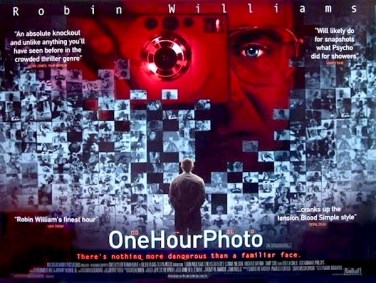
There’s nothing more dangerous
than a familiar face.

Country: USA
Language: English
Runtime: 96 minutes
BBFC: 15
MPAA: R

Original Release: 21st August 2002 (USA)
UK Release: 4th October 2002
First Seen: DVD, c.2003

Stars
Robin Williams (Mrs. Doubtfire, Jumanji)
Connie Nielsen (Gladiator, Basic)
Michael Vartan (Never Been Kissed, Colombiana)
Gary Cole (Office Space, Talladega Nights: The Ballad of Ricky Bobby)

Director
Mark Romanek (Never Let Me Go, a lot of music videos)

Screenwriter
Mark Romanek (Static, Inside Out IV)

The Story
Sy Parrish is the lead technician at SavMart’s one-hour photo developing clinic. A lonely guy, he invests all his energy in doing a great job for his customers. He’s particular fond of the Yorkins, a young family whose seemingly perfect life has become his obsession. When Sy loses his job at the same time as discovering a secret about one of the Yorkins, his quiet obsession threatens to become something darker…

Our Hero
Sy Parrish, the socially awkward but fundamentally nice department store photo technician.

Our Villain
Sy Parrish, when he snaps — though from his point of view, it’s the member of the Yorkin family that shatters his illusions of their perfect life.

Best Supporting Character
Although the film is very much focused on Robin Williams’ tour de force performance as Sy (more on that later), the cast is filled out by good turns in smaller roles. Ones that have always particularly stuck in my mind include Eriq La Salle as a detective who becomes involved as Sy goes off the rails, and Dylan Smith as the Yorkins’ sympathetic young son, who identifies Sy’s lonely sadness before anyone else. Not so hot on his Evangelion, though.

Memorable Quote
“Family photos depict smiling faces… births, weddings, holidays, children’s birthday parties. People take pictures of the happy moments in their lives. Someone looking through our photo album would conclude that we had led a joyous, leisurely existence free of tragedy. No one ever takes a photograph of something they want to forget.” — Sy Parrish

Memorable Scene
When the Yorkins are out, Sy wanders around their home, admiring the photos on the fridge, including one of himself, using the facilities, having a beer, hanging out with their dog watching TV. Then, suddenly, they come home… but it’s okay because he’s their friend. And this is all in Sy’s imagination.

Technical Wizardry
Writer-director Mark Romanek’s background is as a very successful music video director, and, as you might expect from someone with that history, his first proper feature is visually assured. In particular Sy’s workplace, SavMart, created by production designer Tom Foden as a consumerist heaven-cum-hell: a huge, white, slick place, but ultimately sterile, cold, and colourless, especially under glaring fluorescent light in the typically skilful cinematography of David Fincher’s frequent DP, Jeff Cronenweth.

Making of
In keeping with the film’s photographic theme, many of the characters are named after real-life photographers. These include: Sy’s assistant, Yoshi Araki (Nobuyoshi Araki); Sy’s boss, Bill Owens (Bill Owens); detectives Van Der Zee (James Van Der Zee) and Outerbridge (Paul Outerbridge); Officer Dan Lyon (Danny Lyon); Maya Burson (Nancy Burson); customers Mrs. von Unwerth (Ellen von Unwerth) and Mr. Siskind (Aaron Siskind); and the hotel at the end, the Edgerton (Harold Eugene Edgerton).

Awards
1 Saturn Award (Actor (Robin Williams))
4 Saturn nominations (Action/Adventure/Thriller Film, Supporting Actress (Connie Nielsen), Writing, Music)
1 Fangoria Chainsaw Award (Actor (Robin Williams) — it’s not that kind of film, is it?)

What the Critics Said
“It’s a credit to Romanek and Williams that Sy commands much sympathy; for most of the film he’s convincingly played and treated as being odd and quirky but not necessarily threatening. That Williams has come to develop a warm-‘n-fuzzy screen persona over the years works wonders for the character; not only does it make his loneliness palpable and relatable, it makes his inevitable eruption all the more shocking to behold. What makes the turn all the more disturbing, however, is no matter how unhinged he becomes, Sy never becomes nor comes off as a completely despicable character. His actions may veer off into a negative direction, but the motivation comes from a genuinely good place, though to a selfishly obsessive extreme.” — Michael Dequina, TheMovieReport.com

Score: 81%

What the Public Say
“It’s a film that over the years I’ve come to appreciate far more than my initial viewing due to the brilliant, unforgettable effort by Robin Williams who gives one of his most haunting performances. […] It’s a testament to Williams’ talent that you can be both repulsed and sympathetic to Sy. He unnerves you with his calculated obsession and creepy smile, yet it’s hard not to feel bad for a guy who simply just wants a friend or a family to call his own as he enters the twilight of his life.” — Jeffrey Lyles, Lyles Movie Files

Verdict

Part psychological thriller, part character study, One Hour Photo has some interesting things to say about how we record our memories — or how we used to, considering that digital photography and social media have since transformed that aspect of our lives. Whether or not that element of the film is past it, Robin Williams’ performance endures. It wasn’t the first time he’d played a non-comedic role, of course, but he’s so throughly subsumed in the role of the awkward, creepy Sy Parrish that it’s possible to forget it’s Williams at all. It may well be the finest acting performance from an extraordinary talent.

In #69 a ringing phone has to be answered.

Zoolander (2001)

2016 #121
Ben Stiller | 85 mins | streaming (HD) | 2.35:1 | USA & Germany / English | 12 / PG-13

Zoolander15 years before flop comedy Zoolander 2, there was Zoolander… which wasn’t a big hit either (it was 2001’s 68th highest-grossing film). Nonetheless, it developed some kind of mainstream-cult appeal, resulting in: a) that sequel, and b) me, on a night when I fancied something undemanding, deciding I should see what the fuss was about.

The story of an almost-past-it model who’s brainwashed into being an assassin, it’s essentially a one joke film (“aren’t models dumb?”), but gets surprisingly good mileage out of that. Not relentlessly amusing, nor the best thing on anyone’s CV, but some bits are very funny.

3 out of 5

The Bank Job (2008)

2016 #113
Roger Donaldson | 107 mins | streaming (HD) | 2.35:1 | UK, USA & Australia / English | 15 / R

The Bank JobInspired by real events (more on that later), The Bank Job sees the British Secret Service covertly enlist a gang of crooks to rob a bank’s vault in order to retrieve some compromising photos of a member of the royal family — not that the robbers know this is what they’re up to. Unfortunately for them, the vault also contains property belonging to an organised crime boss, who isn’t too happy it’s been pilfered.
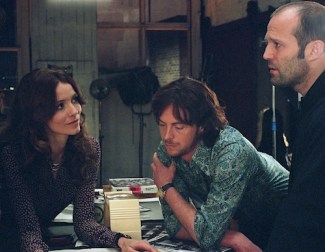
Inspired by a real 1971 robbery, plus a host of other issues that were in the news around that time, The Bank Job is a rich stew of fact, supposition, and wild imagination. Apparently the filmmakers claimed it was very much based on a true story, including new information from an inside source, though eventually admitted some of it (including a major character) was wholly fiction. One fact boldly stated on screen — that black activist Michael X’s files are sealed until 2054 — sounds entirely plausible, but is completely false.

Accurate or not, it’s a heckuva tale. Unfortunately, its telling leaves something to be desired. Screenwriters Dick Clement and Ian La Frenais are names most familiar from their TV sitcoms (The Likely Lads, Porridge, Auf Wiedersehen, Pet), but also have an array of surprising credits to their name (a ’90s crime comedy starring Alicia Silverstone and Benicio Del Toro; Julie Taymor’s Beatles jukebox musical; Aardman’s foray into CG animation) — but, most pertinently, solid TV thrillers like Archangel and Spies of Warsaw. Sadly, their work on The Bank Job lives up to none of these. The dialogue is clunky, every declaration on the nose, and the characters have a habit of discussing their secrets loudly in public places — the apparent lack of volume control in every performance is astonishing.
Mostly, it feels like it wants to be a Guy Ritchie movie — obviously there’s the throwback London gangster milieu, but also that it features disparate-but-connected plot threads, and the way it cuts between them, sometimes jumping back & forth in time… it’s all very Lock Stock or Snatch. Obviously the blame for much of this lies at the feet of director Roger Donaldson, who’s had the film shot in a kind of polished version of Ritchie’s style, too — it’s all very clean-looking, without the picturesque grittiness that’s part of Guy’s initial efforts.

Yet for all that derivativeness and almost homogenisation, the story’s a good’un; and if the quality cast can’t exactly elevate the material, they can at least keep it ticking over. Is the narrative good enough to overcome the filmmaking shortcomings? Your mileage may vary. I liked it almost in spite of itself — I suspect there was an even better film to be had out of this exact setup.

3 out of 5

Scotland, Pa. (2001)

2016 #61
Billy Morrissette | 99 mins | streaming | 1.85:1 | USA / English | NR / R

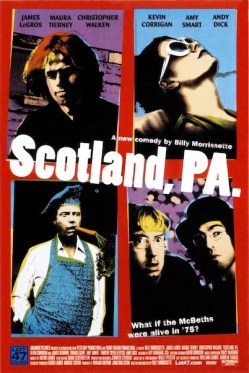
Scotland, Pa.Shakespeare gets transposed to 1970s Pennsylvania in this blackly comedic reimagining of Macbeth, which converts the Thane of Glamis into a diner chef and the Scottish throne into ownership of a new concept: drive-thru.

Writer-director Billy Morrissette cleverly reconfigures aspects of the original (the witches are hippies; the ‘spot’ on Mrs Macbeth’s hand is a burn from spitting oil), but dodges being literally beholden to the text, allowing the humour and new situations to drive matters — you don’t need to be a fan of the Bard to get it.

It’s probably a little too long, but still an amusing variation.

4 out of 5

Moulin Rouge! (2001)

100 Films’ 100 Favourites #63

Truth — Beauty — Freedom — Love

Country: USA & Australia
Language: English
Runtime: 128 minutes
BBFC: 12
MPAA: PG-13

Original Release: 16th May 2001 (L.A., USA)
UK Release: 7th September 2001
First Seen: DVD, 2002

Stars
Nicole Kidman (Eyes Wide Shut, The Hours)
Ewan McGregor (Trainspotting, Star Wars – Episode III: Revenge of the Sith)
John Leguizamo (Super Mario Bros., Land of the Dead)
Jim Broadbent (Iris, Harry Potter and the Half-Blood Prince)
Richard Roxburgh (Mission: Impossible II, Van Helsing)

Director
Baz Luhrmann (Romeo + Juliet, Australia)

Screenwriters
Baz Luhrmann (Strictly Ballroom, The Great Gatsby)
Craig Pearce (Romeo + Juliet, The Death and Life of Charlie St. Cloud)

Music by
Craig Armstrong (Love Actually, The Great Gatsby)

The Story
Paris, 1899: while pitching a show to the owner of the Moulin Rouge nightclub, writer Christian falls for the venue’s leading lady, Satine. Despite her mutual attraction, Satine has been promised to the Duke of Monroth in exchange for his investment in the cabaret. As preparations for the show continue, Christian and Satine’s love blossoms nonetheless. Will true love conquer commerce?

Our Heroes
Christian is just a poor, miserable poet living among Bohemians in turn-of-the-century Paris, until he meets and falls in love with Satine, the Moulin Rouge’s star act and courtesan.

Our Villain
Unfortunately for Christian, Satine has been promised to the Duke of Monroth, a nasty piece of work who will have his way or have Christian killed.

Best Supporting Character
The Moulin Rouge’s exuberant owner, Harold Zidler, is prepared to essentially sell Satine for investment in his establishment. Which makes him sound like a horrible so-and-so, but actually he cares for her deeply.

Memorable Quote
“The greatest thing you’ll ever learn is just to love and be loved in return.” — Christian

Memorable Scene
Zidler convinces Satine that she must tell Christian she doesn’t love him, to save his life from the murderous intentions of the Duke. As she leaves the Moulin Rouge to break Christian’s heart, Zidler delivers an emotional rendition of Queen’s The Show Must Go On.

Best Song
The film is packed with interesting reinterpretations of modern pop hits. Personally, I love a reimagined cover version, so picking just one is bloody tough. There are a couple of mash-ups that work particularly well: the big number when Christian & friends first arrive at the eponymous establishment, which crashes Lady Marmalade against Smells Like Teen Spirit; and the Elephant Love Medley, which wittily re-appropriates lyrics from a gaggle of love songs (eight, to be precise) into one number. However, the best of all may be a reimagining of the Police’s Roxanne as a dramatic dance number, El Tango de Roxanne.

Technical Wizardry
One of the most controversial aspects of what is a love-it-or-hate-it film anyway is its editing style. Eschewing the familiar trappings of Hollywood musicals, Luhrmann has the entire film shot (by Donald M. McAlpine) and edited (by Jill Bilcock) as if it were a modern music video. In total, there are just shy of 3,600 shots in the film (according to this analysis), which gives it an Average Shot Length (ASL) of just 2 seconds. For comparison, the mean ASL for US films released the same year was around 5 seconds. Even now, over a decade later, the ASL for English-language films sits at about 2.5 seconds.

Making of
It’s now quite well known that musicals need to contain a brand-new song to be eligible for the Best Song Oscar. Obviously this is normally relevant to adaptations of stage musicals, but naturally it applies to Moulin Rouge, too. The film’s one new song is Come What May, but it was ruled ineligible for the Oscar because it was actually written for Luhrmann’s Romeo + Juliet, even though it wasn’t used in that film. The music arm of the Academy really are a tricky bunch.

Previously on…
Moulin Rouge is the third part of Baz Luhrmann’s thematically-linked Red Curtain Trilogy, following Strictly Ballroom and Romeo + Juliet.

Awards
Nominated for the Palme d’Or
2 Oscars (Art Direction-Set Decoration, Costume Design)
6 Oscar nominations (Picture, Actress (Nicole Kidman), Cinematography, Editing, Makeup, Sound)
3 BAFTAs (Supporting Actor (Jim Broadbent), Music, Sound)
9 BAFTA nominations (Film, Director, Original Screenplay, Cinematography, Production Design, Costume Design, Editing, Visual Effects, Make Up/Hair)
5 Australian Film Institute (AFI) awards (Cinematography, Editing, Sound, Costume Design, Production Design)
5 AFI nominations (Film, Director, Actor (Ewan McGregor), Actress (Nicole Kidman), Supporting Actor (Richard Roxburgh))
3 World Soundtrack Awards (including Most Creative Use of Existing Material on a Soundtrack)
2 World Soundtrack Awards nominations (including Best Original Score of the Year Not Released on an Album)

What the Critics Said
“The time, the effort and the sweat are all up there on the screen in this opulent, no-holds-barred and multilayered movie. [It] is wrapped up in such an audacious mix of traditional and contemporary song — including David Bowie, Elton John, Madonna and Nirvana — and staged with a near-insane visual ambition, you will either fall in love with every camp flourish, or find yourself exhausted after 20 minutes. It’s a singular achievement either way.” — Andrew Collins, Radio Times

Score: 76%

What the Public Say
“one of the great movie spectacles of this generation, an undertaking of vast scope made all the more fascinating by how it transforms commonplace undercurrents into rich sensations […] There is a sense that these concepts are simplified for the sake of basic comprehension, but the picture doesn’t so much strip them of complexities as it penetrates to the core of their meaning. That creates a scenario where the story simply observes the indulgences that manifest in the rhythms, the music, the dance moves, the vocals, the dialogue, the facial expressions and the daydreams that inhabit the characters. It seeks no more profound a purpose. Some find the implication startlingly straightforward in an endeavor where the technical achievements are such a subversive triumph, but I applaud it; how frequently has any ambitious Hollywood production been willing to see past the varnish of a formula and deal directly with the ideals[?]” — David M. Keyes, Cinemaphile

Verdict

These days there are plenty of musicals appearing on the big screen, and they’re often contending for the top gongs come awards season. This wasn’t the case back in 2001 — Moulin Rouge, divisive as it is, changed all that (it was the first musical nominated for the Best Picture Oscar in a decade, and the previous one was a Disney animation). Baz Luhrmann’s injection of modern MTV style gave the genre a kick up the arse, which isn’t necessarily to the taste of classic musical fans but certainly brought the genre renewed mainstream attention. Mixing in his theatrical storytelling, melodramatic emotions, and vibrant and extravagant costumes and sets, Luhrmann created a heady film designed to give modern audiences a sense of how visiting the Moulin Rouge would’ve felt in 1899 (well, it’s certainly not the literal experience!) It’s clearly not a film that meets all tastes, but if you’re on its wavelength then it’s magnificent.

The first half of Baz Luhrmann’s Netflix series, The Get Down, was released on Friday, which is a neat coincidence.

#64 will be… a lot of fuss over very little.