
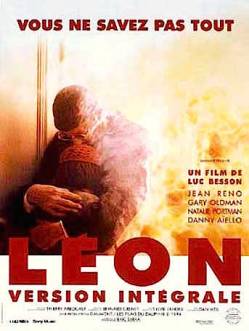
Léon: Version Intégrale (1994/1996)

2008 #42
Luc Besson | 127 mins | DVD | 15*

Léon: Version IntégraleI first saw Léon about 10 years ago, back when video was still an acceptable way of watching things. A friend leant it to me, insisting it was a film I absolutely had to see, and he wasn’t wrong. It’s remained one of my favourite films ever since, though typically I haven’t watched it more than once or twice in the intervening decade. (It also fostered a love for Sting’s closing song, Shape of My Heart, which is criminally missing from a Greatest Hits CD my dad owned (even though his dire song from Demolition Man is on there), and in moderately recent years was indifferently reused by both Sugababes and Craig David.)

I became aware of this extended cut a few years ago, a little while before it was released on R1 DVD. Having held out for a UK R2 release for about half a decade now, I gave in and bought the (apparently superior, and also in a Steelbook, which always has a way of persuading me) German R2. It’s labelled as a “Director’s Cut” but, as Besson states in the relatively lengthy booklet (translated with the aid of [the now defunct] Babel Fish), “the second version is neither better nor worse than the original” — it’s not a preferred cut, just a different, extended one.

But personally, I prefer this version. Not because there’s anything wrong with the original — far from it — but because this one has more. Sometimes you can have too much of a good thing of course, but I don’t think that’s happened here. The additions build on the characters and relationships, primarily between the two leads, and also add extra doses of humour and action. Besson wasn’t necessarily wrong to remove these things from his original cut — the extent of Léon and Mathilda’s relationship is especially controversial for some, and the extended scenes of Léon training Mathilda as a Cleaner are arguably extraneous — but they all add to the experience. Wisely, he doesn’t seem to have touched what was already there. Everything that was great about the original — from the astounding performances of Jean Reno, Natalie Portman and Gary Oldman, to the thrilling action sequences, and plenty else in between — remains intact. They’ve not been buggered about with, just expanded around.

Ultimately, the reason I prefer this version is quite simple: I love the film and the characters, I could happily take more of them, and I very much enjoyed all of the added material. I can understand objections to the insinuations about Léon and Mathilda’s relationship, but I didn’t find it any creepier here than it was before (besides which, any paedophilic notions come from her and he quashes them). The quality of the performances in the new scenes, plus other solid additions, make all the new bits worthwhile.

The version intégrale isn’t too much of a good thing, then, just more of a great thing. To my mind, Léon (in either cut) is unquestionably essential.

5 out of 5

* The original cut of Léon was last classified in 1996 and given an 18. The longer version was classified in 2009 and received a 15. That must be a pretty rare case of a longer version (technically) having a lower certificate. ^
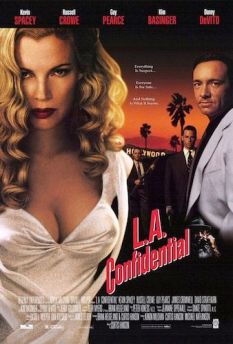
L.A. Confidential (1997)

2008 #26
Curtis Hanson | 132 mins | DVD | 18 / R

L.A. ConfidentialOnce again I’m watching an adaptation shortly after plowing through the source novel, a situation that has so far proved awkward for giving films a fair assessment. L.A. Confidential is an especially tricky one: how does a 480-page, densely written, intricately plotted crime novel, spanning seven years and “no fewer than four and perhaps as many as a dozen major crimes”, translate into a two-and-a-quarter-hour film? With more than a few surprises, as it turns out, because the apparently minor changes near the film’s start turn out to be the proverbial pebble in a pond: their ripples spread so far that, by the second half, not even a reader who can remember the many details of the novel’s complex plot will know for sure what’s coming.

This isn’t necessarily a bad thing. If screenwriters Hanson and Brian Helgeland had tried to squeeze in everything the movie would have been rushed even at three hours. Instead they’ve excised several unnecessary subplots and trimmed others to the bare minimum. Most impressively, they’ve picked apart several of the multitudinous plot threads and completely restructured them. It’s an incredible feat of adaptation. The downside is that some great strands are lost. Ed Exley’s father plays a huge role in the novel but is completely absent here; Inez Soto, the victim of a brutal gang rape, is reduced from a key supporting character to a couple of lines. Another connected loss is some characterisation. Jack Vincennes and Exley lose the most, though Bud White’s development is tied too closely to the main storyline. That said, the characters are still mostly there, painted quickly and precisely; they may lack some of the depth and complexity the novel can offer, but that’s an almost unavoidable difference between a film and a long, well-written novel. To make a good film such sacrifices are necessary — even though it’s been simplified, the novel’s complex plot is still a long way from becoming straightforward.

What impressed me most about L.A. Confidential is that, despite spending huge chunks of the film pondering what they’d cut and changed, I still enjoyed it immensely. Even while distracted with thoughts of the novel, its differences and its relative merits, I could still enjoy the fantastic filmmaking. The casting is perfect, especially Spacey, Pearce and Crowe (perhaps the last most of all, considering his penchant for real life violence). For once it really is as if the roles were written for them, making it easy to forget that Pearce and Crowe were virtually unknown at the time. They’re supported by a cracking screenplay (which I think I’ve praised plenty already) and beautiful direction, which manages to evoke the period without being shot like a period film — Hanson has stated that he aimed to make it period-accurate but shoot it like a modern thriller, and he’s succeeded. There may be one or two imperfections (the music felt a little repetitive to me, for example), but they’re slight and it seems churlish to pick on them in any depth.

I look forward to watching L.A. Confidential again without the novel hanging over my head. I’ve made my comparisons now, and my memory’s weak enough that, by the time I get round to watching it again (perhaps when the long-rumoured special edition re-release turns up), I’ll have forgotten enough of the novel’s specifics to not be bothered by them. I expect I’ll enjoy it even more then. It’s an excellent achievement, both as an adaptation and a film in its own right. You can’t say fairer than that.

5 out of 5

Great Expectations (1998)

2008 #8
Alfonso Cuarón | 111 mins | download | 15 / R

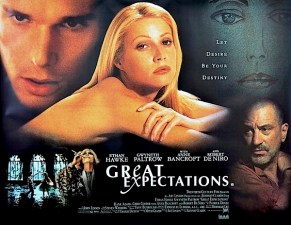
Great ExpectationsAfter re-enjoying the classic David Lean version of Great Expectations (which I reviewed in 2007) last week as part of my adaptations module, it’s now the turn of this American-set re-imagining. Despite a generally-held negative opinion toward this version, I found it to be more of a mixed bag.

Its main problem is that it can’t escape its roots. Not a fault in an adaptation, you might think, but in the case of one so radical as this it is a flaw: you’re left comparing and contrasting it with Dickens’ novel and Lean’s film, rather than appreciating it as a film or narrative in its own right. It comes across more as an academic exercise in turning a British Victorian novel into a modern American movie than a believable tale that works in isolation. Indeed, many of the changes appear to be designed purely to help distance it: the changed character names, the focus on the love story, and so on. Yet it directly recreates many scenes from the novel, and it obviously retains its title, despite there being no reference to that in the film itself.

Another product of this re-imagining is an unremitting sexualisation of everything. When Pip — sorry, Finn’s — hand is placed on Ms Havisham — sorry, Ms Dismoor’s — chest his first guess is that it’s her “boob” rather than her heart; when 10-year-old Estella kisses Pip — Finn, even — it now comes with added tongues; Finn — Pip — Finn! — draws now, and what he draws are nudes of Estella; and then they have sex too; and there are undoubtedly other examples that have since slipped my mind. This was pre Y Tu Mamá También, of course, where perhaps Cuaron exorcised this sexual preoccupations — they’re certainly not so evident in Children of Men or (unsurprisingly) his Harry Potter. His penchant for long takes, as seen constantly to great effect throughout Children of Men, also put in the odd pleasing appearance here.

By the end, it’s tricky to know what to make of this Great Expectations. It’s nicely faithful for a modern version, and yet that forbids it from striking out as its own work — it’s a fairly basic romantic film, bookended with some bizarre American Gothic trappings. I think it must stand as neither a success nor a failure, but as an interesting curio in the canon of Dickens adaptations.

3 out of 5

That picture was the only one I could find in high enough quality to make a banner image. Honest.

Dark City (1998)

2008 #2
Alex Proyas | 97 mins | DVD | 15 / R

Reposted today in memory of the great Roger Ebert, this was a film he championed and, as you’ll soon see, I adored.

Dark CityA little while ago I wrote about not falling in love with new films any more. Well, put bluntly, here’s one.

Dark City is probably the most underrated film I’ve ever seen. It is, to my mind, absolutely brilliant. It’s an intelligent and engaging neo-noir thriller with wonderful sci-fi twists. The imagery is fantastic — the film is beautifully designed and shot in a wonderfully stylised and highly effective manner. The sets and effects are breathtaking — not showy like so many blockbusters, but utterly effective and impressive. The script and story are complex (though never too much) and interesting, allowing you to piece together the mystery of just what is going on. To my mind, it’s much more effective than the whole “what is the real world” thing of The Matrix.

Incidentally, on that subject, if you’ve seen all of that particular trilogy you may find some bits of Dark City eerily familiar — to say which would spoil things, but many are so obvious you don’t have to be a film buff to spot them. Either both universes are based on similar philosophical ideas, or the Wachowskis just ripped this off (in case you hadn’t noticed, it predates The Matrix by a year, and many of the most recognisable elements are in the sequels anyway). Considering there hasn’t been a lawsuit (to my knowledge), I’ll guess it’s the former. But Dark City does it all better: there are no rambling, incomprehensible speeches and it doesn’t batter you around the head with philosophical claptrap when all you want is the story to move forward.

The film’s single major flaw is the studio-imposed opening narration, which gives away far too many plot twists — honest to God, if you ever watch this, mute it during the New Line logo and don’t turn the sound back on til the first close-up of Kiefer Sutherland’s fob watch. If you don’t, you’ll find most of the mystery of the plot ruined, as this narration shockingly gives away most of the answers. (There are rumours of a director’s cut, 15 minutes longer and without that narration, slated for release back in 2006. Maybe this year it’ll turn up as a “10th Anniversary Edition”.)

I could witter on for pages about how much I’ve fallen for Dark City. It’s a superb movie, massively underrated, that I hope I haven’t over-hyped for any reader who wants to seek it out. But please, if you do, heed my warning about muting the opening narration — it really is worth it.

5 out of 5

Dark City placed 3rd on my list of The Ten Best Films I Saw For the First Time in 2008, which can be read in full here.

While You Were Sleeping (1995)

2007 #128
Jon Turteltaub | 99 mins | TV | PG / PG

While You Were SleepingI wound up accidentally watching this on TV, and was ultimately glad I did.
If you’ve ever seen a ’90s romcom then the general shape of everything here will be familiar, though it does have a neat coma-related twist at its core. In spite of this predictability, and Sandra Bullock, I found it to be very enjoyable. It’s not a laugh-out-loud comedy and it is (of course) heavy on the sentiment, but it does have a lovely Christmasiness that is perfect for this time of year. It made me all nostalgic for the ’90s — they don’t make ’em like this any more. I don’t think. I don’t really watch rom-coms…

I can easily see myself tracking this down in time for next Christmas, and probably Christmasses after too.

4 out of 5

Bullets Over Broadway (1994)

2007 #125
Woody Allen | 95 mins | DVD | 15 / R

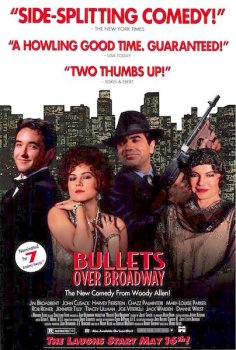
Bullets Over BroadwayThe final Woody Allen film of this little ‘season’ is that rare thing: one that doesn’t star him!

This is its biggest flaw, as John Cusack spends the entire film doing a blatant and middling impression of the writer/director. But he nonetheless does OK, and when the rest of the cast are note-perfect, the script pacy and funny, the photography gorgeous, and the long takes never more appropriate, it’s hard not to be impressed. Special mention for the final scene, a four-way shouted conversation between two high windows and the street — it’s beautifully written and executed.

Another underrated Allen film, and probably the most down-right entertaining of his I’ve seen so far.

4 out of 5

Manhattan Murder Mystery (1993)

2007 #124
Woody Allen | 103 mins | DVD | PG / PG

Manhattan Murder MysteryWoody Allen mixes a bit of the thriller into his usual relationship-based comedy/drama style, with effective results. The combination produces an engaging thriller with the usual character-focused drama woven around it, and a decent dash of comedy too. The first half hour or so is a tad slow, but the pace picks up as the story rattles into the second half.
Murder Mystery has been criticised as lightweight — the comedy stops the thriller being too serious, the thriller stops the drama being the focus, and they both prevent the comedy from overpowering — but Allen has dealt with these elements in isolation elsewhere, so it’s refreshing to see him do more than merely repeat himself.

This is an underrated gem in Allen’s relatively vast body of work.

4 out of 5

Goodfellas (1990)

2007 #123
Martin Scorsese | 139 mins | DVD | 18 / R

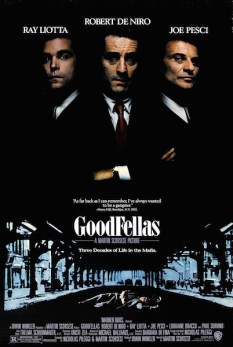
GoodfellasThese days perhaps even more praised than Taxi Driver, Goodfellas tells the true story of Henry Hill’s 25-year career as a gangster.
It’s certainly a notable achievement on virtually every level, which are too numerous to list here. The use of popular music struck me especially though, creating a sense of time (and never too obviously) while also complementing the visuals in its own right.

In the lead role, Ray Liotta seems to have been underrated, lost behind the top billing of De Niro and the award-winning craziness of Joe Pesci. He carries the film, with a performance that isn’t showy but is perfectly pitched.

I didn’t fall in love with the film as so many seem to have, but I also don’t think there’s really any denying its worthiness for full marks.

5 out of 5

A new, restored Blu-ray of Goodfellas is released in the UK today, 25th May 2015.

Wild at Heart (1990)

2007 #116
David Lynch | 120 mins | DVD | 18 / R

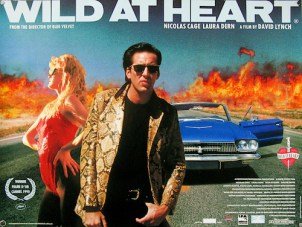
Wild at HeartMy experience of David Lynch’s work has so far been limited to Dune, the first short season of Twin Peaks, and Mulholland Drive. Admittedly, a list including the latter two isn’t that bad, but it fails to encompass any of the acclaimed films that made his name.
Wild at Heart doesn’t come much closer: a quick look at IMDb reveals that it only beats Dune and the Twin Peaks movie in user ratings. I think I can see why: it’s filled with mannered performances that can seem cheaper than those in daytime soaps (I presume this is deliberate, but some people just won’t get, or like, it); characters and plot threads that meander off and seem pointless, while others don’t come to anything; plus it lacks the opaqueness that many seem to hold as the key worthy feature of Lynch’s work.

In spite of its many faults I quite liked a lot of it, so my rating falls on the generous side. I still have no idea why there were so many Wizard of Oz references though.

4 out of 5

Bringing Out the Dead (1999)

2007 #114
Martin Scorsese | 116 mins | DVD | 18 / R

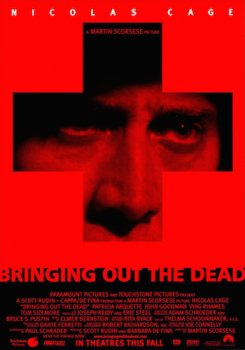
Bringing Out the DeadIt’s hard to know what to make of this, because by the end it all seems a little pointless. The storyline, which follows Nicolas Cage’s paramedic across three nights in New York, is a mixture of short episodic medical incidents with longer threads that continue throughout. These connect and fall apart, feeling as episodic as the rest, and most of them don’t really lead anywhere.

Perhaps the best description is that it’s a collection of subplots in search of proper story. There are some decent scenes and good shots, but the film doesn’t seem to have anything to say, and it doesn’t end so much as simply fade to black when it runs out of things to do.

3 out of 5