Ashes of Time Redux (1994/2008)

aka Dung che sai duk redux / Dong xie xi du zhongji ban

2009 #71
Wong Kar-wai | 90 mins | TV | 15 / R

Ashes of Time ReduxA wandering man with magic wine and no memory; a clan prince who’s also his beloved sister; a master swordsman who’s almost blind; his wife, who loves his best friend; a persistent peasant girl after revenge for her little brother, with only eggs for payment; a young swordsman with no shoes and a camel; a large gang of bandits with a left-handed member; and a desert-dwelling problem solver who connects them all. Oh if only Ashes of Time were as simple as that sounds.

Despite apparently being an Eastern action movie — it’s in the wuxia genre, which, for the uninitiated, also covers the likes of Crouching Tiger, Hidden Dragon and House of Flying DaggersAshes of Time isn’t what one would typically expect from such a billing. Reviews talk about it being a confusingly-plotted art film — and those are the positive ones — which, coupled with my relative dislike of Chungking Express, meant I didn’t really expect to like it a great deal. But I found myself surprised, because I really enjoyed it.

For one thing, I followed the plot right to the end, though the final fifteen minutes throw up a series of twists to rival any thriller. I don’t claim to understand every nuance of every character, the meaning of every event, exactly how everything is connected (assuming it is), or what it’s really all about… but based on what I’ve read, even following it is an achievement on a first viewing. I felt more or less the same way at the end of The Big Sleep, and the trick here is the same: pay attention. Yes, this requires some effort on the part of the viewer — I was aware of myself paying close attention throughout in order to follow and comprehend the story, more so than in most films (even discounting easily-followed mainstream-aimed efforts). An awareness of this need for hyper-attentiveness from the get-go (which, as I say, I had thanks to perusing a couple of reviews) is likely to aid the viewer (which, as I say, it did me).

The story itself, then, is quite episodic. There’s some overlap, but in general characters come and go from the problem solver’s home in a parade, rarely interacting with one another. Each individual piece explores a different facet of a similar theme — “anecdotes about chivalric swordsmen”, as the Radio Times puts it — which serves to tie them together, alongside other plot elements and character points — several have wives in love with others, for example, while others have left their wives at home and one has been followed by his.

Wong (again, so I read) broke ground within the genre by prioritising emotion over action. Therefore potential viewers shouldn’t expect the abundant martial arts/swordplay the genre often provides. If Hero was too arty for you (as it was for me first time round), then this will almost certainly be beyond the pale. Despite the paucity of action — despite several stories concerning assassination and death, the actual act isn’t the point in the slightest — when it does turn up (the first significant sequence is halfway through) it’s excellent; effectively, if differently, done.

Indeed, the film is beautifully shot; perhaps not as obviously as Hero’s colour-coded vibrancy, but there are frequent moments that dazzle and I can’t recall a single weak visual. Wong mucked about with the colours as part of his reduxing, to the reported distaste of cinematography Christopher Doyle, but it still looks stunning throughout.

Wong’s 2008 redux included not only these tweaks to the visuals, but also modifications to the audio and losing seven minutes from the original cut. I’ve never seen it so can’t compare, though some reports claim the changes helped clarify the plot. For the curious, a catalogue of differences can be found here. Equally, those after better-informed reviews might like to read DVD Times’ coverage, with Noel Megahey on the DVD and John White on the BD, and Heroes of the East’s review of both cuts.

Having pointed you toward those wise reviewers, let me just say that Ashes of Time Redux is not your typical wuxia film and not for everyone. My enjoyment of it came as something of a surprise, which is always nice.

4 out of 5

Film4 are showing Ashes of Time Redux tonight at 1:05am.
Alien vs Predator – Part 3

Having already published my thoughts on the two franchise starters and the remaining films in the Alien series (crikey, has it really been three months since that?), this is the concluding entry in my coverage of the Alien, Predator and Alien vs Predator franchises.

This time, I’ve covered the sole Predator sequel (to date [2015 note: times change]), and how the franchises fared as they came together to move into the new millennium. Be warned: things only get worse. Much, much worse.

2009 #17
Predator 2

“I’ve talked about the Alien sequels dramatically switching genres, but Predator 2 leaves them looking as if they couldn’t be more alike. Where Predator is a behind-enemy-lines/covert mission/jungle/war actioner, Predator 2 is an urban drugs crime police, erm, actioner… though both with a sci-fi twist, obviously.” Read more…

2009 #18
AVP: Alien vs. Predator
(Extended Version)

“Anderson manages to amalgamate a popular and acclaimed film franchise, its almost-as-beloved stablemate, and an equally popular and acclaimed comics & video game series, and then decimate all three in one 85-minute (without credits) swoop.” Read more…

2009 #19
AVPR – Aliens vs Predator: Requiem

“By not withholding the monsters, the characters’ dull lives become even duller. One of the Alien series’ strengths was in making the extraordinary (space travel!) seem mundane (space truckers), but AVPR makes the ordinary seem mundane, and that’s no achievement at all; in fact, that’s a great big failure.” Read more…


And that’s it.

Except not for long, because at some point I’ll surely share another three-film entry covering the various extended versions of the three Alien sequels. And then, of course, Robert Rodriguez is working on a Predator continuation/reboot, supposedly still called Predators, not to mention the much-discussed Ridley Scott reboot/remake/prequel of Alien. Each project has good people involved, but it remains to be seen if any of them can pull it off.

Still, you can’t get worse than AVPR, right?

Though, they said that about AVP

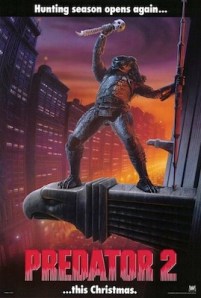
Predator 2 (1990)

2009 #17
Stephen Hopkins | 104 mins | DVD | 15 / R

Predator 2I’ve been looking forward to Predator 2 for a number of years after a friend told me that, despite its poor critical standing, it’s actually a jolly good film. (“A number of years” is the average time it takes me to act on such a recommendation; and, knowing this particular friend, “jolly” was probably not the word he used.)
Here, action director extraordinaire John McTiernan hands the reigns over to Brit Stephen Hopkins (probably best to be remembered for helming half of 24’s phenomenal first season, though you can recall the Lost in Space film and A Nightmare on Elm Street 5 instead if you like) and the action is moved from a jungle to the concrete jungle (see what they did there?) of LA, in the near-future year of 1997. Made in 1990, Predator 2 is set in the future for no good reason — sure, there’s a big gang problem, but this is fiction, you can set it now and still make up things like a huge city-affecting change in the status quo; and that way you don’t have to have silly semi-sci-fi guns either. Not to mention the fact that before too long it seems like they’d rather forget this is the ‘future’ and just get on with things. In the end, all it does is seriously date the film: in almost every facet, from screenplay to costumes to direction, it feels more like 1987 than 1997.

Sadly, this isn’t where the problems end. Out of four Aliens and two Predators, this has to be the only one that doesn’t bother in the slightest with a slow build up of tension. Sure, Alien Resurrection gives us the actual aliens much earlier than the others, but they’re not really in force for a fair old while. Predator 2, on the other hand, opens in the middle of a gunfight that lasts for the next ten minutes, and there’s a second before the half hour. This isn’t necessarily a problem in itself but there’s nothing inspired about any of it, especially the gang drug war plot that provides most of the focus.

It’s a shame this fails so miserably, because the franchise re-location is actually a commendable thing. I’ve talked a few times about the Alien sequels dramatically switching genres, but Predator 2 leaves them looking as if they couldn’t be more alike. Where Predator is a behind-enemy-lines/covert mission/jungle/war actioner, Predator 2 is an urban drugs crime police, erm, actioner… though both with a sci-fi twist, obviously. But the vastly different settings and setups mean that, even with the involvement of the same sneaky alien hunter, the films have a vastly different feel too. It’s just a shame Predator 2’s “urban jungle” concept is so poorly executed… for a while anyway, because when it finally reaches the 30-minute climax things suddenly get quite good.

It’s a bit like all the time, effort and money went on creating a good lengthy climax, then any-old hour-long urban crime movie was bolted on the front to create something feature-length. In fairness there are some good bits earlier on, but the final half-hour (or so) feel like it’s from a slightly different, slightly better movie. The dialogue improves, suddenly filled with some decent lines, and it centres on a mano-a-mano (or mano-a-alien, really) fight that’s nicely reminiscent of the first film while being totally different, sprawling through locations and using lots of high technology. There are still flaws — it nicks the government agents’ motivation from Alien wholesale (they want to capture the alien for its weapons technology, which they admire it for) — but they’re largely forgivable.

Perhaps best of all is that throughout the climax it expands what we know of the Predator, rather than just rehashing what we learnt in the previous film, as in so many weaker sequels. There’s more of its weaponry and its medical kit, what amounts to a tour of its ship, hints of its society and culture, and it’s given a nice balance of fallibility — not so indestructible that it’s stupid when the hero wins, but not so weak as to be undramatic or inconsistent. There’s one especially good moment where the Predator discovers a character is pregnant and so spares her, a nice touch both in terms of how it reveals the previously-unknown pregnancy (through the Predator’s heat vision) and in revealing the creature’s morals. It’s this sense of honour and a heightened mental capacity that marks the Predator out from other such creature movies, especially the Aliens, who are essentially animals (it would seem), albeit cunning ones.

Predator 2 is a dire film rescued by an excellent finale. As well as a decent chase and fight, it also builds on the first film’s mythology, revealing a decent amount about the Predators and hinting at more, without going too far or spelling it out too bluntly. If only such qualities could have extended into the opening hour, this could have been a sequel on par with the original.

3 out of 5

Tomorrow, AVP: Alien vs. Predator.

A Few Good Men (1992)

2009 #38
Rob Reiner | 138 mins | download | 15 / R

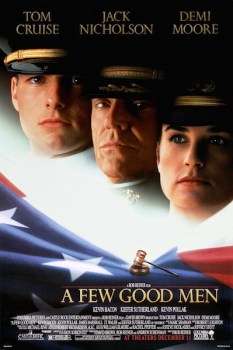
A Few Good MenSometimes you have to wonder where it all went wrong. I can only imagine how good things looked for Rob Reiner at the start of the ’90s, when he’d had an almost-interrupted near-decade-long run of acclaimed movies in the director’s chair: This is Spinal Tap, Stand By Me, The Princess Bride, When Harry Met Sally, Misery, and finally this. ‘Finally’ being the operative word however, as it all seems to have gone down hill from there, to the extent that I actually felt the need to look him up on IMDb to check if he was still working/alive. (He’s both, having recently directed The Bucket List, a bit of a hit if I recall correctly.) Reiner is a recognisable name, and if he’d stopped making films after A Few Good Men perhaps he’d find himself bandied about on lists of Great Directors (at least in certain circles/magazines), but the fact I had to check what he’s been up to (and had forgotten how many acclaimed films he’d made in the first place) shows what a 15-year run of nothingy films can do for your reputation. Even the career of Spinal Tap themselves seems to be in better condition.
All that said, A Few Good Men isn’t really Reiner’s show. It’s not that he does a bad job — far from it — but courtroom dramas primarily depend on two things, even more so than most films: the quality of the writing and the quality of the performances. When you have scene after scene in which a handful of people battle with words alone, often in one-on-one confrontations, then those two elements are virtually all you’ve got. Of course camerawork, editing, music and the rest still have their part to play, but without the underpinning of good writing and good performances the technical attributes are merely fighting to cover for significant shortcomings. Fortunately, A Few Good Men has those underpinnings.

In this case the screenplay is by Aaron Sorkin, adapting from his own play, who would go on to create and write a great deal of The West Wing (which, incidentally, was inspired by leftover ideas from a later Sorkin/Reiner collaboration, The American President). The seeds of that show’s influential style are in evidence here, although the sheer pace and famous ‘Walk and Talk’ scenes aren’t yet part of the formula. As in The West Wing, Sorkin’s writing is both intelligent and witty, a hallmark of high-quality writing that’s able to rise above the shackles of “it’s not real drama unless it’s all grimly serious”. His characters and their personal story arcs may be straight from the stock pile — Tom Cruise is the hot-shot young lawyer who’s actually trying to live up to his daddy (and comes through in the end); Demi Moore is the goody-two-shoes woman trying to make it in a man’s world (who learns to work with her colleagues); and so on — but the plotting of the central case remains undiminished, and Sorkin thankfully avoids such obvious subplots as a romance between Cruise and Moore’s initially-mismatched-but-ultimately-mutually-respectful good guys. Nonetheless, the occasional lapses into extreme, often patriotic, sentiment that would later mar the odd episode of The West Wing are also on show here, most notably at the climax, though they fail to do any serious damage.

It’s in the all-important court scenes that Sorkin’s writing really shines. Dialogue flies back and forth like bullets, full of protocol and technical jargon — like in The West Wing — that we either understand or, when we don’t, get enough of the gist to follow the key plot points — like in The West Wing. The biggie is the final confrontation between Lt. Kaffee and Col. Jessep, an interview that’s the courtroom equivalent of a high noon showdown. It’s true that Tom Cruise plays Tom Cruise and Jack Nicholson plays Jack Nicholson, just as they almost always do, but it makes for a grand act-off. It’s fair to say that Nicholson comes out the victor, gifted with material that guides him from cocksure commanding officer to angry thug in just a few minutes, but it’s the bravado of Cruise’s questioning — undercut with uncertainty and genuine surprise when he pulls it off — that pushes Jessep there.

There are plenty of other good performances — typically competent work from Kevin Pollak doing the best friend thing and Kevin Bacon doing the friend-turned-rival thing, while Kiefer Sutherland’s ‘head bully’ role is memorable and Demi Moore holds her own better than the rest of her career might suggest — but this is undoubtedly a showcase for Nicholson and Cruise, and through them Sorkin’s writing. Not to mention that there are some nice directorial flourishes from Reiner. I wonder what happened to him?

4 out of 5

A Few Good Men is showing on Five tonight at 10pm.

Alien vs Predator – Part 2

Five weeks ago (crikey, time flies) I began my series of reviews of the Alien, Predator and Alien vs Predator franchises with my thoughts on Alien: The Director’s Cut and the original Predator, both of which I’d seen before. Over the past few days I’ve moved on to the remaining Alien films, all of which I viewed in their original theatrical cuts and all of which were new to me.

Here’s a handy summary of what you may’ve missed, then, if you somehow had something better to do on a sunny summer weekend than check blogs every day.

2009 #14
Aliens

“Where Alien is a Horror Movie — but in space — Aliens is a War Movie — but in space. The central characters are a team of marines, as opposed to the original’s ordinary guys; where the first film’s design was dark, shadowy and oppressive, here it’s all gleaming tech, tanks and guns and spaceships and the like; and, just to underline the point, the score is full of military drums.” Read more…

2009 #15
Alien³

“Even if in some ways 3 combines the first two — single Alien, claustrophobia, unarmed heroes; but there are lots of them, most with experience of killing — it adds enough variety, especially stylistically… it soon turns dark, dirty and decrepit, abandoning both the the military sheen of Aliens and the old tanker grime of Alien.” Read more…

2009 #16
Alien Resurrection

“the most notable differences are its black humour, where the tastes of both [writer] Whedon and director Jeunet make their mark, and how grotesque it is — almost two extremes walking hand-in-hand. The deformed, perverted Ripley clones; the Hybrid; the Ripley-Alien sex scene — there’s nothing like this in the other films, and that’s a grand thing.” Read more…


In the third and final part of this series I’ll be setting my sights on the allegedly-underrated Predator 2 and the much-hated pair of AVP and AVPR.

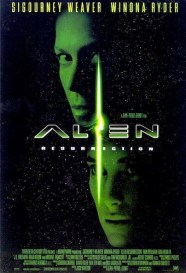
Alien Resurrection (1997)

2009 #16
Jean-Pierre Jeunet | 104 mins | DVD | 18 / R

Alien Resurrection is much maligned, to the point that even screenwriter Joss Whedon has publicly disowned it. Which is interesting to me, because I really liked it.

While you clean up your beverage-of-choice that I’m sure you just spurted all over your monitor, let me reassure you that I’m not about to argue Resurrection is an undervalued classic on a par with the first two films; but, having heard nothing but bad things about it for over a decade, I found myself pleasantly surprised. As so many other reviews have sought to detail the film’s flaws I won’t dwell on them myself, but instead seek to explain why I liked it.

In my Alien³ review I applauded the franchise for taking each instalment in a new direction stylistically, and Resurrection doesn’t drop the baton on this. Structurally it’s the most straightforward of all four, slotting fairly neatly into a standard action-adventure/disaster movie template — especially once Ripley hooks up with the crew of the Betty — but this isn’t the most notable difference. No, that would be twofold: its black humour, where the tastes of both Whedon and director Jeunet make their mark; and how grotesque it is — almost two extremes walking hand-in-hand. The deformed, perverted Ripley clones; the Hybrid; the Ripley-Alien sex scene — there’s nothing like this in the other films, and that’s a grand thing. Even if you disapprove of most (or all) of that, the scene where two aliens kill a third so that its acid blood will burn through the floor, allowing them to escape, is a bit of genius that takes our existing knowledge about the species and does something gloriously new with it.

The Aliens themselves are very well realised. For fans who favour the first film to all others they undoubtedly spend too long in plain sight, but, while there is certainly some poor CGI (the underwater sequence being of particular note, though you can see how it seemed a good idea), the constantly slime-dripping practical creatures are excellent. The Aliens and the company (no longer Weyland-Yutani, for no good reason) are relatively revealed by the story too, which I’m sure is to its detriment for some. Personally, I considered it another sensible change: we’ve had three films of the company attempting to capture the Alien — what would happen when they succeeded? That the plot is still based around the company’s hunt for the Aliens (as significant chunks of the previous sequels were too) is also interesting — essentially, the whole franchise was launched because at some point during the first film someone decided Ash should be an android who wanted to capture this mysterious creature.

I can well imagine many hated all these additions and changes to the series’ mythology (especially the Hybrid — fans always hate things like that), but I found them to be an interesting attempt to further the franchise’s story rather than just rehash previous instalments. I won’t deny that some of it borders on the silly (or even crosses that line) and there are a few plot holes (which is disappointing, because many could have been explained away if someone had taken a bit of effort), but for the most part it’s fantastically creepy, grotesque, and more than a little weird… and all within the confines of a standard action-adventure plot! Plus, within that it also retains an unpredictability over who will die, something Alien³ managed to fudge. (That said, the top four names in the opening credits are the four survivors, so maybe I should just pay more attention.)

Resurrection marries the franchise’s most wonderfully grotesque imagery with a standard action-adventure plot, meaning anyone who comes to this looking for their average sci-fi action-adventure may walk away with their sensibilities shocked — or perhaps mutated beyond recognition. It’s certainly not the series’ best film, but I have a nagging feeling that it might turn into my secret favourite.

4 out of 5

Not so secret now I guess.

Alien Resurrection placed 9th on my list of The Ten Best Films I Saw For the First Time in 2009, which can be read in full here.

Alien³ (1992)

2009 #15
David Fincher | 110 mins | DVD | 18 / R

3 times the stupid taglines.We’re used to seeing big studio’s logos transformed at the start of films — Universal perhaps do it most often, having a handy globe, though others are far from immune — but I think Alien³ is the first instance I’ve seen where the logo is left untouched but the music is altered. Right from the disconcerting modification of the famous Fox fanfare you can tell this is going to be something a bit different and a bit edgy. Unfortunately, it’s also a bit rubbish.
At the very least the Alien franchise has to be applauded for giving each film a very different feel and tone. Even if in some ways 3 combines the first two — single Alien, claustrophobia, unarmed heroes; but there are lots of them, most with experience of killing — it adds enough variety, especially stylistically, to mark it out. This can probably be attributed to first-time feature director David Fincher, who, despite severe studio interference, still manages to quickly make the film his own. Though the story picks up directly from the previous film (as Aliens did from Alien), it soon turns dark, dirty and decrepit, abandoning both the military sheen of Aliens and the old tanker grime of Alien.

The sets and costumes have a Gothic feel, devoid of most of the franchise’s sci-fi trappings, and though the cinematography is glossier than either preceding entry (Aliens looks distinctly ’80s, whilst this has a distinctly ’90s look — I’m not well enough versed in technical details to know why this is) it manages to feel grungier. From style to story, the whole film is bleak and uncompromising, particularly with its brutal plot — from the start, only Ripley survives the crash, and soon after there’s a horrid autopsy performed on Aliens‘ lovable little Newt, who Ripley previously fought so hard to save.

Alien³ is very dark and very nasty — and these are by far the best things about it.

Put simply, the story — or the way the story is handled — lets everything down. It all goes well for the first 40 minutes or so, but then it begins to get scrappy, and gets steadily worse as the running time rolls on. Leaps in story and logic abound, either creating plot holes or doing nothing to hide them. Much of the middle is the worst, where the convicts’ plans are muddled and quickly discarded. That said, this is also true of the climax — something to do with running around corridors and a giant piston and… I have no idea. It’s a shame because someone clearly had plenty of fantastic ideas, plot twists and action sequences, but they’re all squandered either by weak editing or, even worse, simply by being in this film.

As for the Alien, it sadly has no real menace — it just turns up as and when it (or, rather, the plot) fancies, and goes away for the rest of the time. In the first film it could be anywhere, in the second they were constantly advancing, but this time it’s just around, somewhere, sometimes. It’s not helped by poor realisation, spending too much time either in the light or in clear shots, both of which show the shortcomings of the special effects in a way the previous two films fought to hide.

The total lack of weapons or monster-fighting skill on the part of the supporting cast exacerbate these problems, meaning that, even when the Alien does turn up, the result is always a foregone conclusion. Even worse, any characters we really care about — or can even identify, to be honest — are killed early on, leaving a bunch of faceless potential victims who weren’t invested with any character and so who we’re not invested in. This is worsened by using a fantastic, recognisable British cast, none of whom are given anything much to do. For all these reasons, almost the entire film is devoid of any genuine tension.

Alien³ isn’t irredeemable — it’s packed with good ideas and good direction — but that’s also why it hurts. Lumbered with a hatchet job on the plot, characters and editing, it feels like some very talented people made a good film before someone else hacked it up a bit. The result is quite bad but, even worse, it’s disappointing.

3 out of 5

Tomorrow, Alien Resurrection.

My review of the Alien³ Special Edition can now be read here.

The Man in the Iron Mask (1998)

2009 #30
Randall Wallace | 132 mins | download | 12 / PG-13

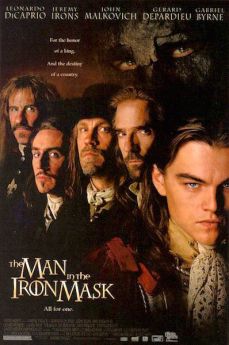
The Man in the Iron MaskFrom the off it’s clear that The Man in the Iron Mask is not going to go well. It’s an adaptation of a tale of the Three Musketeers, so naturally is set in historical Paris… where everyone has a different accent and very few of them are French. It is, to be blunt, a horrid mishmash — much like the whole film.


Wordy political intrigue tries to coexist with broad comedy which is squashed against swashbuckling adventure. The latter two could co-exist, but the film feels like it wants to be the former and so suffers for it. The comedy jars too much to be effective, while instances of unintentional comedy unfortunately provoke more frequent laughs. It should at least be able to swash buckles effectively — these are the Three Musketeers after all — but entirely fails to achieve this until the climax. The plot, semi-faithfully adapted from one of Alexandre Dumas’ original novels, offers a level of complexity to which the film clearly aspires, but the adaptation and acting struggle to match it.

The majority of performances are marred by overacting — John Malkovich, especially, is woefully miscast, while Leonardo DiCaprio doesn’t appear to give a particularly good performance as either Louis or Philippe. In DiCaprio’s defence I suspect this is actually the script’s fault, because he manages to clearly differentiate the two when they are silent or pretending to be the other — it’s when they open their mouths that it all goes wrong. Gérard Depardieu is fine as the comic relief, though that relief is tonally misplaced, while Gabriel Byrne makes an interesting d’Artagnan — there’s nothing at all wrong with him, and yet he doesn’t feel quite right. Which leaves just Jeremy Irons among the main cast. He fares the best of the lot, even getting the occasional scene or speech that is genuinely quite good, though it’s clear he is far better than the material. To be fair, the same is also true of everyone else.

For all this, The Man in the Iron Mask is more disappointing then bad. The Bastille-set climax is occasionally brilliant and never less than entertaining, delivering on the film’s swashbuckling promise in a copious fashion. Throughout, there’s the occasional good scene — or even just a decent line of dialogue — and you can briefly understand what inspired such quality actors to sign on.

Something went wrong somewhere though, and the obvious culprit must be writer/director Randall Wallace. The story’s good, but that’s Dumas’, while the adaptation’s weak — and that’s Wallace’s. The actor’s are good, but battle the poor script — and that, obviously, is Wallace’s. They don’t seem to have been given any significant direction, they’re not helped by an uneven tone, and even the cinematography falls short, failing to make the spectacular locations and costumes look suitably beautiful on screen — and we know who’s ultimately in charge of all that too.

The Man in the Iron Mask desperately wants to be better than it is — it’s a great tale, packed with politics and swashbuckling, and this particular version has the high calibre cast to pull it off. But both are left floundering by a writer/director who isn’t up to either task — poor dialogue, a gyratingly uneven tone and lacklustre direction abound. A missed opportunity, and all the more disappointing for it.

2 out of 5

The Lunch Date (1990)

2009 #9a
Adam Davidson | 10 mins | DVD

Short films are paid minimal attention by most people, but a good one can launch a career. Take this, for example, which won the Short Film Palme d’Or at Cannes in 1990 and the Oscar for Best Live Action Short in 1991. Writer/director Davidson may not have had a significant film career since, but he has directed episodes of Dexter, Deadwood, Grey’s Anatomy, Law & Order, Lie to Me, Lost, Rome, Shark, Six Feet Under, True Blood, and more. Not all great TV, true, but there are some outstanding series in there and it makes for an impressive CV.

If any short were to kick-start a career it would be The Lunch Date. As with many shorts, to attempt to describe the plot would be to give too much away, which would be a mistake because this is a beautifully shot (in grainy black & white) and performed tale with a distinct, yet subtle, character arc and an important, but not over-egged, moral message. There’s virtually no dialogue, everything conveyed by what Davidson does (and, importantly, doesn’t) show and the performances, particularly that of Scotty Bloch as the central Lady.

Some of the film’s power rests in a neat twist, cunningly obscured by intelligent blocking and timing of other plot elements. Personally I saw it coming, but that didn’t diminish its point. It’s also worth nothing that none of the twenty-or-so others I was watching with spotted the twist ahead of time and they all seemed to find it even more effective.

Why short films are ignored is a discussion for another time, but The Lunch Date is an outstanding example of why they shouldn’t be.

5 out of 5

The Lunch Date is available on the Cinema16: American Short Films DVD.

In 2013 it was selected for preservation in the United States National Film Registry by the Library of Congress as being “culturally, historically, or aesthetically significant”.

Anne Frank Remembered (1995)

2009 #4
Jon Blair | 117 mins | TV | E / PG

Anne Frank RememberedAnne Frank’s is arguably the best-known individual story of the Holocaust, perhaps because the diary of a 13-year-old girl in hiding from the Nazis — and, sadly, eventually captured by them — makes a perfect gateway for young people into learning about those atrocities.

In this Oscar-winning documentary, Jon Blair exposes the ‘untold story’ of Anne Frank. He adds to her words with the perspective of her friends, other people who knew her, and relatives of her companions in the annex. In covering these views the film presents alternate interpretations of many people Anne wrote about — for example, Fritz Pfeffer (renamed Albert Dussel in the published diary) is very disliked by Anne, but here is painted in a very different light by his son. The film also reflects on Anne herself, and what it uncovers is not always positive. Such an honest approach could be contentious, but its attempt to uncover the truth — rather than paint a false saintly picture — is admirable.

The film’s second half describes what happened after the diary ends, an often ignored part of the tale — even the BBC’s recent, excellent adaptation ended with the residents of the annex being escorted out, and I think many believe this is where the story ends. In reality there were seven months between the discovery of the annex and Anne’s death, and while only Otto Frank survived the concentration camps, many of the others came heartbreakingly close: Peter van Pels died just three days before his camp was liberated, while Pfeffer was marched away by the deserting SS as the Soviets neared, dying with so many others on that path. Here the film touches on much of what life was like in the camps, adding to its detail of how life was for those in hiding. There are undoubtedly other texts that do this more thoroughly, but by focusing on one family and using just a handful of interviewees, the events are made to feel incredibly personal in a way that some documentaries’ more factual approach fails to.

What happened to the diary after the war is also briefly covered: how the book came to light, the impact it had when published, allegations it was a hoax (due to differences between translations, and fictional events created for the 1955 play and subsequent film adaptation), as well as the positive effect it’s had beyond that, including comments from the likes of Nelson Mandela.

With its honest and extended investigation of the events covered in Anne Frank’s diary, plus its consideration of broader facts of the Holocaust, Anne Frank Remembered adds significantly to the original text. In doing so it becomes an essential companion piece to one of the most famous and important documents of the Second World War.

5 out of 5