2014 #125
Gus Van Sant | 126 mins | download (HD) | 1.85:1 | USA / English | 15 / R
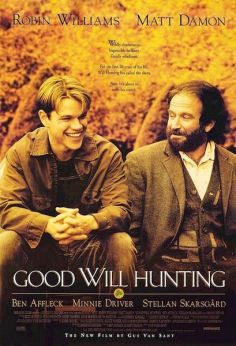 I’d say Good Will Hunting is famous for two things: one, being written by Matt Damon and Ben Affleck when they were young actors after some good roles; and two, Robin Williams’ Oscar-winning supporting actor performance. Such is the power of these two facts that I didn’t even know what it was about until I actually watched it.
Damon is the titular Will Hunting, a 20-year-old from South Boston who works as a janitor at the prestigious MIT, hangs out with his friends (who include Ben Affleck) and sometimes gets into fights for no good reason. He’s also an undiscovered genius, adept at all kinds of maths and philosophy, to a “beating students in arguments in bars” level. Undiscovered, that is, until an MIT professor (Stellan Skarsgård — didn’t even know he was in it) puts a maths problem on a blackboard for his super-intelligent students to solve over the next year, and Will solves it over night.
Williams enters the equation as a therapist, who Will is legally required to meet with. Their initially antagonistic relationship evolves, as the very troubled young man comes to deal with his issues. For all its appearances as a movie about an uncommon maths prodigy, then, Good Will Hunting is really about a messed-up young man trying to deal with his issues — not least intimacy problems that threaten to ruin his relationship with MIT student Skylar (Minnie Driver).
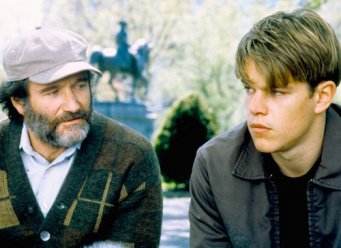 The film is perhaps most enjoyable as an acting showcase. Damon and Williams have numerous incredible scenes together; encounters that feel like genuine slowly-evolving therapy, rather than the simplistic and implausible series of repeated revelations and breakthroughs that such treatment is often reduced to on screen. They run the emotional gamut, too, being not just instances of soul-searching but also moments of wider insight, or intense humour — that’s what you get when you have Robin Williams at your disposal, of course. His Oscar is well earnt.
There’s also the relationship between Williams and Skarsgård, college roommates who have fallen out of touch but are now almost the angel and devil atop Will’s shoulders — and, of course, each believes they’re the angel. That’s to simplify it, though, as their relationship is not so straightforwardly antagonistic. These are friends, but friends with a very different view of what’s best for their young charge.
In that role, Damon is equally excellent. It’s rarely a showy part, instead full of understated feelings, buried beneath the surface but keenly felt. Here is a kid with great potential and hope, but who won’t act on any of it for fear of failure — not that he’d admit that, even to himself. Not initially, anyway. It’s a narrative that strikes me as having a great deal of truth about intelligent kids from impoverished backgrounds, brought into sharp relief by this one being not just intelligent but a genuine world-class genius. It’s also affectingly felt through his relationship with Driver, for once appealingly likeable rather than faintly irritating (is that just me?)  Their promising relationship suffers through inexperience and, to be frank, unwarranted daftness, lending it a melancholic air (or is that just me again?)
Of the leads, it’s Ben Affleck who has the least to show off with — strange, considering he co-wrote it as a chance for some work. That’s not to say he has nothing to contribute, but he’s very much a supporting role — I’ve arrived at him fifth because that’s essentially where he sits in the pecking order of significance. More memorable is his younger brother, Casey, playing another of Will’s friends. Apparently Affleck the Younger frequently improvised lines on set, and there are some great brotherly looks that seem to say, “what the hell are you doing to my screenplay?!”
Affleck the Elder is afforded at least one moment of Proper Acting, though. At one point he tells Will about the best part of his day: when he arrives at Will’s house to pick him up, the ten seconds where he walks up to the door, and there’s the possibility that his friend — who he knows is a genius but hasn’t acted on his potential — has just gone, without word; left for a better life. As the viewer, we know instantly how this is going to pay off later, so when the moment does come (spoiler, sorry), we know what to expect: Affleck will walk up to the door, he’ll knock, there’ll be no answer, he’ll grin like a loon. Except that’s not what happens: Affleck does walk up to the door, he does knock, there is no answer… so he knocks again. Frustrated, he knocks more. He peers through the glass. Now he begins to realise — Will’s gone. Then there’s a long, unbroken shot of his face, as he considers and contemplates. It’s not confused, exactly, but he’s seemingly unsure what to make of it.  Then, slowly, almost imperceptibly, a slight wry grin curls his mouth. Yes, Will has actually done it; and yes, it is what he wanted. It’s all good. Only then does he turn around, and simply announce to his waiting friends that Will isn’t there. It’s a pretty subtle moment, massively over-explained here, but it’s so much more realistic a reaction than the almost-clichéd one we’re expecting to see. In a film full of incredible, powerful performances, speeches and moments, it’s one that stood out to me.
I guess we should also thank director Gus Van Sant for that. This is the man who remade Psycho shot-for-shot “just because”, and made the interminably dull Elephant too. Here, his Artistic predilections are reigned in to just the odd moment — some shots of the friends driving around Boston staring out the car window, that kind of thing. Most of the time, he unfussily shoots the actors doing their thing. For my money, that makes this far and away his most successful movie (that I’ve seen, anyhow).
Apparently some people label Good Will Hunting predictable or implausible, with associated implications of it being twee and sugary. I don’t really think it’s any of those things. Maybe a little, but no more than so many other movies — the vast majority of stories are “predictable” because we all know how narrative works nowadays, for example. There are many worse examples than this.
 Besides, it’s the characters and the performances that shine. It’s no surprise that a pair of actors wrote an “actors’ movie”, but it is an achievement that they wrote one that displays genuine people and genuine emotions, rather than just showy performances. Credit to an exceptional cast — and, this once, an exceptional director — for bringing that so beautifully to life.
Good Will Hunting is on Film4 tomorrow at 9pm. It’s followed by Good Morning, Vietnam, which I’ll review tomorrow.
Both reviews are part of the 100 Films Advent Calendar 2014. Read more here.

 A behind-the-scenes making-of with a difference, American Movie: The Making of Northwestern (to give its full title) is a documentary about wannabe-filmmaker Mark Borchardt attempting to produce a horror feature film with little more than some mates and good intentions, battling against a lack of money, interest, and dedication. It descends, quickly, into the kind of farcicality that leads some to assume it’s a This is Spinal Tap-style spoof. But it isn’t. It’s real.
 Whatever you take away from it, American Movie feels like a must-see for certain sections of film fandom, particularly anyone who wants to make a movie themselves. Its appeal is broader than that though, an everyday story of adversity that isn’t so much overcome as temporarily averted. It’s not bleak or sad, but it is melancholic. And, whatever the morals of it, often laugh-out-loud funny.

 Disgraced national TV journo Dustin Hoffman is slumming it on a local network, covering dull stories like something-or-other going on at the local museum… until a recently-fired security guard from said museum (John Travolta) turns up with a shotgun, accidentally shoots the other security guard, and takes a party of schoolchildren hostage. Suddenly Hoffman finds himself with the inside scoop — literally — as the eyes of the national news turn on the unfolding situation.
 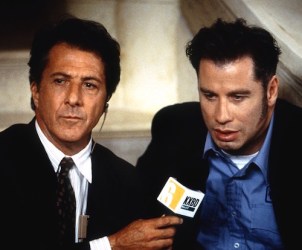 He plays against type as Sam, the nervous, naïve, childlike, and easily-manipulated hostage taker. It’s Travolta’s performance that makes Sam someone you care about, even if you don’t exactly root for him, so that the outcome — which, unusually for this kind of film, remains completely uncertain right until it’s happened — is something you’re fully invested in. There are many better-regarded films than this that don’t achieve that.
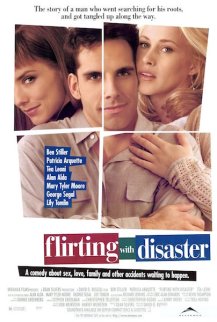 David O. Russell’s second feature sees adoptee Ben Stiller go on a kerazee road trip to find his birth parents, accompanied by dissatisfied wife Patricia Arquette and kooky adoption agency psychologist Téa Leoni, along the way bumping into Arquette’s high school crush (Josh Brolin) and his husband (Richard Jenkins). Cue an almost-PG-13 sex comedy told among sketch-like encounters with quirky people who turn out to not be Stiller’s folks.
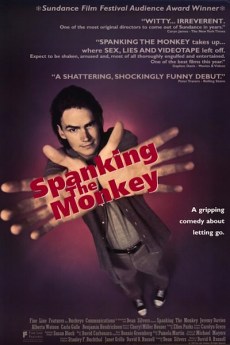 The debut of writer-director David O. Russell sees college student Raymond forced by his controlling father to turn down an exciting summer internship to care for his invalided mother.
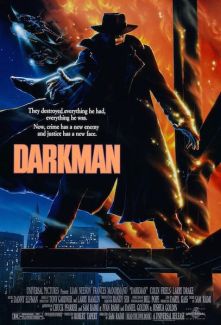 Before he made the insanely successful
  I don’t know if it says more about me or the two Harrison Ford-starring Jack Ryan movies that I wrote 250 words of this review before I realised I was actually talking about
 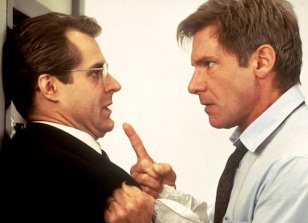 It’ll come as no surprise that Ryan ends up exposing the nasty conspiracy — which goes as high as the President! But what does a good American patriot do when he finds out the practically-holy President has committed such a sin?! The novel ends with Ryan confronting him… and then deciding not to expose his secret war. Presumably this is thanks to Clancy’s obviously-Conservative political views. “Liberal” Hollywood, on the other hand, has given us a more just — and more satisfying — conclusion. Thank goodness for that.
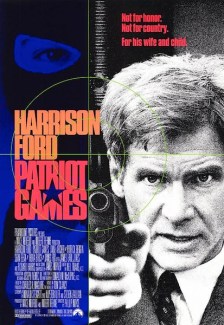 A sequel to
 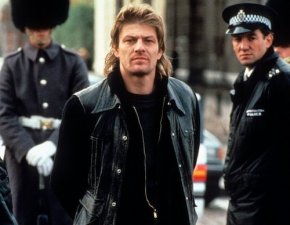 There’s a nasty synth score, just to make things drag more. There are some moments of brilliance though, not least the beautifully-shot boat chase climax. There’s also the dubious joy of seeing Sheffield’s most famous son, Sean Bean, doing an Irish accent. Co-terrorist Polly Walker is English though — twist! Not that her subplot really goes anywhere. Possibly she just couldn’t do the accent.
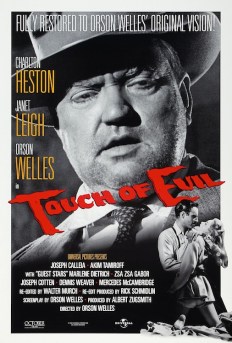 A bomb is stuck to the underside of a car. As the vehicle pulls away, the camera drifts up into the sky, and proceeds to follow the automobile through the streets of a small Mexican border town, until it crosses the border into the US… and explodes. It’s probably the most famous long take in film history, and probably the thing Touch of Evil is most widely known for; that, and it being one of the most commonly-cited points at which the classic film noir era comes to an end.
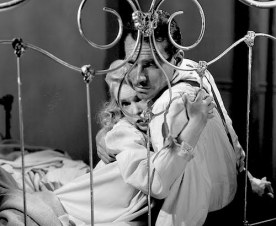 It’s like a terrible fever dream, with events and characters that sometimes seem disconnected, but nonetheless interweave through a dense plot. In this sense Welles puts us quite effectively in the shoes of Vargas and his wife — out of our depth, out of our comfort zone, out of control, struggling to keep up and keep afloat. It might be unpleasant if it wasn’t so engrossing.
 Quinlan at all… there is not the least spark of genius in him; if there does seem to be one, I’ve made a mistake.” You can get pretentious about it all you want, and bring to bear political views that the film doesn’t support (after all, within the film Quinlan is punished for his crimes and the “mediocre” (Truffaut’s word) moral hero triumphs), but sometimes a spade is a spade; sometimes a villain is a villain; sometimes your disgusting moral perspective isn’t being covertly supported by a film that seems to condemn it.
 Notably and obviously absent from that list is Touch of Evil. It was taken away from Welles during the editing process, and though he submitted an infamous 58-page memo of suggestions after seeing a later rough cut, only some were followed in the version ultimately released. Time has brought change, however, and there are now multiple versions of Touch of Evil for the viewer to choose from; but whereas history often resolves one version of a film to be the definitive article, it’s hard to know which that is in this case. Indeed, it’s so contentious that Masters of Cinema went so far as to include five versions on their 2011 Blu-ray (it would’ve been six, but Universal couldn’t/wouldn’t supply the final one in HD.) The version I chose to watch, dubbed the “Reconstructed Version”, tries to recreate Welles’ vision, using footage from the theatrical cut and a preview version discovered in the ’70s to follow his notes. Despite the best intentions of its creators, this can only ever be an attempt at restoring what Welles wanted. Equally, although it was the version originally released, the theatrical cut ignores many of the director’s wishes — so as neither version was finished by Welles, surely the one created by people trying to enact his wishes is preferable to the one assembled by people who only took his ideas on advisement?
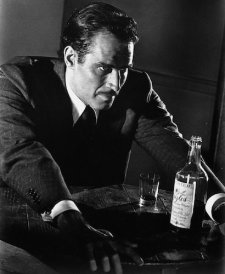 To quote from Master of Cinema’s booklet, “the familiar Wellesian framing appears in 1.37:1: indeed, the “world” of the film setting emerges with little or no empty space at the top and bottom of the frame, almost certainly beyond mere coincidence.” There are things to recommend the widescreen experience (“a more tightly-wound, claustrophobic atmosphere”), and undoubtedly the debate will continue… and such is the wonders of the modern film fan that, rather than having to make do with someone else’s decision on what to put out, all the alternatives are at our fingertips.
 I figured I ran the risk of affecting the outcome of the Scottish independence referendum if I posted this review yesterday (because of course I have that kind of reach and influence), but after Mel Gibson’s historical(ly-dubious) epic wound up on
  Judged as that, Gibson’s three-hour (near as damn it) movie is a pleasingly traditional epic. Many big films these days are just long, but the story here has scope too — it’s about a war, essentially. And war means battles, which are a particular highlight. The standout is surely the famed Battle of Stirling Bridge — you know, the one where the Scots moon the English. Funny and all, but just a small part of a larger sequence. Gibson has the confidence to show the build-up to the fighting, outline the tactics that will be used, and only then launch into the fray. It’s this measured approach that makes it so effective, rather than the crash-bang-wallop straight-to-the-slaughter style of more recent movies. Due to its notoriety I’d assumed the aforementioned clash was the film’s climax, but it’s actually the centrepiece, pretty precisely in the middle of the film. Fortunately there’s enough else going on (because this isn’t actually An Action Movie) that it doesn’t make things feel lopsided.
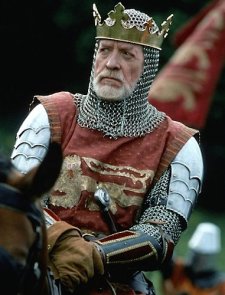 It also doesn’t suffer from that film’s accent issues. Mel Gibson isn’t an American-Scot (or an Australian one), instead delivering an accent that sounds passable to this Englishman. He believed he was too old for the part, which may well be true, but when the rest of it is so inaccurate what does that matter? He’s a solid leading man and a commanding-enough presence. The supporting cast are an array of recognisable Celtish faces — including at least one Irishman playing a Scot and a Scot playing an Irishman — and, because they’re from our fair isles, of course they’re all brilliant. Best of all, however, is Patrick McGoohan. He makes for a fantastic Evil King, given some juicy lines that are even juicier thanks to his delivery. He may not be moustache-twirling-ly memorable like an Alan Rickman creation, but any scene is enlivened by his presence.
 Then there’s that issue of historical accuracy. I know I said we should ignore it, but even if you accept fiction films shouldn’t be slavish history lessons (and not everyone does), how far can they ignore the facts? Often with such films the viewer assumes they’re true until someone says, “actually, I think you’ll find in reality…” Not so with Braveheart: you don’t have to know anything of Scottish history to guess that the face-to-face chats (and more, wink-wink-nudge-nudge) between Wallace and the future-Queen must be almost entirely poppycock (and, in fact, you can drop that “almost”).
 100Films.co.uk