2015 #78
Richard Donner | 121 mins | Blu-ray | 2.35:1 | USA / English | PG / PG-13
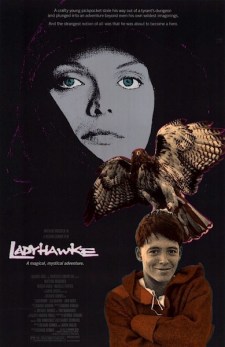 This is one of those films that crops up in the daytime TV schedules now and then and I’d always paid little heed to, because no one else seemed to. Then I read this write-up on Movies Silently and my interest was piqued. (There are many films of interest or recommendation that I haven’t got round to years after hearing of them; other times, I learn of something and watch it more or less instantly. What this says about me I don’t know, but we’ll just have to live with it.)
Ladyhawke is an ’80s medieval fantasy, though relatively light on the fantasy — it’s not Conan the Barbarian. It’s more like an old romance, in the “classical literature” sense rather than the “movie genre” one. (Apparently Warner Bros even marketed it as being based on a real medieval legend, until the screenwriter who actually came up with the story complained to the WGA. Reportedly they paid him off and continued to claim it was a legend. Ah, Hollywood. (Though he has a “story by” credit on the poster, so this may be apocryphal.)) The story concerns fugitive thief Philippe (Matthew Broderick) finding himself indebted to hawk-wielding swordsman Etienne of Navarre (Rutger Hauer), who wants revenge on the bishop (John Wood) who had also imprisoned Philippe — the fact Philippe escaped those dungeons is Navarre’s key to getting in. To add intrigue, that night Philippe is almost murdered by a giant wolf and encounters a mysterious beautiful woman (Michelle Pfeiffer), who disappears with the beast.
“What’s so fantastical about all that?” you may be asking, if you a) have never seen any promotion for the film, and b) didn’t decode the title. So let’s forge ahead with ‘spoiling’ it: the woman is a hawk by day, the man a wolf by night, and they are cursed lovers. See what I mean about “classical-style romance”? The revelation of their situation is played in-film as a mystery and then a twist, and yet it’s central to the film’s concept, how it was marketed, and how it’s discussed today. I always find it weird when movies treat as a big reveal something that’s been readily given away in advance.  Here, there’s a good 45 minutes or so of mystery before said reveal. Obviously, therefore, it would work better as a fresh viewing experience if you didn’t know that going in; but it’s so fundamental to the setup (despite the focus on Philippe, it’s their story) that I wonder if anyone has ever seen it without knowing? On the bright side, it doesn’t really matter: this is not a film where the ‘big twist’ is the point.
Indeed, there’s so much to commend Ladyhawke that I remain baffled as to why I wasn’t more aware of it. Well, there’s one possible explanation: the score. Oh, the score. It’s so reviled that I think it single-handedly explains the entire film’s lack of recognition. The work of prog rocker Andrew Powell, it’s very “of its time”, which means it now doesn’t seem to fit the genre… though, based on people’s comments, I’m not sure it ever did: the music one associates with “the ’80s” has very little in common with what we think of for “medieval fantasy”. It does have its moments though, usually once individual cues have got underway. You’d think you’d get used to it, but no: every time a new bit starts, it still jars. Ah well.
Nonetheless, a terrible score (or “debatably terrible” — it has its fans) is no reason to write-off an entire movie — just look at GoldenEye. Ladyhawke’s many enjoyable elements include some absolutely stunning locations and scenery, often beautifully lensed by Vittorio Storaro. There are good action sequences, in that more freewheeling, less hyper-choreographed way older movies have. They’re also not an end to themselves: this is a story, not a series of set pieces strung together. Concurrently, the screenplay (credited to three writers) is nicely balanced. It’s not a comedy, but it doesn’t feel the need to be po-faced either; the romantic adventure storyline is played straight,  but Philippe occasionally addresses amusing asides to God, for example. It even wisely dodges special effects… most of the time. The few occasions on which it does make motions in that direction, it demonstrates why it was wise not to attempt them more thoroughly. These days they’d slather on the CGI, but shying away from such things is not just due to a lack of technology: it’s far more magical to not be too explicit.
The film also offers an array of likeable characters and performances. For starters: Rutger Hauer as the good guy! Wonders will never cease. In fact, he was originally cast as the villainous captain of the guard, but when the original Navarre, Kurt Russell, dropped out, Hauer got a promotion. It’s a shame, in a way — no offence to Ken Hutchison, who does a solid job, but I wager Hauer would’ve given the villain more presence. Equally, he lends the heroic knight something of an edge that other actors might not have brought. As for the rest, Broderick is a likeable lead; you can believe everyone falls in love with Pfeiffer; Leo McKern turns up as a suitably wise old hermit; and oh look, it’s Alfred Molina, with crazy hair and some prosthetic scars playing a wolf hunter. John Wood’s nameless bishop is an odd primary villain, though. Not afforded much screen time after a couple of scenes early on, we mainly learn of his evil deeds from other characters. Come the climax, he mostly stands there in silence while he’s defeated.
I do wonder if, had I seen Ladyhawke as a kid, among all the other family-friendly ’80s SF/F I watched back then, would it be a beloved childhood favourite? I think it might. 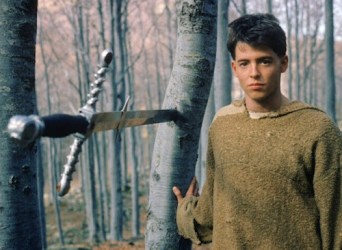 That’s the kind of age when one might be liable to fall in love with it; or, at least, people of (very roughly speaking) my generation would — I suppose Kids These Days fall in love with copious CGI, be that animated or ‘live action’. Anyway, I think it deserves to be less overlooked, and if you’ve never caught it (or not for a while) it certainly merits a chance.

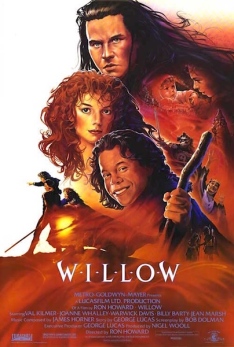 Warwick Davis is the farmer who must return an abandoned baby, unaware it’s heir to a throne evil queen Jean Marsh doesn’t wish to relinquish. Intermittently aided by Val Kilmer’s Han Solo-ish vagabond, they must elude the queen’s forces, led by her daughter, Joanne Whalley.
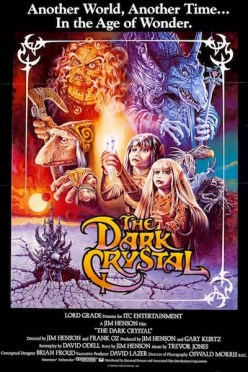 High-fantasy adventure about some elves trying to stop a crystal from destroying their planet.
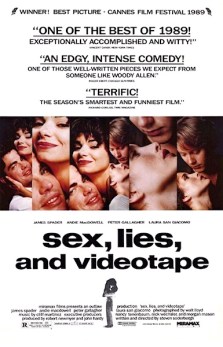 Four acquaintances partake in duplicitous relationships and candid sexual discourse in writer-director Steven Soderbergh’s debut drama.
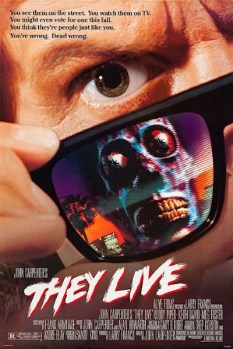 Sci-fi parable about aliens controlling us via subliminal advertising.
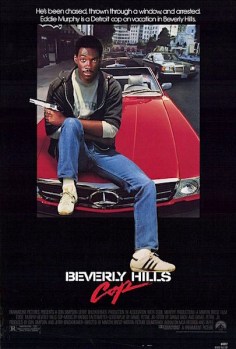 The last time I watched the first entry in a once-popular ’80s comedy cop movie series,
 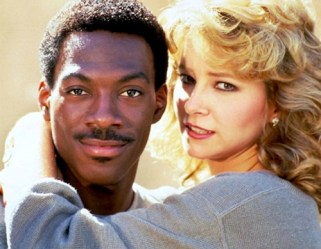 Murphy’s not the only good thing, though. Judge Reinhold and John Ashton make an excellent double act as the pair of cops assigned to keep an eye on Foley in Beverly Hills; Ronny Cox is their amenable boss; Steven Berkoff pretty much just has to turn up to be an excellent villain; Lisa Eilbacher is decent as the girl (presumably changed from being a love interest after they cast a black guy). Her part doesn’t exactly call for a great deal, but she’s fine enough in it; as good as anyone ever is in such a limited role.
 the mystery is non-existent (even if it wasn’t obvious Berkoff would be the villain, the henchman who did the deed is shown to be in his employ the first time we meet him); Brest’s direction is unremarkably static… you could probably go on. But thanks to Eddie Murphy and the rest of the cast, Beverly Hills Cop winds up a highly watchable, very likeable spot of entertainment.
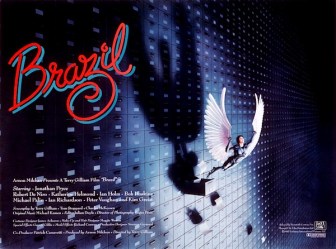 I normally aim for a “critical” (for want of a better word) rather than “bloggy” (for want of a better word) tone in my reviews, just because I do (that’s in no way a criticism of others, etc). Here is where I fail as a film writer in that sense, though, because I’m not even sure how I’m meant to review Terry Gilliam’s dystopian sci-fi satire Brazil, a film as famed for its storied release history as for the movie itself.
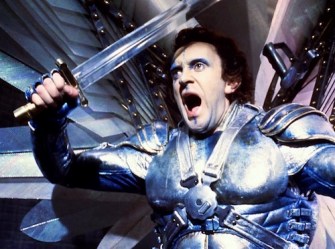 I’m sure there’s a thorough list of differences somewhere, but one good anecdote from Gilliam’s audio commentary tells how the ‘morning after’ scene was cut from the European release so last-minute that it was literally physically removed from the premiere print. (Gilliam regretted it immediately and it was restored for the video release.)
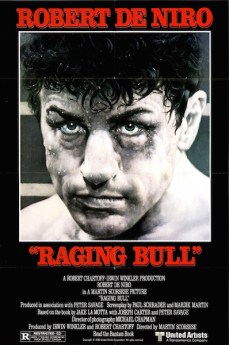 It would be boring if we all liked the same stuff, wouldn’t it? I’m sure there’s at least one ‘universally’-loved classic that we each dislike. Heck, tends to be every ‘universally’-loved classic has at least one Proper Critic that dislikes it. The flip side of this is that, in my opinion, if you don’t like something that everyone else does, there’s a fair chance it’s you who’s missing something. That’s a rule I apply to others, naturally, but I also try to bear it in mind myself (and, at the risk of sounding terribly arrogant, I think a few more people could do with thinking the same).
 The aforementioned fights, on the other hand, are full-on Cinema, and glorious for it. The make-up is also very good. Relatedly, De Niro’s physical transformation, from lithe boxer to washed-up fatso, is remarkable. Decades before the likes of Christian Bale and his
 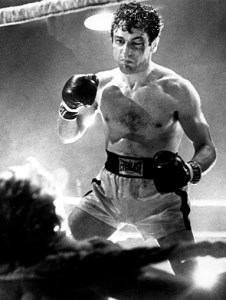 Based on where we find him at the end, I guess LaMotta would appreciate a Shakespeare quotation. For all the film’s “greatest of all time” acclaimedness, this is the one that came to my mind:
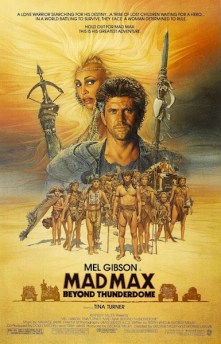 The third (and, for 30 years, final) Mad Max movie sees the titular post-apocalyptic drifter (Mel Gibson) rock up at last-outpost-of-humanity Bartertown in search of his pilfered car and camels. Max finds himself dragged before the town’s ruler, Aunty (Tina Turner), who has a job for him: kill the mutinous overseer of the city’s power supply, Master Blaster. As payment, she’ll arrange for the return of his belongings. The only conditions are he can’t reveal Aunty has employed him, and he has to do it in a fair fight in the town’s arena of combative justice — the Thunderdome. And then the story goes beyond that, funnily enough.
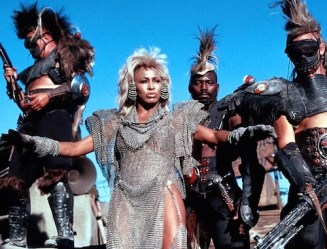 I didn’t even notice the change in level until I read those comments afterwards. The film still reaches a 15 certificate in the UK, so clearly it isn’t toned down that much. And the lack of visible blood doesn’t mean it lacks creativity: Roger Ebert
 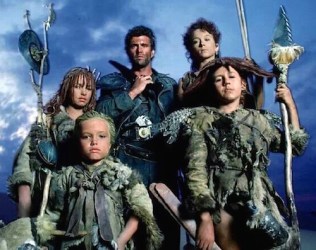 that have been forced to coexist because neither was enough to sustain an entire feature, but at least neither part feels unduly padded, meaning the narrative keeps on rolling. It doesn’t hit the same heights as the exceptional Mad Max 2 — especially with a climax that invites a direct comparison, and is good but not as good — but, as a post-apocalyptic action-adventure movie in its own right, it’s a good film.
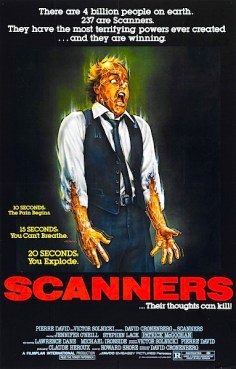 If you’re versed in sci-fi/fantasy cinema, you’ve heard of Scanners even if you haven’t seen it: it’s the one with the (in)famous exploding head. That moment is distinctly less shocking for those of us coming to the film as a new viewer at this point: gore perpetuates genre cinema nowadays, so it’s less striking,
 emotional journey or something is the core of the film. As if to make up for it, McGoohan is of course excellent, acting everyone else off the screen, while Ironside makes for an excellent villain, naturally. Some say that the final psychic battle, between Lack and Ironside, is underwhelming, but I thought it was excellently realised, a tense and effective struggle. Such brilliant effects and sequences are scattered throughout the film.
 100Films.co.uk