The Witches of Eastwick (1987)

2016 #47
George Miller | 113 mins | streaming (HD) | 2.35:1 | USA / English | 18 / R

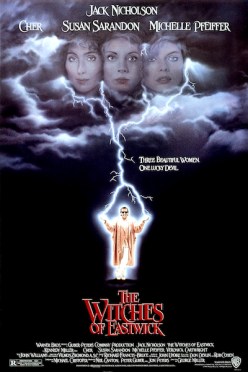
The first US feature from the director of Mad Max is an unusual affair. Three now-single women (Cher, Susan Sarandon, Michelle Pfeiffer) accidentally summon a man (Jack Nicholson) who lures them into a life of debauchery, while helping hone their latent magic powers.

Undoubtedly a comedy, Eastwick is less laugh-out-loud, more wryly amused by small-town tittle-tattle. Nicholson was made for devilish characters like this, but the rest of the film isn’t as focused. A presumed point about female empowerment gets lost in the mix, and it doesn’t know how to end, resorting to an effects-driven climax.

Still, it’s largely fun.

3 out of 5

For more quick reviews like this, look here.

The Color Purple (1985)

2016 #66
Steven Spielberg | 154 mins | streaming (HD) | 16:9 | USA / English | 15 / PG-13

These days, Steven Spielberg is as well-known for his Oscar-worthy historical prestige pictures as he is for his action-adventure genre movies, so it’s kinda strange (at least for me) to imagine the time in his career at which this film came about. I mean, it’s an adaptation of a controversial literary novel about the miserable lives of black women in the American South during the early decades of the 20th Century, directed by the white guy known for Jaws, Close Encounters, E.T., Raiders of the Lost Ark, and Temple of Doom. To give it a modern frame of reference, it must’ve been a bit like if Zack Snyder had made Precious.

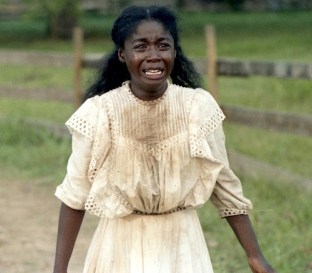
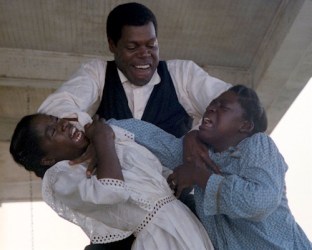
Beginning in 1909, the film tells the life story of Celie, played as a teen by Desreta Jackson and as a woman by Whoopi Goldberg, in her debut role. She’s surprisingly good, actually — often understated, doing a lot with just her eyes. Anyway, over the next 28 years Celie is systematically abused and downtrodden, first by her father, then by her husband Albert (Danny Glover) and his unruly kids from a previous marriage. Her beloved sister Nettie (Akosua Busia) disappears, never to be heard from, despite a promise to write. Various characters and their subplots weave in and out of Celie’s life, like Sofia (Oprah Winfrey), a strong-willed woman who one day slaps a white man and suffers for it; and jazz singer Shug Avery (Margaret Avery), the object of Albert’s affections, who eventually helps Celie find greater independence.

If it all sounds a bit grim then, well, it is. I’m sure it can’t’ve been a great time or place to be a black person (though any suffering at the hands of white folk doesn’t play into this particular narrative too much, aside from Sofia’s storyline), nor is it exactly the greatest period to have been a woman, so put the two together… Yet because it’s a Spielberg film, it never quite feels like we’re getting the full force of the story’s brutality. That’s a mixed blessing: as a viewer, we’re spared all the horrors you can infer from what actually happens; at the same time, how much should a story about such horrors be sparing us from them? Though as it was at one point advertised with the tagline, “Remember how good it made you feel… See it again.”, someone clearly thought it was meant to be a feel-good movie.

Nonetheless, the lack of gritty realism isn’t just Spielberg’s fault, I don’t think, but also the era of filmmaking. These days I imagine such a story wound make for a much grittier movie, like the aforementioned Precious, or 12 Years a Slave, but this comes from a ‘prettier’ time. Look at something like Once Upon a Time in America, released the year before: it’s a film about violent crime and associated dark deeds, but it’s also an historical prestige movie, tinged with nostalgia. There’s not a whole lot of nostalgia in The Color Purple, but there’s something of a similar tone.

That said, Spielberg’s handling of tone here is certainly not as accomplished as Sergio Leone’s in Once Upon a Time. The really grim stuff rubs up against slapstick comedy, and Spielberg’s patented sentimentality is unleashed in undiluted force in a final act where everything comes up roses, and even some of the grim stuff from earlier is retrospectively re-written (some of that is a fault inherited from Alice Walker’s novel, of course). It’s also far too long, in need of a good streamlining rather than losing any one part in particular. Famously, it’s the only Spielberg film not scored by John Williams (until he was too ill to do Bridge of Spies). Ironic, then, that Quincy Jones’ score often sounds quite Williams-y, particularly one motif that constantly feels like it’s going to evolve into the Jurassic Park theme.

Spielberg’s first foray into Serious filmmaking is a long way from being an unqualified success, but it’s not a bad movie either, and at least it was the gateway to him making some superior dramas. Bonus points, too, for a mainstream big name director tackling a story about the historical lives of black women — depressingly, that still feels like it would be a noteworthy move 30 years later.

4 out of 5

The Empire Strikes Back (1980)

100 Films’ 100 Favourites #27
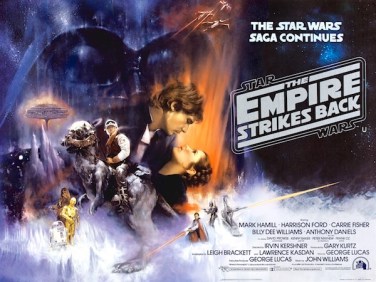
The Star Wars Saga Continues

Also Known As: Star Wars: Episode V – The Empire Strikes Back

(I may be a young whippersnapper, but I’m old enough that, when I was a kid, we still called it just The Empire Strikes Back. I thought that would be a nicer place for it among my 100 Favourites, therefore.)

Country: USA
Language: English
Runtime: 124 minutes | 127 minutes (special edition)
BBFC: U
MPAA: PG

Original Release: 21st May 1980 (UK)
US Release: 20th June 1980
First Seen: VHS, c.1990

Stars
Mark Hamill (Star Wars, The Big Red One)
Harrison Ford (Raiders of the Lost Ark, Air Force One)
Carrie Fisher (Star Wars, Hannah and Her Sisters)
Billy Dee Williams (Mahogany, Batman)
Frank Oz (The Muppet Movie, Monsters, Inc.)

Director
Irvin Kershner (Never Say Never Again, RoboCop 2)

Screenwriters
Leigh Brackett (The Big Sleep, The Long Goodbye)
Lawrence Kasdan (Raiders of the Lost Ark, Wyatt Earp)

Story by
George Lucas (Raiders of the Lost Ark, Willow)

The Story
After the evil Galactic Empire uncovers the Rebel Alliance base on Hoth, our heroes flee for the stars. Guided by a message from beyond the grave, Luke heads to meet an old Jedi master. Meanwhile, Han, Leia, Chewie, and the droids hide for a bit, then go to meet the only black man in the galaxy…

Our Heroes
Luke Skywalker: ace pilot; Jedi in training.
Han Solo: reformed criminal.
Princess Leia: wait, hold on, her planet was destroyed — surely now she’s either Queen Leia or, y’know, nothing?

Our Villain
Darth Vader: daddy issues personified.

Best Supporting Character
R2-D2 is the best supporting character in every Star Wars film, but in this one we are introduced to Yoda. Looks like a Muppet, as cheeky as a Muppet, much wiser than a Muppet. Probably. It’s hard to be certain.

Memorable Quote
“Try not. Do, or do not. There is no try.” — Yoda

Quote Most Likely To Be Used in Everyday Conversation
Leia: “I love you.”
Han: “I know.”

Memorable Scene
After a dramatic lightsaber duel, Darth Vader lops off Luke’s hand, his weapon disappearing with it. As Luke dangles over an endless fall to Certain Death, Vader decides this is the perfect moment to impart a big secret…

Memorable Music
The Star Wars Main Theme is all well and good, but here regular composer John Williams introduces us to arguably an even more iconic tune — it certainly gets played outside of the films more often, as a universal signifier of evil. That’s right, it’s the Imperial March! All together now: dum dum dum dum-duhdum dum-duhdum…

Truly Special Effect
To animate the tauntauns, Phil Tippett and ILM pioneered the use of go motion, a version of stop-motion animation that moves the puppet while the frame is being exposed so as to create motion blur, thereby making the effects more realistic. (It purposefully wasn’t used for the AT-AT walkers, to emphasise their mechanical movement by keeping it slightly jerky.) Go motion would go on to be used on films including Dragonslayer, E.T., RoboCop, and Willow. It was going to be used for the dinosaurs in Jurassic Park, but then someone had another idea…

Letting the Side Down
Lucas’ Special Edition fiddling isn’t as prevalent in Empire as in its original trilogy compatriots. If anything, the big windows in Cloud City are a nice touch.

Making of
The crew took crates of simulated snow from the Hoth set to the shoot in Norway, in case there wasn’t enough real snow on location. Somewhat ironic, then, that the location was hit by a snowstorm, coating the region so thoroughly that some of the scenes set in Hoth’s wilderness were filmed right outside the crew’s hotel.

Previously on…
The story begins, of course, in Star Wars. There’s tonnes of other material set before Empire, not least the infamous prequel trilogy.

Next time…
The Star Wars universe is immense, so don’t expect me to even attempt a summation of it. At the most essential, Return of the Jedi picks up the dangling threads of Empire and completes the trilogy, while last year’s The Force Awakens continues the narrative decades later, with more instalments to come in 2017 and 2019.

Awards
2 Oscars (Sound, Special Achievement in Visual Effects)
2 Oscar nominations (Score, Art Direction-Set Decoration)
1 BAFTA (Music)
2 BAFTA nominations (Production Design, Sound)
4 Saturn Awards (Science Fiction Film, Actor (Mark Hamill), Director, Special Effects)
4 Saturn nominations (Supporting Actor (Billy Dee Williams), Writing, Music, Costumes)
Won the Hugo for Best Dramatic Presentation
1 WGA Award nomination (Best Comedy Adapted from Another Medium — yes, really)

What the Critics Said
“It’s almost too much to expect that a sequel can ever top the success of the original, and I suspect that this will prove the case with The Empire Strikes Back […] While Empire doesn’t quite measure up to Star Wars in the freshness and originality of its script, and the plethora of space operas that has been jamming the screens ever since Star Wars has somewhat lessened the novelty of city-sized ships sailing the stratosphere, nevertheless this 20th Century-Fox release remains a rattling good entertainment, a worthy successor to the original — and far and away the best of its kind since Star Wars itself.” — Arthur Knight, The Hollywood Reporter (This original 1980 review also mixes up Yoda and Boba Fett. Fun.)

Score: 94%

What the Public Say
“the movie suffers from as uneven a vibe as its forebear, with, especially, the midsection lacking in elements designed to wholeheartedly sustain one’s interest. This proves to be especially true of Luke Skywalker’s ongoing (and less-than-captivating) training at the hands of Frank Oz’s Yoda, as such interludes suffer from a lack of momentum that bring the proceedings to a dead stop at each and every turn. […] an erratically-paced yet consistently entertaining installment in a not-quite-great sci-fi series.” — David Nusair, Reel Film Reviews (This site gives Episodes III, IV, V and VI a rating of 3/4, but Force Awakens a full 4/4. Just so you know.)

Elsewhere on 100 Films
I’ve written about the original Star Wars trilogy twice before, both times back in 2007. Of The Empire Strikes Back’s modified DVD version, I said that “the big change comes in dubbing both Boba Fett and the Emperor with appropriate actors from the prequel trilogy […] Other than shunning the poor original actors in such a way, Empire is much the same as ever.” Then, treating the film as the fifth part of the saga, I wrote that “a variety of elements […] have a very different impact in light of what we’ve experienced in the first trilogy. The most obvious is the revelation that Vader is Luke’s father: it’s no longer a twist, of course, but the emotional impact on Luke still makes it an important moment. Yoda […] seems to have gone a little loopy after several decades alone on Dagobah”.

Verdict

What more is there to say about The Empire Strikes Back, really? According to some polls, it’s the greatest movie of all time; even if you don’t go that far, it’s a masterpiece of blockbuster science-fantasy adventure. Every moment is tuned to tickle the thrill-glands; every special effect a labour of love that, with their inventiveness and genuine physicality, remains largely impressive today. And it’s so well paced that most people completely overlook that the storyline is chronologically challenged (Luke travels to Dagobah, meets Yoda, learns a bunch of tricky Jedi skills, and heads off to Cloud City, all while the rest of the characters hide in an asteroid field and are locked up for about five minutes). Plus it has the audacity to end on an almighty cliffhanger/revelation double-header! And in that spirit: it’s not even my favourite Star Wars movie. But I’ll tell you about that another time.

#28 will star… Travolta/Cage.

Starman (1984)

2016 #14
John Carpenter | 115 mins | streaming (HD) | 2.35:1 | USA / English | PG / PG

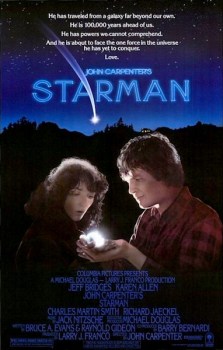
In this sci-fi romance, an alien intercepts the invitation included on the Voyager 2 space probe and tries to visit Earth, but is shot down. Taking the form of Karen Allen’s recently deceased husband, Jeff Bridges, he forces her to drive him to Arizona, where his people will rescue him in three days — if they can escape the attention of the government agents chasing them, anyway.
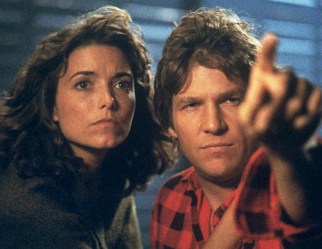
Starman can most pithily be summarised as “John Carpenter does Steven Spielberg”. Almost literally, in that it’s like a cross between E.T. and Always: Bridges’ comical alien learns Earth customs while trying to get home, and Allen’s widow deals with her bereavement while her husband is still ‘there’ (sort of). Of course, Always was actually made five years later, but Columbia Pictures in fact turned down the project that would develop into E.T. in favour of this movie. That’d be E.T., the highest-grossing film of all time for 11 years. Oops.

Although it may not have been the same box office hit or developed into the same cultural touchstone, Starman is certainly not a bad movie. Bridges negotiates a fine line between alien and mannered as the titular visitor who speaks faltering English and struggles with our ways, and I’d argue he always comes down on the right side of said line. Oscar voters certainly agreed, rewarding his performance with a Best Actor nomination (he lost to F. Murray Abraham for Amadeus). Allen is an engaging presence also, and between work like this and Raiders of the Lost Ark it’s a wonder she wasn’t a bigger star.

The film is an oddity on director John Carpenter’s CV, which came about due to The Thing being a box office disaster — Carpenter needed to make a very different kind of movie so he could keep getting work in Hollywood. Nonetheless, Carpenter’s horror roots are on display: there are stalking POV shots as the alien arrives at Allen’s house, and then it grows a human body, a sequence in which the ugliest (prosthetic) baby you’ve ever seen stretches and creaks as it grows into an adult in mere minutes. It’s pretty freaky. Indeed, as per the BBFC, Starman “contains mild language, sex, violence and sci-fi horror”, but is rated PG. Ah, the good old days!

Though it may not quite be a genre classic, the recently-announced remake from Shawn Levy, director of Night at the Museum, Date Night, and Real Steel (not to mention the lambasted Pink Panther reboot) seems ill-advised. While I liked the two of his movies I’ve seen well enough, Levy is a long way from being a John Carpenter, and I don’t envy whoever gets the lead role — copy Bridges and you’ll likely be a pale imitation; do something different and you’ve got to measure up to a very effective take on alienness.

On the bright side, maybe it will shine more attention on this half-forgotten original. I only watched it because I was on a bit of a Carpenter kick and it was available on Netflix, but I’m glad I stumbled across it.

4 out of 5

Starman is on Film4 at 6:45pm today.

The Last Temptation of Christ (1988)

2016 #17
Martin Scorsese | 156 mins | TV (HD) | 16:9 | USA & Canada / English | 15 / R

Scorsese tells the story of Jesus in this controversial epic adapted from Nikos Kazantzakis’ novel. I have no idea how much is actually rooted in scripture — a disclaimer is keen to establish the film isn’t based on the Gospels, but obviously that’s just to appease the devout.

However, the contentious parts are its strengths: it humanises Jesus, as he shows uncertainty about his God-given role and the earthly concerns that tempt him. Willem Dafoe makes Christ a plausible human, but Harvey Keitel’s Brooklyn-accented Judas feels like a spoof.

It’s a little overlong, but an interesting interpretation of the Messiah nonetheless.

4 out of 5

For more quick reviews like this, look here.

Die Hard (1988)

100 Films’ 100 Favourites #23

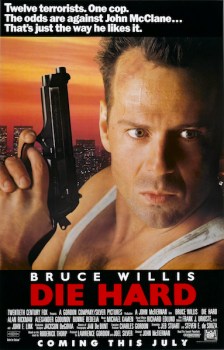
Twelve terrorists. One cop.
The odds are against John McClane…
That’s just the way he likes it.

Country: USA
Language: English
Runtime: 132 minutes
BBFC: 18 (1988) | 15 (2007)
MPAA: R

Original Release: 15th July 1988
UK Release: 3rd February 1989
First Seen: DVD, 2003

Stars
Bruce Willis (Twelve Monkeys, The Sixth Sense)
Alan Rickman (Robin Hood: Prince of Thieves, Sense and Sensibility)
Reginald VelJohnson (Turner & Hooch, Die Hard 2)
Bonnie Bedelia (Die Hard 2, Presumed Innocent)

Director
John McTiernan (Predator, The Hunt for Red October)

Screenwriters
Jeb Stuart (Another 48 Hrs., The Fugitive)
Steven E. de Souza (The Running Man, Beverly Hills Cop III)

Based on
Nothing Lasts Forever, a novel by Roderick Thorp.

The Story
While off-duty cop John McClane is visiting his estranged wife at her office Christmas party, a gang of terrorists enter the building and take the guests hostage. McClane avoids capture, making him their only hope of rescue…

Our Hero
One of New York’s finest unfortunately caught in the wrong place at the wrong time… or, as it turns out, the right place at the right time. They’re currently working on an “origin story” movie for cop John McClane, which is daft because Die Hard is his origin story — he may’ve become an action hero in later movies (I wouldn’t know, I still haven’t got beyond the second), but here McClane is just an ordinary cop. Well, a very committed ordinary cop, anyway.

Our Villain
Smart, witty, and thoroughly ruthless, Alan Rickman’s big-screen debut is a flawless turn that defined thriller villains (British-accented terrorists with a secret plan) for at least the next half-decade. No one does it better, though.

Best Supporting Character
McClane’s only real friend, Sgt. Al Powell is a beat cop on the outside who just happens to pick up his signal. Fortunately, he’s much smarter and more helpful than a team of FBI agents. Well, aren’t we all?

Memorable Quote
Hans Gruber: “Do you really think you have a chance against us, Mr. Cowboy?”
John McClane: “Yippee-ki-yay, motherfucker.”

Quote Most Likely To Be Used in Everyday Conversation
See above.

Memorable Scene
As Gruber lectures the collected hostages on how the terrorists have planned for every eventuality, a nearby elevator door pings open. One of the hostages screams, Gruber and co rush over, to find one of their compatriots dead with a message scrawled on his sweatshirt: “Now I have a machine gun, ho-ho-ho.”

Truly Special Effect
When the bomb in the elevator shaft blows out the side of the building, the effect was accomplished by collecting virtually every camera flashbulb of a particularly powerful type and wiring them to the outside of the actual building to simulate the flash, then superimposing a shot of an actual explosive blowing a hole in an all-black miniature of the building.

Making of
The filmmakers struggled to find a way for McClane and Gruber to meet prior to the movie’s climax. The scene in which they do, where Gruber pretends to be one of the hostages, was dreamt up after it was discovered Alan Rickman could do a good American accent.

Previously on…
Die Hard is adapted from a novel, which is a sequel to one called The Detective, which was filmed in 1968 starring Frank Sinatra as the lead cop (called Joe Leland rather than John McClane). When production began on Die Hard, Fox were obligated to offer the lead to Sinatra. Fortunately for them, he turned it down.

Next time…
Lightning struck twice for unlucky John McClane when he got embroiled in another Christmastime terrorist incident in Die Hard 2, aka Die Harder; then Gruber’s brother sought revenge in trilogy-forming Die Hard with a Vengeance. Years later, someone realised there was money to be made, leading to poorly-received cash-in sequels Live Free or Die Hard, aka Die Hard 4.0, and A Good Day to Die Hard. A sixth is in development.

Awards
4 Oscar nominations (Editing, Sound, Sound Effects Editing, Visual Effects — or, to put it another way: Sound, Effects, Editing, Sound Effects Editing)

What the Critics Said
“From its trailer, Die Hard looks like a typical action movie of the ’80s: a sweaty, bare-chested, all-American hero battles swarthy, heavily accented terrorist villains, accompanied by lots of high-tech explosions, vast sheets of breaking glass and enough sophisticated weaponry to account for the Pentagon’s budget overrun. As directed by John McTiernan, it turns out to be something more — the archetypical action movie of the ’80s, the perfection of the form. Sleekly engineered, impeccably staged and shrewdly dosed with humor and sentiment, Die Hard has everything but a personality.” — Dave Kehr, Chicago Tribune

Score: 92%

What the Public Say
“Vulnerable but witty, McClane is a very well realised action hero who has set precedence as far as similar roles are concerned. […] Unlike Schwarzenegger and Stallone, Willis’ McClane is not the archetypal heroic figure that is invincible and untouchable. He gets his butt handed to him regularly and often finds himself panicking with frequent looks of nervousness and even fear.” — Billy’s Film Reviews

Verdict

The action movie to end all action movies… or, y’know, spawn endless sequels and rip-offs. But Die Hard really did perfect the mix: a capable but not superhuman hero, a genuinely threatening but enjoyable-to-watch villain, plenty of thrills and tension, but also humour and eminently quotable dialogue. And it’s set at Christmas (though originally released in July — what?!), which makes it ideal for seasonal counter-programming. What more could you ask for?

Prepare thyself… for #24.

Return to the 36th Chamber (1980)

aka Shao Lin da peng da shi

2016 #13
Liu Chia-liang | 97 mins | streaming (HD) | 2.35:1 | Hong Kong / Cantonese & Mandarin | PG / R

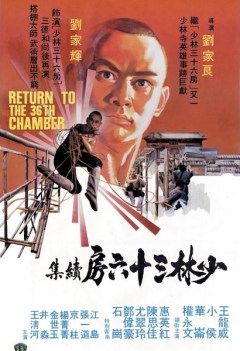
Con man Gordon Liu poses as San Te (Liu’s character from the first film) to help his oppressed friends at the dye factory. When his ruse is rumbled, he heads to the Shaolin Temple to learn kung fu… and spends a year constructing scaffolding and learning to wash his hair with a rock. Of course, he may’ve accidentally learnt a few other things too…
Return’s story follows the shape of its forebear, but with less inventiveness and more comedy, both intentional and not: the villain’s weapon of choice is a collapsible stool. Each to their own.

Fine, but no classic.

3 out of 5

Talking of kung fu and returns, Film4’s Revenge of Martial Arts Gold season kicks off tonight at 11:05pm with The Boxer from Shantung.

For more quick reviews like this, look here.

Blade Runner: The Director’s Cut (1982/1992)

100 Films’ 100 Favourites #13

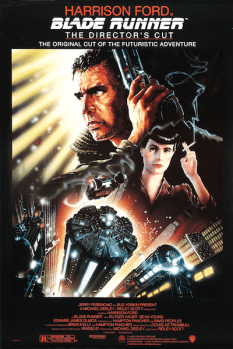
The original cut of the futuristic adventure.


For clarification: as I didn’t see The Final Cut until after 100 Films started, and I’ve still not seen the theatrical cut, it’s only the 1992 Director’s Cut that is eligible for this list.

Country: USA, UK & Hong Kong
Language: English
Runtime: 116 minutes
BBFC: 15
MPAA: R

Original Release: 25th June 1982 (USA)
UK Release: 9th September 1982
Director’s Cut Release: 11th September 1992 (USA) | 27th November 1992 (UK)
First Seen: DVD, c.2001

Stars
Harrison Ford (Star Wars, Raiders of the Lost Ark)
Rutger Hauer (Soldier of Orange, The Hitcher)
Sean Young (No Way Out, Dr. Jekyll and Ms. Hyde)
Edward James Olmos (Wolfen, Battlestar Galactica)
Daryl Hannah (Splash, Kill Bill)

Director
Ridley Scott (Alien, The Martian)

Screenwriters
Hampton Fancher (The Mighty Quinn, The Minus Man)
David Peoples (Unforgiven, Twelve Monkeys)

Based on
Do Androids Dream of Electric Sheep?, a novel by Philip K. Dick.

The Story
L.A., 2019: cop Rick Deckard is dragged out of retirement to hunt and ‘retire’ a gang of Replicants — genetically-engineered androids, almost indistinguishable from humans, used for menial work off-world — who have come to Earth to extend their lives. As Deckard investigates, he comes to question what it means to be human…

Our Hero
Rick Deckard, former blade runner — which means nothing but does sound fairly cool. May or may not be a Replicant. (“He is!” “He isn’t!” “He is!” “He isn’t!”)

Our Villain
Roy Batty, definitely a Replicant. Committed the crime of wanting to live.

Best Supporting Character
Rachael — secretary, love interest, Replicant but believes herself to be human. Do we see a theme developing here?

Memorable Quote
“I’ve seen things you people wouldn’t believe. Attack ships on fire off the shoulder of Orion. I watched C-beams glitter in the dark near the Tannhauser gate. All those moments will be lost in time, like tears in rain.” — Roy Batty

Memorable Scene
At the imposing headquarters of the Tyrell Corporation, blade runner Holden sits employee Leon in front of a strange machine. He begins to administer a Voight-Kampff test, a series of questions designed to provoke a response that the machine analyses. “You’re in a desert, walking along in the sand, when all of a sudden you look down…” “What one?” “What?” “What desert?” Leon’s test isn’t going to go according to plan…

Memorable Music
The synthesised score by Vangelis should by all rights sound terribly dated and oh-so-’80s by now, yet it’s somehow timelessly futuristic.

Technical Wizardry
Visually, Blade Runner is a non-stop marvel: the noir cinematography, the vehicle and set design, the lived-in world, the believable effects… The entire thing is imaginatively conceived and magnificently realised with unwavering plausibility.

Truly Special Effect
The realisation of future-L.A. airspace — packed with giant skyscrapers, videoscreen adverts, flying cars, at night and in the rain — is literally faultless, and only gains impact for being achieved for real with models.

Making of
The Director’s Cut came about after a 70mm print was discovered in storage and an LA cinema got permission to screen it at a film festival in 1990. Only then did anyone realise the print was the workprint version of the film. Warner Bros organised more screenings, advertising them as a “Director’s Cut”. Ridley Scott wasn’t best pleased, which led to some screenings being cancelled. The rest sold out, however, and so Warner decided to create a genuine Director’s Cut. With Scott busy on other projects, film preservationist and restorer Michael Arick was put in charge, using notes and suggestion from Scott to do the best he could. Although Scott considered it better than the theatrical cut, he was never wholly happy with the ’92 version, which ultimately led to the creation of The Final Cut another 15 years later.

Next time…
Between 1995 and 2000, Philip K. Dick’s friend K.W. Jeter continued Deckard’s story in three novels, which apparently attempt to resolve the differences between Blade Runner and Do Androids Dream of Electric Sheep? In 1997, Westwood Studios and Virgin Interactive released a “sidequel” point-and-click adventure game, where you play as another blade runner in a storyline that takes place alongside the movie (it’s excellent, by the way, though I imagine you’d have a nightmare making it run today due to its age, which is a shame). Finally, a long-mooted sequel is in development for a January 2018 release.

Awards
2 Oscar nominations (Art Direction-Set Decoration, Visual Effects)
3 BAFTAs (Cinematography, Costume Design, Production Design)
5 BAFTA nominations (Editing, Make Up Artist, Score, Sound, Visual Effects)
4 Saturn nominations (Science Fiction Film, Supporting Actor (Rutger Hauer), Director, Special Effects)
Won the Hugo for Best Dramatic Presentation.

What the Critics Said
“This is, [Scott] says, the version he would have released in 1982 if he could have. The Ford narration was added because the studio feared audiences would not understand his story of a futuristic Los Angeles. The new ending, which is ironic and inconclusive and gives Ford an existentialist exit line, was of course dropped by studio executives for a more standard violent outcome. I watched the original Blade Runner on video a few years ago, and now, watching the director’s cut, I am left with the same over-all opinion of the movie: It looks fabulous, it uses special effects to create a new world of its own, but it is thin in its human story.” — Roger Ebert

Score: 89%

What the Public Say
“Its such a dark movie, but such a sad movie too. The sadness threatens to overpower everything. A character has her whole life undermined when she learns she isn’t real, not even her memories or experiences. It’s all a lie, a fabrication, as she is herself. Rick Deckard may not even be real. He might be just the same as Rachael. It’s not an idea I subscribe to, but it’s there, a possibility hanging over everything, underlined by the origami unicorn that he finds at the close of the film.” — ghost of 82

Elsewhere on 100 Films
I reviewed The Final Cut in 2009, noting that it was “undeniably one of the most significant films of the last quarter-century thanks to its enduring influence. […] its dystopian future — all constant night-and-rain, busy streets, neon advertising, canyon-like decrepit skyscrapers towering over dirty streets, high technology rubbing with the everyday detritus of humanity — has been copied everywhere. Without this there’d probably be no Ghost in the Shell, no Dark City, no Matrix, no re-imagined Battlestar Galactica, no thousand other things that have nothing close to the brains but do have the look, the style, the feel.”

Verdict

Blade Runner remains something of a divisive film: its thoughtful pace is not to everyone’s taste, especially if they’re expecting a sci-fi action-thriller starring Future Indiana Jones. Instead, it’s a philosophical sci-fi noir, as concerned with issues of what it means to be human as with chases or punch-ups. Remixing sci-fi and film noir influences in a fresh style, realised with some of the greatest design, set-building, and special effects of all time, it’s been inestimably influential on swathes of sci-fi that followed in its wake — and yet, almost 35 years on, it still looks futuristic and feels unique.

#14 will be… Troubled.

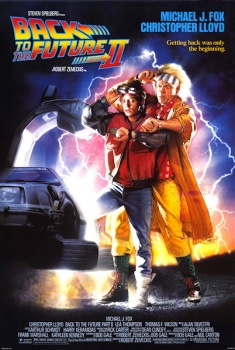
Back to the Future Part II (1989)

100 Films’ 100 Favourites #6

Getting back was only the beginning.

Country: USA
Language: English
Runtime: 108 minutes
BBFC: PG
MPAA: PG

Original Release: 22nd November 1989 (USA)
UK Release: 24th November 1989
First Seen: VHS, c.1991

Stars
Michael J. Fox (Doc Hollywood, The Frighteners)
Christopher Lloyd (Clue, The Pagemaster)
Lea Thompson (Red Dawn, Casual Sex?)
Thomas F. Wilson (Back to the Future, High Strung)
Elisabeth Shue (Adventures in Babysitting, Leaving Las Vegas)

Director
Robert Zemeckis (Who Framed Roger Rabbit, Cast Away)

Screenwriter
Bob Gale (1941, Interstate 60: Episodes of the Road)

The Story
Marty and Doc travel forward to 2015 to save Marty’s son from imprisonment, but this allows future-Biff to steal the DeLorean, taking it back to 1955 to allows his younger self to profit from future knowledge. Faced with a nightmare version of 1985, Marty must travel back into the events of the first movie to fix things.

Our Heroes
Michael J. Fox is not only Marty McFly, but older Marty McFly, and his son, Marty McFly Jr., and also… his daughter, Marlene McFly. Just in case you’d forgotten these were comedy movies, I guess. Christopher Lloyd, meanwhile, is the one and only Doc.

Our Villain
It’s Thomas F. Wilson’s Biff again, but this time he’s not just a bully, but someone who — thanks to his meddling in time — represents a threat to Marty’s whole lifestyle. And he’s a right nasty piece of work in the dystopian variant of 1985, too. Still gets covered in excrement, mind.

Best Supporting Character
Spare a thought for Marty’s girlfriend, Jennifer. The end of the first film has her getting in the DeLorean with Doc and Marty, because she was there and the ending was never intended to lead to anything (yes, kids, once upon a time movies weren’t made with the assumption there’d be sequels). Come the second film, Zemeckis and Gale were stuck having to integrate her into the story, which they did by… knocking her out early on and leaving her out of it.

Memorable Quote
“The time-traveling is just too dangerous. Better that I devote myself to study the other great mystery of the universe: women!” — Doc

Memorable Scene
30 years in the future, they’re still making crappy Jaws sequels. (The irony now is, in the real 2015 we were still getting often-crappy sequels to pretty much every major ’70s/’80s franchise except for Jaws.)

Technical Wizardry
You’ll believe a board can hover. Well, you probably won’t, but some people did. That’s just testament to how well made the sequence is.

Truly Special Effect
Quite apart from the hoverboard, the sequence where they first arrive in 2015 — a ‘road’ of flying cars in a rainy nighttime sky — is a triumph of model work.

Making of
For various reasons (possibly moral, possibly financial) Crispin Glover refused to return as Marty’s father, George McFly. Instead, the filmmakers used outtakes from the first film, as well as an actor wearing prosthetics made from casts of Glover taken for the first film. Glover objected to his likeness being used without permission, sued, and Universal settled out of court. More than that, it led to a change in contract rules at the Screen Actors Guild to stop the same thing happening again. (See also: The Four Musketeers.)

Previously on…
Not only does Part II pick up exactly where the first film ended, it goes back into its events and interacts with them.

Next time…
Part II ends with a huge cliffhanger, leading directly into the series’ final trilogy-forming instalment.

Awards
1 Oscar nomination (Visual Effects)
1 BAFTA (Special Effects)
1 Saturn Award (Special Effects)
3 Saturn nominations (Science Fiction Film, Costumes, Make-Up)

What the Critics Said
“Like its predecessor, Back to the Future Part II does not merely warp time; it twists it, shakes it and stands it on its ear. But as before, the film’s technical brilliance is the least of its appeals. Satirically acute, intricately structured and deftly paced, it is at heart stout, good and untainted by easy sentiment.” — Richard Schickel, TIME

Score: 63%

What the Public Say
“the biggest prediction the film nails is not any one piece of technology, but our reaction to it: indifference met with annoyance of its imperfections. The movie focuses not on what the technology can do, but on what it can’t. The skyway’s jammed. Marty’s hover board doesn’t work on water. The voice-activated home-entrance lights don’t turn on when Jennifer enters. […] What we get is “the future” as “the present.” None of the doom, destruction and dystopia of Blade Runner or The Time Machine. 2015 Hill Valley and 2015 Chicago are just like 1985 Hill Valley and 1985 Chicago, only with cooler stuff.” — Jack M Silverstein, ReadJack.com

Verdict

There are some who consider Back to the Future an all-time classic and think the two sequels are meritless wastes of space. There are others who see them as a complete trilogy of more-or-less equal quality. Considering that ever since I’ve seen them all three parts have existed, it isn’t much surprise I’m one of the latter. Part II may not have the elegant simplicity of the first film, but it still has plenty of original and exciting ideas, not least using the time travel conceit to go back into the first movie. It may not be as good, but it’s a fine adventure in its own right.

#7 will be… wicky wicky wild wild West.

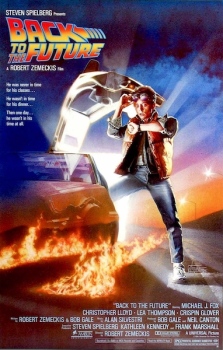
Back to the Future (1985)

100 Films’ 100 Favourites #5

He was never in time for his classes…
He wasn’t in time for his dinner…
Then one day…
He wasn’t in his time at all.

Country: USA
Language: English
Runtime: 116 minutes
BBFC: PG
MPAA: PG

Original Release: 3rd July 1985 (USA)
UK Release: 4th December 1985
First Seen: VHS, c.1991

Stars
Michael J. Fox (Teen Wolf, Stuart Little)
Christopher Lloyd (Star Trek III: The Search for Spock, The Addams Family)
Lea Thompson (All the Right Moves, Howard the Duck)
Crispin Glover (Willard, Alice in Wonderland)
Thomas F. Wilson (Action Jackson, The Heat)

Director
Robert Zemeckis (Romancing the Stone, Forrest Gump)

Screenwriters
Bob Gale (I Wanna Hold Your Hand, Trespass)
Robert Zemeckis (1941, A Christmas Carol)

The Story
After Marty McFly travels back to 1955 in a time machine invented by his friend, Dr. Emmett “Doc” Brown, he accidentally prevents his teenaged parents from meeting. It’s up to Marty to make them fall in love and therefore ensure his own existence.

Our Hero
A star-making turn from Michael J. Fox as Marty McFly, cocky teen and guitar hero.

Our Villain
Thomas F. Wilson is Biff Tannen: in the ’80s, McFly Sr’s bullying supervisor; in the ’50s, McFly Sr’s high school bully. Prone to getting covered in excrement.

Best Supporting Character
An equally iconic turn from Christopher Lloyd as Doc, mad scientist extraordinaire.

Memorable Quote
“Roads? Where we’re going, we don’t need roads.” — Doc

Memorable Scene
The climax: Marty’s one hope to get back to 1985 is a bolt of lightning that will strike the town’s clock tower, which he can use to power the DeLorean. As the moment approaches, Doc battles to connect the wiring, and Marty must make sure the car is travelling at the right speed at the right moment… Well, of course they succeed, and Doc skips happily between the time machine’s flaming tyre tracks.

Write the Theme Tune…
In a rare case of an iconic movie theme from the ’70s and ’80s not composed by John Williams, Back to the Future’s memorable motif was composed by Alan Silvestri.

Technical Wizardry
To some, the DeLorean is a failed automobile. To a generation (and, probably, every generation since) it’s one of the most iconic movie cars of all time. “Are you telling me that you built a time machine… out of a DeLorean?” “The way I see it, if you’re gonna build a time machine into a car, why not do it with some style?” Genius.

Making of
It’s now quite well known that Eric Stoltz was originally cast as Marty, and had even started filming before it was decided he wasn’t right and was replaced with Michael J. Fox. This wasn’t after just a day or two of production, though: Stoltz filmed for four weeks, completing a significant chunk of the film. So much, in fact, that it wasn’t all re-shot with Fox: most of the material without Marty actually on screen was retained (Fox had to film reverse angles for dialogue scenes without the other actors present), and a couple of long shots in the finished film actually feature Stoltz.

Next time…
Two direct sequels (the first of which picks up immediately from the end of this one), as well as an animated series, an iconic theme park ride, a computer game from adventure maestros Telltale, an ongoing comic book that launched last year, and a semi-disastrous Secret Cinema event.

Awards
1 Oscar (Sound Effects Editing)
3 Oscar nominations (Original Screenplay, Sound, Original Song)
5 BAFTA nominations (Film, Original Screenplay, Editing, Production Design, Visual Effects)
3 Saturn Awards (Science Fiction Film, Actor, Special Effects)
6 Saturn nominations (Director, Supporting Actor (Crispin Glover and Christopher Lloyd), Supporting Actress (Lea Thompson), Music, Costumes)
Won the Hugo for Best Dramatic Presentation.

What the Critics Said
“though it is hardly one of the greater flights of cinematic imagination to be seen since science fantasy reared its head as mass appeal material again, it would be virtually impossible not to enjoy it in some way or another.” — Derek Malcolm, The Guardian

Score: 96%

What the Public Say
“nothing short of an example of screen-writing brilliance. Tightly pack[ed] and interwoven from the opening scene to the final ‘cliffhanger’ which, let’s face it, was never meant to be a cliffhanger as much as just a cool and intriguing ending to a stand alone film.” — nEoFILM

Verdict

Who knew a movie about mother-son incest could be one of the most entertaining family comedies ever made? That’s because it’s magnificently written, faultlessly performed, packed with inventiveness… oh, and because the mother is the same age as the son, doesn’t know he’s her son, and the incest doesn’t actually happen. Ah, time travel! A notoriously difficult sci-fi nut to crack, another reason BTTF succeeds is because it isn’t really about time travel. One of those times where talent and good fortune come together to craft perfect movie entertainment.

Roads? Where #6 is going, it doesn’t need roads…