Review Roundup: Superman Sequels

Superman: The Movie is one of the greatest superhero movies ever made, perhaps even the greatest. Its sequels… not so much.

It took three movies to get there, but through them you’ll believe a franchise can die…

Superman II
(1980)

2018 #128
Richard Lester | 127 mins | Blu-ray | 2.40:1 | USA, UK & Canada / English | PG / PG
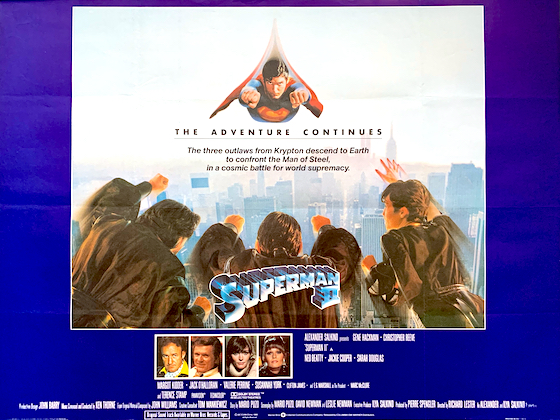
Superman II

I feel like I must’ve seen Superman II as a kid — I know I saw Superman and enjoyed it, so why wouldn’t I have seen the sequel? But all the things people go on about from it (“kneel before Zod!”) I only know because other people go on about them, not from any memory of my own, so maybe I never saw it? Well, sitting down to watch it now, I didn’t remember any part of it. But that doesn’t mean I definitely didn’t see it because, frankly, I didn’t find Superman II particularly worthy of being remembered. I know some people love it — heck, James Gunn even included it in a list of “sequels that are better than the original” the other day. But James Gunn is wrong.

For me, the film breaks down into a few simple and distinct sections. First, it begins with an eight-and-a-half-minute recap of the first movie. That’s… long. And largely unnecessary. I mean, when it bothers to include the telephone booth gag but omits the turning-the-world-backwards climax of the movie, you get the impression it’s not there to get you properly up to speed on the plot.

Next, Lois and Clark spend most of the first hour titting about at Niagara Falls investigating a honeymoon hotel scam (a what now?!), while evil Kryptonian General Zod and his gang veeery slooowly make their way to somewhere significant. Then there’s half-an-hour of Lois and Clark being too self-absorbed to notice Zod take over the world. Not-so-super, Superman. Then, finally, the all-action last half-hour actually gives us some Superman stuff. Hurrah!

Who's kneeling now, bitch?

The humour quotient is waaay upped from the first movie. Based on his previous work, I guess much of that was the influence of replacement director Richard Lester. He wasn’t a good choice all round: Margot Kidder disliked working with him; Gene Hackman didn’t return (all his scenes are either footage previously shot or done with a lookalike and impersonator); John Williams walked off the film after seeing Lester’s footage. He reshot a bunch of stuff original director Richard Donner had already filmed, partly to get a sole director credit, partly because he didn’t approve of the epic visual style Donner had chosen. Instead, Lester aimed for a visually flat “comic book” style. Ugh.

25 years after Superman II’s release, Warner Bros relented and let Donner complete his original cut of the movie, released in 2006 as The Richard Donner Cut. Maybe that version’s better — I haven’t watched it yet, but it does have a much higher score on IMDb. But how anyone could genuinely love the originally-released version, I don’t understand. It’s not outright bad, it’s just mediocre, and not a patch on its predecessor.

3 out of 5

Superman III
(1983)

2018 #161
Richard Lester | 125 mins | Blu-ray | 2.40:1 | UK & USA / English | PG / PG

Superman III

If you said “imagine a Superman film by a director who won the Palme d’Or”, you wouldn’t picture Superman: The Slapstick Comedy… and yet here we are.

The director in question is Richard Lester, returning after Superman II, a movie he inherited, so I guess it’s only here that he’s really allowed to show what he thinks a comic book movie ought to be. Turns out, that’s more like Airplane or a Jacques Tati film than the David Lean influence he felt Richard Donner was aiming for on Superman: The Movie. He even lets the title card appear over the epic superhero imagery of… three phone boxes that have been knocked over dominoes-style by a hot dog cart. Wow.

Ironically, almost all of the film is humour-focused apart from the scenes starring comedian Richard Pryor (who thought the screenplay was terrible, but did like the $5 million salary). Concurrently, the technological and scientific parts of the plot make absolutely no sense. Like, a weather monitoring satellite can be accessed from a small-town wheat firm and then be reprogrammed to control the weather. And that same satellite can then use its lasers to analyse rocks millions of miles away to find out what elements make up another element, which just… Ugh. It so doesn’t make sense that it’s too much effort to explain why it doesn’t make sense.

With Gene Hackman presumably only too happy to be rid of this franchise, the villain is now Robert Vaughn, who has an entourage that feels like a blatant attempt to emulate Lex Luther & co from the previous films. There’s also an all-powerful supercomputer, which Superman defeats with what appears to be a bubbling-over pot of strawberry jam.

That's Larry Lamb on the left, would you believe

The story also involves Superman going bad — you can tell because he’s grown a five o’clock shadow, developed bags under his eyes, and started wearing a suit with a colour scheme more suited to a Zack Snyder interpretation of the character. And he begins to do really terrible things, like… straightening the leaning tower of Pisa, and… blowing out the Olympic flame. Ooh, edgy. Why does he do it? God, I don’t know. There’s no logic in this. There’s a fight between good Superman and bad Superman, which some think is brilliant; “a highlight of the series”, said one comment I read. Maybe it’s just because Evil Superman is so damn cartoonish, but I didn’t particularly care for it.

It did inspire the original title of the movie, though, which was Superman vs. Superman, and that in turn led to a bit of trivia more batshit insane than anything in the film itself: that original title was dropped after legal action was threatened by… the producers of Kramer vs. Kramer. What in the fucking what now?! I know America is famed for spurious lawsuits, but c’mon!

Of course, if you take the whole film at the face value of its tone, it doesn’t really matter — it’s just a daft comedy. But it shouldn’t be, should it? This isn’t the Superman the first film promised us.

2 out of 5

Superman IV:
The Quest for Peace

(1987)

2020 #79
Sidney J. Furie | 90 mins | Blu-ray | 2.35:1 | UK & USA / English | PG / PG

Superman IV: The Quest for Peace

At one point in this movie, a young character calls Superman “the Dude of Steel”. Yeah, we’re down with the kids now! Superman (okay, Clark Kent) even does aerobics. Hip and happening!

After Superman III tried its damnedest to turn Superman into a comedy, Superman IV swings the other way and turns it into a polemic. It’s like an 8-year-old was asked to write an anti-nuclear weapons essay and chose to do it in the form of a Superman story. It seems like a mercy that it only runs 90 minutes, although that’s part of the problem: the original final cut was 134 minutes, but the producers chopped out 45 minutes of material. No wonder it grows increasingly nonsensical as it goes on. But then so did Superman III and they had no such excuse, so there’s no saying the longer cut would’ve been better.

Indeed, on the evidence of what’s left, I think we can assume it wouldn’t have been. Gene Hackman’s Lex Luthor is back (goodness knows how they talked him into it), but his plan involves creating a physical adversary for Superman: Nuclear Man! Nuclear Man has many of Supes’ powers and strengths, but none of his brains, as he stomps around just roaring at people. He flies around the world basically just being a vandal, and Superman follows along to clean up after him, like some kind of super-powered babysitter. Then he punches Supes once and… he loses all his powers? And then Nuclear Man sees a woman on a cover of a newspaper and suddenly getting her is his only motivation; and Superman’s back, thanks to a magic crystal, and he somehow knows exactly what/who Nuclear Man is after; and so Superman defeats him by… tricking him into an elevator… which he drops off on the Moon; but not the dark side, so the sun’s rays revitalise Nuclear Man… when the sun rises. On the Moon. Jesus wept.
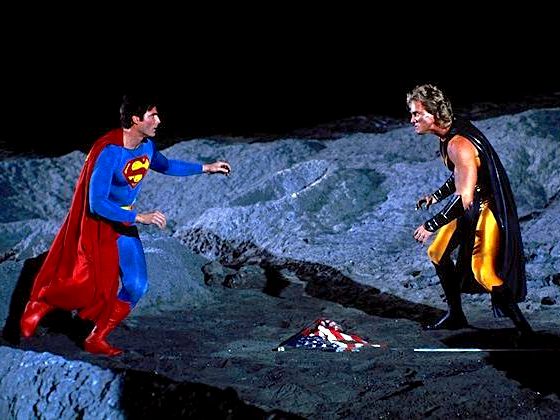
The Moon isn't made of cheese, but this film...

There are some good ideas in Superman IV. As co-writer Mark Rosenthal discusses on his audio commentary, the idea had been to explore the age-old question of “if God is all-good and all-powerful, why is there still suffering” — because, with all his powers, Superman is basically a mythological God; so why doesn’t he just get rid of all those nasty nukes? The answer, of course, is that he’s not real. And so in the fictional world of the fictional film, the fictional hero gets rid of the nukes, which is nice for the fictional people but not so much use to the rest of us.

Because Lois Lane is in love with Superman but not so much Clark Kent, they decided to give Clark a love interest, which I’m not sure quite understands the characters or their dynamic properly, but whatever. It did inspire one fun idea, though: a double date between Superman & Lois and Clark & new-lady. The idea was for a quick-paced farce of a scene, with Clark and Supes coming and going at speed, like something out of a Cary Grant screwball romantic comedy. I guess no one told the director, because the scene as filmed lacks the fast pace needed to make it work. You can have all the great ideas in the world, but if you don’t have the skills to execute them properly, it’s worthless.

Apparently it was really Christopher Reeve who fought to make the movie happen, and everyone involved had good intentions and didn’t want to let him down. Well, they did. The returning cast are the only people who emerge unscathed from this mess — Reeve is as wonderful as ever as Superman; just perfect. His chemistry with Margot Kidder is great, and Gene Hackman is still managing to have fun as Lex. But why suffer through the rest of this terrible movie for those scant bright spots when you could just watch the first Superman instead?

1 out of 5

Superman IV featured on my list of The Worst Films I Saw in 2020.

19 years later, after a couple of decades relegated to various TV incarnations, they attempted to return the Man of Steel to the silver screen in big-budget style with Superman Returns, which was conceived as a continuation of the Christopher Reeve series. My original review of that movie is here.

Sean Connery as James Bond, Part 2

If everything had gone according to plan, this weekend Americans would’ve been flocking to cinemas to see Daniel Craig’s final performance as Bond, James Bond, secret agent 007, in No Time to Die (us Brits would’ve all been to see it last weekend, of course). As that’s not to be, here’s something both entirely similar and entirely different: my reviews of Sean Connery’s final performance in the role — both of them.

This concludes my coverage of Connery’s time as Bond, the previous instalment of which I posted in, er, 2013. (And you thought No Time to Die had a long delay.) That covered his first stint as James Bond — the five films he starred in from 1962 to 1967. Now, here are his two remaining performances:

Neither of these films is Connery’s finest hour as Bond — they’re his worst hours, in fact — but, I must say, they were both better than I had remembered.

Click through to learn more about…

That may be it for Connery, but — as always — James Bond will return… in Daniel Craig’s case, in November (fingers crossed!)

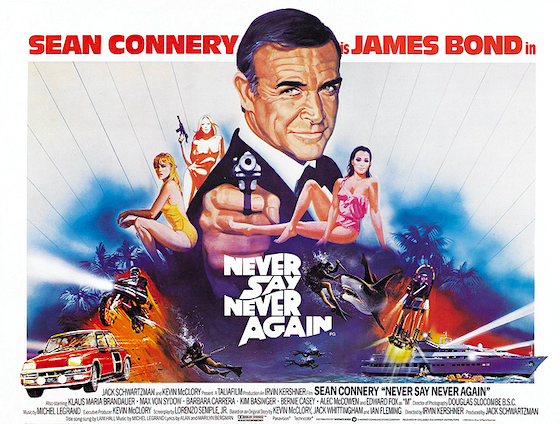
Never Say Never Again (1983)

The 100 Films Guide to…

Never Say Never Again

Sean Connery is James Bond 007

Country: UK, USA & West Germany
Language: English
Runtime: 134 minutes
BBFC: PG
MPAA: PG

Original Release: 7th October 1983 (USA)
UK Release: 15th December 1983
Budget: $36 million
Worldwide Gross: $138 million

Stars
Sean Connery (Thunderball, Highlander)
Klaus Maria Brandauer (Mephisto, Out of Africa)
Kim Basinger (Mother Lode, Batman)
Barbara Carrera (The Island of Dr. Moreau, Lone Wolf McQuade)
Max von Sydow (The Exorcist, Minority Report)

Director
Irvin Kershner (The Empire Strikes Back, RoboCop 2)

Screenwriter
Lorenzo Semple Jr. (Papillon, Flash Gordon)

Based on
An original James Bond story by Kevin McClory, Jack Whittingham and Ian Fleming, which Fleming later novelised as Thunderball.


The Story
Ageing secret agent James Bond is sent to a health spa to get back into shape, but therein stumbles upon part a plot to hijack nuclear warheads and hold the world to ransom. With the theft successful, it falls to Bond to retrieve the weapons before it’s too late.

Our Hero
Bond, James Bond, British secret agent 007. He’s played by Sean Connery — already the first and third actor to play James Bond on the big screen (in a serious movie), here he becomes the fifth too. Unlike the official Bond films, which carried on regardless as Roger Moore began to look more like an OAP than a capable secret agent, Never Say Never Again acknowledges that Bond is getting on a bit. That’s because Connery was 53 at the time, and this is from back in the days when 53 was old, especially for an action star — not like today.

Our Villains
Billionaire businessman Maximilian Largo is actually the highest-ranking agent of SPECTRE, a global criminal organisation masterminded by Ernst Stavro Blofeld. With Blofeld merely pulling the strings behind the scenes, it’s Largo and his lackeys that Bond must defeat to save the world.

Best Supporting Character
Rowan Atkinson’s cameo-sized role as inexperienced local bureaucrat Nigel Small-Fawcett is actually quite amusing, and therefore probably the best thing about the film.

Memorable Quote
Largo: “Do you lose as gracefully as you win?”
Bond: “I don’t know, I’ve never lost.”

Memorable Scene
At a charity event hosted by Largo, Bond comes face-to-face with his adversary for the first time, where he’s challenged to play Domination, a 3D computer game. It couldn’t be more ’80s if it tried.

Memorable Music
James Bond films have a very distinct musical style… but not when they’re unofficial productions they don’t. Without access to familiar themes, Never Say Never Again finds itself having to reach for something different… and fails: the title song is bland and the jazzy score is forgettable.

Letting the Side Down
Where to begin? Well, let’s pick on perhaps my least favourite bit of the whole endeavour: henchwoman Fatima Blush; and, more specifically, how the film ends up handling her. First, there’s a truly terrible sex scene between her and Bond, but it only gets worse later: the self-espoused feminist becomes monomaniacally concerned that Bond should think she’s the greatest shag he ever had, which distracts her to the point that he gets the opportunity to kill her… which he does with an explosive bullet that just leaves her smoking high heels behind. No, seriously. And for this performance Barbara Carrera received a Golden Globe nomination! If you told me she’d been nominated for an award and asked me to guess which, I’d’ve been certain it was a Razzie.

Making of
“So how did an unofficial James Bond film come about anyway?,” I hear you ask. Well, the story starts in the early ’60s, after the Bond novels had become popular but before the film series began. Creator Ian Fleming worked with independent producer Kevin McClory and screenwriter Jack Whittingham on a script for a potential Bond film titled Longitude 78 West, but this was abandoned due to costs. Fleming then adapted the screenplay into a Bond novel, Thunderball, but without credit for either McClory or Whittingham. McClory sued for breach of copyright, and the matter was settled by Fleming giving McClory all rights to the screenplay. By this time the official Bond film series was underway, and Eon Productions made a deal for McClory to coproduce their adaptation of Thunderball, an agreement which forbade him from making any further films of the novel for another decade. That lands us in the mid-’70s, when Bond was still very popular. As McClory began attempting to get a new adaptation off the ground, Eon put legal obstacles in his path, accusing his new script of breaking copyright restrictions by going beyond the confines of Thunderball. Eventually McClory and other producers managed to clear these hurdles and, after rewrites to make Connery happy (which were undertaken by British TV writers Dick Clement and Ian La Frenais, who went uncredited due to Writers Guild of America restrictions, despite much of the final script being their work), the remake finally went before the cameras — with a new title, suggested by Connery’s wife, referring to his vow that he would “never” play Bond again.

Previously on…
James Bond had starred in 13 official movies by the time this came along. It’s kind of ironic that Never Say Never Again’s unofficial status means it can’t acknowledge any of that, while also tacitly acknowledging it with Connery’s very presence in the lead role. Though if it had been able to acknowledge it, the fact this film is a straight-up remake of Thunderball might’ve led to some awkwardness.

Next time…
Early in 1984, producer Kevin McClory announced a sequel, S.P.E.C.T.R.E. It never happened. He spent most of the rest of his life trying to pursue further James Bond projects: he tried to remake the same story again in 1989 as Atomic Warfare starring Pierce Brosnan, and again in the early ’90s as Warhead 2000 AD starring Timothy Dalton. In 1997 he sold the rights to Sony, who already held the rights to Casino Royale and hoped to use that to launch its own Bond series. MGM sued and the matter was settled out of court, with Sony giving up all claims on Bond. (Perhaps this explains why Sony have been so keen on acquiring/retaining the series’ distribution rights in recent decades.) And so we’re left with just one James Bond series, which has mostly gone from strength to strength.

Awards
1 Golden Globes nomination (Supporting Actress (Barbara Carrera))
2 Saturn Award nominations (Fantasy Film, Special Effects)

Verdict

Between this and the state of the official Moore-starring films at the time, it must’ve sucked to be a Bond fan in the early- to mid-’80s. Maybe some thought Connery returning to the role he’d defined would be a boon, but it didn’t turn out that way: in just about every respect, Never Say Never Again plays like a weak imitation of a Bond film… which I suppose is exactly what it is, really.

As an unofficial production, it’s missing a bunch of the identifying features of the Bond films: the gun barrel, the title sequence, the musical stylings, and, most conspicuously, the famous theme. There’s more to Bond than these tropes, of course, and a really good Bond movie can survive without them, but their absence contributes to the feel of this being a low-rent wannabe, when it needs all the help it can get. The stuff it can include isn’t great either. The one-liners and innuendos are particularly bad. The action is rather dated (although the chase between a souped-up Q-bike and the henchwoman’s tacky little ‘80s car is more exciting than the notoriously underpowered car chase in Spectre, which says more about Spectre than Never Say Never Again). Then there’s the sex scene I mentioned above.

One critic retrospectively described the film as “successful only as a portrait of an over-the-hill superhero,” which is true… up to a point. I mean, most of the stuff about Bond being past his best seems designed to explain Connery’s grey hair and lined face — Bond is still irresistible to literally every woman he meets, and has no problem at all doing any of the action stuff. Connery’s performance isn’t bad either, although it didn’t quite feel like Bond to me. I’m not sure why. It’s not that he seems bored or like he’s only going through the motions (a sensation that definitely comes across in some of his original performances as the character), but he no longer seems to have quite the panache you expect from 007.

And yet, for all that, it’s not as irredeemably terrible as I’d remembered. For all the glaring faults, it actually ticks along with a decent level of entertainment value. So is it, in fact, unfairly maligned? It’s nowhere near the best of Bond, but it doesn’t descend into outright silliness like some of the official ones do (well, apart from those smoking shoes), and it even has a couple of pretty good bits. It would definitely be a lesser Bond — if it counted, which it doesn’t — but, as a couple of hours of off-brand Bondian fun, it could actually be a lot worse.

The 100-Week Roundup

Regular readers may be aware that for a while now I’ve been struggling with what to do about my increasingly ludicrous review backlog. It continues to grow and grow — it’s now reached a whopping 215 unreviewed films! (And to think I started that page because I was 10 reviews behind…) Realistically, there’s no way I’m ever going to catch that up just by posting normal reviews, especially given the rate I get them out nowadays. But since this blog began I’ve reviewed every new film I watched — I don’t want to break that streak.

So, I’ve come up with something of a solution — and kept it broadly within the theming of the blog, to boot.

The 100-Week Roundup will cover films I still haven’t reviewed 100 weeks after watching them. Most of the time that’ll be in the form of quick thoughts, perhaps even copy-and-pasting the notes I made while viewing, rather than ‘proper’ reviews. Today’s are a bit more review-like, but relatively light on worthwhile analytical content, which I think is another reason films might end up here. Also, the posts won’t be slavishly precise in their 100-week-ness. Instead, I’ll ensure there are at least a couple of films covered in each roundup (it wouldn’t be a “roundup” otherwise). Mainly, the point is to give me a cutoff to get a review done — if I want to avoid a film being swept up into a roundup, I’ve got 100 weeks to review it. (Lest we forget, 100 weeks is almost two years. A more-than-generous allowance.)

I think it’s going to start slow (this first edition covers everything I haven’t reviewed from April 2018, which totals just two films), but in years to come I wouldn’t be surprised if these roundups become more frequent and/or busier. But, for now, those two from almost two years ago…


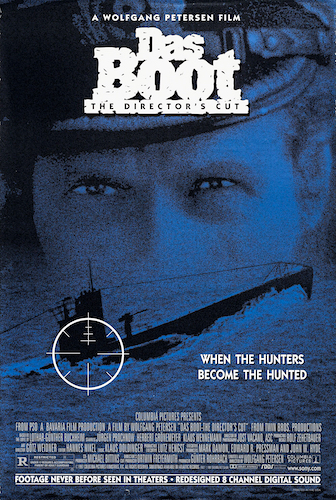
Das Boot
The Director’s Cut
(1981/1997)

2018 #69
Wolfgang Petersen | 208 mins | Blu-ray | 1.85:1 | Germany & USA / German & English | 15 / R

Das Boot: The Director's Cut

Writer-director Wolfgang Petersen’s story of a German submarine in World War 2 may have an intimate and confined setting, but in every other sense it is an epic — not least in length: The Director’s Cut version runs almost three-and-a-half hours. However, the pace is excellently managed. The length is mainly used for tension — quietly waiting to see if the enemy will get them this time. It’s also spent getting to know some of the crew, and the style of life aboard the sub. It means the film paints an all-round picture of both life and combat in that situation. The only time I felt it dragged was in an extended sequence towards the end. I guess the long, slow shots of nothing happening are meant to evoke time passing and an increasing sense of hopelessness, but I didn’t feel that, I just felt bored. Still, while I can conceive of cutting maybe 10 or 20 minutes and the film being just as effective, being a full hour shorter — as the theatrical cut is — must’ve lost a lot of great stuff.

It’s incredibly shot by DP Jost Vacano. The sets are tiny, which feels realistic and claustrophobic, but nonetheless they pull off long takes with complex camera moves. Remarkable. Even more striking is the sound design. It has one of the most powerful and convincing surround sound mixes I’ve experienced, really placing you in the boat as it creaks and drips all around you. The music by composer Klaus Doldinger is also often effective. It does sound kinda dated at times — ’80s electronica — but mostly I liked it.

Versions
Das Boot exists in quite a few different cuts, although The Director’s Cut is the only one currently available on Blu-ray in the UK. If you’re interested in all the different versions, it’s quite a minefield — there are two different TV miniseries versions (a three-part BBC one and a six-part German one), in addition to what’s been released as “The Original Uncut Version”, as well as both of the movie edits. There’s a lengthy comparison of The Director’s Cut and the German TV version here, which lists 75 minutes of major differences and a further 8 minutes of just tightening up. Plus, the TV version also has Lt. Werner’s thoughts in voiceover, which are entirely missing from The Director’s Cut. That means this version “has a lack of information and atmosphere”, according to the author of the comparison.

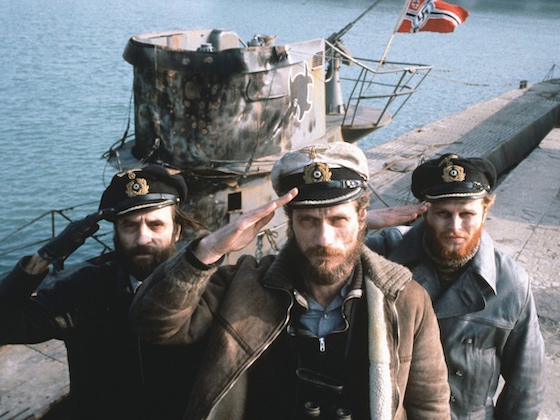
Das salute

As to the creation of The Director’s Cut, the Blu-ray contains a whole featurette about it called The Perfect Boat. In it, Petersen explains that he thought the TV version was too long, but that there was a good version to be had between it and the theatrical cut. It was first mooted as early as 1990, but it was when DVD began to emerge that things got moving — Columbia (the studio, not the country) was aware of the format’s potential even from its earliest days, and so it was with an eye on that market that they agreed to fund the new cut. Not only was it all re-edited, but as for that soundtrack I was so praiseful of, the audio was basically entirely re-recorded to make it more effective as a modern movie. The only thing they kept was the original dialogue… which had all been dubbed anyway, because the on-set sound was unusable.

In the end, the new cut was such a thorough re-envisioning that it took three times as long as anticipated, and led to a glitzy premiere and theatrical re-release. Petersen thinks the main difference between the theatrical and director’s cuts is the latter is more rich and has more gravitas because we spend more time with the individual characters.

5 out of 5

Das Boot: The Director’s Cut was viewed as part of my What Do You Mean You Haven’t Seen…? 2018 project.

It placed 22nd on my list of The 26 Best Films I Saw For the First Time in 2018.

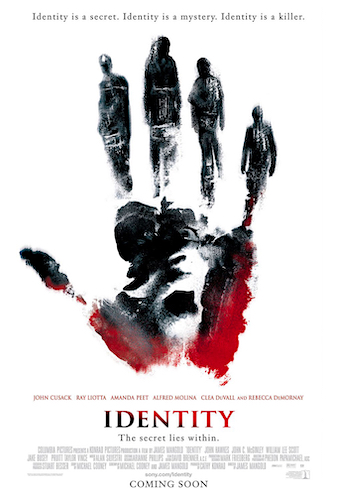
Identity
(2003)

2018 #78
James Mangold | 90 mins | streaming (HD) | 16:9 | USA / English | 15 / R

Identity

I bought Identity probably 15 or so years ago in one of those 3-for-£20 or 5-for-£30 sales that used to be all the rage at the height of DVD’s popularity, and no doubt contributed massively both to the format’s success and even regular folk having “DVD collections” (as opposed to just owning a handful of favourite films). As with dozens (ok, I’ll be honest: hundreds) of other titles that I purchased in a more-or-less similar fashion, it’s sat on a shelf gathering dust for all this time, its significance as a piece of art diminishing to the point I all but forgot I owned it.

But I did finally watch it, not spurred by anything other than the whim of thinking, “yeah, I ought to finally watch that,” which just happens for me with random old DVDs now and then. But, like so many other older films that I own on DVD, I found it was available to stream in HD, so I watched it that way instead. The number of DVDs I’ve ended up doing that with, or could if I wanted… all that wasted money… it doesn’t bear thinking about.

Whodunnit?

Anyway, the film itself. On a dark and stormy night, a series of chance encounters strand ten disparate strangers at an isolated motel, where they realise they’re being murdered one by one. So far, so slasher movie. And, indeed, that’s more or less how it progresses. But there’s a twist or two in the final act that attempts to make it more than that. Without spoiling anything, I felt like it was an interesting concept for a thriller, but at the same time that it didn’t really work. There’s an aspect to the twist that is a cliché so damnable it’s rarely actually used (unlike most other clichés, which pop up all the time), and so the film attempts a last-minute explanation of why it’s better than that, but, I dunno, I feel like a cliché is a cliché.

So maybe Identity is best considered as just a straight B-movie-ish slasher, and just overlook the final act’s attempts at being more interesting as just trying to be different. In fact, more interesting to me was the fact it was mostly shot on an enormous soundstage set, which is kinda cool given the scope of the location.

3 out of 5

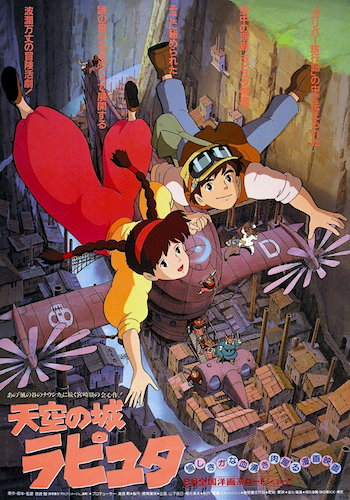
Laputa: Castle in the Sky (1986)

aka Tenkû no shiro Rapyuta

2020 #12
Hayao Miyazaki | 125 mins | Blu-ray | 1.85:1 | Japan / English | PG / PG

Laputa: Castle in the Sky

The names Hayao Miyazaki and Studio Ghibli go hand-in-hand (I wouldn’t be a bit surprised if quite a few people think they’re synonymous, i.e. that all Ghibli films are directed by Miyazaki), but his first two features (The Castle of Cagliostro and Nausicaä of the Valley of the Wind) were produced before Ghibli’s formation. So it’s Laputa, his third film, that is actually Ghibli’s first — which makes it appropriate to look at today, as it’s also one of the first titles being made available under Netflix’s new deal with Ghibli.* (Though if you search Netflix for “Laputa”, you won’t find it.)

Acclaimed as one of the first major works in the steampunk subgenre, Laputa takes place in a Mitteleuropean alternate past — the architecture is inspired by Welsh mining villages; the uniforms and hardware by historical German military; there are steam-powered automobiles and flying machines; but there’s also magic-like stuff, so it’s not just tech-based. In this world we meet Sheeta (voiced in Disney’s English dub by Anna Paquin, retaining her New Zealand accent), a young girl wanted by both the military and sky pirates for a necklace she wears. When she falls from an aircraft, the necklace glows and lowers her gently to the ground — and into the life of Pazu (James “Dawson’s Creek” Van Der Beek), a young orphan who immediately resolves to help her. And so off they go on an adventure to find out just what’s so desirable about Sheeta’s necklace, and what it has to do with the legendary flying city of Laputa.

If you watched Miyazaki’s first three movies ignorant of the knowledge they came from the same writer-director, I’m sure you’d work it out for yourself. It’s an action-packed adventure laced with humour and morally grey characters, like Cagliostro, with a well-imagined fantasy world populated by flying machines and brave young heroines, like Nausicaä. But it’s no act of self-plagiarism — Miyazaki is too inventive for that. His world-building is first rate, sketching in the details of this alternate reality in between character building scenes and thrilling action sequences. If this were live-action, it would make an exemplary action/adventure blockbuster, so well paced and structured is it.

The castle in the sky

That’s why it immediately clicked with me as an instant favourite among both Miyazaki’s and Ghibli’s oeuvre. It’s unquestionably an adventure movie, so it lacks the heartfelt depths of something like My Neighbour Totoro, but it’s at least the equal of Cagliostro in terms of how wildly exciting the set pieces are. And it’s not as if it’s totally empty headed, touching on longstanding universal themes like the corruption of power, and with a minor-key ecological message too (another Miyazaki staple).

I always feel like I should watch anime in Japanese, and I often do, but when the English voice cast includes Mark Hamill, well, that’s good enough for me. He’s the villain, channeling a certain amount of his Joker (but not too much) into a government secret agent in pursuit of Sheeta and in search of Laputa. He’s just one of a memorable cast of characters — I mean, did I mention there were sky pirates? They’re as awesome as they sound, bringing both broad humour and fuelling several action scenes (you’d expect nothing less of frickin’ sky pirates, right?) One of the most memorable characters transcends the language barrier: a giant speechless robot, questionably friend or foe, who leaves a mark almost as great as the Iron Giant’s but in considerably less screen time. (Considering how much Pixar are renowned fans of Miyazaki, and that Brad Bird made Iron Giant over a decade after Laputa’s debut, I wouldn’t be surprised if there was at least a little cross-pollination.)

Like any good blockbuster, Laputa has it all: thrills, humour, emotion, wonder… It’s the complete package. Plus, that level of broad familiarity (it wouldn’t take too many steps to imagine this remade as a Hollywood blockbuster, although they’d inevitably mess it up somehow) probably makes it the perfect starting point for any newbies to anime or Ghibli.

5 out of 5

Laputa: Castle in the Sky is available on Netflix from today. It placed 11th on my list of The Best Films I Saw in 2020.

* If the news passed you by: Netflix have acquired the rights to 21 Studio Ghibli films (that is, their whole back catalogue of features except Grave of the Fireflies, which has separate rights issues, plus Nausicaä) for most of the world (the USA, Canada, and Japan are excluded). They’re being released in three batches of seven — the first lot today, the next on March 1st, and the final ones on April 1st. As well as Laputa, today’s selection includes My Neighbour Totoro, which I reviewed here, plus Kiki’s Delivery Service, Only Yesterday, Porco Rosso, Ocean Waves, and Tales from Earthsea. ^

Review Roundup

This small selection may at first look a little disparate, including as it does two comedies, with release dates separated by a quarter of a century, and a horror movie. The two points of connection are that I watched them all last year, and I didn’t really enjoy any of them.

In today’s roundup:

  • Phantasm (1979)
  • National Lampoon’s Vacation (1983)
  • Step Brothers (2008)


    Phantasm
    (1979)

    2018 #92
    Don Coscarelli | 89 mins | TV | 16:9 | USA / English | 15 / R

    Phantasm

    A cult classic horror that spawned a pile of sequels and numerous novelty-packaged disc releases, Phantasm is about a supernatural undertaker, the Tall Man (Angus Scrimm), who (to quote Wikipedia) “turns the dead of earth into dwarf zombies to be sent to his planet and used as slaves.” Sounds totes plausible, right?

    Well, implausibility is no sin — many great fantasy or horror movies feed off setups that are just as outlandish. No, the problem here comes from the storytelling, because what happens in Phantasm is resolutely illogical. None of it makes any sense. No one behaves plausibly. Is there a mythology? I don’t know, because it all seems random. It appears to operate on some kind of dream logic, wherein stuff… just happens. And then at the end it’s revealed that it was, in fact, all a dream! Eesh. Are either of those things ok? Telling a story with “dream logic”, maybe. But then again, why should that be ok? We can’t control dreams, so we can’t expect them to obey the rules of narrative; but films are consciously made, so surely they should aim for coherence? And as for an “it was all a dream” ending, that’s just about the most despised device in storytelling for a reason. (Of course, there’s an “or was it?!” final twist, because it’s a horror movie and that’s how they always end.)

    It doesn’t help matters that the film simply isn’t well made. No one can act. Characters turn up out of nowhere. Most of it is cheaply shot and uninterestingly edited. There are a couple of good bits of imagery, but the rest of the movie is so nonsensical that that’s all it is — imagery. There’s no meaning attached.

    And yet the Phantasm series has its fans (or, predictably, “Phans”). Perhaps, if we’re being kind, we can say it’s an acquired taste — you either get something from its strangeness or you don’t. Clearly there are people (“Phans”) who see something in it. I wasn’t one of them.

    2 out of 5

    Phantasm featured on my list of The Five Worst Films I Saw For the First Time in 2018.

    National Lampoon’s
    Vacation

    (1983)

    2018 #140
    Harold Ramis | 98 mins | streaming (HD) | 16:9 | USA / English | 15 / R

    National Lampoon's Vacation

    Written by John Hughes and directed by Harold Ramis, Vacation certainly has strong pedigree (I’m not even going to begin to list all the classic comedies attributable to their names). It also spawned three sequels and a remake, so it’s clearly popular. Unfortunately, something about it didn’t click with me.

    It’s about a family going on a summer holiday; specifically, a cross-country road trip from Chicago to California, to visit Disney Walley World. Naturally, the journey doesn’t go to plan, and a series of episodic hijinks ensure. These include such hilarious escapades as meeting some black people (who of course steal their hubcaps); falling asleep at the wheel and careening through a town; hanging out with a cousin who French kisses his own daughter; and accidentally dragging their aunt’s dog along behind the car until it dies. Good times!

    There’s also a song by Lindsey “Fleetwood Mac” Buckingham, called Holiday Road, which is played again and again throughout the film. I started out hating it, but by the end I was listening to it on loop while I updated all my post-viewing lists. It’s sort of gloriously terrible. Sadly, I didn’t have the same Stockholm syndrome reaction to the film itself.

    2 out of 5

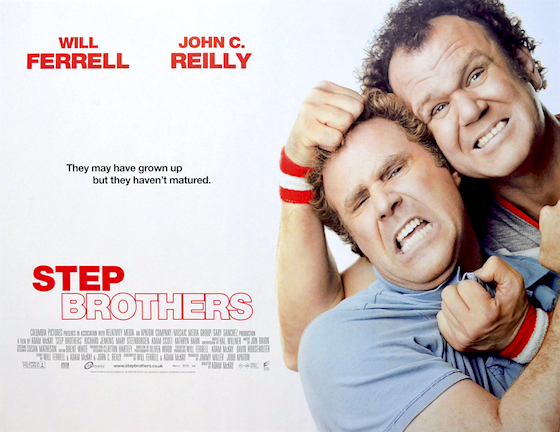
    Step Brothers
    (2008)

    2018 #204
    Adam McKay | 98 mins | streaming (HD) | 2.35:1 | USA / English | 15 / R

    Step Brothers

    Will Ferrell and John C. Reilly star as two developmentally-stunted man-children who are forced to live together after the former’s mom (Mary Steenburgen) and the latter’s dad (Richard Jenkins) move in together.

    The movie relies on the notion that watching two 40-year-old men behave like bratty 10-year-olds will be constantly hilarious. Spoiler alert: it isn’t. Unlike the infamous recent collaboration between Ferrell and Reilly, Holmes & Watson, this effort does at least manage some funny bits, though they generally occur when it moves away from the primary conceit for a moment. It also has the most implausible sex scene this side of The Room, which is some kind of achievement, I guess.

    2 out of 5

  • Witness (1985)

    2018 #74
    Peter Weir | 108 mins | streaming (HD) | 16:9 | USA / English | 15 / R

    Witness

    Witness is, I think, one of those (many) films that used to be pretty well-known but hardly anyone seems to talk about anymore. I guess it falls into that bracket of being “very good, but not great”, and, devoid of the kind of cult appeal that can keep good-not-great movies popular for decades, it’s kind of slipped off the radar.

    It’s the story of an 8-year-old Amish boy (Lukas Haas) who, while travelling with his mother (Kelly McGillis) through Philadelphia, happens to witness the murder of an undercover cop. The case is handed to Detective John Book (Harrison Ford), who manages to get the boy to ID the murderer, but that puts the trio in danger, so they hide out among the Amish community.

    With such a storyline, the film could descend into a culture-clash comedy — the big city cop chafing against historical rural life — but, while that clash is certainly in play, it’s not milked for laughs. Rather, the film is about Book experiencing a way of life so different to his own, and it changing his perspective on the world. Indeed, with the focus it gives to Amish ways, the film almost seems like it wanted to be a documentary about that community as much as a story. Certainly, the crime plot is a little rote, though it builds to a thrilling climax, with a definite touch of “modern Western” about the film’s style and structure. Additionally, the burgeoning romance between Book and the boy’s mother is touchingly and believably handled.

    Witness protection

    Ford gives a good performance, though I didn’t think it was that far outside his usual wheelhouse, actually. Sure, this is a drama where he plays a real-world cop rather than an adventure flick where he’s a dashing space smuggler or a swashbuckling matinee idol, but he’s still a bit of a charming rogue who eventually reveals his good heart. Or maybe Ford is just so effortlessly good that he makes it look easy. Among the rest of the cast, look out for a baby-faced Viggo Mortensen, popping up briefly with no lines.

    The film’s only significant downside is a horrible synth score by Maurice Jarre. Maybe it’d be fine in itself, if ever so ’80s, but it’s an ill fit with the film’s theme about the appeal of traditional ways of life.

    Otherwise, Witness is, as I said, a good-but-not-great kind of drama; a more-than-solid effort from all involved, but not so remarkable that it’s endured among Great Movies. There’s nothing particularly wrong with that, mind. Certainly, in our present era of Western cinema where that sort of dramatic movie is falling by the wayside as studios focus solely on mega-budgeted effects spectacles, this kind of film feels all the more wanted.

    4 out of 5

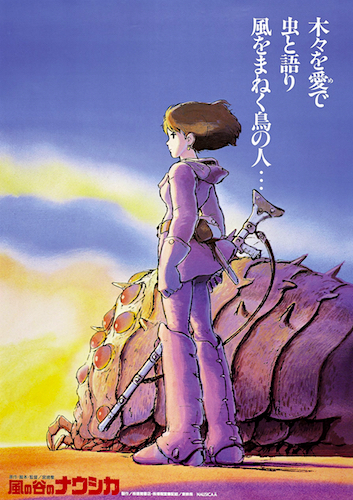
    Nausicaä of the Valley of the Wind (1984)

    aka Kaze no tani no Naushika

    2018 #130
    Hayao Miyazaki | 117 mins | Blu-ray | 1.85:1 | Japan / English | PG / PG

    Nausicaä of the Valley of the Wind

    I watched Princess Mononoke before Nausicaä, and also checked out the Blu-ray’s special features. Those include the film’s original Japanese trailers, which emphasise that it’s “13 years after Nausicaä”, which intrigued me, because director Hayao Miyazaki had made plenty of other films in between. But, having watched the earlier movie, the connection and similarities become clear: Nausicaä features an ecological message, a threat from nature that isn’t, industrial humans (with a female general) being the actual villains, innocent townsfolk that need saving, a princess who’s the only one who understands, and a boy from a different kingdom who helps her. They’re not identical, of course, but there’s a lot of overlap…

    The animation is nice without being quite as mindblowingly good as later Ghibli productions — they certainly hit the ground running, but they would improve too. The full-length English dub was created in 2005 (the original US release was drastically cut and rewritten) and boasts a helluva cast: Uma Thurman, Patrick Stewart, Mark Hamill, Edward James Olmos, plus Alison Lohman as the lead and a young Shia LaBeouf. I don’t mean to disparage those actors who primarily ply their trade dubbing anime, but these starry Disney-funded dubs do add a certain extra oomph to the vocals.

    Nausicaä was only Miyazaki’s second feature, but already shows a lot of the themes and concerns that would go on to characterise his later movies. I feel like maturity and/or experience make some of those later films better, but this is still a powerful demonstration of his talents.

    4 out of 5

    Nausicaä of the Valley of the Wind was viewed as part of my Blindspot 2018 project, which you can read more about here.

    The Ragtag Review Roundup

    My review backlog has got a bit silly: there are currently 128 unposted reviews on it, dating back to stuff I watched in January 2018. I was hoping to really get stuck into that as 2019 began, but I’ve been busier than expected. Anyway, I’ll keep trying — and here’s a start, with a real mixed back of films that have basically nothing in common.

    In today’s roundup:

  • American Psycho (2000)
  • Logan Lucky (2017)
  • A Nightmare on Elm Street (1984)
  • The Treasure of the Sierra Madre (1948)


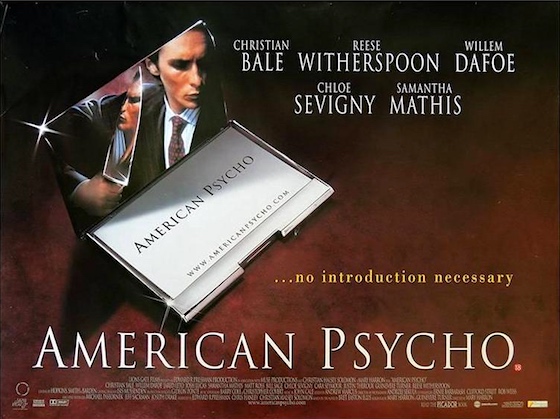
    American Psycho
    (2000)

    2018 #66
    Mary Harron | 102 mins | streaming (HD) | 2.35:1 | USA & Canada / English | 18 / R

    American Psycho

    The film that made Christian Bale’s name sees him play Patrick Bateman, a high-flying New York banker with psychopathic tendencies — well, that just sounds like all those Wall Street types, right? Except hopefully they’re not actually engaging in literal killing sprees, unlike Bateman.

    While the murdering stuff may look like the draw, American Psycho is more interesting as an examination of the corporate mentality. It manages to be remarkably insightful, satirical, and terrifying all at once. Take the scene where they compare business cards, for instance: it’s ridiculous how much interest and importance these guys are placing in little cardboard rectangles with their name and number on, and yet you can believe such business-wankers would care about it. The anger Bateman feels when other people’s cards are considered classier than his is palpable.

    It’s a great performance by Bale across the board — so well judged, despite being barmy. It’s also interesting to observe the links between this and his version of Bruce Wayne, which is a wholly appropriately connection. I mean, who’s more of an American psycho than a guy who spends his days pretending to be a playboy businessman and his nights dressing up as a bat to beat up bad guys? I’m sure someone must’ve already developed a theory / amusing trailer mashup connecting the two films…

    The only thing that really let the film down for me was its final act. No detailed spoilers, but while I thought the rest of the film was engagingly made, the ultimate lack of resolution felt empty. To me, it seemed like it didn’t know how to end.

    4 out of 5

    Logan Lucky
    (2017)

    2018 #65
    Steven Soderbergh | 119 mins | Blu-ray | 2.39:1 | USA / English | 12 / PG-13

    Logan Lucky

    Two brothers, whose family has a historical proclivity for bad luck, decide to rob one of the US’s largest sporting venues, the Charlotte Motor Speedway, during one of its quieter events. But when the situation changes, they end up having to pull the job off during the biggest race of the year.

    Director Steven Soderbergh’s return to the heist genre a decade after Ocean’s Thirteen is something to be noted; and while Logan Lucky is a very different kind of heist movie (there’s none of that trilogy’s Hollywood glamour to be found here), it’s a more successfully entertaining movie than either of the Ocean’s sequels.

    Like them, it’s not terribly serious, instead ticking along as generally quite good fun — though there’s a scene with Take Me Home, Country Roads that’s quite affecting. Between this and Kingsman 2, I’m left to wonder how that wound up becoming just about the most emotional song ever recorded…

    Anyway, the showpiece heist is clever, in its own way, and rolls around sooner than I expected — it’s funny to read some people criticise how long it takes to get to, because I assumed it would be Act Three. Instead, the film constructs a post-heist third act that was the only time it really got too slow for me, though it does eventually reveal a purpose that was kinda worth the wait. That said, the whole thing might benefit from being a little bit tighter and shorter — ten minutes trimmed across the pre- and post-heist acts might make it zing just that bit more.

    4 out of 5

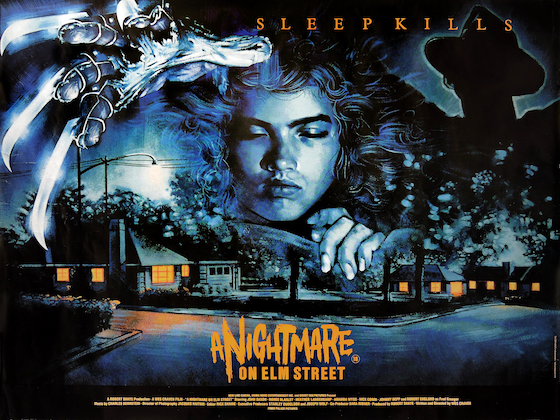
    A Nightmare on Elm Street
    (1984)

    2018 #71
    Wes Craven | 87 mins | TV (HD) | 16:9 | USA / English | 18 / R

    A Nightmare on Elm Street

    It may be regarded as a horror classic, but I have to admit that I found A Nightmare on Elm Street to be a crushing disappointment. To me, it seemed to be a pretty poor movie (all weak: the acting, the dialogue, the music, the timescale events supposedly occur in) with some fantastic imagery. Director Wes Craven was a master, of course, and he manages to construct some truly great shots and moments amid a dirge of mediocrity. There’s a lot of nonsensical stuff too. I guess “dream logic” is meant to excuse it, but… eh.

    I do really like that poster, though.

    3 out of 5

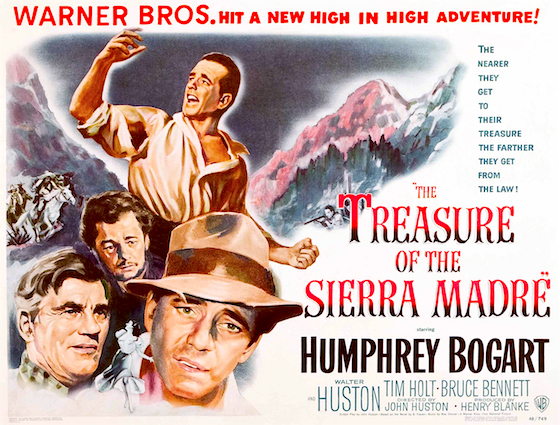
    The Treasure of the Sierra Madre
    (1948)

    2018 #6
    John Huston | 121 mins | TV (HD) | 4:3 | USA / English | PG

    The Treasure of the Sierra Madre

    Set in the mid ’20s, two American drifters in Mexico (Humphrey Bogart and Tim Holt) team up with an old and experienced prospector (Walter Huston, director John Huston’s father) to hunt for gold in them thar hills. Along the way they have to contend with rival prospectors, violent bandits, and — most dangerous of all — their own suspicions and greed.

    The Treasure of the Sierra Madre blends genres like there’s no tomorrow: it’s been described as a plain drama, an adventure movie, a neo-western, it’s included on film noir lists… Of course, depending which angle you look at it, it’s all of the above. It’s both an exciting adventure movie and a character-centric exploration of the effects of greed. In depicting that, Bogart’s performance is excellent, though Huston Sr threatens to steal the show. Poor Tim Holt is overshadowed by them both, even though he gives a likeable turn.

    5 out of 5

  • February Review Roundup

    As 2018 races towards its finish line, I’m sat on a pile of nearly 130 unwritten reviews. Oof. And to think, I started that page when I first got 10 behind.

    Anyway, as my (likely in vain) attempts to reduce that number continue, today’s roundup includes three reviews of films I watched all the way back in February:

  • WarGames (1983)
  • Being John Malkovich (1999)
  • I Origins (2014)


    WarGames
    (1983)

    2018 #22
    John Badham | 113 mins | streaming (HD) | 1.85:1 | USA / English | 12 / PG

    WarGames

    It’s Ferris Bueller’s Third World War as Matthew Broderick plays a precociously talented high schooler who unwittingly hacks into a government war planning supercomputer and instigates a countdown to nuclear annihilation.

    It’s a funny old mashup of genres that I’m not sure you’d get away with today. It starts out as a Cold War thriller, feeling almost like a Tom Clancy adaptation; then suddenly it’s a John Hughes high school comedy; then the two have to awkwardly mesh, before it turns fully into a young adult techno-thriller. Young Adult fiction is almost synonymous with dystopian future adventures nowadays, but WarGames reminded me nonspecifically of the kind of thing YA books used to be about when I was the right age for them — and, considering that would’ve been in the mid ’90s, those books were quite possibly inspired by this film.

    So, it’s inescapably of its era, but no worse off for that… though how The Youth Of Today would take to it, God only knows. If you stop to think too much (or at all) about the ins and outs of the plot then it becomes thoroughly implausible in so many different ways, but if you let those things slide and go along with the film on its own terms then it’s a cracking adventure yarn.

    4 out of 5

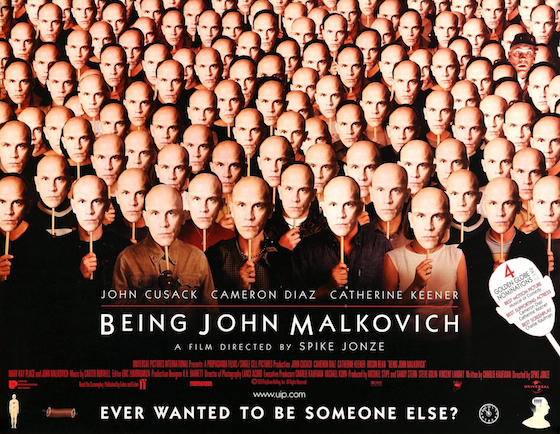
    Being John Malkovich
    (1999)

    2018 #28
    Spike Jonze | 113 mins | streaming (HD) | 1.85:1 | USA / English | 15 / R

    Being John Malkovich

    The film that introduced the world to the kooky imagination of screenwriter Charlie Kaufman (almost 20 years ago now!), Being John Malkovich is about a failing puppeteer (John Cusack) who starts a new job in a bizarre office, where he develops an unreciprocated infatuation with a coworker (Catherine Keener) and discovers a hidden portal into the mind of actor John Malkovich (John Malkovich).

    Even with that mad premise, Being John Malkovich wasn’t the film I thought it was going to be. Well, I don’t know what I was expecting exactly, especially as it’s a Kaufman film so I knew to expect “weird”. But I guess I anticipated that it would focus on people inhabiting Malkovich and doing kerazy things as him, or something, rather than it being a four-way love triangle (in an Escher-esque way rather than an “uh, I think you mean love quadrilateral” sense) in which the whole “inhabiting Malkovich’s body” thing is more a means to an end rather than the film’s raison d’être.

    Said end is an exploration of identity and relationships — indeed, the screenplay reportedly started life as “a story about a man who falls in love with someone who is not his wife” and the kooky body-swap antics came later. I’ve read reviews that frame it in the context of films like Mulholland Drive and Persona as a “comedic meditation on identity”; though what it actually says about identity, I’m not sure (but then, I wasn’t really sure what Mulholland Drive and Persona were saying either, so maybe this is just me). But I wonder: does it just tip its hat in that direction while playing around with the situation to see what happens? Are the filmmakers “yeah, whatever”ing the broader psychological implications (as one of the characters does) while playing out the full bizarreness of the premise to its logical extreme? I’m not sure “logical” is quite the right word for what goes on in this movie, but what I mean is it works through the fullness of the idea, extrapolating it through various events and to a conclusion. Can you even consider the true psychological implications with something so out-there and not-real?

    Well, maybe. Indeed, the film kinda does, through its relationships. One character falls in love with another, but only when the latter is in Malkovich’s body; but then they’re tricked into falling for someone else in Malkovich’s body; but that doesn’t work out in the long run, and the first pair end up together in real life — so the physical body is the initial attraction, but it’s ultimately irrelevant to the actual person inside. Basically, is this just a kooky, crazy, bizarre film whose message is the age-old “beauty isn’t just skin deep”?

    4 out of 5

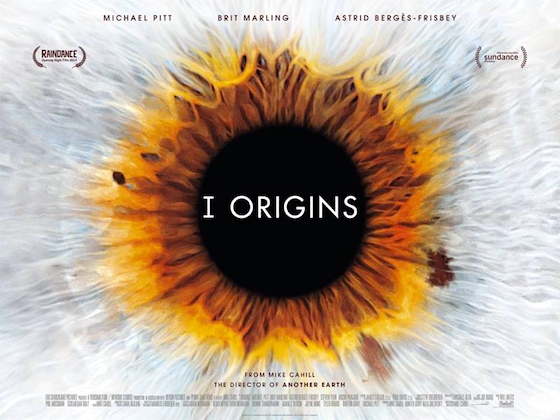
    I Origins
    (2014)

    2018 #36
    Mike Cahill | 103 mins | TV (HD) | 2.39:1 | USA / English | 15 / R

    I Origins

    The second film from Another Earth writer-director Mike Cahill, I Origins is another science-fiction drama with the emphasis on “drama” more than “sci-fi”. It’s about a scientist, Ian (Michael Pitt), who’s mapping the evolution of the human eye with his lab partner (Brit Marling), hoping it will help discredit the superstitious religious ideas that he despises. At a party, Ian is drawn to a masked woman (Àstrid Bergès-Frisbey) by her eyes, and they end up dating — but developments in their relationship send his research in surprising directions…

    I Origins is a consistently engaging, intriguing film; the kind of story that continues to develop and evolve its premise throughout its whole running time, so that I’ve had to be a bit vague to avoid just giving away the entire plot. My only real query is that I don’t know what it all signified in the end. Something to do with there being room for spirituality even in dyed-in-the-wool scientists? Or maybe it’s just about the personal journey of its lead character? Or maybe, as it was developed as a prequel to an unmade script, the really significant stuff lies there, and this is just backstory? (Cahill sold the rights to that screenplay in 2011, but it’s still not been produced.)

    It feels a bit disingenuous to praise a film where I don’t really know for sure what the point was, but I liked it quite a lot all the same.

    4 out of 5