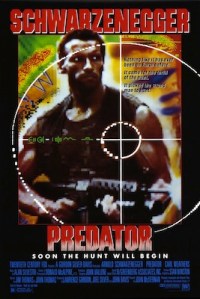
Predator (1987)

2009 #16a
John McTiernan | 102 mins | DVD | 18 / R

PredatorLet’s not pretend here: although the series have become intrinsically linked, Predator is Alien’s poorer cousin. Not that it’s a bad film — it’s an entertaining war flick that turns into a sci-fi/action/horror skirmish thingy — but it doesn’t have the same finesse that imbues Alien and its sequel.

In the lead role, Arnie does his usual macho posturing. Around him, a crack team of special-operations soldiers are characterised enough to be distinguishable but little more. There’s a girl because there should be a girl, not that she does much. Mainly, there are a couple of big fights and one seriously ugly alien.

The main reason for Predator’s success may well be the Predator itself. It’s a fantastic bit of design and animatronics that easily stands up today, its disgusting mouth perhaps not as iconic as the Alien’s phallic extra one but arguably more gruesome to look at. It works differently too: a solo intelligent hunter that is picking off our human heroes and is always one step ahead. Much of the same could be said of Alien’s Alien, but that was like a beast stalking its prey, while the Predator is more like a man hunting some rats. Where Aliens felt like a natural evolution of the former franchise’s concept — more of them! — Predators seems like a rather ill-conceived idea.

Still, there’s plenty of visceral enjoyment to be had from Predator’s straightforward approach, which is more than can be said for its sequel

4 out of 5

Alien vs Predator – Part 1

If you happen to keep an eye on my coming soon page or have been following me on Twitter, you may’ve noticed that I recently watched all eight films in the Alien, Predator and Alien vs Predator franchises, the majority of them for the first time.

As I’m sure you know, I normally only review films I’ve not seen before. In the interests of being thorough, however (and following in the footsteps of Casino Royale, Cube, and the first three… well, really, all the Star Wars films), I’ve also reviewed the only two I’d seen before — perhaps unsurprisingly, Alien and Predator themselves.

2009 #13a
Alien: The Director’s Cut

Alien feels unchanged. It’s been said many times before but, first and foremost, it’s a horror movie — it just happens to be one set in space with plenty of sci-fi trappings… Whatever effect Scott’s trims may have had, they haven’t made it any less effective in this regard” Read more…

2009 #16a
Predator

“it’s an entertaining war flick that turns into a sci-fi/action/horror skirmish thingy — but it doesn’t have the same finesse that imbues Alien and its sequel.” Read more…


Reviews for the remaining six films won’t be too far behind.

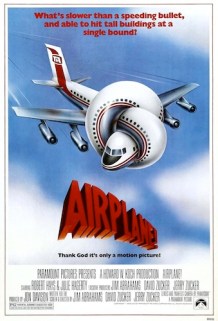
Airplane! (1980)

2009 #21
Jim Abrahams, David Zucker & Jerry Zucker | 84 mins | DVD | PG / PG

Airplane! is not… well, many things. But what it is is a comedy, and, as I’ve said before, if a comedy makes me laugh that’s good enough — it’s its job and, unless there’s more advertised, there’s no good reason to expect or desire more. So is it funny? Yes. But…

The main problem with watching Airplane! for the first time now is that it occasionally suffers from its own popularity. Many jokes are too well known to seem original in context, and while some retain their humour others look tired. The ungenerous would mark it down for this, but that seems unfair considering it’s only the film’s fault in the sense that it was so good everyone’s copied it. However, age is a problem in other ways: cultural references always date, and some jokes here depend on those; some depend on being American too, meaning they passed by with an uncomfortable awareness that I was watching a joke but had no idea why it should make me laugh.

Airplane! combats these almost-faults in two ways: one, it is irrepressibly silly, which in this case is a very good thing; and two, it has an incredibly high joke rate. Combined, these mean it can coast over some of the problems. Even when it slows for a minute or two while running through a gag you don’t get, there’s an overriding silliness that can raise a chuckle and an awareness that there’ll be another along promptly enough.

There’s a good mix of gags too. As well as visual and out-there humour there’s a pleasing use of moderately intelligent wordplay — you’d be hard pushed to find that in a modern populist comedy film. Considering the BBFC’s PG rating there’s also a surprising number of gags that are adults (or, really, teenagers+) only. Even more surprising is that a film with jokes about blow jobs, suicide and cocaine, and which briefly features a pair of bare breasts, only received a PG from the MPAA.

This model of comedy — the silly spoof, as it were — is still in use today in the depressingly endless series of …Movie movies (like this weak example). But where they’re just crude, Airplane! is witty; where they’re just random, Airplane! is irreverent; and where they’re just derivative, Airplane! was original. It may have aged a little, but it’s still funny, and that’s good enough.

4 out of 5

Runaway Train (1985)

2009 #11
Andrei Konchalovsky | 106 mins | TV | 15 / R

This review contains major spoilers.

Runaway TrainRunaway Train bagged itself three Oscar nominations and one for the Palme d’Or back in 1986, which rather begs the question, how?

On the awards-worthy side, it’s based on an Akira Kurosawa script and features grittier-than-average direction and performances. On the other, the majority of its story and supporting characters feel closer to other ’80s actioners like Lethal Weapon or Die Hard. The focus on a high concept (the title says it all), emphasis on exciting action sequences, the way the plot is structured, the faintly pantomime villains, comical supporting characters, and occasional slips into fantasy (one character was welded into his cell, the state the prison has degraded to, the whole concept of the runaway train and its computer control centre) — none of these elements suggest your typical Oscar nominee, but instead a half-forgotten minor action flick.

The lead characters and their performances, by Jon Voight and Eric Roberts, are above average for the genre — this is where two of the Oscar nods come from — but they’re not notably superior to other outstanding examples (see Bruce Willis and Alan Rickman in Die Hard). Praising the acting can only cover the two leads, at best, because the villains and supporting roles are as one-dimensional and clichéd as you’d expect from the genre. The other Oscar nomination was for editing, one that’s more obviously deserved. Visually, the sequences of the train smashing through the countryside are fairly impressive. Perhaps the camerawork deserved a nod in this respect too, as it lends the film a gritty real-world feel that may be explain some’s distraction from the otherwise familiar values. It can’t mask them all though — for example, the occasionally brutal violence is still denied any real-world punch thanks to the fantastical sheen created by some plot points.

The notable exception to most of this is the ending, where Voight’s anti-hero stands atop a train engine we — and he — know to be doomed, his prison warden nemesis handcuffed inside, and rides it out of sight into the fog. It’s a classy finale that flirts with the downbeat ending, though doesn’t quite succumb to it because we also know the young sidekick and girl have survived. Nonetheless, there’s pleasingly no postscript, simply fading to black after the engine disappears into the mist. The titular train, one might theorise, is like some mythic beast — it arrives through snow-mist, leaves devastation in its wake, and then disappears back into it. But that might be getting a bit too pretentious…

In focusing on these lofty pretensions (which may have been forced on it by nominations and some reviews), one can become distracted from the fact that, taken as a straight-up high-concept action-adventure, Runaway Train has an awful lot going for it. And if you want to get pretentious about it, well, it might just support that too.

As a final aside: one of the film’s most memorable moments, in retrospect, is down to an accident of fate. Near the end a character looks at a space shuttle on TV and muses, “with all this high technology, why couldn’t we stop it?” Just 11 days after Runaway Train’s US release, Space Shuttle Challenger disintegrated 73 seconds after launch, killing its seven crew members. For anyone aware of this correlation, it’s an incredibly poignant moment.

4 out of 5

Though the Radio Times review I’ve linked to says Runaway Train is an 18, it was reclassified in 2008. [It has since been updated.]

The Blues Brothers (1980)

2008 #99
John Landis | 142 mins | DVD | 15 / R

The Blues BrothersCult comedy musical, with a more-than-healthy dose of the surreal, about two brothers on a mission from God, here watched in the extended DVD version (full details at IMDb). Maybe this is why it takes a while to get going — the first hour or so could do with a kick up the proverbial — and has a tendency to sprawl like an unruly first draft.
On the other hand, its insistence at being random, crazy, and incessantly silly throughout is beautifully anarchic. There’s an array of fabulous cameos — Ray Charles! Aretha Franklin! and Carrie Fisher, feeding the anarchy with her ludicrous attempts to kill one of the titular pair. While there were fewer songs than I’d expected, they’re all classics rewarded with infectiously fun performances. Then there’s the climactic car chase, which surely challenges many more serious examples for pure excitement value.

And any film which sees Neo-Nazis jump into a river to avoid being run over has to be good.

4 out of 5

The Blues Brothers is on ITV4 tonight, Friday 26th September 2014, at 11:35pm.

(Originally posted on 24th January 2009.)

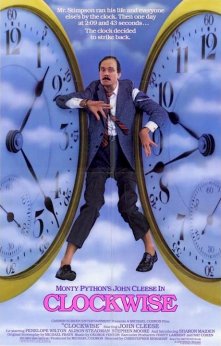
Clockwise (1986)

2008 #76
Christopher Morahan | 92 mins | DVD | PG / PG

ClockwiseClockwise, so I’m told, was written after John Cleese (who, I should point out, isn’t credited as the writer) attended Robert McKee’s famous screenwriting seminar. What this means for your average viewer is that Clockwise is expertly constructed. More importantly, it’s also very funny.
The first 15 minutes are a little dubious, but it soon becomes apparent that some of McKee’s principles are being followed (if you’re aware of them, of course) as this opening serves to establish the everyday life of Cleese’s character, headmaster Brian Stimpson. The point of this soon becomes apparent: when everything goes to hell over the next hour-and-a-quarter, the viewer can fully appreciate the impact on Stimpson’s existence. And all go wrong it does, in a manner that’s rather reminiscent of Fawlty Towers — not in the sense that Cleese is repeating himself, but rather that you could replace Stimpson with Basil Fawlty and merrily carry on along much the same path; though, I hasten to add (to this over-punctuated sentence) that Stimpson is not a clone of Fawlty, but he is prone to ending up in similar accident-and-misunderstanding-based farcical situations.

I imagine that Clockwise is less well known than it deserves because it is so very British. The humour — largely based around issues of punctuality, politeness, and social custom — is particularly British, as are the countryside settings and the finale set at a public school conference. And, in the first instance, everything goes so spectacularly wrong thanks to our wonderful language’s multiple meanings for the word “right”. From this point Cleese & co escalate the hopelessness of the situation beautifully (and very much in keeping with McKee’s ideas of good structure), gradually crafting more absurd events and dragging in more and more characters, most of whom come together in that finale. This final section perhaps goes on too long, with a rather inconclusive ending, and it lays on the anti-public school gags with a trowel — though that suits me just fine.

Some have argued that Clockwise is more like a series of sketches than a cohesive whole, but all the independent scenes are connected by a common goal, meaning very few (if any) feel genuinely out of place or inelegantly shoved in. The calm pauses between the comic scenes also allow it to remain hilariously funny so consistently — an all-out assault of comedy, no matter how good, can become rather wearing. Again, this ebb-and-flow is something the filmmakers may well have picked up from McKee.

While you could probably use Clockwise as a mini masterclass in applying some of Robert McKee’s structural principles, that’s thankfully not the be-all of it. Very funny once it gets going, this is one that fans of Fawlty Towers will likely especially enjoy — and, really, who with a sense of humour isn’t a Fawlty Towers fan?

4 out of 5

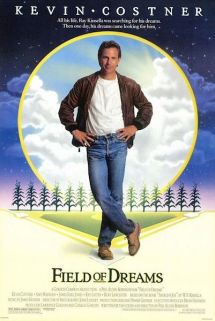
Field of Dreams (1989)

2008 #38
Phil Alden Robinson | 103 mins | TV | PG / PG

Field of DreamsI’ve never made much of an effort to see Field of Dreams, for a couple of reasons. Aside from its famous mantra/catchphrase (“if you build it he will come”), the only things I’d heard were it was mawkishly sentimental and was about Kevin Costner trying to build a baseball pitch for a ghost — which doesn’t sound particularly exciting and is about sport, something I’m not very fond of. Of course, as anyone who’s seen it will know, I was a tad misled on that last point, as the glorified rounders pitch is built in the first 20 minutes. What follows certainly has its fair share of sentimentality, but I wouldn’t call it mawkish.
In fact, it’s almost unremittingly pleasant. The lack of anything hard-hitting is no doubt why some have such a dim view of the film, as “nice” has become synonymous with “not very good” in modern parlance (I blame Primary School teachers desperate to increase vocabulary). Field of Dreams won’t shock you, it likely won’t make you think very hard, and any moral message or meaning it has is positive and reassuring… but what’s so wrong with that? The plot keeps moving, refusing to be bogged down in navel-gazing or star-gazing. The story is also too unusual to be marred by any serious degree of predictability, though some events are of course easily guessed, but the mystery of how the various elements would come together kept my attention throughout. Crucially, it doesn’t labour its sentimentality or batter you round the head with morals or meanings. It’s hardly ambiguous, but nor is it over done.

Field of Dreams may not be astounding filmmaking — it’s not especially complex, radical, thrilling, thought-provoking, intense or revolutionary, nor terribly serious or terribly funny, nor indeed wholly original — but it is nice. And I mean that in a good way.

4 out of 5

Field of Dreams is on ITV today, Saturday 27th September 2014, at 2:35pm.

Henry V (1989)

2008 #29
Kenneth Branagh | 132 mins | DVD | PG / PG-13

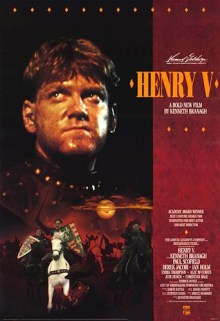
Henry V (1989)Once more unto the breach, dear friends, as I delve into a second version of Henry V in as many (viewing) days. (I dread to think how many reviews of this film began with a similar quote-based pun.) Inevitably, having watched them so close together, this is as much a comment on the relative merits of Branagh’s and Olivier’s interpretations of Henry V as it is a review of Branagh’s film in its own right.
Branagh’s version opens with almost a direct homage to Olivier’s, though with an important difference. Olivier opened with the Chorus’ narration on a stage ; Branagh opens with the Chorus’ narration on a film set. Rather than wasting half an hour with this conceit (as Olivier did), Branagh pushes into the ‘reality’ of the story before another actor has even entered. And his reality is much more real. The film looks as if it’s lit by candles and daylight, the castles and tavern are rough and dark, the battlefields muddy and grimy; everyone gets dirty and bloodied by the fights. On the whole it’s a grittier and more realistic version. Yet there’s room for more than that. The story still seems concluded at the Battle of Agincourt, but the proposal scene no longer feels tacked on. In fact it’s now laugh-out-loud hilarious, with Branagh and Emma Thompson demonstrating the undeniable chemistry that would help make Much Ado About Nothing so good a few years later. Unlike Olivier’s fluffy limp to the credits, this is an entertaining round-off to the plot.

The fact I’d never seen a version of Henry V before Olivier’s ostensibly gives Branagh’s the benefit of a better understanding on my part. Practically, it matters little that I saw Olivier’s first, as the more modern and film-friendly performances in Branagh’s version mean that, while Olivier’s allowed me to broadly follow the majority of what was happening, Branagh’s gives more access to the nuances of both plot and character. He’s aided in the latter by the inclusion of scenes deemed inappropriate for a World War 2 propaganda film: in one, Henry and co confront three traitors; in another, he hangs an old friend in order to make an example. Other scenes are played differently too, so that Branagh’s Henry is a more complex and morally debatable figure, unlike Olivier’s bright-eyed hero. Whatever your opinions on the two actors on the whole, these changes make for a better character and therefore a better film.

It would be remiss not to mention the rest of the cast. Brian Blessed is positively restrained as Exeter, one of Henry’s key associates — you’d never imagine he could turn in such a performance if you’d only seen his recent go at hosting Have I Got News For You. Paul Schofield, as the aging French King, and Michael Maloney, as the contemptible Dauphin, help flesh out the French side more than Olivier’s version managed, as does Christopher Ravenscroft’s Mountjoy, the French herald who all but switches his allegiance. The English ranks are swelled by Bilbo Baggins, Hagrid, and the current incarnations of ‘M’ and Batman (don’t worry, the French have Miss Marple); not to mention the recognisable faces of Richard Briers, Danny Webb, Simon Shepherd and John Sessions (and no doubt others I’ve accidentally missed). Of course, a starry and recognisable cast does not necessarily a good film make, but this is a dependable lot and there are good performances all round — even if Ian Holm’s Welsh accent is somewhat dubious (though it’s a lunar leap on from the one in Olivier’s version).

And deserving of a paragraph unto himself is Derek Jacobi’s masterful Chorus, who, with just a handful of narrational lines and a big black coat, is somehow one of the coolest characters I’ve seen of late.

There’s no contest here for me. Olivier’s version is an over-stylised, propaganda-inspired, outdated version of Shakespeare, whereas Branagh’s is a comprehensible, realistic, textured and, perhaps most importantly, genuinely enjoyable interpretation.

4 out of 5

The Baskerville Curse (1983)

2008 #25
Eddy Graham | 67 mins | DVD | U / G

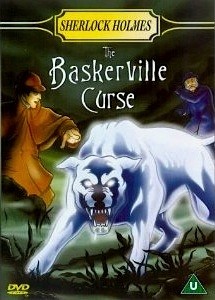
The Baskerville CursePeter O’Toole is Sherlock Holmes (well, his voice) once again in this animated Conan Doyle adaptation from the ’80s (see also my reviews of two others, The Sign of Four and A Study in Scarlet). Of course, this is an adaptation of that perennially popular Holmes story, The Hound of the Baskervilles, and as such O’Toole barely features. A shame, as he’s the only half decent thing in this mess.

As I’ve previously expressed, The Hound of the Baskervilles is not my favourite Holmes story, though it has its moments and there have been some enjoyable screen versions. Unfortunately, this pointlessly renamed offering retains all of the original’s faults but loses most of the best bits, despite wasting time on train journeys, telegram writing and pointless flashbacks to things we saw just minutes earlier. The animation is poor, even for a production of this level, with dire character design and a total lack of atmosphere (it opens with jolly music over views of primary-coloured countryside!) There are further flaws, but there’s no point wasting any more time going through them. I can only hope that the final entry in this series, The Valley of Fear, will be closer in quality to the other two instalments.

In retrospect, I’m certain I underrated the 1939 adaptation of The Hound of the Baskervilles. I’m equally certain that I shall have no such regrets over this lame attempt.

1 out of 5

The Baskerville Curse featured on my list of The Five Worst Films I Saw in 2008, which can be read in full here.

A Room with a View (1985)

2008 #14
James Ivory | 112 mins | download | PG

A Room with a ViewI can’t help but wonder if, back in 1985, there was any audience confusion between A Room with a View and A View to a Kill. One can imagine legions of Bond fans accidentally finding themselves with a witty heritage drama, and legions of old dears accidentally finding themselves with a man twice their age trying to be an action hero. (In actuality the films were released about a year apart — that being just one reason this is a particularly silly notion.)

Putting aside such nonexistent confusion, what of that witty heritage drama? Once again, thanks to the adaptations module of my degree, I’m stuck watching a film straight after reading the novel it’s based on. So far these viewings have supported my long-held theory that reading any novel before watching the film version (especially immediately before) is a Very Bad Idea. However good A Room with a View may be — and it certainly has its share of positives — it still pales slightly in direct comparison to the novel.

The film’s faithfulness is admirable at least, combining events effectively at times and at others leaving well alone. Unfortunately this “copying out” style of adaptation means that the dialogue is exactly as written but sometimes loses important elements through its abbreviation. In the novel, characters frequently mean something entirely different to what they say, but you wouldn’t guess so in the film. Similarly, a lot of the novel’s wittiness is lost — unsurprising, as much is carried in Forster’s narration, which here is largely left unadapted. “Largely”, because chapter names occasionally intrude as intertitles or subtitles. These usually merely skip what would be a few lines of expositional dialogue, but occasionally they’re entirely pointless, and frequently are rendered meaningless by what would otherwise be minor tweaks to the plot. As I suggested at the start, however, a lot of these flaws are only blatant when placed in stark contrast with the novel.

Others aren’t. Julian Sands is disappointingly flat as love interest George Emerson, and he frequently drags Helena Bonham Carter down with him (and not in the “written by Andrew Davies” sense). In my opinion, Bonham Carter is the weak line in an otherwise flawless cast, neither acting nor looking much like my image of Lucy (Sands might not give much of a performance, but at least he looks the part, and Emerson is meant to be quite awkward). This could well be just my personal vision clashing with that of the filmmakers, of course, but there you have it. Those two aside, the rest of the cast are excellent: Maggie Smith and Judi Dench are note-perfect, especially in the handful of scenes they share (it’s a real shame Dench’s character disappears before the halfway mark); Daniel Day-Lewis is the right mix of comical, annoying and unfortunate truth as Cecil; and Simon Callow, Denholm Elliott and a young Rupert Graves are also perfect fits for their roles.

Finally, no Room with a review (ho ho) can be complete without praising how gorgeous Italy looks here. The camera lingers on the art and architecture more like a documentary than a fiction film, taking the viewer on a sightseeing tour just as much as the characters. There are essays to be written (indeed, they have been) on why such spectacle is a bad thing, but if you don’t want to be so pretentious then it’s wonderful to look at. Which, in many ways, sums up the entire film.

4 out of 5