Death Wish (1974)

2010 #29
Michael Winner | 93 mins | TV | 18 / R

Apparently, the recent Michael Caine-starring Harry Brown is a Death Wish for modern times. I’ve not seen Harry Brown yet (Michael Caine killing chavs? Why haven’t I seen this yet), but — as you’ve probably guessed from which review you’re reading — I have seen its spiritual predecessor.

The Death Wish series, as it would later become, seems to be remembered with a certain degree of contempt these days (despite an expressed love for Death Wish 3 from Edgar Wright & co), and I suspect that may be due to the sequels. Not that this first film is a masterpiece or something, but it has plus points.

The characters are surprisingly believable for a start, with serious effort put into their motivation and progression. One expects a shallowness from the genre, plot and director — that the hero’s wife would be killed and daughter raped, and the next day he’s on the street killing scum, building to a climax where he finally gets the gang who committed the original crime — but it’s not so. Months pass before Charles Bronson’s unlucky architect, Paul, grabs his gun and hits the streets, and even then it’s not like he’s slaughtering foes left, right and centre every night.

Indeed, realism permeates: Paul’s encounters aren’t all easily won; he gets injured; his crimes create a media storm, on which public opinion is divided; he never conveniently come across the attackers of his wife and kids — after the crime, they’re never seen again; and so on. There are still unrealistic bits, certainly, but by employing enough believability and leaving aside certain rules of the revenge thriller — for one thing, he never actually gets revenge — Death Wish manages to rise a little above the “heroic vigilante” sub-genre.
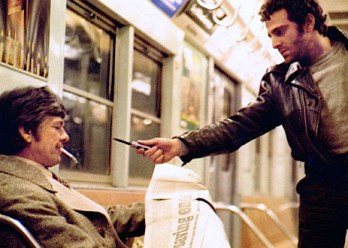
The strongest element is probably Wendell Mayes’ script, because it constructs all this. Weakest is Michael Winner’s direction — some of it’s fine, the occasional shot even good, but largely it’s pedestrian and sometimes mediocre. That said, Winner has become such an unlikeable public figure that it’s somewhat difficult to gauge how much of this is bad direction and how much bias. Still, it’s not the kind of work to make one think, “he’s an idiot, but he knows how to do his job”.

As noted, I hear the sequels get increasingly ridiculous, which I can well believe: as a standalone film, Death Wish has strength in a certain degree of realism; imagining a franchise spun off from it, however, it’s easy to see how it would quickly become diluted and lose the power such veracity gives. One wonders, though, if a well-chosen director might produce an even better remake…

3 out of 5

Saturday Night Fever (1977)

2010 #17
John Badham | 114 mins* | TV | 18 / R

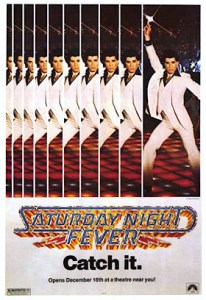
Saturday Night Fever couldn’t be more ’70s if it were made today as a period piece (if you can see how that isn’t a contradiction). From the posters on Tony’s walls, to the fashions, to how it’s shot, it seems to have been designed specifically to exude seventies-ness in a way few other things seem to. It feels natural, then, that some of its original elements have become shorthand definitions for the era: the Bee Gees music, the dancing, and in particular that pose.
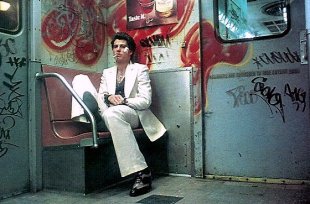
The side effect of these, I think, is that some still think it must be a Grease-a-like jolly musical love letter to the past. Maybe that’s what it somehow became in the kid-friendly PG-rated post-Grease re-edit (I wouldn’t know), but in its original form it’s certainly nothing of the sort. It’s a whole lot seedier, in fact, with dead-end jobs, late-night fights, turn-taking back-of-the-car sex, and other unsavoury pursuits. It’s no wonder Tony wants to escape.

The film it most reminded me of (for some reason) was Mean Streets. I’m not sure that’s anything like an accurate comparison, but it popped into my head more than once.

4 out of 5

Saturday Night Fever is on Film4 tonight at 12:55am.

* There are multiple versions of the film. This is the uncut one in PAL. ^

Murder on the Orient Express (1974)

2009 #94
Sidney Lumet | 122 mins | TV | PG / PG

Murder on the Orient ExpressMurder on the Orient Express is arguably Agatha Christie’s most famous novel, perhaps because of its widely-known twist ending, or perhaps because it’s inspired in part by a high-profile true story, or perhaps because of this multi-Oscar-nominated all-star adaptation.
The plot is the stereotypical Christie set up: a group of fairly well-off people find themselves in a confined setting, one is killed, a sleuth works out who. This time it’s a train rather than a luxurious mansion, but the basics are there. This isn’t a criticism — I enjoy a good Christie adaptation as much as everyone else who’s kept the current TV incarnation on air for 21 years (and counting) — and here at least Christie has a number of twists to her usual style. As mentioned its launching point is a true story, the Armstrong kidnapping and murder being based on the Lindbergh kidnap of 1932 (just a couple of years before the book was written); the snow-bound train’s location (very apt after our recent weather) is certainly different to a stereotypical country estate setting; and then there’s the infamous ending.

I won’t spoil it here, just in case anyone doesn’t know it. Some are very critical of this particular denouement, labeling it an unsatisfactory cop-out that doesn’t make sense. Neither of these things are true. It is not reliant on an extraordinary coincidence — it might look that way at first, but the full explanation reveals it to be anything but — and there are numerous clues along the way as to what it might be, even if some are more thematic than the actual red herrings that almost lead Poirot astray. It’s a shame that knowledge of the ending is quite widespread these days, though that’s perhaps inevitable for a 76-year-old story. Still, I’ve done my bit.

In the lead role, Albert Finney’s Poirot may have received an Oscar nomination and, more importantly, been approved by Christie herself (according to some; according to others, she wasn’t impressed), but he now pales in the inevitable comparison with David Suchet’s definitive portrayal of the Belgian detective. Suchet has defined Poirot in a way few other major franchisable characters have been (Connery may be widely accepted as the best Bond, but there are plenty who’d choose Moore, Craig, Dalton and Brosnan, and you may even find someone who likes Lazenby; equally, Sherlockians may divide themselves between Rathbone and Brett, not to mention Cushing and hundreds of others). He has the advantage of being able to perfect the role across hundreds of hours of television, but nonetheless stands proud as the high-watermark that others can only try to reach (even those who played the role 15 years earlier).

Finney’s version is more obviously comical than Suchet’s. Where humour in the latter is derived from his serious fastidiousness, Finney plays it more for laughs; where Suchet seems almost solemn in his investigations Finney frequently bursts into laughter. It’s a broader interpretation of the character, one that ultimately lacks subtlety. At least Finney is thoroughly subsumed in the role, which means that after a while one does become accustomed to it.

The rest of the cast are well suited to their roles. Ingrid Bergman won the Best Supporting Actress Oscar for her role, though one wonders if it was a weak year for the category as her part is miniscule and not particularly memorable. Elsewhere, famous names such as Lauren Bacall, Sean Connery, John Gielgud, Michael York, and many more, round out a truly star-studded ensemble where each has but a small part to play. It must be relatively easy to attract big names to Christie adaptations — as the TV series still do — when the author is so beloved and the amount of time required to shoot is (for a guest star) so small. Best here, perhaps, is Martin Balsam as Poirot’s friend Bianchi, who’s treated to several good scenes, not least the series of interviews where after each he confidently declares “it was them!”

As a standalone film, Murder on the Orient Express is a skilled effort (I can’t comment on its quality as an adaptation because I’ve never read the book). For a viewer so familiar with Suchet’s interpretation of the character, however, even an all-star cast can’t quite remove the feeling that it’s not quite right. The Suchet-starring adaptation of this particular case has been filming recently, hopefully for broadcast later in 2010 (though knowing ITV we could have to wait as long as 2012), but even though it’ll have the definitive Poirot leading its cast, this film leaves a lot to live up to.

4 out of 5

(Originally posted on 15th January 2010.)

The Taking of Pelham One Two Three (1974)

2009 #43
Joseph Sargent | 104 mins | download | 15 / R

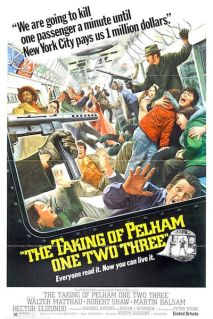
The Taking of Pelham One Two ThreeMovies have taught us many things, and here’s another: don’t take the train from Pelham Bay Park at 1:23. In the past thirty-five years said train has been taken hostage three times, and while once every 11⅔ years may not sound a particularly high average, I’d wager it’s higher than for most trains.
The most recent was this summer, in a Tony Scott-directed remake which unfortunately replaced the titular numbers with, well, numbers in a re-titling move just waiting for reviewers to accuse it of illiteracy. It was criticised for more than just that of course, but one positive is that the original ’70s film cropped up in plenty of places at the time. By which I mean it was on TV once and offered as iTunes’ 99p Film of the Week. But don’t knock shameless tying-in — it means I’ve seen it.

Having not seen either remake (the second was a 1998 TV movie) I can’t compare, but the original is a taught, well-paced thriller. It takes place in something startling close to real-time — a pacing trick I always find pleasing for no explicable reason — but still doesn’t rush things, without ever being slow. Much like the criminals at its heart, then.

Their leader is Robert Shaw, who makes a terrific villain: calm, uncompromising, and British, the primary prerequisite of a perfect Hollywood bad guy. As the unlikely hero, Garber, Walter Matthau is a terrific foil at the other end of the phone, dryly sardonic as he attempts to effectually organise a dozen services. There are also the occasional injections of humour; never inappropriate, instead making the situation feel all the more real.

Unfortunately, for almost every great element there’s a flawed one. The ending is a bit dubious, with the much-hyped escape plan nothing exciting — they simply override the one plot device that stands between them and the most obvious plan. Equally, Shaw’s death, while quite a neat ending for a villain, doesn’t seem to make a whole lot of sense for his character. Mr Green’s sneezing is a handy device, though for my money its ultimate use became obvious the moment Garber first heard it.

And though the credits snappily define all 18 of the hostages (The Homosexual, The Pimp, etc), for the most part it doesn’t really matter — most of them never even speak; at best, only one or two are really characterised. It’s a shame, because having such clear types could be put to good use in all sorts of ways, be it just for laughs, subverting stereotypes, or something as deep as social commentary.

The original Taking of Pelham One Two Three is still an excellent film, but these little niggles take the edge off its quality.

4 out of 5

Flesh for Frankenstein [3D] (1973)

aka Andy Warhol’s Frankenstein

2009 #75
Paul Morrissey | 95 mins | TV | 18 / R

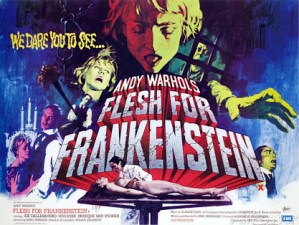
Flesh for FrankensteinFlesh for Frankenstein is thoroughly daft. But it’s also in 3D, so let’s start there.
The best thing about the extra dimension is that it provides some genuinely impressive visuals throughout, and not in the gimmicky, thrust-stuff-into-the-audience way — naturally there are some of those shots, but they seem to work quite poorly here. That could be the fault of Channel 4’s chosen 3D system, or perhaps of watching on a TV rather than a huge screen. Either way, there are also shots that demonstrate why 3D could be genuinely valuable, to visuals if not necessarily to storytelling. For example, early on the wife/sister (a discussion for another time) and her kids go for a picnic. It’s shot from a distance through branches in the foreground, which highlights that there’s a realistic sense of depth to every element of the frame that just isn’t present if you see the same shot in 2D — I know, I checked. For perhaps the first time, I got a sense of why some people harp on about 2D flattening composition.

Unfortunately, while the 3D system used is sometimes flawlessly brilliant, at others it seems to have gone wrong. There’s an odd green ringing in some shots, while at others it appears they’ve used the wrong shade of blue for monochrome-depth because it shows up (in scenes that work, the blue is clearly visible if you take the glasses off, but invisible with them on). Such problems are intermittent in the stuff shown during 3D Week, leading one to suspect it’s as much a fault of the age of the film elements.

I can also now see why people have been complaining so much about 3D — it feels like a constant struggle and strain to watch, like you’re always having to make it work. Perhaps that’s partly down to the technical flaws described above though, because I didn’t suffer as much during an hour of Derren Brown’s Magic Spectacular, whereas here I could feel the strain after just 15 minutes.

As for the film itself… The plot doesn’t make any sense for about 20 minutes, then Udo Kier’s Frankenstein (I presume he’s Frankenstein, I don’t think he’s ever addressed as more than Baron) has a bit of a monologue to explain his Hitler-ish Cunning Plan — to someone who already knows it, naturally — and suddenly most of what’ll happen for the rest of the film is abundantly clear.

The acting is uniformly atrocious. Despite that, it also provides the film’s best moments: the European cast are unable to pronounce “laboratory” — every time it’s uttered it comes out as “lavatory”. Childish I know, but it’s one of the film’s few enjoyable moments. “I had to work for two years before I could even stick my nose in the lavatory” is an instantly classic line. (As is “To know death, you have to fuck life in the gall bladder” — literally, apparently.) Continuing the accented madness, the good-guy serf sounds to be from Brooklyn. At least he can say “laboratory”.

Gratuitous nudity and gore belie some critics’ apparent view that it’s only with the emergence of torture porn that operation-level gore has become a selling point of horror movies — it’s only become more realistic. Just as the gore’s silly, so the sex seems misguided — whoever cast the whores seems to have found believable rather than attractive ones. Oops. That said, whoever in the sound department thought the most realistic sound effects for various sex acts could be found by having someone suck on a balloon, loudly, was even more misguided.

Apparently it’s all meant to be satirical or Pythonesquely humourous. Well, maybe, but it sails too close to the winds of genuine crapness to let such a defence fly — though, as noted, that certainly makes it laughable. Weak in just about every way imaginable, if you’re after a horror, gore, porn or 3D fix, look elsewhere. For “so bad it’s good” value, however, I’ve kindly given it an extra star.

2 out of 5

High Anxiety (1977)

2009 #65
Mel Brooks | 94 mins | TV | 15 / PG

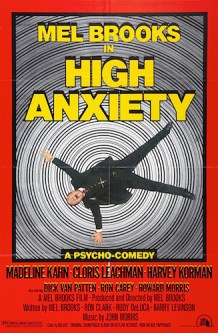
High AnxietyMel Brooks pays comedic tribute to Alfred Hitchcock — in case you can’t tell, the second credit is a prominent dedication — but those unfamiliar with the Master of Suspense’s output need not apply.

Brooks presents a largely Hitchcockian plot, though the clearest references come in a couple of sketches and one-liners. To be fair, there are several significant Hitchcock films I’ve still not seen, leaving the nagging sensation that some allusions and gags simply passed me by. On the other hand, maybe they just weren’t funny — I can’t remember many laughs that didn’t spring from a Hitchcock reference of some kind.

Indeed, whole chunks pass by without a laugh. At other times, bits that are clearly meant to be funny just don’t hit home (though I’m aware that, inevitably, they will for some people), while some gags are almost reassuringly familiar: a dramatic piece of music kicks in, causing characters to look around until they see a band in full swing has appeared nearby, for just one example.

Things pick up considerably in the second half, which is also more obviously Hitchcockian to my mind. Some scenes offer very good, though specific, riffs on famous Hitchcock moments — a version of Psycho’s shower scene is particularly memorable, though a scatological take on The Birds will please some — but these are almost exclusively asides to the story, little sketches inserted wherever Brooks can find space to squeeze them in. They provide welcome amusement, but are far from integrated into the plot.

At this point I’m beginning to suspect Brooks’ humour just doesn’t gel with me. I enjoyed Spaceballs when I was younger, but watching it a couple of years ago I found it more embarrassing than entertaining. Even the widely praised Blazing Saddles raised little more than the occasional smile. High Anxiety, unfortunately, now joins this line-up.

2 out of 5

Alien: The Director’s Cut (1979/2003)

2009 #13a
Ridley Scott | 111 mins | DVD | 15 / R

Famously, Ridley Scott’s 2003 Director’s Cut re-release of Alien came in slightly shorter than the original version, an unusual state of affairs. This disparity isn’t just because Scott lopped a bit out (though, he did) — he also removed scenes and put others back, in the process creating a cut of the film as edited by an older version of the same filmmaker. Or, alternatively, creating a different version to help shift some extra tickets — it depends which quotes you want to believe.

Having only seen the original version once, and several years ago, I can’t offer any meaningful analysis of how Scott’s myriad nips and tucks impact on pace. It certainly doesn’t feel faster on the whole, still exhibiting the same slow-build tension that’s as reminiscent of 2001 as any other horror films. Coupling this with a very realist style of dialogue and action — minimal, overlapping, mundane, light on exposition — makes the film feel positively indie-like today. There’s no way a major effects-filled blockbuster would progress so slowly now, though recently Sunshine came close. In these respects, Alien: The Director’s Cut isn’t all that different from the Alien so many know and love — no surprises there — and all but the most die hard of die hard fans are unlikely to notice such minor changes.

However, Scott also reinserted four deleted scenes, which even I managed to spot. Only one makes a notable difference: during the climax, Ripley discovers Dallas and Brett in alien cocoons and burns them. The Aliens’ cocooning is intrinsic to the plot of later films in the franchise, in which respect it works well to see it first crop up here; taking the film on its own merits though, such an addition in the middle of the climax serves to slow it down and feel like an unnecessary aside, tidying up a loose end that most audience members wouldn’t even think was a loose end (I know I didn’t). Of course, this just goes to show that it was a sensible cut to make back in ’79.

These small moments aside, Alien feels unchanged. It’s been said many times before but, first and foremost, it’s a horror movie — it just happens to be one set in space with plenty of sci-fi trappings. Move it to an oil tanker in the middle of the ocean and a great deal of it would function just as well. Whatever effect Scott’s trims may have had, they haven’t made it any less effective in this regard, though second time round all the jump-scares failed on me, but that’s the nature of such a shock rather than a flaw of Alien in particular. Trying to look at it objectively, we all know that Ripley’s the only survivor and the franchise heroine now, but the film gives you no/few reason/s to presume she’s any more significant than any other character: she’s third in command, Weaver’s only second in the credits, and she doesn’t even go out on the initial mission. It’s an effective step in keeping the audience guessing who might survive.

Some of the effects look rather dated now, especially the ship’s computers, but that’s not really problematic. The design work on the ship is still exemplary, and of course often copied. It’s so grimy, industrial and (for want of a better word) ‘real’ that one wouldn’t even need to reshoot much to claim it was set on that oil tanker. The Alien is still the main consideration in design and effects terms, and it’s still barely seen. This was always a very sensible move, hiding any shortcomings in the design (most of the time at least) and also helping create menace — because it’s never seen in full, and only brief glimpses are snatched in the shadows, we always believe it could be anywhere. This all builds to the great escape pod ending, which cleverly uses a calm-after-the-storm feeling and the distraction of Ripley’s semi-strip to lull the viewer into a state of total unawareness. Even on re-watching when you know it’s coming, this sequence contains arguably the film’s most effective jump.

Alien is 30 this year and the Director’s Cut is now six years old, meaning most seriously interested viewers will have seen it by now. How different this version is from the original cut should be indicated by the fact I didn’t feel justified in giving this a new number, even with my poor memory. I can only imagine that to fans intimately familiar with the film the number of trims (there are rather a lot apparently) and new scenes (just four) make a huge difference, but for a more casual viewer they don’t significantly change how it feels as a whole. That said, even with my vague memory, I’d call the original as the superior cut.

5 out of 5

Alien vs Predator – Part 1

If you happen to keep an eye on my coming soon page or have been following me on Twitter, you may’ve noticed that I recently watched all eight films in the Alien, Predator and Alien vs Predator franchises, the majority of them for the first time.

As I’m sure you know, I normally only review films I’ve not seen before. In the interests of being thorough, however (and following in the footsteps of Casino Royale, Cube, and the first three… well, really, all the Star Wars films), I’ve also reviewed the only two I’d seen before — perhaps unsurprisingly, Alien and Predator themselves.

2009 #13a
Alien: The Director’s Cut

Alien feels unchanged. It’s been said many times before but, first and foremost, it’s a horror movie — it just happens to be one set in space with plenty of sci-fi trappings… Whatever effect Scott’s trims may have had, they haven’t made it any less effective in this regard” Read more…

2009 #16a
Predator

“it’s an entertaining war flick that turns into a sci-fi/action/horror skirmish thingy — but it doesn’t have the same finesse that imbues Alien and its sequel.” Read more…


Reviews for the remaining six films won’t be too far behind.

The Many Adventures of Winnie the Pooh (1977)

2008 #92
John Lounsbery & Wolfgang Reitherman | 71 mins | DVD | U / G

The Many Adventures of Winnie the PoohHaving finished 2007 with Piglet’s Big Movie, it feels somewhat appropriate to round off 2008 (almost) with Disney’s first Winnie-the-Pooh feature.

The Many Adventures… is actually compiled from three shorts made in 1966, 1968 and 1974, with some new linking material. I don’t know if these shorts were produced with any great expense, but there’s occasional evidence of what looks like cheap animation. It’s not that it’s not smooth or fluid, but rather the attentive viewer will often spot sketch marks around some lines, or flashes of other bits not properly erased. Perhaps it was deliberate, considering the sketchy style of the backgrounds, designed to evoke the original illustrations, but I sometimes found it distracting.

This is one relatively minor flaw in an otherwise brilliant adaptation, however. The film faithfully adapts several of the original stories, acknowledging its sources by frequently showing the action as illustrations within a copy of the book. This fourth-wall-breaking move may irritate some, but personally I loved seeing Pooh and co have to leap from page to page, or tipping the book sideways to free Tigger from a tree. Such moves seem tonally in keeping with A.A. Milne’s original stories and, even though some tales are abridged and some good ones left out, that spirit is always retained.

The characterisation is also spot on, producing an array of cute and loveable creations, none more so than Pooh himself. The gopher is an unnecessary addition, though the running joke about him not being in the book is very nicely done. And one can’t fail to mention the excellent songs, now as linked to the world of Pooh as anything from the original books — especially Tigger’s little tune, surely familiar to anyone who was a child in the last 30 years.

If some later Disney ventures have lost sight of the correct spirit for Pooh’s adventures, at least this original is a great adaptation. Bouncy, trouncy, flouncy, and, above all, fun fun fun fun fun.

5 out of 5

Agatha (1979)

2008 #62
Michael Apted | 100 mins | TV | PG / PG

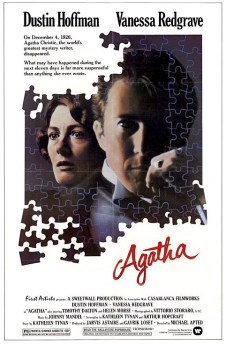
AgathaThere are no giant wasps in sight as Vanessa Redgrave’s Agatha Christie goes missing for eleven days in December 1926, and Dustin Hoffman’s journalist tries to track her down. While the frame of the story is true, the reasons behind Christie’s disappearance, and what occurred during it, aren’t known — which makes it fertile ground for speculation. Sadly, a fantastical plot about jewel thieves and shapeshifting aliens is much more exciting than the down-to-earth mystery we’re offered here.

It’s easy to see the attraction of Christie’s disappearance: it’s a real-life mystery about arguably the greatest mystery author ever, with enough unusual events surrounding it to make it extra suspicious and a long enough gap for something significant to have happened. But while the idea is initially exciting, when it comes to retelling it there isn’t a great deal there — the facts of her disappearance are just the ‘before & after’, amounting to little more than an abandoned car, an assumed name and some amnesia. Unless one invents something to fill those missing days, there’s little to tell (she went to a hotel and forgot what happened, essentially) — so, of course, this film fills in the gap. With a murder mystery, naturally. Sort of, anyway.

To be honest, I found it a tad confusing for the most part. While the initial setup is well handled, showing what drives Christie to run away (consciously or not) and the beginning of the police search, it begins to flounder once the plot slides into its fully fictional phase. Hoffman’s journalist, who had been hoping to interview Christie, manages to stumble across her at the hotel, where he pretends not to know who she is, while she… has health treatments… It’s only at the conclusion, when Christie’s plan begins to come together, that one realises there was a plan at all. It’s a shame the revelation comes so late because it’s actually not that bad a plot, and makes for quite a neat and almost plausible (providing you can accept Christie as a potential murderess (sort of)) explanation for everything.

The performances do nothing to raise the film. Redgrave is lumbered with little to do, mostly wandering around looking dazed. Her performance is decent but the material she has is lacking. Hoffman, on the other hand, is just flat, while Timothy Dalton’s sneering Colonel Christie sadly barely features. On a more technical level, the police investigation subplot is disappointingly forgotten halfway through, and everything is shot with too little light. Sometimes the latter is effective, such as during a train journey where occasional flashes of light illuminate Christie’s uncomfortably blank face, but at other times it merely obscures events. (It’s possible this is just the print, of course.)

Christie’s disappearance remains a fascinating mystery, though in all likelihood the true causes were either very internal or mental health related — not the easiest thing to depict in a movie, especially when your audience is likely expecting a thriller. Agatha has a game stab at weaving an interesting tale into the gaps in the facts, but by the end I was wondering if a straightforward biopic mightn’t have been a better idea.

3 out of 5