Doctor Who:
The Dalek Invasion of Earth
and
Daleks’ Invasion Earth 2150 A.D.
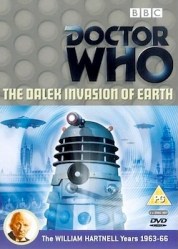
Doctor Who: The Dalek Invasion of Earth
1964 | Richard Martin | 149 mins | DVD | 4:3 | UK / English | PG
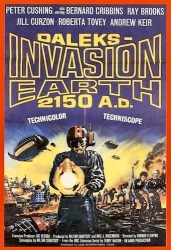
Daleks’ Invasion Earth 2150 A.D.
1966 | Gordon Flemyng | 84 mins | Blu-ray | 2.35:1 | UK / English | U
 In a week’s time, on the 23rd of November 2013, Doctor Who will celebrate its golden anniversary — 50 years to the day since the premiere broadcast of its first episode, An Unearthly Child. (As part of the celebrations, BBC Four are showing that initial four-parter at 10:30pm on Thursday 21st. I heartily recommend it.) The programme’s success was cemented several weeks later, however, with the appearance of the Daleks — a race of xenophobic mutants hidden in metal machines from the planet Skaro. A wave of Dalekmania followed, leading to a boom in merchandising and, naturally, a sequel serial for the TV series, one year later.
It also led to a film adaptation, which I discussed last week. When that was a box office success, a sequel was greenlit. As with the first film, rather than construct an original tale starring the Daleks, the filmmakers turned to the TV series and adapted the aforementioned TV sequel. The story is set hundreds of years in the future (perhaps 10 years after 2164 in the TV series; 2150 in the film), when the Daleks have somehow left their homeworld and their city (which previously they’d needed to survive) and found their way to Earth. But this isn’t a Hollywood-style alien invasion battle: the Daleks have already occupied the planet, and Britain in particular (of course). The Doctor and his friends stumble into this situation and resolve to stop the evil invaders.
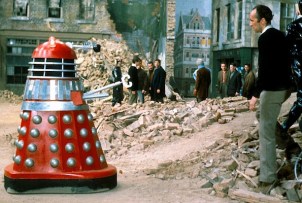
There’s little doubting that The Dalek Invasion of Earth is a minor epic. Where The Daleks struggled a bit to fill its seven-episode order, in six instalments writer Terry Nation takes us from an occupied, bomb-blasted London, to an attack on the Dalek spaceship, to a mine in Bedfordshire that’s digging to the centre of the Earth. Although made on Doctor Who’s typically tiny budget, the TV serial shines. 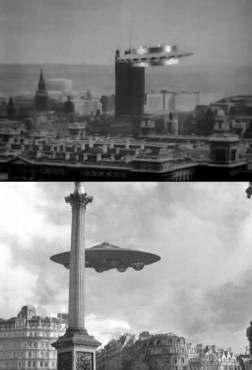 There are some fantastic sets, bolstered by peerless location filming of a deserted London (simply achieved by shooting very early in the morning), and the usual array of quality performances from the series’ regulars and guest cast. It’s only let down by the special effects. The Daleks are as great as ever, and a weird monster that turns up for a few minutes is passable (if you’re being kind), but shots of the Dalek saucer flying over London look like a pair of foil pie cases on some string in front of a photo. Even by the standards of the era it’s bad. The DVD release includes the option to watch the story with new (in 2003) CG effects in place of these sequences, and for once I’d actually recommend that.
The story once again trades on the Daleks’ clear Nazi undertones. Here they’ve occupied a bomb-blasted country where a small band of rebel fighters hold out against them, attempting small-scale attacks while trying to work out a bigger plan. It can only be deliberate that these parts — hidden workshops, missions in enemy uniform, even the fighter’s casual clothes — all trade on familiar imagery from World War 2 resistance movies. Here, at least, collaborators are men rendered brain-dead by Dalek machinery, controlled via radio waves directly into their heads, rather than those who have chosen to betray their people.
That said, this is not a cheery view of the world. We can see that right from the opening shot: a derelict stretch of urban river bank, overgrown and decrepit, and the caption “World’s End”. 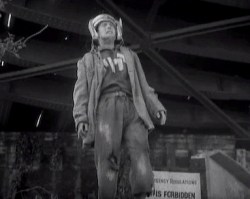 A man stumbles towards the steps, he screams in agony, battling with the strange machinery on his head. And then he hurls himself into the river, where he floats face down — dead. Beginning a kids’ programme with suicide? You wouldn’t do that today! We later learn that he’s a Roboman, controlled by the Daleks, essentially dead already… but it’s a bit late by then. Later, we meet unscrupulous country folk: a black marketeer who won’t give over food to the enslaved mine workers without payment, and won’t escort Ian out of the camp without payment either; and two women, employed by the Daleks to mend the workers’ clothes, who betray Barbara to get more food. There are heroes here, certainly — men and women who fight the Daleks, and some who give their lives for the cause — but not everyone’s doing the honourable thing.
The film is a bit less bleak in its outlook for humanity. The black marketeer remains, more treacherous than ever: he actively betrays the Doctor to the Daleks, though is killed for his troubles; the two women are there, too; but there’s no suicidal Roboman, and indeed the climax suggests the Robomen are able to return to being human just by taking their helmets off. 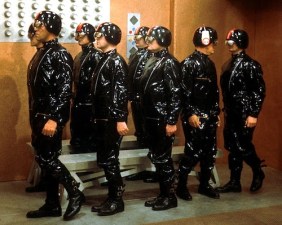 So that’s nice for them. There’s also some significant additions of humour, like when Tom is pretending to be a Roboman to stow away on the Dalek saucer and ends up in a mime act as he attempts to mimic a group of the real thing while they have lunch. Bless Bernard Cribbins. There aren’t too many of these almost-farcical bits, but the few there are lighten the general tone.
Overall, however, Daleks’ Invasion Earth 2150 A.D. (aka Daleks – Invasion Earth: 2150 A.D., and many other such punctuation-based variations, thanks to inconsistent spelling on posters and trailers) is, much like the the previous film, a strikingly faithful adaptation… at first. The running time is again a clue: while the TV serial takes two-and-a-half hours on its story (albeit with some subtractions for six sets of titles and five recaps), the movie rattles through it in 84 minutes. That’s with a new bookend sequence designed to establish the new character of PC Tom Campbell (Bernard Cribbins), leaving the film 75 minutes in which to condense Nation’s epic. Nonetheless, it’s scene-for-scene faithful, just picking the pace up with key actions and lines of dialogue rather than the comparatively-luxurious speed of the original.
As it goes on, though, things begin to diverge quite rapidly. Significant characters have been cut for time, while legacy changes from the first film also alter the plot — 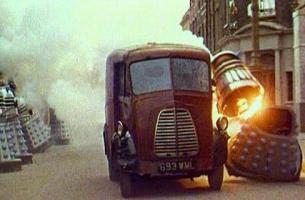 no burgeoning romance for Susan, here a small girl rather than TV’s young woman. Both stories split our leads into three groups following the assault on the Dalek saucer, but while the film retains the outline of these subplots, it rearranges which characters take which route. It’s a slightly bizarre turn of events, to be honest, and doesn’t always pay off: whereas the TV series manages to plausibly pace the various characters’ journeys from London to Bedfordshire, in the film the Doctor and his chum walk there in the same time it takes the Dalek saucer to fly it. Either that saucer’s underpowered or they’re impressive hikers.
Even with all these changes, the general shape of the story remains the same; yet the film feels less epic than the TV serial. It’s not just the length, but the sense of time passing: on TV the Doctor and co seem to be stuck on Earth for several days, while in the film it’s practically an afternoon’s work. And though the movie’s special effects are better (immeasurably so, in fact, because the model work in the film is fantastic), and there’s some great stunts too, the bigger-budget big-screen outing lacks the TV version’s London location filming. This makes a startling difference to the relative effectiveness of the story. On TV, you really feel like the Daleks have conquered Earth; in the film, it feels a little like they’ve conquered some expansive studio sets and impressive matte paintings. 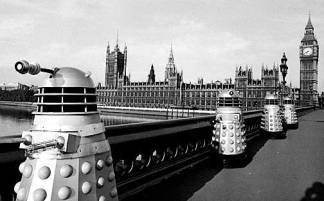 (Incidentally, perhaps the most striking thing about the serial’s location sequences are that they don’t include the iconic shot of the Daleks rolling across Westminster Bridge. That bit is in there, but it was filmed from an entirely different angle; I guess the famous image was just a unit photograph.)
There are other bits that work less well on film. Dortmun’s sacrifice on TV makes sense, a bold character moment; in the film, he seems to do it for the hell of it. On TV, the Doctor commits himself to stopping the Daleks (in one of the series’ clunkiest bits of dialogue, to be honest), whereas in the film he just stumbles into things — which, funnily, is more like the Doctor of the time. Ian and Barbara have been replaced by the aforementioned PC Tom and the Doctor’s niece, Louise, because Dr. Who and the Daleks actors Roy Castle and Jennie Linden were unavailable. Not that it matters much — Bernard Cribbins is just as adept in the comedy role, and Jill Curzon’s Louise is just Barbara by any other name. Then there’s the music, which is often jauntily comedic rather than action-packed; and the ever-so-’60s main theme, as with the first film replacing the TV series’ iconic, groundbreaking, electronic howl with something altogether more forgettable. What the film most benefits from losing, however, is a couple of hilariously of-the-time lines from the Doctor — particularly one when he tells Susan she needs “a jolly good smacked bottom”!
That aside, perhaps the film’s biggest loss is in the age of Susan. Nothing against Roberta “One-Take” Tovey, who is fortunately much less irritating than your average child actor, 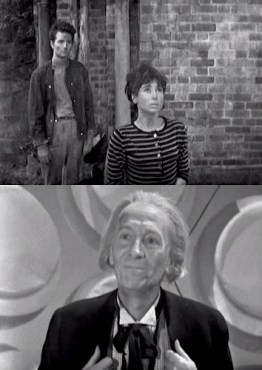 but the TV serial has a real advantage in this department. The original companion, this was Susan’s final story — the first companion departure in the series’ history. It handles it marvellously: rather than the final-minutes cut-and-run so many companions suffer, Susan’s growing sense of departure is built throughout the story… and then it’s the Doctor who realises it’s time for her to go, not her, and he leaves her behind. The speech he gives is one of the finest in the series’ history, beautifully and poignantly delivered by William Hartnell, and with a nicely under-played reaction from Carole Ann Ford. Doctor Who has had countless companion exits now, but this one still takes some beating.
Each version of The Dalek Invasion of Earth does something better than the other, but on balance the TV series is the clear victor. That said, the film is probably more entertaining than its big-screen predecessor; but that’s just the story itself, I guess, which I think is a more effective use of the villains. You could argue it ties into the fairly-modern idea of the first encounter being an establisher and the sequel a bigger, bolder, deeper, more exciting, experience. Both versions are certainly that.
Despite the enduring popularity of the titular villains, Daleks’ Invasion Earth 2150 A.D. wasn’t as much of a box office success as its predecessor. Combined with an overrunning schedule that led to a higher budget, its profitability was clearly lower. Production company AARU had the option to make a third film (presumably to be based on the third Dalek story, 1965’s The Chase), but the money-men passed. 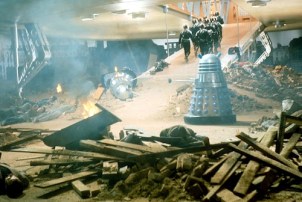 Most Doctor Who fans won’t lament that (especially as The Chase isn’t the most well-loved of Dalek adventures either), but, even though the TV series remains the superior product, I think the Dalek movies have their own merits and charm. I’m not suggesting we should be finding a way to write them into Doctor Who canon, but as an alternative to the norm, they’re a good bit of fun.
Tied in with Doctor Who’s 50th anniversary celebrations, Channel 5 are screening the Dalek movies next weekend. Dr. Who and the Daleks can be seen on the anniversary itself, Saturday 23rd November, at 10:05am. Daleks’ Invasion Earth 2150 A.D. is on Sunday 24th at 10am.

 Magnificently strange film about a man (Burt Lancaster) who decides to ‘swim’ home through his friends’ pools. It becomes clear they know something he’s forgotten…
 That quote comes from Thomas Elsaesser in the introduction to his Criterion essay “
 The plot, such as it is, concerns an actress (Liv Ullmann) who has decided to become mute and her nurse (Bibi Andersson), who travel to a seaside summerhouse to attempt recuperation. After we’re told how they grew closer, events concern the breakdown of the relationship between the two women… or is there only one woman? We might end up inside one of their heads… but whose? Or is it both of their heads? Or…
 The film’s other most famous bit is a monologue Andersson delivers one night about a foursome she found herself in. As with most of the film its exact meaning is debatable, but it’s another unusual behind-the-scenes story: it was nearly cut, apparently, even though it’s in many respects the pivotal scene. It’s where the nurse opens up the most, leading to the actress’ ‘betrayal’ by repeating the story in a letter, which is what leads to the disintegration of their relationship and all the confusion/weirdness/’deep psychological filmmaking’ that follows. Later, Bergman lets a monologue (yes, another one) play in full twice. The meaning? He had intended to cut back and forth between the two actresses, but couldn’t decide which shots to discard, so just let it all run twice. At least that’s some confusion cleared up, then.
 Adapted from one of Agatha Christie’s best-regarded novels (now commonly known by its US title, And Then There Were None), Ten Little Indians sees a group of ten people invited to a remote location (in the book, an island; here, an alpine hotel) by a mysterious host, who doesn’t appear but does accuse them all of murder via a recorded message. Then, stranded, they begin to die one by one.
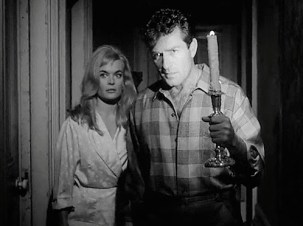 voiceover informs us this is our chance to have a guess. Ah, the ’60s.
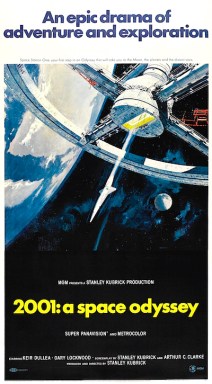 As
As 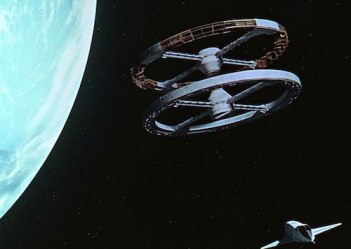 with this kind of pace and uncertainty would be unthinkable, but I guess audiences were a little more mature in the Good Old Days. Even then, Kubrick cut 19 minutes after the film’s premiere in order to “speed up the pacing”. Maybe he succeeded, but no one’s going to be calling this a fast-paced thrillride any time soon.
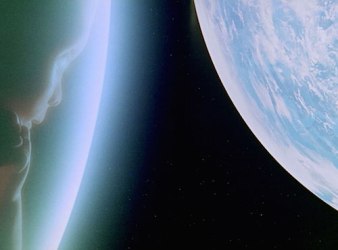 Technically, then, 2001 is undeniably stunning. Thematically, though… what’s it all about? What does it mean? Author Arthur C. Clarke once said that “if you understand 2001 completely, we failed. We wanted to raise far more questions than we answered.” Some find such goals unsatisfying, especially when it comes to storytelling, but the very spirit of space exploration, of science, is to keep asking questions that don’t necessarily have answers. Of course, the ending is actually very easy to explain: the evil alien monolith kidnaps Dave, ages him to death, then mutates him into a giant Space Foetus, which it sends back to Earth. Why they didn’t make 2002: Invasion of the Giant Space Baby, I don’t know. Who doesn’t want to see that movie?
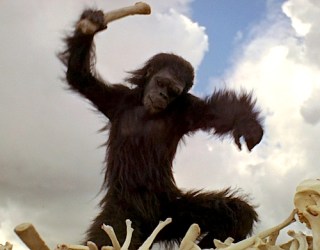 and almost immediately use them to kill, first a beast for food, then another ape for territory. Then, in a literal split second, we jump forward millennia, as that simple tool turns into a nuclear weapon drifting in orbit — the entirety of human technological innovation summed up in a single cut.
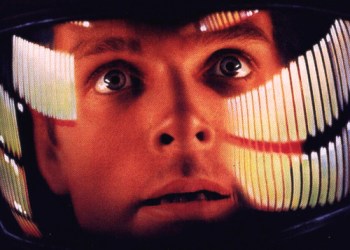 In the end, I think 2001 is a film that’s very easy to admire, for all sorts of reasons, but to enjoy in the traditional sense of “enjoyment”? Surely it’s far too removed, too obtuse, too joyless, for that? Some people will like those qualities, of course, and all power to them. For me, 2001 is a film to be impressed, even awed, by; but not one to love.
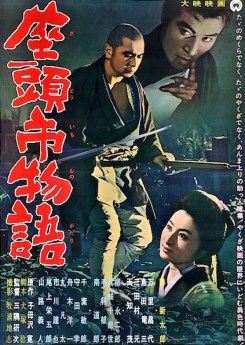 Adapted from a short story by Kan Shimozawa, The Tale of Zatoichi was a low-key release for its studio, Daiei: despite being helmed by “a topflight director”
 But enough hyperbole — what about The Tale itself? The story sees blind masseuse Zatoichi accepting an old invitation to visit an acquaintance, Sukegorô (Eijirô Yanagi). But Sukegorô is a yakuza boss, and he presses Zatoichi to join his side in a brewing war with rival Shigezô (Ryûzô Shimada) — because although he’s blind, the masseuse has legendary sword skills. On Shigezô’s side is a hired samurai, Hirate (Amachi), who Zatoichi encounters by chance. Despite the mutual respect between these two coerced warriors, the eventual gang battle comes down to a duel between them…
 Those prepared for a calmer, more considered film may find much to like, however. Katsu’s understated style holds your attention and makes you want to learn more about the character; not his past, necessarily, but his qualities as a man. The same is true of Amachi, in some ways even more appealing as the doomed ronin. You get a genuine sense that Zatoichi and Hirate would have had a great, long-lasting friendship if they’d met under better circumstances, which makes the manner of their encounter all the more tragic. For all the bluster about a big gang war on the horizon, it’s the relationship between these two men that forms the heart of the film.
 Reportedly this opener is “not the best of [the] series”, but remains “a grand introduction to the character and a touchstone for many of the themes and gags presented in the later films”.
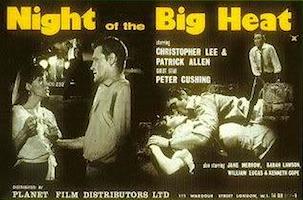 These days largely sold as a horror movie (the old Collector’s Edition DVD is branded as part of a “Masters of Horror” series), probably thanks to its cast (Christopher Lee and Peter Cushing), director (Terence Fisher, of many a Hammer Horror, including five with Cushing and Lee), and rating (an X originally, a 15 now), Night of the Big Heat is not really anything of the sort. Well, maybe a little; but you’re more likely to get scared by a contemporaneous episode of
 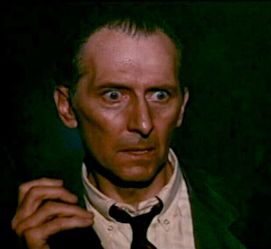 the pair were brought in to redraft because the original screenplay’s dialogue was “unsayable”. Anyone familiar with their ’80s work on Doctor Who, and their associated reputation, will find that highly ironic.) However, when the sci-fi stuff does roll in it’s a bit of a damp squib, leaving the scenes relating to the affair, whether it will be discovered, and what various characters do about their various feelings, as some of the more unique and interesting elements.
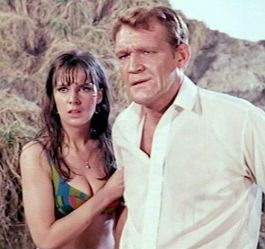 which considering it was shot in February and March is a real achievement. During night shoots the cast had to suck ice to stop their breath being visible, while running around in wet clothing to look like they were drenched in sweat. Poor sods. Said night scenes are a mess of genuine and atmospheric nighttime shooting, alongside the kind of day-for-night filming where everything’s extremely dark except for the sky, and also the kind of day-for-night filming where it’s day and… um… shh!
 If you were looking for the archetype of an epic movie, Lawrence of Arabia would be a strong contender. It has a wide scope in just about every regard, from the desert locations that stretch as far as the eye can see, to the thousands of extras that fill them, to the glorious 70mm camerawork that captures it all, to the sweeping story that also contains a more personal throughline, to the 3½-hour running time.
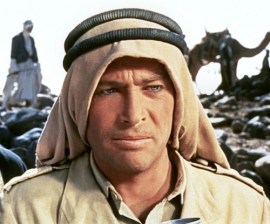 As such, the film hangs on the performance of O’Toole. We’re told Lawrence is an enigmatic figure and his depiction arguably supports that — we never fully get inside his head; we’re always observing him. And yet that’s no bad thing, because even as Lawrence’s confidence waxes and wains, as his allegiances shift and alter, we can feel what he wants to achieve, why he thinks he can. He attempts the impossible and succeeds, which is why he later attempts a bigger impossibility, and must leave the pieces to the more level-headed men, who didn’t have his genius but can therefore play the political game better than he.
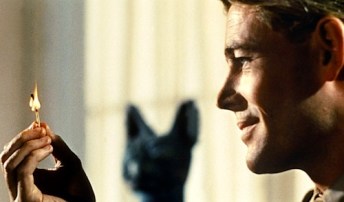 A similar legacy is left by those behind the scenes. Maurice Jarre’s score is the reference point for many a period desert epic — indeed, his music is so synonymous with such settings that it has arguably transcended its source to simply be what music for those locations and times is. It graces a film edited with class by Anne V. Coates, where scenes are allowed to play in luxuriantly long takes at times, while at others smash edits throw us from one location to another. This is undoubtedly supported by F.A. Young’s cinematography, where the wide frame can encompass so much action that there’s no need to cut amongst close-ups; and which can show the world in such majesty that you want it to hold for long, lingering takes. Even viewed on the small screen, the 70mm photography shines, especially on Blu-ray.
 As with any great film, Lawrence of Arabia is at least the sum of its parts. Replace any of the artists I’ve mentioned, or surely many more, and it would not be the film it is. In fact, when working on such a scale, this is more than a film — it’s an experience. And if that sounds pretentious, well, tough. If you haven’t experienced it yet, try not to leave it as long as I did.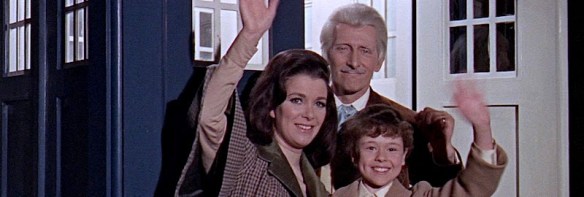

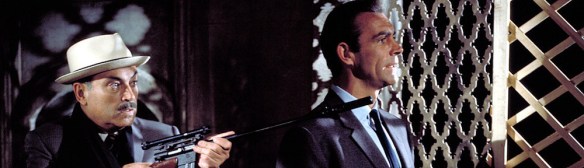
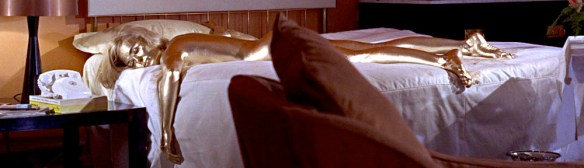

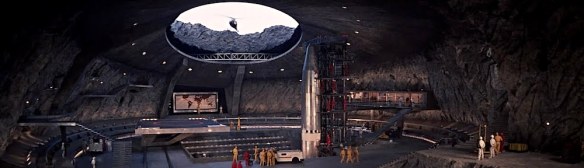
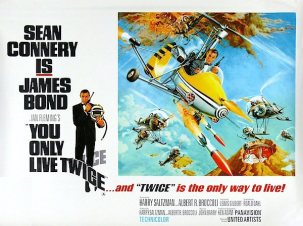 Everyone knows You Only Live Twice; if not from the film itself then from cliché and
 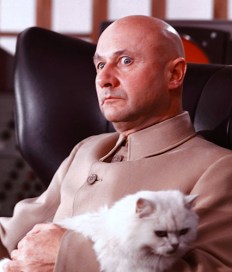 There’s that rooftop chase, where the camera just keeps pulling back and back and back to reveal the action. There’s Charles Gray’s cameo-sized but memorable role as MI6’s man in Japan, or Tetsuro Tamba’s loyal and capable Tiger Tanaka — why didn’t they bring him back? He’s better than any Leiter we’ve yet seen.
 100Films.co.uk