Quentin Tarantino’s Swinging Sixties Movie Marathon Roundup: Spy-Fi

I introduced the concept behind QT’s movie marathon in my previous roundup of films from it, but to quickly recap, these are all movies with a connection to Tarantino’s latest flick, Once Upon a Time in Hollywood.

While many of Tarantino’s selections speak to the setting of OUaTiH (in terms of depicting its time and place on screen, or the social landscape of its era), others have a bearing on it in quite a different way. These are movies his characters might’ve seen, or might’ve appeared in, or (in the case of Sharon Tate) did actually star in. Three of those also fall under the banner of espionage fiction. Two hail from the James Bond-inspired spy-fi craze of the ’60s, while one is a ’50s war movie about a secret mission. (Yeah, that last one is stretching the definition — it’s not really a spy movie at all — but it doesn’t pair up with anything else in Tarantino’s selection, so here it is.)

In today’s roundup:

  • Hammerhead (1968)
  • The Wrecking Crew (1968)
  • Battle of the Coral Sea (1958)


    Hammerhead
    (1968)

    2019 #112
    David Miller | 95 mins | TV | 16:9 | UK / English

    Hammerhead

    The success of the James Bond movies led to a whole raft of imitators throughout the rest of the ’60s, a spy-fi craze that kickstarted other long-running franchises like Mission: Impossible and The Man from U.N.CL.E. Of course, as well as the memorable and enduring successes, there were piles of cheaply-made, entirely-forgettable knockoffs. Hammerhead is one of the latter. Like Bond, it’s based on a series of espionage novels, these ones by James Mayo (pen name of English novelist Stephen Coulter) and starring the character Charles Hood. Coulter had been friends with Ian Fleming, and apparently (according to Quentin Tarantino) his Hood novels were popular with secret agent fans because they were written in a similar style to Fleming. Hood didn’t have the staying power of Bond, though, the series running to just five novels which (as far as I can tell) haven’t been in print for decades. On film, he fared even less well: this is the only Charles Hood movie.

    The film’s biggest problem is its desire to be a Bond movie, but without the money or panache to carry it off. As Hood, Vince Edwards has none of the easy charm of Sean Connery, instead seeming like a stick-in-the-mud who’d rather be anywhere else (preferably back in the ’50s, I suspect). And the film itself so wants to be like Bond that there’s even a pop song named after the titular villain… though rather than playing over the opening credits, it pops up two or three times mid-film, incongruously played diegetically. As a Letterboxd reviewer put it, “apparently in the late ’60s if you were a pornography-obsessed master criminal you could also be the subject of a pop song.”

    Oh yes, that’s right: the villain collects porn. Not just any old rags, though, but Art — paintings and sculptures by renowned masters, that kind of thing, just ones that feature boobies. Something about that does feel ever so ’60s. The film itself is as pervy as its villain’s obsession. Well, okay, maybe not that pervy, but there are certainly gratuitous shots of women in their underwear, etc. Perhaps the most egregious is the closeup of female co-lead Judy Geeson’s bouncing behind as she rides on the back of a motorbike up some steps, complete with boinging sound effect. That’s about as explicit as it gets, though: it may be firmly set in the Swinging Sixties, with up-to-the-minute fashions and scenes set at experimental art happenings, but it’s stuck in the past enough to not feature any actual sex or nudity, just plenty of cleavage, gyrating dance moves, and the odd bit of innuendo (don’t expect any Bond-quality puns, mind — it’s not that clever).

    Trying to swing

    I haven’t mentioned the plot, but it’s a frequently nonsensical bit of nonsense involving a report so top-secret its author has to have a highly public cover story for what he’s supposed to be doing while he actually sneaking off to present to international delegates who’ve arrived in the country unannounced. If anyone ever said what this report was actually about, or why the conference had to be kept a secret (or how something like 23 different countries, and their associated delegates and security staff and so on, all managed to keep it hush-hush), I missed it. The villain wants to intercept the report — not steal it, not stop the conference, just learn what’s in it — which requires an elaborate plan with an impressionist and various decoys. Why not just honeytrap one of those 23 delegated? I guess that’d be too easy. What’s the villain’s motivation for wanting the report? No idea — he’s defined by being a reclusive pornography connoisseur, not by whatever he does to make money to afford his expensive porn habit.

    Well, it’s all part of the film wanting to be like Bond, but not seeming to really understanding what makes the Bond films tick. On the bright side, it doesn’t take itself very seriously, which means it’s kooky fun in places (there’s a nice bit of farce in a hearse, for example). Not without entertainment value, then, but only hardened ’60s spy-fi fans need apply.

    2 out of 5

    The Wrecking Crew
    (1968)

    2019 #115
    Phil Karlson | 101 mins | TV | 16:9 | USA / English | PG / PG
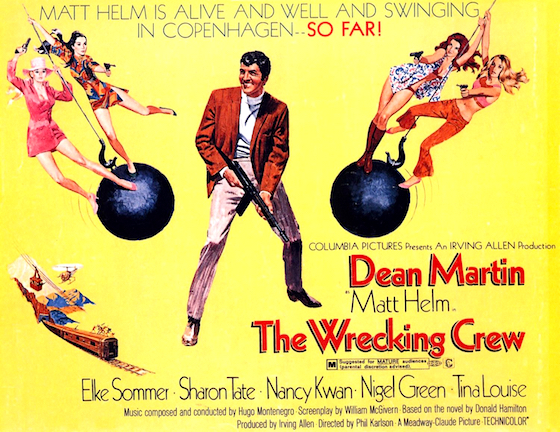
    The Wrecking Crew

    Unlike Hammerhead, I’m not sure anyone should apply to watch The Wrecking Crew, the last in a series of four movies starring the Rat Pack’s Dean Martin as Donald Hamilton’s Matt Helm. The character was a mite more successful than Charles Hood, then, but on screen and in his original literary form: the book series ultimately ran to 27 novels, the last published in 1993, with a 28th written but left unpublished after Hamilton’s death in 2006. The film series would’ve continued too — I guess not for that long, but for at least one more film. Reports vary on why a fifth instalment never happened, but one highly plausible version ties it to the murder of Sharon Tate. Tate co-stars in The Wrecking Crew and is quite the best thing about it. Martin loved working with her, and the plan was for her to return as Helm’s sidekick in the next film. But then what happened happened, and the followup was abandoned. (The alternate version is that poor reviews and poor box office for The Wrecking Crew just led the studio to scrap the series.) There are several tragedies about the murder of Sharon Tate, but I don’t think depriving us of more Matt Helm movies is one of them.

    As for the lead character, Helm is a secret agent cum fashion photographer — and that’s not the only thing here that’ll remind you of Austin Powers. The Bond movies are often cited as the sole inspiration for Powers, but it was really drawn from across the ’60s spy-fi spectrum, and it’s clear Matt Helm was part of the mix. Unfortunately, The Wrecking Crew plays like a low-rent Austin Powers movie with any humour value sucked out. In his discussion around the film, Tarantino recalls seeing it in the cinema on its original release, and how audiences found it hilarious at the time. That wasn’t a quality I observed, personally. It’s clearly all tongue-in-cheek, but it rarely achieves levels of genuine amusement.
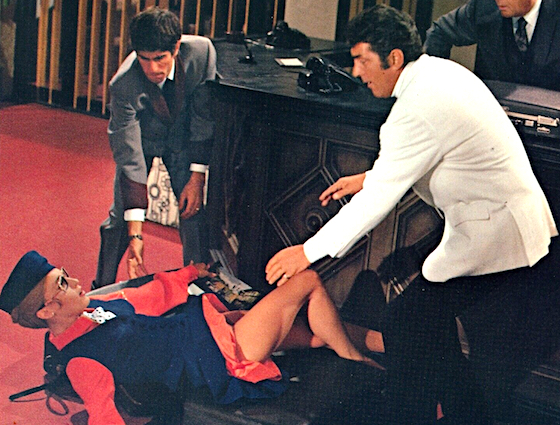
    Enter Sharon Tate

    More tangible is the sensation that the film thinks it’s super cool and hip, but really isn’t. That might just be because of its lead. Dean Martin feels a bit like Roger Moore in his later Bond films: still behaving like he’s a young playboy while looking far too old for it. But even Moore, with his ageless class, felt more ‘with it’ than this. It really shows that the “effortless cool” of Bond does require some effort. The past-its-date feel is underscore (literally) by frequent random snippets of old-fashioned-sounding songs — presumably Dean Martin numbers, placed awkwardly to convey some of the hero’s thoughts (sample lyric: “If your sweetheart puts a pistol in her bed, you’d do better sleeping with your uncle Fred”). So much for the Swinging Sixties… and this was nearly 1970, too!

    There’s no respite in the actual storyline, which is at least broadly followable (the villain has stolen $1 billion in gold, because who doesn’t want to be rich?), but then drowns itself in a flood of little logic problems and implausibilities, shortcomings of research or insight into foreign cultures, casual racism, lazy casting (why does someone called Count Massimo Contini sound like an English public schoolboy, other than because he’s the bad guy?), and no consideration for where surveillance cameras might actually be placed. You despair of constructively criticising the film for its mistakes — it’s beyond help.

    The Wrecking Crew is another movie no doubt inspired by the desire to emulate the success of James Bond, but this is the kind of mediocre imitation that gives you a new appreciation for even the worst Bond movies. Hammerhead clearly struggled to compete due to the constraints of a tight budget, which it at least made up for somewhat with a vein of authentic Swinging Sixties antics. The Wrecking Crew, on the other hand, seems to have all the money it could need (it was produced by a major studio and had star names attached, remember), but nothing like enough charm or skill. It can’t even find benefit in fight choreography by the great Bruce Lee, with stunt performers incapable of convincing combat.

    2 out of 5

    Battle of the Coral Sea
    (1958)

    2019 #116
    Paul Wendkos | 83 mins | TV | 16:9 | USA / English | PG
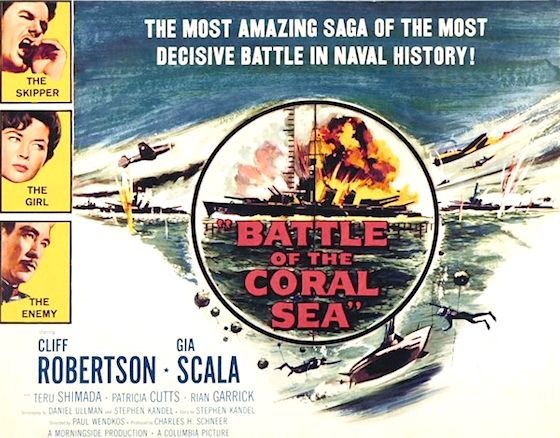
    Battle of the Coral Sea

    May, 1942, the South Pacific: a US submarine on a top-secret reconnaissance mission is captured by the Japanese fleet. Its crew are taken to remote island interrogation camp, where they just have to keep silent for a couple of days until what they know will no longer be of use to the enemy.

    Yes, far from the combat movie the title implies, this middle-of-the-road World War 2 movie is one part submarine adventure (the first act) to two parts POW thriller (the rest). The latter also includes an action-packed escape for the climax, which is almost a moderately exciting action sequence, but is marred by a litany of minor daft decisions. For example: the escapees start by killing a couple of guards, but only pick up one of their guns; then they use that gun to mow down more guards, but still don’t bother to grab any more weapons. When some of them get killed a minute or two later, you can’t help but feel it was their own damn fault.

    It picks up some points for making the camp’s commander a reasonable man — a human being, rather than an alien, vicious, evil torturer, which is the stereotype of Japanese WW2 prison camps. That said, considering how infamously brutal said camps were/could be, the niceness of the prisoners’ treatment makes the film feel somewhat neutered. It’s not like the captured seamen get to laze around all day — they’re put to work — but you feel like these guys aren’t really suffering, not compared to what others went through. It contributes to the feeling of the film being a something-or-nothing tale; just another story of the war, rather than an exceptionally compelling narrative.
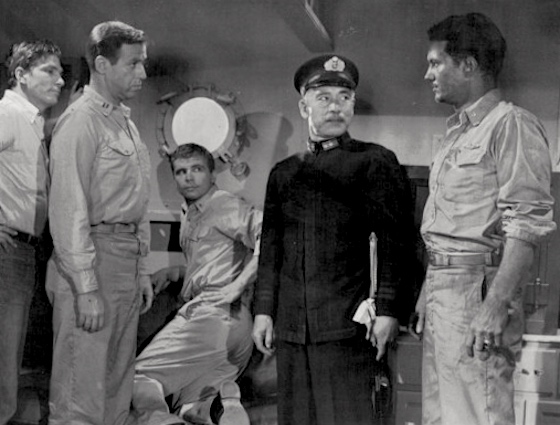
    Under the Coral Sea

    Apparently the eponymous battle was rather important, though: a voice over informs us that “it was the greatest naval engagement in history”… before adding that “the victory laid the groundwork for the even greater sea victory at Midway.” So it was the greatest… except the next one was greater? Who wrote this screenplay, Donald Trump? We do actually get to see the battle, eventually, when it turns up as an epilogue, conveyed via a speedy stock-footage-filled montage. I wonder how much of that was fed into the trailer…

    Battle of the Coral Sea is the kind of film I would’ve completely overlooked if Quentin Tarantino hadn’t included it in his Swinging Sixties Movie Marathon (it represents the kind of thing Once Upon a Time in Hollywood’s Rick Dalton would’ve appeared in early in his career, as one of the seamen with a couple of lines), and I don’t feel I’d’ve really missed anything. It’s not a poor film — anyone with a fondness for ’50s-style war movies will find something to enjoy in it — but it’s not a noteworthy one either.

    3 out of 5

    Once Upon a Time in Hollywood is in cinemas now.
  • Quentin Tarantino’s Swinging Sixties Movie Marathon Review Roundup

    To promote his new movie, Once Upon a Time in Hollywood, writer-director Quentin Tarantino has curated a selection of movies from the Columbia vault (because Columbia is owned by Sony, and Sony are releasing OUaTiH) that are in various ways connected to said new movie. Some are influences on its style; some are the kinds of movies that the film’s characters would’ve appeared in; some speak to the societal concerns of the era. Along with film writer Kim Morgan, QT has hosted a “movie marathon” of his ten picks on TV, broadcast in the run-up to OUaTiH’s release in various territories (it’s on Sony-owned channels in 60 countries, and has been sold to other broadcasters in 20 more — “check local listings for details” and all that).

    It’s been on this past week in the UK, airing nightly at 11:30pm on Sony Movie Channel, finishing with a double-bill tonight. If you’ve missed it, Movies4Men are repeating the lot next week from 6:30pm. I’m away from home this weekend so will have to catch some of those repeats, but I did watch the films on earlier in the week, and here are some thoughts on the first two…

  • Model Shop (1969)
  • Getting Straight (1970)
  • (If you watched this series elsewhere and are thinking “but those weren’t the first two films,” you’re right: for no apparent reason they’ve juggled the order in the UK.)


    Model Shop
    (1969)

    2019 #106
    Jacques Demy | 97 mins | TV | 16:9 | USA & France / English

    Model Shop

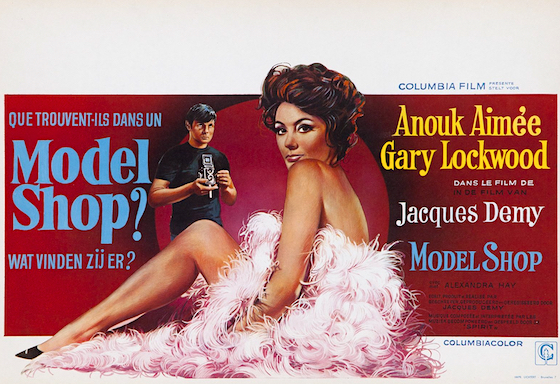
    The English-language debut of French writer-director Jacques Demy, Model Shop shows us a day in the life of George (2001’s Gary Lockwood), a 26-year-old whose disillusionment is ruining his life. He’s quit his job at an architect’s because it was too low-level — he wants to design the big stuff, but isn’t interested in putting in the work to get to that tier. Consequently his girlfriend is getting fed up with him, he’s in debt, and his beloved car is about to be repossessed. George manages to talk the repo man into giving him until the end of the day to find the $100 he owes, and so he sets off on a drive around L.A. to find a friend to borrow it from. That’s when he spots a mysterious glamorous woman (Anouk Aimée) and begins to follow her.

    That perhaps makes the film sound more focused than it seems in viewing. There’s a definite European sensibility in play here — a laid-back, wandering feel, as George drifts around L.A. in his car, meeting up with different friends in different situations. The possibility of the draft hangs over their heads, informing their actions. As Morgan and Tarantino discuss in their introduction, some people might view the conversations and speeches in the film as being unnecessarily ‘heavy’, but it’s more than mere existentialism when there’s a genuine life-or-death experience just an unwanted call-up away.

    The atmosphere all that creates can make the film feel aimless, but, as Tarantino puts it, “the more you talk about Model Shop, the more you realise there is more to talk about.” Even while it feels like nothing is happening, stuff is happening. It’s the kind of film where we’re accumulating knowledge about the character and his world, and sometimes it’s only with hindsight we realise its signficance. At first it may not even seem like there’s much of a story — what could pass for the inciting incident (needing to acquire $100) is actually solved relatively quickly — but there is definitely a story, even if it’s a relatively small, somewhat undramatic one. This combination is I think why Tarantino describes the film as “deceptively simple and deceptively complicated.” I suppose it depends how much you want to see; how much you want to engage.

    “Open the pod bay doors, Lola.”

    Personally, I found George to be an immensely, almost painfully relatable character. The way he doesn’t quite know what he wants to do, just what he doesn’t; the way he doesn’t want to put in the long slog, just jump to the more interesting stuff at the end; the way he drifts and kills time rather than doing anything useful; and his big speech after he’s made to consider his own death “for the first time in [his] life”: he’s not a coward, but he doesn’t want to lose his life, because what’s better than life? Only, perhaps, art that reflects it. I’m not saying I am George, exactly, but boy, there were reflections.

    I was less engaged by Anouk Aimée’s character, Lola, who, once she’s properly introduced, takes over somewhat. Turns out she’s a character from Demy’s debut feature, Lola, making this a sort of sequel — only “sort of” because, while Model Shop does continue her story, she’s not at all the focus. Apparently a lot of Demy’s films feature crossover characters and connections in this way, which I guess was also an inspiration to Tarantino.

    I’d not heard of Model Shop before it cropped up in Tarantino’s selection, and it’s not been classified by the BBFC since its original release, so I presume it’s never had a video / DVD / etc release in the UK. While I would hardly say it’s some kind of ‘lost’ masterpiece, it does evoke a place and a time and the kind of lives that may’ve lived there — which is precisely why QT showed it to his Once Upon a Time crew, for the way it depicted L.A. in 1969 (he reckons it’s possibly the best movie ever for showing Los Angeles). Some of it is interesting, but at other times it retains that sense of aimlessness. It’s far from meritless, but I can also see why it’s the kind of film that’s been half forgotten.

    3 out of 5

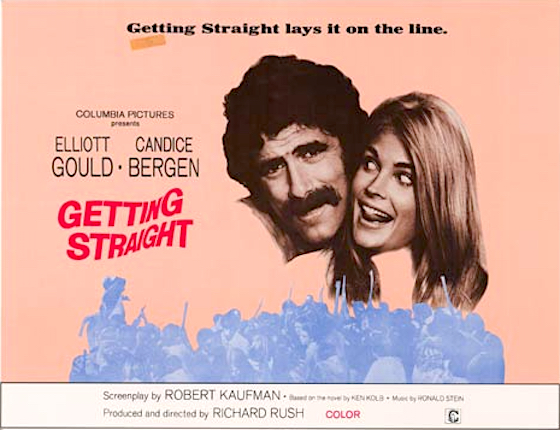
    Getting Straight
    (1970)

    2019 #107
    Richard Rush | 120 mins | TV | 16:9 | USA / English | 15 / R

    Getting Straight

    According to Quentin Tarantino (I suppose I could try to independently verify this, but I haven’t), Getting Straight is one of four “campus radical” movies that were all released in 1970 (the other three are Zabriskie Point, R.P.M., and The Strawberry Statement). It stars Elliot Gould as Harry Bailey, a post-grad student at an unnamed Californian university, where he intends to qualify as a teacher, but where he’s also revered by the other students for his history of activism — even as he’s basically trying to join the establishment, they’re trying to lure him back to his old radical ways, beliefs he hasn’t left behind but doesn’t seem to wholly stand by anymore… or does he?

    So Harry is, on the surface, a potentially interesting main character: someone caught between the revolutionary youth and the establishment; who tells the youth why they’re dreaming and deluded, and tells the old men why they need to listen and buck up their ideas; but who is, therefore, conflicted about his own place in it all. But while putting someone in the middle might seem like a fair why to argue for both sides, it’s a bit obvious; allowing the film to have its cake and eat it, to an extent. And while it might seem objectively true that Harry is conflicted, evidenced by his flip-flopping from side to side, he seems pretty sure of himself for most of the film. There’s little done to explore his fence-sitting; to question his status as someone who proclaims to believe certain things yet seems to still find himself sat in the middle. Is he a hypocrite? If he is, I’m not sure the film bothers to interrogate that. So, if he isn’t, is that just because the film doesn’t want to show him as one? Perhaps we’re meant to buy that he’s the only sane person in a mad world, which seems a bit of a cliché.

    At the end Harry does ultimately pick one side, dramatically rejecting the establishment to go join rioting students. Why? He’s goaded into snapping by a professor’s smug, self-satisfied interpretation of The Great Gatsby, but if we’re meant to know why this bugs him so then I missed it. Does he reject the reading? Is it the tone of it, which is like being lectured down to? Maybe it’s just the straw that broke the camel’s back, but I didn’t really follow that as an arc. Earlier in the film Harry talks about finding a student riot sexy, a turn on, and then the movie ends with him and his girlfriend stripping off to shag literally in the middle of a riot, which does make you wonder if he was just thinking with his dick. I mean, he was for half of the rest of the film.

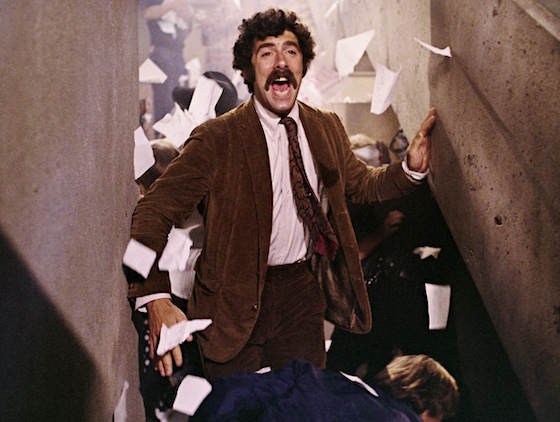
    Ranting and rioting

    With its focus on Harry, Getting Straight is something of a character study, and if this is anyone’s film it’s Gould’s. At times he gets a chance to expose different sides of this divided person, but he also certainly does a lot of shouting, lecturing, and ranting in the role. So maybe instead it’s about the times, with Harry basically a cipher to explore pertinent issues and different sides. It’s based on a 1967 novel, so was a relatively prompt adaptation, though to remain timely it would’ve had to be. Then again, Leonard Maltin’s movie guide apparently describes it as a “period piece”, and there’s a point there: the film is so much about that specific point in time that it couldn’t be set anytime else. Along with the slightly detached view of its main character, it doesn’t seem to be in or of the moment, like you might expect from a countercultural film made during the actual counterculture. It’s reflecting on it, like a period movie.

    Getting Straight is “one of [Quentin Tarantino’s] favourite movies ever,” or so he says, which unfortunately is a sentiment I can’t get on board with. I’m not even sure I can stretch to giving it a passing grade, because it was a bit too freewheeling and, by the end, in spite of the climactic ranting and rioting, kinda boring.

    2 out of 5

    Once Upon a Time in Hollywood is in UK cinemas from Wednesday, 14th August.

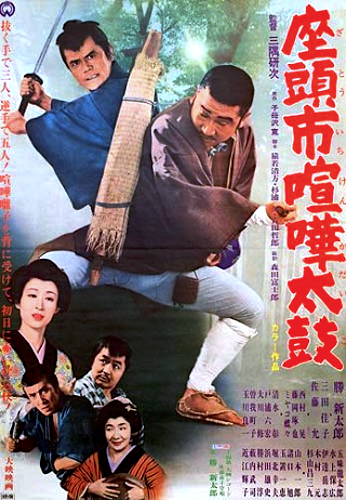
    Samaritan Zatoichi (1968)

    aka Zatôichi kenka-daiko

    2019 #42
    Kenji Misumi | 83 mins | Blu-ray | 2.35:1 | Japan / Japanese | 15

    Samaritan Zatoichi

    The 19th Zatoichi movie begins with our hero fulfilling some yakuza responsibilities: on the orders of a boss he’s been staying with, Ichi (Shintaro Katsu) is part of a group who try to collect overdue debts from a man. When he refuses to come peacefully, Ichi is forced to kill him. Only then does his sister, Osode (Yoshiko Mita), turn up, and Ichi learns what’s really going on: the debt was just a pretext for the boss to acquire Osode, who’s wanted by a local government official for, you know, the kind of thing corrupt officials want pretty young women for. Incensed, Ichi vows to protect Osode, although she’s not so keen on palling around with the guy who just murdered her brother…

    As opening acts go, it’s a strong setup. Okay, it’s similar to ones the series has played before (see Zatoichi’s Pilgrimage), but it finds its difference in the character of Osode. Where most characters quickly decide Ichi is the good guy and get on his side with no regrets, Osode struggles with her grief and her feelings towards the blind swordsman, swinging back and forth between acceptance and, well, not: at one point she gives serious consideration to murdering him and then committing suicide. It feels like a bit more psychological realism than we often get, especially from characters Ichi has wronged, and it’s realised on screen with some effectively different visuals. For example, when Ichi engages in a show of skill at a fairground ball game, Osode is initially as gleefully impressed as everyone, before she comes to realise it’s these skills that allowed him to murder her brother, an event she imagines in starkly-coloured purple/green ‘flashbacks’ as she looks at Ichi with new eyes. It’s a particularly striking departure from the series’ usual grounded visual style (one echoed when Osode has red/blue ‘flash forwards’ to killing Ichi), although the whole film is very nicely shot. Of course, Osode’s ambivalence can’t go on forever: eventually she forgives Ichi and falls in love with him, because she’s only a woman and, in the world of Zatoichi, nothing is more attractive than a blind, tubby, slovenly, rice-guzzling, depressed-by-his-own-conscience, roaming mass murderer.

    Grief

    Lest you think Samaritan Zatoichi is one of the series’ heavy instalments, fear not, because there’s some quite broad slapstick-ish comedy in counterbalance. The first half of that ball game, for instance, is definitely played for laughs. A later sequence sees Ichi wrapped in reeds to be dumped in the river, but fate gives him a chance to get to his feet, whereupon he engages in a fight with his would-be killers, stumbling around still wrapped up — despite which he still comes out victorious, of course. Ichi also ends up with a sidekick for part of the film, Shinsuke, played by Takuya Fujioka, who was a friend of Katsu and consequently pops up in a couple of Zatoichi films. Apparently he was mainly known for comic roles, which he brings a dash of here, but Shinsuke isn’t entirely useless, nor just played for comic relief, which makes a nice change for the sidekick role.

    Other memorable sequences in this instalment include one where Ichi commandeers a horse to catch up with the villains, in which he takes to riding about as well as you’d expect for a blind man (i.e. not very); a dice gambling scene where, in an about turn from every other one featured thus far, it’s Ichi who’s doing the cheating; and a final one-on-one duel that is another classic in a series absolutely filled with them (I mean, how many times in these reviews have I referred to the climactic scene as “one of the best”? It must be a pretty long list at this point.) What’s different this time is how much of a challenge it is for our hero. According to IMDb trivia, it’s the longest one-on-one duel of the series, lasting 2 minutes 14 seconds, which feels like an eternity next to the mere seconds it usually takes Ichi to defeat a solo foe. It’s set as dawn breaks on a new year, and the drums at a nearby shrine begin to pound to mark the occasion, so loudly that they impair Ichi’s senses and, therefore, abilities. The film’s original title translates as something like Zatoichi Fighting Drums, and here we see why. Combining a duel that’s more protracted than usual with a thumping score courtesy of those drums, the finale feels like an epic confrontation… even if the fight’s happening for very little motivation.

    Ichi struggles

    And here we reach what’s wrong with Samaritan Zatoichi: despite an initial clean and clear setup, the plot gets a bit scrappy. Much of it is driven by the yakuza boss desperately pursuing Osode to please the government blokey, but it turns out he’s actually not that bothered about her. The boss doesn’t believe that, so he wastes time continuing to pursue Osode; but no, government blokey meant it, and it winds up with him not awarding a contract to the boss. Despite that, the boss continues to pursue Osode… Just Because, I think? Or maybe we’re supposed to take it he’s really after Ichi at that point? Other contrivances occur just to keep the plot rolling, too (at one point Osode sets off without Ichi — again, Just Because — which leads to a whole heap of trouble), and I wasn’t joking when I said the final ronin has little motivation: he seems to decide to pick a fight with Ichi just for shits and giggles.

    But if you don’t worry about logical character behaviour too much, there’s an awful lot to enjoy in Samaritan Zatoichi. Such niggles hold it back from being amongst the series’ very best instalments, but there’s much else to recommend it, including likeable supporting characters, great fight scenes, and various other memorable set pieces.

    4 out of 5

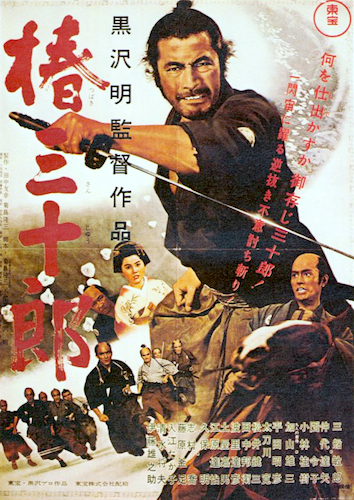
    Sanjuro (1962)

    aka Tsubaki Sanjûrô

    2018 #139
    Akira Kurosawa | 96 mins | DVD | 2.35:1 | Japan / Japanese | PG

    Sanjuro

    Yojimbo was such a box office success that the studio requested a sequel. Director Akira Kurosawa obliged by reworking his next project, an adaptation of an unrelated story (Peaceful Days by Shūgorō Yamamoto), so that it featured Toshiro Mifune’s eponymous scheming samurai, Sanjuro. This follow-up came out just nine months later — and, by genuine coincidence, I happened to watch it nine months after I watched Yojimbo; and now, in a mix of tardiness and planning, I am also reviewing nine months after I reviewed Yojimbo. All of which signifies absolutely bugger all, but it happened so I’m noting it.

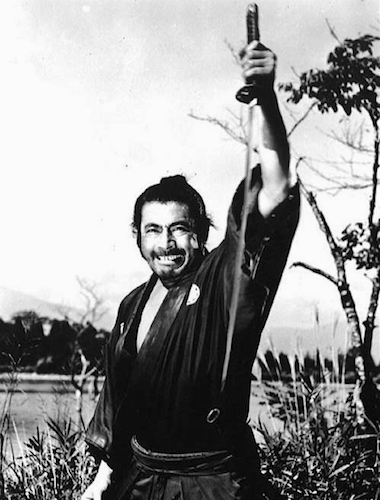
    This time, Mifune’s anti-hero becomes involved with nine young samurai who suspect corruption among the local authorities. The youngsters are well-meaning but naive to a fault, and so Sanjuro decides to help them. That’s a real boon for them, as it turns out, because they’d all die several times over if it weren’t for him stopping them and guiding them in a better direction. As well as showing us what a smart operator Sanjuro is, it’s often quite humorous, something this film feels more inclined to than its predecessor. For instance, there are several great bits of funny business with an enemy guard they capture and stash in a closet, but who keeps being let out after he sort of converts to their side.

    Sanjuro's sword

    In the booklet accompanying Criterion’s DVD of the film, Michael Sragow writes that “in the Akira Kurosawa movie family tree, Sanjuro is the sassy kid brother to Yojimbo, and like many lighthearted younger siblings, it’s underrated.” I’d certainly agree. It doesn’t feel as significant as Yojimbo, probably because of the lighter tone (in my review, I described the previous film as “almost mercilessly nihilistic”) and a less fiddly story. But I found it more readily enjoyable than Yojimbo. It’s got a straightforward but clever plot, plenty of funny bits that don’t undermine the rest, and some decent bursts of action. It’s also just as well-made, particularly the cinematography, which is beautifully composed and framed by DPs Fukuzô Koizumi and Takao Saitô.

    The making-of documentary that accompanies Sanjuro begins with Kurosawa stating that “a truly good movie is really enjoyable, too. There’s nothing complicated about it. A truly good movie is interesting and easy to understand.” I can think of few better quotes to describe Sanjuro, which is a truly good movie.

    5 out of 5

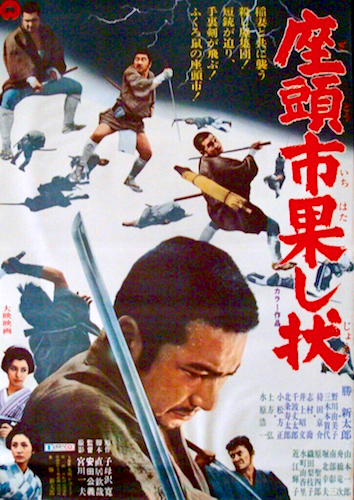
    Zatoichi and the Fugitives (1968)

    aka Zatôichi hatashijô

    2019 #20
    Kimiyoshi Yasuda | 82 mins | Blu-ray | 2.35:1 | Japan / Japanese | 15

    Zatoichi and the Fugitives

    Not to be confused with the earlier Zatoichi the Fugitive (no fear in the original Japanese, where that’s titled something like Zatoichi’s Criminal Journey and this is along the lines of Zatoichi, A Letter of Challenge), the series’ 18th instalment pits our favourite blind masseur-cum-swordsman against a gang of six remorselessly violent fugitives. Along the way he shacks up with the venerable Dr. Junan and his caring daughter/assistant Oshizu (Kayo Mikimoto), and once again Ichi hopes he may’ve found a place to settle down, only for events to snatch the dream away.

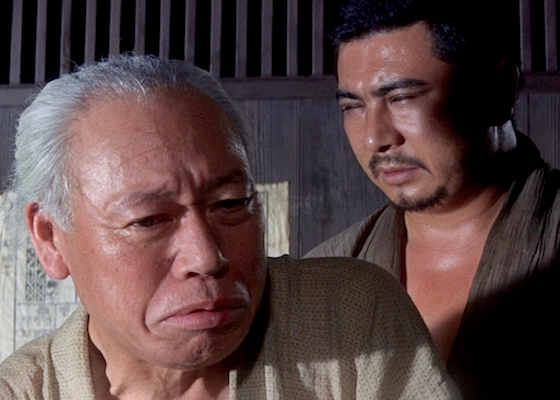
    That doctor is played by the great Takashi Shimura, star of Seven Samurai and Ikiru, amongst many, many other classics of Japanese cinema. He brings an effortless class to the role, which initially seems to be just an honourable and wise gentleman, but later has more to it. You see, in a thoroughly unsurprising twist, it turns out one of the fugitives — namely their leader, Genpachiro (Kyôsuke Machida) — is the doctor’s estranged son. When Genpachiro attempts to visit his father and sister, Oshizu is overjoyed to see his return, but the doctor refuses to even acknowledge his son’s presence.

    As the gang’s leader and the one with the connection to Ichi’s new friends, naturally it’s Genpachiro who will prove to by Ichi’s nemesis in this film. Writing for The Digital Bits, Bill Hunt and Todd Doogan reckon he’s “one of Zatoichi’s single greatest enemies,” which is certainly a bold claim. They have something of a point, given his intelligence — an early encounter makes him aware of how skilled Ichi is with a sword, so he keeps stopping his hot-headed underlings from tackling Ichi head on — but I didn’t think he was as memorable an individual as several other foes have been.

    Zatoichi and the doctor

    The fugitives as a group do provide quite the challenge for Ichi, however, almost defeating him at one point. Naturally, our hero comes out on top in the end: spurred by righteous anger, his final-act slaughter is even more brutally efficient than normal. Having been shot and nearly killed in his first attempt at a climactic showdown, Ichi ain’t messing around the second time. Well, they have it coming. They’re a vicious lot, happily slaughtering innocents on practically anyone’s say-so, at one point even coming this close to murdering a baby. Indeed, this is quite a tonally dark instalment of the series. It’s certainly not the only one by this point — it may not even be the darkest, in fact — but it’s still not very cheery, with little of the humour we’re accustomed to from our hero. Even the final defeat of the villains is tinged with sadness. At one point he gets very introspective, as Oshizu asks him about his blindness: “At first I remembered all the colours — green, red, and so forth. I told myself I had to remember them and tried hard not to forget. But they gradually faded away. All that’s left now is darkness.”

    Ichi could just as well be talking about his lifestyle, as once again he struggles with being a gangster. When a bunch of yakuza turn up at the doctor’s to pay their respects to Ichi (his reputation having preceded him once again), the truth of his position is exposed to his new potential-family, much to his shame. Again, it’s a point of conflict for the good doctor: he doesn’t like criminals, as we see with his attitude to his own son, but he’s also seen what a kind-hearted fellow Ichi really is. And if Ichi going on an emotional rollercoaster wasn’t bad enough, he’s put through the ringer physically too — I mean, he gets shot, then digs the bullet out by himself with his sword, lest you were in any doubt of his credentials as a badass. And if that doesn’t convinced you, multiple displays of his skill with a blade should.

    Bloody Ichi

    One of those demonstrations has led to cuts by the BBFC for the UK release. Yes, Criterion have finally bothered to get the films classified — I’ll write a bit more about that when it comes relevant again on a future film, but for now we’re concerned with the four seconds they’ve cut from Fugitives. At one point a snake drops on Ichi and he slices it in half, after which we see the bisected creature writhing on the ground. I guess they did it with a real snake, or real enough to the BBFC’s eyes, because that shot has been cut for animal cruelty. I know some people object on principle to the BBFC censoring anything, but I can’t say cutting that kind of thing bothers me much (though, as I have the US set, I’ve already seen it).

    To quote Hunt and Doogan again, they reckon that “if this series were to be compacted into a trilogy, this would be at the tail-end of part two. In other words, this is Ichi’s Empire Strikes Back. No hyperbole”. Eh, I think there might be a bit of hyperbole there. It’s just coincidence that this instalment falls at the two-thirds point of the series (more or less), and I don’t even think it’s the darkest film there’s been — for what it lacks in humour, it has a lot of kindness in Ichi’s relationship with the doctor and his daughter, and some redemption for one of the gang members. Rather than comparing it to the consensus-greatest film of another series, I’m more inclined to Paghat the Ratgirl’s point of view: “After nineteen [sic] feature films, this story is entirely familiar. But great even so.” Zatoichi and the Fugitives is not one of my favourites in the series, but it is a good mid-tier one.

    4 out of 5

    Zatoichi Challenged (1967)

    aka Zatôichi chikemurikaidô

    2019 #10
    Kenji Misumi | 87 mins | Blu-ray | 2.35:1 | Japan / Japanese

    Zatoichi Challenged

    The seventeenth film in the Zatoichi series is rated the second best according to IMDb users. As with so many opinions, that’s not one shared by Letterboxd users (who’ve placed it 15th), and it’s not shared by me, either. While I wouldn’t call it bad (every Zatoichi film has things to commend it, even the de facto worst), it’s definitely towards the lower end of my ranking.

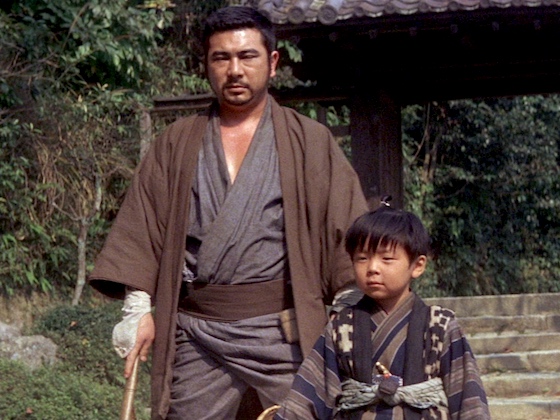
    The basic plot is a semi-rehash of one of the series’ crowning glories, Fight, Zatoichi, Fight, with Ichi (Shintaro Katsu) agreeing to reunite a young boy with this father after the child’s mother dies. They first fall in with a group of travelling performers, which seems to be an excuse to squeeze in an incongruous ’60s pop song and a bit of a love interest for Ichi. After wasting half-an-hour on that, Ichi and the kid rock up in the town where the dad, Shokichi (Takao Ito), is being held captive by a gang of… pottery makers. It’s slightly more exciting than it sounds, because their scheme is all about making plates and jugs featuring erotic imagery, which was illegal at the time, and Shokichi is a skilled artist. Now, of course, Ichi must free him to unite him with his son. Along the way, Ichi strikes up a respectful acquaintance with a travelling ronin, Tajuro Akazuka (Jûshirô Konoe), which you know isn’t going to end well because, well, that’s how these films always go.

    Zatoichi and son... just not his son

    There’s nothing particularly wrong with being a formulaic Zatoichi film — many of them are, and I enjoy them just the same — but here it all feels rather slow and uneventful. The stuff with the travelling performers is a dead end, a total aside from the main story; and that plot, such as it is, just never catches light. The final 25 minutes are fairly action-packed at least, both in terms of fighting and with the plot finally getting somewhere; but it also makes you realise how much time has been wasted going nowhere — the villains are little more than introduced before it’s time for Ichi to cut them down. It doesn’t help anything that the kid’s annoying. He comes to care for Ichi, but Ichi doesn’t really seem to care for him that much, meaning their relationship lacks the emotional resonance found in Fight, Zatoichi, Fight.

    The one part of the film that does work is Akazuka. As I alluded to before, it’s a story arc that’s played out in many Zatoichi films before (and I’m sure it’ll come up again), but Zatoichi Challenged executes it as well as any. At first it just seems like Akazuka is a wanderer who Ichi happens to keep bumping into, including a memorable encounter where Akazuka attempts to overpay for a massage, but honourable Ichi refuses his charity. Eventually, of course, it turns out he has a secret mission which is at odds with Ichi’s own goals and values, and so, inevitably, they must duel. Their climactic confrontation is by far the best bit of the film. It’s a battle of words at first, as Ichi pleads with Akazuka to be reasonable and have mercy. He won’t, of course, and so a sword fight ensues. It doesn’t pan out how you might expect. The whole sequence is beautifully shot through falling snow by cinematographer Chikashi Makiura (quite why it’s suddenly snowing I’ve no idea, but it looks good). It’s an absolutely fantastic sequence; one of the series’ very best duels.

    Snow fight

    The finale aside, perhaps the most interesting thing about Zatoichi Challenged (certainly the most uncommon) is that it was remade in America, forming the basis for 1989 actioner Blind Fury, starring Rutger Hauer and directed by Phillip Noyce (Patriot Games, The Bone Collector, Salt, et al). I’ve not seen it, but other reviewers describe it as “a total turd that captures none of the charm and humanity of Zatoichi” (Lard Biscuit Enterprises), noting that it “begs the viewer to overlook too much that is idiotic [about a blind swordsman], whereas the original convinces the viewer it isn’t idiotic at all” (Weird Wild Realm). Suffice to say… I’ll still watch it someday.

    Quite why this Zatoichi film in particular was tapped for a US remake, goodness only knows. It’s a kinda boring Ichi adventure on the whole, with a thin, recycled plot and a first half-hour that’s almost a total aside from the actual story. It’s saved by the climax, one of the best sequences in any Zatoichi film, which single-handedly makes the movie worth a watch.

    3 out of 5

    Zatoichi the Outlaw (1967)

    aka Zatôichi rôyaburi

    2018 #257
    Satsuo Yamamoto | 95 mins | Blu-ray | 2.35:1 | Japan / Japanese | 15

    Zatoichi the Outlaw

    The sixteenth Zatoichi movie begins by boldly declaring it’s “the first feature by Katsu Productions”, the production company of series star Shintaro Katsu. While the change isn’t radical — this is still the Zatoichi we know and love — there does seem to be a different style and tone about this particular instalment.

    It all starts as a pretty regular tale: wandering into a new town, Ichi finds himself accidentally drawn into a feud between two neighbouring gangs, one run by the usual unscrupulous and vicious boss, the other by a kind-hearted and socially conscious chap. But even more moral than him is a ronin, Shusui Ohara (Mizuho Suzuki), who’s renounced violence and is preaching to the local farmers about the evils of the yakuza way of life. He challenges Ichi’s sword-based moral code, which is fertile ground for the series — Ichi is often questioning his own actions, after all. Ohara suggests there might be another way, but Ichi isn’t convinced — sometimes violence is necessary to help, he believes, and that goodly boss proves that the yakuza way can work for the people.

    Anyway, at the risk of spoiling things, that plot comes to a head in the usual fashion… but before the halfway mark. Via a montage (something I’m not sure we’ve seen in a Zatoichi film before, and it’s not the only one in this movie either), it’s a year later, and Ichi’s somewhere else in the world living a different life, only to receive news of trouble back in that earlier town. Naturally, he heads back to sort it out. It’s an effectively wrong-footing structure: the film wraps up more-or-less the usual Zatoichi movie within its first 40 minutes, then jumps ahead to show the long-term fallout of Ichi’s actions. It’s not the first time the series has touched on the fallout of all Ichi’s good intentions, but it’s the first time it’s been done so explicitly and succinctly.

    Hot stuff

    It’s not just structurally different to the norm, though. This is a particularly brutal film, with dismembered limbs, attempted rape, torturous beatings, punishment by hot wax, women being forced into prostitution, multiple suicides, a graphic beheading…! There’s a crudeness to situations and dialogue too, with Ohara giving a lecture about how the yakuza are “shits and farts”, and an extended (and unwelcome) comedy interlude when Ichi lives with a bunch of bawdy and lascivious fellow masseurs. This is one of the few Zatoichi films rated by the BBFC (due to it being released in a DVD box set in the early ’00s — Criterion don’t seem to have bothered to get them certified for their recent set, which is perhaps why it isn’t available from major retailers anymore), and I don’t know what the other films would be classified as, but this easily earns its 15.

    This is also the most political movie in the series, something you’ll see regularly noted in reviews because it’s rather hard to miss — after all, Ohara is effectively trying to unionise the farmers against the bosses. Director Satsuo Yamamoto was a left-wing political activist, known for his films that engaged with such subjects, and also real-life protests that had seen him fired from Toho in their “red purge” of 1948. Hat-tip to Weird Wild Realm for that detail; that review also includes more analysis of this film’s politics and the way they impact — or don’t — Ichi and the viewer. By which I mean, the film makes a point of contrasting the perspectives of Ichi and Ohara, and the way events unfold suggest the ronin’s ideals of pacifism and reform may well be correct… but that wouldn’t do future Ichi adventures any good, so of course he maintains his violent ways.

    Violent delights have violent ends

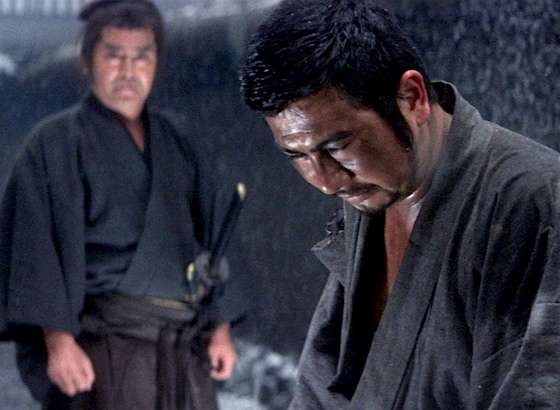
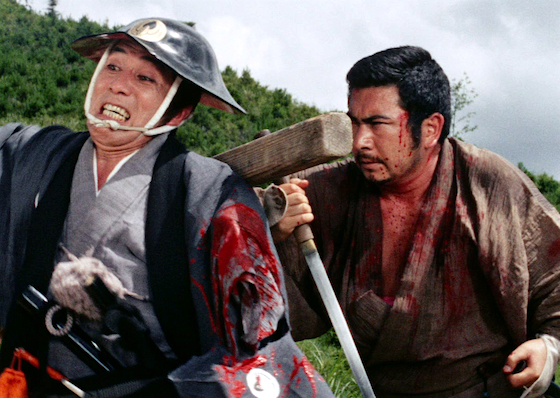
    And of course we still enjoy it. Indeed, the final fight is a stunner — well, they almost always are, but this is certainly another for those burgeoning ranks. Initially taking place in torrential rain, it’s a muddy and bloody scramble, including a great shot of Ichi unrelentingly coming for his foe, even as he’s pelted with rocks, blood dripping down his face (see this post’s header image). And that’s not even the end, because the peasants pick up an injured Ichi and, in a dramatically-scored sequence, carry him down backroads to intercept the caravan transporting the captured Ohara, who Ichi rescues in another flurry of swordplay. Even as the film seems to preach against violence, it revels in it. Parse that how you will.

    There were a lot of bits I didn’t like along the way in Zatoichi the Outlaw (that comedy interlude is a real mood-killer), and I can see why some fans think it gets too dark for a Zatoichi movie (it’s not just the events themselves, but the bleak atmosphere they create), but I admired its commitment to being a bit different. In a long-running series, films that challenge the norm are to be welcomed.

    4 out of 5

    Zatoichi’s Cane Sword (1967)

    aka Zatôichi tekka-tabi

    2018 #241
    Kimiyoshi Yasuda | 93 mins | Blu-ray | 2.35:1 | Japan / Japanese

    Zatoichi's Cane Sword

    The 15th Zatoichi movie is another that’s regarded as one of the very best: Letterboxd users rank it in the series’ top ten; IMDb voters have tied it for first place (with the first and 17th films); while The Digital Bits reckon it’s the best of them all, the only film in the series they gave an A+ rating. Well, I wouldn’t go that far, but it’s another fine instalment in this series that consistently delivers.

    Ichi’s sword skills attract the attention of an old blacksmith, a former sword maker, who it turns out was the protégé of the man who forged Ichi’s blade. Upon examining it, the blacksmith informs Ichi of a sad fact: the sword has an invisible crack — it’s good for one more strike, but that strike will break it. Giving the weapon to the blacksmith as a memento, Ichi quits his roaming ways and finds work as the live-in masseur at a nearby inn. There he stumbles into familial intrigue involving a dead boss’ children, the schemes of a cheating gang from the next town over, and the machinations of a corrupt official.

    Zatoichi’s Cane Sword comes with a great setup — Ichi giving up his sword and, with it, renouncing his wandering, battling lifestyle; trying to get by without falling back on his old combative skills — but, actually, I’m not sure how much our hero’s new status quo really changes things. I mean, you know Ichi’s going to end up with a sword in hand slashing down his foes eventually; and until we reach that point, the rest of the plot is pretty standard Zatoichi stuff. It’s solid, but not the most interesting the series has offered, despite some promising building blocks. For example, there’s a revelation about a supporting character’s parentage that feels like it could and should go somewhere interesting, but instead it just turns out they already knew. Later, Ichi tells Boss Iwagoro that he’s met many evil men, but Iwagoro is the worst. Well, that’s patently not true — we’ve seen much worse than him over the course of the series.

    Zatoichi and his sword

    I don’t want to sound too down on the film, though, because while it’s not in the absolute top tier of the series, it’s surely at the upper end. Even if the way events play out didn’t dig into their promise as much as I’d hoped, it still leads to numerous engaging or entertaining moments — the quietly emotional scene where Ichi decides to completely change his life, for example; or, by complete contrast, a fun and silly scene where Ichi abuses the respect/fear of a snivelling boss by pretending to be drunk and pouring sake all over the chap. There’s also a nightmare sequence, which makes this the second Zatoichi film in a row to feature a dream scene, fact fans. Whereas the last one was a bit… odd, this one is a memorable insight into Ichi’s fears. Finally, the inevitable climactic mass slaughter is set in falling snow, which gives it a nice bit of visual beauty to stand out, seeing as the rest of the film’s fight choreography is pretty standard stuff for the series — which of course means that, considered in isolation, it’s as impressive as ever.

    Anyone who watches and enjoys the Zatoichi series is bound to end up with their own particular favourites, for whatever reason. Clearly Cane Sword particularly clicked for the writers at The Digital Bits; for me, it’s been other films — I’m reminded of Adventures of Zatoichi, which seems to score lowly with most people but was one of my favourites. Either way, Cane Sword is another very good entry in a series which is, fortunately, full of them.

    4 out of 5

    Zatoichi’s Pilgrimage (1966)

    aka Zatôichi umi o wataru

    2018 #214
    Kazuo Ikehiro | 83 mins | Blu-ray | 2.35:1 | Japan / Japanese

    Zatoichi's Pilgrimage

    Zatoichi’s Pilgrimage is the ‘lost’ Zatoichi movie: at some point the Weinsteins bought the rights to it because Quentin Tarantino was considering a remake, with the side effect of making it unavailable legally for years — while all the other Zatoichi films appeared on DVD in the US, Pilgrimage remained AWOL.* Its legal release finally came in 2013 as part of Criterion’s Blu-ray box set (which, coincidentally enough, is out in the UK this week). Clearly it was felt to be worth the wait, because it’s a highly-regarded instalment in the series. That might cause a newcomer to wonder if said wait led to some bias — that “hurrah, a new one!” feeling. Well, if it did it was entirely justified, because Pilgrimage is superb.

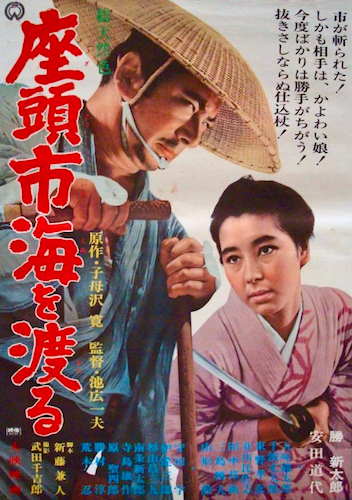
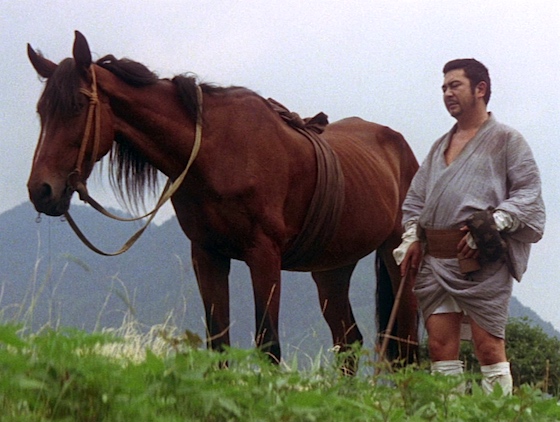
    I’ve often written in my Zatoichi reviews about the inaccuracies of the English-language title “translations”. Pilgrimage is another one… but, for once, the English title seems more apt. The original translates along the lines of Zatoichi’s Ocean Voyage, and while the film does begin with Ichi going on a voyage across the ocean, that’s the extent of its relevance — after that, he’s on his pilgrimage. Well, until he kills a guy and is followed by the chap’s horse, who then leads Ichi to the man’s home. Maybe Zatoichi and the Horse would be the most accurate title… but he’s sort of on a metaphorical pilgrimage even after he abandons his official one, so that’s okay. What develops could pithily be described as Seven Samurai meets High Noon: a group of humble farmers need protection from a violent gang, but, despite Ichi’s efforts to recruit them to defend themselves, they cowardly leave him as their sole protector.

    Zatoichi and the horse

    We’re up to the 14th film in the series now, and in a bid for something different star Shintaro Katsu and director Kazuo Ikehiro tapped Kaneto Shindo (director of Masters of Cinema/Criterion-friendly films Onibaba and Kuroneko) to write a screenplay focused on Ichi doing penance for all his killing, hence the titular pilgrimage. But by this point the Zatoichi series was a reliable money-spinner for studio Daiei, so the head of the studio ensured they didn’t let things stray too far from the formula. They got away with enough, I think. Ichi’s early attempts at atonement set the tone for the piece, and the final many-on-Ichi fight is more of a struggle for our hero than usual.

    Indeed, the way Ikehiro and Shindo build up to the finale — Ichi’s late-night heart-to-heart with latest love interest Okichi, then slowly walking out alone as the villagers hide away in their houses — actually creates a bit of tension and suspense before the battle, something rarely felt as we know Ichi’s always going to win. In the fight itself, Ichi actually seems overwhelmed by the onslaught of so many opponents. It’s a (slightly) more realistic take on the character: we’ve seen him take on this many with ease before now, but it wouldn’t really be easy; here we feel his struggle to come out on top, which makes the action more tense and exciting. The series’ other big final fights have marked themselves out with gimmicks or trickery (fire, drums, bird’s-eye camerawork, etc), but with this one it’s just how hard-won it is, how tough it is. Plus, as noted, it also recalls High Noon quite effectively: Ichi stands alone in the middle of the empty village, ready to face the attackers, while Okichi runs from house to house, begging the villagers to help, and we see them cowering inside.

    Oh, Okichi

    Ah, Okichi. Ichi has had many female admirers before (one per film, more or less), but most of the time their interest in him isn’t reciprocated; or, if it is in Ichi’s heart, he never lets his head get in the way and always leaves. Here, though, this feels genuinely like a romance. A lot of credit for this surely belongs to actress Michiyo Yasuda — as Walter Biggins lays out at Quiet Bubble, she “gives simmering intensity and density to a role that seems implausible on the page. It’s not that Katsu is unattractive, and he definitely has a bumbling charm, but this woman falls in love with the dude who killed her brother and who she savagely slashed with a knife during their first meeting. Yasuda makes Okichi’s turnabout seem natural and realistic […] rather than crazed.”

    There’s quality throughout Pilgrimage’s supporting cast. Isao Yamagata makes for a top-drawer villain as ‘smelly’ Tohachi, the local boss and horse trader (hence why he smells of horse manure). He gets a lot of good screen time alongside Ichi himself, trading veiled threats as much as physical assaults. His confidence makes for a nice change from the recent bad guys, who generally cower from Ichi’s reputation. Also, his weapon of choice is a bow and arrow, an unusual armament for this sword-focused series, but it leads to a couple of fun demonstrations of Ichi’s skill. Equally great is Masao Mishima as village headman Gonbei, jovially smiling and laughing while he’s threatened, or while discussing the conquering of their village, or while scheming and plotting to let Ichi fight on their behalf but without their backing. The villagers’ hiding is partly cowardice, but also a cunning scheme that, basically, gives them plausible deniability. Sneaky so-and-so.

    Tis but a scratch!

    The skilfulness extends behind the camera, too. I’ve already discussed screenwriter Shindo, but fans of the Zatoichi series will have good reason to recognise the name of director Kazuo Ikehiro: he previously helmed Chest of Gold and Flashing Sword, two of the best-directed Zatoichi films, and Pilgrimage can comfortably join their ranks. The whole film is nicely directed, with beautiful shot choices and framing, but particular standout sequences include an underwater sword fight (it’s only brief, but it’s effective), and a fantastic opening scene where Ichi punishes a brazen purse snatcher (credit to Shindo, again, for setting up some of the film’s themes and mirroring its finale as Ichi steps up from a crowd of do-nothings to bring justice). Some bad news, though: this is Ikehiro’s final contribution to the series, sadly.

    At least he goes out on a high. As Bill Hunt and Todd Doogan of The Digital Bits put it, Zatoichi’s Pilgrimage is “one of the crown jewels of the series.” It’s little wonder Tarantino was considering a remake.

    5 out of 5

    Zatoichi’s Pilgrimage placed 13th on my list of The 26 Best Films I Saw For the First Time in 2018.

    Criterion’s Blu-ray box set of the Zatoichi films is available in the UK as of this week.

    * If you purchased a UK DVD titled Zatoichi’s Pilgrimage back in the ’00s, it wasn’t this film. For reasons unknown, a company called Artsmagic released the 23rd film, Zatoichi at Large, under the wrong title. There’s more information about that here. ^

    Zatoichi’s Vengeance (1966)

    aka Zatôichi no uta ga kikoeru

    2018 #199
    Tokuzô Tanaka | 83 mins | Blu-ray | 2.35:1 | Japan / Japanese

    Zatoichi's Vengeance

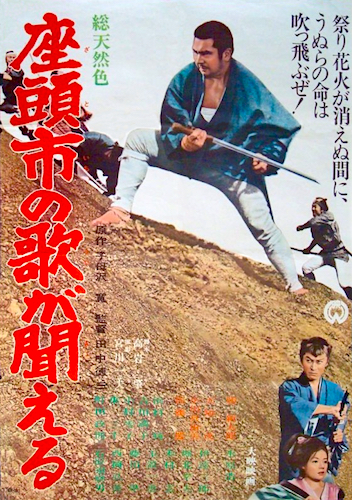
    Not to be confused with the series’ similarly-titled tenth film, Zatoichi’s Revenge (not a problem with the original Japanese titles, where the former translates as something like Zatoichi’s Two-Stage Sword and this is something along the lines of Zatoichi Hears the Song — I’m just using online translators to guess at these, so those translations may well be too literal), Zatoichi’s Vengeance marks the exact halfway point of the series — both chronologically and, according to Letterboxd users, for quality, too.

    After encountering a dying man whose last wish is for Ichi to deliver a moneybag to someone called Taichi, our blind hero bumps into an equally blind priest and accompanies him to the village of Ichinomiya for their “thunder drum” festival. Once a quiet, peaceful place (er, despite all that drumming), that very calm has led a nearby yakuza boss to move in and take advantage, setting up a brothel and demanding protection payments from local businesses. One of the last holdouts is, it turns out, the dying man’s mother, along with her young grandson — Taichi. Naturally, Ichi’s sense of justice compels him to stop the yakuza, but he’s mindful of being a negative influence on the boy’s impressionable young mind.

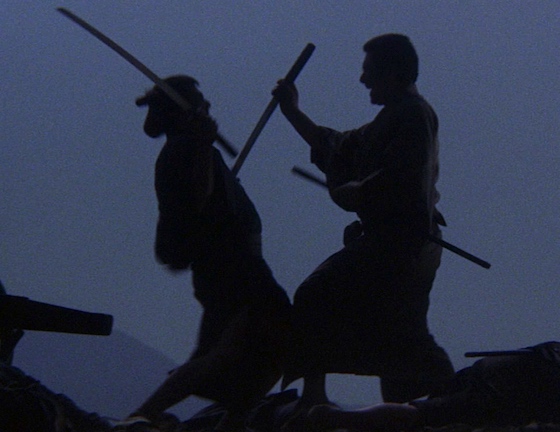
    Vengeance starts out as a quieter, more dramatic Zatoichi film than many, at times marked by Ichi’s deliberate refusal to engage in combat… until he starts cutting everyone down in a flurry of second-half action sequences, anyway. There’s a couple of the requisite scenes of Ichi killing hordes of enemies, the best being an encounter on a bridge where the yakuza employ those thunder drums to frustrate Ichi’s hearing. It’s a beautifully staged sequence, shot in an almost-silhouetted manner.

    Silhouette attack

    But the action is the lesser element here, with some of it feeling almost perfunctory alongside the interesting ideas presented by the plot. It engages on multiple fronts. Firstly, there’s Taichi and Ichi’s potential influence on him. There’s a good explanation of the effect of this plot thread by Walter Biggins at Quiet Bubble. Biggins writes that “Taichi gets hope from the blind swordsman. He sees freedom through violence. He doesn’t see how conflicted, lonely, and desperate Zatoichi’s life is — the boy sees only the glamor, the swagger, the escape. [Zatoichi] allows the gang to beat him, allows Taichi to see him humiliated, so that he doesn’t get the wrong idea about this lifestyle. [Taichi’s story] ends the film on an ambiguous note — we don’t quite know how the poor kid will turn out, or if he’s learned the right lessons from Zatoichi. In this sense, Zatoichi’s Vengeance is an indictment of its very genre, and the boy is central to this critique.” (I’ve chopped that up somewhat from the original because I didn’t want to rip it off by quoting too extensively, but the full piece is even more insightful on this aspect of the film.)

    Connected to this is the blind priest, a wise man who seems to see into Ichi’s very soul, and advises him on his interactions with the boy and, well, his lifestyle in general. This is one part of the film I wasn’t wholly convinced by, because I’m not sure how well the film pays it off. For one thing, he advises Ichi to be a good influence on Taichi, which leads Ichi to attempt to reason with the boss and get a beating for his trouble; but rather than pursue that diplomatic tack, it’s only a few minutes before he whips out his sword and gives them a good thrashing — once again setting a bad example. The priest reassures Ichi that sometimes violence is the only way. Um, you what? Well, the priest is presented as wise and insightful — almost too wise, because the film admits this advice seems contradictory, and Ichi can’t quite process that contradiction either. The priest also warns Ichi not to rely so much on his sword of he’ll die, which seems to pay off at the climax: when Ichi enters the yakuza’s lair, they’re all afraid of him, standing back to allow him to enter, take their money, and shut down their operation. But the reason they’re afraid of him is the awesome sword skills he demonstrated earlier, and when they attempt a last-minute stealth attack, he cuts them down.

    Uh-oh, Ocho

    While both of these characters and their associated views of Ichi’s methods provide food for thought, perhaps my favourite part of the film is the subplot about a prostitute, Ocho, who Ichi encounters at that recently-opened brothel. She’s a kindhearted woman — almost the stereotypical “whore with a heart of gold” — who’s revealed to have a tragic backstory when the samurai husband she ran away from arrives. He’s been searching for her for three years, but she doesn’t want him or his help, even as he’s desperate to win her back — so desperate that he agrees to take on Ichi for money, even though he’d had a good relationship with our hero. But the real success here is the beautiful portrayal of Ocho by Mayumi Ogawa, which makes her one of my favourite characters in the series: the way she’s so kind and generous at first, but then her personal tragedies are revealed, and her bleak ending… As the film goes on, Ogawa peels back the layers of who Ocho is and how she’s ended up this way, transcending any fears of a stereotypical character to instead reveal a sympathetic figure with a poignant ending.

    Indeed, the whole film comes to a kinda melancholic, kinda bleak conclusion (spoilers here, naturally). Ichi ostensibly wins, of course — the boss is defeated, the town freed from his influence, no one (currently) out to kill him — but there are no real happy endings: Taichi’s father is still dead, the young boy in limbo about where his life will go; Ocho’s life has been ruined beyond repair (we last see her sprawled drunk on the floor, no longer caring that she finally has enough money to free herself from prostitution); and her samurai husband, the man who killed Taichi’s father and was only after Ichi because he was desperate for the money to free his lover, even though she didn’t love him, lies dead by Ichi’s reluctant hand, a fate he both deserved and didn’t. As Paghat the Ratgirl describes it, this is an “important element of Ichi’s most compelling adventures: the tragedy of victoriousness. He has won. He lives. But he has killed someone who was by no means a villain. […] Discovering himself to be a menace even to those he loves, he realizes he is undeserving even of little Taichi’s affection, and avoids the boy in order to flee the village toward his next horrific adventure”.

    Ichi gets knocked down, but he'll get up again

    My original conclusion to this review described it as a film of mixed success. It has some really nice ideas and spins on the usual Zatoichi formula, but I also felt like it didn’t carry some of them all the way to fruition. I wanted to love it, because I so liked some of what it did, but felt it didn’t all come together well enough. On reflection, and after reading some other reviews, like the ones I’ve quoted, I’m no longer sure it comes up so short. These Zatoichi films may just look like brief action flicks about an almost-supernaturally-gifted swordsman and righter-of-wrongs, but sometimes they leave you with a surprising amount to chew on.

    4 out of 5

    Criterion’s Blu-ray box set of the Zatoichi films is released in the UK next month.