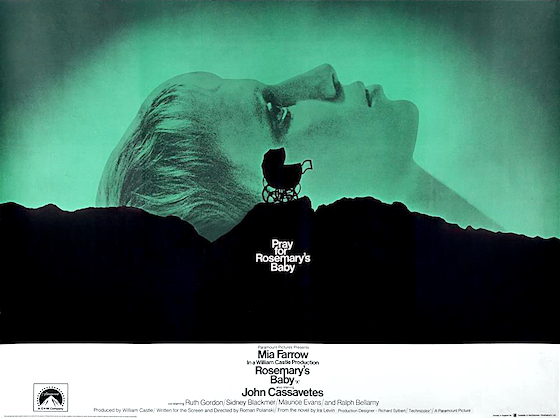
Rosemary’s Baby (1968)

Roman Polanski | 138 mins | UHD Blu-ray | 1.85:1 | USA / English | 18 / R

Rosemary's Baby

If you came to Rosemary’s Baby without any kind of context about its place in film history, you might well conclude it had been made in the last few years. Well, if you learnt about it on paper — visually, it’s obviously a film of the’60s thanks to its cinematography and production design (not a criticism; indeed, if anything, that’s praise). But in terms of its plot, its themes, its characters and their relationships, and what they might be signifying, that all feels quite ‘of the moment’. Maybe it did in the ’60s too. Maybe it has in every time period since — maybe that’s why the film has endured so well for over 50 years. (Plenty of other films have endured just as long — and longer — without feeling pressingly relevant to the present day, so I don’t want to overemphasise that point too much.) If it had been made more recently, the usual blowhards would be decrying it as “woke” and that it debases the traditional family unit, or something. The fact you can apply such ‘arguments’ as readily to something made over half a century ago as you can to something produced today is just one reason they’re absolute bollocks. But I digress.

To dig deeper into what the film is saying about such things, and how and why, necessitates some spoilers. I know some people think it’s ridiculous to consider spoilers in the context of a film as old as this, but there are always new generations and more people coming afresh to any film decades later — heck, I’ve only just watched it; that’s the whole point of this. That said, Rosemary’s Baby is sort of a self-spoiling film. We all know it’s a horror movie, so when it starts out like a pleasant slice-of-life domestic drama about a young couple moving into a new apartment building, making friends with their quirky neighbours, and deciding to start a family… well, we already know that’s not all it’s going to be, and the hints at more sinister goings-on are easy to spot.

Rosemary's scream

This is another way one might argue it feels modern, as it’s close to the “elevated horror” sub-genre that’s sprung up in the past few years. Again, the fact works like this have existed since at least the ’60s — and I’m sure there are other horror movies that could be similarly classified — shows that so many “new” things have actually been around before, we’ve just forgotten them, or not bothered to label them. Basically, rather than being an outright schlocky genre movie, it’s restrained and dramatic and realistic (in tone, at least). There’s not even an early fake-out jump scare to reassure you you’re watching a genre piece, a trick employed by so many films where the real frights only come in later. There’s a conceivable version of this film where the big reveal is that everyone’s normal, Rosemary was paranoid, and you’ve been watching a mental health drama, and literally all you’d have to change for that to work is the events of the final few minutes.

Indeed, it’s interesting to sort of take a step back and almost-objectively consider this as “a horror movie”. There are very few (if any) scares, and it doesn’t create the same kind of uneasy irrepressible mood as something like The Shining; although I would wager it can have a different effect on women, especially women of childbearing age, than it does on me, because the horrors are that much closer to home. I don’t think it’s failing in those respects — it’s not setting out to terrify you and then failing to achieve it — I just think it’s going for a different kind of horror. It’s the slow realisation that something is not just ‘not right’ but definitely very wrong; and by the time you grasp the scale of it, it’s too late to do anything; and too insidious to convince anyone else that it’s real. In that sense, it really is a good analogy for things like toxic relationships that look fine to the outside world.

And that’s the way in which the film is most modern, as I was saying at the start. Its central concerns seem to be issues of women’s bodily autonomy, controlling relationships, the way they isolate their victims and lead to abuse. If you want to close your senses to such unmissable subtext, I guess you could still see the film as no more than a genre piece about (spoilers!) a cult trying to birth the Antichrist, but I think you’d be burying your head in the sand to do so. Sure, the film doesn’t expressly call those elements out — doesn’t underscore them, or bluntly explain that’s what’s going on in modern terminology — but they’re inescapably in the mix. I do think that’s a difference between the film having been made in the late ’60s vs today: now, it would be hard to resist thoroughly leaning into those themes and making them more overt, because they’re things we’re much more aware of as a society, and much more concerned with combating. Again, it’s not that they’re exactly subtle here, but you get the sense some of the psychology involved was still not widely understood; that there perhaps wasn’t yet the agreed-upon terminology to explicitly call it out, other than to present it and show how negative it was.

Controlling relationships

All of which said, the timeliness or otherwise of the film’s concerns is irrelevant to its overall quality. As much as it would be a key point of interest to some, I’m sure it’s of no matter to others. Either way, though, Rosemary’s Baby remains a compelling story because of how it grounds its supernatural goings-on in day-to-day life. Without playing the “is it or isn’t it” angle, it nonetheless renders them almost mundane — these devil-worshippers aren’t wearing robes, enacting elaborate arcane rituals in ancient stone circles in the British countryside: they’re modern-day Americans, living pretty typical lives in a New York apartment block. Horror can exist everywhere and anywhere; it is everyday. Oops, maybe we’ve come back round to making a sociological point again…

5 out of 5

Rosemary’s Baby is the 82nd film in my 100 Films in a Year Challenge 2024. It was viewed as part of Blindspot 2024. It was my Favourite Film of the Month in October 2024.

The Swordsman of All Swordsmen (1968)

aka Yi dai jian wang

Joseph Kuo | 86 mins | Blu-ray | 2.35:1 | Taiwan / Mandarin | 12

The Swordsman of All Swordsmen

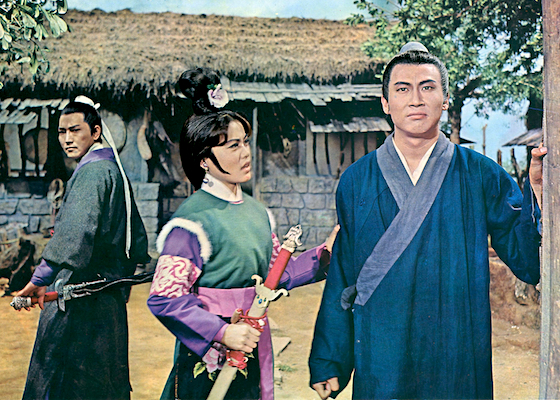
Revenge is a dish best served cold, according to the Klingons, and Tsai Ying-jie (Tien Peng) is the embodiment of that mantra. As a young child, he witnessed his whole family murdered by group of assassins who wanted his father’s legendary sword. As an adult, he’s a fully-trained expert swordsman, and the time has come for vengeance. As word of his victories spreads, he’s intercepted by Flying Swallow (Polly Shang-Kuan Ling-Feng), who tries to persuade him off his murderous path, and Black Dragon (Chiang Nan), who seeks to cement his reputation as the foremost swordsman by defeating Tsai in combat.

It’s pretty standard fare as wuxia plots go — I suspect that was as much the case in 1968 as it is today — but the art, as is so often the case, lies in the execution. Director (and co-writer) Joseph Kuo hits the ground running: we meet Tsai as he arrives in the town of his first target, and just minutes later they’re duelling. His motivations are only then revealed via flashback. The film runs a tight 85 minutes, and in that time manages to pack in seven sword fights and still find room for some honour-based moral conflict. The action comes thick and fast (that’s an average of a fresh duel starting every 12 minutes, maths fans) but remains thrilling throughout. That said, I do love a good sword fight, so I’m somewhat biased. While some of the direction almost borders on perfunctory (it’s fine, but nothing remarkable), other parts are glorious — the fights, in particular; and the finale, especially, is quite gorgeous.

Swordsmen, swordswoman, swordspeople

In between the action, the film pauses to consider the morals. It’s hardly a think-piece, but it does make a reasonable thematic argument against generational conflict… although Flying Swallow only tries to convince our hero to alter his course after he’s already taken revenge on four out of five targets, so it does come across as too little too late. Still, it matters because honour and rightness are major concerns in films like this, and those considerations have a key role in how the final two bouts play out. Kuo’s background was in romances and melodramas (before the success of King Hu’s Dragon Inn caused the Taiwanese film industry to shift focus), so perhaps he brought a greater understanding — certainly, a greater interest — in human emotion to the film than you’d get from your run-of-the-mill combat junkie. That the film doesn’t have excessive time to spend navel gazing means these quandaries add to the texture, rather than overwhelming it or making us feel too guilty for enjoying the spectacle of clashing blades.

Eureka’s blurb notes this is the first part of a trilogy about Tsai Ying-jie, followed by The Bravest Revenge and The Ghost Hill. They sound pretty cool and borderline insane (the third apparently involves Tsai and Swallow going to Hell), though Kuo wasn’t involved in them (contrary to what Eureka’s blurb claims). Still, I’d welcome Eureka bringing them to disc too.

4 out of 5

The Swordsman of All Swordsmen is the 66th film in my 100 Films in a Year Challenge 2024. It was my Favourite Film of the Month in August 2024. It placed 13th on my list of The Best Films I Saw in 2024.

Black Girl (1966)

aka La Noire de…

Ousmane Sembène | 59 mins | Blu-ray | 1.33:1 | Senegal & France / French | 15

Black Girl

Let’s be upfront about this: I’m a middle-class Western white man who herein will be critiquing a film made by a black African filmmaker about the life of a black African character. I’m stating this baldly because I wouldn’t want anyone to think I wasn’t aware of the potential connotations and pitfalls of that situation, especially as I’m about to challenge (what seems to me to be) the accepted reading of the work in question. Spoilers follow.

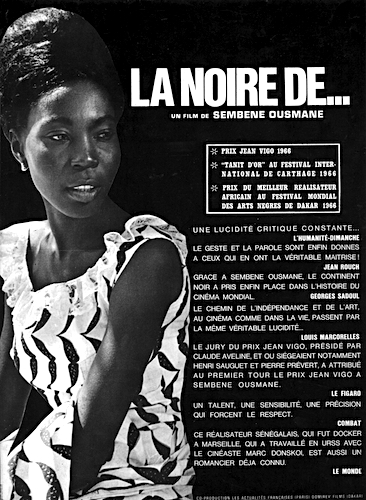
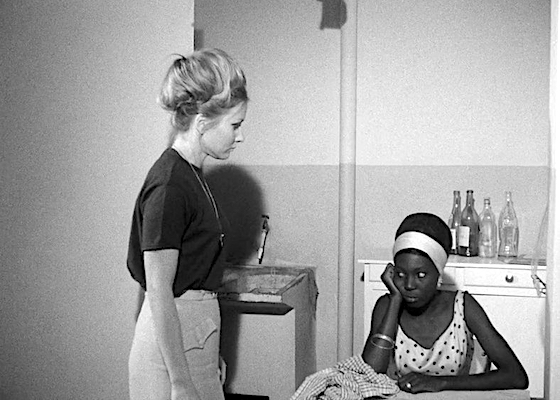
Believed to be the first feature film made by an indigenous black person from sub-Saharan Africa, Black Girl is the story of Diouana (Mbissine Thérèse Diop), a Senegalese women who is looking for work as a maid and finds employment babysitting the children of a French family. When they return to France, she is the only servant to travel with them; but the glamorous life on the Riviera that she’d imagined turns out to be one of drudgery, confined to the couple’s apartment, the children now nowhere to be seen.

What little I’d read about Black Girl beforehand led me to expect something about modern slavery; the eponymous black girl being mistreated by her white employers in such a way that, even though it’s the 1960s, she’s still basically a slave. Most of what I’ve read since viewing has confirmed that as the standard reading of the film. I’m not going to dispute that that’s one aspect of what’s there, but only the sum total of it if we take Diouana’s reactions and narration at face value. I mean, life in France is clearly not all she was promised; but she was looking for work as a maid and, while that wasn’t what she was doing for the family initially, the tasks they’re now asking of her don’t seem that out of step with a maid’s duties. And she gets paid for doing them. There is a period when Diouana complains (in her internal monologue) that she’s not getting paid, but the film is a little unclear on timescale — when the husband eventually gives Diouana her wages, it feels like payday has finally arrived, rather than that she’s been denied them for an unfair period of time.

Equally, there’s no denying that the wife is a demanding and demeaning bitch; and when they have some guests round for a meal, there’s the kind of casual racism that white people like to dismiss as “fun and games”, but is still degrading in its own way. So, I’m not saying Diouana is wrong to be upset with how things have turned out, but I do think the interpretation that she’s subjected to modern slavery — as opposed to just unfavourable employment — is taking things a little too far.

White bitch

The key to how I interpreted the film is to realise that Diouana is more than upset — she’s depressed. Taken as a portrait of Diouana’s failing mental health, the film makes much more sense to me. Stranded in France with no one but her employers — thus, no one she can talk to honestly — her thoughts spiral round and round in her head, sinking lower, like some kind of self-fulfilling negative prophecy. It also made me wonder if we should consider Diouana an unreliable narrator. Almost the whole film is presented from her perspective, much of it via her thoughts in voiceover. So, for example, we’re told a lot about how bad her employer is before we see any sign of it; and we’re told what she was promised about France, but we never see those promises being made. Could it be she was offered to go to France, which she interpreted it as “you’ll get to see France”, but her employer never actually promised that? We don’t see the offer being made; we only have Diouana’s word for what she was promised.

Going back to my opening clarification, I appreciate that this kind of analysis might lead some to accuse me of unconscious racism — as a white person, thinking the black character might be lying and the white people are alright really, despite the evidence. But I’m not saying they are alright — they’re clearly not treating Diouana with as much humanity as she deserves — and I’m not saying she is lying, just that the film doesn’t give us hard evidence to confirm it; we only hear her memory of events. Even then, I wouldn’t say she was “lying”, just that she’d misinterpreted the situation.

Personally, that’s the only way what unfolds makes sense to me: that Diouana is misunderstanding things due to being mentally unwell. This is most relevant in how the story ends, with Diuoana taking her own life as her only route of escape — but, also, it’s the first route she takes. She doesn’t try to speak to her employers and improve her situation. Okay, maybe they wouldn’t listen, or she thinks they wouldn’t — it’s understandable not to even try under those circumstances. But she also doesn’t ask to be sent home. There’s no reason to think they wouldn’t agree to that — they’re not actually imprisoning her. They might not be pleased about it — they’ve brought her with them to do a job she was employed to do, after all — but that doesn’t mean they wouldn’t agree. Even if she thought they were holding her captive, she doesn’t attempt to escape. Sure, she’s in a foreign country and doesn’t know who to turn to — escape might not be easy — but it’s an option that doesn’t seem to cross her mind.

Just upset, or clinically depressed?

No, instead of any of that, she turns straight to death. As I see it, that’s the ‘logic’ of someone who’s mentally ill. That’s not someone who is merely unhappy with their situation and decides it needs to change; that’s someone who is mentally unstable and makes a bad choice. If she was genuinely enslaved — if her life was abusive and miserable and there was genuinely no other way out— then you could make an argument that, in those circumstances, taking your own life is a viable choice for escape. But that’s not the situation she’s in. Her life is not nice — it’s certainly not what she was hoping it would be — but it’s… fine? Like, other people might be content with that setup, especially if it was only temporary (we don’t know how long they’ve been in France, but the implication is weeks or a couple of months, at most; and it comes up that they might just go back to Dakar soon anyway). But instead of waiting it out, or asking to change it, or asking to leave, or running away from it, Diouana goes directly to the most final option.

Now, maybe I’m projecting a modern understanding of mental health onto the film; but the alternative (that we’re supposed to think Diouana is wholly in the right and her actions are reasonable given the circumstances) doesn’t add up for me. This also raises the question of authorial intent: was Sembène intending to explore mental health, or was he focused on racism and colonialism? I haven’t read any direct statements from him, but certainly most critics assume the latter. Normally I’m happy to write off authorial intent (“death of the author” ‘n’ all that), but I think authorship is particularly important in this case (being that it’s the first film by a black African director about the black African experience). To be honest, I don’t know for sure what he was intending — I haven’t seen any direct statements by Sembène — but the film as a whole is well-made, nicely shot and intelligently constructed (for example, using flashbacks for a nonlinear narrative), with characters who seem plausible rather than caricatures in aid of a political point. All of which is a roundabout way of saying that I think it stacks up as a psychologically-accurate depiction of someone in that situation, whether it was consciously made to be about mental health or not.

4 out of 5

Black Girl is the 7th film in my 100 Films in a Year Challenge 2023. It was viewed as part of Blindspot 2023.

Archive 5, Vol.6

Hey, wouldja look what it is! After getting off to a fairly strong start back at the beginning of 2022, I allowed my Archive 5 strand to fall by the wayside while I made a concerted attempt to stay up-to-date reviewing my new viewing (with mixed success). But now it’s back, hopefully on a more permanent basis. And I guess going forward it should include what’s left of 2022, because otherwise I’m stuck trying to catch up on those reviews before I can even begin 2023. But not just yet, because I selected today’s five films back when Vol.6 should originally have been posted (last February, gasp!)

For those who’ve forgotten, I have a backlog of 421 unreviewed feature films from my 2018 to 2021 viewing (448 if we add in 2022 too). This column is where I give those films their day, five at a time, selected by a random number generator.

Today, some films sizzle with heat or tension, while others fizzle into disappointment. This week’s Archive 5 are…

  • Paris When It Sizzles (1964)
  • 7500 (2019)
  • The Rhythm Section (2020)
  • Carefree (1938)
  • The Lie (2018)


    Paris When It Sizzles

    (1964)

    Richard Quine | 110 mins | digital (HD) | 16:9 | USA / English | U

    Paris When It Sizzles

    William Holden and Audrey Hepburn are clearly having a whale of a time in this marvellously cine-literate romp about a struggling screenwriter (Holden) and the secretary (Hepburn) hired to type up the script he hasn’t actually started. With the deadline just two days away, the pair rush to put a script together, which plays out as a film-within-a-film, also starring Holden and Hepburn, and allowing them even more fun as they get to overact extraordinarily. The “inside baseball” feel of the thing is furthered by a handful of surprise cameos.

    Perhaps it’s me just misjudging the era, but the whole thing feels somewhat ahead of its time. In the way its such an insider’s riff on the movie industry, it feels like something you wouldn’t expect to have emerged until maybe the ’90s (The Player being an obvious point of reference). How well that worked for audiences at the time, I don’t know — maybe it did come across as too esoteric — but, viewed today by anyone with an idea of the history and inner workings of the Hollywood machine — it’s a lot of madcap fun.

    5 out of 5

    Paris When It Sizzles was #129 in my 100 Films in a Year Challenge 2020. It placed 20th on my list of The Best Films I Saw in 2020.


    7500

    (2019)

    Patrick Vollrath | 93 mins | digital (UHD) | 2.39:1 | Germany, Austria & USA / English, German & Turkish | 15 / R

    7500

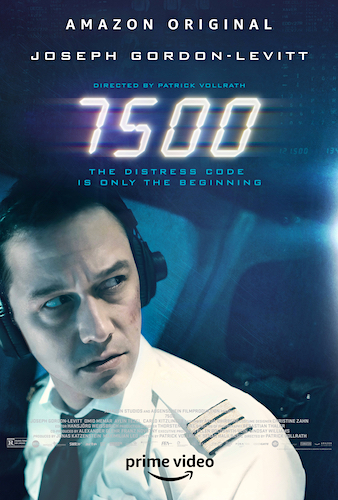
    After a title sequence that uses security camera footage to follow some shifty-looking blokes around Berlin airport, the film fades up in a passenger airplane cockpit as the crew arrive and begin their regular pre-flight routines. It’s a location we won’t leave for the next 80 minutes, as the unremarkable flight to Paris takes a turn when the aforementioned shifty-looking blokes attempt to invade the cockpit mid-flight, leaving it up to copilot Joseph Gordon-Levitt to try to rescue the situation.

    A tense thriller set entirely in one confined location and told in (near-as-dammit-)real-time? This film could have been made just for me. Suffice to say, I was suitably pleased. This kind of style and pace clearly won’t be to everyone’s taste (I mean, the first 15 or so minutes are almost entirely about watching the pilots just doing their everyday job), but there’s something about the format that does it for me. I think it’s something to do with the inescapability of real-time — that what’s happening and what will happen is going to last as long as it lasts, no shortcuts — that serves to underscore the tension of a thriller storyline. That said, in this case the final act does lose some of the momentum and tension, as much as it tries to maintain it, meaning it feels like it limps to the end, with the really suspenseful stuff having expired a little after the hour mark. It’s not that this final act is bad, just that it feels like a comedown from what’s gone before.

    Still, Gordon-Levitt is great throughout, carrying a large chunk of the film singlehanded, and there’s ultimately a more nuanced treatment of the terrorists than you might expect. I saw someone criticise it for trying to humanise one of them, as if that was problematic. Sure, terrorists are bad guys, but they’re still human beings underneath, and they’ve been plenty demonised enough in plenty of less thoughtful media — I’m not sure it should be considered controversial or a step too far to suggest that one of them (out of four) might be a misguided teenager rather than Evil Personified. On the flip side, I read another review that trashed the film for “featuring brown terrorists again”. I imagine those two reviewers would have a lot to disagree about…

    4 out of 5

    7500 was #144 in my 100 Films in a Year Challenge 2020.


    The Rhythm Section

    (2020)

    Reed Morano | 110 mins | digital (HD) | 2.39:1 | UK & USA / English & French | 15 / R

    The Rhythm Section

    I don’t know about you, but sometimes I watch movies with a bad rep in case I see something in them that everyone else* missed — because that does happen. In that vein, The Rhythm Section isn’t some overlooked masterpiece, but I don’t really get why everyone hated it so much.

    Blake Lively uglies up and forces an English accent to star as Stephanie Patrick, a drug-addicted prozzie who used to be a pretty Oxford student until her family died in a plane crash three years earlier, which a journalist now tells her was a terrorist attack that MI6 have covered up. Events lead her to a disgraced agent (Jude Law) who agrees to train her to hunt down the people responsible.

    Hardly the most plausible storyline ever, but it’s no more ludicrous than many a thriller. So, as a genre piece, well, it’s certainly not the greatest action-thriller ever made, but it’s decent overall with a couple of neat twists on the usual formula. The primary one is that our heroine isn’t actually very good at being an action hero and keeps fucking up. Normally these films are about highly competent super agents (Jason Bourne, John Wick, etc), or newbies who take to it like a duck to water. Stephanie’s borderline incompetence is not only a mite more realistic, it makes a refreshing change, and at times is even successfully used to heighten the tension.

    Unfortunately, other aspects were stale on arrival. For no reason, it begins halfway through and then does the “8 Months Earlier” thing. This is a personal bugbear of mine, because it’s a trick that’s been used to death at this point, routinely trotted out to no real purpose. Usually it’s used as a cheap way to deliver some action upfront because otherwise there won’t be any until somewhere in Act Two, which is just an insult to the audience’s attention span. In other cases, the film just got unlucky. I imagine when they conceived of a single-shot car chase it seemed like an original idea — as it probably did to all the other filmmakers who attempted the same thing around the same time; not least Netflix’s Extraction, which did it bigger and therefore better. Oh well.

    Ultimately, I suppose The Rhythm Section is fundamentally derivative, with only fleeting moments of originality. But I still thing everyone else was overly negative — it’s not bad, just not strikingly fresh. I think if you enjoy Bourne-esque action-thrillers, you should enjoy this.

    3 out of 5

    * It’s never everyone else, but you know what I mean. ^

    The Rhythm Section was #138 in my 100 Films in a Year Challenge 2020.


    Carefree

    (1938)

    Mark Sandrich | 83 mins | digital (SD) | 4:3 | USA / English | U

    Carefree

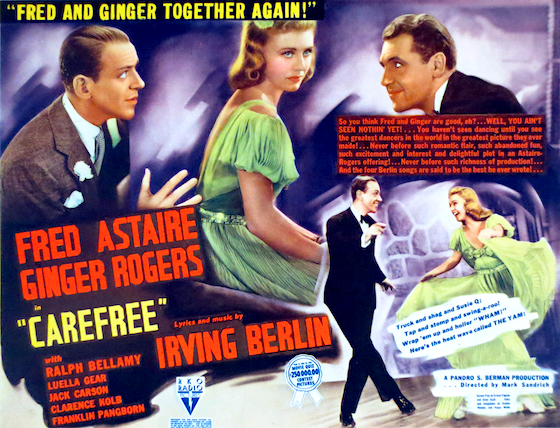
    Fred Astaire is a psychiatrist prone to misogynistic views and unethical practices who mimes playing the harmonica and performs dance routines with golf balls, and Ginger Rogers does a song & dance about yams (because Astaire thought it was so silly, he refused to sing it. He was right). Yeah, I think it’s fair to say this isn’t the couple’s finest hour. The public agreed: this was the first Astaire-Rogers film to lose money on its initial release.

    That said, it’s not without the occasional charm. Rogers still shines — the sequence where she goes around playing naughty pranks with a cheeky grin while under the influence of anaesthetic is a delight — and there’s a slow-motion dream-sequence dance that is rather lovely. But these are fleeting pleasures amongst the distasteful storyline (see: my description of Astaire’s character) and less refined moments (there’s a song about yams).

    2 out of 5

    Carefree was #97 in my 100 Films in a Year Challenge 2021.


    The Lie

    (2018)

    Veena Sud | 95 mins | digital (UHD) | 2.39:1 | USA / English | 15 / R

    The Lie

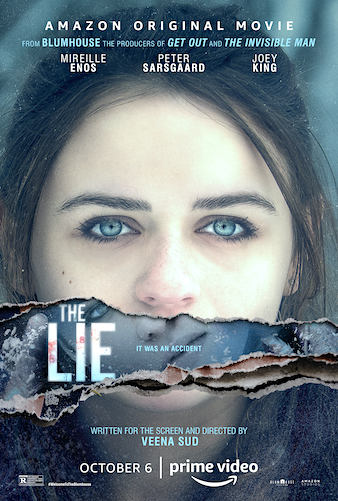
    Although it debuted to most of the world as one in a series of eight Blumhouse original movies that premiered together on Amazon Prime in 2020, The Lie is listed as a 2018 film because that’s when it premiered at TIFF under a different title (Between Earth and Sky). The fact it went from being a standalone production to one of a series released en masse provides a clue as to how well it went down.

    The film has a solid premise that starts out well enough: a father (Peter Sarsgaard) and daughter (Joey King) are driving to a ballet retreat when they spot her best friend waiting by the side of the road, so they offer her a lift. Later, they stop in the middle of nowhere so the friend can go to the bathroom, but she falls off a bridge into an icy river. Or possibly the daughter pushed her. Either way, presumably she couldn’t survive the fall, and her body has washed away. Fearing how all that would look, they set about covering it up… which is where things go awry, both for the characters and us viewers. The longer the story goes on, the further it departs from actions and consequences that feel plausible. It’s not ludicrously far-fetched, it just doesn’t feel right; like people wouldn’t make those decisions, or those decisions wouldn’t have those consequences. The lead cast give it their best shot, but they’re battling against material that’s below their skills.

    Then there’s an inevitable last-minute twist that just hurls the whole thing off a bridge. Kate Erbland for IndieWire wrote that it “should rank among the all-time great fake-outs,” and she’s sort of right: it could have been a reveal for the ages, but rather than eliciting a pleasant “OMG I don’t believe it!”, it plays as “ugh, I don’t believe it.”

    2 out of 5

    The Lie was #245 in my 100 Films in a Year Challenge 2020.


  • High and Low (1963)

    aka Tengoku to jigoku

    Akira Kurosawa | 144 mins | Blu-ray | 2.35:1 | Japan / Japanese | 12

    High and Low

    Akira Kurosawa has a good many classic films to his name, but, according to users of both IMDb and Letterboxd, this is the second best of them all — and, on the latter’s list, the 12th greatest film ever made, to boot. No pressure.

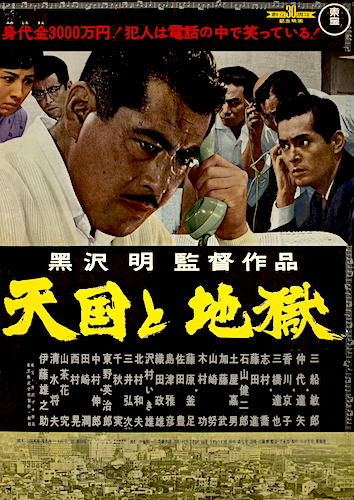
    Adapted from the American crime novel King’s Ransom by Ed McBain, the film stars Toshiro Mifune as a business executive who we first meet being wooed to join a potential coup of the company. (The film rattles through a few twists early on to set up its initial dilemma, which I’m now going to spoil, so if you want to go in completely cold, jump to the next paragraph.) In fact, Mifune is plotting his own takeover, paid for by leveraging everything he has. But then, his young son is abducted, with the kidnappers demanding a huge ransom — if he pays, his carefully-laid plans will be impossible to execute; but it’s his son! But then, it turns out it isn’t his son — the crooks took the wrong boy, instead kidnapping the son of Mifune’s lowly chauffeur. But they don’t know that, and there’s no way in hell the poor chauffeur could pay a ransom. What’s a man to do?

    Some might power a whole film on that storyline and dilemma, but it’s only the beginning of High and Low. Its original Japanese title (天国と地獄) literally translates as Heaven and Hell, and, as both monikers indicate, this is a film of two halves; of opposing forces; of extreme choices. Without wishing to spoil any more of what goes down, I’ll say that almost the first hour of the film takes place almost entirely in a single room. It feels like the whole thing might unfurl there, a la Hitchcock’s Rope — almost a formal exercise in telling a story from a single setting. But then it moves to an immediately more dynamic locale — a train — for a properly thrilling sequence, around which the story and structure pivots. The rest of the film goes ultra-procedural. A lengthy scene early in this half depicts a police debriefing in a manner that feels almost documentarian, as if we’re witnessing a genuine meeting filmed and presented in real-time, as various detective duos update senior officers and their colleagues on the specific aspect of the case they’ve been working.

    Hanging on the telephone

    This eye for detail, presented with a degree of mundanity, makes the film feel extra realistic. That extends to the final details. No spoilers, but, although you may call this a Thriller due to the type of story being told, it doesn’t climax with a big twist or revelation; no reveal of some super-clever grand plan that, with implausible foresight, anticipated and accounted for everything that’s happened. Rather, the film seems to proceed methodically and logically through every thread of investigation and consequence for its primary characters, until it simply has no more left to tell.

    It’s certainly a fine piece of work — although, on first watch, I’d say I’ve seen several better examples of the genre and several better films by Kurosawa. But that isn’t truly a criticism of the film, rather of its high placing on the lists mentioned at the start. Awareness of such accolades has a tendency to overshadow any first viewing of a film that warrants them (just witness how many people are underwhelmed by Citizen Kane), so I look forward to returning to High and Low sometime under less pressure.

    5 out of 5

    High and Low is the 30th film in my 100 Films in a Year Challenge 2022. It was viewed as part of Blindspot 2022. It placed 6th on my list of The Best Films I Saw in 2022.

    2022 | Weeks 14–15

    Only four reviews this time, taking us up to April 17th. It was going to be five, but then Spider-Man got far too long. So, we’re left with…

  • Withnail & I (1987)
  • Munich: The Edge of War (2021)
  • tick, tick… BOOM! (2021)
  • Move Over, Darling (1963)


    Withnail & I

    (1987)

    Bruce Robinson | 103 mins | digital (HD) | 16:9 | UK / English | 15 / R

    Withnail & I

    This may be a beloved cult comedy in its own right, but I can’t help but make comparison to a certain other British cult property. You see, each of the three primary cast members — Richard E. Grant (Withnail), Paul McGann (‘I’), and Richard Griffiths (Uncle Monty) have an atypical relationship to the lead role in Doctor Who. That has no bearing on the film itself, not least because their involvement (or non-involvement, in one case) took place years later, but it’s a correlation I can’t shake. I mean, what other work can claim to star the man who was simultaneously the shortest and longest serving Doctor; the man who was definitely, officially the new canonical Doctor, until he wasn’t; and a man who might well have been the Doctor if things had gone to plan? Nothing else that I can think of, that’s for sure.

    Setting all that aside, everything about Withnail & I screams “cult favourite”, and I guess that’s what it is — not a film that started out with a dedicated fanbase before being subsumed into the mainstream, but one that remains beloved of a relatively few devotees. Perhaps that explains why it’s one of those films I thought would’ve wound up on my Blindspot list by now, but never has: because it lacks that crossover appeal. (Maybe I need to factor in some lists of cult and/or British movies when compiling my Blindspot choices.) Coming to it afresh in 2022, aware of that rep it’s built up over the last 35 years, does it no favours. The characters aren’t likeable or interesting enough to truly enjoy hanging out with (even as they’re convincingly brought to life by the talented cast); the “gay panic” stuff that drives several sequences lands differently now than I suspect it did in 1987; and the supposedly never-ending quotable lines didn’t materialise (there are a small handful of memorable ones, at least). That said, there are quite a few lines that would be fun for a game of “did Paul McGann say this in Withnail or in Doctor Who?” (Oops, sorry to bring that up again.)

    The best bits of Withnail have been dulled by repetition out of context (variations on “we’ve gone on holiday by mistake” are a certifiable meme at this point), and I suspect I personally left it too long to see it, allowing it to build up too much of a reputation. I didn’t dislike it, I just wasn’t won over.

    3 out of 5


    Munich: The Edge of War

    (2021)

    Christian Schwochow | 129 mins | digital (UHD) | 2.39:1 | UK & USA / English & German | 12 / PG-13

    Munich: The Edge of War

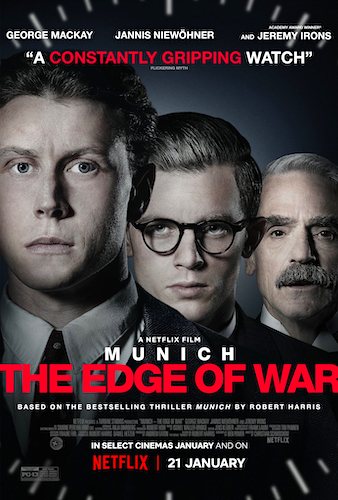
    Robert Harris has been a best-selling author for decades, but his works have had a rockier reception on the screen; perhaps not helped by the fact a couple have been helmed by director non grata Roman Polanski. Harris’s stock in trade is fictionalised tellings of historical events — the eruption of Vesuvius in Pompeii; the politics behind the invasion of Iraq in The Ghost; and so on. His 2017 novel Munich is set around war-avoiding negotiations between Adolf Hitler and Neville Chamberlain that took place in the titular city in 1938. This film adaptation gains a subtitle, presumably to differentiate it from Steven Spielberg’s Best Picture nominee, which retold entirely different historical events.

    The big names aren’t the main characters, however. Those would be a pair of low-ranking civil servants from the opposing sides: Brit Hugh Legat (1917‘s George MacKay) and German Paul von Hartmann (Jannis Niewöhner), former university chums who fell out when Hitler came to power. Now, von Hartmann is disillusioned with the Nazi regime and wishes to pass information to the British, but will only make contact with Legat, thus roping the inexperienced diplomat into the world of espionage, untrained. If the storyline is ringing bells, perhaps you too recently watched The Courier with Benedict Cumberbatch. It’s not an identical narrative — I’m not accusing anyone of plagiarism here — but there are definite parallels. Legat even has a strained relationship with his wife, who he has to leave at home and not tell the truth.

    But where the story in The Courier was true, and thus lent an inherent fascination, the story of Legat and von Hartmann is fictionalised. That’s not necessarily a problem — most thrillers are entirely made-up, of course — but Munich is hampered by feeling kind of muddy. It’s not so bad as to be described as muddled, but does seem like it’s perhaps the victim of being badly truncated from the book, or possibly just in its own edit. It’s not always clear what the point is of what we’re watching, or where certain characters have disappeared off to. That makes the overall experience longer and, occasionally, more plodding than it needs to be.

    That said, though it takes time, it does eventually develop the tension it needs; and it has definite merit for depicting a bit of history that’s normally relegated to footnote status. Indeed, it makes an interesting argument for “what Chamberlain did was good, actually”, which is not the normal point of view on politicians’ pre-WW2 actions.

    3 out of 5

    Munich: The Edge of War is the 27th film in my 100 Films in a Year Challenge 2022.


    tick, tick… BOOM!

    (2021)

    Lin-Manuel Miranda | 120 mins | digital (UHD) | 2.39:1 | USA / English | 12 / PG-13

    tick, tick… BOOM!

    Rent was one of the definitive Broadway musicals of the ’90s, but its creator didn’t live to see its success: composer, lyricist, and author Jonathan Larson died, with poetic timing, the night before the show’s premiere. It came after years of Larson struggling trying to break into the industry, much of which was documented in his semi-autobiographical (almost-)one-man show, Tick, Tick… Boom! This film adaptation broadens out and adds additional detail to become a more direct biopic of Larson, albeit one with musical numbers.

    Struggling musical theatre people in Manhattan… Yes, some people are going to find this insufferable. Others will look upon it as a dream life, especially as any actual hardship (Larson’s apartment didn’t have heating, for example) is played down or romanticised. Even setting that side, it remains the kind of movie that will speak to anyone who’s dreamt of making art (especially if that art is musical theatre), but might leave others (primarily those without such ambitions) identifying more closely with some of Jonathan’s friends — “there are bigger things to worry about,” they say.

    In the centre of it all is a pitch perfect performance from Andrew Garfield. He throws himself into the role, transformatively so: his Larson seems to be powered by a restless enthusiasm that I don’t think I’ve seen the actor portray in anything else. In the musical numbers, he holds his own against much more experienced singers (Garfield couldn’t even sing before production began — he spent a year learning and practicing).

    This is more than just a ‘one good performance’ film, though. Although based on a stage show, the screen version certainly doesn’t feel stage-bound, coming to cinematic life through Alice Brooks’s photography and Myron Kerstein and Andrew Weisblum’s editing as if it had always been meant for the screen. However, many people have been critical of Lin-Manuel Miranda’s direction. While I wouldn’t shout it out as anything amazingly special, I also don’t think it’s bad. You routinely see lesser work in Marvel movies, for example.

    4 out of 5


    Move Over, Darling

    (1963)

    Michael Gordon | 99 mins | digital (HD) | 2.35:1 | USA / English | U

    Move Over, Darling

    Doris Day and James Garner star in this remake of My Favourite Wife, one of the trio of screwball comedies Irene Dunne and Cary Grant made together, and which I watched back in May 2020. Two years ago?! Time flies. Despite which, I’ve not reviewed it yet.

    Well, Move Over, Darling is an incredibly close re-envisioning. If someone authoritative told me it used the same screenplay with only minor tweaks, I’d believe them. I’m sure it’s not that close, in actual fact, but it’s darn near it. Certainly, one bit is definitely new: a fun sequence that sees Day recount the plot of the earlier film. Very meta. Alongside the screenplay, the remake also carries the original’s primary flaw, which is that they both lack the pace and snap of the very best screwball comedies. Day does her best to enliven the material, being a consistent source of fun and clearly game for a laugh — a sequence where she goes through a car wash in a convertible is a highlight. Garner can’t manage to equal Cary Grant, but who can?

    Nonetheless, on balance, I slightly preferred this version. That might just be due to my lowered expectations — knowing it had the double drawback of being (1) a remake, and (2) of a film I hadn’t particularly loved the first time, it was able to overcome that by simply being not too bad.

    3 out of 5


  • 2022 | Weeks 9–11

    Right, let’s try (again) to get things back on track.

    These compilations were/are meant to keep my reviewing roughly up-to-date with my viewing, but I don’t think stuffing them with too many films at once is the right way to go. I don’t know about anyone else, but I feel like five or six per post is about right (with some leeway, of course — I’m sure four or seven would be fine too). However, dividing like that means getting out of sync with Real Life, so I suppose I should clarify when “weeks 9–11” were: Monday February 28th to Sunday 20th March, to be precise. And back then, I watched…

  • Tintin and the Temple of the Sun (1969), aka Tintin et le temple du soleil
  • Los Olvidados (1950), aka The Young and the Damned
  • The Very Excellent Mr. Dundee (2020)
  • The King’s Man (2021)
  • Dirty Rotten Scoundrels (1988)
  • Nothing Like a Dame (2018)


    Tintin and the Temple of the Sun

    (1969)

    aka Tintin et le temple du soleil / The Adventures of Tintin: The Prisoners of the Sun

    Eddie Lateste* | 75 mins | DVD | 4:3 | Belgium & France / English | U

    Tintin and the Temple of the Sun

    This fourth big-screen outing for the Belgian reporter also continues the popular TV series, Hergé’s Adventures of Tintin, made by Belgian studio Belvision from 1957 to 1962. Having adapted ten of Hergé’s volumes for TV, here they tackled two more: two-parter The Seven Crystal Balls and Prisoners of the Sun. The story sees Tintin and chums head to Peru on the trail of their kidnapped friend, Professor Calculus, and to investigate an Incan curse that has befallen a previous party of archaeologists.

    Trekking up mountains and through jungles, with nefarious agents in pursuit, plus all the to-do with ancient curses and whatnot, this is chock-a-block with good old “Boy’s Own Adventure” stuff. As with so many of those, the joy lies in being swept along with the adventure rather than thinking about it too hard (our heroes are saved at the end because the Captain happens to have a scrap of newspaper that Snowy happens to steal that Tintin happens to fancy having a look at that happens to mention a handy forthcoming event). By the same token, there’s also the unavoidable effects of time: some of it feels a teensy bit racist nowadays; Tintin makes his way through the jungle merrily murdering animals left, right and centre. The animation itself is fine, with designs and an overall visual style that emulate Hergé well, but it does have a certain TV-ness.

    It’s also not available in the greatest of copies, at least to English-language viewers. Reportedly the original version contains two songs, both of which were cut from the UK video release, but only one of which has been restored for the DVD (and, I presume, the version currently available to stream from Apple, etc). Although most of the film is dubbed, the song is in the original French, unsubtitled; and has clearly been edited, because there are digital freeze frames around it. At the start of the film, the title card has been replaced in a similarly awkward fashion. Then there’s the 5.1 remix, which seems to be missing some effects and music cues. You can still enjoy the majority of the film despite these distractions, but it’s disappointing that we still have to put up with such palaver nowadays.

    3 out of 5

    Tintin and the Temple of the Sun is the 19th film in my 100 Films in a Year Challenge 2022.

    * Many (but not all) online sources list Lateste as the director, including IMDb, but the film itself doesn’t actually credit him — the only director-like credit is for “Belvision”. Lateste is credited as one of the screenwriters, at least. ^


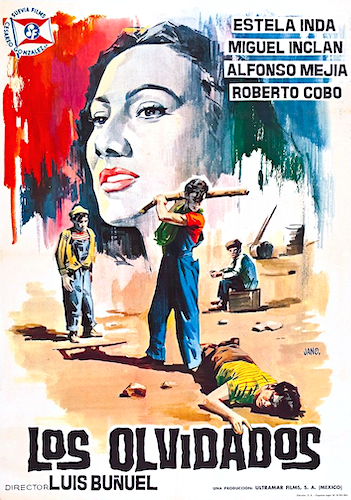
    Los Olvidados

    (1950)

    aka The Young and the Damned

    Luis Buñuel | 81 mins | digital (HD) | 1.37:1 | Mexico / Spanish | 12

    Los Olvidados

    Combine the literal translation of the film’s title — The Forgotten Ones — with the US retitling — The Young and the Damned — and you build a sense of what Los Olvidados (as it’s been released in the UK) is about. To be clearly, it’s a socially-realist depiction of life for children in the slums of Mexico City. Although initially condemned (according to IMDb, it only played for three days in Mexico before the “enraged reactions” of the press, government, and upper- and middle-class audiences caused it to be pulled), it’s since been reevaluated as one of the greats of Latin American cinema. Certainly, watching it after films like The 400 Blows (made almost a decade later), City of God (over 50 years later), and Capernaum (almost 70 years later), its influence is felt.

    The downside to that is the film feels somewhat less fresh and more worthy than the later efforts. It’s got an overt anti-poverty message that is admirable but sometimes heavy-handed (a school principal character feels like he’s been inserted just to state the film’s thesis out loud) or naïvely optimistic (the opening voiceover asserts that child poverty will ultimately be solved by progress. Over 70 years later, I don’t think progress is doing a great job…) While much of the movie works at its intended goal, when aspects like these intrude it stops feeling like a realistic depiction of poverty and more like a straightforward polemic about how it should be fixed. On the bright side, it avoids the lure of a pat happy ending — although one was actually discovered in 2002, apparently shot to appease Mexican censors. Clearly they managed to get the film released without having to cave on that point, and it’s better for it.

    4 out of 5

    Los Olvidados is the 20th film in my 100 Films in a Year Challenge 2022. It was viewed as part of Blindspot 2022.


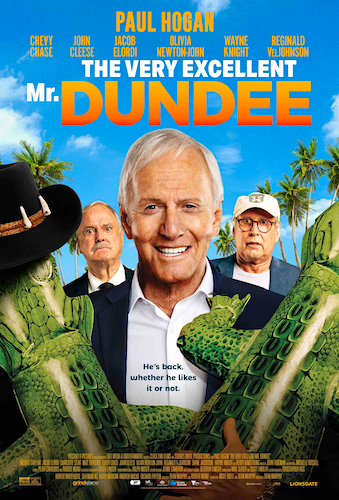
    The Very Excellent Mr. Dundee

    (2020)

    Dean Murphy | 88 mins | digital (HD) | 2.35:1 | Australia & USA / English | 12 / PG-13

    The Very Excellent Mr. Dundee

    Not a fourth Crocodile Dundee film, but rather a depiction of the accidentally-chaotic life of that series’ leading man, Paul Hogan, the archetypal Aussie now living in LA and, reaching his 80s, somewhat bemused by the modern world.

    Even from that quick summary, you can tell it’s not a terribly original premise. Couple that with a clearly small budget and you have a recipe for many dismissing the film out of hand. Personally, I found it to be surprisingly enjoyable, in a laidback, undemanding way. None of it is properly hilarious (though a bizarre musical sequence comes close), but it’s kinda amiable, and almost heartwarming at the end. Discerning viewers should perhaps not apply, but if you have any affection for the second or third Crocodile Dundee films (again, widely maligned instalments that I found passably entertaining), this is worth a punt.

    3 out of 5


    The King’s Man

    (2021)

    Matthew Vaughn | 131 mins | Blu-ray (UHD) | 2.39:1 | UK & USA / English | 15 / R

    The King's Man

    Co-writer/director Matthew Vaughn expands the Kingsman universe with this World War I-era prequel that delves into the backstory of how the eponymous organisation was founded. Unlike so many prequels, this does feel like a story worth telling — we don’t necessarily need it, but it’s not merely an exercise in visualising events we’ve already been told, or coming up with over-elaborate reasons for people’s names or whatever (why couldn’t Han Solo’s birth name have just been Han Solo, hm?)

    The story begins with Europe on the brink of war, and our heroes — led by the Duke of Oxford (Ralph Fiennes) — attempting to stop it. History tells us they fail, and so the narrative unfurls across WWI as they try to bring it to a close. That will see them come up against the manipulations of Rasputin (Rhys Ifans), who’s part of a secret organisation plotting to bring down the great empires.

    Let’s cut to the chase: the Kingsman films have a rep for elaborate fight scenes set to pop music. One of the major villains is Rasputin. You only need a passing familiarity with the disco hits of the ’70s to know what I was looking forward to here. Well, it doesn’t happen. Indeed, that stylistic calling card is more or less entirely abandoned (the fight does happen, of course, but it’s set to Tchaikovsky’s 1812 Overture — kind of like era-appropriate ‘pop’ music, I guess?) Apparently Vaughn did originally intend the sequence to be set to an orchestral version of the song in question, but ultimately felt it didn’t work.

    This, perhaps, speaks to another concern I had going in, which was that Kingsman’s highly irreverent, almost satirical tone might clash with the all-too-real WWI setting. Such an historical tragedy doesn’t feel right to be made light of in that way, even over a century later. So, as if to compensate, Vaughn and co have toned down the humour, making The King’s Man fairly serious… but without fully sacrificing the near-whimsy at other times, because, well, it’s part of the franchise. The result is a little awkward, tonally, swinging back and forth between historical seriousness and franchise-establishing fun. Put another way, it’s hamstrung by being an entry in a series known for its irreverence that feels the need to show due reverence to WWI. That’s a clash of values it struggles with, some might say admirably, but can’t quite reconcile. In short, it’s too serious to be a Kingsman film, but too Kingsman-y to be a standalone WWI-set action-adventure.

    I wouldn’t say it’s a disaster, by any means — but then, I enjoyed The Golden Circle when many lambasted it, so make of that what you will. Nonetheless, I’m looking forward to the next film getting back to Eggsy & co in the present day.

    3 out of 5


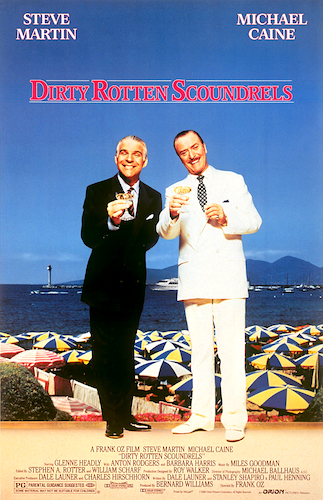
    Dirty Rotten Scoundrels

    (1988)

    Frank Oz | 110 mins | digital (HD) | 1.85:1 | USA / English | PG / PG

    Dirty Rotten Scoundrels

    Michael Caine and Steve Martin star as a couple of chalk-and-cheese con men, pilfering the fortunes of wealthy single ladies on the French Riviera, in this fun con caper with a neat sting in its tail.

    Caine hits just the right note as a charming con artist, his manner inspired by David Niven, who played the role in the original, 1964’s Bedtime Story. I was unaware the film was a remake until after watching it, though I did know it was itself subject to a gender-bent do-over in 2019, The Hustle. I don’t know how similar Bedtime Story and Dirty Rotten Scoundrels are, but, based on its trailer, The Hustle seems to be a direct lift from this, albeit peppered with the kind of pratfalling that’s de rigueur in modern big screen comedy.

    Marlon Brando was Niven’s co-lead, whereas here Caine gets Steve Martin as the very embodiment of a brash American — a little too brash, if anything, though reportedly there were bits he actually reined in. The running time could have done with a similar consideration, because it’s a little long for its breezy premise and tone (running 110 minutes, it would be better nearer 90), but that’s a minor complaint — it rarely feels too slow or draggy, just a little long overall.

    4 out of 5

    Dirty Rotten Scoundrels is the 21st film in my 100 Films in a Year Challenge 2022.


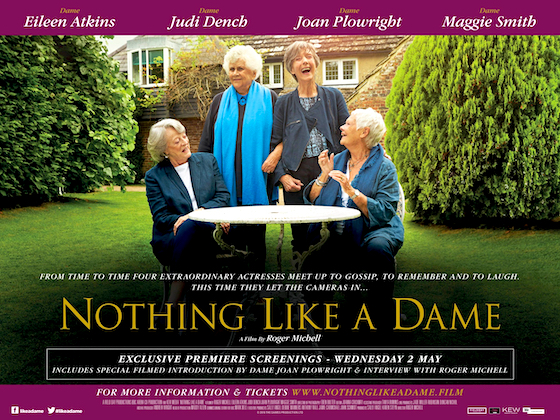
    Nothing Like a Dame

    (2018)

    aka Tea with the Dames

    Roger Michell | 77 mins | digital (HD) | 16:9 | UK / English | 12

    Nothing Like a Dame

    Four thespian friends, Dames all — Eileen Atkins, Judi Dench, Joan Plowright, and Maggie Smith — gather for a natter about their careers and lives. That’s it, that’s the film.

    Given the setup, plus the style of advertising and US retitle, you’d be forgiven for expecting a gentle bit of fluff; eavesdropping on a pleasant chinwag with four venerable British actresses. The film is that, in places, but it also has a surprising undercurrent of sadness running throughout, as these ageing ladies reflect on the ups and downs of their careers and personal lives now that they’re (shall we say) closer to the end than the beginning. It rarely bubbles to the surface, but it always feels like it’s there, somehow inescapable.

    If that gives proceedings more texture than you might’ve expected, then the film’s biggest flaw lies elsewhere. For me, it’s that it wasn’t long enough. The conversations are often delightful and occasionally insightful, but you feel like there’s so much more to be gleaned from these women. The film chops about between topics and pairings, always feeling like we’re getting snippets of the full conversation, never the true depth; like we’re watching a highlights reel of what should be a three-hour series, or something like that. I know it’s an old theatrical adage to “leave ’em wanting more”, but I really did want some more.

    4 out of 5


  • 2022 | Weeks 4–6

    It’s been a busy start to the year… at my day job, which has had the knock-on effect of lower film viewing than has been the case in recent years. (I say that, but as February passes its midpoint, I’ve actually watched slightly more films than I had at the same point in 2020; but the last time I was lower than that was right back in 2014, so…)

    As well as work, there’s the psychology of my new reviewing practices. These regular up-to-date roundups have taken me right back to the days when I used to review everything in order, and how not being caught-up on my reviews made me not want to watch anything more. I’m getting those same kinds of twinges now. I need to try to use them to my advantage — take the time to read more books or something.

    Anyway, enough about me — let’s have some film reviews…

  • Voyage of Time: An IMAX Documentary (2016)
  • L’avventura (1960)
  • She’s Gotta Have It (1986)
  • Don’t Look Up (2021)
  • Jackass: The Movie (2002)
  • Jackass Number Two (2006)


    Voyage of Time

    (2016)

    aka Voyage of Time: An IMAX Documentary / Voyage of Time: The IMAX Experience

    Terrence Malick | 46 mins | digital (UHD) | 1.90:1 | USA / English | NR / G

    Voyage of Time: An IMAX Documentary

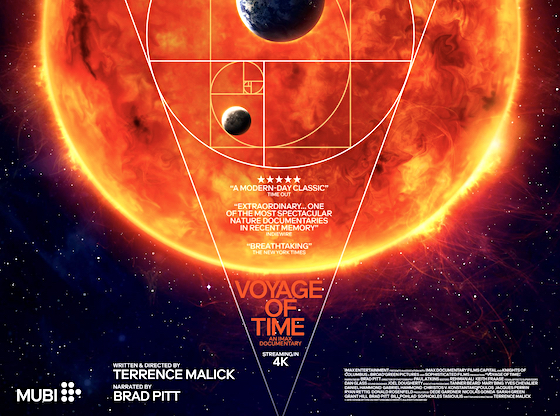
    Calling a film “a visual poem” sounds either clichéd or pretentious, or both, but how else to accurately describe this work by Terrence Malick? It’s labelled “a documentary”, because only because it’s not strictly fiction — if you come looking for the kind of education you’d get from something narrated by David Attenborough or Brian Cox, say, then I think you’d leave disappointed.

    No, film-as-poetry is the most appropriate way to attempt to engage with Voyage of Time; and, as with so much written poetry, your personal tolerance for and interest in it will vary. That’s how I found it, anyway: like most poetry, I felt I should appreciate it, but really was glad it was quite short. (The non-IMAX version of the film, subtitled Life’s Journey, runs about twice as long.) There’s some stunning photography, of everything from the birth of the universe to prehistoric vistas (presumably shot in remote modern-day locales rather than computer-generated), and Brad Pitt occasionally whispers some abstrusely meaningful ponderings over the top. As much as the pretty pictures are a draw, you can also find gorgeous nature photography in a BBC Attenborough documentary, and you’ll learn something at the same time.

    The IMAX version of the film has been streaming on MUBI since the end of last year, and they definitely sold it on the visual experience, boasting about offering it in 4K. I found the quality to be variable, with the stream unable to keep its end up for the whole running time, sometimes sinking to sub-1080p levels, becoming blocky and compressed. This is why physical media remains the best, when possible.

    3 out of 5

    Voyage of Time: An IMAX Documentary is the 11th film in my 100 Films in a Year Challenge 2022.


    L’avventura

    (1960)

    aka The Adventure

    Michelangelo Antonioni | 143 mins | digital (HD) | 1.85:1 | Italy & France / Italian, English & Greek | PG

    L'avventura

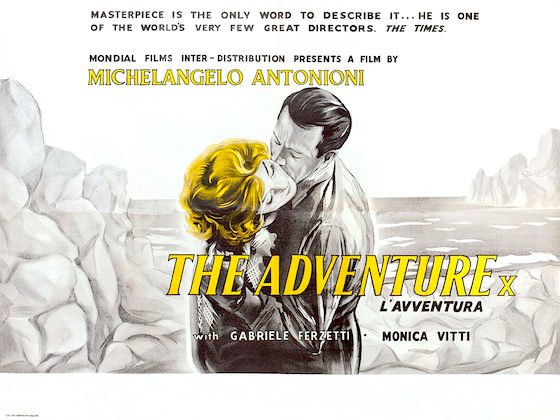
    I don’t have a great track record for enjoying acclaimed classic Italian cinema (neither Bicycle Thieves nor were to my taste, for example), so I’ve put off watching L’avventura for years, expecting I wouldn’t get on with it. But, inevitably, I had to face it someday… and, as it turned out, I really liked it… for a while…

    The film begins with Claudia (Monica Vitti) and her wealthy friend Anna (Lea Massari) meeting up with the latter’s wealthy boyfriend, Sandro (Gabriele Ferzetti), to go for a cruise on the yacht of some other wealthy friends. When they dock on a small island, Anna goes missing. The party scour the island, but there’s no sign of her. Police and divers arrive, but no luck. Reports suggest maybe she boarded another boat; possibly she was kidnapped. The wealthy friends quickly drift back to their lives, but Claudia and Sandro keep searching, following scant clues. Soon they too begin to get distracted — by each other.

    I don’t think it’s a spoiler to say that L’avventura starts out looking like a missing-person mystery only to get sidetracked into being a kind of romantic drama. I certainly knew that going in; and it’s probably beneficial to know it, spoiler or not, so as to manage your expectations of the film appropriately. Anyone expecting a Christie-style hunt through clues and suspects until the truth is unearthed will come away severely disappointed. No, this is the Mystery genre reimagined through an arthouse lens: it’s inconclusive, more interested in the characters than the hunt they’re on, and notoriously slow paced.

    With that in mind, I was surprised by how effective I found the mystery part of the movie. It’s not a whistle-stop action-adventure, but it’s not significantly slower than your average murder mystery, and accusations of it being uneventful seem misplaced — if I were expecting it to unfold like a regular mystery, there’d be plenty of places to look out for clues. It’s as the film shifts more towards Claudia and Sandro’s burgeoning romance that it begins to drag. The pair start just hanging around places as tourists, at which it does begin to seem like nothing’s happening and so what’s the point? The conceit of them falling for each other when they’re meant to be searching for someone they mutually care about is a good storyline, but I wasn’t convinced by how it played out. There doesn’t seem to be any time when they’re actually falling in love, they just suddenly are. Maybe I’m missing some point there. Or maybe it’s beside the point. Until I can work that one out, I’m going to have to chalk this up as half great, half A Shame.

    4 out of 5

    L’avventura is the 12th film in my 100 Films in a Year Challenge 2022. It was viewed as part of Blindspot 2022.


    She’s Gotta Have It

    (1986)

    Spike Lee | 84 mins | digital (UHD) | 1.66:1 | USA / English | 18 / R

    She's Gotta Have It

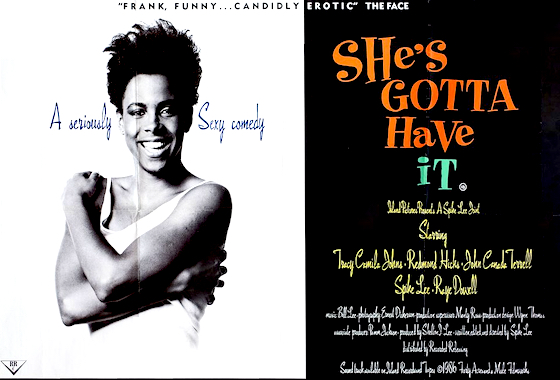
    Spike Lee’s post-student debut concerns twentysomething Brooklynite Nora Darling (Tracy Camilla Johns), who’s openly dating three men: upright ‘nice guy’ Jamie (Tommy Redmond Hicks), preening model Greer (John Canada Terrell), and streetwise Mars (Lee himself). And let’s not be coy (because the film certainly isn’t): she’s not just dating them, she’s sleeping with them all. The story of this love ‘square’ is partially narrated to camera by its four participants, as well as some of Nora’s other friends and acquaintances.

    It’s kinda crazy to think that the American indies were making sexually frank films like this and sex, lies and videotape in the late ’80s (a precursor, no doubt, to the wave of ‘real sex’ movies in the early ’00s), while nowadays we regularly get young people on Twitter arguing that no movie ever needs to have a sex scene, ever. So while I’m tempted to describe the film’s views on promiscuity as “then-modern”, perhaps just “modern” will still suffice — it’s certainly taken most (arguably all) of the intervening decades to get rid of the double standard for men and women as regards having multiple partners. That said, what has perhaps changed is our idea of what counts as “sexually explicit”. The film was obviously quite shocking back in its day, with the MPAA insisting on cuts before they’d give it an R (the unrated “director’s cut” had a Criterion LaserDisc release, but hasn’t surfaced anywhere else since), but you’ll see more nudity, more thrusting and moaning, on certain TV shows nowadays.

    Sexual stereotypes are not the only ones Lee sought to subvert here, as he also attempts to combat stereotypical depictions of African-Americans on screen — note the prominent message in the end credits that “this film contains are no jerri curls!!! and no drugs!!!” (punctuation as seen on screen). It extends beyond those basic signifiers; for example, how Nora’s three lovers are such different personalities. Partly that makes sense for the plot — that different sides of Nora’s personality like different types of guy — but also it shows different ideas of male Blackness; that The Black Guy is not just one thing. The jazzy score is another definite contrast to what you’d expect from a Hip Young Black Movie in the ’80s. Maybe that’s just Lee’s personal preference, but maybe it’s another conscious subversion of expectations.

    Lee’s politics are clear and forthright, but his filmmaking still needed some work. A lot of the film looks great, mostly shot in high-contrast black-and-white (plus one striking, ultra-saturated colour sequence), but some of the editing and performances could use refinement. Rough round the edges though it may be, She’s Gotta Have It is so clearly the calling card of a talented and individual voice with something brand-new to say that those rough edges are almost more of a feature than a bug.

    4 out of 5

    She’s Gotta Have It is the 13th film in my 100 Films in a Year Challenge 2022. It was viewed as part of “What Do You Mean You Haven’t Seen…?” 2022.


    Don’t Look Up

    (2021)

    Adam McKay | 138 mins | digital (UHD) | 2.39:1 | USA / English | 15 / R

    Don't Look Up

    Oscar statue2022 Academy Awards
    4 nominations

    Nominated: Best Picture, Best Original Screenplay, Best Editing, Best Original Score.

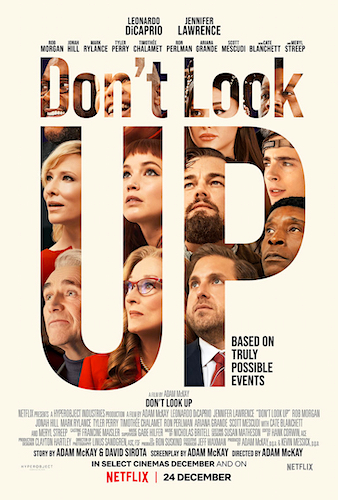
    Having targeted those responsible for the 2008 financial crash in The Big Short, and Dick Cheney and his responsibility for everything bad that’s happened in the last few decades in Vice, writer-director Adam McKay now turns his satirical attention to a fictional scenario, basically so he can have a go at anyone and everyone he feels like. The plot concerns a giant asteroid headed for Earth; an extinction-level event just 6½ months away. But, despite a handful of scientists trying to warn everyone, nobody seems in a great rush to do anything about it. It’s all an allegory for America’s carefree attitude to climate change, see.

    Really, this is a film I should be fully onboard with. It’s setting its sights on vacuous mainstream culture and Trumpian politics, after all. The problem is, these targets are low-hanging fruit, and — somewhat ironically, given its title — Don’t Look Up is satisfied with only plucking those lowest branches. Repeatedly. Unhurriedly. When they said the comet was 6½ months away, I didn’t expect the rest of the film to feel like it was covering that in real-time. It needed a better editor, or perhaps a studio who exerted a bit more quality control than Netflix’s famed “do what you want, we’ll just release it” approach. There are funny moments, certainly, but they’re literally few and far between when the pace is languid and the satire so broad, simplistic, and repetitious. Indeed, the most laugh-inducing stuff has nothing to do with the satire at all, just funny bits of business along the way (the best is a running gag about a general and snacks, which keeps cropping up unexpectedly).

    And for a film that’s entire thesis is being critical of American attitudes, it’s (again) ironic that it depicts this global crisis as so America-centric. Sure, there are cutaways to people watching events in other parts of the world, and a couple of belated nods to the idea that other countries might have their own thoughts on this impending disaster, but that’s all they are — sops and nods. “If America’s not going to fix this, no one can,” says the film. Ah, fuck off.

    2 out of 5


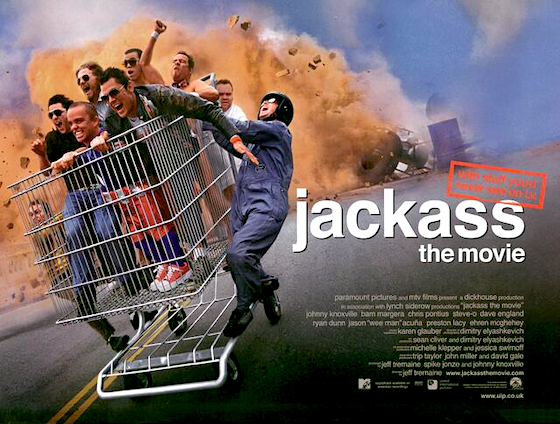
    Jackass: The Movie

    (2002)

    Jeff Tremaine | 85 mins | digital (SD) | 16:9 | USA / English | 18 / R

    Jackass: The Movie

    Jackass never appealed to me. I was a 14-year-old boy when it started, surely the franchise’s target audience; but I was an intelligent 14-year-old boy, so I was above it. Sorry, not sorry. But with everyone going on about the new movie, and reevaluating the whole franchise as some kind of essential classic of Cinema, I thought it was finally time to see for myself.

    For those not au fait with the series, it’s about a bunch of men who clearly aren’t old enough to know better performing stunts and pranks that no one in their right mind should ever want to do anyway. They’re frequently designed to induce pain. They’re often trying to be as crude or gross as possible. Some may make you feel ill just by watching them. And yet others are almost on the level of wholesome fun… albeit “wholesome fun” where you know participants will come away with bruises, at the very least.

    Almost everything the guys get up to is “dumb” — that’s kinda the point — and yet… It borders on “educational” when, for example, lead troublemaker Johnny Knoxville submits to being shot by “less lethal” riot control ammunition. The plan was for him to be shot in the chest, but the guys who make the stuff say if it hits his heart it could kill him, so they revise it to him being shot in the abdomen. Whereas most of the other stunts are followed by cutaways to the rest of the crew in hysterics, here the shocked silence of their reaction is telling. Or how about the kinda-feminism of a segment called “Ass Kicked by a Girl”, in which one of the gang enters the ring against a world champion female kickboxer. There’s no “haha, I can take her easily ’cause she’s a girl” posturing: the guy knows he’s about to get his ass handed to him. There’s some kind of respect for women in that, anyway, which you might not expect given the rest of the laddish antics.

    Taken as ‘a movie’, it’s rather formless — I suspect the TV show was exactly the same, just shorter — but the rapid-fire, standalone-stunt style does mean that no sketch hangs around too long. Some are literally seconds. But there’s not even a sense of escalation, say — it’s not like they save the largest or most outlandish stunt for the end (although there’s a post-credit scene that seems like it was probably the film’s most expensive single sequence). In some respects it doesn’t matter (who cares about the structure of a Jackass movie?), but in others, it’s what keeps it at the level of “feature-length special” rather than true Movie.

    But, ultimately, the important thing is this: some of it is funny. Reader, I laughed.

    3 out of 5


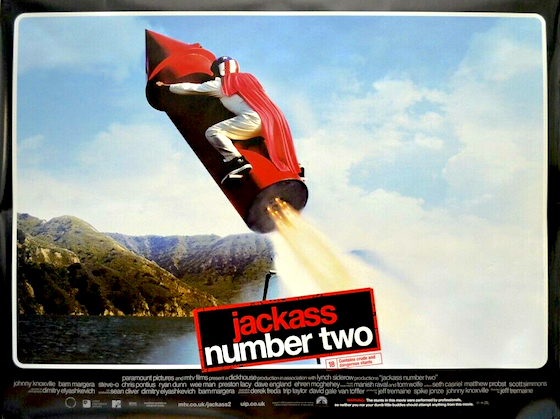
    Jackass Number Two

    (2006)

    Jeff Tremaine | 88 mins | digital (HD) | 16:9 | USA / English | 18 / R

    Jackass Number Two

    Even Jackass isn’t immune from the law of diminishing returns: after three seasons on TV plus a movie, this second big-screen outing feels kinda uninspired, like they’ve used up all their truly great ideas and are mostly running on fumes. That said, there are some good sequences — a variety of rodeo-based stunts with real live bulls are among the highlights — but other pranks feel reheated, or are just underwhelming; things you suspect would have been rejected in favour of better material before.

    In that sense it almost feels like it was rushed out to capitalise on success, but there’s a gap of four years, the TV show had ended, and they hadn’t necessarily intended to do any more — surely the only reason to return, then, was fresh ideas? Or, perhaps, being given the budget to do things they couldn’t before. That might be the case, because some of the material does feel like it’s got too much money and/or time behind it. I say “too much” because I think Jackass works best when it has a rough, cheap, “made at home” vibe. The finale here — a big “old Hollywood”-style musical number, with stunts mixed in — feels particularly out of place. Obviously it’s all a big joke, but the glossy, clearly-expensive visuals don’t feel of the right style.

    Plus, at various points you can feel some of the cast are getting genuinely fed up with this shit. Maybe they’d been doing it for too long by this point (I say there was a years-long gap, but some had been involved in spinoff projects). Whatever the reason, it serves to undermine the fun somewhat. One of the reasons you can enjoy these fools doing life-threatening stunts is because they’re volunteering for it and they seem to be having fun, however much they’re getting hurt or disgusted. But if they’re not enjoying it, aren’t we just watching people be tortured for our entertainment? It almost tips it from being stupid-but-funny into exploitative bullying. And we shouldn’t be having to think about anything that deep during a Jackass movie.

    As I’ve given both films 3 stars, let’s be clear: I’d definitely rate the sequel lower than the first movie, just not a whole star lower — it doesn’t merit being pulled down to a 2, while the first doesn’t merit a retrospective bump up to 4. If this kind of tomfoolery tickles you, there’s still plenty of entertainment to be had in Number Two, it’s just (mostly) not their finest output — which I guess is kinda apt, given the title.

    3 out of 5

    Jackass Number Two is the 15th film in my 100 Films in a Year Challenge 2022.


  • 2022 | Weeks 1–3

    Here we go — finally, and somewhat later than anticipated (it’s been a slow start to the year, viewing-wise) — the new review format for 2022!

    …which you’ll have already seen in Archive 5, of course; and is fundamentally similar to what I was doing before in roundups and what-have-you; and which I’ve already ‘broken’, because my review of Flight of the Navigator came out so long that I posted it alone.

    But still, the intention is this is now my regular review format, popping up every week or two (or three) to review everything in a more timely fashion than I have for many, many years. We’ll see how it goes — I feel like I need to relearn how to write short pieces, because longer reviews feel like they should get their own posts, and that’s happened to pieces intended for every one of these roundups so far this year.


    Anyway — to kick things off for 2022, a film with a broadly appropriate title. Because, despite (deliberately misleading) hints to the contrary, I’m carrying on. Get it? Carrying on watching. And “spying” is a synonym of “watching”, right? (Look, there aren’t any Carry On films with more apposite titles, okay?)

    These weeks’ films are…

  • Carry On Spying (1964)
  • Penny Serenade (1941)
  • The Navigator (1924)
  • In the Line of Fire (1993)
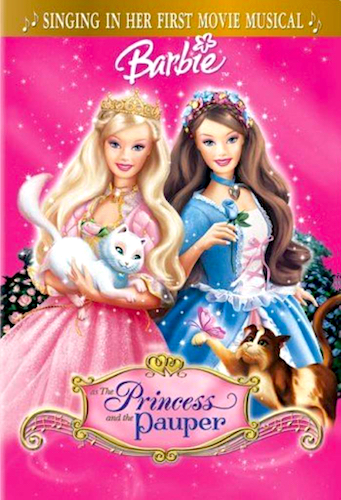
  • Barbie as The Princess and the Pauper (2004)
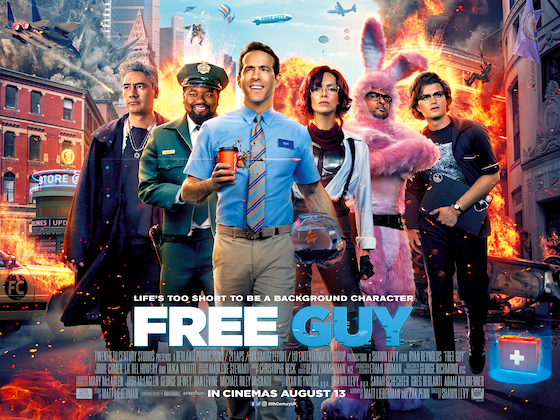
  • Free Guy (2021)


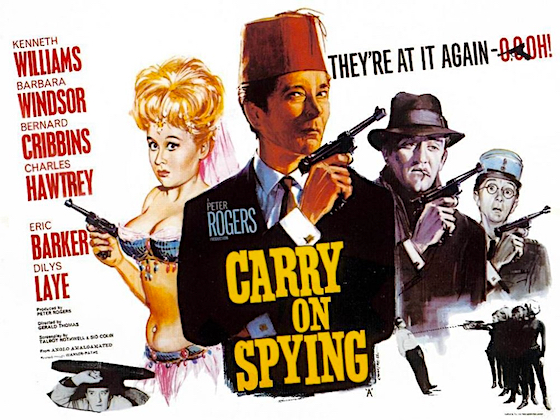
    Carry On Spying

    (1964)

    Gerald Thomas | 84 mins | digital (SD) | 16:9 | UK / English | U

    Carry On Spying

    Believe it or not, I’ve never actually seen a Carry On film before. Maybe that’s not so surprising these days. They were once such a part of British culture that they produced 30 of the things, but I think they were seen as “a bit old fashioned” even before I was born, and by 2022’s standards… oof. But, lest you get the wrong end of the stick (oo-er, etc), this isn’t me intending to finally dive into all of them. Rather, as well as its timely title, I chose to watch Carry On Spying primarily because it’s a James Bond spoof — the first, I believe, seeing as it was released in July 1964, when the Bond series only encompassed Dr. No and From Russia with Love (Goldfinger would follow a couple of months later).

    With Bond not yet even properly into its initial phenomenon phase (the first two films were hits, but it was the next two that skyrocketed its popularity), you might think Spying came too soon, and would be disadvantaged by being produced before the famous Bond formula was fully in place. Instead, it sets its spoofing sights a little wider, including an extended riff on The Third Man. I couldn’t tell you everything it’s drawing on, but its third-act villain’s lair — all sleek metal corridors and little road-train thingies and jump-suited identikit henchpeople — appears to be a take-off of You Only Live Twice, some three years before that film even came out. So I can only presume Spying’s point of reference there is something else, which I can’t quite remember; some other spy fiction that was already doing stuff the Bond franchise would still be pulling off years later. That doesn’t reflect too positively on YOLT, when you think of it, although Bond’s cultural dominance and longevity has come to ensure it’s the one that’s remembered for pioneering all this stuff.

    I don’t know how many Carry On films were genre spoofs, but the series’ reputation is more for smut and innuendo. There’s pleasantly little of that here — some, for sure, mostly based around Barbara Windsor (of course) as a trainee agent; but while it’s all fundamentally juvenile, it’s not as ceaselessly ribald as I was expecting. Satisfyingly, it remains primarily focused on its chosen genre. In that respect, I’ve definitely seen worse spoofs.

    3 out of 5

    Carry On Spying is the 1st film in my 100 Films in a Year Challenge 2022.

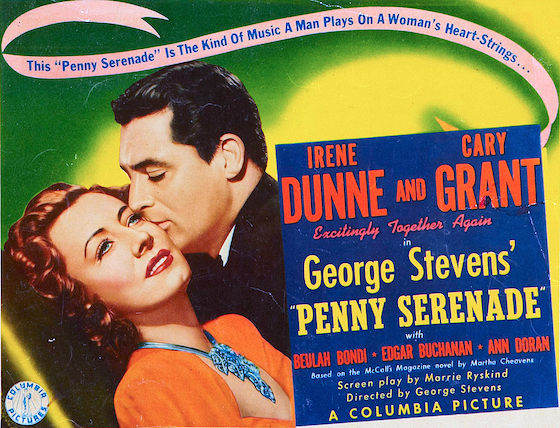
    Penny Serenade

    (1941)

    George Stevens | 120 mins | digital (HD) | 4:3 | USA / English | U

    Penny Serenade

    This is the third and final film to pair up stars Irene Dunne and Cary Grant as a married couple (I’ve watched all their collaborations within the past couple of years, but not posted reviews of the first two yet. I thought it was within the last year, but turns out I watched my first in May 2020. These strange days have really messed with my sense of the passage of time!) But where their first two films were screwball romcoms, this is undoubtedly a melodrama, following a couple as they meet, marry, and attempt to start a family.

    Dunne and Grant both make a fair fist of the serious stuff — Grant, in particular, gives an uncommonly sensitive performance at times — although they can’t resist slipping back into a spot of almost-slapstick given half a chance, with various individual sequences playing more like one of their comedies. Those scenes stand at odds with the film’s overall narrative and tone, which goes for full-on weepy. Indeed, if anything, I thought it was overdone, in particular an ending that throws in sudden tragedy followed so quickly by a pat happy ending that it feels almost distasteful.

    The film’s hook is that it begins with Dunne planning to leave, before she discovers a book of records that, as she plays them, take her back through their relationship. Different songs provoking specific memories is a neat narrative device on paper, but doesn’t really come across on screen. Aside from the first track, and maybe a later burst of Happy Birthday (although that could be almost any birthday, surely), the songs don’t seem to have any special relevance to the memories they supposedly call forth. It doesn’t help that, to modern ears, they all sound kinda samey. Plus, that the songs lead everything to unfurl in chronological order, with every major beat of their life story accounted for, is certainly convenient.

    If you can look past such artifice, and just want to revel in an old-fashioned bit of heart-tugging, Penny Serenade is fit to make you shed a tear. Personally, I’d rather the headline duo had given us another bout of screwball tomfoolery.

    3 out of 5

    Penny Serenade is the 3rd film in my 100 Films in a Year Challenge 2022.


    The Navigator

    (1924)

    Donald Crisp & Buster Keaton | 66 mins | Blu-ray | 1.33:1 | USA / silent | U

    The Navigator

    This is my fourth Buster Keaton feature now (I’ve only previously reviewed The General, but Sherlock Jr made it into my 2019 top 3), and he’s established himself as my favourite of the major silent comedians (I rarely enjoy Chaplin’s films as much as I feel I should; and, in fairness to Harold Lloyd, I’ve only seen one of his so far, which I liked a lot). The Navigator was the biggest hit of his career, though is probably my least favourite of his I’ve seen so far — though I don’t want to damn it with false criticism, because it’s still a brisk and entertaining comedy.

    Keaton stars as a spoiled rich kid whose marriage proposal is rejected. He’d already booked the honeymoon tickets, so sets off by himself; but, due to several points of confusion, he ends up adrift at sea on a decommissioned ship, empty but for one other passenger: his would-be fiancée (Kathryn McGuire). It’s up to this pair of brats to get along and survive while they hope for rescue. (Rescue does not come quickly. Considering McGuire’s father is a successful shipping magnate who’s aware of what’s happened, you’d think he’d send a vessel after them; but then, he might have his own problems, owing to a bunch of foreign spies who… look, it’s best not to overthink the logistics and plausibility of the plot.)

    Although Keaton gets the lion’s share of the gags, as well he might, for a stretch in the middle he and McGuire form an effective double act. The two rich kids being hilariously useless at household basics, like making coffee or opening a tin of food, is well observed; a flash-forward to their automated solutions is also fun. While Keaton still gets to show off by himself — particularly in an elaborate underwater diving sequence, naturally saved for the final act — McGuire makes the most of the material she’s given.

    The only outright demerit to the film is that the finale hasn’t aged particularly well: the ship finally drifts near land, but it’s an island with a village-full of black natives, at which McGuire immediately exclaims “cannibals!” That she’s sort of proven right when they start attacking the ship is… well, maybe not even worse, but at least just as bad. Still, by 1920s standards, maybe we can take comfort in the fact that it’s only casual racism…

    More than that, the reason I say it’s my least favourite Keaton so far is simply that it doesn’t have as many comedic highs as his very best work. Nonetheless, his genius regularly shines through in moments and even whole sequences, and there are a couple of individual gags that are all-timers.

    4 out of 5

    The Navigator is the 4th film in my 100 Films in a Year Challenge 2022.


    In the Line of Fire

    (1993)

    Wolfgang Petersen | 129 mins | digital (HD) | 2.39:1 | USA / English | 15 / R

    In the Line of Fire

    Clint Eastwood is a Secret Service agent who failed to stop the JFK assassination, now taunted by John Malkovich’s mysterious wannabe-assassin and his threats to kill the current President. It’s a fundamentally strong idea for a thriller, and works especially well by having the villain constantly phoning the hero for little chats. Malkovich’s always makes for a first-rate antagonist, and his slightly loony personality clashes well with Eastwood’s stoic, dry-witted, old-fashioned tough guy. There are a couple of chase scenes and shoot-outs here and there, but, rather than any elaborate physical action, it’s the verbal sparring that represents the film’s highlights.

    On the downside, the pace is a little on the slow side (perhaps matched to the “too old for this shit” age of Eastwood’s hero — in real life, he’d be a whole decade past the mandatory retirement age) and there are one too many clichés as important plot points (don’t get too attached to the partner who’s always talking about his wife and kids). Plus, there’s a wholly unnecessary romance between 62-year-old Clint and 39-year-old Rene Russo — the film doesn’t need it, even if there wasn’t that age gap. It leads to an (almost) sex scene that’s worthy of the Naked Gun films, which is amusing but tonally misplaced.

    They used to make this kind of political thriller on the regular back in the ’90s, one of those bread-and-butter genres for grownups that have fallen by the wayside in favour of hyper-budgeted kids’-movie spectacle that men of allegedly adult age flock to nowadays. In the Line of Fire may not truly stand out among its brethren of the era, but I do wish they still made ’em like this.

    4 out of 5

    In the Line of Fire is the 6th film in my 100 Films in a Year Challenge 2022.


    Barbie as
    The Princess and the Pauper

    (2004)

    William Lau | 85 mins | digital (SD) | 16:9 | USA & Canada / English | U

    Barbie as The Princess and the Pauper

    One of the many film lists I have my eye on completing is Letterboxd 100: Animation, which lists the highest-rated animated feature films on the site (with a few caveats). There are over 40 titles left that I’ve not seen, and I could’ve chosen to watch almost any of them… but I chose the Barbie one. Well, not the Barbie one, because there are actually two Barbie titles on the list. And that’s not some temporary fluke: they’ve been on there for quite a while now. This merited investigation.

    As you’ve no doubt gathered from the title, this particular Barbie film is a reimagining of Mark Twain’s The Prince and the Pauper. A fairytale-esque story, about a princess, done as a musical? Yep, this is very much a wannabe Disney, but without the production values of that major studio: the computer animation here looks more like a PS2 cutscene. But hiding beneath the cheap animation is a halfway decent musical fairytale. Take the second musical number, How Can I Refuse, for example: it’s every inch in the mould of a “Disney villain’s song”, but is better than some genuine examples, and comes complete with a dance routine by the antagonist and his two henchman. This film has ambition, I’ll give it that.

    Other songs vary in quality. When the eponymous duo first meet, there’s an unintentionally hilarious number in which they sing about how similar they are, the indentured servant and the pampered royal. If you say so, girls. A later track is a typical “you be you” song, but sung to a pet cat who behaves like a dog. That’s a level of barminess I can get on board with.

    I would never have dreamed of watching this if it weren’t on the Letterboxd animation list. Now, I wouldn’t exactly say I’m glad I watched it, but I enjoyed it more than I thought I would — even if sometimes that was due to laughing at it rather than with it.

    3 out of 5

    Barbie as The Princess and the Pauper is the 7th film in my 100 Films Challenge 2022.


    Free Guy

    (2021)

    Shawn Levy | 115 mins | digital (HD) | 2.39:1 | USA / English | 12 / PG-13

    Free Guy

    Ryan Reynolds plays his role again as Guy, a bank worker in city riddled with crime and superheroics. But, it turns out, Guy isn’t real — he’s an NPC in a computer game, programmed to do the same thing over and over and basically be ignored by the real-world players. Until, that is, he spots the woman of his dreams (Jodie Comer) and his programming breaks as Guy becomes self-aware.

    The basic concept sounds like a fun, fresh, and timely idea, right? Video games have never been more popular, AI is ever-improving, and there’s room for both gags and action in the core idea — that’s the winning Marvel formula, right there. Unfortunately, the execution is as if someone found a way to make a new movie by collaging others. Free Guy is just The LEGO Movie + The Truman Show + Wreck-It Ralph + Ready Player One + the PG-13 version of Deadpool 2 — not put in a blender, but cut up and stuck back together side-by-side, with snippets of Groundhog Day, Fortnite, and multiple Disney-owned properties scattered in for good measure.

    That last aspect, the Disney references, has been singled out for particular derision on social media. The film was initially produced by 20th Century Fox, but ended up a Disney title after the buyout, which allows a bunch of stuff they own to pop up in the movie. I know we’re supposed to find this infinitely depressing — a sad reminder that Disney are on course to own all culture, and that’s a bad thing — and it is bad, of course… but the bit with Captain America’s shield still made me laugh. Sorry, not sorry. Yeah, you can be miserable about this stuff, because obviously the total homogenisation of all American media under The Walt Disney Company is not worth that a couple of meta gags; but the homogenisation of all American media under The Walt Disney Company is happening anyway, so we may as well enjoy the gags we get along the way.

    Whether you have that kind of attitude or not will probably dictate how much you enjoy Free Guy. Its originality is surface deep, at best, and at every second it will call to mind some other film that already did the same thing. But, allowing for that, it’s still a fairly entertaining couple of hours of action-comedy.

    3 out of 5

    Free Guy is the 8th film in my 100 Films in a Year Challenge 2022.
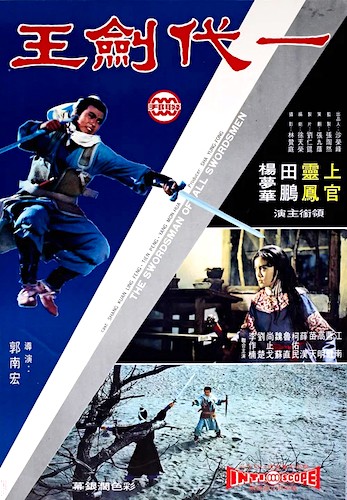

  • Archive 5, Vol.1

    Part of the impetus behind this new era of 100 Films was to solve ‘problems’ like my repeated failure to post reviews. Hopefully my plan for regular groups of capsule-sized reviews will solve that going forward. But this has been an issue for a while, and that’s led to a huge backlog of unreviewed films from 2019 to 2021 — it totals a ridiculous 449 feature films (counting shorts too, it goes over 500). Rather than abandon those to the mists of time, I present a new weekly (more or less — let’s not overcommit myself) series: Archive 5.
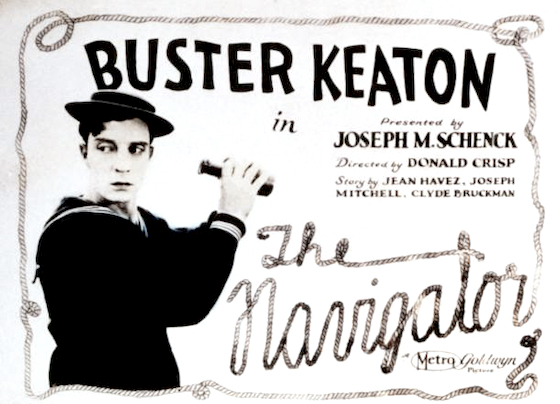
    Essentially, it’s the same format as new viewing: each post is a collection of short reviews; but here they’re five titles plucked at random from my archive of unreviewed films (and I’ve used a random number generator, so it’s genuinely unmethodical). If I can keep this up weekly, it will take me just under two years to clear the backlog — which means I could still be reviewing stuff from 2019 in 2023. Hahaha… haha… ha… ugh.

    With that in mind, there’s no need for further ado. This week’s Archive 5 are…

  • Never Too Young to Die (1986)
  • Bachelor Knight (1947)
  • Little Women (2019)
  • Aniara (2018)
  • Who’s Afraid of Virginia Woolf? (1966)

    (I Care a Lot was originally intended to be part of this post, but then the review turned out a little long, so I spun it off by itself. That’s the kind of thing I’ll probably keep doing, too.)


    Never Too Young to Die

    (1986)

    Gil Bettman | 97 mins | digital (HD) | 1.85:1 | USA / English | 18 / R

    Never Too Young to Die

    If you dropped A View to a Kill, Rocky Horror, WarGames, and Mad Max 2 into a blender, the end result might be Never Too Young to Die. And if that sounds like a ludicrous, unpalatable mash-up… yep, that’s Never Too Young to Die.

    This direct-to-video action-adventure stars a pre-Full House John Stamos as Lance Stargrove, a teenage gymnast whose dad is a secret agent (played by George Lazenby — aged 47 at the time, but looking at least 20 years older). When daddy is killed, Lance teams up with his partner (singer turned actress Vanity) to go after the culprit: gang leader and wannabe terrorist Velvet Von Ragnar (Gene Simmons (yes, from Kiss), chewing scenery as if he’s not been fed for months).

    If you’ve never heard of this film… well, neither had I, until a Cracked article suggesting comical substitutes for Covid-delayed blockbusters. But what really convinced me to watch it is that it has The Greatest Trailer Ever Made. If you set out to make a spoof ’80s trailer, I’m not convinced you’d be able to beat that. Unfortunately, neither can the film as a whole. It’s fun at times (the boob-biting final fight, or a scene where Stamos tries to distract himself from Vanity’s sexuality by… eating multiple apples), but it’s not quite camp or daft enough to really earn a place as a cult classic.

    I’ll say this for it, though: rewatching that trailer has made me really want to watch the film again…

    3 out of 5

    Never Too Young to Die was #70 in my 100 Films in a Year Challenge 2020.


    Bachelor Knight

    (1947)

    aka The Bachelor and the Bobby-Soxer

    Irving Reis | 91 mins | digital (SD) | 4:3 | USA / English | U

    Bachelor Knight

    If you ever need to name an obscure Oscar winner for some reason, you could do worse than Bachelor Knight — or, to give it its even-dumber-sounding original title, The Bachelor and the Bobby-Soxer. Yes, this won the Oscar for Best Original Screenplay (the other nominees aren’t the greatest field you’ve ever seen, but altogether they’re either better-remembered or were considered good enough to nominate for other gongs that evening, so quite how this took the prize, I don’t know).

    The plot also stretches credibility: after high schooler Susan (Shirley Temple) becomes infatuated with artist Richard Nugent (Cary Grant), she sneaks into his place to model for him, much to the disapproval of her older sister Margaret (Myrna Loy), who also happens to be a judge; and when Nugent ends up in her court room, she sentences him to date Susan until her infatuation inevitably wears itself out. I know things are different in the US, and also in the past, but did/do judges there really have the power to hand out any crazy made-up sentences they like?

    On the bright side, the film moves sprightly through its plot. Perhaps that’s because it takes a whole 40 minutes to get through the basic setup, even while running at a pace, means there’s less screen time left to dwell on all that follows. Not that some individual bits don’t go on a tad, like a picnic sequence; but others work very well, like a scene in a nightclub that is a nicely-written bit of escalating farce.

    It’s not the best work of anyone involved, but Bachelor Knight belies its iffy title (both of them) to be a likeable-enough 90 minutes of screwball comedy.

    3 out of 5

    Bachelor Knight was #70 in my 100 Films in a Year Challenge 2021.


    Little Women

    (2019)

    Greta Gerwig | 135 mins | cinema | 1.85:1 | USA / English | U / PG

    Little Women

    Writer-director Greta Gerwig’s adaptation of Louisa May Alcott’s beloved novel was greeted in some quarters by questions of if it was necessary: it’s the sixth big-screen version of Alcott’s book, and came just two years after a major new BBC adaptation. Well, I don’t know if it was ‘necessary’ or not, but Gerwig’s version is definitely a very good film.

    A key point that marks it out from other adaptations is that Gerwig has restructured the story: instead of playing out in a straightforward chronological fashion, it flashes back and forth in the sisters’ lives, starting with them as young women in 1868, with Jo in New York and Amy in Paris, before mixing in events from their childhood, seven years earlier, when the four sisters lived together in Massachusetts. This might seem like a rejig for the sake of differentiation, but Gerwig uses it to create interesting juxtapositions or to reframe plot points. For one example (spoilers follow, if you’re not familiar with the story), I felt it made Laurie and Amy’s relationship less creepy. Told chronologically, they first meet when he’s a young man and she’s a child, and he only moves his affection to her after Jo’s rejected him and Amy’s grown up. In Gerwig’s version, we first meet them together in Paris, and they seem more destined for each other, with a genuine spark between them as individuals, rather than a nagging sense of “if I can’t have one sister, this other will do”. It’s only later we learn the full backstory of Laurie and Jo — and, for that matter, of Jo and Amy — which, yeah, is obviously still a bit creepy, when you think about it.

    Whichever way you cut it, Gerwig seems to really get to the heart of the meaning in the story and characters, as well as giving it a lightly feminist polish (misogynists would probably consider it Terribly Feminist and Evilly Revisionist, if they watched it, which I don’t imagine they would). A star-studded cast ensure the whole thing is well acted, and it’s beautifully shot by cinematographer Yorick Le Saux. Questions about ‘necessariness’ are particularly irrelevant when the work is this good.

    5 out of 5

    Little Women was #4 in my 100 Films in a Year Challenge 2020.


    Aniara

    (2018)

    Pella Kågerman & Hugo Lilja | 106 mins | digital (HD) | 2.35:1 | Sweden & Denmark / Swedish & English | 18 / R

    Aniara

    A sci-fi movie based on, somewhat oddly, a 1950s Swedish poem, Aniara is about a spaceship transporting migrators from Earth to Mars that accidentally veers off course and heads irretrievably into deep space. Rather than the kind of action-adventure this might provoke if it were a Hollywood production, Aniara follows how the passengers and crew attempt to cope with their new lives.

    It’s a premise interesting enough that you feel it could fuel a TV series — how this mass of people, forced together by accident and terrible circumstance, comes to function (or not) as a society. Or maybe the remake of Battlestar Galactica already nailed that kinda thing. Either way, here it’s condensed into about 100 minutes; and because it has such a long-term view of what it wants to pack in, there are some surprisingly large time jumps (by the half-hour mark we’ve already reached Year 3). It takes some odd detours when it does that (society completely breaks down into weirdo cults… then a probe that might allow them to return home is discovered, at which point everything goes back to normal), but overall it has a pretty clear thesis about humanity and how we cope with things — “not well”, fundamentally.

    The final act kind of rushes a similar point, skipping ahead (several times) to how things are even worse without really tracking the descent. Maybe that’s why I liked the idea of a series version so much: to fill in all those blanks. But I don’t want to take this criticism too much to heart. If anything, the fact I wanted more detail is a compliment. It’s not the film bungling developments and me searching for justification, but rather that I’d be interested in seeing the themes and characters explored in even more detail. As it stands, Aniara is an epic-scale story told well in a somewhat condensed fashion.

    5 out of 5

    Aniara was #65 in my 100 Films in a Year Challenge 2020. It placed 21st on my list of The Best Films I Saw in 2020.


    Who’s Afraid of Virginia Woolf?

    (1966)

    Mike Nichols | 131 mins | Blu-ray | 1.85:1 | USA / English | 12

    Who's Afraid of Virginia Woolf?

    When a middle-aged college professor (Richard Burton) and his wife (Elizabeth Taylor) have his new young colleague (George Segal) and wife (Sandy Dennis) around for drinks one evening, the occasion soon degenerates into a verbal slanging match between the elder couple, the younger inescapably caught in the middle.

    And as the film takes place in almost-real-time, in just a couple of locations, it feels like we’re trapped with them. With a running time north of two hours, the film’s drunken sardonicism almost becomes an endurance test, particularly when it goes on a bit too long in the middle. But it’s carried through by some magnificent performances. Everyone talks about Taylor — just 33 at the time, she wasn’t sure she could play the part of a bitter 52-year-old, but she’s excellent — or they talk about Taylor and Burton — similarly, he wasn’t sure he could play a beaten-down failure of a man, having been used to taking dashing heroic roles — but Sandy Dennis is great too, and deserved her Oscar. Of the four actors, its George Segal who draws the short straw, not really getting the material to truly stand toe-to-toe with the other three (he still got an Oscar nom, though).

    Director Mike Nichols insisted the film be shot in black & white, which helps it to pull off Taylor’s ageing makeup, but was also intended to stop it seeming too ‘literal’ and instead give an abstract quality. That fits the material, because the characters, events, and revelations are all pretty odd; the way it plays out pretty strange. Plus, the pitch-black darkness of the night fits the film’s themes. Cinematographer Haskell Wexler does a superb (indeed, Oscar-winning) job, the photography looking more striking than you might expect, or even need, for such an actor-focused character piece.

    A whole featurette on the film’s disc release discusses how it was “too shocking for its time”, mainly because of the language used (the fact the film was made relatively unedited set a ball rolling that, just a couple of years later, saw the Production Code replaced by the modern MPAA classification system). While such concerns are no longer really relevant (once-controversial terms like “screw” and “goddamn” are hardly “fuck”, are they?), that the film is still powerful shows it was never truly about what was said, but who said it and how they said it. I don’t mean to say that it would still be offensive today, but rather that it still packs an emotive punch.

    5 out of 5

    Who’s Afraid of Virginia Woolf? was #22 in my 100 Films in a Year Challenge 2021.