2012 #50
manlly Wilder | 101 mins | Blu-ray | 1.37:1 | USA / English | PG
 Directed by the inestimable Billy Wilder, winner of the Grand Prix (forerunner to the Palme d’Or) at the first Cannes, winner of the Best Picture Oscar in 1946, and also Best Actor, Director, and Screenplay, it’s a wonder that The Lost Weekend isn’t better known. I don’t think I’d even heard of it until Masters of Cinema announced their Blu-ray release back in January 2012, and comments I’ve seen around the internet express a similar experience of prior unawareness. Thank goodness for MoC, then, because this isn’t a film that deserves to be forgotten.
Adapted from the novel by Charles R. Jackson, the entire film takes place across one particularly eventful weekend (well, that plus flashbacks), in which should-be-recovering alcoholic Don Birnam (Ray Milland) tries desperately to fall back off the wagon.
The plot may smack of a worthy social drama (perhaps why it’s been forgotten), but most every sequence is loaded with more tension than a thriller. This is Wilder’s skill as both co-writer and director: he gets us on Birnam’s side early on, so that we follow him through the almost-self-induced hell that follows; and he keeps us on the edge of our seat, as desperate for it to work out as Birnam himself is. But, right from the very first scene, hardly a one of his plans does work out; 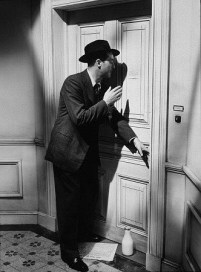 all of them thwarted at the last possible moment, when victory seems assured. The film isn’t preachy, but if it does teach us a lesson then this is how it does it.
Wilder’s direction is excellent throughout, with innumerable striking compositions, perfectly paced scenes, and the aforementioned tension ratcheted up to maximum. There are other very good directors who would’ve made a hash of a film like this — made one that screams “meaningful movie about An Issue” — but the way Wilder handles affairs means it’s more than that. It explores its issue, it exposes us to the facets of it so that we might learn something, but it does so under the auspices of a drama about a man we come to care about. It’s not an “alcohol is bad” sermon, it’s a “can this man survive it?” thriller.
Equally, the flashback structure could scupper the film, but instead it raises it, with two of the best sequences coming here. There’s the exceptional La Traviata scene — it’s very obviously a bit of Good Direction, but while you could call it showy, it works — and the scene where Wick tries to cover for his brother to his new girl, which lends weight and backstory to the opening scene where he seems ready to (and, indeed, does) callously abandon him.
 Milland is astounding. The film rides on him and he really carries it. It’s easy to play a comic drunk, but Milland doesn’t sink to that. Indeed he doesn’t do one type of drunk at all, swaying back and forth across various levels of inebriation as required. I often find films of this era contain performances we assess as great, but if you put them in a film today no one would buy it; they’d find it stagey and fake. Milland’s transcends that — it fits the era, but I wouldn’t be surprised to find it would play just as potently today. I think it’s fair to say that Milland is not widely known today, but with every film of his I become more convinced that history has been unkind.
Also worthy of praise is Frank Faylen as Bim. In his featurette on the MoC release, Alex Cox says he’s the second best character in the film, and he’s probably right. Cox notes that at least one review at the time really laid in to Bim, painting him as an evil sadist. Today, I don’t think we have that perspective at all. Bim tells Birnam the truth, painting his illness like it really is. Whereas his other friends and relations all try to do their best for him, but wind up enabling his addiction to continue, Bim’s experience and detachedness means he can be blunt and truthful. Birnam may not realise the good it’s done him, but good it does ultimately do.
 There’s also able support from Howard Da Silva as barman Nat and Doris Dowling as Gloria (is she a whore of some kind? Just an escort? A bar-crawler? Did I miss something?), whose slang is oddly infectious. No offence to Jane Wyman, but her lovelorn-but-strong girlfriend character only seems to really come alive in the closing minutes, when she considers abandoning Birnam to his fate.
The Oscar-nominated score by Miklós Rózsa at first seems highly unusual, a warbling horror movie score, but it quickly comes to fit very well, and not just the nightmarish daydream sequence near the film’s climax. The movie was also nominated for John F. Seitz’s cinematography and Doane Harrison’s editing. They lost to The Picture of Dorian Gray and National Velvet respectively, neither of which I’ve seen, but they must have something special to outclass the work on show here.
I think the same can be said of the whole film. Issue-focused movies from the past are often badly dated, even if we can still admire the filmmaking techniques involved. That’s not their fault — it’s the cultural climate of the time, or the shifts in understanding that have come since. I’ll admit I know next to nothing about alcoholism so can’t comment definitively on the film’s enduring accuracy, 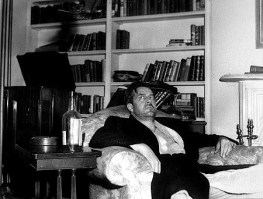 but from what I do know of other conditions of addiction and mental health, this feels as if it’s still thoroughly relevant.
Even if you don’t care about The Issue, there’s an engrossing, thrilling drama for everyone to enjoy. If The Lost Weekend is indeed forgotten, then it merits widespread rediscovery.
That concludes my reviews from 2012.

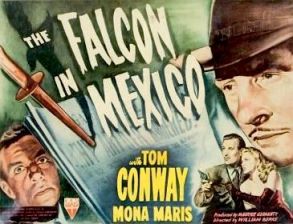 “In our peaceful country, life is very seldom in danger,” states one character halfway through The Falcon in Mexico, just one of many instances that might make you think the film was co-funded by the Mexican tourist board. Oh sure, there’s the usual array of thefts and murders that you’d expect from a Falcon adventure, but they’re mostly committed by Americans. No, the film on the whole is very keen on the place, and the quality of its police, and even ends with a shot of a poster proclaiming “Visit Mexico!”
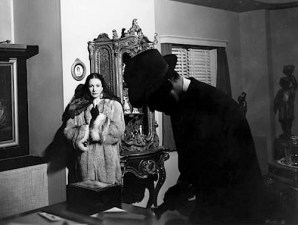 What I did make out was grandly far-fetched — more so than normal, I mean. Considering the tone and style of the series, it’s kind of OK that most of the plot’s explanations are not even close to plausible in the real world. On the bright side, it does make for another genuine mystery (I should stop praising the series for this now, all the films do it).
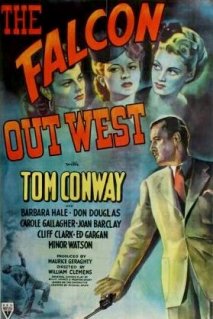 With each passing entry, the Falcon films become less reminiscent of their Saint forebears and more akin to the Poirots and Marples of this world: a gently comical murder mystery, with a finite location and a finite number of suspects, where the ‘game’ of solving the plot is the point.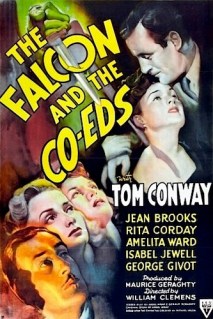
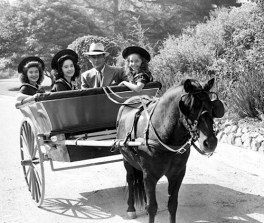 In fact, the worst thing about the film is purely a result of its age, and that’s the occasional bout of misogyny. Let’s face it, the girls going all giggly over the Falcon is pretty defensible (look at modern-day reactions to the likes of One Direction, Justin Bieber, or even Benedict Cumberbatch), but the bit where he picks a twenty-something girl up to smack her bottom is a bit much. Still, it opens with a great bit: the Falcon parks his car, a girl immediately runs up to it: “Mr Lawrence?” “Yes?” She jumps in, instantly kisses him full on the lips, and when she pulls away all he can say, with a slightly surprised look, is, “Nice!” You could put that in something today and it’d still work.
 such thoughts always endear them to me.
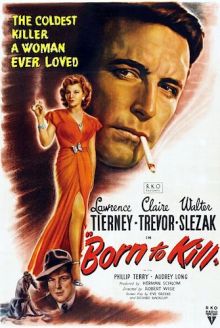 Director Robert Wise certainly had an eclectic career. Depending on your genre predilections, you may feel he’s best known for
 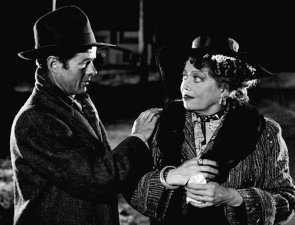 Even today, it’s quite a nasty little work, although tastes have evolved to the point where “discriminating people” are likely to be attracted to it — though not purely for the violence. You’d imagine that would pale by today’s standards, but even now the opening double homicide — presented pretty much in full on screen — is quite shocking, especially because it seems so horrendously plausible. Much movie violence is heightened, involving gangsters or spies or whatever, but here it’s a lover in a jealous rage killing two people in the kitchen of a regular house. Grim.
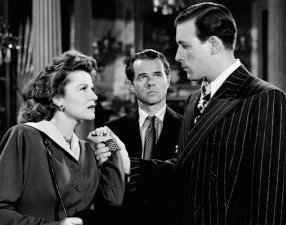 sometimes develop a cult following.
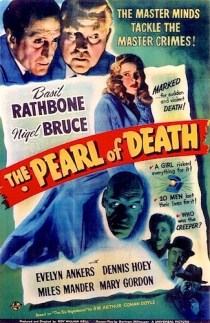 The Pearl of Death is one of the better-regarded films of the Basil Rathbone Sherlock Holmes canon, but somehow it didn’t quite click for me. That doesn’t meant there isn’t a lot to enjoy, however.
 Elsewhere, Nigel Bruce gets to indulge in a slapsticky scene that, as ever, people who dislike this interpretation of Watson would be happy to do without. Also worth noting is the female lead, British actress Evelyn Ankers: she was a regular fixture of Universal’s horror features, terrorised in no less than
 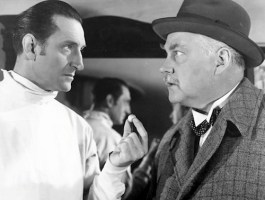 Neill somehow managed to pick one of the least dramatic. Neither of these reveal fudges are ruinous, of course, and are outweighed by the handling of sequences like Holmes setting off the museum’s alarm, the ensuing robbery, the villains stalking round a potential victim’s house, and so on. Still, I was surprised to find them so wanting.
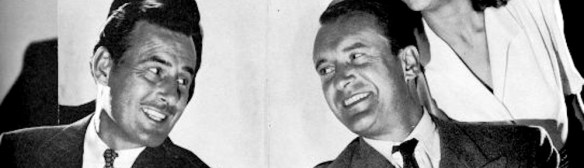
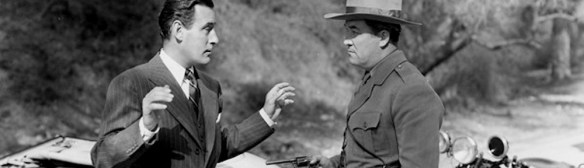
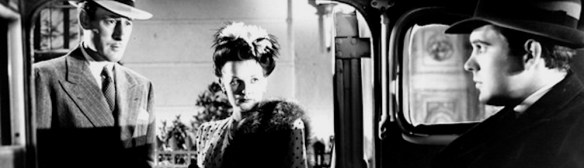
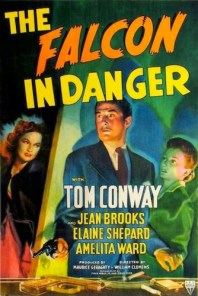 We’ve had the Saint in New York, in London, and in Palm Springs; soon we’ll have the Falcon in Mexico, in Hollywood, and in San Francisco; but here, he’s just in danger. He’s also in perhaps the best film either series has offered to date.
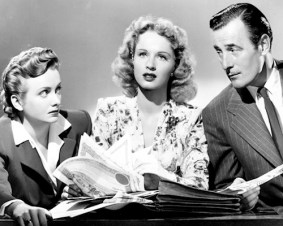 Though the Falcon clearly agrees with everyone else’s assessment and shrugs her off as often as he can, to our benefit.
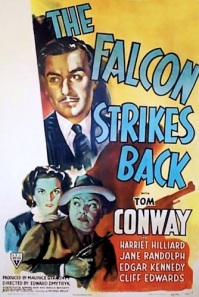 Directed by Edward Dmytryk (who, a couple of years later, would helm
 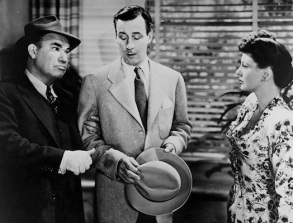 His eye for the ladies remains the same, although Conway feels a bit slicker and less whipped. Neither carry the same charisma as Sanders’ Saint.
 The Falcon may’ve done it in the third entry in RKO’s Saint-a-like film series, but now it was time for Tom Conway to
  Aside from housekeeping, the film offers one of the series’ better plots, a proper detective mystery that doesn’t lead where you’d expect it to for once. That said, I didn’t like the ending so much, especially the way it abruptly dispatches our former hero followed by the gang carrying on with barely a care. The Mysterious Threatening Voice On The Phone is interesting though — will we be seeing a recurring enemy; a Moriarty or Blofeld for the new Falcon? Time shall tell…
 in spite of all the other factors (changing sources of adaptation; changing leads) that should make them feel wildly varied. And the Falcon’s butler, Jerry, is Asian again, after being caucasian in the last two films. Played this time by Keye Luke, rather than being some nasty stereotype he has a nice bit using stereotypes to the characters’ advantage. It’s one of the series’ better comic inventions.
 100Films.co.uk