2010 #20
Fritz Lang | 111 mins | Blu-ray | PG
 M is a film of immense significance, not least because of its place on numerous Best Ever lists (even if it is a nightmare to find quickly on any list or website thanks to its single-letter title), and not to mention it being director Fritz Lang’s favourite among his own work (consequently he definitively moved away from his fantastical work on the likes of Die Nibelungen, Frau im Mond and (of course) Metropolis, choosing to largely direct crime pictures, including a significant contribution to film noir). As with any film of such acclaim, where near-endless essays and articles and whole books have been penned discussing every notable aspect, it’s unlikely I’m going to have much either new or significant to say after one viewing (never mind “ever”). Just so you know.
But I can sing some of its praises. Like Peter Lorre’s extraordinary performance as child killer Hans Beckert. He could have survived on his naturally unusual looks, which fit the role perfectly, but he also skillfully conveys the realistic complexities of such a character. Beckert’s psychology feels completely accurate, something you might not expect from an 80-year-old film. To show such care in making a conceivable human being out of a villain who has committed some of the most horrendous crimes imaginable, and not just going for the easy approach of showing an incomprehensible monster, is a vital step in creating a realistic crime movie — a step that’s often been ignored, and still can be today.
And Lang did set out with the express aim of making a realistic factual film, albeit still a fictional one — it’s ‘inspired by’ real cases, not specifically ‘based on’ them as some have claimed. Along with his writer (and wife) Thea von Harbou, Lang drew on innumerable press reports about murders and their investigations, spoke to police officers and psychoanalysts about their jobs and what they had learnt about such criminals, and generally researched every area he aimed to cover on screen. His intention was for the film to constantly shift its focus, examining every aspect of a high-profile serial killer case, and so it does: we see the victims and their families (before and during the crime, though not after it to any significant degree);  the public reaction and hysteria; the police’s flailing investigations and increasing exasperation; the criminal underworld, who begin their own manhunt because police inquiries are “bad for business” (despite sounding like a filmic conceit, this element was directly inspired by a newspaper article); and the criminal himself — trying to lay low, but constantly having to fight his urges… and ultimately giving in to them again.
Such a diffuse set of perspectives could lead to a messy structure that revealed each facet in only half-hearted broad strokes, but Lang never allows this to happen. The opening sequence, depicting the latest in a long line of kidnap/murders, is exemplary: every shot and edit contributes to a growing sense that Something Horrible Is About To Happen… and when it does, not a glimpse is shown on screen. An empty place setting, a balloon caught in overhead wires, a ball bouncing to a stop… They, along with each viewer’s imagination of the worst possible fate for little Elsie Beckmann, convey all the terror — and a palpable and heartbreaking sense of absence — that’s required.
And then Lang shifts focus: public fury, paranoia. A series of scenes that each typify broader social reactions. People are accused for nothing more than following a girl up some stairs, attacked because they’ve been arrested, the crowd simply assuming they’re the killer. Such scenes remain disturbingly relevant and plausible — the bit where a surly bloke confronts a man who was merely giving a girl the time feels like something one might see occur on our streets today.
And then it’s the police: a distinctly procedural style as a long sequence describes the police’s investigative efforts — how they follow up leads and how they lead nowhere; 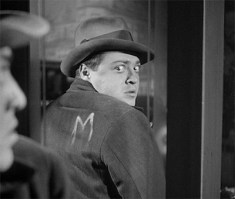 how they search crime scenes with a fine-tooth comb; another sequence shows their methodology for staging a raid; and so on. Such precise and clinical methods ultimately pay off: it’s a pair of tiny clues, carefully reasoned and sought out, that reveal the killer’s identity — and if it weren’t for the criminals getting there first, they’d’ve surely caught him too. Indeed, were it not for this breakthrough then the film might hold a Life On Mars-esque observation that only the criminals and their, shall we say, alternative methods can finally catch Beckert when the police have failed.
One of Lang’s aims in being factual — or, responsibilities he felt by being factual — was to present a debate on the morality of capital punishment. So Beckert murders children because that was the worst crime imaginable to Lang and von Harbou, and still when he’s dragged before a court (albeit an impromptu one made up of the criminal underworld) a debate is had on the merits of the death penalty — disguised, of course, in the decision of Beckert’s fate. The baying mob of criminals want him killed; his sole defence representative cites the law to show why such a punishment is wrong. Lang’s point — the one he wanted to make, even if he tried to present it as a debate — is that even in this instance the death penalty is wrong. Somewhat distressingly, the moral and legal points raised throughout the film remain highly relevant today.
Even leaving these aside, M is packed with beautiful moments of pure cinema: the shadow on the wanted poster; the intercutting of the police and criminals’ meetings; Inspector Lohmann dropping his cigar at the news the criminals were looking for the child killer (on his audio commentary, Peter Bogdanovich wonders how this would play to a modern audience, implying it wouldn’t really work — well, it did for me); the roving camera in the beggars’ market — a decade before Citizen Kane, Lang employs his camera in ways Welles seems to get all the credit for (I’m sure Welles pushed boundaries too, but some of his ‘innovative’ ideas —  like tracking from outside to inside through a window within a single shot — are present here). M’s individual moments of brilliance go on — perhaps my favourite is when the police arrive just after the criminals have apprehended Beckert. We don’t even see an officer on screen, but the burglar’s reactions let us know who’s there. Its a funny moment (even if we’ve seen it dozens of times since) and a lovely shot too.
M was Lang’s first sound film, made at a time when the technology was still very new. So he uses — indeed, establishes — a variety of techniques: voiceover; selective hearing (e.g. the audio cutting out when a beggar covers his ears); silence (or only selected sound), used to represent how a space appears to sound rather than the genuine noise one would/could hear; conversations continuing across scenes (such as when a criminal begins a sentence and a police officer finishes it, in completely different rooms at different times); not to mention that the killer’s whistling is a vital clue, both in terms of the plot (it’s how the criminals first identify him) and for the viewer (indicating when he’s about his sorry business).
This is the longest existing version of M, restored from multiple negatives and prints held in several countries, which stands about seven minutes shorter than Lang’s original cut. IMDb’s alternate versions section claims the film originally showed the full trial at the end, implying this is among the lost minutes. In Masters of Cinema’s booklet, Anton Kaes instead details a scene early in the film pertaining to false confessors. Kaes has evidence that his scene existed, IMDb doesn’t present any; and in one of the audio commentaries Lang and others discuss the ending as-is — even if there was another ending at some point, it certainly wasn’t Lang’s intended one.
This definitive one, then, is suitably downbeat: Frau Beckmann — the mother from the opening sequence, her first appearance on screen for over an hour and a half bringing the tale full circle — bemoans that dispensing justice to 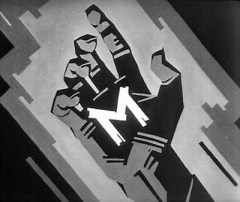 the murderer won’t bring the children back, and warns viewers to watch out for their own. It’s not the triumphant “we got him!” that concludes most serial killer films, but a blunt warning that, though Beckert has been caught, there are always more out there, waiting to strike. History has sadly proven her right; but while the world has produced many men and women like M’s villain, it hasn’t produced many films quite like M.
Masters of Cinema’s new edition of M is released on DVD and Blu-ray on Monday. One of the special features is Zum Beispiel: Fritz Lang, which I’ve briefly reviewed here.


 The third film in RKO’s Saint series is a bit of a mixed bag, from my point of view.
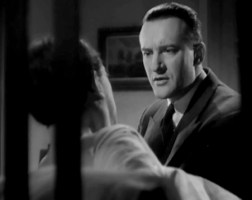 I bring up Bond again because this is perhaps the most proto-Bond of all the Saint films. Within the first few minutes we have a tuxedoed Saint introduce himself as “Templar, Simon Templar”, enter a fancy restaurant where he drinks a martini, and expertly orders a swish meal and the appropriate wine to go with it. Later, villain Bruno Lang (because yes, he is relevant in the end) is a somewhat Bondian villain, a powerful man with a grand plan who thinks he’s smarter than our hero. Which he isn’t, of course. Perhaps there was an abundance of these kind of heroes in the middle decades of the twentieth century, but as Bond is the only one that’s endured while retaining the same iconography, these similarities are striking.
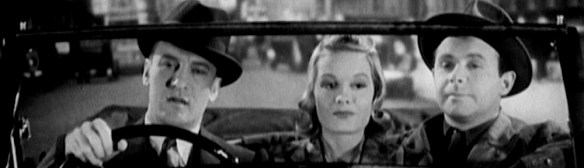
 Best of all is Sally Gray as Penny Parker, a charming girl Templar bumps into — as he’s wont to do — who forcibly strings along for the ride. Every film in the series contains a pretty young thing who falls for the Saint, and who he seems to fall for back before casually disregarding at the end — at least Bond faded to black, leaving the inevitable parting off-screen, whereas Templar is almost callous-with-a-smile. Of all the girls the series offers, though, plucky Penny is the one you’d wish had stuck around. Even with that silly hat.
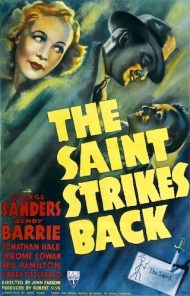 The first film to star the Roger Moore-ish George Sanders as Simon Templar, aka the titular Saint, is also one of the RKO series’ better entries.
 Nonetheless, it’s mostly a fun romp. Sanders’ portrayal of Templar is witty and enjoyably knowing, even more so than Louis Hayward in the previous film. He’s at once more laid-back and less self-certain; by which I mean you can sometimes see him working out his devilishly clever plans as he goes along, rather than floating through with invulnerability. This Saint is the kind of man who’ll bluff that a criminal’s house is surrounded by police so that he can escape, but then can’t resist phoning back to have a little gloat about how his bluff worked. Lighter, jokier — if Hayward was Sean Connery, Sanders is (as noted) Roger Moore. Though I’ve never seen
 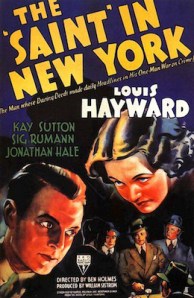 The Saint in New York is a B-movie in every sense of the term, but it’s certainly one of the fun kind.
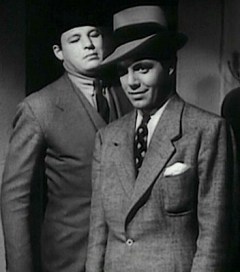 His habit of jumping into moving vehicles, much to the surprise of their drivers, is also fun. The other stand-out character is henchman Hymie, played by Paul Guilfoyle, who is enamoured of the Saint and constantly comments on his actions. Together they make the film a light, fun, amusing experience, with more memorable lines than a film of its stature deserves.
 Sometimes you watch one of the most acclaimed films of all time and find yourself with very little to say about it. La Règle du jeu — or, as it’s commonly known in America thanks to Criterion’s incessant title translation (in fairness, that’s probably the most sensible way to combat the mass attitude of “argh! it’s in Foreign!”), The Rules of the Game
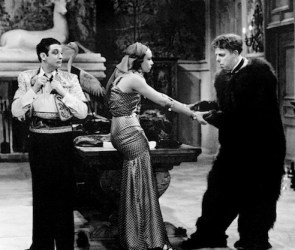 There’s a lot packed in, and I can see how multiple viewings could reveal even more going on. Perhaps a better researched awareness of the period (beyond the obvious Eve Of War, though that’s important) and of French class structure at the time is necessary to get the full richness of Renoir’s vision. The fact it was banned by the French government due to being bad for morale, then also banned by the occupying Nazis, suggests it did have a lot of social relevance.
 Holiday stars Cary Grant as an everyday chap who falls in love with a girl who, it turns out, is a wealthy heiress type… but who it also turns out may not share his views on the future. Her kooky sister, played by Katharine Hepburn, on the other hand…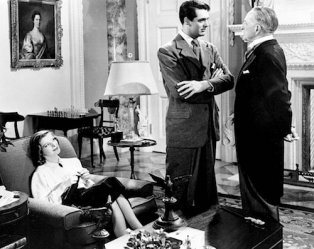

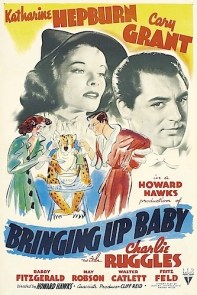 A box office flop on release (which directly led to Hawks being fired from his next film and co-star Katharine Hepburn being bought out of her contract & named “box office poison”), screwball comedy Bringing Up Baby has grown massively in stature since. And deservedly so, because — aside from a first act where Hepburn is no less than irritating, and an occasionally slow middle — it has some real comic high points and can be riotously funny.
 Also worth noting is that it is, perhaps, the first work of fiction to use the word “gay” to mean “homosexual”. Apparently the term originated in the homosexual community in the ’20s (possibly earlier) but would not become widely known until the late ’60s. Its use here was ad-libbed by Grant, though whether that makes it more or less likely to have meant “homosexual” I don’t know. I suppose no one was ever in a position to ask.
 Swing Time is, I’m told, widely hailed as the greatest of the Fred Astaire/Ginger Rogers pictures. The plot isn’t especially captivating, one of the stock variations on “boy meets girl” that still serve
  The Wizard of Oz is one of those films whose reputation unavoidably precedes it. Considering it’s nearly 70 years old now, that’s a reputation long in the making.
 100Films.co.uk