
Christopher Nolan | 106 mins | cinema | 2.20:1 | UK, USA, France & Netherlands / English | 12A / PG-13
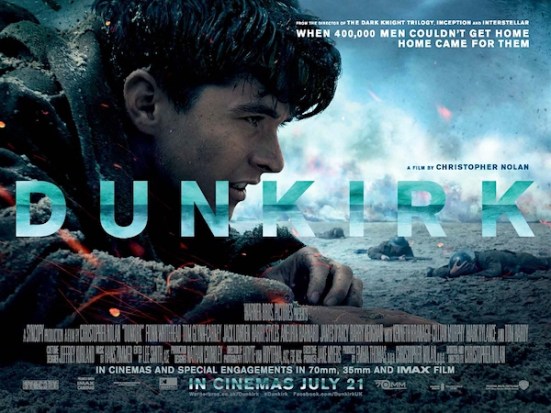
Batman Begins. The Dark Knight Rises. Memento. The Prestige. Interstellar. Inception. The Dark Knight. Of his previous nine feature films, Christopher Nolan has seven on the IMDb Top 250 (in descending order as listed). I’m sure Following and Insomnia have their advocates as well. Nonetheless, many reviews are hailing Dunkirk as his best film yet. Some are even say it’s his first genuine masterpiece. Some that this is the film where he finally lives up to those endless Kubrick comparisons.
And some just harp on about how we have to see it in bloody IMAX, even though most of us can’t.
Personally, coming out of it I felt pretty much the same way I have about every Christopher Nolan film bar The Dark Knight: it was very good, but was it great?
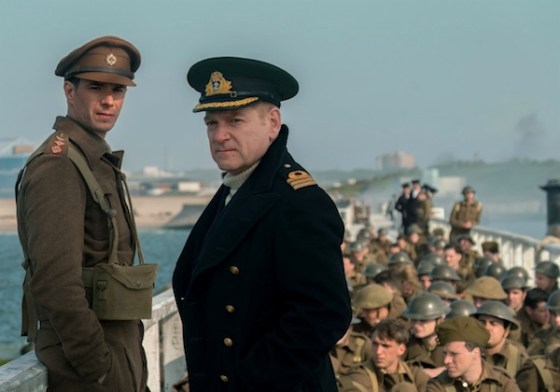
I don’t know how well the Battle of Dunkirk is known outside British shores (a lot better after this film, I’d wager), but I think it has a kind of ‘national myth’ status here; the sort of thing the phrase “our finest hour” was invented for. In 1940, British and allied troops retreated from the Nazi advance across Europe, ending up with their backs to the sea on the beach at Dunkirk, France, waiting for rescue from the British Navy. As their ships were plagued by German bombers and U-boats, eventually civilians were mobilised, with hundreds of fishermen and hobbyists sailing their tiny craft across the Channel to save as many as they could — in the end, over 330,000 troops. That’s ‘The Story’, anyway — I’m sure the truth is more nuanced. It’s also what provoked Churchill’s “We shall fight on the beaches” speech, which is probably even more famous.
So why hasn’t Dunkirk been more widely depicted on screen before now? Well, it didn’t involve the Americans, so I imagine that’s a big part of it. Also, it was technically a defeat — not exactly uplifting fodder. And where do you lay your focus? To take D-Day as a counterpoint: sure, it was a massive operation involving multiple beaches and thousands of troops, but you pick a handful of men to follow and you’re depicting the general experience. With Dunkirk, you’ve got the men who made it on to boats, those left on the beach, the civilians coming to their rescue, the sailors, the airforce… Or maybe I’m trying to make it sound more difficult to film than it actually is, and it all just comes back down to “the yanks weren’t there”.

But Christopher Nolan is allowed to basically do what he wants nowadays, and so Christopher Nolan is the one who’s finally made a film of Dunkirk. (I say “finally” — there have been others, a long time ago.) Despite it being the shortest film of his Hollywood career, Nolan gets round the perspective problem by making it an epic, driven by spectacular visuals and universal themes rather than a focused tale of just a character or two. In aid of this, it’s a three-pronged affair: in separate storylines we follow the soldiers on the beach and in the boats; a civilian craft on its way to rescue them; and a pilot providing air cover.
To complicate matters, Nolan stages each of these stories at a different time period — respectively, one week, one day, and one hour before the film’s climax — but intercuts them all as if they were happening at once. At times, literally: rather than limit each storyline to whole scenes one by one, events in each (like, say, a boat sinking with the soldiers on it and the pilot in a dogfight) are intercut as if they’re occurring simultaneously. It’s… an unusual choice. I’m not saying it’s bad, but I’m not sure what its goal is, exactly. For the film as a whole, it works effectively, especially spotting background details in each story that then crop up again later when other storylines catch up to them.
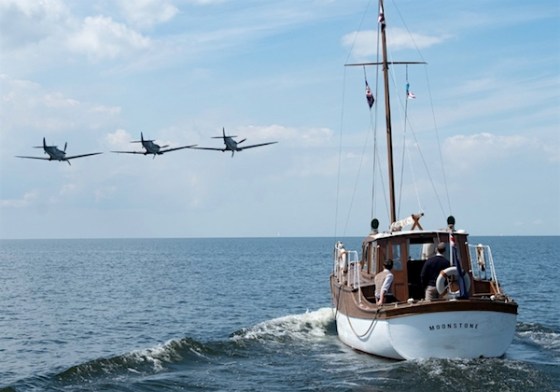
I think the main effect Nolan was aiming for is intensity. Not of war, so much, but of survival. That this is a PG-13 war movie caused some to balk — how can you depict war nowadays without blood and gore? But this isn’t a war movie per se, it’s an escape movie. It’s not about the reality of someone getting their arm or head blown off, it’s about escaping a sinking ship, or running out of fuel, or keeping going when the odds are against you. Couple this with the aforementioned visual spectacle, and a thunderous sound mix, and Dunkirk is definitely an Experience.
Indeed, for those without access to an IMAX — and, let’s face it, that’s the vast majority of viewers — the film’s sound is the main reason to see it in the cinema. It’s loud. I saw other people in my screening actually covering their ears at some points. That’s not just because my cinema had the volume too high (well, I don’t think it is), but I think it’s purposefully part of the effect. Of course, if you’ve got a decent sound system at home and are prepared to crank it up, maybe the Blu-ray will yet offer a similar experience. Certainly, in terms of the visuals, the disc release is likely to use the film’s IMAX Digital version, which features 80 minutes of 1.90:1 footage (vs. the constant 2.20:1 framing that you’ll see in most cinemas); and, if we’re lucky, they’ll include the IMAX footage in its full 1.43:1 ratio too (they did for Nolan’s Batmans, but not for Interstellar). It’s kind of ironic that this is a new-release film from a director hell bent on the sanctity of the theatrical experience (you probably saw his comments about Netflix earlier this week), where most of us will better see his intended visuals on a home video format than we will at the cinema.

In trying to think how to sum up, I’ve come to the conclusion that early reviews have put too much weight on Dunkirk. I’m sat here pondering “is it Nolan’s best film?” or “is it the greatest war film ever made?”, rather than just “how was it as a film in itself?” On first blush, I wasn’t as enthralled by it as I was by The Dark Knight, or even Inception, but in some respects it’s a more mature, maybe even more cinematic, movie than either of those. As for being the greatest war film, I can’t help but instantly think of Saving Private Ryan, whose opening scene remains the one to beat, but also follows through with the rest of its story; and if we expand our scope to allow cinematic TV series, can anything top Band of Brothers? But, as I said earlier, Dunkirk isn’t trying to out-war those war movies.
So, setting aside questions of its place in film history, Dunkirk aims to be an intense experience about trying to survive events bigger than yourself. In that regard, it’s as successful as the evacuation itself.

Dunkirk is in cinemas everywhere now. It’s also been released in IMAX, donchaknow.
It placed 9th on my list of The 17 Best Films I Saw For the First Time in 2017, which can be read in full here.

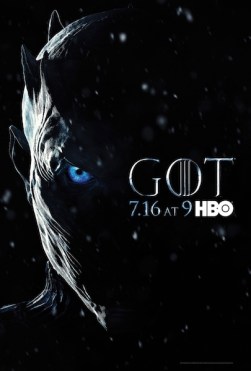 Season premieres of Thrones are typically concerned with re-establishing where all the major characters are, and maybe moving their stories on a few baby steps to indicate where they’ll be headed this season. Dragonstone is no exception. So where Arya had arrived in Westeros to kill the Starks’ enemies, now she’s slaughtering them by the hallful; where Bran and Meera were headed for the Wall, now they’re passing through it; where Jon and Sansa were taking charge in the North to be ready for war, now they’re preparing for war; where Sam had headed to the Citadel to research important stuff, now he’s in the Citadel researching important stuff; where Cersei had taken the Iron Throne and Jamie had his doubts, now Cersei’s preparing to defend her kingdoms and Jamie has his doubts; and where Dany was sailing for Westeros with her hodgepodge military, now she’s landed in Westeros. The wonder of Thrones is that it can take such scene-setting and turn it into riveting television.
 In fact, the only thing letting the side down was the well-publicised cameo by Ed Sheeran. If you have no idea who Mr Sheeran is then perhaps his appearance was fine — his acting was no worse than dozens of other bit players they’ve had on the series before now. But if you do know who the singer-songwriter is, his appearance was like being served a cheese board accompanied by cheese crackers with a glass of melted cheese and extra cheese on the side. After devoting what felt like a significant chunk of time (but was probably mere seconds) to him singing a song, Arya trots over to him and goes, “I don’t know that one,” and he says, “it’s a new one,” which he may as well have followed up with, “which you can hear in full on my new album, available now everywhere music is sold.” I have no idea if he has a new album out, or if that song would be on it if he did, but that’s how it felt.
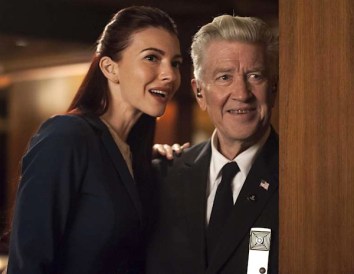 Slowly, very slowly, the disparate strands of Twin Peaks Mk.III seem to be coalescing into a coherent, connected story… which is almost more frustrating, in its own way. By that I mean: when it was wilfully obscure, you just kind of went with it — it was Lynch being Lynch, and you had to let it wash over you and allow your feelings to do the deduction about what it was supposed to signify. Now that the plot is beginning to crystallise into something your rational brain can make sense of, it feels a mite slow in getting there. I mean, while Dougie Jones is less annoying than he used to be (helped in no small part by the brilliance of Naomi Watts), I still miss real Coop, and we’re running out of episodes to spend time with him again. Was MacLachlan just feeding us a red herring when he said he’d “almost forgotten how to play him”? Because he hasn’t played him yet! Ach, we’ll see. It remains defiantly its own thing, and at least we can trust Lynch is going somewhere with it — even if we may never be able to work out precisely where that somewhere was…
 Based on a webcomic from the creators of Penny Arcade and funded through Kickstarter (so far it’s only available to backers), this miniseries-cum-pilot (the five short episodes total 58 minutes) takes place in an alternate Prohibition-era America, where “Prohibition” instead refers to the ban on production of automatons — sentient robots. Ex-copper Sam Regal (Basil Harris) and his partner Carl (voiced by Doug Jones), an automaton, now make ends meet as PIs, doing the usual PI thing: photographing cheating spouses. Only this time the run-of-the-mill case leads them into a murderous web that encompasses speakeasies, robo-gigolos*, underground automaton-hating gangs, and a twist ending (natch).
 The biggest TV news this fortnight was undoubtedly the BBC’s announcement of the 13th actor to take the title role in Doctor Who. (Well, the 14th. Well, the… oh, let’s not get into that.) As you surely can’t have missed, it was Jodie Whittaker, who is a woman! Gasp! Naturally, there was some outrage. After all, it makes no sense whatsoever that an alien being who can travel in time and changes his whole body every time one gets worn out could possibly, during that change, switch from being a man to a woman, even if it’s been established multiple times within the series itself that such a change is possible. It’s just not plausible, is it?
 This month, I have mostly been missing The Handmaid’s Tale. It belatedly started airing on this side of the pond at the end of May, but it slipped my mind so much that I didn’t even mention it in













 100Films.co.uk