Anthony & Joe Russo | 149 mins | cinema | 2.39:1 | USA / English | 12A / PG-13
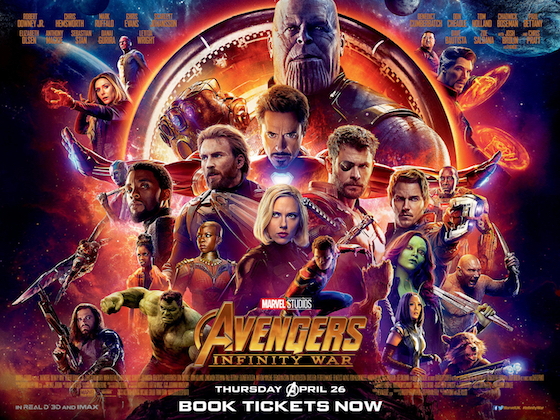
People are incredibly wary of Infinity Wars spoilers right now — understandably — so here’s the deal: this review starts off completely spoiler-free, until a clearly-marked move into spoiler territory. Then the last paragraph (after the picture of Thanos and right above my star rating) is everyone-friendly again. Get it? Got it? Good.
Ironically, it’s actually quite easy to give a fair summary of the plot without spoiling anything that’s not already been teased in previous films: alien warlord Thanos (mocapped and voiced by Josh Brolin) is out to collect the six Infinity Stones, crystals from the birth of the universe with unique powers, which when amassed together will grant him ultimate power. Out to stop him is pretty much every hero introduced in the previous 18 MCU films.
I confess, I was all prepared for Infinity War to fail to live up to the hype and hyperbole of the reviews that have swarmed over the internet in the past few days, just like happened for me with Avengers Assemble six years ago. In this case, there’s so much going on, the experience is such a huge rush, that it’s almost hard to get your head around what to think of it. I don’t believe there’s ever been another movie quite like it — so many disparate primary heroes, all needing time, and facing a single huge villain, who also gets plenty of focus… Setting aside any of the usual quantifiable elements, reviewing the film comes down (as it really always should) to one simple question: did I enjoy it? Yes, I did.

Like the first Avengers, it’s certainly a great event of a movie — but more so, natch. It trades off that event status too: the stakes are huge, the pace and size relentless. It could’ve been like a Transformers movie — “a beginning, then AHHHHH! for another two hours or so”, as someone once described them — but thankfully it’s not so one note: as well as big action, there’s room for humour (plenty of that, it being a Marvel movie, but never ill-placed) and emotion (some affecting dramatic scenes, most of them too spoilersome to mention here).
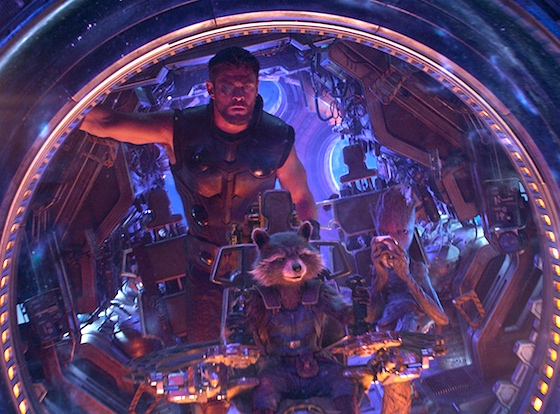
It’s impressive to join together so many different sub-franchises and manage to create a consistent tone. In some respects it does feel like they’ve chopped up bits from the characters’ individual movies and spliced them together. The most striking for this is the entrance of the Guardians of the Galaxy, when the Russos cut so abruptly into those films’ style that it initially feels misjudged… though I guess a lot of people won’t mind because, hey, everyone loves the Guardians (my audience practically cheered with recognition — not at seeing the characters on screen, but at the very obvious stylistic shift just before they appear). But, across the movie as a whole, it gels well. I suppose some would counter this with “all Marvel films have the same formula and tone so obviously it works”, but that’s not wholly fair — The Winter Soldier and Thor: Ragnarok are hardly the same, are they?
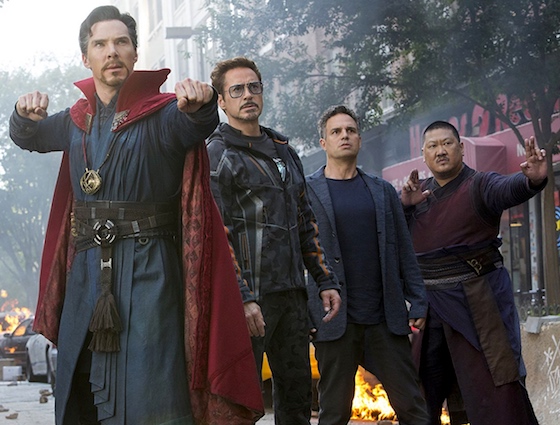
Whatever the cause, the big plus is that none of the characters ever feel inconsistent — you’ve not got funny people suddenly being serious, or serious people suddenly cracking one-liners, just to make it all fit together. On one level that’s just good character writing, but it’s also good story structure: which characters get teamed up together, because each group has a good mix to butt against each other in the right ways. That doesn’t mean every set has one Funny One, one Serious One, etc, because sometimes the film needs to be able to cut from The Serious Group to The Funny Group. Several reviews I’ve read talked about the film’s “surprising team-ups”. Well, maybe… if you haven’t watched any trailers or seen any posters. Whatever, they mostly work very well. Some characters are better served than others, which is inevitable in a film of this scope, but pretty much everyone gets at least a line or a moment. Who your personal favourites are might dictate whether you think the screen time was fairly allocated or not.
(Spoilers follow.)
Talking of other reviews, I read one that said that, while the film may be entertaining, it’s ultimately hollow because it has no major thematic throughline to explore. I disagree. It leans quite heavily into the question of “at what cost?” What is everyone prepared to sacrifice to achieve their end goal? Both the heroes and Thanos are presented with this question, again and again. Heck, it’s not only a major test for Thanos, it’s part of his origin story too! Now, you can argue about how well the film expounds on this theme, as you can with any work of art (In this case: several of our heroes make that ultimate sacrifice, only for it to be undone by plot necessity), but to say the theme isn’t there feels disingenuous.
With all of that accounted for, I don’t know what more could be asked of the movie, in some respects. That said, two fairly specific things bothered me. The bigger one was that we only witness Thanos collecting five of the six stones. Why not show us the lot? How he acquires his second stone makes for an effective opening scene — immediately killing off two well-liked characters, as well as defeating two of the MCU’s main heroes, quickly establishes Thanos’ power — but then how he got the first stone is just revealed in some exposition dialogue later on? C’mon, you can do better than that! The other was the random reappearance of the Red Skull, not seen since Phase One. I guess they felt in need of some kind of reveal at that point, but I’m not sure why. Does him being there even make sense? I don’t see how, but then I’ve not watched The First Avenger in the last six years so maybe I’ve just forgotten. They even had to get a sound-alike to do the voice, so clearly they felt it was vitally important!
Something I’ve previously written about being bothered by in movie franchises are two-part films. As a rule I prefer that, even when a pair of films are connected, they should function as finite units — think Back to the Future Part II and Part III, for example, or the link between The Empire Strikes Back and Return of the Jedi. Avengers 3 and 4 have an interesting history in this regard: originally announced as Parts 1 and 2, this was later changed to them having individual titles, to indicate they were two separate stories… but still connected, because the two films were shot back to back, and Avengers 4’s final title hasn’t been announced presumably because it’s an Infinity War spoiler. Nonetheless, some people seemed to interpret all this as meaning the two films would be completely standalone from each other, and are now annoyed at Marvel because, surprise surprise, there’s a cliffhanger.

(I know I already gave a spoiler warning, but just in case you read on regardless: the paragraphs between now and the next photo give away, like, everything.)
So, here’s my take: obviously Infinity War is not entirely isolated from Avengers 4, but I don’t think this is a Kill Bill one-film-split-in-two situation either. Fans who now think the original Part 1 and 2 titles would’ve been apt are maybe taking too simplistic a view of story structure. I mean, look at it this way: it’s only half a movie to us because we know the Avengers are going to come back and win somehow; but if you’re Thanos — the film’s real protagonist, remember — then the story’s over: he did what he set out to do, the end. Maybe this is an academic distinction, but I do think it’s fair enough to have ditched the subtitles that implied it was one movie in two halves. This film tells a whole story (of Thanos trying to wipe out half the universe) and the next film will tell a new story set after it (presumably, how the Avengers try to undo that).
Either way, the film ends on a cliffhanger — a bloody huge one! But I have to wonder: is it actually too much? By that I mean: it has to be undone. Yes, obviously we know the heroes will win in the end, but none of those final deaths can stick. Even if you took Benedict Cumberbatch at his word that Doctor Strange 2 isn’t confirmed, and James Gunn at his that Guardians Vol.3 might feature a changed line-up, we know they need Peter back for Homecoming 2, T’Challa back for Black Panther 2, and so on. So if it has to be undone — if there have to be resurrections — well, why not also resurrect Loki, and Heimdall, and Gamora, and Vision, and anyone else who genuinely died earlier in the story? In fairness, in this I may be getting too far ahead — how the resurrections occur is absolutely a question for next time, after all. But it’ll have to be a very specific solution — one that undoes Thanos’ final act, but doesn’t undo all the ones that led up to it — to not just seem like a stereotypical death-doesn’t-matter superhero cop-out.
A final point on these deaths. I’m not sure I can actually remember everyone who lived and died during the wipe-out-half-the-universe finale (there were so many!), but I’m fairly certain they were mostly Phase Two and Three characters. I remember that Iron Man, Thor, Hulk, and Cap all definitely made it, anyway. My point is this: things are now set for Avengers 4 to really cap off the first 11 years and 22 films of the MCU by placing at its core the heroes who started it all. That’s quite neat, isn’t it? You’ve got to assume that’s deliberate.
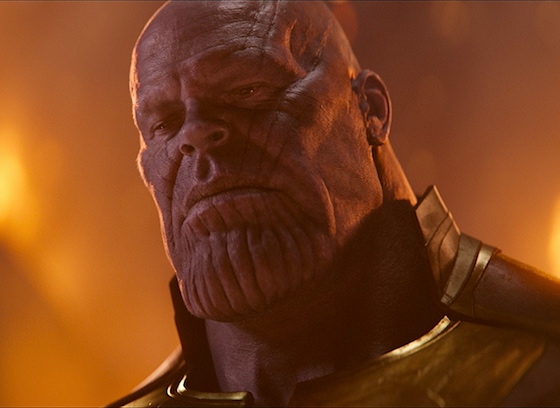
Avengers: Infinity War is like a massive comic book crossover rendered in live-action. You might think “of course it is”, but it’s not that long ago that this wouldn’t even have been possible (the CGI required is phenomenal), and even less time since it would’ve been considered profitable (remember when all superhero movies had to be “grounded”?) As much as it’s a familiar epic sci-fi action blockbuster, it’s also a new kind of thing to the big screen. There are pros and cons to turning that kind of narrative into a movie, but Infinity War is heavy on the former and relatively light on the latter. When it comes down to it, it’s just marvellous entertainment.

Avengers: Infinity War is in cinemas everywhere (except Russia and China) now.
The fourth Avengers movie will be released this time next year.
Avengers: Infinity War placed 6th on my list of The 26 Best Films I Saw For the First Time in 2018.




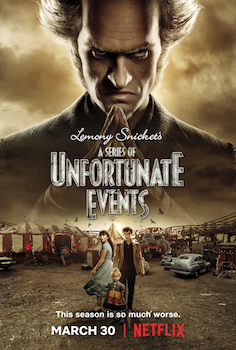 Abandon your vapid, facile distractions and set aside your very fine dramas, because it’s time to indulge in some vicarious fearsome disaster with the return of Netflix’s venerable family delight — a phrase which here means: A Series of Unfortunate Events is back.
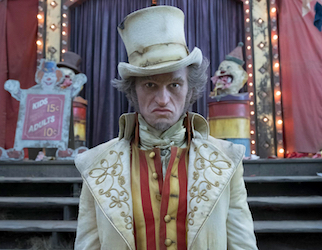 Neil Patrick Harris is having a whale of a time as Olaf and all his varied aliases, while the apparent earnestness of child actors Malina Weissman and Louis Hynes is clearly well measured for effect rather than poor work. There’s an array of memorable guest performances this season as well, from Kitana Turnbull, fantastically horrid as Carmelita, a little-goody-two-shoes teacher’s-pet bully the Baudelaires encounter in the opening two-parter; to Lucy Punch as an obsessive fashionista; to Sara Rue as a new inductee into the secret organisation trying to help the Baudelaires. Best of all is Nathan Fillion, born to play the fast-talking dashing hero who gets a ton of the best lines. If there’s a downside, it’s that we don’t see enough of some people. Unlike most kids’ fare (and, let’s be honest, some stuff made for adults), this isn’t a show where good is always rewarded and bad behaviour always punished, and that means some people may be shuffling out before we’ve had as much as we’d like. I guess the clue was in the title…
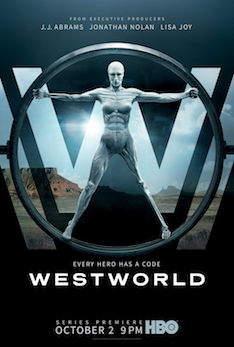 With season two imminent (it begins tomorrow, people!) I finally got my behind in gear (it’s only taken 18 months) and missioned my way through the first season of HBO’s reimagining of
  During its production Westworld hit the headlines because they shut down production for a while to retool the scripts and hone the story. Maybe this was why. If so, it paid off, because from the fifth episode things pick up considerably. Developments and twists really kick the mysteries into gear. Scenes between characters begin to carry more meaningful dialogue and affecting emotion. There’s even some action to give it a nice adrenaline kick at times. Rather than feeling like it’s ambling nowhere in particular, you feel like showrunners Jonathan Nolan and Lisa Joy have some very particular things in mind, but good luck guessing what they are because there are many surprises in store: however close you think you are to uncovering Westworld’s games, someone always has something else up their sleeve. It develops an almost
  The other most striking thing about the show are the performances. It’s like an acting masterclass: there are numerous fine performers here, and they’re all doing their best work. Ed Harris, Anthony Hopkins, Thandie Newton, Evan Rachel Wood, Jeffrey Wright… they’re all so magnificent that I don’t know who to single out without going on forever. And that’s not to undersell the rest of the cast either, many of whom would be said to excel in most other shows, but here there’s just so much raw talent on display.
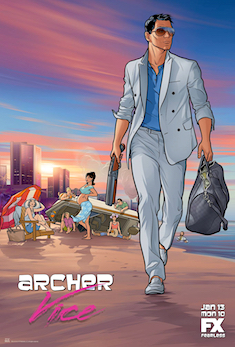 Here in the UK, animated spy-comedy Archer originally aired on Channel 5, until they started really titting about with the scheduling, which is what led me to drop off watching. It’s all on Netflix nowadays though, so I’m finally getting back into it.
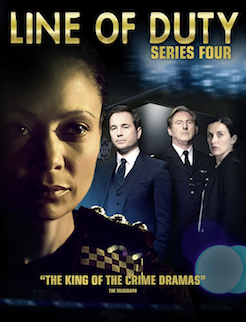 Another superb performance from Thandie Newton here, as the subject of AC-12’s latest internal affairs investigation. She’s convinced she’s arrested a notorious serial killer known as “Balaclava Man”; our faithful heroes reckon she’s cut corners, overlooking serious concerns about the evidence; the higher-ups who were exerting pressure on her to close the case would rather it all just went away. And as is the Line of Duty way, some shocking early developments send things spiralling in different directions. After the programme had become increasingly mired in its multi-season meta-arc
  While I very much enjoyed
 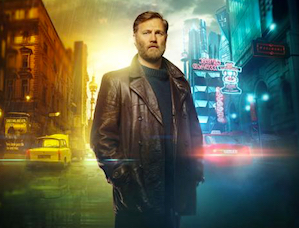 This month, I have mostly been missing the BBC’s miniseries adaptations of China Miéville’s The City and the City and Agatha Christie’s Ordeal by Innocence, both of which I’ve been saving up to watch in a more condensed fashion once they’re finished. The Christie ended on Sunday but the Miéville is only halfway through. Anyway, I imagine I’ll cover both next month. Also released this past month was Netflix’s big-budget reboot of Lost in Space, which I would’ve watched if I hadn’t been missioning my way through Westworld this past week. That might be here next month also. And finally, the last-ever season of The Best Show On TV™, The Americans, is underway in the US. Again, I’m saving it all up ’til it’s done, but I do intend to watch it promptly so as to avoid finale spoilers — my real hope is to time it just right so that I can watch the finale the day after it airs in the US, but we’ll see. Said finale isn’t until May 30th, so whatever happens I won’t be reviewing that until June.