
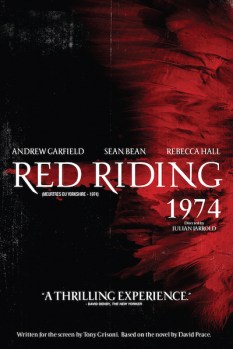
 The Red Riding Trilogy covers nine years of police corruption and child kidnap/murder in Yorkshire, amongst one or two other things, and begins here with a very film noir tale, courtesy of author David Peace and screenwriter Tony Grisoni, slathered in neo-noir stylings, courtesy of director Julian Jarrold.
Jarrold is most recently responsible for Kinky Boots, Becoming Jane and Brideshead Revisited, all of which stand in a sharp juxtaposition to the style and content of Red Riding. But turning from his lovely English-as-they-come costume dramas to something altogether nastier should come as no great surprise, for Jarrold is merely returning to his TV roots: in the mid ’90s he directed episodes of Cracker, Silent Witness and Touching Evil.
He certainly seems to know his territory, but perhaps he knows it too well — though this is also the fault of Grisoni and, perhaps, Peace — as the plot that he unfolds is not only familiar but told as if he’s all too aware we know what’s coming. The feeling one gets is of a British James Ellroy, albeit a low-rent, less complex version. (The same is true of 1980, though for me 1983 manages to escape such comparisons.) The story idles along, not exactly slow so much as in no hurry, full of near-clichéd plot points and an unrelentingly standard structure. These things aren’t necessarily a problem, but when you’ve got as big and bold a reality claim as the Red Riding Trilogy they feel out of place.
Another recent point of comparison would be David Fincher’s Zodiac — young newspaperman on the hunt for a serial killer in an inspired-by-fact ’70s setting — though this does 1974 no favours. It may be grittier than Fincher’s film, but it lacks the polish, the originality, and manages to feel slower, despite being a whole 50 minutes shorter. However much arty photography, disjointed storytelling, relatively dense accents and ‘gritty reality’ is plastered over the barebones of the tale, the familiarity of it — to both viewers and the makers, who don’t even seem to be trying — means there’s not an ounce of suspense or surprise to be had.
The cast is made up of established names, familiar faces and rising stars, many of them unfortunately stuck in familiar roles or otherwise left stranded by the unrewarding material. If they’re not quite stereotypes it’s because they’re too bland, lacking enough discernible character traits to reach such lofty heights. Occasionally this is because, with two films to come, some minor parts here have a major role later, but this can’t be said of them all. As the lead, Andrew Garfield’s journalist is as much of a stock character as the plot he finds himself in: a young reporter type, idealistic among journalists who no longer care (if they ever did), hunting to expose The Truth. Again, it could work, but is belied by the insistence — in both promotion and filmmaking style — that Red Riding is something more than Another Murder Mystery. Only Rebecca Hall, as a mother whose young daughter went missing years earlier, is granted the material to give an outstanding performance — which she does, easily justifying her recent BAFTA Rising Star nomination.
Besides Hall, the best thing about 1974 is its dull, desaturated photographing of grimy, desolate locations, where any colour that isn’t beige desperately wants to be. It suits the story and era perfectly, and the choice of 16mm seems to add a level of haziness that is equally appropriate. It’s perhaps indicative of everything this is aiming for that the most beautiful imagery is of an incinerated gypsy camp. Rendered almost black and white by the soot and desaturisation, ash floats through the air like snowflakes as Garfield stumbles through it, the whole picture a vision of Hell. It’s a kind of perverse beauty, true, but that’s also entirely in keeping with Red Riding.
1974 is a stock noir tale, dressed up with fancy filmmaking techniques and claims of realism to look like something more truthful, more real, more Important. And it makes me a little bit angry because of it. Maybe the violence is more realistically depicted than your average genre entry, maybe the police corruption is a little more plausible — then again, maybe it isn’t — but the real story here is so familiar they haven’t even bothered to hide the plot beats and twists properly, no doubt assuming a “gritty” veneer plastered over the top would do the job for them. It doesn’t. Maybe 1974’s grimy setting, brutal violence and unbeatable police corruption are all true to life, but the familiar and predictable plot leaves the realism feeling like no more than a pretence.
I was enjoying 1974 a lot more by the time the unexpectedly satisfying conclusion came around, but the sense that it had tried to pull the wool over my eyes throughout — and not in the good way a thriller should — just leaves a bitter taste.

* Though I watched Red Riding: 1974 on 4HD, it’s my understanding that it was upscaled. ^
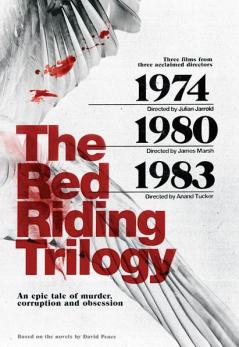 You’d think Red Riding was a TV miniseries, wouldn’t you? After all, it was on Channel 4 on the same day for three consecutive weeks (recently repeated over three consecutive nights).

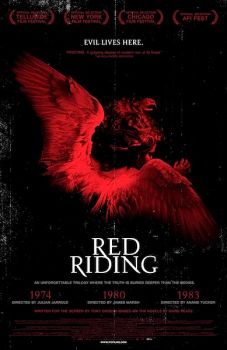 My final thoughts about Red Riding — other than “that was disappointing” — are stuck on the reality (or not) of the police corruption it portrays. It’s difficult to know whether anyone who believes our police were never so nasty as this is naive, or whether anyone who believes they were quite this bad is paranoid. The truth no doubt lies somewhere in between.
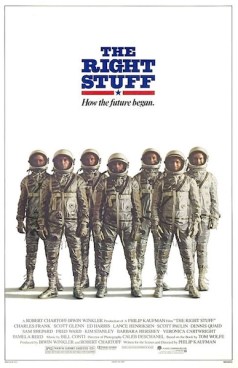 The Right Stuff ostensibly dramatises the story of the ‘Mercury 7’, America’s first group of astronauts, but in fact equally concerns itself with the tale of test pilot Chuck Yeager. But I’ll get to him.


 I’ve never actually seen a Richard Lester film before, and so spectacularly failed to put two-and-two together about who the director was and what else he’d done before I watched this. If I had, recent (at the time of viewing) reviews of the BFI’s release of Lester’s later
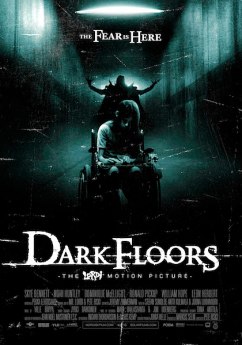 You may remember Lordi, the surprise winners of the 2006 Eurovision Song Contest. If that doesn’t help, they were the Finnish rockers all dressed up in monster suits. Here in the UK we gave them our highest number of points.
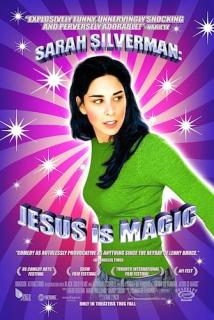 Stand-up concert films are an awkward business (as are rock concert films), raising questions that are oft pondered on this blog about what constitutes a “film”. After all, if this were just shown on TV or released direct to DVD rather than released in cinemas, no one would be considering it a feature. Indeed, Channel 4’s TV showing cut the 70-minute (PAL) version down to just 50, much as they do for the TV showing of any other direct-to-DVD stand-up gig. But the fact remains that this was released in cinemas (albeit not many) as a feature film. Though if it’s worthy of review under this blog’s remit, and direct-to-DVD movies are worthy of review too, surely direct-to-DVD comedy gigs should be? It’s enough to make your head hurt — something Jesus is Magic might also do, if it hasn’t sent you to sleep.

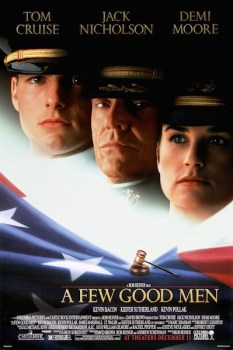 Sometimes you have to wonder where it all went wrong. I can only imagine how good things looked for Rob Reiner at the start of the ’90s, when he’d had an almost-interrupted near-decade-long run of acclaimed movies in the director’s chair:
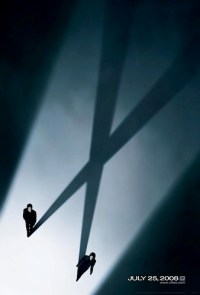 Six years after the once-phenomenal TV series meandered to an inconclusive conclusion, Mulder and Scully were back at the cinema, a decade on from their previous between-seasons big screen outing. The big threat this time was not aliens, however; nor even something more Earthly supernatural; but rather, where they would find an audience? There are now kids old enough to watch this in a BBFC-endorsed fashion who weren’t even born when the series started, and that’s not to mention the misguided attempt to pitch this as a Summer blockbuster.

