
Provoked by, of all things, the Blu-ray release of The Wolfman (this started out as the opening paragraph of my review of that — oh how it grew), I’ve once again been musing on one of my ‘favourite’ topics. No, not “what’s TV and what’s film these days?”, but “which version of a film is definitive these days?”
I apologise if I’ve written extensively on this before; I think I’ve only had the odd random muse in a review, at most. So, much as I got the TV thing out of my system (a bit) in that editorial, here’s an attempt at the “definitive cut” one:
The age of DVD has managed to throw up all kinds of questions about what is the definitive version of a film. Never mind issues of incorrect aspect ratios, fiddled colour timing, or excessive digital processing — these are all potentially problems, yes, but usually quite easy to see where the correct version lies. The question of a ‘definitive version’ comes in the multitude of Director’s Cuts, Extended Cuts, Harder Cuts, Extreme Cuts — whatever label the marketing boys & girls slap on them, Longer Versions You Didn’t See In The Cinema is what they are. But are they better? Or more definitive? Does it matter?
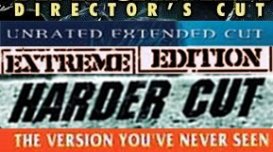 So many consumers hold off for the DVD these days, especially with the added quality offered by Blu-ray, that the old answer of “what was released in the cinema” doesn’t necessarily hold true any more. Filmmakers know some will be waiting for the DVD, so are less concerned with releasing a studio-mandated, shorter, mass audience friendly cut into cinemas when their fuller vision can be found on DVD. Equally, the PR people know that “longer cut!” and “not seen in cinemas!” and other such slogans can help sell DVDs, and so may be forcing needless and unwelcome extensions onto filmmakers. Then there’s all those older directors who think they’re doing a good thing finally getting to tamper with their film 30 years on, who may well be misguided.
Some make it nice and clear for us. Ridley Scott, for example, is particularly good at this: Blade Runner has taken decades to get right, but The Final Cut is quite obviously the last word on this; he was well known to be unhappy with the theatrical version of Kingdom of Heaven, and was vindicated when the aptly-titled (for once) Director’s Cut received much improved reviews; conversely, he’s been very clear that the Director’s Cut of Alien and Extended Cut of Gladiator are not his preferred versions, just interesting alternate/longer edits.
On the other hand, Oliver Stone has now churned out three versions of Alexander [2015 edit: now four], each with significantly differing structures and content. None have received particularly good reviews. Is one the definitive cut? Or is it just a very public example of the editing process; what difference inclusions, exclusions, and structural overhauls can (or, perhaps, can’t) make?

The issue is somewhat brushed aside by two things, I think. Firstly, most stuff that suffers this treatment is tosh. Who cares which version of Max Payne or Hitman or Beowulf or either AvP or any number of teen-focused comedies is ‘definitive’ — no one liked them in the first place and they’ll be all but forgotten within a decade or two, at most (well, not AvP, sadly — its connection to two major franchises will see to that).
Secondly, more often than not both versions are available. Coppola may have vowed never to release the pre-Redux Apocalypse Now ever again, but the most recent DVDs [and, later, Blu-rays] include both cuts — listen to him or go with the original theatrical cut, it’s your choice. The same goes for Terminator 2, or indeed a good deal of the rubbish listed above. Rare is the film that doesn’t fit into one of these two camps, or the third “it’s been made clear” one.
So, with all that said, does it even matter? If we can choose which version we prefer, is that the right way to have things? Because, having gone through the options and examples I can think of, it’s not often that there’s not an easy way to resolve it — by which I mean, if the film is good enough to want the clarity of “which version is final”, we tend to have a way of knowing; and if the film’s tosh, well, what does it matter which we choose? There’s every chance no one involved in the production cares anyway.
 There remains one argument for clarity, I think. How does one guarantee that, in the future, the ‘correct’ version remains accessible? With new formats always coming along, there’s no assurance that every cut of a film will be released; with TV showings, there’s no assurance the preferred version will always be the one shown (though there’s another argument for how much the latter matters considering they already mess around with aspect ratios and edits for violence/swearing/sex/etc.) But then, even if a filmmaker makes it clear that their preferred version is the one that only came out on DVD/Blu-ray, what chance is there that unscrupulous disc / download / unknown-future-format producers or TV schedulers won’t just revert to the theatrical version by default?
Sometimes one longs for the simpler age of a film hitting cinemas and that being that. We wouldn’t have had to suffer Lucas’ Star Wars fiddles, for one thing. But then nor would Ridley Scott have been able to redeem some of his films, or Zack Snyder treat fans to an improved Watchmen, or Peter Jackson truly complete The Lord of the Rings. If some level of uncertainty is the price we have to pay for these things, then it’s one even my obsessive nature is willing to pay.
There are 20 different films featured in this post’s header image.Anyone who can name them all wins special bragging rights.
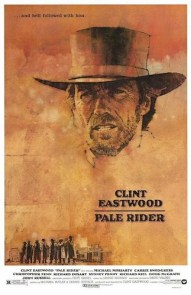 Pale Rider is, in many ways, a pretty stock Western. The plot is likely to be familiar even to those who haven’t seen a great deal of the genre: remote community, where some controlling business-type is making life hard for a bunch of everyday poor grafters; in rides a mysterious stranger, who sees the injustice of the situation; when peaceful methods don’t work, there’s the climactic shoot-out; and the mysterious stranger finally rides into the sunset/from whence he came/forever on.
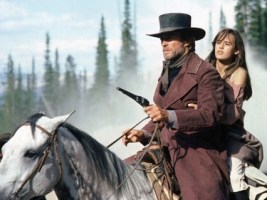 but the person he has in mind is dead… and yet, when they come face to face, the marshall repeatedly utters, “it is you”.
 the only particularly memorable role is Sydney Penny’s naïve young teenager, Megan. Her shifting emotions and variable actions are perhaps the only parts of the story one can’t necessarily see coming from the off.
 Readers may remember that I opened my
  Mac and Kutcher play the roles they always play— No, actually, in fairness, I can’t say that: I think I’ve only seen Mac in the
 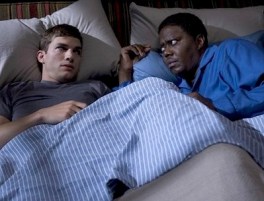 It’s as recognisable from TV sitcoms —
 It’s generally taken as a rule that an original film is better than the remake, particularly so if that original is in a language other than English and the remake is American. But there’ll always be something to buck the trend, and in my view that’s Insomnia.
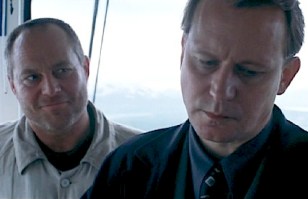 surprised how little his lack of sleep had to do with anything. Here, there are several scenes of Skarsgard struggling to sleep, he’s visibly rougher as the film progresses, and it seems to impact his judgement and sense of what’s going on more than in Nolan’s film. If the other character elements are apparently less developed, this is something the original does better.
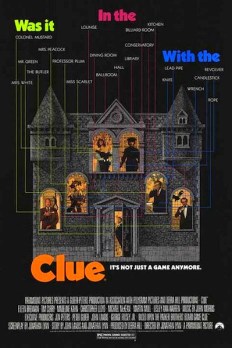 Although Disney have recently treated (I use the word loosely) us to a glut of films based on theme park attractions, movies adapted from good old board games seem a lot rarer. This is probably for good reason — even more so than Disney rides, the majority have no kind of useable narrative. Cluedo (aka Clue in the US) is one of the few that does, and consequently is one of the few (only?) board games that has reached the silver screen. So far, anyway.
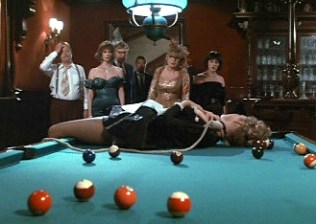 Other than the board game connection, Clue is best known for its three different endings, all of which were released, with each screening having just one attached. On TV the film shows with all three consecutively, and they perhaps work best this way — there’s a rising scale of ridiculousness, and the varied repetition of a couple of gags underlines rather than steals their amusement value. My personal favourite variant was the first, incidentally.
 #58
#58 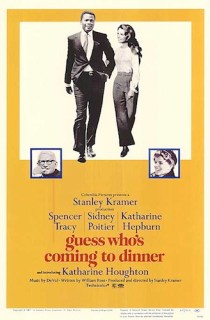 In Guess Who’s Coming to Dinner, a white girl falls in love with a black man and brings him home to meet the parents. You can almost imagine this premise still being launched today, as one of those dreadful ‘comedies’ Hollywood pumps out every year, in which the parents are outrageous racists — played by some ageing stars who should really know better — and one of the young couple is a bit accident-prone and played by someone like Ben Stiller or Adam Sandler.
 It could easily have been a simplistic message movie — these people are liberal, these people are racist, etc — but instead there’s complexity at every turn. There’s the liberal white parents who never expected to find themselves in this situation, and suddenly are struggling with their own ideologies; or the black characters, who you might think would be eager to move ‘up in the world’ but actually react even worse to the idea; or the Catholic priest being one of the few characters unwaveringly in favour of the union. And even then, these characters could just become ciphers for the arguments and debates; but they’re not, they’re characters, having believable reactions, and from this comes the debate.
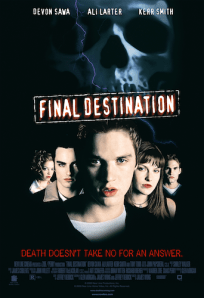 Final Destination is a full decade old this year, which somehow seems too long — it can’t be so old, surely? On the other hand, it fits quite comfortably into that run of teen-centric horror films from the the mid- to late-’90s, like
  The most important part, all things considered, are the ways Death settles the score. No mysterious “natural causes” demises here — Final Destination is all about inventive executions. Even after a decade, in which some of the Great Big Shocks have been revealed in various Top 10s and “OMG do you remember the bit where…” conversations, some bits remain impressive and/or amusing. And it certainly has fun with a few of them, teasing the viewer with various means of dispatching the victim before they ultimately succumb to one. Or, alternatively, just surprising us with a sudden whack. Both are good. Only one bit — a fidgety-armed corpse — is a thoroughly gratuitous jump-scare.
 but that one solitary shot confirms it must be some kind of entity with a very specific motive. And that’s a shame, because it’s not developed further — i.e. no Big Reveal of the nasty Death-thing — and would’ve been more interesting to play with that ambiguity — is Alex right that it’s all planned, or is it just a series of nasty coincidences?
 Ah, Rambo. Rambo Rambo Rambo. The only Rambo film I’ve seen is
  Stallone is perfect for the character: suitably calm and ‘everyman’ at the beginning; muscular and mostly silent as the trained assassin; and even an actor capable of pulling off the final breakdown, when the horrors of war spill over. It’s difficult to imagine most muscle-men action stars pulling off Rambo’s closing speech. Throughout, Rambo’s PTSD is made obvious without being overdone: brief flashbacks suggest all the horror we need to know, topped by his final outburst. Rambo isn’t the beast, the men who made him that way are, along with those he did it for who fail to appreciate what he’s been through.
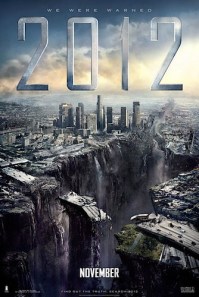 It’s the end of the world, and Roland Emmerich feels fine. The “master of disaster (movies)”, as I’m sure someone (probably himself) has labelled him, here attempts the biggest disaster of them all — as I said, it’s the end of the world.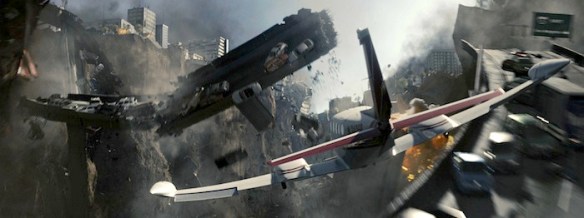
 as the US President, but a couple of the cast members hold the screen well enough.
 On the other hand, you do get more or less what you’d expect from the film. No one’s going into this thinking they’re getting a deep character piece — it’s great big spectacle all the way, and while it’s not the greatest big spectacle ever, it delivers something close enough to prevent it being the ultimate disaster of a movie — but it’s not the ultimate disaster movie either.
 100Films.co.uk