
Jonathan English | 121 mins | Blu-ray | 16:9 | UK, USA & Germany / English | 15 / R
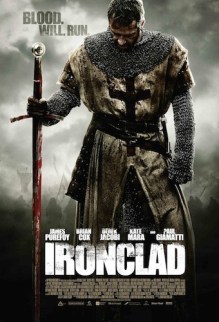 In medieval times, a group of filmmakers set out to prove you can make a Hollywood-quality historical action epic with independent funding in Britain, while in the present day a ragtag group of seven samurai— sorry, gunslingers— sorry, warriors, defend a small town— sorry, castle, from evil bandits— sorry, an evil king.
I think I got some details confused there.
Set shortly after the signing of the Magna Carta, Ironclad tells the true story of King John not being very happy and, with the backing of the Pope, setting about reclaiming England. Violently. Naturally the men who forced him into scribbling on the famous document aren’t best pleased, so while some set off to persuade the French to invade, others hole up in Rochester castle, vital to John’s efforts as it controls trade routes to the rest of the country or something.
Firstly, I say “true story” — I have no idea how much fact has gone into this. Some, at least. Was John really supported by a Viking-ish army? Dunno. Were the Knights Templar really dead set against him? Dunno. Was Rochester really defended by a dozen men? Dunno. But this isn’t a history lecture, it’s a piece of entertainment — aiming for the same ballpark as Gladiator, Braveheart, Kingdom of Heaven, and so on, albeit less grand; and there’s a sort of connection to Ridley Scott’s Robin Hood too, which I seem to remember included the signing of the Magna Carta.
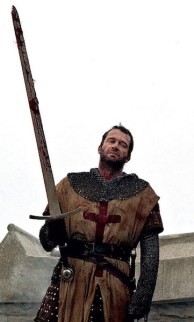 Anyway, it seems to me its use of facts are probably strong enough to support it as an entertainment. So some of the story structure may be reminiscent of Seven Samurai/The Magnificent Seven, but it’s not the first to use that and it won’t be the last (and I’ve never seen either anyway. Bad me). And so the special effects-driven climax may occur on the wrong tower of the castle’s keep — I think we can live with that level of deception.
As to the point of “why not just go round the castle?”, I presume the answer is more or less, “well… he didn’t…” Somewhat thankfully, the commander of the Danish forces puts this very question to the King, whose answer is some muttered speech about how his family built it and… I dunno. I’m not clear why they can’t just use the massive camp next to the tiny castle as their appropriate base of operations, other than the film wouldn’t be half as exciting.
And exciting it of course is. There are stretches some may find dull — there’s little new to be done with the whole Recruiting The Team bit, and once John gets the castle under siege and everyone’s twiddling thumbs and eating horses some viewers will be doing one of the two as well — but there are regular bursts of sword-swinging violence that achieve the film’s primary aims. The fights are generally well staged, even if many resort to the modern vogue for close-up quick-cut handheld shakiness, and they’re certainly gory.
 I’ve seen some complain about the level of graphic detail in this regard, but this is medieval times, they didn’t just bump each other about a bit; and you don’t think a giant axe swung down on someone’s shoulder with all a man’s weight is going to just leave a scratch, do you? Director Jonathan English doesn’t linger on detail as if this were a horror movie. There’s cleaved bodies, severed limbs, squirts of blood and more, and it all feels gruesomely realistic, but individually each moment passes quickly.
This is as appropriate a moment as any to mention that the film should be in the ratio 2.40:1, but the UK Blu-ray (and presumably DVD) was for some unknown reason mastered in a screen-filling 16:9 — I thought some of the shots looked tight! On the bright side it means English isn’t incompetent; on the dark side it means whoever mastered the UK Blu-ray is. (I’ve seen grabs from the US BD and that’s in the right ratio. Completely different special features too — a director’s commentary may well trump the half-hour of EPK interview snippets we get, for those that care.) I found this to be most blatant in dialogue scenes, where characters are barely squeezed into the extreme edges of the screen, with even the occasional moment of pan & scan required to get everyone who’s speaking on screen. I think it must also hamper the impact of the occasional epic shot — and there are a few — which is a shame because I think that feeling is really part of English’s aim here.  I imagine it also makes some of those fight scenes even more disorientating, which is a pity. Nothing will help the sometimes-too-obvious use of digital video though, which looks as nasty as ever.
The battling cast — led by James Purefoy and supported by the likes of Mackenzie Crook, Jason Flemyng and Jamie Foreman — all seem to have a whale of a time with their swords and axes and general fisticuffs. Their roles don’t offer too much depth, but only Flemyng (who I never rate) struggles. They’re supported by some talented thesps in the shape of Brian Cox, Derek Jacobi and Charles Dance, quality actors who maybe don’t always have the greatest taste for quality roles (Dance was recently in that direct-to-DVD Tesco-funded Jackie Collins adaptation, for instance) but always offer gravitas. There’s also Kate Mara, who does a fine British accent as an unnecessary love interest for Purefoy’s warrior monk type.
The real star, though, is Paul Giamatti as King John. Petulant, entitled and fundamentally weak, he rants and raves and chews any piece of scenery he can get his teeth into (not literally, but at times I swear he came close). It’s a well-pitched performance — he doesn’t go too far with it, making the King ridiculous and laughable without dragging the whole film down around him. That makes for a good villain.
Despite some occasional cheapness in the cinematography, Ironclad largely achieves its goal of creating a Hollywood-esque historical action movie on British soil (it was shot in Wales). Yes some of the CGI is obvious, and some stuff that looks like CGI was apparently model work, but these are all forgivable, especially when you remember this was made for just $25 million. 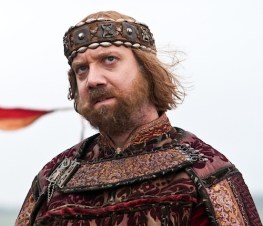 The unfamiliar true story also gives it the added edge of not knowing who lives or dies, or whether our heroes even succeed. If the ultimate end feels guessable, I think it’s only in retrospect. Of course, that doesn’t mean any of it’s historically accurate anyway.
And so what? It’s an action movie. And on all points that matter, it scores well.

Ironclad began on Sky Movies Premiere last night and continues daily throughout the week. I have no idea which aspect ratio it’s in.
It placed 10th on my list of The Ten Best Films I Saw For the First Time in 2012, which can be read in full here.
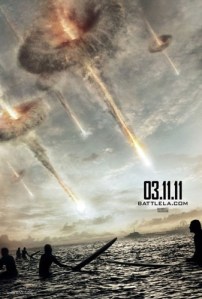 Battle Los Angeles (on screen; Battle: Los Angeles on posters — c’mon, let’s have some consistency with punctuation! Punctuation matters) seemed to come in for a wall of criticism when it hit cinemas way back whenever. For my money, though, it wasn’t that bad.
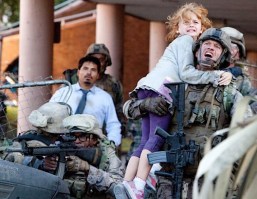 This kind of gung-ho militarism is laid on too thick. It seems fine for much of the film, but then as it heads into the second half and, especially, the third act, we have to suffer all manner of speeches and Emotional Moments that lack weight due to characterisation issues. The latter is badly handled for all kinds of reasons. All of the marines are entirely clichéd; so too are their story arcs; too much time is wasted trying to make us care about them — there are too many and they’re too shallowly drawn; things are worsened when a couple of civilians are added to the mix, who suffer from all the same problems… except they’re perhaps under- rather than over-developed. As we reach the third act, anything approaching plausible characterisation is jettisoned. Like the small-scale focus, what begins as naturalistic ends up with Big Speeches and all manner of Emotional Moments.
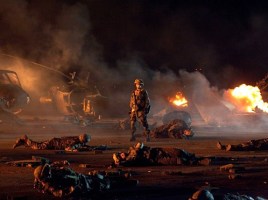 evoking the likes of the aforementioned as well as Black Hawk Down and
  They may take a little while to get to, but they’re relatively worth the wait.
 It never seems to have been fashionable to admit to liking
  being set in medieval/dark ages times, this has a very different, more traditional feel than the urban original film… albeit with lashings of CGI.
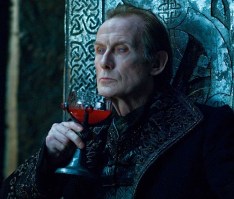 In the director’s chair for the first (and, to date, last) time is special effects whizz Patrick Tatopoulos, who does a fine job of producing an action-fantasy film. There’s nothing remarkable about it but it largely works, though it’s a little bit on the dark side at times. I don’t know why so many films do this, incidentally — we’ve reached an era where people are mostly watching films in cinemas where the bulbs are under-lit to save money, or at home in probably less-than-ideal conditions, with various lights on and a screen left on factory settings. I wouldn’t mind if these dark movies looked fine once you were properly calibrated, but most of them are still ever so dark. Why do they think this is a good idea? Especially when you flick into 3D (which, fortunately, this film was just ahead of.)
 Half a decade ago I would surely have hated this film. I had no love for animals in general, certainly not pets. But in the past few years I’ve become a certified canine convert, and watching it now I loved it.
 but to be honest I could’ve done without some of the meagre scenes we did get, never mind more of them. Supposedly character building stuff like the teeny party to get to know future classmates — bleurgh. Luckily, such things are brief. And someone wanted more of Lisa Kudrow and Kevin Dillon’s failed-rocker foster parent characters? I’d rather have had less, thanks.
 a scruffy white terrier with an exceptional ability to sniff out food (featured in every picture, because… aww, just look at him!), but then he reminded me so much of my own dog that I may well be biased. There’s all sorts of mutts here for pretty much every kind of dog lover.
 Judged as simply a movie, on its story and its characters and all that regular palaver, I can see why Hotel for Dogs attracts so many poor scores (it has an exceptionally low
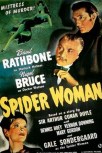
 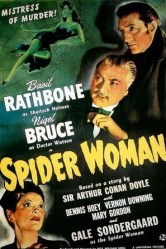 The seventh feature starring Basil Rathbone as Sherlock Holmes and Nigel Bruce as Dr John Watson is the first since
 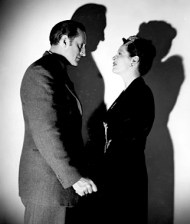 Gale Sondergaard, is so good that they crafted a sequel around her, albeit Holmes-less. I’ve not seen it and don’t own it, so I’ve no idea what that does for its quality.
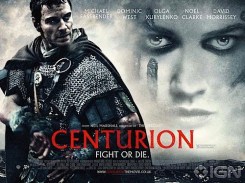 The fourth feature from writer/director Neil Marshall (despite owning his first three on DVD, this BD rental is the first I’ve actually watched — story of my life) is a bit of a departure: where the first three were horror (or at least horror-leaning) flicks, Centurion is an action-adventure crossed with something a little more artsy. Only a little, mind. Think
  Regular readers may know that I have an ever-growing dislike for films that begin at or near the end for no good reason (and most of those that do have no good reason to do so). Centurion’s opening line notes that “this is neither the beginning nor the end” of the lead character’s story. Oh dear, thought I; though perhaps “nor the end” signifies we might reach this point suitably distant from the credits, maybe. Not meaning to spoil it, but we’re there just 10 minutes later. Nice work Mr Marshall.
 The cast is packed with people who, even if you don’t know their names, there’s a fair chance you’ll know the faces (assuming you watch your share of British drama): in addition to Fassbender and Morrissey there’s Dominic West, JJ Field, Lee Ross, Paul Freeman, Liam Cunningham, Noel Clarke, Riz Ahmed, Imogen Poots, Rachael Stirling, Peter Guinness… not to mention Film Star Olga Kurylenko. Recognisability doesn’t guarantee quality, of course, but that’s a pretty good list.
 I really enjoyed Centurion, appreciating its mix between brutally real action and stunning scenery, with a slightly more thoughtful side emerging in the final act. It’s also always pleasant to see a film that runs the length it wants to at a reasonable speed, rather than padding itself to reach two or even two-and-a-half hours. Splendid.


 10)
10)  9)
9)  8)
8)  7)
7)  6)
6)  5)
5)  4)
4)  3)
3)  2)
2)  1)
1)  the last perfect score I handed out was in September, and before that July. Anyway, those in the top ten were Easy Virtue, Let the Right One In, Lupin the Third: The Castle of Cagliostro, Monsters, My Neighbour Totoro, The Social Network, Super and X-Men: First Class. From the handful that missed out, The Three Musketeers was also a five-star-er. The remaining eight were
  The Adjustment Bureau
 Conan the Barbarian
 Gnomeo & Juliet
 The Help
 Melancholia
 Real Steel
 The Three Musketeers
 #1
#1  #8
#8  #14
#14  #22
#22  #29
#29 
 #42
#42  #48
#48  #55
#55  #62
#62  #68
#68  #75
#75  #82
#82 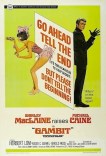 #89
#89  #96
#96  Alternate Cuts


 #93
#93 
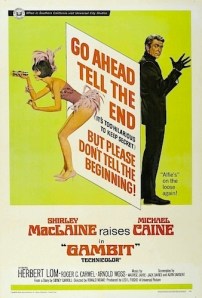 I decided to watch Gambit, which I’d never heard of, after it was recommended on twitter by
 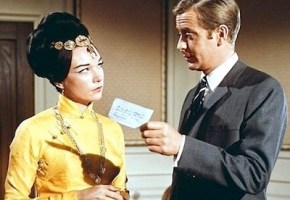 Twists in con movies are par for the course, of course, but here it’s not just the opening that has one: there’s also a salvo in the closing minutes, just to keep you on your toes. You may guess one or two as they rush up on you, but perhaps not all of them. Though as I’ve just warned you they’re coming you stand a better chance than me.
 100Films.co.uk