
November: the month with Men in its posters!
(I was going to open this post by ‘singing’ Europe’s The Final Countdown. Then I realised I did exactly that in November 2011. I’m nothing if not unoriginal.)
Yes, for the first time in 23 months, 100 Films in a Year has a #100! And for the first time in the history of ever, I’ve made it to #100 in a month that isn’t called “September” or “December”.
There’s a more detailed history of this blog’s #100s further down, but an analysis-like bit first: in the previous six years, I’ve made to 100 films a total of four times. Two of those were reached in September, two on December 31st. November now joins those illustrious ranks, completely ruining any patterns you thought you might’ve been able to see. But that’s good, because it breaks a cycle that only led to expectations, and expectations are always awkward.
More about November’s total and the usual analysis in a bit. First:
What Do You Mean You Haven’t Seen…?
I always intended each year’s #100 to be a film that was significant in some way. That hasn’t always panned out (missing it twice and “squeezing in anything I can” two other times have seen to that), but with a more leisurely arrival this year I was able to plan it out. And what could be more appropriate than one of my WDYMYHS films, supposedly the greatest examples of the cinematic art that I’ve yet to see?
And so, #100 was also my latest WDYMYHS conquest, and it was… David Lean’s acclaimed and beloved epic Lawrence of Arabia. That was one of the films that inspired me to start WDYMYHS in the first place, so it seemed only fitting.
I tried to squeeze one more in before the end of the month, but no doing. That leaves three to get through in December, which wasn’t the plan in the slightest. We’ll see how that goes.
 November’s films in full
#99 The Falcon’s Alibi (1946)
#100 Lawrence of Arabia (1962)
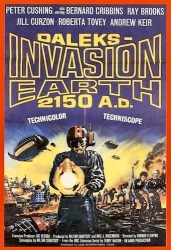
#100a Daleks’ Invasion Earth 2150 A.D. (1965)
#101 The Wolverine: Extended Cut (2013)
#102 Doctor Who: The Day of the Doctor (2013)
#103 Man of Steel (2013)
I meant to post my review of The Day of the Doctor by now, in which I will explain/defend why an episode of TV counts as a film; but as I haven’t got round to that yet, let’s quickly run through it here as well: it was simultaneously released in cinemas; it’s feature-length. That’s good enough for me. Oh, and it did huge business and cracked into the charts both here and in the US — that’s not “oh, and it’s in cinemas too”, is it? No. Good.
Moving on to November itself, then. The past three years (i.e. 2010, 2011 and 2012) I’ve watched exactly four films in November, so it’s good to break another cycle of expectation with this month’s five. That also means it’s not 2013’s worst month (a two-way tie between June and July), but instead equals April’s five.
Having reached #103, November sits in a unique place in the history of Totals Reached By The End Of November. In the two years I’d reached #100 in September, I was in the 110s or 120s by now; in 2008 and 2009 I was at #81 and #80 respectively; and in 2011 and 2012 I was at #92 and #91 respectively. If you really want to dig into it there’s almost some kind of pattern there, but I think it’s best I leave well enough alone.
With just one month to go, I’ve averaged 9.36 films per month in 2013, on which basis I should end the year having watched 112 or 113 films. But considering said average includes months with viewing as low as four and as high as 17, my final tally could theoretically be anywhere from 107 to 120. My money says closer to the former than the latter.
In seven years of 100 Films, I’ve made it to the titular goal five times. Here are those films that received the glorious honour of being #100…
- Citizen Kane
 Upon reaching my goal the first time, I decided (quite rightly, I think) that #100 should be An Important Occasion — and what can be more important than The Greatest Film Ever Made™? Many viewers these days seem to struggle with Kane’s reputation, or it just leads them to dismiss the film out of hand, but I thought it was genuinely exceptional and deserving of its acclaim.
 - Swing Time
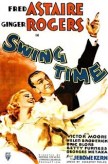 Come the second year, and watching Something Significant went out the window as I scrabbled through 11 films in 6 days to make it to 100, and this Fred Astaire/Ginger Rogers picture happened to be the last of them. That said, Swing Time is hardly a poor movie — while not my favourite Astaire/Rogers movie (not that I’ve seen many, but the honour goes to Top Hat), their dancing is nonetheless sublime.
 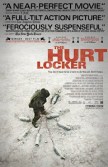 The Hurt Locker
Having failed in 2009, 2010 was a return to form. Whether its #100 is a classic for the ages remains to be seen, but at the time it was the most recent Best Picture winner. How much insight it casts on the broad scope of recent conflicts is debatable, but it’s an interesting — and certainly tense — depiction of modern warriors’ mentality. The A-Team
Though not as much of a rush as 2008, in 2011 I only just made it to 100 again — and, again, it was less a special choice more something fit-in-able. That said, I liked The A-Team: it sets out to be a funny, entertaining action movie and, by and large, it achieves that goal. Not for those who like Serious Movies, or for those who take their movies too seriously.- Lawrence of Arabia
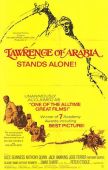 And so, after missing it again in 2012, we come to this year. The alternation continues, with arguably the most acclaimed and beloved film that I’d never seen earning the spot of my fifth #100. As a double bonus, it’s one of my WDYMYHS films too (OK, that’s not an accident). That status, and the film’s sheer size (its length! its scope!), makes it a little tricky to get your head around. But wow, it looks incredible on Blu-ray.
And also…
- Failure.
What of the other two years? Well, in 2009 I fell well short at 94. #94 itself was the 1974 Murder on the Orient Express, directed by Sidney Lumet and starring an Oscar-nominated Albert Finney as Poirot.

And then last year, when I made it even closer with 97, but couldn’t quite reach those final three films. #97 itself was cult favourite comedy The Plank, which I didn’t really connect with and is the lowest-scored of these seven films.
What will the next #100 be, I wonder? Hopefully we won’t have to wait another 23 months to find out…
For December, my 100 Films Advent Calendar is starting up again. The introduction is here; reviews commence in the morning.
Next month on 100 Films in a Year…
Join me on New Year’s Day (you’ve got nothing better to do, right?) for the first of my usual array of retrospectives on the year just passed.
























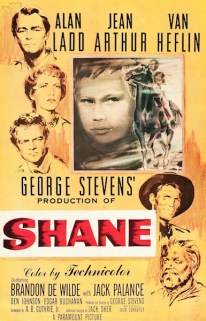 Though not part of my
  The thing with the wife, for instance, is mainly down to a few looks, or the way a line of dialogue is played. I was once taught that if a writer doesn’t put any subtext into a scene the actors will add it themselves — perhaps that’s even what happened here. I was wondering if it was going somewhere, if we were going to learn that Shane and wifey actually knew each other, or if they were going to have A Thing now (this being a ’50s American movie, “almost have a thing but then not quite” is probably nearer the mark). But, without meaning to spoil things, it doesn’t play out like that. At all.
 A mash-up of mythology and… well,
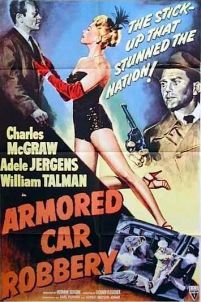 A B-picture from the middle of the classic film noir era, Armored Car Robbery is perhaps most notable today for being one of the first films directed by Richard Fleischer, who would later call the shots on
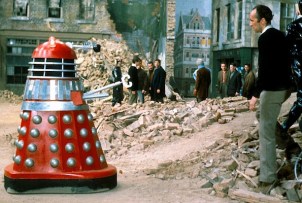 In a week’s time, on the 23rd of November 2013, Doctor Who will celebrate its golden anniversary — 50 years to the day since the premiere broadcast of its first episode,
 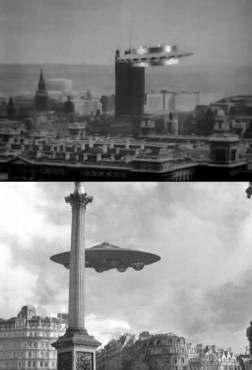 There are some fantastic sets, bolstered by peerless location filming of a deserted London (simply achieved by shooting very early in the morning), and the usual array of quality performances from the series’ regulars and guest cast. It’s only let down by the special effects. The Daleks are as great as ever, and a weird monster that turns up for a few minutes is passable (if you’re being kind), but shots of the Dalek saucer flying over London look like a pair of foil pie cases on some string in front of a photo. Even by the standards of the era it’s bad. The DVD release includes the option to watch the story with new (in 2003) CG effects in place of these sequences, and for once I’d actually recommend that.
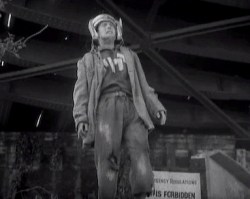 A man stumbles towards the steps, he screams in agony, battling with the strange machinery on his head. And then he hurls himself into the river, where he floats face down — dead. Beginning a kids’ programme with suicide? You wouldn’t do that today! We later learn that he’s a Roboman, controlled by the Daleks, essentially dead already… but it’s a bit late by then. Later, we meet unscrupulous country folk: a black marketeer who won’t give over food to the enslaved mine workers without payment, and won’t escort Ian out of the camp without payment either; and two women, employed by the Daleks to mend the workers’ clothes, who betray Barbara to get more food. There are heroes here, certainly — men and women who fight the Daleks, and some who give their lives for the cause — but not everyone’s doing the honourable thing.
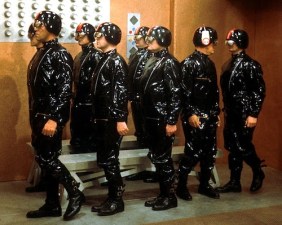 So that’s nice for them. There’s also some significant additions of humour, like when Tom is pretending to be a Roboman to stow away on the Dalek saucer and ends up in a mime act as he attempts to mimic a group of the real thing while they have lunch. Bless Bernard Cribbins. There aren’t too many of these almost-farcical bits, but the few there are lighten the general tone.
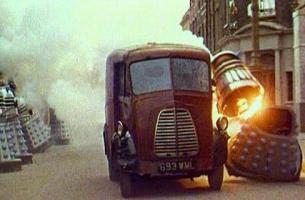 no burgeoning romance for Susan, here a small girl rather than TV’s young woman. Both stories split our leads into three groups following the assault on the Dalek saucer, but while the film retains the outline of these subplots, it rearranges which characters take which route. It’s a slightly bizarre turn of events, to be honest, and doesn’t always pay off: whereas the TV series manages to plausibly pace the various characters’ journeys from London to Bedfordshire, in the film the Doctor and his chum walk there in the same time it takes the Dalek saucer to fly it. Either that saucer’s underpowered or they’re impressive hikers.
 (Incidentally, perhaps the most striking thing about the serial’s location sequences are that they don’t include the iconic shot of the Daleks rolling across Westminster Bridge. That bit is in there, but it was filmed from an entirely different angle; I guess the famous image was just a unit photograph.)
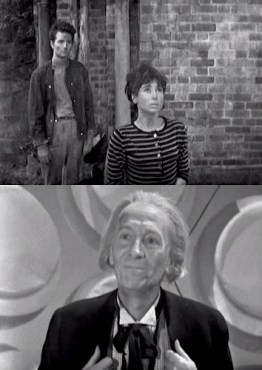 but the TV serial has a real advantage in this department. The original companion, this was Susan’s final story — the first companion departure in the series’ history. It handles it marvellously: rather than the final-minutes cut-and-run so many companions suffer, Susan’s growing sense of departure is built throughout the story… and then it’s the Doctor who realises it’s time for her to go, not her, and he leaves her behind. The speech he gives is one of the finest in the series’ history, beautifully and poignantly delivered by William Hartnell, and with a nicely under-played reaction from Carole Ann Ford. Doctor Who has had countless companion exits now, but this one still takes some beating.
 Most Doctor Who fans won’t lament that (especially as The Chase isn’t the most well-loved of Dalek adventures either), but, even though the TV series remains the superior product, I think the Dalek movies have their own merits and charm. I’m not suggesting we should be finding a way to write them into Doctor Who canon, but as an alternative to the norm, they’re a good bit of fun.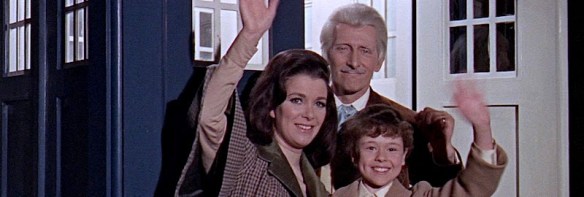



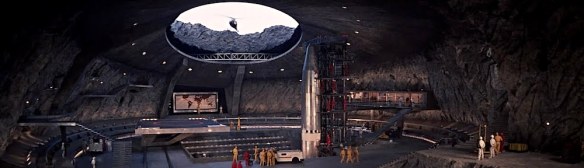
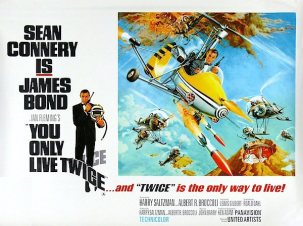 Everyone knows You Only Live Twice; if not from the film itself then from cliché and
  There’s that rooftop chase, where the camera just keeps pulling back and back and back to reveal the action. There’s Charles Gray’s cameo-sized but memorable role as MI6’s man in Japan, or Tetsuro Tamba’s loyal and capable Tiger Tanaka — why didn’t they bring him back? He’s better than any Leiter we’ve yet seen.
 There is, I think, a degree of consensus amongst Bond fans (both serious and casual) about a great number of things. Everyone has their personal favourites and dislikes that go against the norm, of course, but there are few things that are genuinely divisive on a large scale. It’s largely accepted that
  there’s an awful lot of grand, expensive-looking underwater stunt work; and it’s relatively long too, the first Bond to pass two hours (and, even in the nicest possible way, it feels it). Accompanying it was an array of merchandising that, at least as I understand it, wouldn’t be seen again for years (these days it’s par for the course, kicked off by
  but if you just accept a few of those, allow them to wash over you as it were, then it’s quite good fun. For all its flaws, it’s also packed with brilliant moments: the scene at the Kiss Kiss Club is arguably the best-directed bit in the series to date, and remains one of my favourite moments from any Bond; then there’s the jet pack, indeed the whole opening titles; almost any scene between Bond and one of the numerous females; “I think he got the point”; Domino’s (first) swimming costume… Um, where was I?
 It’s long been held as a truism that, though it’s the third film, Goldfinger really defined ‘the Bond formula’; and I’ve long argued against that, pointing to the elements that were ready-to-go in
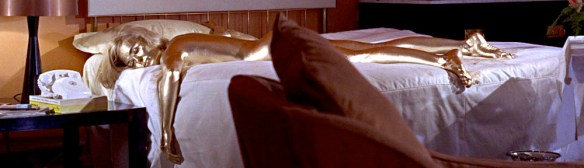
  However, I did also note that “those parts are mostly so excellent that its still a greatly entertaining film, and, I’m sure, not undeserving of the adulation lavished upon it by so many”, and that’s certainly true. You only have to list bits to bring back fond memories: the pre-titles (filled with multiple memorable moments, even if it’s completely unrelated to the rest of the story); the title song; the title sequence (by Robert Brownjohn, not Maurice Binder); the gold-painted girl; the gold game; Oddjob and the statue; the Q scene (despite Goldfinger’s Q-branch-tour being the archetype, it’s not repeated in a similar manner for decades); the gadget-laden car; the stunning Swiss locations; “no Mr Bond, I expect you to die”; Pussy Galore; the epic raid on Fort Knox; Oddjob and the electricity; the clock stopping at 007; Goldfinger being sucked out of the plane; hiding from rescue in the life raft… That’s quite a haul. Even the less feasible bits, like the cardboard-cut-out gangsters, have a certain charm.
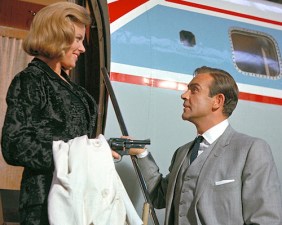 If you think about it too much then the plot is like a machine-gunned windscreen — spattered with holes. But they’re mostly minor niggles rather than glaring errors, and it’s more than covered by the fun you’re having. There are several films that would contend the top spot on my list of Favourite Bond Films and Goldfinger probably isn’t one of them, but that’s a personal thing and it’s surely destined for at least the top ten.
 100Films.co.uk