The Chronicles of Narnia: The Voyage of the Dawn Treader (2010)

2013 #62
Michael Apted | 108 mins | TV (HD) | 2.35:1 | USA / English | PG / PG

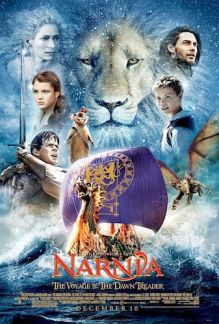
The Chronicles of Narnia: The Voyage of the Dawn TreaderI’ve never actually read the Narnia novels, but I did have them read to me when I was very young and, for some reason, I remember Voyage of the Dawn Treader being my favourite. Sadly, this doesn’t quite translate to the big screen.

We’re re-introduced to the younger two Pevensie siblings, still during World War 2, staying with their irritating cousin Eustace. They are of course sucked into Narnia, this time much closer to their last visit: Prince— sorry, King Caspian is searching for some missing chaps, giving a nice excuse for a quest narrative across the seven seas. Or however many seas there are in Narnia.

What that means, unfortunately, is two things that often cause films trouble: an episodic narrative, and a surfeit of different locations and creatures. There’s no shortage of ambition in their rendering on screen, but the film sadly comes up short on occasion. Despite director Michael Apted’s experienced hand on the wheel, the course strays into Syfy Channel TV movie territory at times, with a kind of cheapness that won’t please anyone (though, of course, some simply won’t notice). Elsewhere, sequences that were surely fine in a children’s novel sit awkwardly amidst the grander, Lord of the Rings-y tone these adaptations strive for. By contrast, the epic finale is actually quite scary, surely stretching the bounds of the modern PG certificate… or possibly just demonstrating why more 12As could stand to be rated PG.

Then there’s the ending, which is all a problem sourced from the novel. While The Golden Compass was forced to downplay its atheism in an attempt to garner lucrative box office from grimly non-secular countries, like the United States (which ultimately did it no favours because the news that it was Ungodly and Evil had already got out), Dawn Treader offers no such courtesy with C.S. Lewis’ blatant Christ analogy version of Aslan. I never noticed this when I was little, The Dawn Treaderbut as a grown adult it is painful. The level of subtlety here is so low a participant in TOWIE or one of those other dreadful shows would surely be able to grasp that the film is screaming, “here’s Jesus, and that place behind the water is Heaven, and you should all aspire to this!” And it goes on, and on, and begins to feel like nasty propaganda, especially in a family movie.

I actually quite liked Dawn Treader while I was watching it, the distasteful final sequence aside. But looking back, I was kindly glossing over some of its flaws, even before the nasty taste you’re left with at the end. Nonetheless it hasn’t killed the franchise, with a fourth entry recently announced, at long last. I’ll catch that at some point, but, sadly, I’m in no hurry to revisit this one.

3 out of 5

This review is part of the 100 Films Advent Calendar 2013. Read more here.

Black Death (2010)

2013 #13
Christopher Smith | 97 mins | TV (HD) | 2.35:1 | UK & Germany / English | 15 / R

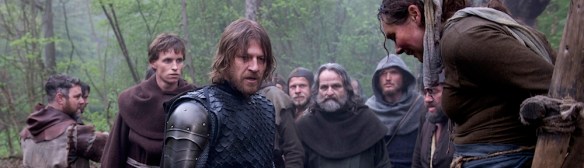
Black DeathSean Bean and his ragtag band of knights investigate an unaffected village during Ye plague-adled Olden Days in this folk horror from the director of Creep, Severance and Triangle.

Though not entirely devoid of gore or jumps, this is more a creeping horror; a tale of the supernatural where an uncanny mood is more important than visceral thrills. I don’t think it’s too lofty to suggest comparison to The Wicker Man rather than an historical Saw.

Still not for the faint-hearted, Black Death is the kind of eerie experience that can weave a spell over viewers who aren’t genre aficionados.

4 out of 5

This review is part of the 100 Films Advent Calendar 2013. Read more here.

In the interests of completing my ever-growing backlog, I decided to post ‘drabble reviews’ of some films. For those unfamiliar with the concept, a drabble is a complete piece of writing exactly 100 words long.

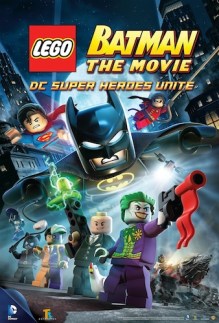
LEGO Batman: The Movie – DC Super Heroes Unite (2013)

2013 #75
Jon Burton | 71 mins | download (HD) | 1.78:1 | USA & UK / English | PG

LEGO Batman The MovieWell. What can I say? Curiosity got the better of me.

It’s weird to think that a generation or two of kids have now grown up with there always being tie-in LEGO. Until about 15 years ago, the toy brick manufacturer did not do licences. For whatever reason that all changed with The Phantom Menace, when sets were released that tied in to both that film and the original trilogy. I doubt it surprised anyone when these were a huge success, and since then pretty much any action figure-friendly franchise has received the LEGO treatment: Harry Potter, Lord of the Rings, Pirates of the Caribbean, Indiana Jones, even The Lone Ranger and Prince of Persia!

It was such a success that they got kind of cocky and made a LEGO Star Wars video game. What the hell?! Except it turned out to be massively popular, thanks to its mix of irreverent but informed humour and clever gameplay mechanics that emphasised and utilised the LEGO-ness of the world. After multiple sequels and the concept again branching out to encompass more licenses, this same style made its way to animated TV specials and, ultimately, feature-length animations — of which I believe this is the first.

But it’s also a bit of a cheat. It’s an adaptation of the game LEGO Batman 2: DC Super Heroes — so much so that it takes the game’s cinematic cut scenes and fills in the blanks (i.e. the bits you’d actually be playing in the game) with new animation. This has, understandably, quite irritated those who’ve played the game — it’s just the thing they’ve already seen, only less interactive. For the rest of us, it’s not startlingly obvious where all the gameplay bits would be, but every once in a while a character outlines a set of mission goals right before an action sequence, which slightly gives the game away (ho ho). The side effect is that at times it feels a little like watching someone play a computer game, and that’s rarely fun.

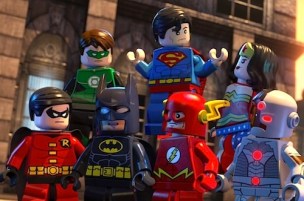
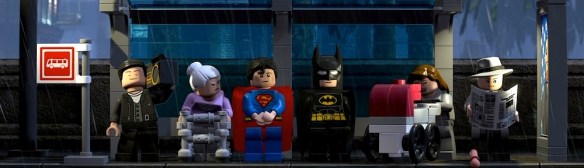
Justice League-OThis wouldn’t matter so much if what was left was entertaining, but it’s a little weak. I’ve seen a couple of the LEGO Star Wars TV specials and found them to be quite fun, but LEGO Batman can’t reach their level. It’s not just that it’s almost four times as long as one of those, it’s that the humour it does contain doesn’t hit home in the same way. It’s often too juvenile, too “that’ll do”, too “I can tell this is supposed to be humorous but it’s just not funny”. I know I started by saying that I just watched this through curiosity, but partly it was that I’d found those Star Wars specials enjoyable enough and thought this would be more of the same with superheroes. It wants to be, but it isn’t.

The top thing that struck me, however, was this: imagine that, instead of Zack Snyder directing Henry Cavill and Ben Affleck in Batman vs. Superman in 2015, we’d instead been treated to Joel Schumacher directing George Clooney and Nicolas Cage in Batman and Superman in 1999. The result, I can’t help but suspect, would have been rather like LEGO Batman: The Movie. And yet, as a 70-minute kid-focused animated confection, it’s gone down a lot better than I suspect my imagined Schumacher opus would have.

I don’t really think it deserves to. In fact, I’d kinda rather see that Schumacher version.

2 out of 5

This review is part of the 100 Films Advent Calendar 2013. Read more here.

Dredd (2012)

2013 #6
Pete Travis | 96 mins | Blu-ray | 2.40:1 | UK, USA, India & South Africa* / English | 18 / R

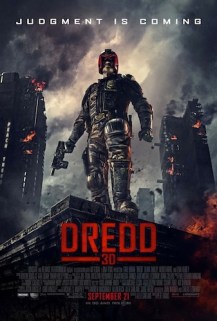
DreddDogged by comparisons to The Raid (which filmed after but released before), and enforced 3D that its 18+ audience didn’t go for, Dredd underwhelmed at the box office.

Huge shame. It’s the gritty take on 2000AD’s primary hero that aficionados have long desired, but also an exemplary sci-fi/action movie in its own right. With impressive gun battles, dry humour, and Karl Urban nailing the title character (yes, including the voice), it’s an hour-and-a-half of unencumbered testosterone entertainment.

Screenwriter/producer Alex Garland’s trilogy outline sounded unmissably good. We must hope home media sales are ultra-strong and the ongoing sequel campaign ultimately succeeds.

5 out of 5

This review is part of the 100 Films Advent Calendar 2013. Read more here.

Dredd placed 6th on my list of The Ten Best Films I Saw For the First Time in 2013, which can be read in full here.

In the interests of completing my ever-growing backlog, I decided to post ‘drabble reviews’ of some films. For those unfamiliar with the concept, a drabble is a complete piece of writing exactly 100 words long.

* IMDb used to list the countries of production as UK, USA and India, while the end credits of the film itself refer to it being “A South Africa/United Kingdom co-production”. With that in mind, I found the BFI list all four. Seems only fair. (IMDb have since taken my suggestion and added South Africa.) ^

November 2013 + 5 Number 100s

November: the month with Men in its posters!

(I was going to open this post by ‘singing’ Europe’s The Final Countdown. Then I realised I did exactly that in November 2011. I’m nothing if not unoriginal.)


Ooooooone-huuuuuundred!

Yes, for the first time in 23 months, 100 Films in a Year has a #100! And for the first time in the history of ever, I’ve made it to #100 in a month that isn’t called “September” or “December”.

There’s a more detailed history of this blog’s #100s further down, but an analysis-like bit first: in the previous six years, I’ve made to 100 films a total of four times. Two of those were reached in September, two on December 31st. November now joins those illustrious ranks, completely ruining any patterns you thought you might’ve been able to see. But that’s good, because it breaks a cycle that only led to expectations, and expectations are always awkward.

More about November’s total and the usual analysis in a bit. First:


What Do You Mean You Haven’t Seen…?

I always intended each year’s #100 to be a film that was significant in some way. That hasn’t always panned out (missing it twice and “squeezing in anything I can” two other times have seen to that), but with a more leisurely arrival this year I was able to plan it out. And what could be more appropriate than one of my WDYMYHS films, supposedly the greatest examples of the cinematic art that I’ve yet to see?

And so, #100 was also my latest WDYMYHS conquest, and it was… David Lean’s acclaimed and beloved epic Lawrence of Arabia. That was one of the films that inspired me to start WDYMYHS in the first place, so it seemed only fitting.

I tried to squeeze one more in before the end of the month, but no doing. That leaves three to get through in December, which wasn’t the plan in the slightest. We’ll see how that goes.


Lawrence of ArabiaNovember’s films in full

#99 The Falcon’s Alibi (1946)
#100 Lawrence of Arabia (1962)
#100a Daleks’ Invasion Earth 2150 A.D. (1965)
#101 The Wolverine: Extended Cut (2013)
#102 Doctor Who: The Day of the Doctor (2013)
#103 Man of Steel (2013)


Analysis

I meant to post my review of The Day of the Doctor by now, in which I will explain/defend why an episode of TV counts as a film; but as I haven’t got round to that yet, let’s quickly run through it here as well: it was simultaneously released in cinemas; it’s feature-length. That’s good enough for me. Oh, and it did huge business and cracked into the charts both here and in the US — that’s not “oh, and it’s in cinemas too”, is it? No. Good.

Moving on to November itself, then. The past three years (i.e. 2010, 2011 and 2012) I’ve watched exactly four films in November, so it’s good to break another cycle of expectation with this month’s five. That also means it’s not 2013’s worst month (a two-way tie between June and July), but instead equals April’s five.

Having reached #103, November sits in a unique place in the history of Totals Reached By The End Of November. In the two years I’d reached #100 in September, I was in the 110s or 120s by now; in 2008 and 2009 I was at #81 and #80 respectively; and in 2011 and 2012 I was at #92 and #91 respectively. If you really want to dig into it there’s almost some kind of pattern there, but I think it’s best I leave well enough alone.

With just one month to go, I’ve averaged 9.36 films per month in 2013, on which basis I should end the year having watched 112 or 113 films. But considering said average includes months with viewing as low as four and as high as 17, my final tally could theoretically be anywhere from 107 to 120. My money says closer to the former than the latter.


5 Number 100s

In seven years of 100 Films, I’ve made it to the titular goal five times. Here are those films that received the glorious honour of being #100…

  1. Citizen Kane
    Citizen KaneUpon reaching my goal the first time, I decided (quite rightly, I think) that #100 should be An Important Occasion — and what can be more important than The Greatest Film Ever Made™? Many viewers these days seem to struggle with Kane’s reputation, or it just leads them to dismiss the film out of hand, but I thought it was genuinely exceptional and deserving of its acclaim.
  2. Swing Time
    Swing TimeCome the second year, and watching Something Significant went out the window as I scrabbled through 11 films in 6 days to make it to 100, and this Fred Astaire/Ginger Rogers picture happened to be the last of them. That said, Swing Time is hardly a poor movie — while not my favourite Astaire/Rogers movie (not that I’ve seen many, but the honour goes to Top Hat), their dancing is nonetheless sublime.
  3. The Hurt LockerThe Hurt Locker
    Having failed in 2009, 2010 was a return to form. Whether its #100 is a classic for the ages remains to be seen, but at the time it was the most recent Best Picture winner. How much insight it casts on the broad scope of recent conflicts is debatable, but it’s an interesting — and certainly tense — depiction of modern warriors’ mentality.
  4. The A-TeamThe A-Team
    Though not as much of a rush as 2008, in 2011 I only just made it to 100 again — and, again, it was less a special choice more something fit-in-able. That said, I liked The A-Team: it sets out to be a funny, entertaining action movie and, by and large, it achieves that goal. Not for those who like Serious Movies, or for those who take their movies too seriously.
  5. Lawrence of Arabia
    Lawrence of ArabiaAnd so, after missing it again in 2012, we come to this year. The alternation continues, with arguably the most acclaimed and beloved film that I’d never seen earning the spot of my fifth #100. As a double bonus, it’s one of my WDYMYHS films too (OK, that’s not an accident). That status, and the film’s sheer size (its length! its scope!), makes it a little tricky to get your head around. But wow, it looks incredible on Blu-ray.

And also…

    Failure.
    What of the other two years? Well, in 2009 I fell well short at 94. #94 itself was the 1974 Murder on the Orient Express, directed by Sidney Lumet and starring an Oscar-nominated Albert Finney as Poirot.Failures

    And then last year, when I made it even closer with 97, but couldn’t quite reach those final three films. #97 itself was cult favourite comedy The Plank, which I didn’t really connect with and is the lowest-scored of these seven films.

What will the next #100 be, I wonder? Hopefully we won’t have to wait another 23 months to find out…


P.S.

For December, my 100 Films Advent Calendar is starting up again. The introduction is here; reviews commence in the morning.


Next month on 100 Films in a Year…

Join me on New Year’s Day (you’ve got nothing better to do, right?) for the first of my usual array of retrospectives on the year just passed.

The 100 Films Advent Calendar 2013

It’s that time of year again, dearest readers. Where does it go, eh? It feels like mere weeks since I was churning out reviews daily for my last advent calendar.

Yes, at the risk of starting some kind of tradition, it’s back — 25 days of chocolatey goodness. Except without the chocolate. And possibly without the goodness. I can guarantee some “y”s though. Or maybe “why?!”s.

I don’t know if last year’s ‘calendar’ was a big hit with readers or anything, but it was a big hit with me: my review backlog was considerably less engorged by the end. It really needs deflating once again this year, so that’s grand. And if you want an idea about some of the reviews that might be materialising over the next few weeks, do have a look.

In case it’s not obvious, then: I’ll present a shiny new review every day up until Christmas, and then one on the day itself too, in case you fancy avoiding the festive frivolities. Or you could just read it on Boxing Day. Or indeed any other day after that. I don’t have anything as momentous as last year’s Skyfall epic planned for the big day, but you never know, there’s still time.

Below, you can once again see a big pile of unopened links. If you so desire, you can check this post regularly over the next three-and-a-half weeks as those generic Christmassy images turn into exciting images that are all clickable. Or you can just see the new reviews appear on the front page. Or in your email inbox (if you already follow this blog with a WordPress account, you can change email notification settings here). Or follow me on Twitter. Always worthwhile.

And so without further ado, the festivities begin… in the morning…


December 1st

December 2nd

December 3rd

December 4th

December 5th

December 6th

December 7th

December 8th

December 9th

December 10th

December 11th

December 12th

December 13th

December 14th

December 15th

December 16th

December 17th

December 18th

December 19th

December 20th

December 21st

December 22nd

December 23rd

December 24th

December 25th

Merry Christmas!

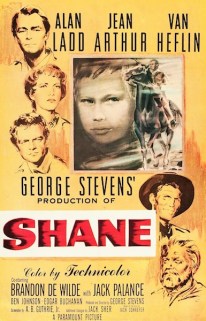
Shane (1953)

2013 #52
George Stevens | 113 mins | TV | 4:3 | USA / English | U

ShaneThough not part of my “What Do You Mean You Haven’t Seen…?” project, Shane is exactly the kind of film that could have been: a widely acclaimed classic that therefore comes with all that associated baggage. Like many of those films, that baggage weighs the film down to a point where, on a first viewing, it’s hard to just purely appreciate it.

The general shape of the plot is one familiar to Western fans, though that may well be because the others are based on Shane: a mysterious stranger rides into town, just looking for lodgings and/or work. Turns out the honest good-hearted town-folk are in some way being oppressed by a local gang/landowner/etc. The stranger doesn’t want to intervene, he just wants a quiet life… but eventually something galvanises him and he can’t help it. Cue climactic shoot-out.

I don’t mean to do Shane down by reducing it to these generic elements — as I say, my history of Westerns isn’t so hot, so it may well be the template from which all similar narratives are pressed. But perhaps this is why so many reviews emphasise the film’s subplots, particularly the fondness displayed towards Shane by the wife of the man he’s working for, and the hero-worship adorned on him by the man’s son. This is where the baggage comes into play, however, because while those elements get emphasised in reviews and commentary, I didn’t find them noticeably prominent in the film — calling them subplots is to increase their import.

A man they call ShaneThe thing with the wife, for instance, is mainly down to a few looks, or the way a line of dialogue is played. I was once taught that if a writer doesn’t put any subtext into a scene the actors will add it themselves — perhaps that’s even what happened here. I was wondering if it was going somewhere, if we were going to learn that Shane and wifey actually knew each other, or if they were going to have A Thing now (this being a ’50s American movie, “almost have a thing but then not quite” is probably nearer the mark). But, without meaning to spoil things, it doesn’t play out like that. At all.

I didn’t dislike Shane, but I’m trying to both work out and explain why I didn’t love it. If I sound overly critical then it’s because of those expectations, for which look to sources like the Radio Times, who state that, “if you’ve never seen it, Shane is a revelation”. It wasn’t, and I kinda blame them.

4 out of 5

Shane is on Film4 today at 4:30pm.

Immortals (2011)

2013 #64
Tarsem Singh Dhandwar | 111 mins | Blu-ray | 1.85:1 | USA / English | 15* / R

ImmortalsA mash-up of mythology and… well, not giving a toss about mythology, Immortals is largely style over substance. Trailers reminiscent of 300 belie a (slightly) higher degree of artiness: in the making-of, Tarsem espouses that there are many “comic strip” movies, but he wanted to make a “painted strip” movie; Henry Cavill calls it “Fight Club meets Caravaggio”.

In the finished film the style doesn’t come across so self-consciously, but it does look beauteous more than strive to make sense. Nonetheless, despite a slow-ish first half and muddled final act, it’s often entertaining in a “pretty pictures with fighting” way.

3 out of 5

* The UK version was modified to get a 15: a couple of cuts to extreme violence (beheadings, throat slittings), red blood re-coloured black, and a reduced sound effect. Unusually, this is the same on the DVD & Blu-ray as it was in cinemas. Technically, therefore, the version I watched isn’t rated R; though it’s still very violent, so it’s hard to imagine it would have missed out. ^

In the interests of completing my ever-growing backlog, I decided to post ‘drabble reviews’ of some films. For those unfamiliar with the concept, a drabble is a complete piece of writing exactly 100 words long.

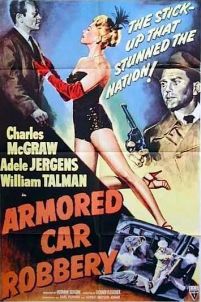
Armored Car Robbery (1950)

aka Armoured Car Robbery*

2013 #8
Richard Fleischer | 65 mins | TV | 4:3 | USA / English | PG**

Armored Car RobberyA B-picture from the middle of the classic film noir era, Armored Car Robbery is perhaps most notable today for being one of the first films directed by Richard Fleischer, who would later call the shots on 20,000 Leagues Under the Sea, Doctor Dolittle, Tora! Tora! Tora!, Soylent Green, and Conan the Destroyer, amongst many others.

To be honest, I’ve never seen a Fleischer film, and, like most cheap productions, Armored Car Robbery doesn’t seem to display much of a directorial voice. Which isn’t to say it’s badly done — there are some effectively tense sequences, and the titular act is well staged, plus some nice low-angle shots of the criminals scheming.

The story sees a gang of thieves go on the run after their plan results in the death of a copper. As ever, policemen are more important than anyone else when it comes to the effort exerted in investigating their demise, and so the dead guy’s partner is doggedly on the gang’s tail. The execution of his search at times makes the film feel like CSI: 1950s, as the cops track down the crooks via tyre treads, fingerprints, lipstick types, and so on.

A solid rather than exceptional film noir, Armored Car Robbery is worth a look for fans of the genre if they get a chance.

3 out of 5

* Normally my review-titling rule is to go with the UK title and/or the title card on the version I watched (generally the same thing). But Armored Car Robbery is universally referred to by its US-spelt title (understandably). That said, UK prints did feature the correct spelling of “Armoured”, as per the one shown on BBC Two.

** As with many films released on DVD by Odeon Entertainment, this has apparently not been passed by the BBFC since its original release. Nonetheless, it’s available on DVD rated PG. ^

Make/Remake: The Daleks’ Invasions of Earth

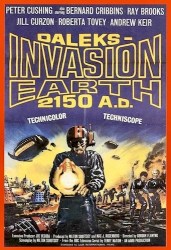
Doctor Who: The Dalek Invasion of EarthDaleks' Invasion Earth 2150 A.D.

Doctor Who:
The Dalek Invasion of Earth

and
Daleks’ Invasion Earth 2150 A.D.


Doctor Who: The Dalek Invasion of Earth
1964 | Richard Martin | 149 mins | DVD | 4:3 | UK / English | PG

Daleks’ Invasion Earth 2150 A.D.
1966 | Gordon Flemyng | 84 mins | Blu-ray | 2.35:1 | UK / English | U
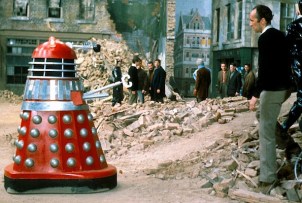

Daleks! On Earth!In a week’s time, on the 23rd of November 2013, Doctor Who will celebrate its golden anniversary — 50 years to the day since the premiere broadcast of its first episode, An Unearthly Child. (As part of the celebrations, BBC Four are showing that initial four-parter at 10:30pm on Thursday 21st. I heartily recommend it.) The programme’s success was cemented several weeks later, however, with the appearance of the Daleks — a race of xenophobic mutants hidden in metal machines from the planet Skaro. A wave of Dalekmania followed, leading to a boom in merchandising and, naturally, a sequel serial for the TV series, one year later.

It also led to a film adaptation, which I discussed last week. When that was a box office success, a sequel was greenlit. As with the first film, rather than construct an original tale starring the Daleks, the filmmakers turned to the TV series and adapted the aforementioned TV sequel. The story is set hundreds of years in the future (perhaps 10 years after 2164 in the TV series; 2150 in the film), when the Daleks have somehow left their homeworld and their city (which previously they’d needed to survive) and found their way to Earth. But this isn’t a Hollywood-style alien invasion battle: the Daleks have already occupied the planet, and Britain in particular (of course). The Doctor and his friends stumble into this situation and resolve to stop the evil invaders.

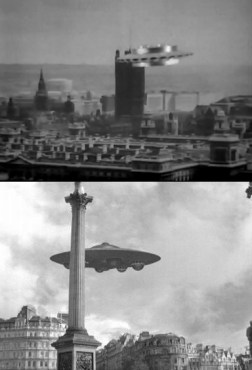
There’s little doubting that The Dalek Invasion of Earth is a minor epic. Where The Daleks struggled a bit to fill its seven-episode order, in six instalments writer Terry Nation takes us from an occupied, bomb-blasted London, to an attack on the Dalek spaceship, to a mine in Bedfordshire that’s digging to the centre of the Earth. Although made on Doctor Who’s typically tiny budget, the TV serial shines. Models vs CGIThere are some fantastic sets, bolstered by peerless location filming of a deserted London (simply achieved by shooting very early in the morning), and the usual array of quality performances from the series’ regulars and guest cast. It’s only let down by the special effects. The Daleks are as great as ever, and a weird monster that turns up for a few minutes is passable (if you’re being kind), but shots of the Dalek saucer flying over London look like a pair of foil pie cases on some string in front of a photo. Even by the standards of the era it’s bad. The DVD release includes the option to watch the story with new (in 2003) CG effects in place of these sequences, and for once I’d actually recommend that.
The story once again trades on the Daleks’ clear Nazi undertones. Here they’ve occupied a bomb-blasted country where a small band of rebel fighters hold out against them, attempting small-scale attacks while trying to work out a bigger plan. It can only be deliberate that these parts — hidden workshops, missions in enemy uniform, even the fighter’s casual clothes — all trade on familiar imagery from World War 2 resistance movies. Here, at least, collaborators are men rendered brain-dead by Dalek machinery, controlled via radio waves directly into their heads, rather than those who have chosen to betray their people.

That said, this is not a cheery view of the world. We can see that right from the opening shot: a derelict stretch of urban river bank, overgrown and decrepit, and the caption “World’s End”. Don't try suicideA man stumbles towards the steps, he screams in agony, battling with the strange machinery on his head. And then he hurls himself into the river, where he floats face down — dead. Beginning a kids’ programme with suicide? You wouldn’t do that today! We later learn that he’s a Roboman, controlled by the Daleks, essentially dead already… but it’s a bit late by then. Later, we meet unscrupulous country folk: a black marketeer who won’t give over food to the enslaved mine workers without payment, and won’t escort Ian out of the camp without payment either; and two women, employed by the Daleks to mend the workers’ clothes, who betray Barbara to get more food. There are heroes here, certainly — men and women who fight the Daleks, and some who give their lives for the cause — but not everyone’s doing the honourable thing.
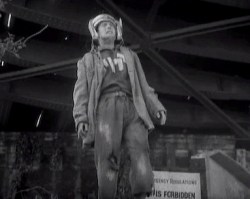
The film is a bit less bleak in its outlook for humanity. The black marketeer remains, more treacherous than ever: he actively betrays the Doctor to the Daleks, though is killed for his troubles; the two women are there, too; but there’s no suicidal Roboman, and indeed the climax suggests the Robomen are able to return to being human just by taking their helmets off. Robo-farceSo that’s nice for them. There’s also some significant additions of humour, like when Tom is pretending to be a Roboman to stow away on the Dalek saucer and ends up in a mime act as he attempts to mimic a group of the real thing while they have lunch. Bless Bernard Cribbins. There aren’t too many of these almost-farcical bits, but the few there are lighten the general tone.
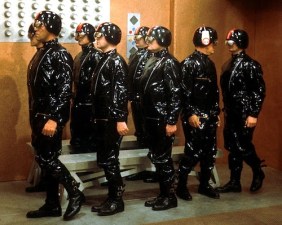
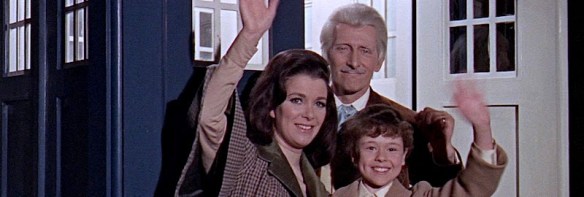
Overall, however, Daleks’ Invasion Earth 2150 A.D. (aka Daleks – Invasion Earth: 2150 A.D., and many other such punctuation-based variations, thanks to inconsistent spelling on posters and trailers) is, much like the the previous film, a strikingly faithful adaptation… at first. The running time is again a clue: while the TV serial takes two-and-a-half hours on its story (albeit with some subtractions for six sets of titles and five recaps), the movie rattles through it in 84 minutes. That’s with a new bookend sequence designed to establish the new character of PC Tom Campbell (Bernard Cribbins), leaving the film 75 minutes in which to condense Nation’s epic. Nonetheless, it’s scene-for-scene faithful, just picking the pace up with key actions and lines of dialogue rather than the comparatively-luxurious speed of the original.

As it goes on, though, things begin to diverge quite rapidly. Significant characters have been cut for time, while legacy changes from the first film also alter the plot — Dalek vs vanno burgeoning romance for Susan, here a small girl rather than TV’s young woman. Both stories split our leads into three groups following the assault on the Dalek saucer, but while the film retains the outline of these subplots, it rearranges which characters take which route. It’s a slightly bizarre turn of events, to be honest, and doesn’t always pay off: whereas the TV series manages to plausibly pace the various characters’ journeys from London to Bedfordshire, in the film the Doctor and his chum walk there in the same time it takes the Dalek saucer to fly it. Either that saucer’s underpowered or they’re impressive hikers.
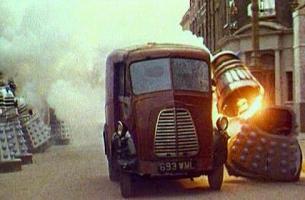
Even with all these changes, the general shape of the story remains the same; yet the film feels less epic than the TV serial. It’s not just the length, but the sense of time passing: on TV the Doctor and co seem to be stuck on Earth for several days, while in the film it’s practically an afternoon’s work. And though the movie’s special effects are better (immeasurably so, in fact, because the model work in the film is fantastic), and there’s some great stunts too, the bigger-budget big-screen outing lacks the TV version’s London location filming. This makes a startling difference to the relative effectiveness of the story. On TV, you really feel like the Daleks have conquered Earth; in the film, it feels a little like they’ve conquered some expansive studio sets and impressive matte paintings. The famous image(Incidentally, perhaps the most striking thing about the serial’s location sequences are that they don’t include the iconic shot of the Daleks rolling across Westminster Bridge. That bit is in there, but it was filmed from an entirely different angle; I guess the famous image was just a unit photograph.)

There are other bits that work less well on film. Dortmun’s sacrifice on TV makes sense, a bold character moment; in the film, he seems to do it for the hell of it. On TV, the Doctor commits himself to stopping the Daleks (in one of the series’ clunkiest bits of dialogue, to be honest), whereas in the film he just stumbles into things — which, funnily, is more like the Doctor of the time. Ian and Barbara have been replaced by the aforementioned PC Tom and the Doctor’s niece, Louise, because Dr. Who and the Daleks actors Roy Castle and Jennie Linden were unavailable. Not that it matters much — Bernard Cribbins is just as adept in the comedy role, and Jill Curzon’s Louise is just Barbara by any other name. Then there’s the music, which is often jauntily comedic rather than action-packed; and the ever-so-’60s main theme, as with the first film replacing the TV series’ iconic, groundbreaking, electronic howl with something altogether more forgettable. What the film most benefits from losing, however, is a couple of hilariously of-the-time lines from the Doctor — particularly one when he tells Susan she needs “a jolly good smacked bottom”!

That aside, perhaps the film’s biggest loss is in the age of Susan. Nothing against Roberta “One-Take” Tovey, who is fortunately much less irritating than your average child actor, Go forward in all your beliefsbut the TV serial has a real advantage in this department. The original companion, this was Susan’s final story — the first companion departure in the series’ history. It handles it marvellously: rather than the final-minutes cut-and-run so many companions suffer, Susan’s growing sense of departure is built throughout the story… and then it’s the Doctor who realises it’s time for her to go, not her, and he leaves her behind. The speech he gives is one of the finest in the series’ history, beautifully and poignantly delivered by William Hartnell, and with a nicely under-played reaction from Carole Ann Ford. Doctor Who has had countless companion exits now, but this one still takes some beating.
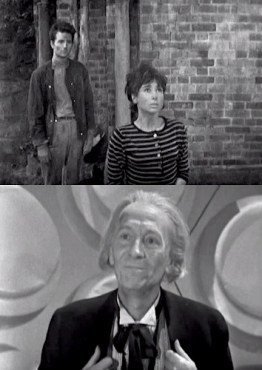
Each version of The Dalek Invasion of Earth does something better than the other, but on balance the TV series is the clear victor. That said, the film is probably more entertaining than its big-screen predecessor; but that’s just the story itself, I guess, which I think is a more effective use of the villains. You could argue it ties into the fairly-modern idea of the first encounter being an establisher and the sequel a bigger, bolder, deeper, more exciting, experience. Both versions are certainly that.

Despite the enduring popularity of the titular villains, Daleks’ Invasion Earth 2150 A.D. wasn’t as much of a box office success as its predecessor. Combined with an overrunning schedule that led to a higher budget, its profitability was clearly lower. Production company AARU had the option to make a third film (presumably to be based on the third Dalek story, 1965’s The Chase), but the money-men passed. Awesome.Most Doctor Who fans won’t lament that (especially as The Chase isn’t the most well-loved of Dalek adventures either), but, even though the TV series remains the superior product, I think the Dalek movies have their own merits and charm. I’m not suggesting we should be finding a way to write them into Doctor Who canon, but as an alternative to the norm, they’re a good bit of fun.
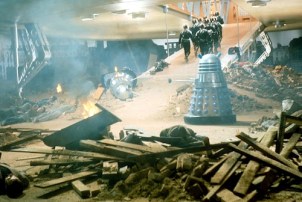

Tied in with Doctor Who’s 50th anniversary celebrations, Channel 5 are screening the Dalek movies next weekend. Dr. Who and the Daleks can be seen on the anniversary itself, Saturday 23rd November, at 10:05am. Daleks’ Invasion Earth 2150 A.D. is on Sunday 24th at 10am.

Cheery-bye!