
Neil Jordan | 119 mins | Blu-ray | 2.35:1 | UK, USA & Ireland / English | 15 / R
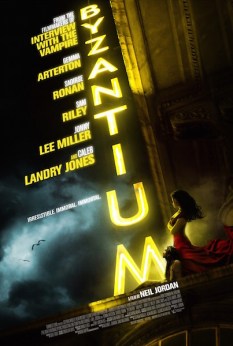 18 years after he adapted Anne Rice’s seminal vampire novel Interview with the Vampire into a seminal vampire film, director Neil Jordan helmed another tale of two inextricably-linked immortal bloodsuckers. However, while the older film was a lavish, luscious, romantic fantasy, Byzantium is an altogether seedier, baser view of eternal life.
The narrative unfurls in two timelines: the present day, where vampire mother Clara (Gemma Arterton) and daughter Eleanor (Saoirse Ronan) find themselves in a washed-up seaside resort while on the run from who-knows-what (well, Clara knows; Eleanor doesn’t); and 200 years ago, when a young Clara found herself entangled with a pair of military officers (Jonny Lee Miller and Sam Riley) that led to… well, you can guess what. Between them the two strands hint at a rich mythology; one we seem to be witnessing a side story of, rather than the usual epic world-altering confrontation of most fantasy cinema. Screenwriter Moira Buffini (adapting from her own play, A Vampire Story) retains enough familiar vampiric tropes to be recognisable to aficionados, but also offers unique twists and tweaks to keep us engaged.
Although the past storyline has its pros, and merges with the present day in time for the climax, the less mythologically-minded viewer will see the meat of the film as being Eleanor’s story. The forever-16-year-old is becoming disillusioned with her secretive existence, longing to share her truth with someone. When she twice bumps into genuine-16-year-old leukaemia survivor Frank (Caleb Landry Jones), it’s easy to see where the broad strokes of their encounter will lead. A back-cover pull-quote describes Byzantium as “the best vampire film since Let the Right One In” — their relative qualities are a separate point, but this adolescent ‘love(?)’ story is an obvious point of comparison nonetheless.
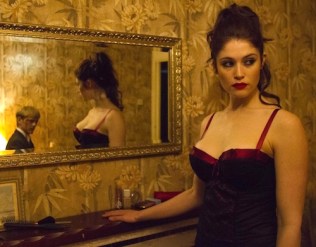 The most effective part of the movie isn’t so much its plot or its mythology, though, but its atmosphere. Vampire movies take place in castles or drawing rooms, or high schools in more modern iterations. They are grand and sensuous. Any glamour in Byzantium is discarded and decrepit, like the titular hotel that Clara reshapes as a whorehouse; faded and left to ruin. The seafront is characterised by graffitied concrete, the glaring lights of arcade machines, heroin-chic Eastern European prozzies. The pier appears to have burnt down at some unspecified previous time and just been left. The only people left behind are the ones without a means of escape, stuck with their miserable lot. Clara and Eleanor fit in almost seamlessly.
Some have picked up on an apparent lack of change or development in the lead characters’ personalities over 200 years, calling it out as a plot hole. Is it? Or is it part of the point? These two haven’t become wiser and more experienced over their long lives, but instead have become stuck in a rut, repeating the same lies and performing the only roles they know. That’s why Clara still works as a whore; why Eleanor still struggles with the guilt from her religious upbringing; why they stick together as protective mother and innocent daughter. It’s just as true of the other immortals we ultimately meet, an organisation stuck in outmoded patriarchal beliefs, who have held a grudge for two centuries. Here, the immortality of vampirism seems to mean not only staying physically the same, but mentally so as well.
 Other alleged faults include the film not giving enough time or heft to facets individual viewers want it to cover. For one example, someone criticised it for not fully exploring the issue of voluntary euthanasia. I’d argue it doesn’t explore it at all, because it’s not trying to. That Eleanor chooses to only kill people she perceives as wanting to die is not her making a moral statement on a contentious issue, but finding a way to marry her conscience and upbringing with the necessities of her vampiric life; and it’s probably practical, too. That’s not to say a vampire movie can’t be used to explore a topic like voluntary euthanasia, but if you want that I’m afraid you might have to write your own.
I don’t wish to imply that Byzantium is faultless in its execution of every point it raises, however, as some do fall by the wayside. Not least of these is Frank’s leukaemia, which has its useful points (bloooood), and I suppose it’s a good thing we’re spared the “wants to become a vampire to survive fatal illness” trope (because his cancer is in remission), but it also feels like it’s there for that trope, and by dodging it the film has nowhere else to go with his illness. A similar fate befalls the character of Frank’s mother, probably by association. What does she think of her sickly son disappearing off with some girl he just met, possibly forever? We’ll never know…
 Technically, DoP Sean Bobbitt grants us some gorgeous cinematography. There’s a cruel, aptly soulless beauty to the faded town, while some countryside vistas, both past and present, offer more traditional scenic pleasure. A remote rocky, misty isle — central to the mythology and so repeatedly visited — is particularly notable. Captured entirely on digital cameras, it seems sometimes that Bobbitt tried to push his equipment too hard: some shots during the climax look flat-out weird, as if someone has applied a Photoshop “comic book” filter or something. Also of note is the score by Javier Navarrete, which makes particularly good repeated use of The Coventry Carol.
Byzantium is a particular kind of experience. It’s the kind of film that hints at an epic mythology but doesn’t explore it, which some will be glad of and others regret; personally, I feel both at once — there’s a grander story left here, but I’m not sure I want it told. The narrative the film does contain is grounded in a melancholic reality; one that finds a kind of splendour in forgotten things and places; that almost elevates the shabbiness of a half-abandoned community to desirability, while acknowledging that it’s nothing of the sort. It takes vampirism and its associated immortality as something tempting but terrible and fantastical but tangible, and finds reflections of that in real-life experiences and locations.  For all its dual-period storytelling and its grubby settings, it’s a resolutely modern kind of take on vampire mythology.
There’s little doubt that the film’s brand of melancholic beauty is not to all tastes — an array of poor and middling reviews are easy to find — but it has qualities that must be recommended, and the potential to be darkly loved.

The UK TV premiere of Byzantium is on Film4 at 9pm tonight.
It placed 5th on my list of The Ten Best Films I Saw For the First Time in 2015, which can be read in full here.
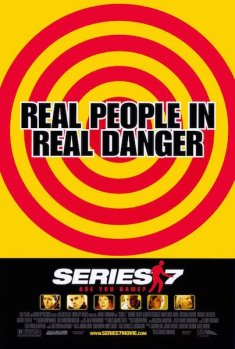 The debut of director Daniel Minahan — who’s since helmed episodes of over a dozen TV shows, including HBO hits
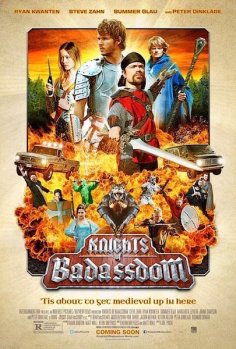 After being dumped by his long-time girlfriend, Joe (
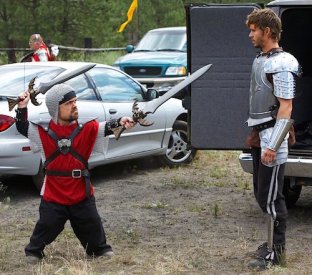 It’s a fine line to tread, and it seems to me that Knights of Badassdom manages it well. You get a sense of why people choose to do this and the fun that it can be — indeed, the final epic battle between the two factions of LARPers, complete with grand pre-fight speeches from each army’s general, and an awesome surprise, is kinda cool. Equally, the film doesn’t hold back from riffing off the sillier aspects of LARPing, including the rules of combat.
 if that’s your bag, there are plenty of films to cater for it; is a comedy about role-players really the occasion? There are elements of the film that could do with tightening up — the beginning is a little slow, as well as the issues with the middle, and towards the climax it’s sporadically jumpy in a way that makes it clear something has been excised — but just adding gore is not what this film needs to improve it.
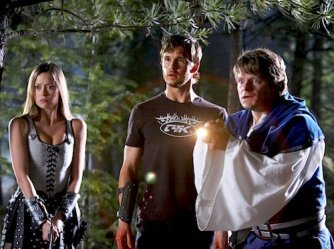 As it stands, Knights of Badassdom is an entertaining way to spend just under 90 minutes. A more restrained approach might yield a tighter movie, one that could be funnier by percentage (the trailer remains popular, and you don’t get more condensed than that), but I think it’s still well enough constructed to keep genre-minded viewers entertained.
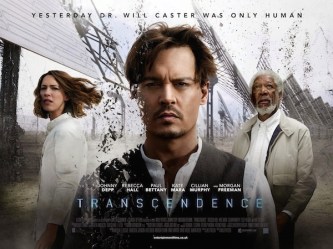 Christopher Nolan’s regular director of photography (he’s lensed seven Nolan films, from
 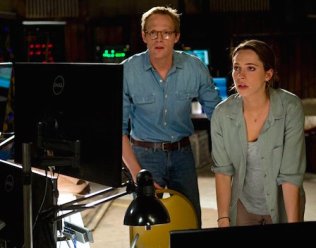 Another element that’s probably too challenging for some is where our allegiances are meant to lie. (Some spoilers follow in this paragraph.) At the start, it’s clear Depp & friends are the heroes and the murderous anti-tech terrorists are the villains. As events unfurl, however, artificial-Will perhaps goes too far, Bettany teams up with the terrorists, and eventually so do the government and Will’s other friends. There is no comeuppance for some characters who are initially begging for it; a good one self-sacrifices somewhat heroically. This doesn’t fit the usual Hollywood mould at all (well, the last bit does, sometimes), no doubt to some’s annoyance. The number of people who clamour for any sliver of originality or texture to their blockbusters, but then are unhappy when they actually get it…
 robbing the entire film of tension and nullifying any sense of surprise, and the movie doesn’t compensate with, say, a feeling of crushing inevitability. The climax in particular becomes a drawn-out exercise in connect the dots: we’ve been shown how this all ends up, now we’re just seeing the minutiae of how it got there. There’s no twist or reveal to speak of, just a wait for it to marry up with what we already know.
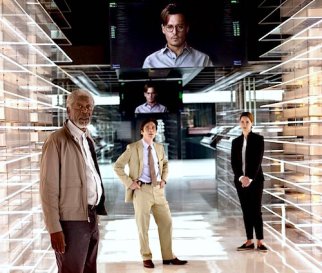 I guess that’s probably the explanation for Transcendence’s poor reception, in the end: it’s too blockbuster-y for viewers who’d like a dramatic exploration of its central moral and scientific issues, but too lacking in action sequences for those who misguidedly expected an SF-action-thriller. I maintain it’s not slow-paced, especially if you think it’s going to be, but nor does it generate doses of adrenaline on a committee-approved schedule. It’s not all it could have been, but if all you’ve heard is the mainstream drubbing, it’s probably better than you expect.
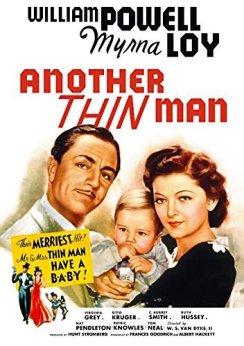 Husband-and-wife detective duo Nick and Nora Charles (William Powell and Myrna Loy) — now with a baby in tow — are once again coerced into investigating a crime when the manager of Nora’s estate fears a dismissed employee is plotting murder.
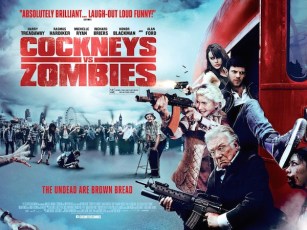 Screenwriter James Moran doesn’t like it when people compare Cockneys vs Zombies to
  And why is their imagination so stunted that they can’t accept them anyway?
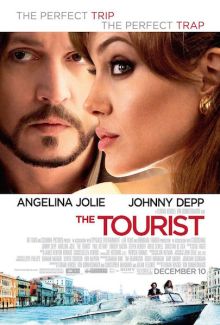 Much maligned on its release, I thought The Tourist was actually a decently entertaining light thriller.
 An unnamed woman (Martina Gedeck) goes to stay with some friends at their lodge in the Alps. The friends pop into town, leaving their dog behind with the woman. When she wakes up the next morning, they’ve not returned, and she finds an invisible wall surrounding the mountain. Exploring its boundaries, she sees people outside, paused mid-life, as if frozen. As hours turn into days turn into weeks, she begins to realise the need to fend for herself, farming the land and caring for her animals, which come to also include a cow and a cat. As weeks turn into years, she comes to accept her new life, from which it seems there may be no end…
 The Wall starts out with a compelling mysterious premise, but seems to have no interest in exploring it or answering the many questions it raises. In some respects that’s better than the kinds of rote explanation offered by lesser films — you know, “Aliens did it. Why? Because.” — but it’s a bit like a joke without a punchline. Taking the setup as a mere excuse for an exploration of the human condition, I don’t know that it’s that illuminating. Either way, it makes for a sporadically interesting but ultimately unsatisfying experience.
 #1
#1  #9 Kingdom of Heaven: Director’s Cut (2005)



















 Robert Redford on a boat with no dialogue for over an hour and a half. That’s not a spurious way of describing All is Lost — that is what it is. Well, OK, he does say a couple of words — more or less literally “a couple”, though.
 Through chance, coincidence, bad luck, but never forced tension-mounting on the part of the filmmakers (at least, not obviously so), our man’s fortunes go from bad to worse to even worse to even worse than that. Despite his best efforts, he’s on a downward spiral, a seemingly irreversible series of unfortunate events. If you ever had an interest in solo sailing, this is liable to put you off.
 Sometimes self-imposed filmmaking limitations lead to an exercise in competency over good moviemaking — “can we pull this off?” rather than “can we make a good film?” Chandor and co do pull their limitations off, I suspect not because someone set out purely to make a film with one character and no dialogue, but because it’s a gripping, exciting, tense movie, carried by a powerful near-silent performance and first-rate direction.
 100Films.co.uk