The Babadook (2014)

2015 #170
Jennifer Kent | 94 mins | streaming (HD) | 2.35:1 | Australia & Canada / English | 15

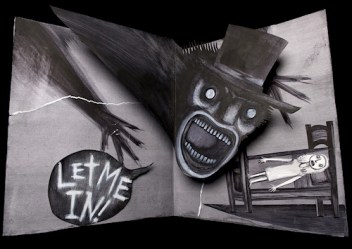
Essie Davis is best known for playing the sassy title role in popular Australian Christie-esque TV series Miss Fisher’s Murder Mysteries (for now — she’s in Game of Thrones next year), but here goes completely against type as single mother Amelia, who has to battle not only the stress of her awkward child, but also a strange storybook that may contain some kind of monster… but that would be silly… wouldn’t it?

Perhaps it’s best to not say too much about what’s going on with all that, because the film does a fantastic job blurring the lines between reality and dreams, facts and imaginings, whether it’s all happening or is all in Amelia’s head. For the majority of the film you’ll wonder: is this real? Is she being pranked? By who? A stalker? Her kid? Is she going insane and imagining it all? Sure, it’s a horror movie, so you’re thinking it’s real, but that’s what twists are for — the scares may be real, doesn’t mean the monster is.

And the scares are very real indeed. Not simplistic jump scares, but a festering tension that occasionally bursts forth in moments of specific terror. That doesn’t work for… a certain kind of viewer (to put it politely), but, for me, it makes the film far more genuinely scary, and memorably so, than being made to jump out of my seat a couple of times. Some have also criticised The Babadook for not being 100% original. Well, what is after a century of moviemaking and millennia of storytelling? What it does do is rearrange the familiar in new and terrifying ways, and tap into seams of fear that are harder to access and consequently too rarely touched by horror films. In that regard, the film it most reminded me of was The Shining — a horror film for people who think about what they’re watching, rather than just waiting for something to be thrown at the screen to make them jump. The slow burn tension will bore those content with the latter, who I suspect don’t tend to think a great deal (for one thing, they’d spot most of the jumps coming if they did).
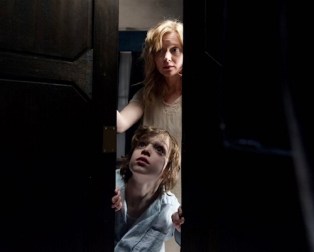
Underpinning this is an incredible performance by Essie Davis. If this were merely a drama about a single mother coping with grief, rather than a genre movie, I’m sure she’d’ve been being rewarded all over the place. Again, I guess this turns off the ‘gorehound’ cadre of horror fans, but it’s the combined strength of the writing (by director Jennifer Kent) and Davis’ performance that mean the entire film is interpretable as a drama about grief and mental illness, rather than about an attacking monster or demonic possession or whatever else it might seem is going on (trying to avoid spoiling it again there!) For more on that, see this interpretation, for instance (bearing in mind it’s obviously spoilersome).

Although it’s Davis’ film, Noah Wiseman gives an accomplished performance as her kid. Well, maybe he’s too young to call it “accomplished”, I don’t know, but it must’ve been a difficult role to play — it calls for him to be a sweet little boy one minute, and a nightmare demon-child (in the real-world rather than horror-movie sense!) the next. He starts off immensely irritating — you can see why no one in the film likes him! — but he does grow on you. The next best performance is, of course, by their very cute little dog. (Do not watch this movie just because of the dog. Seriously.)
There is little in The Babadook that will make you jump, and even less that will make your stomach turn in disgust, but that’s absolutely fine. What it will do is chill your blood, make your hair stand on end, make you worry about every little creak or thump you hear elsewhere in the house after dark, and make you want to sleep with the lights on. Not just the bedroom lights, all the lights. Because once you’ve seen it, you can’t get rid of the Babadook.

5 out of 5

This review is part of the 100 Films Advent Calendar 2015. Read more here.
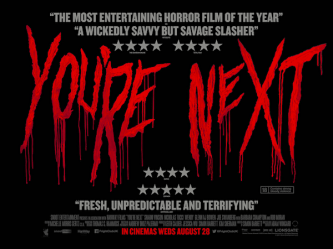
You’re Next (2011)

2015 #172
Adam Wingard | 91 mins | TV (HD) | 2.35:1 | USA & UK / English | 18 / R

From the makers of The Guest, a horror-thriller that’s really a dark comedy.

Murderous home invaders get a surprise when one of their targets is a secret badass. She’s cool; everyone else is thinly sketched. I’d’ve liked more character development; some viewers think it’s already too slow getting to ‘the good stuff’. That’s very violent, but imaginative and funny — the lead villain suffers an exceptionally inventive amusing demise.

You’re Next isn’t all it could be, but is pretty fun. My score errs towards generosity — those with no taste for horror, or laughs derived from murder methods, will like it less.

4 out of 5

This drabble review is part of the 100 Films Advent Calendar 2015. Read more here.

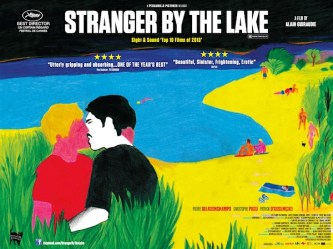
Stranger by the Lake (2013)

aka L’inconnu du lac

2015 #117
Alain Guiraudie | 100 mins | TV (HD) | 2.35:1 | France / French | 18

Iiiiiit’s the arthouse gay sex thriller!
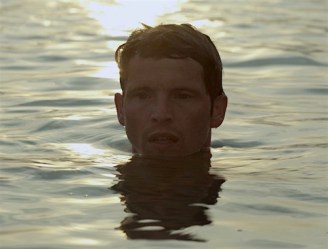
I’m just going to mention that before it comes the elephant in the room: this movie features lots of ultra-explicit gay sex. If you catch it on TV, that stuff’s been partially removed (the BBFC may’ve passed it as an 18, but it remains illegal to show so much detail on TV, even at 1:20am when Channel 4 aired it), so even if I wanted to I won’t be discussing that aspect in detail. Still, even without the, er, money shots, the sex is more frank than you normally see. It’s also set on an all-male nudist beach, so even when they’re not at it there’s plenty of flesh to go round. If that kind of thing bothers you, this is certainly a film to steer clear of.

For the less prudish, it’s worth getting past the initial titillation, because pornography isn’t the point. Rather, it’s an intriguing dramatic thriller about what we’re prepared to accept, risk, or ignore in the name of attraction: Franck (Pierre Deladonchamps) fancies Michel (Christophe Paou), then spies him murder his former lover (in an extraordinary long, unbroken take), and then enters into a relationship with him anyway. This exploration plays out through a slow-burn pace, which balances burgeoning romance with an almost casual, incidental attitude to the thriller elements. It works thanks to our investment in the characters, their relationships (both sexual and friendships), and how these feed and influence the storyline.

In this regard it has a very particular speed and style — even if there was a version without copious full-frontal male nudity and explicit sex, it still wouldn’t be for everyone. It helps to evoke both a certain time and place (lazy summer days on holiday) and a particular lifestyle (that of gay cruising — which, much to the (presumably straight) policeman’s bafflement, continues virtually unabated even after one of their number is murdered in unexplained circumstances). This is further emphasised by the gorgeous cinematography. Claire Mathon apparently shot it using only natural light, and it looks fantastic — understated (this isn’t a heavily-graded hyper-real kind of beauty), but sumptuous.
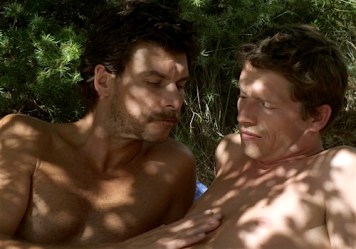
The film never leaves its lakeside beach setting. That’s interesting for several reasons. One, it might seem like a limiting move, but isn’t — the beach is where the main action occurs, so why leave? Two, the story is about that aspect of these people’s lives — so that focus probably makes the film stronger. But, three, the characters’ lives do exist outside of this place. Franck gets drinks with friends from the beach; he has dinner with new acquaintance Henri (Patrick D’Assumçao) at least once, and misses an arranged meal at least one more time; he’s even interviewed at the police station, which you’d think would be vital to the plot. But we don’t see any of that. We learn about it when it’s arranged or after it’s occurred, from conversations at the lake. It’s an interesting choice; one that creates a particular kind of focus, and some sort of unity of space and time. It would give the movie a very different feel (though no less valid) if we actually saw those other encounters on screen.

The style is supported by strong performances. I suppose some would say “brave”, by which they’d mean “they’re naked a lot and having gay sex”… so, I mean, maybe it is brave, but, still, that’d be a euphemistic description. What I mean is that they’re strong because they’re calm, understated, realistic, and believable without tipping over into amateurish. You feel Franck’s complex mix of fear and excitement, his lust overpowering common sense; there’s a certain timidity, maybe even naïvety, present in his eyes. Conversely, his lover Michel is unreadable; a closed book, where you never know what he’s thinking, feeling… plotting. Franck’s new friend Henri is similarly tricky to get an accurate handle on, but he’s the yin to Michel’s yang (or vice versa). He’s not plotting, he just is. Or maybe he was plotting all along…?
Stranger by the Lake has a lot of factors that would put various people off, but for those that aren’t bothered by a slow pace or… nope, forgotten what the other ‘problem’ was… there’s a fascinating character drama cum murder thriller to be engrossed by.

5 out of 5

This review is part of the 100 Films Advent Calendar 2015. Read more here.

sex, lies, and videotape (1989)

2015 #147
Steven Soderbergh | 100 mins | streaming (HD) | 1.85:1 | USA / English | 18 / R

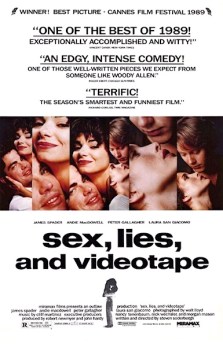
Four acquaintances partake in duplicitous relationships and candid sexual discourse in writer-director Steven Soderbergh’s debut drama.

All four actors are good, covering every base on the spectrum of sexual openness, but, at the two extremes, James Spader and Andie MacDowell are excellent. They get the wealth of the material, the latter as a repressed, neurotic housewife, the former as an oddball whose truth obsession makes him both the strangest and most idyllic character.

26 years on, our world and attitudes have changed plenty — there are now whole websites dedicated to Spader’s weird, private obsession — but this is still strikingly frank.

5 out of 5

This drabble review is part of the 100 Films Advent Calendar 2015. Read more here.

Seeking a Friend for the End of the World (2012)

2015 #118
Lorene Scafaria | 91 mins | TV | 2.35:1 | USA, Singapore, Malaysia & Indonesia / English | 15 / R

This melancholic apocalyptic comedy wasn’t too well received, which is a shame because I thought it was absolutely brilliant.
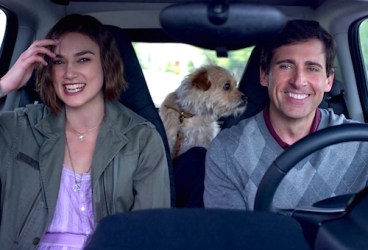
As an asteroid heads inevitably towards Earth, Steve Carell decides to go on a road trip to reconnect with his high school sweetheart. Neighbour Keira Knightley tags along. Quirky things happen; they bond; as the end of the world nears, they rethink their lives.

Carell gives a very good performance, trading in the kind of understatement that makes him a much more interesting actor than his stock-in-trade outrageous comedies continue to imply. I guess Knightley is playing a Manic Pixie Dream Girl, at least to an extent, but I thought she was a plausible character nonetheless. There are certainly more egregious examples of the trope. It’s another strong performance, anyway, containing a lot more truth than your average MPDG.

Also, there’s a really, really cute lickle doggie.

The thing both leads nail, as does writer-director Lorene Scafaria, and what made the film so good for me, is an overwhelming sense of melancholy. It’s a hard feeling for films to evoke, I think — more complex than happiness or sadness, or excitement, or even fear. It comes to a head in an ending that actually brought a tear to my eye, a rare enough feat that it cemented a five-star rating.
5 out of 5

Seeking a Friend for the End of the World placed 11th on my list of The 20 Best Films I Saw For the First Time in 2015, which can be read in full here.

This review is part of the 100 Films Advent Calendar 2015. Read more here.

They Live (1988)

2015 #123
John Carpenter | 94 mins | streaming (HD) | 2.35:1 | USA / English | 18 / R

Sci-fi parable about aliens controlling us via subliminal advertising.
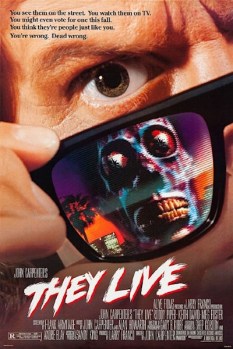
There’s action, including a comically lengthy fight between lead good guys Roddy Piper and Keith David, but the meat is satire. Thirty years on, it remains thematically relevant; perhaps even more so. That no one’s actively considering a remake suggests how Hollywood has lost its political teeth. I’m not saying they should remake it, just, y’know, Hollywood.

In fact, considering the apparently-victorious ending is kinda bleak if you think it through, perhaps they should make a sequel with the status quo unchanged decades later. It might be rubbish, but there’s potential.

4 out of 5

This drabble review is part of the 100 Films Advent Calendar 2015. Read more here.

The Grandmaster (2013)

aka Yi dai zong shi

2015 #160
Wong Kar Wai | 109 mins | streaming (HD) | 2.35:1 | Hong Kong & China / Mandarin & Cantonese | 15 / PG-13

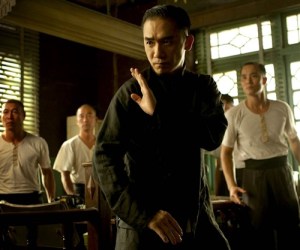
As a Western viewer, if you know anything about Ip Man beyond “he’s the chap who trained Bruce Lee”, it’s probably thanks to the pair of eponymous biopics starring Donnie Yen (soon to become a trilogy). Heck, if you know that much there’s a fair chance it’s due to those films. This take on the man, directed and co-written by Wong Kar Wai and starring Tony Leung as Ip, is tonally very different.

Some of the facts remain the same, naturally: Ip is a master of Wing Chung in Foshan, China, until the Japanese occupation ruins everyone’s lives. Post-war, he moves to Hong Kong and sets up a school there. Concurrently, there’s something about being the grandmaster of martial arts in all of China, or somesuch. When the previous incumbent is murdered by his disciple, the old man’s daughter, Gong Er (Ziyi Zhang), has revenge in mind.

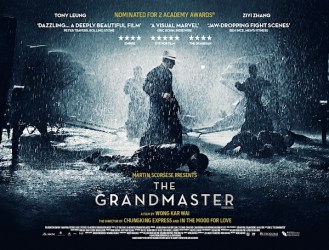
The Grandmaster is very much more an arthouse version of the story than the Ip Mans’ accessible action-movie stylistics, with elliptical storytelling and a carefully-measured pace, even in the action sequences. I’ve seen at least one review criticise Wong for leaning too heavily into ‘genre’ pictures — I guess that critic doesn’t actually watch too many genre pictures, because a good number of genre fans criticise this for being too arty. It is more “arty” than “genre”, even given its inclusion of numerous fantastic fight scenes. The duels are stunning, though pure adrenaline-junkie viewers seem to find even those a disappointment. Well, they’re wrong.

It helps that it’s gorgeously shot. Ultra-crisp blue-black rain-soaked night time duels; rich golden hues in pre-occupation Foshan; cold bright-white snowy landscapes; a train platform fight that’s almost sepia-like. Between the photography and the ever-excellent action choreography of Yuen Woo-ping (The Matrix, Crouching Tiger, Kill Bill, et al), the film is immensely satisfying on a visual level.

One factor that may — or, as we will see, may not — have an effect on how the film fares beyond the purely visual is that there are at least three different cuts: a 130-minute original cut, a 122-minute international cut, and the 108-minute version released in the US by the Weinsten Company. “Ah,” you might think, “yet another Weinstein hack job.” Well, Wong himself says otherwise:

As a filmmaker, let me say that the luxury of creating a new cut for U.S. audiences was the opportunity to reshape it into something different than what I began with — a chance one doesn’t always get as a director and an undertaking much more meaningful than simply making something shorter or longer. The original version of The Grandmaster is about 2 hours, 10 minutes. Why not 2 hours, 9 minutes or 2 hours, 11 minutes? To me, the structure of a movie is like a clock or a prized watch — it’s about precision and perfect balance.

We always knew that we wanted to have a U.S. version that was a bit tighter and that helped clarify the complex historical context of this particular era in Chinese history, focusing further on the journeys of Ip Man and Gong Er. While the previous version was more chronological, adding narration and captions to explain certain plot points gave us the freedom to bring more life to moments in the characters’ stories. I also aimed to enhance the audience’s understanding of the challenges faced between North and South, especially during the Japanese invasion.

Well, the narration and explanatory title cards are at times useful, but at others feel heavy-handed. I guess that’s the result of them being added retroactively as an explanatory device — if Wong had felt that information needed to be in the film throughout production, I’m sure it could’ve been better integrated into the storytelling.

However you look at it, the other Ip Man films are undoubtedly more palatable to a mainstream audience. Does that mean they’re worse? No. Better? Not necessarily. But I don’t think The Grandmaster is all it could’ve been. It seems to run out of story and lose its way as it gets towards the end. The focus shifts entirely to Gong Er, and it feels less clear what it’s meant to about as a whole film. It becomes a movie of great moments, and maybe even scenes, but an unsatisfying whole. But oh, the images…
4 out of 5

This review is part of the 100 Films Advent Calendar 2015. Read more here.

The Decoy Bride (2011)

2015 #155
Sheree Folkson | 89 mins | streaming (HD) | 2.35:1 | UK / English | 12 / PG

This is not a well-reviewed film — Little White Lies described it as “possibly the worst thing ever in world history.”

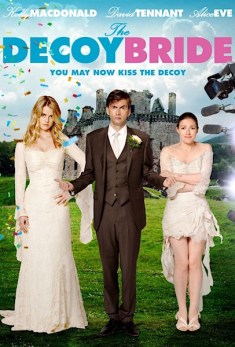
Obviously they’re being intentionally hyperbolic (well, I hope), but it’s not merited. Okay, it’s a standard rom-com, of the form we’ve seen dozens of times, but it’s no worse than most and better than plenty. Kelly Macdonald and David Tennant are appealing leads with some chemistry, “TV director” Folkson’s work is cinematic enough, and there are decent laughs in the screenplay by Sally Phillips.

There’s nothing special about The Decoy Bride, but it’s pleasantly entertaining. It could be much worse.

3 out of 5

This drabble review is part of the 100 Films Advent Calendar 2015. Read more here.

The Fifth Estate (2013)

2015 #144
Bill Condon | 128 mins | streaming (HD) | 2.35:1 | UK & Belgium / English | 15 / R

It’s The Julian Assange Movie, in which Benedict Cumberbatch dons a lanky white wig and an Australian accent to portray one of the most significant figures of our times, whether you like it or not.

The story is told from the perspective of Daniel Berg, played by Daniel Brühl, who first encounters Assange in Germany and is somewhat captivated by him. Daniel helps Assange to really launch WikiLeaks, and is by his side through their early fame-garnering exposés. He functions a little as Assange’s moral compass, too, especially when they receive some stolen US military files relating to their controversial Middle Eastern exploits…

Cumberbatch’s performance is the showstopper here, and it’s been justly praised. It can seem a little over the top and affected, but then people who actually knew Assange say it’s bang on, so I think we have to take it that’s what he’s like rather than it being Cumberbatch overplaying. I largely rate him as an actor anyway, so he earns the benefit of the doubt. Brühl excels in the less showy role, however — much like he did in Rush, in fact, though even that role had its share of affectations to work with, which this part does not.

Daniel is torn between ‘saving the world’ and a love interest, played by Alicia Vikander, who is everywhere right now but I think this is the first time I’ve actually seen her in something. There’s nothing remarkable about her part, so I can’t really judge her. The same goes for the rest of the cast, where a wide array of starry and/or acclaimed names (Peter Capaldi, Laura Linney, Anthony Mackie, Alexander Siddig, Dan Stevens, David Thewlis, Stanley Tucci, Carice van Houten (who’s big in Belgium, it would seem)) don’t falter, but nonetheless struggle to make a mark when none are awarded anything meaty to do.

The rest of the film is unfortunately hit or miss. It begins with an absolutely fantastic two-and-a-half-minute title sequence that covers the whole history of human mass communication, from hieroglyphs to the internet and everything in between. It’s succinct, thorough, and excellent, probably the best thing about the entire movie. Elsewise, Bill Condon’s direction is a little rote. At times he seems to want to be clever and cutting edge, with on-screen tech and the visual representation of WikiLeak’s virtual office space, but it’s inconsistent, a grab-bag of tricks without a guiding principle. The rest of the movie is shot plainly. Not badly, just plainly; normally; almost old-fashioned-ly. Its directorial style doesn’t match the material. For contrast, look to David Fincher’s The Social Network, which also told the story of cutting-edge ever-so-now tech developments, but did so with filmmaking that could be described in similar terms.

Every once in a while the film interjects a US-set subplot that seems to go nowhere. The posters and trailers imply these American officials were people hunting Assange; instead, they’re relatively minor cogs in the political wheel who get caught out by what he does. They don’t seem to have any particular significance in themselves — they’re not famous, nor more wronged than anyone else — so maybe they’re just meant to be emblematic? As in, Laura Linney’s character is there to be representative of Assange’s effect, not the only person it happened to. Or was she the only person fired, and that’s the point? The film doesn’t make it clear.

In terms of understanding, it’s also very much a movie of Now. It assumes you know an awful lot of real-world context — essentially, the history of the last decade or two. Before too long, it’ll be a tough film for new viewers to follow or engage with without some kind of degree. Not everything should be made with an eye to its longevity, but one wonders how successful The Fifth Estate is in and of itself. It’s almost fiction-filmmaking as journalism: it’s about something that just happened — in some respects, is still happening — rather than an attempt to look back and explain those happenings in a historical context.

Indeed, one wonders how enlightening the film is in any respect. Assange is clearly a difficult person to get to know, by turns crusading hero and egotistical wannabe. That’s how the film depicts him, and if that’s accurate to life, well, that’s not the film’s fault — what’s wrong with having a primary character who isn’t a hero? Anyway, that’s the role Daniel is there to fulfil — he’s the honourable one; the one who’s actually invested in the site’s supposed values. But then the film is partly based on his book, so he would be the good guy.
In the end, this is an immensely complex story, with many different and contradictory sides to tell, and the film isn’t up to the task of covering them all. Great performances, though.

3 out of 5

This review is part of the 100 Films Advent Calendar 2015. Read more here.

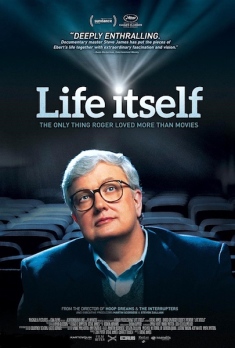
Life Itself (2014)

2015 #166
Steve James | 121 mins | streaming (HD) | 16:9 | USA / English | 15 / R

Roger Ebert was an influential, respected, beloved critic for decades, and one with an interesting life: he began in old-school newspaper journalism, defined TV movie criticism, and eventually spearheaded the profession’s move online. So it merits recounting in this documentary by the director of Hoop Dreams, a film Ebert championed.

Based on his memoir, it tells Ebert’s story while also documenting his final days — as filming began, his long-standing illness worsened. The result serves as a tribute, but it’s no hagiography: his darker sides are explored, making the film more truthful (something Ebert would have supported) and better for it.

4 out of 5

This drabble review is part of the 100 Films Advent Calendar 2015. Read more here.