
Tim Johnson | 90 mins | streaming (HD) | 1.85:1 | USA / English | U / PG
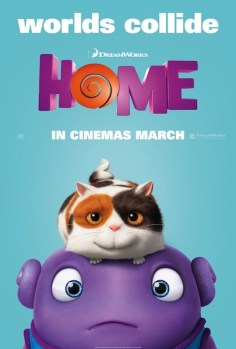 Oh (Jim Parsons) is a Boov, a race of friendly aliens looking for a new home planet to escape their enemies. When they arrive on Earth, Oh tries to invite everyone to a party, but accidentally alerts their enemies to their new home. Outcast, he bumps into Tip (Rihanna), a girl accidentally left behind when the rest of mankind was relocated by the Boov. Desperate for friendship, Oh agrees to help her find her mother.
Initially I ignored Home, because nothing about it looked particularly inspiring. But I’ve been wrong about CG kids animations before (How to Train Your Dragon; Cloudy with a Chance of Meatballs), so when I happened to see the trailer and it amused me, I decided to give it a go. Unfortunately, characters and affectations that are amusing in the form of highlights lasting two minutes quickly grate in the film proper.
Home’s biggest problems are all in its most fundamental aspect: the story. It doesn’t just have plot holes — the whole premise and inciting incident don’t even hang together. I don’t believe this is just a movie for little kids, I reckon it was written by them too. That’s surely the only way to explain its absence of plausible logic.
Why do the Boov speak English? Why do they speak it wrong? Why does Oh speak it so much more wrong than any other Boov? Why do they know the words for things they have no concept of? Why would humanity accept total relocation without any kind of response? How would only one girl on the entire planet be missed? How would she have had time to come to hate the Boov enough to make multiple pieces of anti-Boov art and set up an elaborate Home Alone-style trap in her apartment when the film suggests the Boov arrived just a couple of hours earlier? How does she know how to drive? If she’s old enough to know how to drive (and to be voiced by Rihanna), why does she do art that looks like it’s by a six-year-old? Why do the Boov make recognisable monuments float in the air? Why would a communication device’s two options be “send to one person” and “send to not only the entire species, 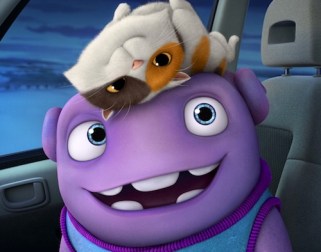 but the entire universe, including our enemies”? Why is there no option to cancel such a transmission that is going to take 40 hours to reach said enemies? I mean, that last one’s a stupid question, because why is there even a way to message the enemies?
And those questions are just from the first 15 minutes.
Tip’s full name is Gratuity Tucci, which may just be the most implausible name in the history of the world. Our heroes spend a chunk of the middle of the film just driving across the Atlantic (don’t ask) doing things like listening to Rihanna music (you mean, they listen to songs by the lead voice actress? What a coincidence!) Sometimes the film is scored with such Popular Songs, often tweeny crap, but other times it’s blandly generic Movie Music. Either would be an adequate creative choice, albeit resolutely unremarkable, but having both at random is distractingly schizophrenic. And the songs don’t even have accurate relevance to what’s happening.
Story aside, Home is not poorly made, and there are fleeting glimmers of entertainment. Which is damning with faint praise, really. Naturally, I don’t recommend you waste your time on it.

Home featured on my list of The Five Worst Films I Saw in 2016, which can be read in full here.

 Score:



 Con man Gordon Liu poses as San Te (Liu’s character from

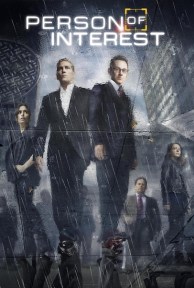 I have very mixed feelings about Person of Interest, whose fourth season has only made it to UK TV in the past few weeks (the belated fifth starts in the US in May, they announced yesterday). When it works, it’s a good quality vigilante/procedural action show; but its array of arc plots are as unrewarding as they are never-ending, and are consequently unsatisfying to a fault (literally). However, now that I’m so deep into it, and with cancellation finally confirmed (the foreshortened and delayed fifth season will indeed be its last, as was also finally announced yesterday), I feel like I’m in ’til the bitter end. The makers just bloody better have had the notice to get a proper ending into that now-final episode…
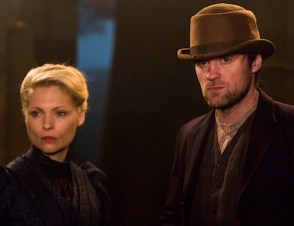 When Amazon picked up Ripper Street after the success of the third series, it was for a fourth and fifth season totalling 13 episodes. The show’s writers seem to have taken the double recommission to heart and crafted an arc plot to last throughout those two seasons, meaning this first half ends on a big surprise and with all sorts of things left up in the air. And now we have to wait. Still, it’ll be fascinating to see how there are six or seven more episodes left, considering the predicament they’ve put the characters in.
 I think I sounded a little more dismissive of Shetland than I’d intended in
  The quality of this revival has certainly been all over the place. I was wary of episode three, Mulder & Scully Meet the Were-Monster, because comedy always seems at odds with The X Files’ grand conspiracy storylines, but I thought it was hilarious and deserving of its acclaim as the best episode of the season. Home Again felt like solid standard X Files fodder, and Babylon was clearly trying to be zeitgeisty but perhaps wasn’t fully thought-through. As for the much-maligned finale, My Struggle II… well, it was a mess, and over-ambitious, and a stupid idea to end it on a cliffhanger when no one knew how well the revival would go down. Let’s hope Chris Carter is right that there’ll definitely be more.
 This month, I have mostly been missing The Night Manager. The critically-acclaimed ratings hit is, as you likely know, a spy thriller adapted from a John le Carré novel, which not only means it has pedigree, but that its star — Tumblr-beloved Marvel villain Tom Hiddleston — is now being tipped to take over as Bond. I wouldn’t know, I’ve not seen it yet.



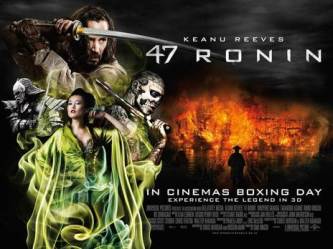 Blighted by behind-the-scenes difficulties, 47 Ronin wound up among
 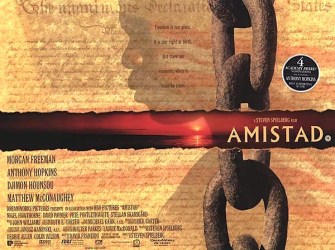 Feeling in need of more intellectual fare after helming
  Though Spielberg is certainly not immune to the Africans’ plight — the depiction of life on a slave ship is appropriately harrowing — it’s clear from early on which side he expects us to identify with, in terms of cultural background if not shared morality: as survivors of the mutiny talk the next day, the slavers’ Spanish dialogue is subtitled but the slaves’ African dialect is not. It’s a simple but effective technique to align us with one side — as I say, not morally (in no regard is Spielberg trying to apologise for the slavers), but socially. Unfortunately, it’s not sustainable: later, when we need to understand the Africans to follow a scene’s point, their dialogue is suddenly subtitled, and from then it’s sporadically translated as needed. I can see why that choice was made, but it makes the unsubtitled bits feel like a cheat.
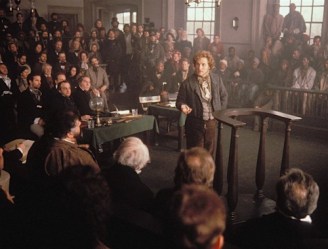 This can be said of Spielberg’s approach to the drama, too. Some of the courtroom stuff is suitably mired in legal technicalities and argument, but by film’s end it gets a little bit too… what’s the word? Not “preachy”. Not “sentimental”, exactly, though it’s born of that old criticism of Spielberg. “Melodramatic” may be on the money, though. It doesn’t help that everything reaches a climax — not only narratively, but also in the way it’s written, shot, acted, and scored — only for it to be revealed that it’s just the end of act two. Okay, that’s the truth of what happened (or near enough, for the purposes of this dramatisation), and by adapting it in that way it emulates the emotions the characters experienced; but from the audience’s perspective, you feel like you’ve reached the end… only to be served up another half-hour of movie. And it’s a long film too, so you feel that. It gets by because it’s fundamentally a good film, with strong performances and technical merits, but it’s a little bumpy for a bit.
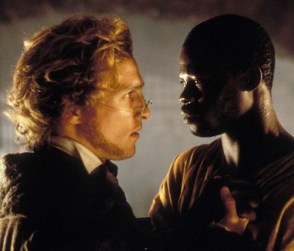 It’s easy to criticise Amistad, because Spielberg makes the production of very good movies look effortless, so the missteps stand out all the more. The story of La Amistad and its ‘cargo’ is a powerful one, and Spielberg has — naturally — turned it into a good film; but by remixing history to over-egg the message, it loses a little something. A valiant effort, but a film like


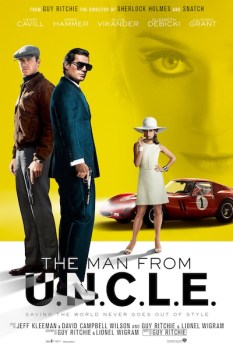 Guy Ritchie is a self-confessed non-fan of the classic ’60s spy-fi series
  I appear to be coming at director Ben Wheatley’s films in reverse order (having covered
  Kill List mixes in its genre elements — and they’re elements from a couple of different genres at that — so gradually that, as I said, it’s hard to discuss them without spoiling the film. (Much like the film itself, this review is getting progressively more revealing, so jump off when you’ve had enough.) It’s kind of a compilation of traditional British movie genres: we begin with kitchen sink, then discover we’re actually watching a crime film, before the final act swerves (though not without foreshadowing) into folk horror. The skill of Wheatley, and his co-writer Amy Jump, is in not making these transitions too implausible. That’s not to say they’re not surprising, but the doom-laden music, inexplicable proclamations by some characters, and a couple of very strange events should all clue the viewer in to the film not being a common-or-garden hitman flick.
 The final act is naturally where the film reveals its overarching purpose… or rather doesn’t reveal, because there are a shortage of answers here. It’s a lot more straightforward than A Field in England, but it still offers few (or, some would say, no) explanations for what’s occurred. According to Wheatley, the screenplay was more explicit about what was happening and why, and so was some of what they shot, but he cut back on the exposition to leave it up to audience interpretation. This isn’t a film to passively watch and have everything explained, but even viewers prepared to do a little work for themselves may find it frustrating.
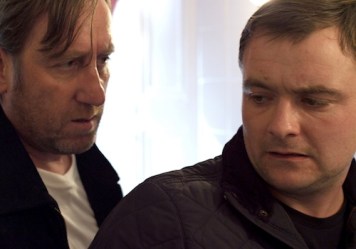 Memorable sequences keep it ticking over throughout — and so they should: taking inspiration from the likes of Kubrick and Stephen King, Wheatley started from specific images and worked backwards to a plot. Here, I think that method has been effective. The abstruse ending won’t be to everyone’s taste, but the journey there is worth experiencing.
 100Films.co.uk