Archive 5, Vol.3

I have a backlog of 437 unreviewed feature films from my 2018 to 2021 viewing. This is where I give those films their day, five at a time, selected by a random number generator.

Today, everything from silent comedies to afterlife comedies to toy-licence-based adventure comedies (a burgeoning genre we’re sure to see more of in years to come). Plus a revisionist Arthurian legend for good measure.

This week’s Archive 5 are…

  • Guinevere (1994)
  • The Kid (1921/1972)
  • Defending Your Life (1991)
  • The LEGO Movie 2: The Second Part (2019)
  • Sherlock Jr. (1924)


    Guinevere

    (1994)

    Jud Taylor | 91 mins | digital (SD) | 4:3 | USA & Lithuania / English

    Guinevere

    This Lifetime TV movie is like an American Renaissance faire cosplay version of Arthurian legend. Its attempt at a feminist take on the famed stories is interesting, but deserves better writing, filmmaking, and accents.

    Most of Guinevere’s flaws come from its low-rent made-for-US-TV-in-the-’90s roots (the mediocre direction; the tacky music score), but that’s also its biggest asset, because when and for whom it was made means it was shot on film, which gives it a certain gloss (even when downgraded to SD) that taped or digital productions simply lack.

    Story-wise, the love triangle stuff from legend is there, but given a YA spin — it’s practically Arthurian Twilight. Are you Team Arthur or Team Jacob? The feminist bent is not subtle either, which, given changes in attitudes over the past few decades, makes you wonder if it’s ripe for a re-adaptation (it’s based on a trilogy of novels with magnificently florid titles like Child of the Northern Spring and Queen of the Summer Stars).

    You see, despite everything, I didn’t hate it. Maybe I should — it’s not good, by any means — but I liked what it was trying to do, even while it didn’t do it well (at all). It’s a concept someone should definitely take another run at.

    2 out of 5

    Guinevere was #209 in my 100 Films in a Year Challenge 2020.


    The Kid

    (1921/1972)

    Charlie Chaplin | 50 mins | DVD | 4:3 | USA / silent | U

    The Kid

    Charlie Chaplin’s first feature-length work as star and director sees his Tramp character caring for an abandoned child (Jackie Coogan). I say “feature length”, but when you combine a re-edit Chaplin performed in 1972 with PAL speedup, it runs just 50 minutes. I’ve gotta say, I appreciated that. I’ve felt some of Chaplin’s other films have gone on a bit, whereas this didn’t outstay its welcome. That said, I did feel the Dreamland sequence near the end was filler. That aside, it’s quite a nice film. Coogan is particularly effective — he has just the right look for the role, and was obviously very good at imitation and/or taking direction.

    Regarding the length, the original 1921 release was 68 minutes, but for a 1972 reissue Chaplin cut some footage, appears to have sped up the frame rate of the rest, and added a score and some sound effects too. It’s only this cut that gets released on disc nowadays (often with the excised footage included as deleted scenes). The original cut clearly still exists, and yet everyone just seems to overlook it — it’s only if you bother to read up on the film that you discover what most people are watching and reviewing as “a 1921 film” is actually a 50-years-later director’s cut. Imagine if we all just ignored, say, Blade Runner’s original version and just treated The Final Cut as— oh, wait. Never mind.

    4 out of 5

    The Kid was #60 in my 100 Films in a Year Challenge 2020.


    Defending Your Life

    (1991)

    Albert Brooks | 111 mins | Blu-ray | 1.85:1 | USA / English | PG / PG
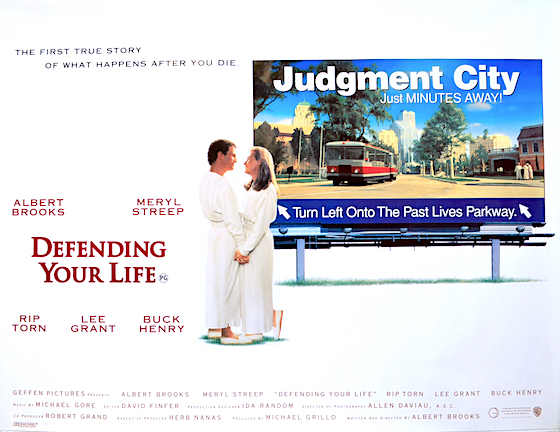
    Defending Your Life

    Writer-director Albert Brooks stars as a loner advertising exec who dies and finds himself in a bureaucratic afterlife where he has to prove that he overcame his fears. While he awaits his trial, he finally meets the love of his (after)life, Julia (Meryl Streep).

    For a film that’s literally about life and death, Defending Your Life is rather gentle. Like, it’s rarely laugh-out-loud funny, but it’s often slightly amusing. And it’s unhurried, too: its 111 minutes aren’t tedious by any means, but it doesn’t rush anywhere. A fun side effect of this is how casual its world-building is. This is a very specific vision of the afterlife, an entire world with its own rules, and while that’s all explained, it’s not laid out in minute detail like a how-to guide. I feel like this is something movies used to happily do but has been eroded by the need for everything to be over-explained and -analysed.

    I liked Defending Your Life a good deal (I’ve picked up a couple more of Brooks’s films on Blu-ray off the back of it), and part of that is certainly its laidback style. Nonetheless, perhaps if it were snappier — quicker witted and paced — it might be a better-remembered film, comparable to something roughly contemporaneous like Groundhog Day.

    4 out of 5

    Defending Your Life was #113 in my 100 Films in a Year Challenge 2021.


    The LEGO Movie 2:
    The Second Part

    (2019)

    Mike Mitchell | 107 mins | Blu-ray (3D) | 2.40:1 | USA, Denmark, Norway & Australia / English | U / PG
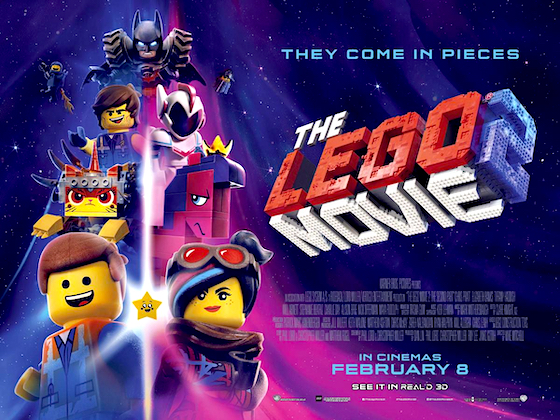
    The LEGO Movie 2

    After the surprise success of The LEGO Movie, naturally a sequel had to follow. Unfortunately, it’s altogether less surprising, because it’s that old fashioned sequel thing: a less-good do-over of the first movie.

    The Second Part feels less focused than its predecessor. It still has a positive message (about not needing to grow up, and about playing together, or something), but it takes a while to get to it, rather than baking it into the entire experience. Maybe that’s intellectualising things a bit — this is a family-friendly adventure-comedy starring toys, after all. But still, the overall journey doesn’t feel as exciting or fun. There are fun little bits on the way, but, moment to moment, it lacks the spark of the first one.

    For a specific example, take the breakout hit of the first film, the irritating song Everything Is Awesome. That angle has been doubled down on, with multiple attempts at emulating the “irritating but kinda loveable” song formula; but while these numbers are annoying while they last, they don’t have the irrepressible catchiness of the first film’s signature achievement — a mixed blessing, to be sure (at least they won’t be stuck in your head afterwards). The end credits are accompanied by a song that jokes about the credits being the best part… but, in this case, the credits kinda are the best part.

    3 out of 5

    The LEGO Movie 2: The Second Part was #33 in my 100 Films in a Year Challenge 2020.


    Sherlock Jr.

    (1924)

    Buster Keaton | 45 mins | Blu-ray | 1.33:1 | USA / silent | U
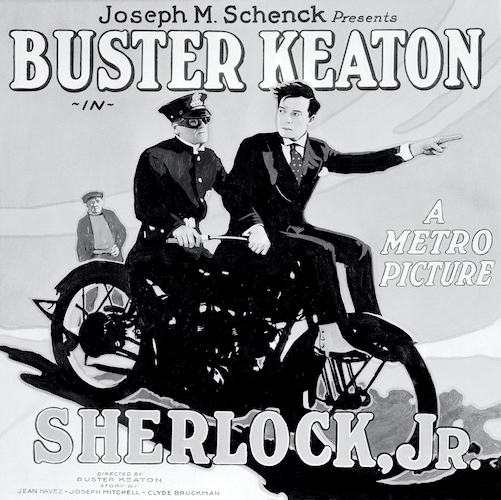
    Sherlock Jr

    Apparently there are ever-raging arguments within the silent film fan community about who was the best comedian of the era. Charlie Chaplin’s got the most widespread recognition, but Buster Keaton and Harold Lloyd have their advocates, of course, and I guess there are probably people shouting in favour of smaller names too. I didn’t think I’d ever pick a ‘side’ in these debates — I’m certainly not about to go seeking them out and wading in — and, fundamentally, I do hold with the notion that the greats are all great and so why not appreciate them all? — but, from what I’ve seen thus far, I’m finding Keaton’s work more consistently enjoyable than Chaplin’s. Sherlock Jr. is my favourite of his that I’ve seen so far.

    Keaton plays a film projectionist who’s studying to be a detective on the side. When he’s framed for the theft of a watch, his apparent guilt doesn’t give him much chance to put his skills to the test. But when he falls asleep during a movie, he steps inside it and becomes the world’s greatest detective. And when I say “steps inside”, I mean it in the most literal sense possible: the projectionist walks through the screen and into the movie, and is suddenly subject to its whims — for example, he’s confounded whenever it cuts to a new location. The sequence is both thoroughly entertaining and technically faultless — and I say that viewing it nearly 100 years after it was made, after all the advances in technique and effects we’ve had in that time. Reportedly, the film’s cameraman, Byron Houck, went as far as using surveying equipment to ensure the camera was positioned correctly so the transitions were seamless. The effort paid off.

    The same is true in several other incredible sequences, like a billiards game filled with trick shots, which Keaton rehearsed for four months with a pool expert and then took five days to film. Or a motorbike chase with more I-can’t-believe-he-just-did-that death-defying stunts than one of Tom Cruise’s impossible missions. The technical skill is faultless and, even if you’re not wowed by how they pulled it off, the sequences are immensely entertaining in their own right. Maybe it’s just personal taste, but this is why I have a preference for Keaton: his skits are more ingenious, better paced, and backed up with impressive stunt work. When you mix those daredevil antics with genuine movie magic, as he does here, you get a majestic, unforgettable farce.

    5 out of 5

    Sherlock Jr. was #102 in my 100 Films in a Year Challenge 2019. It was viewed as part of What Do You Mean You Haven’t Seen…? 2019. It placed 3rd on my list of The Best Films I Saw in 2019.
  • Archive 5, Vol.2

    I have a backlog of 442 unreviewed feature films from my 2018 to 2021 viewing. This is where I give those films their day, five at a time, selected by a random number generator.

    Today: musical comedies from ’41 and ’51; murder mysteries from ’33 and ’73; and an animated film that changed the Oscars.

    This week’s Archive 5 are…

  • Royal Wedding (1951)
  • A Study in Scarlet (1933)
  • Chicken Run (2000)
  • The Last of Sheila (1973)
  • Road to Zanzibar (1941)


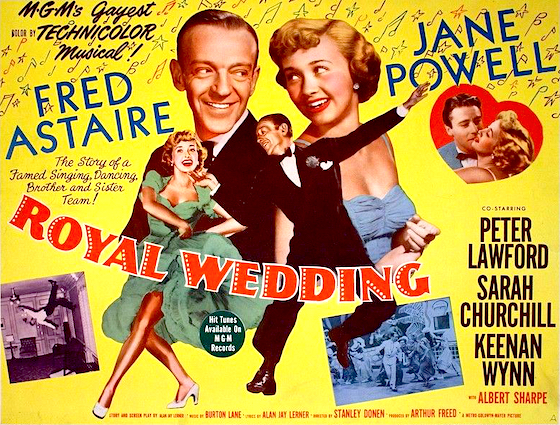
    Royal Wedding

    (1951)

    aka Wedding Bells

    Stanley Donen | 93 mins | digital (SD) | 4:3 | USA / English | U

    Royal Wedding

    Cynically, I assumed this US production was designed as a cash-in to a news event, most likely the wedding of Princess Elizabeth (i.e. the Queen) and Philip. Although those are indeed the eponymous nuptials, they actually took place several years earlier, in 1947; and in the UK, for its initial release the film was retitled Wedding Bells so audiences wouldn’t think it was a documentary about the real event. So much for my modern cynicism.

    The actual plot is semi-biographical, inspired by the real-life dance partnership of the film’s star, Fred Astaire, and his sister Adele, and who she went on to marry. Here the sister is played by Jane Powell (almost 30 years Astaire’s younger) as the duo take their successful Broadway show across the ocean to London in time for the royal wedding. Such window dressing aside, the plot that unfurls is run-of-the-mill, with both siblings finding themselves in romantic entanglements, and the songs are unmemorable too. The object of Astaire’s affection is played by Sarah Churchill, daughter of Winston Churchill, which adds a bit of fun trivia, at least.

    There is one noteworthy highlight: a set piece in which Astaire dances up the walls and across the ceiling of his hotel room, an effect that’s achieved seamlessly — there’s no wobble or what have you to give away the trickery, and Astaire’s choreography helps hide the behind-the-scenes technique too. There are one or two other neat bits if you’re a fan of dance-y musicals, but, on the whole, this is a thoroughly middle-of-the-road Astaire musical — not bad, just no more than adequate.

    3 out of 5

    Royal Wedding was #180 in my 100 Films in a Year Challenge 2021.


    A Study in Scarlet

    (1933)

    Edwin L. Marin | 72 mins | Blu-ray | 1.33:1 | USA / English | U

    A Study in Scarlet

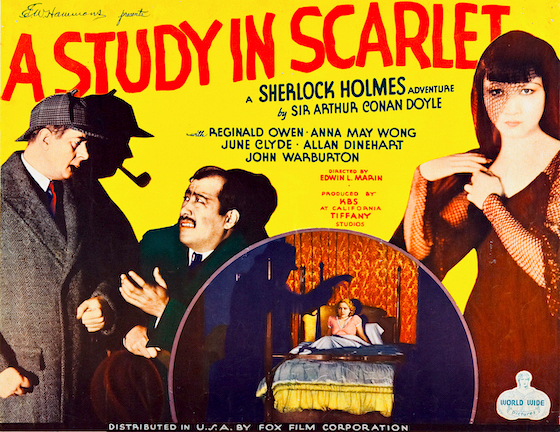
    For some reason, cinema has a long history of taking the titles of original Sherlock Holmes stories but then producing an entirely new plot underneath. A Study in Scarlet — the very first of Sir Arthur Conan Doyle’s Holmes works — seems to be a particularly afflicted tale. It features the first meeting of Holmes and his roommate / sidekick / chronicler, Dr Watson, but I think there are two adaptations that actually show this — and, ironically, neither of them are actually called A Study in Scarlet (one is the debut episode of Sherlock, A Study in Pink, and the other is the first episode of the Russian series The Adventures of Sherlock Holmes and Dr. Watson, which is called Acquaintance). According to IMDb, “the Conan Doyle estate quoted the producers a price for the rights to the title and a considerably higher price to use the original story” — perhaps they did that all the time, hence my observed phenomena.

    Obviously, this ‘poverty row’ effort is one such example of title/story mismatch: this so-called adaptation stars Sherlock Holmes and Dr Watson… and that’s where similarities to the novel end. The pair don’t even live at 221b Baker Street — for no apparent reason, it’s been changed to 221a. Did the filmmakers just misremember one of the most famous addresses in literature? Having only paid for the rights to the title, the producers hired director Robert Florey (the Marx Brothers’ The Cocoanuts; Murders in the Rue Morgue) to write a new story, and actor Reginald Owen — who stars as Holmes — wrote the dialogue. Owen hoped this would be the first in a series of Holmes films starring himself. It wasn’t.

    Physically, Owen isn’t anyone’s ideal image of Holmes, but his actual performance is adequate. Much the same can be said of the whole film: it’s an entertaining-enough 70-minute crime romp, with enough incident to create a brisk pace, and a use of the rhyme Ten Little Indians that makes you wonder if Agatha Christie saw this movie before she published And Then There Were None six years later (or is it just a coincidence? The audio commentators spend a good deal of time chewing it over). Given second billing behind Owen is bona fide Chinese-American movie star Anna May Wong, even though she has relatively little screen time. She makes her mark, though, with a role that doesn’t simply conform to racial stereotypes (possibly an unintended side effect of her late casting rather than genuine progressivism by the filmmakers, but sometimes you gotta take what you can get).

    This particular Study in Scarlet is a long way from being a definitive Sherlock Holmes movie, but for fans of ’30s detective flicks, it’s nonetheless a likeable little adventure.

    3 out of 5

    A Study in Scarlet was #206 in my 100 Films in a Year Challenge 2021.


    Chicken Run

    (2000)

    Peter Lord & Nick Park | 84 mins | digital (HD) | 16:9 | UK, USA & France / English | U / G

    Chicken Run

    I’ve always enjoyed Aardman’s work. I grew up watching the Wallace & Gromit shorts on TV, and have seen all of their feature output — except their first. I’m not sure why it’s taken me 20 years to get round to Chicken Run. I guess when it was originally released I had grown out of “kid’s movies” but not yet grown back into them; but since then, to be honest, something about it never particularly appealed to me. It certainly has its fans: it’s still the highest grossing stop motion film ever; there was a push to get it an Oscar Best Picture nomination, the failure of which led to the creation of a category it could’ve won, Best Animated Feature (trust the Academy to shut the door after the horse had bolted); and when Netflix recently announced a sequel, there was much pleasure on social media.

    So, finally getting round to it, would I discover what I’d been missing all along? Unfortunately, no. I thought it was fine. In no way did I dislike it, but nor did it charm me in the way of my favourite Aardman productions. It’s rather dark for U-rated film — it doesn’t mince its words or imagery about the fact the chickens are being killed — and that contributes to some particularly effective sequences, like when our heroes end up inside the pie machine, or a suitably exciting climactic action sequence. There are some reliably decent gags along the way, too.

    I’m sure I’ll watch the sequel. Maybe I’ll like it more. But, I confess, the fact they’ve now announced a new Wallace & Gromit movie for the year after does have me even more excited.

    3 out of 5

    Chicken Run was #148 in my 100 Films in a Year Challenge 2020.


    The Last of Sheila

    (1973)

    Herbert Ross | 120 mins | digital (SD) | 1.85:1 | USA / English | 15* / PG

    The Last of Sheila

    I’d never even heard of this before Rian Johnson mentioned it as an inspiration for Knives Out 2. Co-written by Anthony Perkins (yes, Norman Bates from Psycho) and Stephen Sondheim (yes, the famous musical composer), The Last of Sheila is a murder mystery firmly in the Agatha Christie mould — despite the writers’ pedigree, there are no significant horror elements (even the deaths are, at worst, on the PG/12 borderline) and certainly no song-and-dance numbers (excepting a magnificently inappropriate song over the end credits, sung by Bette Midler). Apparently Perkins and Sondheim used to host elaborate scavenger hunts for their friends in the late ’60s and early ’70s, and they adapted them into a screenplay at the suggestion of a guest, Herbert Ross, who produced and directed the film (seems only fair).

    Further inspiration came from their professional lives and acquaintances, because the potential victims and suspects are all actresses, agents, and the like, gathered for a Mediterranean cruise aboard a producer’s yacht. He proposes they play a game about secrets and gossip — but clearly one of the secrets in play is too big, because someone winds up murdered. A well-constructed mystery is unfurled throughout the film, although its execution is a little variable: a fun, very Christie-esque first half gives way to long talky scenes in the second, as characters stand around and explain the plot to each other. But when that plot is as good as this — with some nice surprises, plus motives dark enough to give it a little edge — it feels churlish to object too strongly.

    4 out of 5

    The Last of Sheila was #186 in my 100 Films in a Year Challenge 2021.

    * IMDb says it was given a 15 on video, but the BBFC say it hasn’t been rated since 1973, when it got an AA. The BBFC site is crap nowadays; IMDb will accept any old junk users submit. You decide. ^


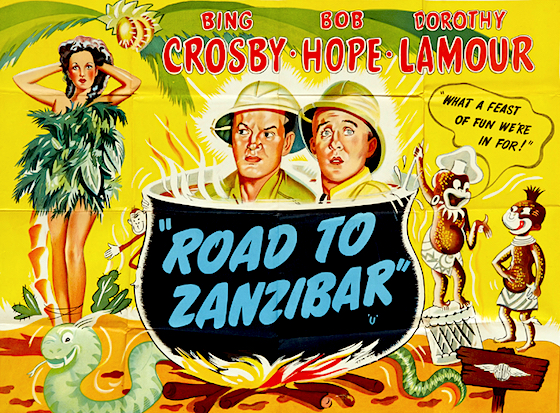
    Road to Zanzibar

    (1941)

    Victor Schertzinger | 87 mins | DVD | 1.33:1 | USA / English | PG

    Road to Zanzibar

    The second in what became the Road To… series — though it was never intended as such. What ended up becoming Road to Zanzibar was initially an original feature, first offered to Fred MacMurray (this before his roles in the likes of Double Indemnity and The Apartment) and George Burns (an actor I’m not particularly familiar with). After they rejected it, apparently someone at Paramount remembered Road to Singapore had done relatively well, and that Bob Hope and Bing Crosby seemed like a good pairing, and so they were offered it.

    As I wrote in my last review of a Road To film (which was over 11 years ago?! Jesus…), if you’ve seen one Road To film then you’ve a fair idea what to expect from any other — essentially, a suitably daft bit of fluff and fun. This one’s a bit thin — on plot, on gags, on everything — but it skates by on the charm of Bob and Bing, joined, as ever, by Dorothy Lamour. The only serious problem is the same as Singapore: dated depictions of African stereotypes. It kind of gets away with it by being a spoof of “African adventure”-type movies, but maybe that’s me being kind with hindsight. Either way, the bit where the tribe’s African dialogue is subtitled with contemporary American vernacular is one of the film’s more amusing gags.

    3 out of 5

    Road to Zanzibar was #110 in my 100 Films in a Year Challenge 2019.


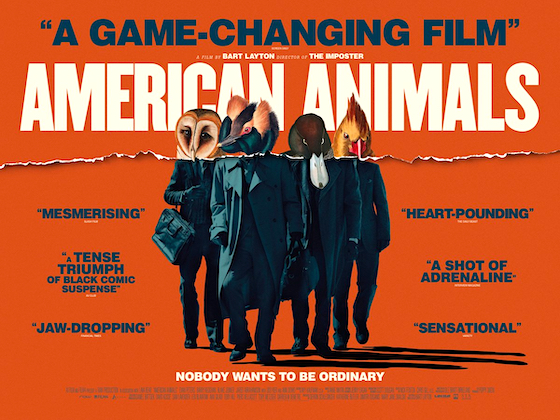
  • American Animals (2018)

    Bart Layton | 117 mins | digital (HD) | 2.39:1 | UK & USA / English | 15 / R

    American Animals

    I don’t want this to turn into a rant about IMDb — there’s a time and a place for those, certainly, but what’s meant to be a short review of one film is not one of them — but the way they’ve devalued the documentary in recent years is not also depressing but also inaccurate. Because anything that has the genre Documentary is now marked as “(documentary)” on someone’s filmography, and therefore IMDb, and/or its contributors, are reluctant to use it about anything that isn’t 100% a documentary. Something like, say, American Animals.

    To be clear: American Animals is unquestionably a documentary. It tells a true story, about some students who plan to rob a library of its rare books. It features interviews with the real people involved, both the students and others. But it’s mostly told via reenactments starring actors, several of them fairly recognisable faces. The real people appear as talking heads scattered throughout, particularly at key moments. So, it’s also unquestionably a hybrid of documentary and fiction. On the surface, it can look a lot like any fictionalised adaptation of a true story; but it’s hidebound to be more accurate than those often are, because it’s also got all these interviews. IMDb isn’t built for nuance such as this.

    Prior planning prevents piss-poor performance... possibly

    The film’s director, Bart Layton, previously made widely-praised definitely-a-documentary The Imposter. In my review of that, I described his style as “flashy” and “over-eager”, wondering if “perhaps he better belongs in fiction filmmaking? Perhaps that’s where he wants to go in future”. Here, I guess he’s moving to bridge that divide; but the blurred line means that, when the film says “here’s the real [person X]”, you kind of question it. Especially as, if a crime was committed, how come they’re interviewing the criminals?

    That latter thought contributes to a genuine tension and suspense throughout the film. How far will this plot go? Do they even actually attempt it? One of the guys keeps saying, “I expected there to be something to stop us”, and you think maybe something will stop them… but the fact this film exists, and there’s all the chat about how the boys let their parents down and whatever, shows something happened. (No spoilers!) Yet it’s also surprisingly funny, like a bit where we’re shown the “Ocean’s Eleven version” of the robbery, complete with Elvis song on the soundtrack.

    Some have criticised these kinds of flights of fancy, or the whole hybrid form, for inviting us to sympathise with these guys rather than condemn their actions. I think there’s room for both. The film seeks to explore what led these pretty normal guys to do such a thing, and (to an extent) how it has affected them since. I think you can both disapprove of what they did and seek to sympathise with them — to understand how it happened is not to condone it.

    4 out of 5

    American Animals was #107 in my 100 Films in a Year Challenge 2020.
    It is streaming on All 4 until 10th February.

    Archive 5, Vol.1

    Part of the impetus behind this new era of 100 Films was to solve ‘problems’ like my repeated failure to post reviews. Hopefully my plan for regular groups of capsule-sized reviews will solve that going forward. But this has been an issue for a while, and that’s led to a huge backlog of unreviewed films from 2019 to 2021 — it totals a ridiculous 449 feature films (counting shorts too, it goes over 500). Rather than abandon those to the mists of time, I present a new weekly (more or less — let’s not overcommit myself) series: Archive 5.

    Essentially, it’s the same format as new viewing: each post is a collection of short reviews; but here they’re five titles plucked at random from my archive of unreviewed films (and I’ve used a random number generator, so it’s genuinely unmethodical). If I can keep this up weekly, it will take me just under two years to clear the backlog — which means I could still be reviewing stuff from 2019 in 2023. Hahaha… haha… ha… ugh.

    With that in mind, there’s no need for further ado. This week’s Archive 5 are…

  • Never Too Young to Die (1986)
  • Bachelor Knight (1947)
  • Little Women (2019)
  • Aniara (2018)
  • Who’s Afraid of Virginia Woolf? (1966)

    (I Care a Lot was originally intended to be part of this post, but then the review turned out a little long, so I spun it off by itself. That’s the kind of thing I’ll probably keep doing, too.)


    Never Too Young to Die

    (1986)

    Gil Bettman | 97 mins | digital (HD) | 1.85:1 | USA / English | 18 / R

    Never Too Young to Die

    If you dropped A View to a Kill, Rocky Horror, WarGames, and Mad Max 2 into a blender, the end result might be Never Too Young to Die. And if that sounds like a ludicrous, unpalatable mash-up… yep, that’s Never Too Young to Die.

    This direct-to-video action-adventure stars a pre-Full House John Stamos as Lance Stargrove, a teenage gymnast whose dad is a secret agent (played by George Lazenby — aged 47 at the time, but looking at least 20 years older). When daddy is killed, Lance teams up with his partner (singer turned actress Vanity) to go after the culprit: gang leader and wannabe terrorist Velvet Von Ragnar (Gene Simmons (yes, from Kiss), chewing scenery as if he’s not been fed for months).

    If you’ve never heard of this film… well, neither had I, until a Cracked article suggesting comical substitutes for Covid-delayed blockbusters. But what really convinced me to watch it is that it has The Greatest Trailer Ever Made. If you set out to make a spoof ’80s trailer, I’m not convinced you’d be able to beat that. Unfortunately, neither can the film as a whole. It’s fun at times (the boob-biting final fight, or a scene where Stamos tries to distract himself from Vanity’s sexuality by… eating multiple apples), but it’s not quite camp or daft enough to really earn a place as a cult classic.

    I’ll say this for it, though: rewatching that trailer has made me really want to watch the film again…

    3 out of 5

    Never Too Young to Die was #70 in my 100 Films in a Year Challenge 2020.


    Bachelor Knight

    (1947)

    aka The Bachelor and the Bobby-Soxer

    Irving Reis | 91 mins | digital (SD) | 4:3 | USA / English | U

    Bachelor Knight

    If you ever need to name an obscure Oscar winner for some reason, you could do worse than Bachelor Knight — or, to give it its even-dumber-sounding original title, The Bachelor and the Bobby-Soxer. Yes, this won the Oscar for Best Original Screenplay (the other nominees aren’t the greatest field you’ve ever seen, but altogether they’re either better-remembered or were considered good enough to nominate for other gongs that evening, so quite how this took the prize, I don’t know).

    The plot also stretches credibility: after high schooler Susan (Shirley Temple) becomes infatuated with artist Richard Nugent (Cary Grant), she sneaks into his place to model for him, much to the disapproval of her older sister Margaret (Myrna Loy), who also happens to be a judge; and when Nugent ends up in her court room, she sentences him to date Susan until her infatuation inevitably wears itself out. I know things are different in the US, and also in the past, but did/do judges there really have the power to hand out any crazy made-up sentences they like?

    On the bright side, the film moves sprightly through its plot. Perhaps that’s because it takes a whole 40 minutes to get through the basic setup, even while running at a pace, means there’s less screen time left to dwell on all that follows. Not that some individual bits don’t go on a tad, like a picnic sequence; but others work very well, like a scene in a nightclub that is a nicely-written bit of escalating farce.

    It’s not the best work of anyone involved, but Bachelor Knight belies its iffy title (both of them) to be a likeable-enough 90 minutes of screwball comedy.

    3 out of 5

    Bachelor Knight was #70 in my 100 Films in a Year Challenge 2021.


    Little Women

    (2019)

    Greta Gerwig | 135 mins | cinema | 1.85:1 | USA / English | U / PG

    Little Women

    Writer-director Greta Gerwig’s adaptation of Louisa May Alcott’s beloved novel was greeted in some quarters by questions of if it was necessary: it’s the sixth big-screen version of Alcott’s book, and came just two years after a major new BBC adaptation. Well, I don’t know if it was ‘necessary’ or not, but Gerwig’s version is definitely a very good film.

    A key point that marks it out from other adaptations is that Gerwig has restructured the story: instead of playing out in a straightforward chronological fashion, it flashes back and forth in the sisters’ lives, starting with them as young women in 1868, with Jo in New York and Amy in Paris, before mixing in events from their childhood, seven years earlier, when the four sisters lived together in Massachusetts. This might seem like a rejig for the sake of differentiation, but Gerwig uses it to create interesting juxtapositions or to reframe plot points. For one example (spoilers follow, if you’re not familiar with the story), I felt it made Laurie and Amy’s relationship less creepy. Told chronologically, they first meet when he’s a young man and she’s a child, and he only moves his affection to her after Jo’s rejected him and Amy’s grown up. In Gerwig’s version, we first meet them together in Paris, and they seem more destined for each other, with a genuine spark between them as individuals, rather than a nagging sense of “if I can’t have one sister, this other will do”. It’s only later we learn the full backstory of Laurie and Jo — and, for that matter, of Jo and Amy — which, yeah, is obviously still a bit creepy, when you think about it.

    Whichever way you cut it, Gerwig seems to really get to the heart of the meaning in the story and characters, as well as giving it a lightly feminist polish (misogynists would probably consider it Terribly Feminist and Evilly Revisionist, if they watched it, which I don’t imagine they would). A star-studded cast ensure the whole thing is well acted, and it’s beautifully shot by cinematographer Yorick Le Saux. Questions about ‘necessariness’ are particularly irrelevant when the work is this good.

    5 out of 5

    Little Women was #4 in my 100 Films in a Year Challenge 2020.


    Aniara

    (2018)

    Pella Kågerman & Hugo Lilja | 106 mins | digital (HD) | 2.35:1 | Sweden & Denmark / Swedish & English | 18 / R

    Aniara

    A sci-fi movie based on, somewhat oddly, a 1950s Swedish poem, Aniara is about a spaceship transporting migrators from Earth to Mars that accidentally veers off course and heads irretrievably into deep space. Rather than the kind of action-adventure this might provoke if it were a Hollywood production, Aniara follows how the passengers and crew attempt to cope with their new lives.

    It’s a premise interesting enough that you feel it could fuel a TV series — how this mass of people, forced together by accident and terrible circumstance, comes to function (or not) as a society. Or maybe the remake of Battlestar Galactica already nailed that kinda thing. Either way, here it’s condensed into about 100 minutes; and because it has such a long-term view of what it wants to pack in, there are some surprisingly large time jumps (by the half-hour mark we’ve already reached Year 3). It takes some odd detours when it does that (society completely breaks down into weirdo cults… then a probe that might allow them to return home is discovered, at which point everything goes back to normal), but overall it has a pretty clear thesis about humanity and how we cope with things — “not well”, fundamentally.

    The final act kind of rushes a similar point, skipping ahead (several times) to how things are even worse without really tracking the descent. Maybe that’s why I liked the idea of a series version so much: to fill in all those blanks. But I don’t want to take this criticism too much to heart. If anything, the fact I wanted more detail is a compliment. It’s not the film bungling developments and me searching for justification, but rather that I’d be interested in seeing the themes and characters explored in even more detail. As it stands, Aniara is an epic-scale story told well in a somewhat condensed fashion.

    5 out of 5

    Aniara was #65 in my 100 Films in a Year Challenge 2020. It placed 21st on my list of The Best Films I Saw in 2020.


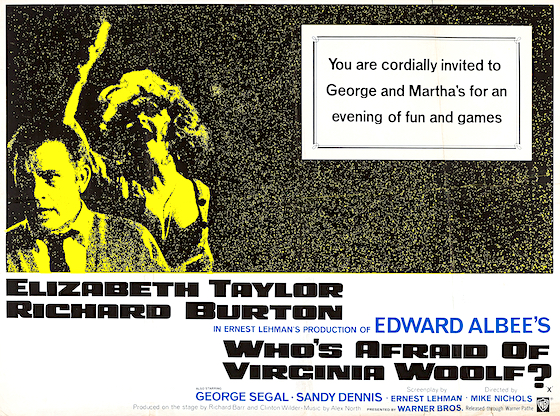
    Who’s Afraid of Virginia Woolf?

    (1966)

    Mike Nichols | 131 mins | Blu-ray | 1.85:1 | USA / English | 12

    Who's Afraid of Virginia Woolf?

    When a middle-aged college professor (Richard Burton) and his wife (Elizabeth Taylor) have his new young colleague (George Segal) and wife (Sandy Dennis) around for drinks one evening, the occasion soon degenerates into a verbal slanging match between the elder couple, the younger inescapably caught in the middle.

    And as the film takes place in almost-real-time, in just a couple of locations, it feels like we’re trapped with them. With a running time north of two hours, the film’s drunken sardonicism almost becomes an endurance test, particularly when it goes on a bit too long in the middle. But it’s carried through by some magnificent performances. Everyone talks about Taylor — just 33 at the time, she wasn’t sure she could play the part of a bitter 52-year-old, but she’s excellent — or they talk about Taylor and Burton — similarly, he wasn’t sure he could play a beaten-down failure of a man, having been used to taking dashing heroic roles — but Sandy Dennis is great too, and deserved her Oscar. Of the four actors, its George Segal who draws the short straw, not really getting the material to truly stand toe-to-toe with the other three (he still got an Oscar nom, though).

    Director Mike Nichols insisted the film be shot in black & white, which helps it to pull off Taylor’s ageing makeup, but was also intended to stop it seeming too ‘literal’ and instead give an abstract quality. That fits the material, because the characters, events, and revelations are all pretty odd; the way it plays out pretty strange. Plus, the pitch-black darkness of the night fits the film’s themes. Cinematographer Haskell Wexler does a superb (indeed, Oscar-winning) job, the photography looking more striking than you might expect, or even need, for such an actor-focused character piece.

    A whole featurette on the film’s disc release discusses how it was “too shocking for its time”, mainly because of the language used (the fact the film was made relatively unedited set a ball rolling that, just a couple of years later, saw the Production Code replaced by the modern MPAA classification system). While such concerns are no longer really relevant (once-controversial terms like “screw” and “goddamn” are hardly “fuck”, are they?), that the film is still powerful shows it was never truly about what was said, but who said it and how they said it. I don’t mean to say that it would still be offensive today, but rather that it still packs an emotive punch.

    5 out of 5

    Who’s Afraid of Virginia Woolf? was #22 in my 100 Films in a Year Challenge 2021.


  • The Secret Life of Pets 1&2

    Imaginatively-titled sequel The Secret Life of Pets 2 is available on Netflix in the UK from today, so what better time for me to finally get round to reviewing both that film and its predecessor? (Unfortunately, the first one isn’t currently available on any subscription streaming service.)

    The Secret Life of Pets
    (2016)

    2019 #73
    Chris Renaud | 86 mins | digital (HD+3D) | 1.85:1 | USA, France & Japan / English | U / PG

    The Secret Life of Pets

    In a Manhattan apartment, terrier Max’s quiet life as favourite pet is upended when his owner brings home stray Duke. But they must put their quarrels aside when they get lost in the city and discover that abandoned magician’s bunny Snowball is building an army of lost pets, determined to wreak their revenge. — adapted from IMDb

    Make your main character a cute little terrier-like dog and you’ve basically halfway sold me on your movie already (see: Hotel for Dogs; Benji). It works best with a real cute little dog, of course, but The Secret Life of Pets is proof the effect can carry over to animation, at least somewhat. It helps that the behaviour of the various animals in the film is all quite well observed — heightened, obviously, but there are many reasonable riffs on pet behaviour… that is until the revolutionary group led by a bunny, who’s followed by a tattooed pig and a lizard, hijack an animal control van. That’s a bit silly.

    From the trailers, I thought the animation style looked a bit flat — presumably a deliberate choice, almost like it was going for a Peanuts Movie kinda style — but watching it in 3D adds some pleasing depth and shapeliness, especially as I don’t think flatness actually was the intended effect for the whole movie.

    The Secret Life of Pets mostly reheats, remixes, and recombines stuff you’ve seen done in other movies (although as it came out around the same time as Finding Dory, it’s really a toss up as to who can claim that “animals in control of a human vehicle” climax), but it manages just enough charm to tick over as entertaining rather than irritatingly derivative.

    3 out of 5

    The Secret Life of Pets 2
    (2019)

    2020 #81
    Chris Renaud | 86 mins | digital (HD+3D) | 1.85:1 | USA, France & Japan / English | U / PG

    The Secret Life of Pets 2

    Max faces some major changes after his owner gets married and has a child. On a family trip to the countryside, Max meets farm dog Rooster and attempts to overcome his fears. Meanwhile, Gidget tries to rescue Max’s favourite toy from a cat-packed apartment; and Snowball sets off on a mission to free a white tiger from a circus. — adapted from IMDb

    As the above plot description goes some way to indicating, The Secret Life of Pets 2 feels like watching three episodes of a Secret Life of Pets TV series strung together: for most of its running time, it cuts back and forth between three completely unrelated storylines, seemingly just so that every major character from the last movie has something to do. Things do tie together in the final quarter-hour for an all-action climax, but that doesn’t stop them being entirely disconnected until that point.

    The only thing that really elevates it above TV-level is the visuals, which show off suitably expensive and slick animation, especially in 3D. At this point it almost goes without saying that computer-animated movies look fantastic in 3D, but it’s still pleasing.

    None of which is to say The Secret Life of Pets 2 is an outright bad movie. It’s a step down from the first (as things have panned out, I’ve given them both the same score, but the first one is kind of a 3+), but it has its moments — like the opening five minutes, where Max bonds with his owner’s new kid, which are sweet and cute; or the casting of Harrison Ford as a take-no-bullshit farm-dog, which is perfect. If you liked the first movie, this one passes some time amiably.

    3 out of 5

    The Secret Life of Pets 2 is available on Netflix in the UK from today.

    Palm Springs (2020)

    2020 #163
    Max Barbakow | 90 mins | digital (HD) | 2.39:1 | USA / English | 15 / R

    Palm Springs

    For a couple of decades, Groundhog Day stood alone in a genre of one. But no good idea is allowed to rest in the Hollywood machine, and so the last few years have seen a veritable explosion in time loop stories, like sci-fi-actioner Edge of Tomorrow; or a slasher variant in Happy Death Day; or darkly comic Netflix mystery Russian Doll; or, most recently, teen romance The Map of Tiny Perfect Things. But just as you begin to think that maybe time loop comedies are becoming repetitiously overdone (irony), along comes one of the most acclaimed entries in this newly-abundant subgenre: Palm Springs, which debuted on Hulu in the US in the middle of last year and is now finally coming to the UK via Amazon Prime Video.

    In this instance, the scene is set at a wedding, where two disconnected guests — Nyles (Andy Samberg), the boyfriend of the maid of honour, and Sarah (Cristin Milioti), the sister of the bride — end up stuck in a loop together, reliving the day of the wedding over and over. And I’ll say no more on that, because even giving away that it’s time loop comedy spoils what would otherwise be a first-act twist. (I don’t know if they ever thought they’d get away with keeping that a secret, what with it being a foundational conceit of the entire film, but some official blurbs do try to keep it hush-hush. Not many reviews, or even news articles, have been similarly circumspect, so I feel at this point trying to pretend you, dear reader, don’t already know (or wouldn’t accidentally find out some other way) is a fool’s errand.)

    While the premise may be more-or-less familiar, one thing Palm Springs has in its favour is it upends numerous tropes that the subgenre has already acquired, even in its short lifespan. Some of these variations have already been explored in other examples listed in my opening paragraph, but Springs has one or two more up its sleeve, and its own way of tackling them. It can also boast its own tone and style of humour, which will be broadly familiar if you’ve seen any other Samberg vehicle (Brooklyn Nine-Nine, say, or Popstar: Never Stop Never Stopping). For the uninitiated, it’s kinda silly without going to Pythonesque extremes, and kinda earthy without being vulgar (that the BBFC classification says the film contains “strong sex” is ridiculous).

    Let's do the time loop again

    Notably, when Palm Springs was sold at Sundance it went for the highest price ever paid for an acquisition at the festival: $17.5 million… and 69 cents, those few cents adds in order to beat the previous record. That they chose that additional figure gives you some insight into the film’s level of humour. But it also says something about how positively the film was received, which led to a degree of buzz that, personally, I found crippled the final film somewhat. To be clear, I still really enjoyed it, but, from reading reviews and watching the trailer, I was half expecting to be blown away by a new comedy masterpiece. Such is the danger of letting yourself get hyped up — if I’d seen it with no prior knowledge, I might’ve enjoyed it even more. The one benefit from the ludicrous delay in it crossing the pond is that hype has cooled to an appropriate background level; from a “OMG watch this new innovative groundbreaking amazing best comedy ever!” to more of a “that’s good, you should see it”.

    All of which said, you should see it. I don’t want to accidentally undersell the movie by citing my own misapprehensions, because it’s definitely a funny, likeable, surprisingly romantic (but not twee) film. Indeed, even without the time loop USP, Palm Springs would be welcomed because it hits a really good tone on the romance angle. It doesn’t dive into full romcom cheesiness, but it’s also not that kind of “tacked on love story that the filmmakers clearly wish they didn’t have to bother with” that you normally find in these sorts of (for want of a better word) edgier comedies. Rather than rolling your eyes as the inevitable plays out, you might actually be rooting for these crazy kids.

    4 out of 5

    Palm Springs will be available on Amazon Prime Video in the UK from tomorrow.

    Godzilla: King of the Monsters (2019)

    2020 #38
    Michael Dougherty | 132 mins | Blu-ray (3D) | 2.40:1 | USA, Japan, Canada & Mexico / English | 12 / PG-13

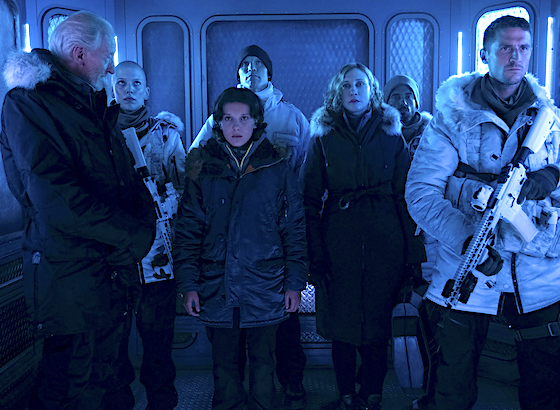
    Godzilla: King of the Monsters

    Five years on from the events of Godzilla, the world is very much aware of the existence of Titans, gigantic prehistoric creatures — or, if you prefer, monsters. These creatures are studied and, where possible, contained by the secretive organisation known as Monarch, and one of their scientists, Dr. Emma Russell (Vera Farmiga), has developed a device capable of attracting Titans and altering their behaviour. When Emma and her daughter Madison (Millie Bobby Brown) are kidnapped by a group of terrorists, Madison’s father and former Monarch employee Mark (Kyle Chandler) is re-recruited by Monarch to help track them, before the terrorists can unleash the Titans to wreak havoc on mankind.

    As well as a direct followup to the 2014 reboot of the Godzilla franchise, King of the Monsters is the third film in Legendary’s “MonsterVerse”. The in-between entry was 2017’s Kong: Skull Island, whose 1970s setting kinda leaves it adrift and standalone from the rest of the present-day-set films in this shared universe (although, following the Marvel template, Kong did have a post-credit scene designed to vaguely tee-up King of the Monsters). That said, it does have a role to play tonally. Whereas Gareth Edwards’ Godzilla was a fairly strait-laced, serious take on the concept of a giant lizard attacking mankind, Jordan Vogt-Roberts’ Skull Island took a more pulpy approach to the movie, playing like a monster B-movie with a modern spectacular effects budget.

    Here, Michael Dougherty’s offering feels like a combination of those two previous MonsterVerse films. As a direct sequel to Godzilla, it brings in plot threads and a couple of supporting characters from that movie (namely Ken Watanabe and Sally Hawkins as a pair of Monarch scientists, given more prominent roles here). It also adopts the dark visual style of Edwards’ movie, eschewing the colourfulness that was part of Vogt-Roberts’ contribution. But what Dougherty does retain is that pulpiness in the storyline. I mean, Godzilla showed us a world where the real-life (more or less) military had to scramble to find a way to respond to a giant lizard suddenly appearing.

    Puny humans

    Conversely, in King of the Monsters we find a government organisation that maintains multiple huge facilities around the world to research and contain a variety of giant beasties (one of whom is an alien, by-the-way), and a terrorist organisation that’s well organised and financed enough to break into several of those facilities and set about freeing the Titans. And that’s without mentioning a side quest into a vast sunken kingdom. If you wanted more of the real world Edwards gave us in the first film, sorry, you’re shit out of luck; but if you’re into some of the craziness that other kaiju movies have doled out down the decades, here we go!

    And, in some respects, that makes this the first MonsterVerse movie that truly feels like it’s in a shared universe of monsters. Sure, the previous films had monster antagonists — MUTOs in Godzilla, Scullcrawlers in Kong — but, frankly, they were kinda generic nasties to give our hero-monsters something to fight. In King of the Monsters, we finally get to see some of the big-name stars from Godzilla’s rogue gallery; namely: inventively-named giant moth Mothra, pterodactyl-like Rodan, and the baddest of them all, three-headed dragon Ghidorah. Okay, we haven’t been introduced to these creatures in previous movies, so it’s not technically a team-up / versus movie in that sense, but you can still feel these are headline-bout-worthy characters in a way the franchise’s previous villains just weren’t. Obviously there’s still no doubt about who the ultimate victor of these monster punch-ups is going to be (clue’s in the title), but the brawls are meatier and more impactful.

    I imagine that’s even more true for long-time kaiju fans, who’ll have a much greater familiarity with the ‘supporting’ monsters. Indeed, there’s a sense in which King of the Monsters has been made expressly for those fans, because it’s absolutely loaded with nods and references to the older films. I’ve not seen many classic Godzilla movies, so my knowledge of what was being referenced was second-hand at best — though one I’ll make room to highlight is composer Bear McCreary’s new realisation of Akira Ifukube’s classic Godzilla theme. It’s epic and awesome; a real hair-raiser when it kicks in.

    There can be only one

    Unfortunately, the parade of callbacks seems to have been a major problem for some viewers. Fans who got the references regard them as either hollow fan service or a pointless remix of past glories, while normal folk found it all a bit confusing and weird — because God forbid any blockbuster try to do stuff from outside your normal well-worn expectations. Clearly, these monster flicks aren’t for everyone. Even among those who like them, you don’t have to read many viewer’s rankings before you’ll have seen every possible iteration of which film is better than which, often accompanied by bafflement that anyone could hold an opposing view. It’s like an inadvertent case study for the fact that different people want different things. So it seems none of these movies please everyone, although personally I like the idea that each film is its own thing to some degree; that you might not love every film in the MonsterVerse, but hopefully one of them will hit the sweet spot for you. The MCU cookie-cutter format may be reassuring, but there’s delight in variety too.

    There’s certainly plenty of variety here. The MonsterVerse could’ve gone down the route of wheeling out these storied foes one by one, eking the franchise out across Godzilla vs. Mothra, Godzilla vs. Rodan, Godzilla vs. Ghidorah… Instead, we get them in one Titan-sized hit. If you’re in the mood for gigantic creatures thwacking each other, there’s something wholly satisfying about that.

    4 out of 5

    The Man Who Reviewed Some Films

    There are a lot of films about a man who did something — already on this blog I’ve written about men who invented Christmas, sued God, and, um, laughed. But I noticed I have many other reviews pending about such apparently-noteworthy fellas, so I’ve rounded most of them up into this one handy location.

    Some of these men knew stuff; some shot somebody; one just had a nap… but they’re all men who had a movie named after them. They are:

  • The Man Who Knew Infinity (2015)
  • The Man Who Knew Too Much (1956)
  • The Man Who Shot Liberty Valance (1962)
  • The Man Who Sleeps (1974)


    The Man Who Knew Infinity
    (2015)

    2019 #65
    Matthew Brown | 109 mins | digital (HD) | 2.39:1 | UK & USA / English | 12 / PG-13

    The Man Who Knew Infinity

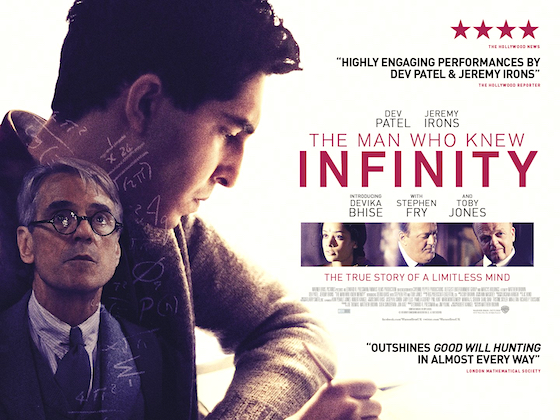
    Srinivasa Ramanujan (Dev Patel) is a man of boundless intelligence that even the poverty of his home in India cannot crush. His skill for mathematics attracts the attention of noted British professor G.H. Hardy (Jeremy Irons), who invites him to develop his computations at Trinity College, Cambridge. Ramanujan finds that his largely-intuitive mathematical theories clash with stringent academic requirements, just as his cultural values are challenged by the prejudices of 1910s Britain. With Ramanujan’s health in decline, the two men join in a mutual struggle that would define him as one of India’s greatest scholars. — adapted from IMDb

    Writer-director Matthew Brown takes this interesting true story and turns it into an ironically by-the-numbers biopic. Even with reliable actors like Patel and Irons headlining, there are some surprisingly stuff performances, and the film struggles to truly convey the genius or importance of the maths involved. Instead, it’s just lots of characters saying “OMG look at this stuff he thought up” and other characters saying “nah mate, it’s wrong” (except in the vernacular of 1910s Cambridge, of course). Alongside that, it doesn’t have many places to go with the story or characters, so it comes to feel repetitive as it goes round and round over the same points. Even the start of World War I has no genuine impact on events, factoring into the film only because that’s when these events actually happened, so Brown seems to feel it must be mentioned. Indeed, a lot of the film feels beholden to fact in this way, though I’m sure it must be doing the usual biopic thing of bending the truth.

    3 out of 5

    The Man Who Knew Too Much
    (1956)

    2019 #84
    Alfred Hitchcock | 120 mins | Blu-ray | 1.85:1 | USA / English | PG / PG

    The Man Who Knew Too Much

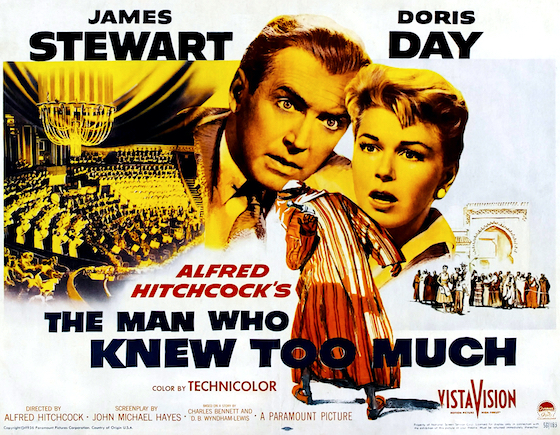
    Dr. Ben McKenna (James Stewart), his wife Jo (Doris Day), and their eight-year-old son Hank are on vacation in Morocco when they witness the public murder of a mysterious man who, before he dies, manages to reveal to Ben details of an assassination about to take place in London. The plotters kidnap Hank to keep the McKennas silent, so Ben and Jo return to London to take matters into their own hands. — adapted from IMDb

    Famously, this is the time Hitchcock remade himself: he’d previously filmed The Man Who Knew Too Much in 1934 while he was still working in Britain. Later, he’d compare the two by calling the original “the work of a talented amateur” while the remake “was made by a professional”, although he reportedly preferred the earlier version precisely because it wasn’t so polished.

    Undoubtedly, the 1956 Man Who Knew Too Much is not top-tier Hitchcock, but that doesn’t mean it’s without joys. Jimmy Stewart and Doris Day are perfectly cast as an ‘everyman’ American couple who accidentally get embroiled in international espionage, and Hitch could make such thrills work with his eyes closed. He’s also on top form during a sequence in the Albert Hall, a stunning set piece that lasts 12 minutes without a single word of dialogue, in which Hitch has the balls to just keep going through an entire piece of music, allowing the tension to almost build itself as he cuts around the room; even when Stewart finally turns up, we still don’t need exposition — we know exactly what’s happening.

    Although a key part of the film’s conclusion, it’s not the actual finale, which is a shame because the following plan to rescue Hank is a bit daft. And, when you think about it, the villains’ plot doesn’t make a whole lot of sense either. It’s stuff like that which gets in the way of The Man Who Knew Too Much being among Hitch’s very best work, but it remains a fine suspense thriller.

    4 out of 5

    The Man Who Shot Liberty Valance
    (1962)

    2020 #66
    John Ford | 118 mins | digital (HD) | 16:9 | USA / English | U

    The Man Who Shot Liberty Valance

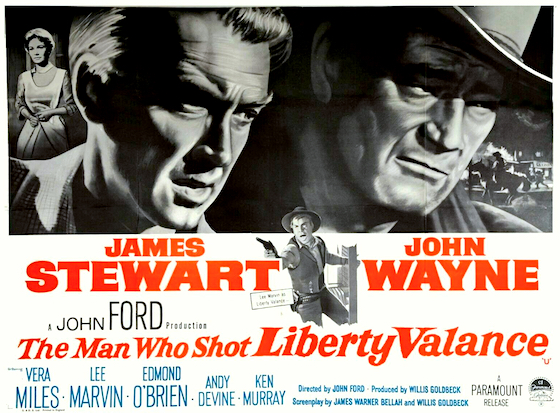
    When US Senator Ransom Stoddard (James Stewart) returns to the town of Shinbone to attend the funeral of his friend Tom Doniphon (John Wayne), a young reporter persuades him to tell the story of why he’s there. Flashback to a quarter-century-or-so earlier, when Ransom, a newly-qualified lawyer (still played, unconvincingly, by 53-year-old Stewart), arrived in Shinbone with a plan to bring law to the West. After Ransom receives a beating from local heavy Liberty Valance (Lee Marvin), he recuperates at the Ericsons’ restaurant, where he takes a job in their kitchen to repay their kindness. He develops an affection for their daughter, Hallie (Vera Miles), who’s also being wooed by young rancher Doniphon (still Wayne, also in his early 50s — it seems there was a good deal of movie star vanity in this casting). With local law enforcement refusing to do anything about Valance’s violent oppressive tactics, Ransom eventually takes it upon himself to face the villain down…

    Despite the violent promise of the title, Liberty Valance is very much a dramatic western rather than an action-packed one. Just shooting Valance isn’t the characters’ first recourse; indeed, the film on the whole is interested in the clash between the moral values of the old West and incoming modernity, and how the old ways can persist even as new ones come into force. That older Ransom is a senator is not incidental: a major part of the plot concerns Shinbone (or, rather, wherever it is) applying for statehood, and Ransom and Valance both standing to be a representative.

    All of which is fine, but unfortunately the dramatic focus seems to have resulted in the film being rather slow-going at times. The main plot is fine, but the telling could’ve been tighter — there’s a lot of stuff about Ransom washing dishes and teaching everyone to read and write. It establishes his place in town, sure, but it takes forever getting there. At the other end, Valance is actually shot a full 25 minutes before the end. There’s story to wrap up and twists to reveal, but it takes its sweet time doing it. None of which is distracting as the age-related issue I already referred to. I was genuinely puzzled why everyone kept talking about how young Ransom was, when Stewart patently isn’t, until I realised it was an example of good ol’ Hollywood vanity, where someone thought a star in his 50s could get away with playing a guy in his 20s.

    Despite that, however, Stewart and Wayne remain powerful screen presences, and the commentary on the changing face of the West — indeed, of the country as a whole — is indicative of a direction the genre continues to explore to this day (it’s what the whole of Deadwood is about, at its core).

    4 out of 5

    The Man Who Sleeps
    (1974)

    aka Un homme qui dort

    2020 #203
    Bernard Queysanne | 78 mins | digital (SD) | 4:3 | France & Tunisia / French

    The Man Who Sleeps

    When I watched this, it was ranked as one of the greatest films of all time by Letterboxd users. I did not feel the same — rather than Un homme qui dort, I found it more like Un homme qui t’endort. (That’s a joke I’m so pleased with, I’ve now used it four times.)

    At first it plays like a stereotype of French art house cinema: shot in black & white, it’s about a disaffected student, told with introspective voiceover narration, which philosophises at the level of a pretentious undergraduate, and nothing actually happens. But then I began to feel that, actually, it does a pretty good job of capturing how I’ve felt often in my life; especially back when I too was a pretentious undergraduate. But that feeling didn’t last much more than quarter-of-an-hour — and as the film is an hour and a quarter, that became a problem. As I slogged on through it, the interminable narration became repetitive; the musings less relatable. Just because warped minds exist doesn’t mean it’s worth our while to spend 78 minutes in their thoughts.

    The Man Who Sleeps is the kind of film that thinks it’s profound, but is actually pretentious. That may gel with the worldview of its undergrad subject, but, just as you wouldn’t want to listen to a real-life undergrad’s philosophising for over an hour, I don’t want to endure the same from a fictional one either. I guess it’s apt that a film titled “the man who sleeps” would be a good cure for insomnia.

    2 out of 5

    The Man Who Sleeps featured on my list of The Worst Films I Saw in 2020.

  • Zatoichi in Desperation (1972)

    aka Shin Zatôichi monogatari: Oreta tsue

    2020 #95
    Shintarô Katsu | 93 mins | Blu-ray | 2.35:1 | Japan / Japanese | 15

    Zatoichi in Desperation

    The 24th and penultimate film in the original Zatoichi series is also the first to be directed by star Shintarô Katsu. (He previously wrote the 21st film, Zatoichi Goes to the Fire Festival, and would later direct 22 episodes of the TV series and write & direct the 1989 revival movie.) Despite such fundamental creative control by the man who arguably knew the character best, Zatoichi in Desperation is widely regarded as one of the series’ worst instalments, and yet you’ll find some people full of praise for it. It’s one of the series’ darkest entries, and I suspect it’s unpopular overall because it’s so grim; but for those who do like it, they love it.

    The plot starts with Ichi accidentally causing a polite old woman to fall from a bridge and die — as I said, cheery. The woman was on her way to visit her daughter, Nishikigi (Kiwako Taichi), so Ichi seeks her out. She’s a prostitute, so, as recompense, Ichi sets about raising the funds to free her from prostitution. Meanwhile, 14-year-old Kaede (Kyoko Yoshizawa) is also employed at Nishikigi’s brothel, to earn money to care for her younger brother Shinkichi (Yasuhiro Koume); so when some out-of-town bigwig starts letching over her, well, you can guess what route she’s set to head down. Said bigwig is funding a move by gangsters to crush the local fishermen and set up some kind of modern fishing empire. Just the kind of ordinary folk vs yakuza fight that Ichi would normally find himself embroiled in…

    Except he’s busy with Nishikigi, and that doesn’t really change. This is the cornerstone of the film’s moral thesis, which seems to be that the world is a brutal and unjust place. While kind-hearted Ichi is busy helping Nikigiki out of a perhaps-misplaced sense of duty (she doesn’t seem fussed about her mum’s demise, nor with escaping the brothel), he’s missing the people who could really use his help, i.e. Kaede and Shinkichi, or the village’s oppressed fishermen.

    Kaede and Shinkichi

    And they really could use a hand, because it’s against them that the film’s brutality is fully manifested. The gangsters burn all the villagers’ boats, then murder them for complaining about it; and while Kaede’s busy preparing to have to sell her body at 14, Shinkichi provokes the gangsters and consequently gets brutally beaten to death; and when Kaede finds his body, she commits suicide — and all of that occurs without Ichi even being aware Kaede and Shinkichi exist. Makes you wonder: were events like that playing out just offscreen in every other Ichi movie? Well, not consciously, obviously, but perhaps Katsu is provoking us to wonder about all the people Ichi has failed down the years while he was distracted elsewhere. Maybe our hero is blind in more ways than one.

    Aside from the violence, this is also an uncommonly filthy film for the series. First Ichi overhears a whore talking about how taking ten men makes her wet; then he’s hiding in a room while a couple have sex; then later a bunch of yakuza round up a mentally ill kid and start wanking him off until he ejaculates on one of them, for which they give him a beating. Yep, that all happens on screen. (Nearly every review I’ve come across comments on that last scene. Well, no surprise, really — it’s rather striking.)

    Hopefully you’re beginning to understand why this movie is so divisive. But if the content wasn’t enough, Katsu seems determined to show off with form, too. His bold directorial style is evident from the off, when the old woman’s fall from the bridge is represented via an impressionistic barrage of flash-cut images. This is followed through the rest of the film by weirdly-framed close-ups and various odd angles. It doesn’t always pay off: the requisite gambling scene is a rehash of a trick from an earlier film, shot with a certain kind of dark tension (Ichi feels in genuine peril from those he swindled) that’s in-keeping with the film’s tone, but the trick itself is less entertainingly performed, the scene not as well paced and constructed. There’s also an atypical score by Kunihiko Murai, which some praise as being ’70s funk, but I thought sounded just like cheesy electronic nastiness. Sometimes his unusual choices emphasise the film’s glum tone, as in the opening credits, which play out in silence over black — not the usual mode for a Zatoichi film, and so it somewhat suggests the goal is to present this as a Serious Movie.

    Blind in more ways than one

    Certainly, many describe this as a more realistic version of Zatoichi than we’ve seen before. It’s removed from the superheroics of the other movies, instead offering a brutal portrait of real violence and how it scars, with innocents suffering unnoticed and even our hero failing to emerge unscathed. Whether that’s realist or just depressive might depend on your view of the world; although, considering the time and place these films are set, I imagine its closer to reality than all of the “Ichi saves everyone” narratives. That either/or extends to the film’s reception: everyone agrees that it’s nastier, darker, and closer to reality than the other Zatoichi films, but whether that’s merited — an interesting diversion — or a case of taking things too far — a low point for the series — is a matter of personal taste.

    Personally, then, I appreciate what it was going for, but I wonder if Katsu left it too long to go there. Coming so late in the series means we’re very familiar with the tropes it’s subverting, which is necessary — it works best as a counterpoint to what we’ve already seen rather than as a standalone piece — but it almost feels too late to go about such subversion — it’s a departure from the groove these films have worn for themselves. Maybe Katsu should’ve entrusted such a departure to a more sure-handed director; maybe it’s the roughness of his directorial voice that makes the film what it is.

    3 out of 5

    The Best of 2020

    And so, we reach the end of 2020.

    I don’t know about you, but this feels like a, “what, already?!” moment to me. Putting my year-in-review posts together used to seem to take ages, but this year it feels like I’ve barely begun and now it’s over. But that’s enough about my subjective perception of time — let’s talk about movies in 2020, like Tenet, which is partly about… um, never mind.

    This final year-in-review post does what it says on the tin: it’s a list of my favourite films that I saw in 2020 (normally my least-favourites would be here too, but I did those already). A note for newcomers and/or reminder to the forgetful: rather than just 2020 releases, I select my list from all 264 movies I saw for the first time during 2020. That’s partly because there are tonnes of new releases that I never see in time — which is also why this post contains a list of 50 significant films I missed.

    Compiling this year’s lists has taken a lot of thinking, rearranging, cutting, reflecting, re-adding, re-rearranging, and a certain amount of “oh, that’ll do, what does it matter anyway” to actually get them out the door. Here’s what I ended up with…


    The 26 Best Films I Saw For the First Time in 2020

    Since 2016, I’ve replaced the usual “top ten” with a “top 10%”. As I watched 264 films in 2020, that means this year’s list has 26 films. (If you think that’s too many, feel free to scroll down and start from wherever you like.)

    Although all the movies I watched for the first time in 2020 are eligible, I did watch 57 films that had their UK release in 2020, so I’ve noted the ‘2020 rank’ of the eight that made it in. (I also saw a couple of 2020-UK-release films at FilmBath Festival in 2019. As they were already ranked as 2019, I’ve not factored them in here.)

    26 Klaus

    The animation is absolutely gorgeous in this Oscar-nominated BAFTA-winning Netflix original about a disaffected postman who helps originate the legend of Santa.

    25 The Looking Glass War
    The mundanity of real-life espionage; conflicted morals; the futility of the whole thing — this John le Carré adaptation is full of all the things that made his work so great.

    24 Dial M for Murder

    As intelligent and tense a thriller as you’d expect from Hitchcock; so good it even manages to make you overlook its obvious stage-bound roots. Superb in 3D, too.

    23 The Invisible Man
    2020 #8 This #MeToo-era reimagining of the HG Wells / Universal Horror classic could hardly be more timely. But even leaving that aside, it’s a chilling exercise in ratcheting tension.

    From its astounding opening to its hard-hitting final act, Last Black Man is an astonishing cinematic experience about the stories we tell ourselves about ourselves. [Full review.]

    A space ship full of colonists is sent irretrievably off course in this Scandi sci-fi that’s driven by big ideas about human behaviour in extremis. [Full review.]

    William Holden and Audrey Hepburn are clearly having a whale of a time in this marvellously cine-literate ’60s romp about a struggling screenwriter. [Full review.]

    19 Philomena
    Judi Dench is extraordinary and Steve Coogan is a revelation in this intensely affecting drama about a wronged woman searching for her son who was taken decades earlier.

    18 Fanny and Alexander

    Ingmar Bergman described this as “the sum total of [his] life as a filmmaker”. Blending familial drama with a dash of magical realism and the supernatural, it’s a masterful work.

    17 Belladonna of Sadness
    Delicate watercolour artwork and medieval folklore smash against a storyline fuelled by rape and a penis-shaped devil in this astonishing animation full of psychedelic imagery and experimental music. I’ve never seen anything quite like it.

    2020 #7 It’s “Agatha Christie meets the Coen brothers in a nudist camp” as the eponymous handyman searches for his missing hammer in a world full of wobbly bits, where anyone might’ve taken it. [Full review.]

    15 Tenet
    2020 #6 If you let go of the need to fully understand the mechanics of the film’s time-reversal conceit, Christopher Nolan’s latest is an audacious and exciting spy thriller. It’s a shame real-world arguments have come to overshadow what is actually a suitably thrilling spectacle.

    14 Soul

    2020 #5 Pixar have often been praised for making films for grown-ups. That’s not something I’d wholly agree with, until now. Not as cutesy as the rest of their output (largely), Soul asks big questions about what makes us who we are. All wrapped up in a buddy-quest storyline, of course.

    Rian Johnson’s tribute to whodunnits a la Agatha Christie pulls off something that genre can’t always manage: rewatchability. It barely matters who actually dunnit when it’s this much fun spending time with the outrageous suspects and Daniel Craig’s implausibly-accented detective. [Full review.]

    12 The Old Dark House

    As amusing as a droll comedy and as atmospheric as a creepy old-school horror, James “director of Frankenstein” Whale’s genre classic is just a lot of fun.

    If this anime were live-action, it would be an action-adventure blockbuster. It’s got it all: thrills, humour, emotion, wonder… That makes it so accessible, it would be a perfect starting point for any Westerner new to anime. [Full review.]

    Taron Egerton stars as Elton John for this unusual biopic of the singer. Part traditional musician biopic, part jukebox musical, director Dexter Fletcher remixes John’s music into some imaginatively staged sequences, while Egerton and his supporting cast (in particular Jamie Bell) give thoughtful, nuanced performances. The cumulative effect is a movie that is highly enjoyable but not without depth. [Full review.]

    9
    The Lady Vanishes

    Alfred Hitchcock is probably most renowned for his Hollywood movies (Pyscho, Vertigo, Rear Window, etc), but we shouldn’t forget his British output — these are the films that got him Hollywood’s attention, after all. The director’s second appearance on this year’s list is one of the last films he made before that jump across the pond. It’s a mystery thriller about an old lady who somehow disappears from a moving train, and a couple of youngsters who try to find out how and why. It’s witty, it’s clever, and it’s exciting — all the things for which Hitch is best known.

    8
    Judgment at Nuremberg

    This fictionalised account of the military tribunals that took place following the Second World War sets its sights not on the trials of major Nazi leaders, but on the subsequent trials that assessed the guilt of people further down the chain — here, four judges and prosecutors who helped facilitate the Nazi’s crimes. For such weighty material, this is an appropriately weighty film — a long, complex, methodical, harrowing account. Boldly directed by Stanley Kramer, and with an incredible cast all giving first-rate performances, this remains a powerful, brilliant film.

    7
    Tim’s Vermeer

    Computer graphics pioneer and inventor Tim Jenison is an art enthusiast, fascinated by the work of Dutch master Johannes Vermeer, in whose work his engineer’s brain sees a near-impossible photographic accuracy. So, he sets out to prove and expound upon existing theories that Vermeer painted with the aid of some kind of optical device. What unfolds is an astonishing story of obsession, dedication, and art historiography, which challenges your idea of where the line lies between art and technology.

    2020 #4 Sam Mendes’s single-take(-kinda) World War One adventure ended up losing many of the big prizes to Parasite last awards season (FYI, they both count as 2020 films here due to UK release dates in January and February, respectively). But that doesn’t mean it’s any less of an extraordinary experience. I love a long single take (fake or not), and I love stories that unfold in real-time, and I feel World War One has been under-represented on screen — so when Mendes takes all of those things and executes them brilliantly (having Roger Deakins on cinematography helps), you get a film that’s right up my street. [Full review.]

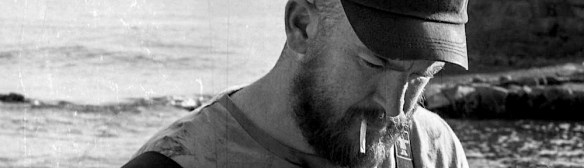
    If 1917 uses all the skills of modern tech to craft an almost old-fashioned epic, Bait is practically the polar opposite: old-school techniques (a wind-up camera; hand-developed 16mm film; post-sync sound) to tell a very modern story (broadly, about the economic plight of Cornish fishermen). It could be pretentiously arthouse or an insufferable polemic, but it’s neither. Instead, the story is told with genuine heart, drama, and humour, and the handmade aesthetic adds an appreciable, beautiful texture. [Full review.]

    4
    Parasite

    2020 #3 If you use Letterboxd, the latest film from acclaimed South Korean director Bong Joon Ho comes with a heavy millstone round its neck: according to that site’s users, it’s the greatest film ever made. Like Citizen Kane before it, such a label can be a distraction, and makes some people want to push back against it (is that why I’ve only ranked it at #4? You decide). “Best film ever” or not, the first non-English-language film to win the Best Picture Oscar is a timely deconstruction of class systems — just who are the eponymous parasites, actually? Even aside from big societal questions, it’s a thrilling piece of filmmaking; tense, exciting, and surprising.

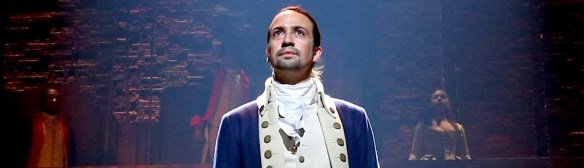
    2020 #2 Can a filmed stage production be the year’s best film? Um… Well, that’s a major reason why Hamilton is in 3rd place for my 2020 viewing and 2nd place for 2020 releases: it’s not really a film, right? Well, it’s definitely some kind of historical record — not of the life of Alexander Hamilton, but of a theatre production that took the world by storm. Here we get to witness the original Broadway cast in the show’s original staging, allowing us all the chance to witness a genuine cultural phenomenon first-hand. But this is not merely a couple of cameras plonked into the audience for the sake of posterity: director Thomas Kail users multiple cinematic techniques to make a film that truly feels like a film. Yes, it’s still theatrical, but it feels like this is how this story is meant to be (cf. something like Dogville: also very theatrical; also definitely a film). Theatres will reopen and we’ll be able to see Hamilton in the flesh again; and someday they’ll inevitably make a ‘real’ movie adaptation; and even still, this film will stand as a legitimate, magnificent experience in its own right. [Full review.]

    2020 #1 Writer-director Eliza Hittman’s story of a Pennsylvanian teenager forced to travel to New York for an abortion is told with documentary-like subtlety and understatement, but the result is incredibly moving and powerful. Without ever explicitly stating it, the film is an eloquent condemnation of US systems that force poor and struggling individuals to jump through hoops to access care that those of us in the rest of the developed world might consider basic rights. It’s a potent reminder that, for all its claims of being a highly-developed world-leader, for many of its citizens the US is as regressive, prejudiced, and unequal as the ‘Third World’ countries it so often seeks to demonise. [Full review.]

    1
    Do the Right Thing

    If there’s one feature that links many films on this year’s list, it’s timeliness: films that connect with some of the big sociopolitical issues of our day. Do the Right Thing was made over 30 years ago, but in its subject matter — a stiflingly hot day in a Brooklyn neighbourhood causes tensions to boil over into white-on-black violence — it could scarcely be more 2020. But this is not about “which film best encapsulates the year”, and so Spike Lee’s film tops my list because of all its other qualities, too. It’s a portrait of a place; a day-in-the-life hangout movie, where we follow myriad characters as they go about their business; 90-or-so minutes in which we get to understand the neighbourhood, to know its inhabitants… before the powder keg explodes and everything changes. Except, as we now know, nothing’s really changed at all.


    As usual, I’d just like to highlight a few other films.

    First, the cinematic masterpiece that is Love on a Leash. If you’re unfamiliar with this feat of cinematic excellence, may I recommend my review. It’s not exactly #27, because at various points while curating my list I had it in the top ten, the top twenty, in 26th place… but, eventually, not in the list at all. As I discussed in my review, it’s a film that’s hard to categorise: it’s simultaneously a one-star disaster and a five-star artistic experience. It’s an object lesson in why criticism of art can never be objective, because it’s unquestionable that it’s terribly made in every respect, and yet it’s nonstop entertaining, even thought-provoking, and certainly unique. (Of course, some people would say it’s objectively bad. Those people are wrong.)

    I’m someone who believes “best” and “favourite” can be different things: in 2020, I saw some movies I would acknowledge as great but that didn’t make the Top 26 because they didn’t really entertain me; equally, some films got in that are indeed great but I may never rewatch, whereas I left out simpler fare that I’m sure I’ll revisit. In a ranking of the “best” films I saw this year, no way does Love on a Leash get close; but in terms of my “favourite” films, it might’ve been pretty damn high. My final Top 26 falls somewhere between those two stools, but does carry the “best of” name, and so it felt insulting to any other film in the list (or, indeed, to those that tried but failed to squeeze in) to rank Love on a Leash above them. So here it is instead: first among my “honourable mentions”, with two solid paragraphs dedicated to it — more than any film in the actual list. So who’s the real winner, eh?

    Next, let’s recap the 12 films that won Favourite Film of the Month at the Arbies, some of which have already been mentioned and some of which haven’t. In chronological order, with links to the relevant awards, they were Laputa: Castle in the Sky, All Quiet on the Western Front, The Lady Vanishes, Aniara, Belladonna of Sadness, Paris When It Sizzles, Hamilton, Bad Boys for Life, Fanny and Alexander, Tim’s Vermeer, An American Werewolf in London, and Klaus.

    Finally, I always list every film that earned a 5-star rating this year. It’s especially pertinent this year, given how few reviews I’ve actually posted; although, as I noted in my stats post, it’s possible some of these ratings will be revised when I come to write a full review. But, for now, the 39 films with full marks are 1917, All About Eve, All Quiet on the Western Front, An American Werewolf in London, Anand, Aniara, Bait, Belladonna of Sadness, Dial M for Murder, Do the Right Thing, E.T. the Extra-Terrestrial, Fanny and Alexander, The French Connection, Hamilton, Harakiri, I Am a Fugitive from a Chain Gang, In the Mood for Love, The Invisible Guest, Judgment at Nuremberg, Knives Out, Lady Bird, The Lady Vanishes, Laputa: Castle in the Sky, The Last Black Man in San Francisco, Little Women, The Looking Glass War, Love on a Leash, The Lunchbox, A Man for All Seasons, Man on Wire, Marriage Story, Never Rarely Sometimes Always, Parasite, Paris When It Sizzles, Philomena, Rocketman, Safety Last!, Soul, and Tim’s Vermeer. Plus, this year I also gave five stars to Mission: Impossible – Fallout in 3D, and (earmarked for the ‘Guide To’ treatment at some point) Tim Burton’s Batman and Monty Python’s Life of Brian. There were also several short films that merited the accolade, namely Flush Lou, The Last Video Store, The Monkeys on Our Backs, and The Starey Bampire.


    It may have felt like 2020 was a year bereft of movies, as blockbuster after blockbuster got kicked into 2021, but plenty of stuff still came out — both major releases that took the streaming plunge, and smaller titles that probably wouldn’t’ve seen huge theatrical box office anyway; not to mention stuff that’s going to count as 2020 due to festival screenings but won’t really be released anywhere until 2021; and, of course, all the streamers’ own original movies.

    Even though I did watch 57 movies that had a UK release in 2020, there were a considerable number I missed. So, as always, here’s an alphabetical list of 50 films from 2020 that I’ve not yet seen. (I normally use IMDb’s dating to decide what’s eligible for inclusion, but I’ve allowed a handful that are listed as 2019 only because of festival screenings.) These have been chosen for a variety of reasons, from box office success to critical acclaim via simple notoriety. There are many more I want to see that I could have included, but I always attempt to feature a spread of styles and genres, successes and failures.

    Another Round
    Da 5 Bloods
    The Hunt
    The New Mutants
    Promising Young Woman
    WolfWalkers
    Bill & Ted Face the Music
    The Eight Hundred
    I'm Thinking of Ending Things
    Nomadland
    Rebecca
    Wonder Woman 1984
    An American Pickle
    Ammonite
    Another Round
    Artemis Fowl
    Bill & Ted Face the Music
    The Call of the Wild
    Da 5 Bloods
    David Byrne’s American Utopia
    The Devil All the Time
    Dolittle
    The Eight Hundred
    The Father
    The Gentlemen
    The Half of It
    Happiest Season
    Hillbilly Elegy
    Host
    The Hunt
    I’m Thinking of Ending Things
    Kajillionaire
    The King of Staten Island
    Ma Rainey’s Black Bottom
    Mank
    The Midnight Sky
    Military Wives
    Minari
    Miss Juneteenth
    Mulan
    My Spy
    The New Mutants
    News of the World
    Nomadland
    One Night in Miami…
    Onward
    Peninsula
    Possessor
    Promising Young Woman
    Rebecca
    Saint Maud
    Scoob!
    The Secret Garden
    Shirley
    The Social Dilemma
    Sonic the Hedgehog
    Supernova
    The Trial of the Chicago 7
    True History of the Kelly Gang
    The Witches
    WolfWalkers
    Wonder Woman 1984


    And that is 2020 over and done with — hurrah!

    Ignoring for a moment all the news that’s currently telling us how 2021 will be just as bad, if not worse, one thing to look forward to is that it’s my 15th year writing this blog. 15 years! I feel old… The actual date of the blog’s 15th birthday is at the end of February 2022, so I’ve got a little time yet to prepare some kind of celebration.

    In the meantime, let’s watch some more films…