The Navigator: A Medieval Odyssey (1988)

2018 #162
Vincent Ward | 92 mins | Blu-ray | 1.85:1 | Australia & New Zealand / English | 12* / PG

The Navigator: A Medieval Odyssey

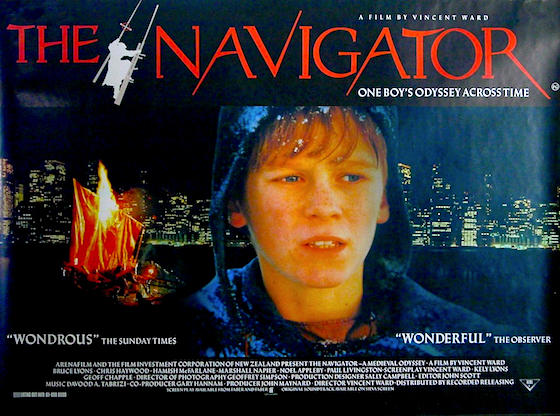
1348: the Black Death is sweeping across Europe. A remote mining village in Cumbria is yet to be afflicted, but they fear the disease is close at hand. When young Griffin (Hamish McFarlane) reveals he’s been having visions of a quest to a great cathedral, they decide this is their best hope for salvation: a band of brave men will follow Griffin’s vision and make an offering to God so he will protect the village. The journey begins by travelling down a pit so deep it’s rumoured to lead to the other side of the world. As they emerge, they’ve unwittingly travelled not only across the world, but also forward in time some 640 years, to New Zealand, 1988.

If that sounds like an adventure movie but also a bit, well, weird, then you’ve probably got a handle on The Navigator already. It’s a men-on-a-mission time travel adventure quest filtered through an arthouse sensibility — writer-director Vincent Ward trained at a school of fine art, intending to become a sculptor and painter, before getting sidetracked into moviemaking; and he’d previously helmed the first New Zealand film to screen in competition at Cannes, Vigil. (I didn’t realise until after viewing that he’d gone on to direct What Dreams May Come and also did a lot of development on Alien³ (the “wooden planet populated by monks” version), but once you know that, the aesthetic similarities seem obvious.) The Navigator has thus been likened to the work of Werner Herzog and Terrence Malick, but also Terry Gilliam.

So, on the one hand, it can play as a straightforward heroic quest, but the sometimes slow pace and occasional presence of symbolism suggest, on the other, a film with greater depths. Primarily, I think, this is the way the villagers’ fear of the plague is reflected by our modern-day fears — or, as the film’s press book rather nicely puts it, in the present day the adventurers are “surrounded by echoes of the fear which haunted medieval England”. So, for example, their journey is disrupted by the rise of a monolithic submarine, presumably a nuclear one; the issue of nuclear deterrence is also brought up on a TV broadcast; and that’s followed by a famous Australian AIDS commercial, perhaps the most obvious mirror of the plague there could be for an ’80s movie.

Plagued by the, er, plague

It’s also a somewhat spiritual film, though not in a heavy-handed, pro-religion kind of way. After all, the men are on a quest to seek protection from God, and the climax revolves around placing a spire atop a church. Naturally, the reliance of medieval folk on their belief in God is counterposed with the modern world’s disregard for such values — though, again, the comparison isn’t made in too forceful a manner. For example, when they first arrive in the present they look out over the city to find the cathedral, because a church is always the tallest building, but, to their confusion, they can’t see it because of all the skyscrapers. The point is subtly put: we worship different gods today.

But aside from all these nods to philosophising, the film does work as an adventure movie, with certain sequences relying on the gang overcoming obstacles rather than musing on the state of the world. Standout set pieces include crossing a four-lane motorway (it was Ward trying to do exactly that in Germany that first gave him the idea for the film!), and the climax atop the church, which — between John Scott’s superb editing and Griffin’s premonition that one of them will die there — is as suspenseful a finale as you could ask for. Scott’s editing also shines in the sequences depicting Griffin’s visions, which become cleverly sprinkled in so that at times you’re wrong-footed about whether what you’re seeing is happening or another premonition. Although the film never chooses to play this for a big twist, it keeps things dynamic.

The real star from the crew, however, is probably cinematographer Geoff Simpson. The entire movie is gorgeously shot in a couple of styles: the medieval stuff is presented in high-contrast black & white, which combines with the snowbound setting to create a stark, gritty beauty; then the present day stuff is in colour, mostly lit in rich oranges and blues so that it feels almost opulent, with the choice of colours drawing inspiration from medieval art. Ward’s reasoning for this delineation was to emphasise how striking the modern world would feel to someone coming from the grimness of the plague years, and it works. A word too for composer Davood A. Tabrizi, an Iranian émigré here charged with writing Celtic-esque music. Inspiration was taken from genuine ethnic music that was specially researched in Britain, Italy, New Zealand, and Australia, and the score was performed entirely with traditional instruments. The resulting folksy sound is wholly fitting and very atmospheric.
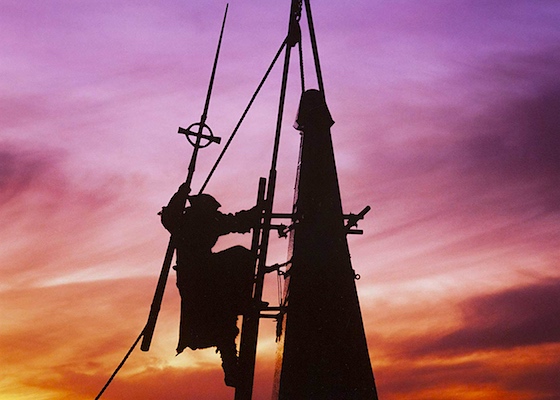
Steeple chase

The film doesn’t devote much time to fleshing out the characters of its band of heroes, but they’re succinctly delineated nonetheless. Standouts include Bruce Lyons as Connor, Griffin’s admired older brother, an experienced adventurer, but that also leaves him prone to thinking he knows best; and Marshall Napier as Searle, a likeable but pragmatic and sceptical man, with a tragic backstory. Young Hamish McFarlane also acquits himself well as Griffin, a young lad whose unexplained gift leaves him with the weight of the world on his shoulders, but a determination to live up to what’s needed of him. (Incidentally, although he did act a couple more times, during filming of The Navigator McFarlane apparently became fascinated by the process of filmmaking, and he’s gone on to have a career behind the scenes — his most recent credits as first AD include episodes of Ash vs Evil Dead, Supergirl, and forthcoming giant shark movie The Meg).

All of the above mixes together to create a film that both has familiar elements, but also feels strangely unique. It’s at once a straightforward heroic quest, with sequences of adventure, tension, and humour, and also a thoughtful, spiritual, philosophical musing on communal fears, how we deal with them, and how they resurface. Or, you know, something. It’s a marvellously idiosyncratic film in that regard, and while I wouldn’t say I loved it, it’s an experience I’d definitely take again.

4 out of 5

The Navigator is released on Blu-ray this week by Arrow Video in both the UK and US.

* It used to be rated PG in the UK too, until Arrow had it reclassified for the Blu-ray. The higher certificate is due to a man stuck on a speeding train, a boy climbing a church spire, and the “unsettling” psychic visions. Frankly, it strikes me as needlessly excessive — the PG was fine. ^
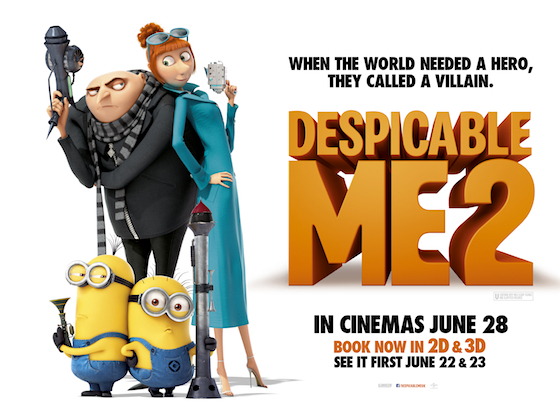
Despicable Me 2 (2013)

2018 #155
Pierre Coffin & Chris Renaud | 98 mins | download (HD+3D) | 1.85:1 | USA, France & Japan / English | U / PG

Despicable Me 2

In this sequel to the popular animated comedy (which I wasn’t that fond of, personally), supervillain turned adoptive dad Gru (Steve Carell) is dragged back into his old world when the Anti-Villain League recruit him in order to track down the villain who stole a dangerous serum. Meanwhile, Gru’s daughters think he needs a girlfriend, and the AVL agent assigned as his partner, Lucy Wilde (Kristen Wiig), seems the perfect fit. Also, his yellow Minions are still around, getting up to all sorts of ker-azy antics.

That’s the concise version, anyhow. This is a film that rambles around a lot in the telling, presumably out of fear that it might ever become boring to hyperactive youngsters. Unfortunately, it almost had the opposite effect on me. The main plot just felt like a shape on which to hang the romantic and Minion subplots, but those subplots just felt like a constant distraction from the main plot. The end result is a film that’s narratively unsatisfying on all fronts.

So. Many. Minions.

Instead, entertainment value comes from individual scenes or moments. Personal preference will dictate just how entertaining those are, however. I didn’t feel there was much consistency, with the humour able to spin on a dime from being pretty amusing to falling flat. It doesn’t help that it feels way too long, overloaded with subplots that don’t go anywhere meaningful and the Minions’ sketch-like shenanigans. And there’s a lot of the Minions, clearly the breakout stars of the first movie (and hence why the series’ next film was entirely centred around them). While they amuse me on occasions, I mostly find them annoying, and am slightly baffled that anyone over the age of about six can find them significantly amusing.

But it looks pretty great in 3D, at least — turns out Gru’s long pointy nose was made for the format — and it’s quite funny and imaginative in places. Still, a good trim would’ve benefitted it enormously. Unless you do really enjoy the Minions, I guess.

3 out of 5

The UK network TV premiere of spin-off Minions is on ITV today at 6:15pm.

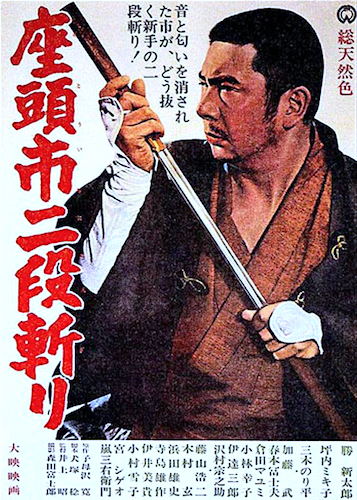
Zatoichi’s Revenge (1965)

aka Zatôichi nidan-giri

2018 #135
Akira Inoue | 84 mins | Blu-ray | 2.35:1 | Japan / Japanese

Zatoichi's Revenge

In the series’ tenth instalment, our favourite blind masseur-cum-master swordsman, Zatoichi, arrives back at the village where he was trained as a masseur, and decides to pop in to see his old sensei, Hikonoichi. Much to his dismay, Ichi discovers that Hikonoichi was slain by an unknown murderer some months ago, and his daughter has been sold into prostitution to repay his debts. She’s not the only one, though: the local gang boss has basically tricked everyone he can into giving their daughters to his brothel, mainly so the corrupt magistrate has a supply of virgins to deflower. It’ll come as a surprise to no one that they had a hand in Hikonoichi’s murder too. Naturally, Ichi is not impressed by any of this, and his revenge is twofold: for his old master they callously murdered, and for what they’ve tried to do to his daughter since.

Said revenge is more than the series’ usual slashathon, though that does come in the end. First, though, Ichi methodically and coldly humiliates the cowardly villains, which is no less than they deserve. When they manage to give Ichi the slip and put their army of goons in front of him, he kills as many as he must to get back to the bosses. Then, he escorts the villainous pair in front of their victims… before wordlessly cutting them down. Revenge indeed.

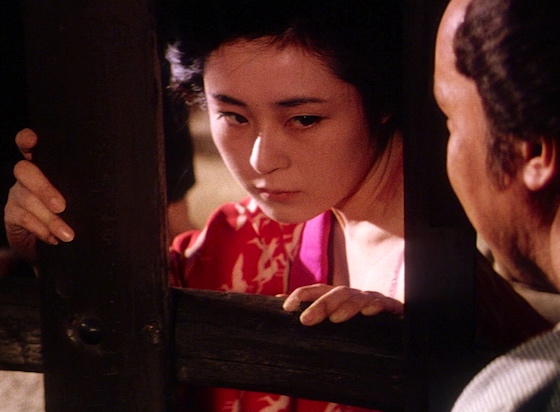
Caged girl

As all the above should make clear, it’s a very dark film thematically. There’s some of the usual comedy sprinkled in now and then, almost as a respite from the seriousness of the main plot. Ichi gets up to some of his other regular antics as well, such as exposing a cheating dice game. This one’s a bit different, however, as he’s already befriended the dice roller, Denroku “the Weasel”. It’s a nice twist on the usual format to have Ichi being chummy with the guy he’d usually expose, and Denroku has a bigger role to play than just that, almost becoming Ichi’s sidekick at times. He’s just one of a strong supporting cast, another standout of which is Denroku’s cheery young daughter, Otsuru, one of the few people who gets one over on Ichi (however briefly).

Director Akira Inoue makes his series debut (it’s the only one he did, though he later helmed six episodes of the TV series), and he makes a mark. It’s a classily directed instalment, but with some visual exuberance (overexposed-looking flashbacks; wild handheld camerawork when a good inspector searches the bad magistrate’s office), as well as some other scenes that are more simply but nicely staged (like when Ichi and Otsuru are suddenly attacked from behind and Ichi cuts down the assailant without even looking).

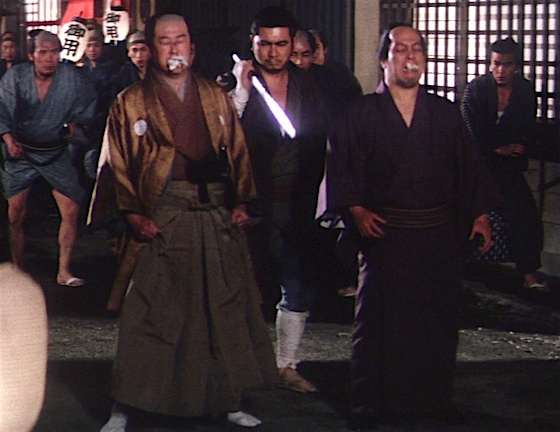
A dicey situation

Revenge isn’t perfect: there’s a “seen it all before” aspect to Ichi being surrounded by dozens of faceless goons who he proceeds to slaughter while trying to get to his real target, not to mention the series’ other repeated scenes and plot points. This aspect hasn’t gone unnoticed by other reviewers: J. Doyle Willis at DVD Talk accuses it of having “dips where the formula is a bit too tired and predictable”, though notes that “the obviousness of similarity/repetition strikes you more if, like me, you were watching the films back to back.” Paghat the Ratgirl puts it thus: “we have to decide if on the given day it all seems like the same Ichi film we’ve already seen time & again, or if every variation of the same story isn’t as satisfying as any other sort of ritual event.” Ritual event is quite a good way of describing it, I think. Remember, these films were made in an era before home video, so you couldn’t just watch the previous ones again on DVD. Therefore I would guess it’s probably quite deliberate that it repeats some of the same tropes and scenes — it’s a conscious “you know what you’re getting” device. Other series, like Bond, do the same thing. It’s part of the joy for fans to tick off the expected elements.

(Incidentally, for some reason this particular film seems to have inspired some particularly good writing about the series as a whole (perhaps because it’s the tenth movie). The pieces from Weird Wild Realm and Quiet Bubble are worth a read for their general view of the whole series as much as for their opinions on this particular instalment.)

A dish best served cold

Repetitious or not, there’s a lot of really great stuff in Zatoichi’s Revenge to mark it out as another superb entry in the series. I feel like I say something along those lines in almost every review, but the series is on a real winning streak at this point — by example: I’ve placed the last five films from #2 to #6 on my running ranking (with the first film seemingly unassailable as the series’ best). Long may it continue… though if Letterboxd users’ rankings are anything to go by, the next film is where the bubble bursts.

4 out of 5

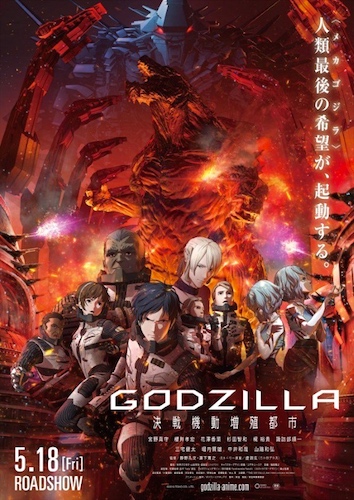
Godzilla: City on the Edge of Battle (2018)

aka Gojira: Kessen Kidō Zōshoku Toshi

2018 #156
Hiroyuki Seshita & Kôbun Shizuno | 101 mins | streaming (HD) | 16:9 | Japan / English | PG

Godzilla: City on the Edge of Battle

The 31st official Godzilla film from Japan’s Toho studio is the second part of their anime trilogy. Released theatrically in Japan, it’s a Netflix exclusive in the rest of the world — which is probably for the best, because it means we don’t have to pay money specifically for this shite.

Picking up where the previous film left off, City of the Edge of Battle is set on Earth 20,000 years in the future, where a 300-metre-tall Godzilla (the largest ever, fact fans) rules the planet. I could go into the rest of the backstory, but we’ll be here for a paragraph or two — you can either watch the first film or, better yet, save yourself a couple of hours and just don’t bother with any of it. But anyway: in this instalment, the party that have landed on Earth to defeat Godzilla discover a tribe of humans (or, possibly, just a human-like species) who have somehow survived Godzilla’s reign. They in turn lead them to the remains of Mechagodzilla, a failed project by alien chums to help defeat Godzilla. Left alone for 20 millennia, the mech’s “nanometal” has grown into an entire city, which they now hope to use to defeat Godzilla.

There are some neat sci-fi ideas in this trilogy — aside from the Battlestar Galactica-esque stuff I talked about last time, there’s some interesting notions about how the planet might’ve changed and evolved over 20,000 years without us, and a city that’s grown itself has potential — but promising concepts alone are not enough to overcome the clunky dialogue, dull visuals, unmemorable characters, turgid philosophising, and sauntering plot. And if you’re here for the eponymous big guy, once again he doesn’t even get involved until over an hour in, just in time for the final big action sequence. That’s so badly done, it requires constant narration from the human command centre to explain what’s supposed to be going on. It would make as much sense as an audio drama as it does as a film.

Look, Godzilla is in this film! (Eventually.)

Another way this second film suffers is that many actions are built on motivations that were established and explained in the first film, but which aren’t restated here — and they were easy to miss in the first one anyway, because it was overloaded with exposition and jargon. It should be no surprise that this sequel is no better in that regard, justifying my decision to watch it in English this time. It did seem weird to switch language part way through a trilogy, but it’s not like any of the characters were memorable enough that I associated their voices with them, so why not? Well, I always feel I should watch anime in its original Japanese, for purism’s sake, but English is just easier — especially when the amount of made-up jargon flying around made the first film something of a chore to read.

I didn’t really enjoy the first film, but generously gave it 3 stars on the basis that it wasn’t completely terrible and had some ideas with potential. This sequel squanders most of that. I still like the mythology they’ve loaded into this universe — the conflicting ideologies of the different species on the spaceship; the situation on Earth when they return (the human-like tribe; the self-built city-with-a-brain) — but it’s all bungled in the execution, coming out as gloop that is, at best, barely intelligible, and, at worst, flat out boring. And if there wasn’t already more than enough backstory, mystery, and potential conflict to be going on with (which there was), City on the Edge of Battle throws a ton more into the mix. But hey, maybe the third film will actually generate some excitement if it has to rush to wrap all that up?

2 out of 5

Godzilla: City on the Edge of Battle is available on Netflix now. The final film is scheduled for release in Japan in November, and worldwide in early 2019.

If You Meet Sartana… Pray for Your Death (1968)

aka Se incontri Sartana prega per la tua morte / Sartana

2018 #143
Gianfranco Parolini
(as Frank Kramer) | 96 mins | Blu-ray | 1.85:1 | Italy, France & West Germany / English | 15

If You Meet Sartana… Pray for Your Death

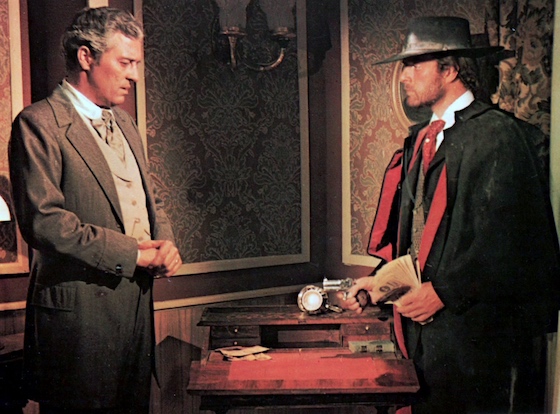
Arrow Video have a way of tempting me to buy films I never knew I wanted, often because I’ve never even heard of them before Arrow’s release is announced. The latest such purchase is a box set of Spaghetti Westerns starring the character Sartana, which collects all five of the ‘official’ movies (as with other popular Spaghetti Western characters, like Django, many unofficial sequels were produced), all of which have amusingly verbose titles in the same vein as this one — which, I must confess, was half of what convinced me the aforementioned purchase was necessary. The other was how the eponymous hero is described in the set’s blurb:

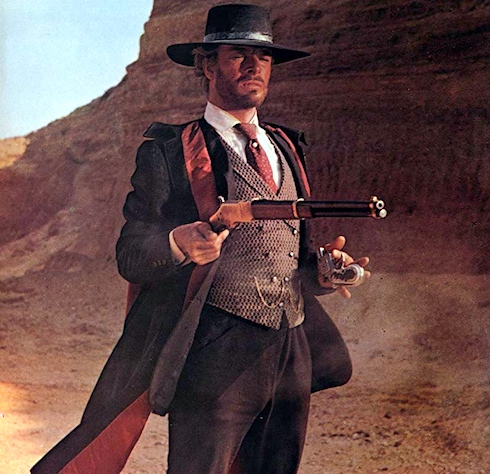
a mysterious figure, he has a spectral quality, aided by his Count Dracula-like cloak which also nods towards comic strip figure Mandrake the Magician, with whom he shares a penchant for card tricks. He takes pride in his appearance unlike Eastwood’s dusty wanderer or Nero’s mud-caked drifter. And there’s a dose of James Bond too in his fondness for gadgetry and the droll sense of humour.

This first movie only hints at that persona, because it’s busy being occupied with two other things: delivering as much action as it possibly can (there are shoot-outs galore, leading to a phenomenal body count), and an overly complicated plot, both of which are rolled out at a breakneck pace. The story has something to do with an insurance scam by a provincial bank, which involves having their gold stolen by some Mexicans, then re-stolen by some bandits. Quite why it needed to be stolen twice I couldn’t figure out.

“Give me your money!” “You're, er, already holding it...”

The same goes for why everyone seems immensely concerned about where the original money is, rather than waiting for the insurance payout, which is surely the primary point of such a scam. Okay, you would need both sets of dough to turn a profit, but everyone just seems to want to make off with the original loot. Unless I misunderstood something, which I might have, because goodness knows what’s going on half the time — there’s plenty of to-ing and fro-ing of allegiances, which is equally as baffling. It gets particularly ludicrous in the final fifteen minutes, when everyone keeps double-crossing everyone else until only Sartana and one villain are left standing, ready for the final duel.

Is the “story” just a big ol’ excuse for plenty of shoot-outs and horseback chases? Quite possibly. At least much of the action is rather good — well staged, with the occasional neat idea on display. The whole film looks pretty nice, too. The print used for the Blu-ray is a bit ropey, with some spots of very bad damage, but I presume it must’ve been the best available. Nonetheless, the film underneath those issues is quite well shot. There are splashes of humour (deliberate or otherwise, like the Mexican leader who insists on calling himself Excellentisimo Señor Jose Manuel Francisco Mendoza Montezuma de la Plata Perez Rodriguez, aka El Tampico), and some stylistic flourishes as well. Particular highlights including the use of a pocket-watch’s tune to scare one of the villains, and Sartana’s favoured gun, a little four-barrelled pistol that he seems to be able to draw as if by magic, which gets even cooler when it reveals a hidden trick at the climax.

Sartana, the classy bandit

Sartana himself delivers on the promise of the blurb: in contrast to the rough, dusty Spaghetti Western heroes we’re used to, he cuts quite the dash, smartly dressed in a black suit replete with red-lined cape. He may be an out-for-himself money-centric gunslinger just like the rest, but he’s also a cardsharp for variety, which is revealed in a fun sequence when he joins a poker game shortly after arriving in town. Him pulling a fast one on the other players leads to a stand-off and shoot-out, because what doesn’t in this movie?

In his chatty audio commentary, fan and expert Mike Siegel acknowledges that the plot is incoherent and, for that reason, it’s not his favourite film of the series. I found that rather heartening to hear, because by the end of this first film I was beginning to wonder if I’d let myself in for a less-than-satisfactory time with this acquisition. Not that If You Meet Sartana is a bad movie, so long as you focus in the right places: the action is suitably exciting, even as its undermined by the frustrations of a confusing storyline.

3 out of 5

Rocky III (1982)

2018 #138
Sylvester Stallone | 100 mins | Blu-ray | 1.85:1 | USA / English | PG / PG

Rocky III

It’s the
eye of the tiger, it’s the thrill of the fight
Risin’ up to the challenge of our rival
And the last known survivor stalks his prey in the night
And he’s watchin’ us all with the eeeeyyyyeeee…

of the tiger.

Sorry, got swept up in the moment there!

Yes, this is the Rocky movie where that song, so associated with the franchise, finally makes its appearance. It’s also where the sequels are believed to start going down hill (assuming you rate Rocky II, anyway), though Stallone himself was once asked to score the films and gave this 9 out of 10. I don’t know if I’d go that far, but I liked it.

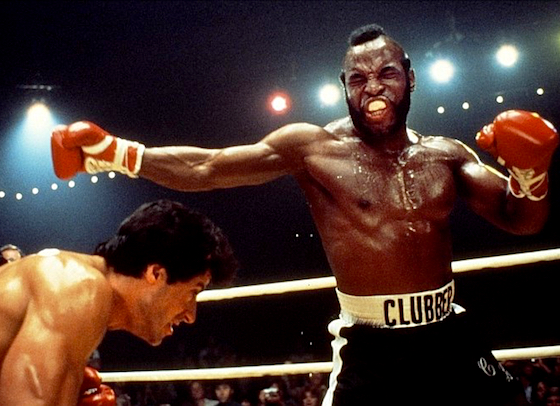
Picking up on Rocky II’s cue, this film also begins where the last one left off — in this case, that’s with Rocky just about beating Apollo Creed in their rematch. We’re then led through the next few years of Rocky’s life via an excellent five-minute montage, which shows his continued success and massive fame, and, simultaneously, the rise of Clubber Lang (played by Mr. T) through the boxing ranks, with one goal: beating Balboa. All of that’s conveyed with just images soundtracked to Eye of the Tiger. It’s a great bit of filmmaking — conveying story economically and clearly through pure imagery — a level of artistry and accomplishment you don’t expect to encounter in the third movie in a boxing franchise.

Rocky and Apollo training

So, after all that success, Rocky is set to retire, until Lang goads him into one more bout. What Rocky doesn’t know is that his trainer, Mickey (Burgess Meredith), has been protecting him, only arranging soft fights he thinks Rocky can win; but Lang is a real force, one Mickey doesn’t think Rocky is up to fighting. Determined to prove his worth in the ring, Rocky goes ahead anyway, but, with distractions from his personal life weighing down, he loses badly. A rematch seems off the cards, until an offer of help comes from an unlikely source: Rocky’s erstwhile nemesis, Apollo Creed (Carl Weathers).

Rocky III is much more action orientated than the first two films. Those were almost social dramas that happen to be about someone who boxes, while this is a sports movie through and through. Stallone once confessed he’d run out of ideas after the first two films, which is why this and Rocky IV focus so much on the fights and training. It’s odd he should say that, because there’s definitely something here about how fame has changed Rocky’s life. It’s more something that’s alluded to rather than being examined by the story — used as background and ‘dressing’ rather than being central to the narrative — but it suggests that, if Stallone had really wanted to add a different dimension to the film, there was a storyline staring him in the face.

It feels appropriate that this was the first Rocky released in the ’80s: our down-and-out coulda-been-a-contender hero is now rich, dressing smart, living in a big house with a nice lifestyle. The whole thing feels like it’s left behind gritty realism for slick aspirational success. But it’s not a completely empty experience, generating emotional attachment from Rocky’s relationships — not only with his wife and young son, but also Mickey and, to a somewhat lesser extent, Apollo Creed. Plus the action and montages are slick and exciting, making this perhaps the most adrenally satisfying of the series to date.

Taking a Clubbering

It’s also quite smart to reposition Rocky as an underdog, make him need his hunger again — there’s not much satisfaction in watching the story of how the best in the world beats someone who isn’t the best! Our hero needs to be challenged, and the film definitely gives him that. That’s the same as the preceding movies, but what’s different here is that it’s a purely sporting challenge, rather than a life one. There are developments in Rocky’s personal life that have a big effect on him, sure, but they’re intrinsically tied to the sporting aspect.

If the first two films are a mirror image of each other, this is something different. It lacks the grit or depth of those two, but still entertains, albeit in a somewhat more superficial way. Giving it a title-mirroring three stars feels a bit harsh, because I did rather enjoy it, but its straightforward focus on the action in the ring means it’s not on the same level as the first two. That said, I’d wager it’s the most effortlessly rewatchable Rocky so far.

3 out of 5

Paddington 2 (2017)

2018 #58
Paul King | 103 mins | streaming (UHD) | 2.35:1 | UK & France / English | PG / PG

Paddington 2

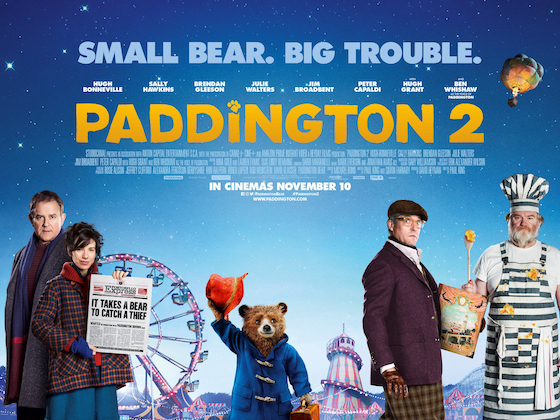
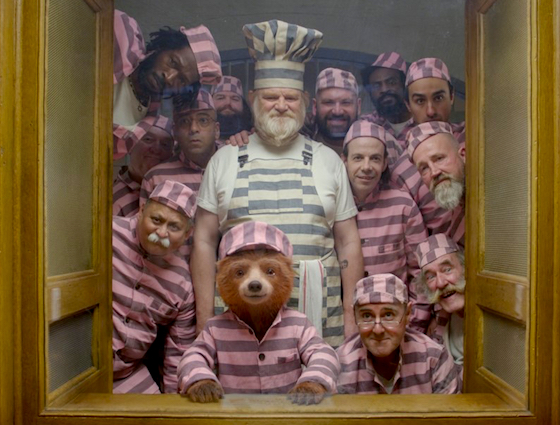
Famous for its untarnished 100% Rotten Tomatoes score after almost 200 reviews (the best critical record of any film ever), Paddington 2 consequently comes with an awful lot of hype attached — perhaps too much for a movie that is, at heart, just a kind-hearted bit of fun about a marmalade-loving bear. But then, in our current climate, such a film is less barely necessary (unlike many sequels) and more a bear necessity.

Said bear (voiced by Ben Whishaw) wants to buy a unique, and consequently expensive, pop-up book for his Aunt Lucy’s 100th birthday. When the book is stolen by failed actor Phoenix Buchanan (Hugh Grant), he manages to frame Paddington, who is consequently sent to prison. His adoptive family (Hugh Bonneville, Sally Hawkins, et al) set out to prove his innocence, while Paddington makes the most of his jail time by making friends and livening the place up.

The film’s joy lies less in the facts of the storyline and more in the emotions it inspires. The whole thing has clearly been crafted with a lot of love, inventiveness, generosity, and a good-hearted outlook on life, which comes across from all the characters and their actions, making for a resolutely charming and feel-good film that’s beautifully made. Of course, the first one had a lot of those elements too, but they’ve managed that rare thing of striking gold twice. One thing the first movie didn’t have is Hugh Grant, who proves he’s more than just a stuttering romcom lead with a superbly witty turn as the film’s villain. HIs BAFTA nomination wasn’t as silly as it perhaps sounded.

Friendly criminals

But while there’s nothing bad about Paddington 2, and an awful lot to like, I feel like my expectations for its absolute perfectness were set too high. I feel like I should be giving it 5 stars just because of how lovely everyone else said it was — and it was lovely, but 5 stars lovely? I’m not sure. I did like it a lot — it’s funny, clever, sweet, and good-natured — but I wasn’t bowled over in the way I’d been led to believe I would be. Maybe I would’ve been if I’d seen it before all the hype? That element of almost-disappointment means I can’t give it full marks, but it’s still a film I’d definitely recommend, especially if you’re after something thoroughly nice, or that’s both suitable for and entertaining to the entire family. I look forward to watching it again sometime and refining my opinion. Maybe in a double-bill with the first film, which I’m currently tempted to say was slightly better.

4 out of 5

Paddington 2 is available to stream on Amazon Prime Video UK as of yesterday.

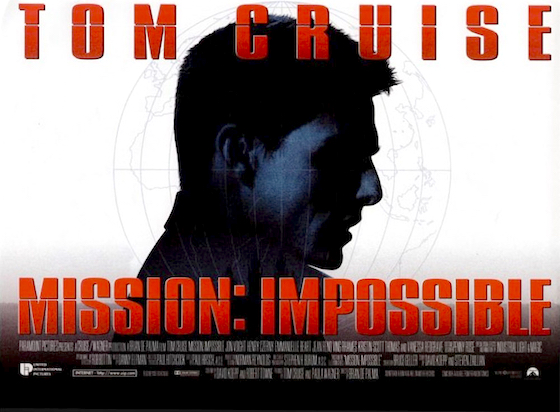
Mission: Impossible (1996)

The 100 Films Guide to…

Mission: Impossible

Expect the Impossible

Country: USA
Language: English
Runtime: 110 minutes
BBFC: PG
MPAA: PG-13

Original Release: 22nd May 1996 (USA & Canada)
UK Release: 5th July 1996
Budget: $80 million
Worldwide Gross: $457.7 million

Stars
Tom Cruise (Top Gun, Minority Report)
Jon Voigt (Midnight Cowboy, Superbabies: Baby Geniuses 2)
Emmanuelle Béart (Manon des Sources, 8 Women)
Henry Czerny (Clear and Present Danger, The Ice Storm)
Jean Reno (Léon, Ronin)
Ving Rhames (Pulp Fiction, Dawn of the Dead)

Director
Brian De Palma (The Untouchables, Snake Eyes)

Screenwriters
David Koepp (Jurassic Park, Spider-Man)
Robert Towne (Chinatown, Tequila Sunrise)

Story by
David Koepp (Death Becomes Her, Panic Room)
Steven Zaillian (Schindler’s List, Gangs of New York)

Based on
Mission: Impossible, a TV series created by Bruce Geller.


The Story
When a covert mission goes sideways and the rest of his team are killed, agent Ethan Hunt is blamed for their murder. On the run from his CIA employers, he sets out to prove his innocence and bring the real culprit to justice.

Our Hero
Mission: Impossible may be meant to be a team exercise, but as most of them get killed we’re focused on surviving member Ethan Hunt, an exemplary agent who must figure out what happened and track down who’s responsible.

Our Villain
The CIA man, Kittridge, who thinks Hunt is responsible for killing his team and is determined to bring him in. Of course, Hunt’s innocent — so is Kittridge really behind it all?

Best Supporting Character
Needing a new team, Hunt recruits a couple of disgraced IMF agents. One is Luther Stickell, a stylish computer expert and hacker. Despite his initial doubts, he’ll become one of Ethan’s loyalest team mates.

Memorable Quote
Kittridge: “I can understand you’re very upset.”
Ethan Hunt: “Kittridge, you’ve never seen me very upset.”

Memorable Scene
Ethan and his team need to retrieve a computer file from the only place it exists: a highly secure room in the centre of CIA headquarters. Access is controlled by voice print identification, a six-digit access code, a retinal scan, and a double electronic key card — none of which they have. In the vault itself, security measures include sensors for pressure (anything on the floor sets if off), noise (anything above a whisper sets it off), and temperature (a rise of a single degree sets it off). All of which leaves Ethan with only one option: to lower himself in from the ceiling, staying calm and cool enough not to raise the temperature, while not making any noise — all while hoping the guy who works in the room doesn’t come back. The resulting heist scene is a fabulous bit of suspense moviemaking.

Memorable Music
Danny Elfman provides a good score for the main body of the film, but the shining star remains Lalo Schifrin’s main theme, as iconic a piece of spy-fi music as the James Bond one. The new version featured here wasn’t produced by Elfman, however, but by the less famous half of U2, Adam Clayton and Larry Mullen. It was also released as a single and became a sizeable hit, reaching #7 in both the UK and US charts (where it received a gold certification) and even making it to #1 in some countries.

Technical Wizardry
The main title sequence is a modern do-over of elements from the TV series: a fast cut (even by today’s standards) montage of scenes from the film to come, plus a burning fuse, all scored by that updated version of the peerless theme music.

Making of
Jon Voigt, as pudgy “getting soft in his old age” Jim Phelps, was 57 years old when they made this film. For the new one, Tom Cruise learnt to fly a helicopter so he could do it all himself throughout a major stunt sequence, and actually performed hundreds of tricky HALO skydives for another major sequence, not to mention sundry other bits of running around and jumping off buildings — most of it while recovering from a serious leg injury. He is 55. How times change.

Previously on…
The original Mission: Impossible TV series was a popular and long-running part of the James Bond-provoked spy-fi craze of the ’60s. It was revived for two seasons in the ’80s. Although the film might look like a reboot, it kind of isn’t: there’s supporting material (such as the character bios on the film’s DVD and Blu-ray releases) that reconciles both TV series into the same continuity as the movie.

Next time…
Multiple never-less-than-entertaining sequels, starting with the standalone M:i-2, before becoming increasingly serialised through M:i:III, Ghost Protocol, and Rogue Nation. This summer’s sixth instalment, Fallout, promises to bring them all to some kind of head.

Awards
1 Saturn Award nomination (Action/Adventure/Thriller Film)
1 Kids’ Choice Award nominations (Favourite Movie Actor (Tom Cruise))
1 MTV Movie Award nomination (Action Sequence (for the train-helicopter chase) — it lost to Twister)
1 Razzie nomination (Worst Written Film Grossing Over $100 Million — it lost to Twister, again)

Verdict

Watching Mission: Impossible now, it’s funny that people used to regard it as unfollowably complex. I’m not saying the plot is straightforward, but if you pay attention then it’s all there. Obviously it can’t be that there were no complicated movies made before 1996, but I guess because at the time it was a summer blockbuster (not enough CGI or superpowers for that nowadays, of course) people didn’t expect to have to think about the story. Arguably it displays the kind of intricacy and complexity we specifically praise in spy thrillers, meaning the film has actually aged very well indeed. Well, it’s always been popular (it was the third highest grossing film of ’96), so I guess it just took a while for its reputation to catch on.

The world premiere of the new Mission: Impossible, Fallout, is in Paris today. It hits UK cinemas on 25th July and US theaters on July 27th. It’s not actually released in France until August 1st.

Red Sparrow (2018)

2018 #149
Francis Lawrence | 140 mins | download (UHD) | 2.40:1 | USA / English | 15 / R

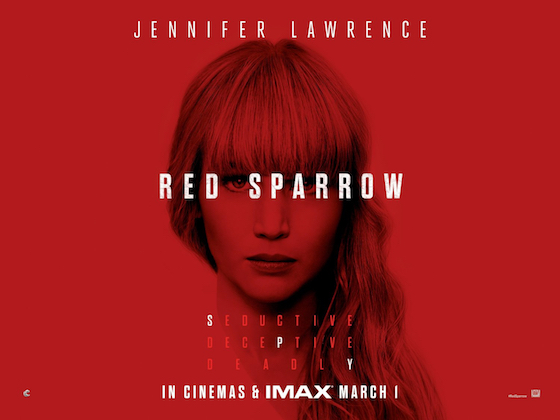
Red Sparrow

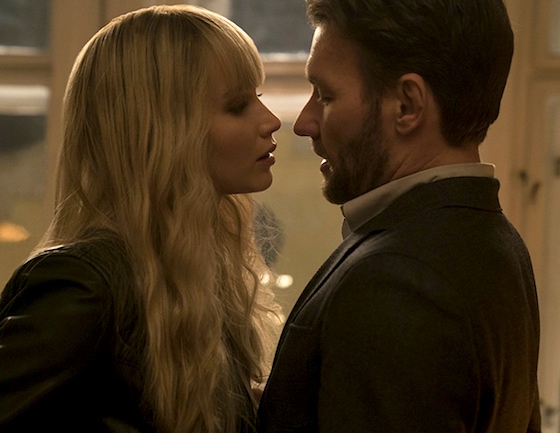
Jennifer Lawrence stars as Dominika, a Russian ballerina whose career-ending injury leads her down a path to becoming a “sparrow” — a highly-trained undercover operative for the Russian secret service. Used and abused throughout her training, when she’s sent after a CIA agent (Joel Edgerton) in order to find a mole within Russian intelligence, a series of double- and triple-crosses leave everyone in doubt about whose side she’s really on… including, er, us viewers.

Red Sparrow is set today. I think. It’s easy to forget. I had to check on a couple of occasions, including one final double-check before writing this review. The thing is, the politics of it all is very Cold War. Of course, given the current state of geopolitics, a neo-Cold War between Russian and the West is probably at its most believable since the ’80s, it’s just that this film’s handling of it doesn’t feel timely and modern, but like a Cold War story that someone decided should be set today. Partly that’s because a lot of the technology and tradecraft feels like it comes from a previous era too. I mean, one major sequence revolves around floppy disks. Floppy disks! I can’t even remember the last time I saw a floppy disk. Either that bit is based on something real-world (like, there’s a reason why someone stealing secrets would still be using floppies) — and, if it is, the film doesn’t bother to lay out why — or it’s the single most unrealistic thing in a movie that’s about a former ballerina being trained to be a Russian spy skilled in psychological influence and sexual manipulation in just three months — i.e. this is a pretty unrealistic movie all round.

Lady spy in red

Even if we ignore the inconsistencies of its temporal setting, it struggles with what else it has going for it. In its attempts to provide a twisty-turny plot, it’s not as clever as it thinks it is. As it flips and flops around about which side Dominika is supposed to be on really, clearly intending for us to feel wrong-footed every half-hour or so, the gears of how it’s setting up an inevitable final “reveal” begin to show through. Either that or I’m a genius for working it out ahead of time, whichever. One great well-disguised twist is better than endless back-and-forthing, but none of the filmmakers here seem to realise that, or don’t have the confidence to rely solely on that final reveal. Another side effect of this is it becomes hard to root for any particular character. Maybe this is the legacy of it being a US production: it can’t quite bring itself to ask us to fully invest in Dominika, a Russian spy, even as it tries to keep her the heroine. Plus the supposed twists wouldn’t work if we were actually let in on what she was plotting.

And away from the plot, the whole movie is sort of… seedy, but without owning it. It wants to be about sex and to somehow be honest about that, while also trying not to titillate in any way. It wants to be realistically violent, while merely being nasty in just one or two scenes. Conversely, it also wants to be a grown-up, labyrinthine Le Carré-esque thriller, but it’s so busy trying to repeatedly fool you that it forgets to properly engage you. It certainly doesn’t succeed in being plausible, with the elaborate plan Dominika supposedly concocted relying rather too much on crossed-fingers-type logic — or, I’m sure the filmmakers would say, her unparalleled ability to read people.

Sexy spy shenanigans

I’d rather it had picked a side: either go all out schlock — more violence, more tits — or go full intelligent thriller — rein in the seediness, rein in the superhuman foresight. As it is, Red Sparrow is not trashy enough to be titillating, certainly not clever enough to challenge Le Carré as the go-to example of intelligent spy thrills, and not stylish enough to get away with it either. It kind of sits in an awkward middle ground between all those things. I didn’t actually dislike it, but it didn’t thrill me either.

3 out of 5

Red Sparrow is released on DVD, Blu-ray, and UHD Blu-ray in the UK today.

Dudes & Dragons (2015)

aka Dragon Warriors

2018 #145
Maclain Nelson & Stephen Shimek | 113 mins | Blu-ray | 16:9 | USA / English | 12

Dragon Warriors

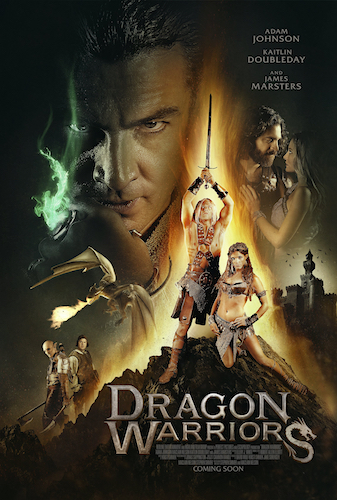
Back in 2014, when it felt like I was contributing to Kickstarters for film projects left, right and centre (including a variety of short films I still haven’t got round to watching and several projects which never amounted to anything, which is why I’ve largely stopped), I helped fund a fantasy comedy called Dragon Warriors. To cut to the quick, it was eventually released as Dudes & Dragons, the title changed presumably to better indicate its comedic tone, and apparently at the end of last week it popped up on Prime Video UK — so, naturally, that made me finally get round to watching my Blu-ray copy.

In a Dungeons & Dragons-y world, no one can show signs of love lest they be torched by the fearsome dragon Dolvarnög (the pronunciation of which is one of the film’s better recurring jokes). In fact, the dragon is commanded by evil sorcerer Lord Tensley (James Marsters, of Buffy and Angel fame), whose personal experiences with love have left him bitter. The dragon is just one threat to the relationship between human Camilan (Maclain Nelson) and elf Larec (Clare Niederpruem), and so he teams up with his mercenary brother Ramicus (Adam Johnson) — plus Camilan’s stable boy, Samton (Jake Van Wagoner), and Ramicus’ lodger, orc Shokdor (Erik Denton) — to save the world, etc.

Comedy!

As I said, and as the title surely implies, Dudes & Dragons is ostensibly a comedy — though not the kind of comedy the re-titling implies, I don’t think. I guess the lead characters are “dudes”, but they’re not, like, “dude” dudes… if you know what I mean. Setting that aside, potential hilarity is undercut by the film being overburdened with plot. My summary didn’t even mention the object of Tensley’s affections, his cousin Ennogard (Kaitlin Doubleday), who summons our heroes on their mission; or that Camilan’s parents forbid his marriage to Larec because of some stuff to do with laws of succession or something — this is meant to be a comedy, fellas! Who wrote it, Phantom Menace-era George Lucas? This necessitates rather too many scenes of exposition, especially early on, meaning it’s a while before the gags really begin to flow.

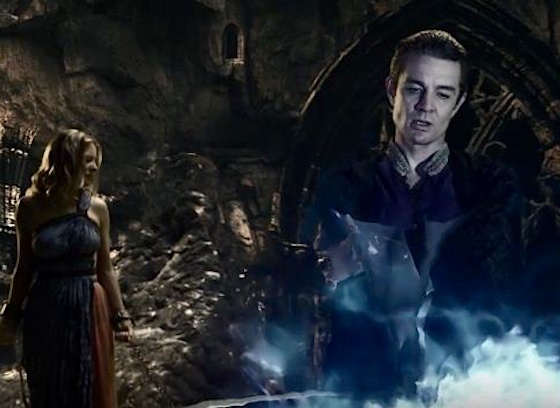
Well, “flow” is a generous descriptor — the gag rate is alarmingly low. The exposition scenes are balanced on a knife edge where you can’t tell if the actors are playing it tongue-in-cheek because it’s supposed to be humorous, or if it’s because they’re reaching for a florid style that they think is correct for a serious High Fantasy movie. (“High” fantasy is probably what you expect from a movie called Dudes & Dragons, actually, isn’t it?) Put another way: take those joke-less scenes out of context and you might think they were just am-dram Fantasy. James Marsters is probably best equipped to navigate this, giving a sterling go at being both villainous and comic, though the uneven tone means he’s never allowed to be properly menacing nor properly hilarious, a balance we know he can strike thanks to the aforementioned Whedon series. The rest of the cast actually aren’t bad — when the script gives them some decent material, there are laughs to be had. The weakest link is a cameo from Luke Perry, who’s worse than most of the non-famous cast.

Buffy flashbacks

Production-wise, this is a very low-budget effort and it shows, but if you give it the benefit of bearing those cheap-and-cheerful roots in mind, it doesn’t look half bad. Well, mostly. I mean, some of the costumes are a bit cosplay, but the creature prosthetics are pretty good; and the CGI monsters are alright considering the next-to-no-budget; and it’s decently shot, especially some sequences that spoof the oeuvre of Zack Snyder, though it’s sometimes distracting that it was all done on green screen — were there no real forests nearby they could’ve popped down to?

There’s some enjoyment to be had in Dudes & Dragons for the more forgiving viewer. It would’ve been helped immeasurably by a more streamlined plot, a higher preponderance of genuine gags, and probably by being a good 20 or 30 minutes shorter, too. As it is, most people after some fantasy-based laughs are going to want to look elsewhere.

2 out of 5