If there’s something strange in your neighbourhood, who ya gonna call? Three middle-schoolers on their bicycles, apparently…

Stranger Things (Season 1)
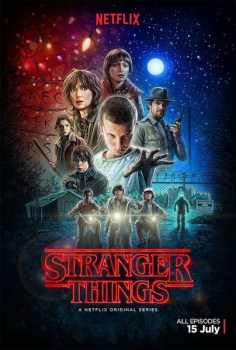 Hype — it’s a funny old business. It’s hard to have avoided hearing something about Stranger Things, Netflix’s summer hit that went down like gangbusters, its ’80s nostalgia perfectly calibrated to target the kind of people who run entertainment news websites these days — just to be cynical about it. Or truthful. Then there came the backlash, which attested there was nothing more to the show than those callbacks and tributes; a hollow experience of copying and “hey, remember this? That was good, wasn’t it?”
So, I confess, I approached the first chapter with the thought in mind that I might be about to watch the most overrated thing since sliced bread. The opening instalment did little to sway me either way — as with many a ‘pilot’ episode (it’s not a pilot if it goes straight to series, but anyway), it’s got a lot of establishing to do: teaching us the normality of this world, introducing us to the players, setting up a mystery, teasing where that might be going… Stranger Things does all this well, but not exceptionally. It’s good, it makes you want to stick with it, it has promise, but it’s not one of those first episodes where you come away thinking, “Holy moly, this is gonna be great!” (First example of that that comes to mind: Game of Thrones. Another: Firefly. I’m sure you have your own.)
Like so many streaming series, produced with an awareness that they’ll be released all at once like a really long movie, it’s a little slow-going at times, but it’s kept ticking over with some exceptional elements. Yes, it’s bedded in the style and tone of many beloved ’80s genre classics — primarily Stephen King tales and films produced (not just directed) by Steven Spielberg — but that’s just the execution. In storytelling terms, it has its own mythology, and it feels like there’s a rich vein of originality there. Or possibly it’s just references and riffs I’m not familiar with, who knows. Even better than that are the performances. Winona Ryder is incredible as the mother of a missing boy, her raw feelings and frantic actions forming a core of plausible emotional reaction in the centre of fantastic events. Millie Bobby Brown is also excellent as the mysterious Eleven, conveying so much personality and internal conflict with very little dialogue.
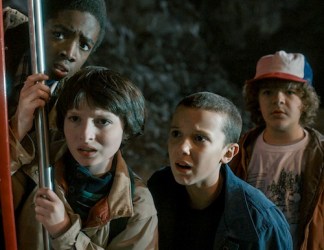 Without wanting to get into spoiler territory (despite what the media would have you believe, not everyone has Netflix all the time and not everyone watches every new zeitgeisty series immediately. Apologies if you write for an entertainment site and I’ve just given you palpitations), everything comes together nicely for a barnstorming pair of climactic episodes. For my money, the penultimate chapter is the best one: with a bunch of revelations out of the way (some of them easily guessed but finally confirmed), the series kicks off a run of long-awaited fan-pleasing events (as in many a drama, it takes this long for everyone to finally start talking to each other; also, the bit with the van!) The finale is less accomplished, with some characters wandering around for a bit in a way that feels designed to pad the running time. Still, it’s a satisfying conclusion… to season one, anyway.
As an outsider for most of the summer, the endless and ever-increasing handwringing over whether there would be a second season was actually kind of amusing — and the punchline came when it was revealed Netflix had actually commissioned season two before season one was even released, they’d just decided to keep it secret for a bit. Here’s the thing: Netflix has never not recommissioned one of its original series. Even Marco Polo, which apparently no one watched or talked about, got at least a second run. And here you have a show which everyone’s talking about, and presumably most of them are actually watching too, and you think Netflix aren’t going to bring it back? I mean, it wraps itself up quite well, but there’s a whole pile of blatant teases for future storylines. C’mon, people!
Anyway, I’m happy to report that Stranger Things by and large lives up to the hype, especially by the time it reaches its climax. Bring on season two! Between that and all the Marvel series, maybe I’m going to end up with a year-round Netflix sub after all… You win, Netflix. You win.
Class (Series 1 Episodes 1-5)
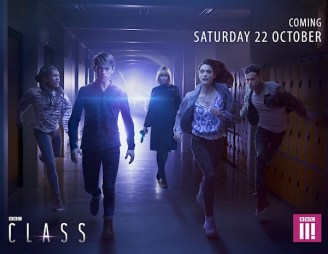 Ten years to the very day since the launch of the original dark, sexy BBC Three Doctor Who spin-off, Torchwood, we got this dark, sexy BBC Three Doctor Who spin-off. Playing as much like the other 21st century Who spin-off, CBBC’s The Sarah Jane Adventures, it concerns a bunch of Sixth Formers battling alien threats coming through cracks in time and space that occur around their school. And also having sex with each other at the drop of a hat, because that’s totally what life is like for all teenagers. So yes, Torchwood + Sarah Jane x Skins = Buffy, pretty much. I really liked the first episode (as pilot-type episodes go, it’s a strong’un), and the third, Nightvisiting, was also a great concept well executed; but the other three instalments were run-of-the-mill and/or awash with niggles. Plus the two-parter in episodes four and five suffered from having too little story to fill two whole episodes. So it’s a mixed bag, but Torchwood was the same at the start and eventually produced one of the best miniseries ever made (Children of Earth), so you never know.
The Flash (Season 3 Episodes 1-2)
Arrow (Season 5 Episodes 1-2)
 The CW’s raft of superhero shows restarted on UK TV this month. I’ve given up on Legends of Tomorrow and am still not joining Supergirl (though I got hold of the opening episodes, co-starring Superman, to maybe make time for at some point); but, five seasons in, Arrow has me suckered for the long-haul, and The Flash tempted me back with the intrigue of adapting Flashpoint. I’ve never got on the bandwagon with Flash, which attracted a lot of praise during its first season that I simply didn’t agree with, leading it to outshine Arrow in ratings and people’s affections. Arrow has long been off the boil, and season five certainly hasn’t got it back up to temperature so far, but The Flash had plenty of issues of its own. It’s not problem free now, but I actually really liked the first couple of episodes of the new season. It’s still a long way from the top tier of TV superheroes (Netflix have that sewn up), but it’s likeable.
Also watched…
Castle Season 7 Episodes 2-15 — it feels like the quality takes a nosedive with this season, and, sure enough, as I suspected, it turns out this is when they changed showrunner. Halfway through it’s beginning to pick back up a bit, at least.
The Crystal Maze Stand Up To Cancer Celebrity Special — I used to love this as a kid. As an adult… eh. I’m sure it’s a lot of fun to actually do, though.
The Great British Bake Off Series 7 Final — bye bye, Proper Bake Off. Whatever Channel 4 do in 2018, it won’t be the same.
The Musketeers Series 2 Episodes 8-10 — in which everything is wrapped up… and then left open-ended. Good thing there’s a third series.
The National Lottery: Who Dares Wins Series 9 Episodes 1-4 — I don’t waste much time on gameshows, but naming as many things as you can think of from semi-obscure lists? Right up my street. An impossible show to watch live, though — you need to fastforward the filler and pause the answers.
The Rocky Horror Picture Show: Let’s Do the Time Warp Again — full review here.
Things to Catch Up On
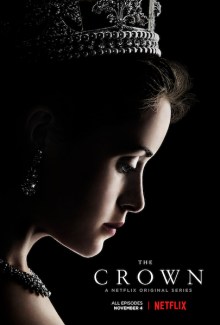 This month, I have mostly been missing the most expensive TV show ever made*, Netflix’s much-discussed The Crown. I don’t know if they’ve been pushing it as much in the rest of the world as they did in the UK, but it certainly felt like it was everywhere… for about a week, as is usually the way with Netflix series. Also missed: the equally-discussed Netflix-exclusive new run of Black Mirror. Both of these are because I don’t keep up a permanent Netflix subscription, but between them, the forthcoming Gilmore Girls revival, and the Series of Unfortunate Events remake in January, I will be signing up again late in December (using the free month voucher they had in the Radio Times, hurrah!)
* Apparently it isn’t, actually.
Next month… I’ll be out of the country when the next update is due, so it may be a little later than normal — perhaps a ‘Christmas special’.

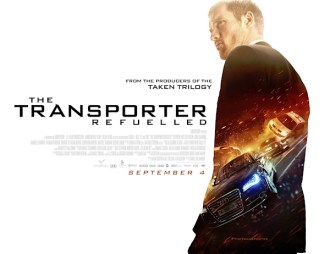 I kind of knew The Transporter Refuelled was going to be bad before I even began, but I watched it anyway because, well, I watched the first three Transporter movies and I really liked one of them, so… It’s just the completist in me, really; though why I was able to ditch Transformers when they semi-rebooted after three films and not this I don’t know. Possibly because the Transporter films have never been good, just entertaining trash, and even though Refuelled’s acting looked terrible and I can’t even remember if the trailer gave any indication of the plot, if it had half-decent action scenes then I’d be passingly happy for 90 minutes of entertainment (unlike Transformers 4, which runs the best part of 3 hours).
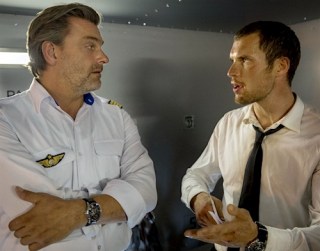 Unfortunately I wasn’t wrong about the acting, which is indeed pretty shit. Ed Skrein was truly dreadful in Game of Thrones (until he was thankfully recast) but was passable as the villain in Deadpool. As this film’s Statham-replacement hero he charts a course somewhere between those two stools. The supporting cast aren’t much better, with the notable exception of Ray Stevenson as Skrein’s dad, who brings much fun whenever he’s on screen. If anything makes Refuelled work as entertainment away from the violence, it’s the father-son dynamic. I want a sequel just to get another dose of that.
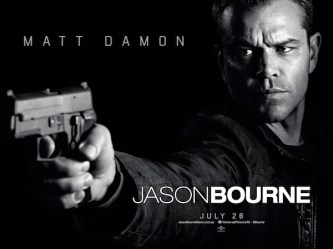 Much like the Bond films to which they’re so often compared, the Bourne movies have their devotees while only fitfully pleasing the critical establishment. This fifth movie — which is notable for marking the return of star Matt Damon and director Paul Greengrass after the semi-reboot of
 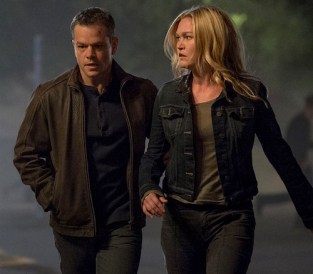 Action sequences ensue, shot with all the ShakyCam you’d expect from Greengrass. By now I imagine you have your own view on whether his style works or not. Personally, I think it’s considerably less bamboozling than when it made its debut in
 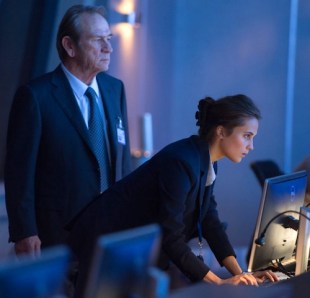 Frankly, Jason Bourne is at pains to mix in hyper-current iconography; the reasoning for Damon and Greengrass’ return now being that the world has changed and how does Bourne fit into that? So as well as social media and Greek riots we’ve got references to and riffs on hacking, Edward Snowden, government surveillance of its own citizens, the prevalence of Facebook/Twitter-esque tech companies, and so on. Sadly, I’m not sure the film’s actually got anything to say about any of these things. Greengrass and his co-writer, editor Christopher Rouse, have appropriated all these zeitgeisty concepts to make the film feel very Now, but that surface sheen is more or less where it ends. I mean, there’s a whole subplot starring Riz Ahmed as the Zuckerberg-like CEO of a social media company that I didn’t even mention in my plot summary because it’s kind of an aside. It’s kind of ironic, really, that it always seemed as if Greengrass’ more natural stomping ground was his documentary-ish real-world-exposé type movies, with his contributions to the Bourne series an unusual sideline; yet when he finally marries the two halves of his filmmaking career, it’s the action rather than current-affairs commentary that takes precedence.
 The end result is that Jason Bourne does thrill as an action movie, which seems to have been the primary goal of its makers, at the end of the day. As an action-thriller, however, the rinsed-and-repeated plot is a slightly faded imitation of former successes; a through-the-motions way to provide those impressively staged chases and punch-ups. It’s not the definitive Bourne movie one might’ve expected from the returning star/director combo (why else come back if not to perfect, or at least add to, the formula?), but instead means the film ends on an odd note: even though it wasn’t a wholly satisfying experience, and even though it doesn’t end with questions still blatantly hanging (as every Bourne movie bar Ultimatum has done), I want Damon and Greengrass to come back and do it all again, please. Only do it properly next time, yeah guys?
 Once upon a time, Pixar could do no wrong. Then
  Pixar have on several occasions produced films with an innovative opening act that descends into derivative kids’ animation runaround territory.
 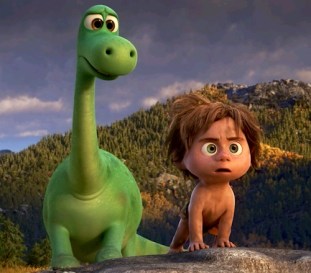 Perhaps most powerful of all is the relationship it creates between Arlo and a young human child he befriends, Spot. With humanity in a much earlier state of evolution, Spot is basically characterised as a dog — the way he moves, comes to his name, follows scents, shakes, scratches and enjoys being scratched, and so on — so of course I warmed to him. Nonetheless, though the building blocks used to create their friendship are very familiar, the way the film sells its emotional arc is ultimately immensely effective. Its resolution may even bring a tear to the eye.
 Set in Chicago during the Great Depression, The Sting follows a young street-level con artist (Robert Redford) as he seeks revenge for his murdered partner by teaming up with a seasoned big-con pro (Paul Newman) to scam the mob boss responsible (Robert Shaw).
 Between his popular English-language debut
 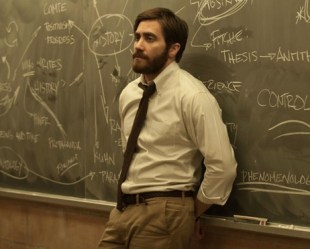 While looking up those various explanations, I read at least one review that asserted it’s a good thing that the film doesn’t provide a clear answer at the end. Well, I think that’s a debatable point. I mean, there is an answer — Villeneuve & co clearly know what they’re doing, to the point where they made the actors sign contracts that forbade them from revealing too much to the press. So why is it “a good thing” that they choose to not explain that answer in the film? This isn’t just a point about Enemy, it’s one we can apply more widely. There’s a certain kind of film critic/fan who seems to look down on any movie that ends with an explanation for all the mysteries you’ve seen, but if you give them a movie where those mysteries do have a definite answer but it’s not actually provided as part of the film, they’re in seventh heaven. (And no one likes a movie where there are mysteries but no one has an answer for them, do they? That’d just be being mysterious for precisely no purpose.) But why is this a good thing? Why is it good for there to be answers but not to give them, and bad for there to be answers and to provide them too? If the answers the filmmakers intended are too simplistic or too pat or too well-worn or too familiar, then they’re poor for that reason, and surely they’re still just as poor if you don’t readily provide them? I rather like films that have mysteries and also give me the answers to those mysteries. Is that laziness on my part? Could be. But I come back to this: if, as a filmmaker (or novelist or whatever) you have an answer for your mystery and you don’t give it in the text itself, what is your reason for not giving it in the text? Because I think perhaps you need one.
 Fortunately, Enemy has much to commend aside from its confounding plot. Gyllenhaal’s dual performance is great, making Adam and Anthony distinct in more ways than just their clothing (which is a help for the viewer, but not for the whole film), and conveying the pair’s mental unease really well. It would seem he errs towards this kind of role, from his name-making turn in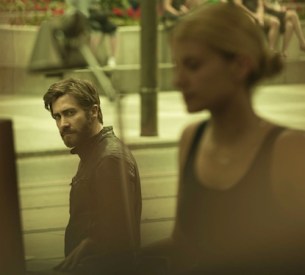
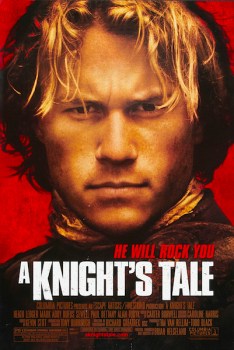 A squire fakes being a knight to win a jousting contest, and a lady’s affection, in this medieval comedy-adventure.
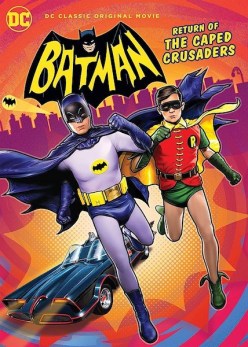 Holy nostalgia hit, Batman! This animated movie reunites the surviving stars of the enduringly popular
 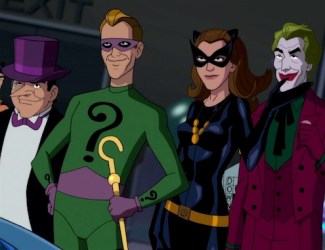 fundamentally, a comedy. Conversely, Ward still sounds pretty spry, and is gifted plenty of those “Holy [insert something here], Batman!” catchphrases that never cease to be fun. Unfortunately, Newmar also sounds her age, but doesn’t seem to quite have the liveliness that West retains. In the behind-the-scenes featurettes she seems a delightfully kooky old bird (at the recording she’s wearing cat ears, for one thing), so it’s hard to resent her, but the portrayal of Catwoman as slinky and sexy feels a little… odd. On the bright side, it means you don’t get the uncomfortableness of West flirting with a much younger actress, even in animated form.
 On the whole, Return of the Caped Crusaders is a resounding success. It’s a fun return to a beloved incarnation of arguably the most popular superhero; a version who’d been somewhat left out in the cold for a couple of decades by a world that grew up a bit too much, but is now being re-embraced and held in deserved esteem. And, even better, there’s already a follow-up in the works. Holy must-see sequel, Batman!
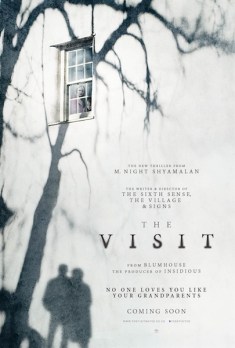 After a sidestep into big-budget director-for-hire movies that brought him even less acclaim than his last couple of self-penned efforts, once-fêted director M. Night Shyamalan goes back to basics with this low-key found-footage horror.
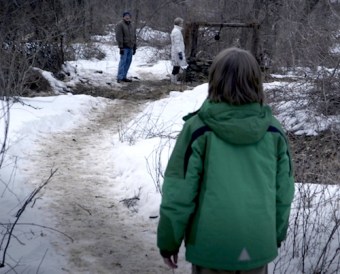 Of course, there’s a big reveal to explain everything that’s been going. People call it a “twist” because it’s a Shyamalan movie, but it’s more of an explanation. I mean, what was going on had to be explained somehow, and the explanation comes at the point where you’d expect the explanation to be. I’m not saying it’s not a twist, because it does change what you think you’ve been seeing, but it’s also not a be-all-and-end-all kind of failed-rug-pull, which Shyamalan’s worst twist-obsessed efforts have been. This one works. Or, it did for me.
 ’70s self-sufficiency sitcom
  100Films.co.uk