
We’re a quarter of the way through the year — but with the #25 milestone passed last month, how far ahead have I forged?
Also this month: some quick thoughts on the best James Bond pre-titles sequences. Which is your favourite?
March’s films

#30 Alois Nebel (2011)
#31 Godzilla (2014)
#32 Jack the Giant Slayer (2013)
#33 Midnight in the Garden of Good and Evil (1997)
#34 Violet & Daisy (2011)
#35 The Girl with the Dragon Tattoo (2011)
#35a The Hobbit: The Desolation of Smaug (Extended Edition) (2013/2014)
 #36 The Hobbit: The Battle of the Five Armies (2014)
#37 God Bless America (2011)
#38 Videodrome (1983)
#39 Grosse Pointe Blank (1997)
#40 Looper (2012)
#41 Valkyrie (2008)
#42 Mad Max 2 (1981), aka The Road Warrior
#43 Tarzan (1999)
#44 Empire of the Sun (1987)
- This is the third month in a row where I’ve watched 16 films, all in. Weird.
- Several I’ve been meaning to get round to for years were ticked off this month: Alois Nebel, The Girl with the Dragon Tattoo, and Looper. All thanks to TV premieres.
- It’s a complete accident that I left it a year to the month between watching Mad Max and Mad Max 2. Both were on Now TV, which I’m ending my subscription to imminently, so the third may crop up among April’s films.
- No WDYMYHS film this month. Two in April, then.
A grand total of 15 new films watched this month brings with it a few interesting observations. For one, this is the first time (since such records began) that January is the largest of a year’s first three months. That doesn’t really signify anything, just one of those random correlations (which has now been broken).
2015’s is the second largest March ever, and the fifth month in a row to improve on the same period from the year before. Plus it’s the tenth month in a row to have a final tally over ten. Regular readers will know my goal for this year is to have a run of 12 months that each exceed that figure, so I’m 25% of the way there. Meanwhile, the average total for January and February was 14.5, so by just tipping over that in March, the year-to-date average rises to 14.67.
2015 is clearly shaping up well on the whole. #44 is the furthest I’ve ever reached by the end of March, with second place being a three-way tie between 2010, 2011 and 2013 at #38. As ever, all indicators must be taken with a pinch of salt: last year (my highest year ever, lest we forget) I was actually running behind schedule until the last day of March; conversely, in 2012 I’d made it to #34 by the end of March, a full ten ahead of schedule, but still finished the year with just 97 films viewed.
Nonetheless, it’s prediction time! Never say never, but with the halfway point already looming next month, I feel 100 films is a fairly comfortable expectation this year (famous last words…) So, if I ‘merely’ manage to maintain my monthly ambition of ten-a-time from here on out, 2015 would make it to #134. That’d be my second-best year ever, so not to be sniffed at. If the current average (14.67, in case you forgot) holds, that would see me reach #176. Considering my previous best is 136, that’d be quite extraordinary. I live in hope.
Continuing apace, with 28 reposts this month.


























The past week has brought us both the first trailer for October’s 24th James Bond film, Spectre, as well as the news that it will feature the largest pre-titles sequence the 53-year-old franchise has ever staged. What better time to revive my “list of 5” format and look back at the finest examples of one of 007’s defining features, then?
 Except, goodness, I couldn’t get it down to just five! From Connery alone you’ve got ‘Bond’ being bested in From Russia with Love, the iconic jetpack in Thunderball, and the trend-setting mini-adventure from Goldfinger. As the series rolls on there’s The Spy Who Loved Me and its parachute, Moonraker’s free-fall fistfight (you couldn’t do that today — everyone would assume it was CGI and it’d have no magic), and the perfectly staged training-exercise-gone-wrong from The Living Daylights. The Brosnan era really kicks in the action, first with another peerless mini-adventure in GoldenEye (and the bungee jump…!), then increasingly expansive and suitably witty openers to both Tomorrow Never Dies and The World is Not Enough. Finally, the Craig era tipped the whole shebang on its head with Casino Royale’s moody black-and-white quickie, and Quantum of Solace’s attention-demanding car battle. Skyfall may have moved back towards the Brosnan mould, but it’s an exceptionally well done one.
That’s 12 and I don’t even know where to start paring back, at least as far as my personal favourites go.
We can all agree A View to a Kill and its use of California Girls is the worst, though, right?
Next month on 100 Films in a Year…
A third of the way through the year… but halfway to my goal?

 a supporting character who’s come and gone over the years, initially seeming one-note but revealing more in more recent seasons — but here you get that kind of arc condensed into 90 minutes. Barr is every bit his equal, the pair forming a genuine if sometimes complicated bond. That it acknowledges but dodges the whole “mid-life-crisis man and teenage girl” iffiness is further to its credit.
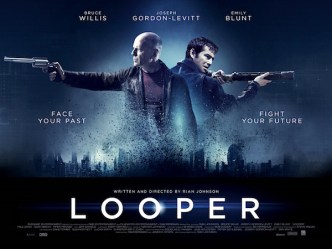 Writer-director Rian Johnson re-teams with the star of
 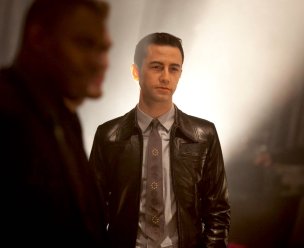 Firstly, the less you know the better. I pretty much knew the above before I went in, and that meant the film had surprises from the get-go. For instance, the near-future world most of the action takes place in has been well-realised by Johnson and his design and effects teams, and time travel is not the only SF concept or imagery employed here, which I wasn’t aware of. Their vision is
 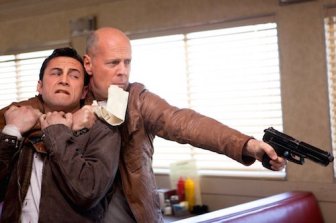 Heading up the cast, Gordon-Levitt does a good Bruce Willis impersonation — believable, but not a slavish impression. That was probably quite necessary, because I don’t imagine Willis has the thespian chops to emulate an older Gordon-Levitt. Notoriously, the younger actor does the whole thing under prosthetics designed to make it more plausible he’d age into Willis. They’re a bit weird: not badly done — far from it, in fact — but you’re always kind of aware they’re there. A highly able supporting cast flesh out the rest of the characters, though most memorable is young Pierce Gagnon as an imperilled child you wouldn’t necessarily mind getting killed. And I mean that in a nice way; about the film and his performance, if not the character.
 Even if there are some logic issues, it doesn’t fatally undermine the movie. Looper comes with the joys of a well-imagined future, a captivating storyline, engaging characters, and enough twists and turns along the way to keep you guessing at the outcome. The best genre movie of 2012? That was a year of stiff competition among SF/F pictures, but Looper may have the edge.
 Jack Palance is an actor wanting out of his studio contract in this stagey film noir.
 Partially driven by a seeming twist that’s obvious from the outset (which, in fairness, the film reveals only 40 minutes in), the story never quite comes alive. Palance and Corey make parts worth watching, but at other times it’s a bit of a slog, not helped by an awful score that chimes in now and then, loudly. Expansive cinematography (so much headroom — was it shot to be cropped for widescreen? Perhaps it was) combats any feeling of claustrophobia the single location and oppressive moral situation might have leant it.
 At the start of their audio commentary on The Desolation of Smaug, co-screenwriters Peter Jackson and Philippa Boyens note that, when the decision was made to extend the already-shot Hobbit duology to a trilogy, it wasn’t a third movie that need to be created but a second. That is to say, it was the middle instalment that required the most extra material, including a new prologue and climax. The
 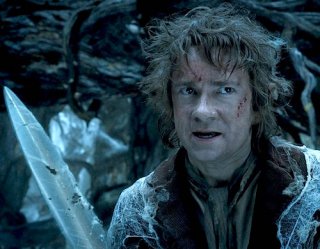 The extended cut amps him up even more, with an extra part in Mirkwood and a moment where he stands up for Thorin in Laketown. In fairness, he doesn’t have as much character development in this film as the first, while Thorin is on a definite arc and Gandalf is off on his own side-plot, but he’s undoubtedly a key character. I really don’t understand that complaint.
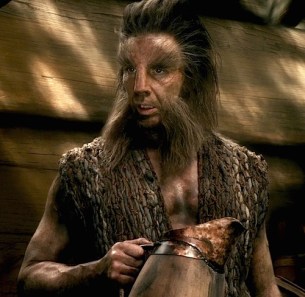 Even if some of the additions are worthless, on balance this is a better version of the film: more Beorn, more of the atmospheric Mirkwood, an additional character whose appearance will hopefully pay off in the extended
  When it comes to hitman movies, I’d’ve said there’s
 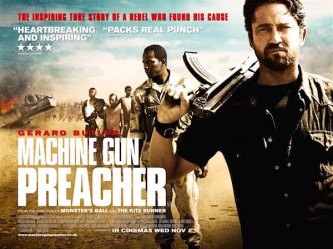 Between the mega-hits of
  The problem with the last point is that, in real life, Sam is still over there, still doing the same thing, while conflicts rage on. But this is a film — you need to find some kind of conclusion. The makers have tried, but its an incredibly half-arsed climax; less a resolution to the entire story and more Sam having learnt one lesson from something that went wrong a little earlier.
 mashed together with a polemical charity documentary about Africa, and then with some
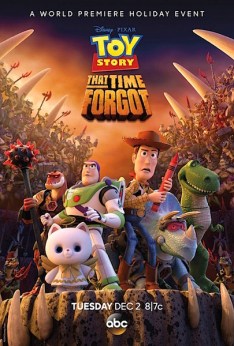 The second Toy Story TV special, and the fifth short adventure for the characters that perhaps should have had their last hurrah in
  The whole thing just feels undercooked. Apparently it took three years to make, with two of those dedicated to development. The Battlesaurs toy line was imagined in full, for example. There’s evidence of that on screen, but it’s just an impression that there’s a lot of background work we’re not getting to see. A TV special gives them limited time to explore the new world they’ve created, of course, but
  If you’ve ever found a late-night train commute dull, this single-location thriller may make you rethink any complaints. Half-a-dozen people travelling from London to Tunbridge Wells find their train speeding out of control. It’s up to them to discover what’s happening and how to stop it.
 Sherlock Holmes has appeared in more films than any other fictional character (yep, even those Marvel ones that are everywhere), which also means that Sir Arthur Conan Doyle’s Great Detective has been portrayed by a staggering number of actors. “Who’s the best?” debates usually settle around Basil Rathbone, Jeremy Brett and, these days, Benedict Cumberbatch, though there are ardent fans of Douglas Wilmer, Peter Cushing, Robert Downey Jr… I could go on. In certain rarified circles, however, the “Sherlockian’s Sherlock” is, believe it or not, a Russian: Vasily Livanov, who starred in five popular (in their homeland) Russian miniseries/TV movies between 1979 and 1986 that some regard as definitive adaptations. We even gave him an MBE for them in 2006, so I guess he’s state-recognised.
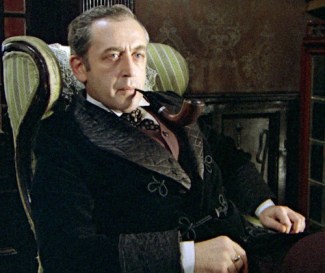 As many a Holmes fan will know, Baskervilles is not the best choice to get a handle on an actor’s interpretation of Holmes. Written by Doyle in the period after he’d killed Holmes off because he was tired of writing him, but before he later brought him back to life (as it were), presumably the author was still a bit bored with his creation, because Holmes disappears for a good chunk of the tale — in this adaptation, cited by many as the most faithful yet made, he’s in roughly the first and last half-hours, leaving a 72-minute stretch in the middle where he doesn’t appear at all. From what we do see of him, Livanov portrays a nicely understated Holmes. Clearly fiercely intelligent, but without the terseness of Cumberbatch’s version or the somewhat-jolly-hockey-sticks take of Rathbone. I’m compelled to get hold of the rest of the series to see what else he had to offer. (Sadly, only Baskervilles has reached UK DVD, but English-friendly imports are available. It’s also been released on Blu-ray, but I believe without English subtitles.)
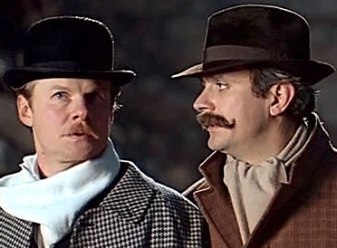 Several other cast members manage to be both faithful to the novel and different to how their characters are usually depicted on screen. For instance, Dr Mortimer is usually played as an older gent, but is quite young in the novel — this is a rare (the only?) instance of that being followed. It’s the first time I’ve seen him played as being a bit shifty and suspicious, too. It benefits the storytelling here, because there really aren’t many suspects — it’s abundantly clear whodunnit, even if you don’t know, because there are no other options! Perhaps most memorable from the supporting cast is “internationally acclaimed actor/director” Nikita Mikhalkov as Henry Baskerville. The role is usually played as young, handsome, keen and brave (in
  There’s more of an emphasis on people spying on each other suspiciously, which at least is rather appropriate to a murder mystery.
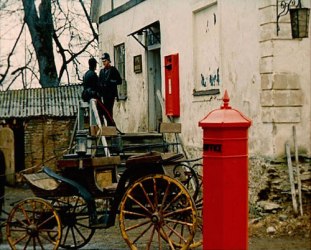 including scattering iconic red VR post boxes around willynilly. The Russian countryside probably doesn’t look very much like Dartmoor either, but its qualities work for the story: very desolate, barren, bare trees, waterlogged dirt tracks for roads, rubble strewn around, the buildings rundown… All very atmospheric for a Gothic horror-tinged mystery, and far superior to the picture-postcard look of some adaptations.
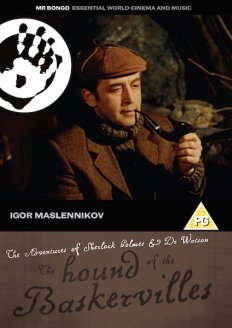 The Hound of the Baskervilles has been filmed far too many times (a
  100Films.co.uk