2015 #36
Peter Jackson | 144 mins | Blu-ray | 2.40:1 | USA & New Zealand / English | 12 / PG-13
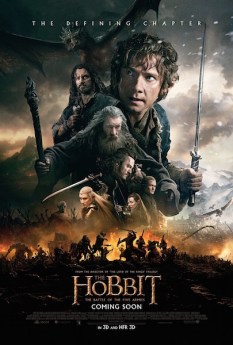 Peter Jackson’s epic Tolkien adaptation blunders its way to a conclusion with an instalment some have declared the trilogy’s best, presumably because they really enjoy watching someone else play video games. That’s what about half of this sextet-completing movie feels like, as it concludes the three-part Hobbit narrative with a CGI-riddled rendering of the titular battle. It’s the shortest film in Jackson’s Middle-earth magnum opus, though it comes to something when a film the best part of two-and-a-half hours long is described as “short”.
Before said battle, the movie finds itself with some business to attend to: we pick up immediately where the second part left off, with giant dragon Smaug flying towards Laketown with destruction on his mind. Kicking things off with a gigantic ten-minute action sequence isn’t a wholly bad decision pacing-wise, but this particular sequence is the wrong way to do it. Really, it’s the second film’s climax displaced — once Smaug is dealt with, a whole slew of new developments and subplots grow out of it, and that’s where the material that feels like it belongs in this film commences. Of course, that means there’s a lot of talking and manoeuvring, both politically and literally as people and troops shuffle about the board. Were it not for the big opening, there wouldn’t be an action sequence for about half the movie, and I guess that’s not considered acceptable in the modern blockbuster environment.
Now, if you were to watch all three films in one sitting, I suppose it wouldn’t matter precisely where the breaks fall. But how many people are actually going to do that? Not first-timers, that’s for sure. And then you’d get the problem of massive action sequences butting up against each other: the one that opens this film, right after the dwarfs-vs.-Smaug sequence invented during reshoots to take its place at the end of Film 2. Surely there were two other options available to Jackson when he made the decision to extend from a duology to a trilogy: he could have ended Film 2 before it even reached Smaug, 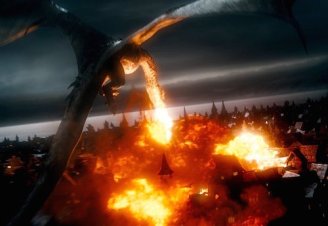 or he could have ended the second film with Smaug defeated and added more material to this third film to reach his desired running time. Or not even bothered adding stuff: if you lost the Smaug opener, The Battle of the Five Armies would still be over two hours long, which anywhere but Middle-earth is considered a decent length for a movie.
The rest of the film is a mixed bag for different reasons. For instance, Ryan Gage’s Alfrid is given a significant role — that’s the Mayor of Laketown’s assistant, if you’ve (understandably) forgotten who he is. Every minute that’s spent on his “comic relief” part is a minute wasted, and there are far too many minutes of it. Why that wasn’t left to the extended cut is anybody’s guess. It wouldn’t be particularly palatable there either — he’s just irritating, his actions predictable and unfunny — but longer versions are where there’s time for such indulgence. Conversely, Tauriel and Legolas are underused, wandering off on a completely aimless mission before wandering back for the battle.
Said battle feels a long time coming, but when it arrives… well, it’s a long time happening. It’s an epic by default, due to its sheer length. There are good bits, like the effort that has clearly been put into working out the armies’ tactics and the ebb and flow they would create. Wide aerial shots showing legions of troops swarming in formation, directed by generals with flags and horns mounted on high, are rather effective. 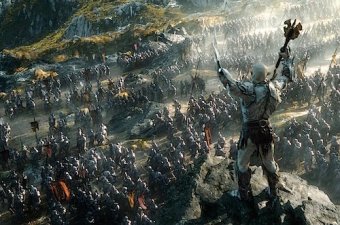 On the ground, the meat of the conflict only occurs when individual heroes are parcelled off into one-on-one duels. None of these particularly stand out, however, other than Legolas athletically jumping around a collapsing bridge that’s all so much CGI. This is where my earlier video game comparison really comes into play.
Some characters die. The impact is little-felt because of all the noise and bluster. That’s partly because there’s not really enough time for all the characters, of which there are more than ever. As with the second film, there’s been criticism that Martin Freeman’s eponymous Bilbo is barely featured, and, as with the second film, I disagree. Freeman’s not especially well-served in the acting stakes — Bilbo’s character development remains completed by the first part — but there’s still a focus on the actions of the little hero, some of which are pivotal.
Coming out of things best is Richard Armitage as Thorin, who succumbs to the paranoid madness that has afflicted generations of his family. Can he overcome it to do the right thing? The extent of this is sometimes laid on a little thick, but that’s the filmmakers’ fault (maybe this is another place that would benefit from a few trims) rather than Armitage’s performance. As the leaders of two of the titular armies, Lee Pace (elves) and Luke Evans (humans) also get a bit of a part to play, but the remaining dwarfs are given short shrift. That includes those played by James Nesbitt, Ken Stott and Aidan Turner, 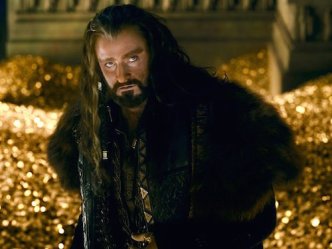 all of whom I’d thought would have more to do in the second and third parts of the trilogy. Turner, in particular, should have expected a bigger boost from Jackson’s decision to enrol him in an interracial romantic triangle, but it feels like they pulled back from that story thread a little after it proved unpopular in the previous film. It’s still obviously there, I just expected more of it.
On balance, The Battle of the Five Armies is probably the weakest of the three Hobbit films. Really, it’s just one big battle with a lengthy preamble. I can sort of see why Jackson felt like he could extend his original second film into a second and third — if you imagine them shorn of the reshoot-added bits, there’s still too much material for a single feature. The better solution, I suspect, would have been to accept splitting it into two shorter (i.e. regular-length) films, applying a bit of restraint in the process, rather than padding things further in an attempt to create two epics out of one ultra-epic.
As the credits begin, we’re treated to a sequence that emulates the one from Return of the King, with pencil sketches of the main cast alongside their names. On the Lord of the Rings concluder, it felt earnt; a special ending to a grand adventure. Here, it doesn’t. If anything, it feels like a reminder that the story we’ve just seen may have pushed to reach Lord of the Rings-level epicness, but is really just a tale of a small group going on an eventful hike, capped with a fairly large skirmish. A contemplative, momentous credit sequence does not feel warranted.
 I was something of a defender of Jackson’s version of The Hobbit at first. I enjoyed An Unexpected Journey and stand by my comment that, while it’s not The Lord of the Rings, it is the next best thing. As the trilogy has dragged on, however, it’s been dragged out, and the shine has gone off it. I still think there are elements to commend it, but I also think it could have been executed better. It’s hard to imagine an even longer version will improve much this time.
The Hobbit: The Battle of the Five Armies is released on DVD and Blu-ray in the UK on Monday.
My review of the Extended Edition can now be read here.
 Steven Spielberg’s second feature (or “first” if you’re American) is based, loosely, on a true story. The fictionalised version sees Lou Jean (Goldie Hawn) breaking her husband (William Atherton) out of prison so they can travel cross state to liberate their baby from foster care. Everything goes smoothly until they accidentally kidnap a police officer (Michael Sacks), hundreds of police cars begin to follow them, and a multi-day slow-paced chase ensues.
 when filmmakers became contractually obliged to keep their compositions “TV safe”). The camerawork is frequently extraordinary, including at least one unbroken shot where the camera moves around inside and outside the car, like something out of
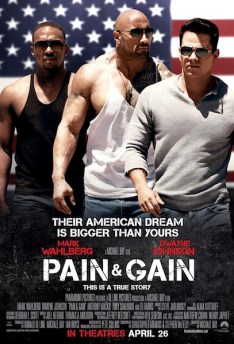 For his first non-sci-fi movie in a decade, divisive action director Michael Bay channels Tarantino (kinda) for this based-on-a-true-story crime comedy. Dwayne “The Rock” Johnson, Mark “Marky Mark” Wahlberg and Anthony “
 Bay is aided by leads who are surprisingly adept at comedy. Johnson is the best thing in it, consistently hilarious as his conscience battles former addictions and newfound religious convictions. I noted down some of his best lines to quote in the review, but they lose something without his delivery.
 After he’s become so sidetracked making the
 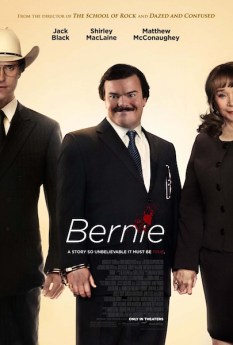 I seem to vaguely remember dismissing Bernie as just ‘Another Jack Black Comedy’ back whenever it came out (in the UK, that wasn’t until April 2013), and essentially forgot about it until earlier this month when it came up on
 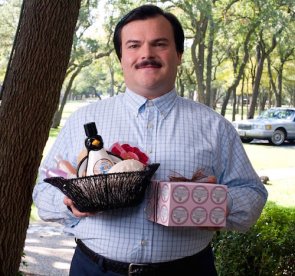 (If you’re observing similarities to Midnight in the Garden of Good and Evil there, you’re not the first: the magazine article that inspired Bernie, published around the same time as
 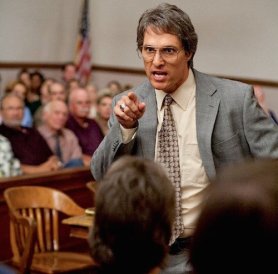 The local attorney seeking Bernie’s prosecution is played by man-of-the-moment Matthew McConaughey. I don’t know when we’re meant to deem the start of his “McConaissance”, but I’m not sure this really qualifies as part of it. Not that he’s bad, but it feels like the kind of played-straight comedy Southerner I’ve seen him do a few times now; indeed, it’s how he comes across in real life, from what I’ve seen. It fits the role like a glove, but doesn’t make for a remarkable performance.
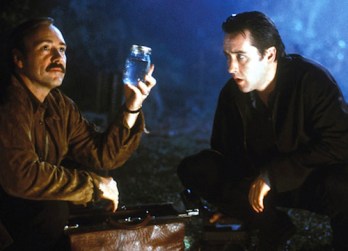
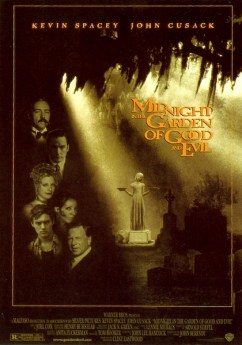 Sent to write “500 words on a Christmas party” in Savannah, Georgia, journalist John Kelso (John Cusack) instead finds himself covering a murder trial where he’s become friendly with the accused (Kevin Spacey).
 Like many an “adapted from a bestseller!” movies, I guess Midnight in the Garden was a big deal in its day that’s faded to semi-obscurity since (see:
  The second feature from
 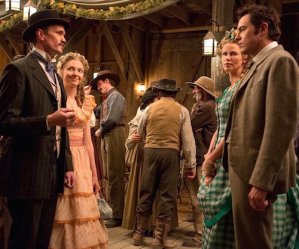 and two other men’s hats, briefly has a funny bit in the middle when he tries to acquire the second hat. The film also uses swearing as a comedic crutch too often. I’m not one of those people who’s only tolerant of swearing if they feel each and every use is absolutely justifiable, and I don’t object to it as just part of dialogue, but too often the film leans on someone saying “oh shit” (or whatever) as if that’s a serviceable punchline.
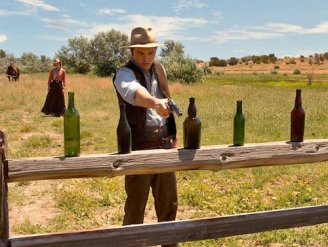 The movie’s best running gag is its titular one. At first it just seems like the concept is going to be limited to Albert sitting in a saloon and listing ways to die, which isn’t funny; but then it keeps cropping back up, sometimes unexpectedly, which really works. The whole fair thing — a running gag within a running gag — is particularly effective. If the film had traded more on this, less on farting and other bodily functions, it would’ve been much improved.
 I dread to think what the
 As
As 


 That quote comes from Thomas Elsaesser in the introduction to his Criterion essay “
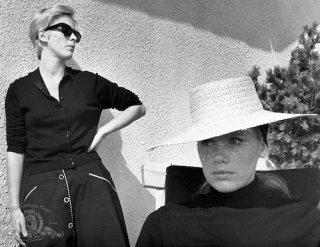 The plot, such as it is, concerns an actress (Liv Ullmann) who has decided to become mute and her nurse (Bibi Andersson), who travel to a seaside summerhouse to attempt recuperation. After we’re told how they grew closer, events concern the breakdown of the relationship between the two women… or is there only one woman? We might end up inside one of their heads… but whose? Or is it both of their heads? Or…
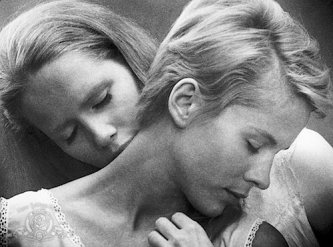 The film’s other most famous bit is a monologue Andersson delivers one night about a foursome she found herself in. As with most of the film its exact meaning is debatable, but it’s another unusual behind-the-scenes story: it was nearly cut, apparently, even though it’s in many respects the pivotal scene. It’s where the nurse opens up the most, leading to the actress’ ‘betrayal’ by repeating the story in a letter, which is what leads to the disintegration of their relationship and all the confusion/weirdness/’deep psychological filmmaking’ that follows. Later, Bergman lets a monologue (yes, another one) play in full twice. The meaning? He had intended to cut back and forth between the two actresses, but couldn’t decide which shots to discard, so just let it all run twice. At least that’s some confusion cleared up, then.
 Sometimes, films are so maligned that you feel you just have to see for yourself. Or I do, anyway. Crime thriller Runner Runner, with its
 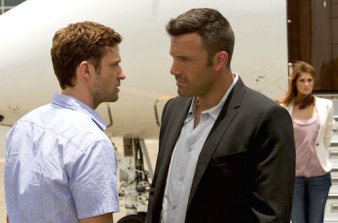 Brian Koppelman and David Levien’s screenplay is packed full of dreadful dialogue, which isn’t helped by phoned-in performances from all the principle cast, in particular Affleck. I guess he needed a payday between his Oscar-winning directorial efforts. I’ve seen some assert that the dialogue and delivery are meant to be mannered and stylised, but I just don’t buy it. Unless the style was meant to be “cable TV cheapie”, anyway. The Puerto Rican filming locations are quite prettily shot by DP Mauro Fiore, at least, but that’s scant consolation when everything else is so woeful.
 100Films.co.uk