
J.C. Chandor | 102 mins | streaming (HD) | 2.35:1 | USA / English | 12 / PG-13
 Robert Redford on a boat with no dialogue for over an hour and a half. That’s not a spurious way of describing All is Lost — that is what it is. Well, OK, he does say a couple of words — more or less literally “a couple”, though.
Redford plays “Our Man”, who’s pleasantly drifting around on his small yacht when it strikes a shipping container that’s just floating in the middle of the ocean. Now with a massive great hole in the side of his boat, he has to repair it using what he has to hand. The radio is damaged too, so he can’t call for help. And then an almighty storm rolls in…
It’s hard to succinctly pigeonhole All is Lost. It’s a survival movie, if that’s really a genre; man vs the elements. It’s an adventure movie, a little bit in the old-fashioned sense, as here’s a man who, through no choice of his own, has what you might describe as “an adventure”. He doesn’t have a companion to natter to, which would’ve surely been easier to write and more readily palatable to audiences; nor is there any narration of his thoughts, besides opening with the reading of a letter he will write later, which is, frankly, a needless addition to the movie. Redford doesn’t need to speak, because he conveys his character’s every thought, emotion, fear, indecision, and resolve through his face and his movement. Some viewers may overlook it because there’s no dialogue for him to emote with, but it’s a sublime example of acting.
Indeed, it’s testament to Redford’s performance (much discussed but ultimately overlooked during last year’s awards season), J.C. Chandor’s direction, and the work of the special effects and stunt teams, that the film remains gripping throughout. 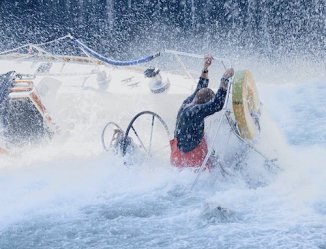 Through chance, coincidence, bad luck, but never forced tension-mounting on the part of the filmmakers (at least, not obviously so), our man’s fortunes go from bad to worse to even worse to even worse than that. Despite his best efforts, he’s on a downward spiral, a seemingly irreversible series of unfortunate events. If you ever had an interest in solo sailing, this is liable to put you off.
It all leads to an ending that has proven divisive. I shan’t spoil it, but I was fine with it. I don’t think it’s in any way a betrayal of what’s gone before. I will say that it provides a resolution, rather than leaving things open-ended, which I give away purely because some reviewers have stated a preference for a lack of resolution here. Why? Once our man finds himself in this situation, there are all of three possible outcomes: he gets himself out of it, he gets rescued, or he dies at sea. Not telling us which happens would be a contrivance on the part of the filmmakers — if this were a real story, for example, we’d know which happens, so why deny it in fiction too? I’m not saying unresolved/ambiguous endings are always bad, because I think they do have a place, but this isn’t one of those places. Indeed, I’d argue that to leave it open would have been a cop-out. Fortunately, Chandor is man enough not to do that. As to which of the three aforementioned options he went with, they all seem fundamentally just as likely to me, so I also don’t object to the one he did pick.
 Sometimes self-imposed filmmaking limitations lead to an exercise in competency over good moviemaking — “can we pull this off?” rather than “can we make a good film?” Chandor and co do pull their limitations off, I suspect not because someone set out purely to make a film with one character and no dialogue, but because it’s a gripping, exciting, tense movie, carried by a powerful near-silent performance and first-rate direction.

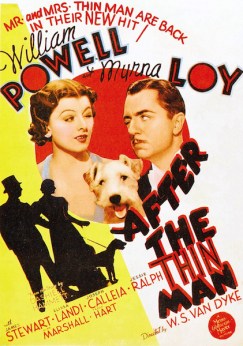 Immediately after their New York Christmastime adventure in
  There’s also an increased role for the couple’s dog, Asta, granted his own subplot as he has to fend off a philandering Scottie with intentions toward Mrs Asta. I make no apologies for preferring this over the previous film in part because there’s more amusing doggy action.
 25 years before Jennifer Lawrence had to
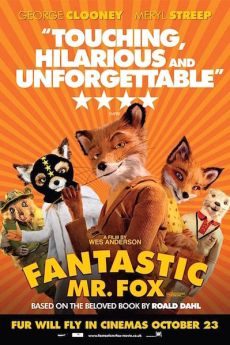 Quirky cult-y director Wes Anderson tries his hand at stop motion animation with this Roald Dahl adaptation, in which an all-star cast voice the tribulations of a gaggle of talking animals — led by the eponymous vulpine — who come into conflict with three vicious farmers.
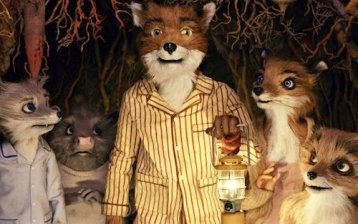 Compositionally, I thought I’d get sick of the squared-off 2D style, but Anderson’s cleverer than that. It might look flat and lacking in dimension at first, but that’s the starting point for variation, including some great bits of depth (farmer Bean trashing a caravan is a particular highlight of this), and when it breaks form (like a rabid dog chase) it’s all the more effective. There’s also a fantastic score by Alexandre Desplat. Not your usual plinky-plonky Quirky Kids’ Movie music (though there are instances of that), but something more raucous. Nice spaghetti Western riffs, too.
 Fantastic Mr. Fox is the kind of film I feel I may enjoy more on a re-watch. Indeed, some comments on film social networking sites (e.g.
 You know the kind of people who wait ages and ages for something and really want it and pre-order it or whatever and then when it finally arrives they… add it to a pile and don’t get round to watching/reading/listening to it for even longer than the ‘forever’ they were waiting in the first place? If you don’t, you do now — that’s me.
 To be precise, Panahi’s ban is from filmmaking, writing screenplays, leaving the country, or giving interviews, so they conclude that reading aloud an existing screenplay while someone else films him doesn’t contravene any of those rules. Nonetheless, the edited (not-a-)film was smuggled out of Iran on a USB stick hidden in a cake in time for its Cannes premiere.
 In fact, despite the singular input and focus put into this ‘project’, it could be used quite successfully as part of an argument against auteur theory. But that isn’t what it sets out to do either.
 questions that are always worth asking about purported documentaries.
 Produced as a B-movie, but eventually nominated for four of the biggest Oscars (Picture, Actor, Director, Screenplay
 like a Christmas party which is regularly interrupted by victims and suspects. Even the final scene, a rambling and none-more-Christie-like “gather all the suspects and reveal the answers” dinner party, seems natural because of the characterisation throughout the rest of the film. Loy’s part may not be quite as showy — as demonstrated by its failure to gain an Oscar nomination — but she’s an invaluable half of the double act.
 Liam Neeson shoots wolves for an arctic drilling company, but when his flight home crashes, he must attempt to lead the small band of survivors across an icy wilderness to the mere hope of safety — pursued all the way by murderous wolves…
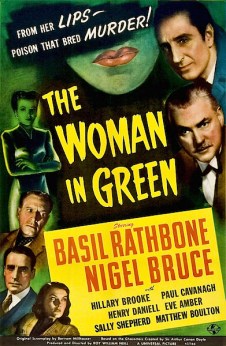 Basil Rathbone’s Sherlock Holmes starred in films which, although they typically involve murder, are best described as “adventures”. The series’ 11th film, The Woman in Green, is one of the few — perhaps the only one — that could genuinely be described as dark and grim.
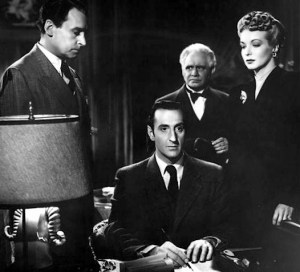 The evil is carried off with aplomb by Daniell. Reportedly a cold actor to work with, he chills on the screen too. This is a man you can believe would carry out such a scheme without a single twang to his conscience. His comeuppance, even with its surprising finality, is welcomed. The titular woman, played by Hillary Brooke, is one of Moriarty’s cohorts, posing as the ‘girlfriend’ of the aforementioned widower in order to set him up. The film is of course in black & white, so we can’t see what colour she’s wearing, and no one ever refers to it — even when they’re hunting for her based on looks alone. I guess someone thought it was an evocative title nonetheless.
 Released the same year as
  Even with the undercurrents of grief and the difficulties of moving on, this is fundamentally a light, amiable romance.
 Jackie Chan’s breakout hit sees him as Chien Fu, the floor-scrubber-cum-punch-bag at a martial arts school where he bumps into Pai Cheng Tien (Yuen Siu Tien), one of the last two proponents of the Snake Fist style after its other students were murdered by their old enemies, the Eagle Claw clan. The old man trains Chan so he can overcome his bullying schoolmasters, while the Eagle Claw grand master (Hwang Jang Lee) hunts for his last remaining rival…
 Also striking is the music score, a strange mix of weird, cheap, dated, electronic stuff… and yet, it’s so odd I kind of warmed to it. It’s all poached from elsewhere, which was apparently the way things were done in Hong Kong at the time. Stand-out tracks are Magic Fly by Space and Oxygene Part II by Jean Michel Jarre, though bits of famous scores are in there too, most recognisably (for me)
  100Films.co.uk