
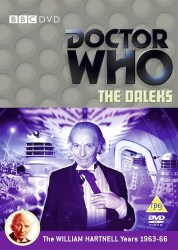

The Daleks
and
Dr. Who and
the Daleks
Doctor Who: The Daleks
1963-4 | Christopher Barry & Richard Martin | 172 mins | DVD | 4:3 | UK / English | U
Dr. Who and the Daleks
1965 | Gordon Flemyng | 83 mins | Blu-ray | 2.35:1 | UK / English | U
In a fortnight’s time, on the 23rd of November 2013, Doctor Who will celebrate its golden anniversary — 50 years to the day since the premiere broadcast of its first episode, An Unearthly Child. Those 25 minutes of 1960s TV drama still stand up to viewing today. OK, you couldn’t show them on primetime BBC One anymore; but the writing, acting, even the direction, and certainly the sheer volume of ideas squeezed into such a short space of time, are all extraordinary. It is, genuinely, one of the best episodes of television ever produced.
But that’s not why Doctor Who is still here half a century later. It may be the strength of that opening episode, the ideas and concepts it introduced, that has actually sustained the programme through 26 original series, a 16-year break, and 8 years (and counting) of revived mainstream importance; 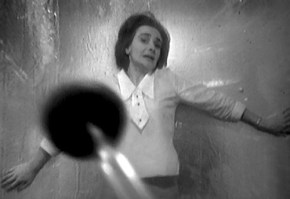 but that’s not what secured the chance to prove the series’ longevity. That would come a few weeks after the premiere, in the weeks before and after Christmas 1963, when producer Verity Lambert went against her boss’ specific orders and allowed “bug-eyed monsters” into the programme — in the shape of the Daleks.
Something about those pepperpot-shaped apparently-robotic villains clicked with the British public, and Dalekmania was born. Toys and merchandise flowed forth. The series soon began to include serials featuring the Daleks on a regular basis. And, naturally, someone snapped up the movie rights.
Rather than an original storyline, the ensuing film was an adaptation of the TV series’ first Dalek serial. These days you probably wouldn’t bother with such a thing, thanks to the abundance of DVD/Blu-ray/download releases and repeats by both the original broadcaster and channels like Watch; but back then, when TV was rarely repeated and there certainly wasn’t any way to own it, retelling the Daleks’ fabled origins on the big screen probably made sense. Nonetheless, there was an awareness that the filmmakers were asking people to pay for something they could get — or, indeed, had had — for free on the telly. Hence why the film is in super-wide widescreen and glorious colour, both elements emphasised in the advertising. The film is big and bold, whereas the TV series, by comparison, is perhaps a little small, in black & white on that tiny screen in the corner of your living room…
But, really, that was never the point. Doctor Who has always thrived on its stories rather than its spectacle (even today, when there’s notably more spectacle, it’s those episodes that offer original ideas or an emotional impact that endure in fans’ (and regular viewers’) memories). The plot of The Daleks is, by and large, a good’un, and certainly relevant to its ’60s origins —  its inspiration comes both from the Nazis, not yet 20 years passed, and the threat of nuclear annihilation, at a time when the Cold War was at its peak. The film adaptation is so unremittingly faithful (little details have changed, but not the main sweep) that these themes remain, all be it subsumed by the COLOUR and ADVENTURE of the big-screen rendition.
The Daleks were, are, and probably always will be, a pretty blatant Nazi analogy. There’s not anything wrong with that, though its debatable how much there is to learn from it. Where it perhaps becomes interesting is the actions of the other characters. Here we’re on the Daleks’ homeworld, Skaro, which is also populated by a race of humanoids, the Thals. They are pacifists and, when they learn the Daleks want to kill them all, decide it would be best to just leave rather than fight back. The Doctor’s companion Ian has other ideas, goading them into standing up for themselves. These days the idea that our heroes would take a pacifist race and turn them into warmongers strikes a bum note; but this is a serial made by a generation who remember the war, perhaps even some who fought in it, and naturally that colours your perception of both warfare and what’s worth fighting for. The Daleks aren’t just some distasteful-to-us foreign regime that maybe we should leave be unless they threaten us directly — they’re Nazis; they’re coming to get us; they must be stopped.
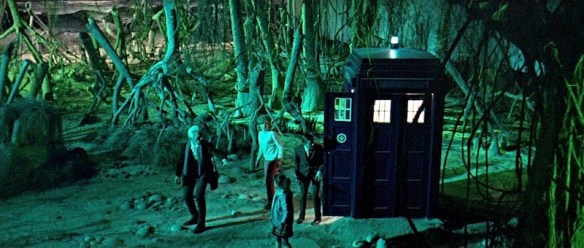
On the other hand, this is contrasted with Skaro itself — an irradiated wasteland, the only plant and animal life petrified, with the Thals and our time-travelling heroes requiring medication to survive. This is a Bad Thing… but this is where war has led, isn’t it? This is why the Thals are pacifists — because they don’t want this to happen again. And then they go and have a fight. Perhaps we shouldn’t be digging so deeply into the themes after all. It’s not that a “children’s series” like Doctor Who is incapable of sustaining their weight, it’s that writer and Dalek creator Terry Nation is really more of an adventure storyteller. That said, he did go on to create terrorists-are-the-good-guys saga Blake’s 7 and how-does-society-survive-post-apocalypse thriller Survivors, so maybe I’m doing him a disservice.
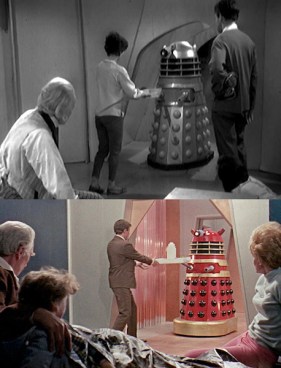 If the film’s rendering of the story and consequent themes is near-identical to its TV counterpart, plenty of other elements aren’t. The most obvious, in terms of adaptation, is that its 90 minutes shorter — roughly half the length. That’s not even the whole story, though: the film is newbie friendly, meaning it spends the first seven minutes introducing the Doctor and his friends. When we take out credits too, it spends 75 minutes on its actual adaption — or a little over 10 minutes for each of the original 25-minute episodes. And yet, I don’t think anything significant is cut. Even the three-episode trek across the planet that makes up so much of the serial’s back half is adapted in full, the only change being one character lives instead of dies (a change as weak as it sounds, in my view).
The funny thing is, even at such a short length it can feel pretty long. It’s that trek again, as Ian, Barbara and some of the Thals make their way to the back of the Dalek city to mount the climactic assault. It feels like padding to delay the climax, and some say it is: reportedly Nation struggled to fill the seven-episode slot he was given, hence the meandering. When it came to the film, Nation insisted Doctor Who’s script editor David Whittaker was hired to write the screenplay (apparently the trade-off was that producer Milton Subotsky got a credit for it too), which perhaps explains the faithfulness. It’s a shame in a way that Whittaker just produced an abridgement, because a restructured and re-written version for the massively-shorter running time might have paced it up a bit.
 The most obvious change — the one that gets the fans’ goat, and why so many dislike the film to this day — comes in those opening seven minutes. On TV, the Doctor (as he is known) is a mysterious alien time traveller, his mid-teen granddaughter Susan is also a bit odd, and Ian and Barbara are a pair of caring teachers who he kidnaps to maintain his own safety. In the film, the title character is Dr. Who — that’s the human Mr. Who with a doctorate — who has a pair of granddaughters, pre-teen Susan and twenty-ish Barbara, while Ian is the latter’s clumsy fancyman. They visit the time machine that Dr. Who has knocked up in his backyard, where clumsy old Ian sends them hurtling off to an alien world. In many respects this is once again the difference between TV and film: the former is an intriguing setup that takes time to explain and will play out over a long time (decades, as it’s turned out — the Doctor is still a mysterious figure, even if we know a helluva lot more about him now than we did at the start of The Daleks), while the latter gives us a quick sketch of some people for 80 minutes of entertainment. Plus, making Ian a bumbler adds some quick comedy, ‘essential’ for a kids’ film.
Even more different is Peter Cushing’s portrayal of the Doctor. At the start of the TV series, William Hartnell’s rendition of the titular character is spiky, manipulative, tricksy, and in many respects unlikeable. In the first serial he even considers killing someone in order to aid his escape! Not the Doctor we know today. As time went on Hartnell softened, becoming a loveable grandfather figure. It’s this version that Cushing adopts in the film, with a sort of waddly walk and little glasses, looking and behaving completely differently to his roles in all those Hammer horrors. If proof were needed of Cushing’s talent, just put this side by side with one of those films. But this was at a time when Hartnell was the Doctor — with ten men ‘officially’ having replaced him in the TV series (not to mention Peter Capaldi to come, a recast Hartnell in The Five Doctors, and various others on stage, audio, fan films, and so on), it’s easy to forget that Cushing taking over must have been a bit weird. It certainly put Hartnell’s nose out of joint. And for all Cushing’s niceness and versatility across his career, Hartnell’s Doctor is a more varied, nuanced, and interesting character.
You can see why fans don’t like it — it’s not proper Doctor Who. I think that’s not helped by the film’s prominence in the minds of ordinary folk. During the ’90s, when Who was out of favour at the BBC (except with Enterprises/Worldwide, for whom it’s always made a fortune), the main way to see it was with repeats of the films on TV. Even before that, I’m sure the films have been screened much more regularly than the serials that inspired them. Plus the general public don’t understand that Cushing isn’t a real Doctor (even now, you see people asking why he isn’t in the trailers for the 50th anniversary, and so on), which just rubs it in. But if you let that baggage go (which you really should), Dr. Who and the Daleks is an entertaining version of the TV serial.
And yet… it isn’t as good. The widescreen colour looks good, sure, and the Daleks’ tall ‘ears’ are an improvement (hence why they were adopted for TV in the 2005 revival), but other than that the design is lacking. 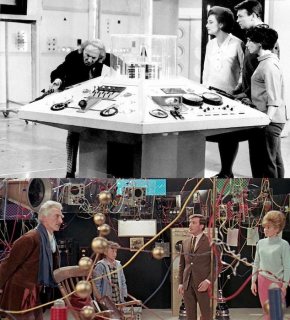 The console room in the TARDIS is another iconic piece of design, the six-sided central console and roundel-decorated walls having endured in one form or another throughout the show’s life (even if some of it’s become increasingly obscured in the iterations since the 1996 TV movie). In the film, however, it’s just… a messy room. There are control units and chairs and stuff bunged around, with a mess of wires draped about the place. On TV it looks like a slick futuristic spaceship; on film it looks like a junkyard. Oh dear.
Then there’s the Dalek city. The film’s version is more grand, with lengthy corridors rather than the faked photo-backdrops used on TV; but that’s besides the point, because that very grandness undermines its impact. The Daleks’ corridors on TV feel truly alien — they’re the same height as the Daleks, which is about a foot smaller than most of our leads, meaning they’re constantly having to duck through doorways. It’s perfectly thought-through design, led by how the place would actually have been built rather than making it convenient for the cast. The film’s city is the opposite, with big doorways and rooms. It’s a minor point perhaps, but it can leave an impression.
Ridley Scott is, by and large, a great film director, and is responsible for at least two of the all-time greatest science-fiction movies; but I doubt even his 26-year-old self, then a BBC staff designer originally assigned to work on Doctor Who’s second serial, could have come up with a more iconic look for the Daleks than Raymond P. Cusick. With the exception of the ‘ears’ and the colour scheme, his design is rendered faithfully from TV to film, because it’s so good. Why does it work? I have no idea. Perhaps because it’s genuinely alien — they’re not in any way the same shape or size as a human. Of course, it sort of is: the design is based around being able to fit a man sitting down, in order to control it — but it doesn’t look like that.  Then there’s the way they glide, the screechy voice, the sink-plunger instead of some kind of hand or claw… It’s a triumph, and it works just as well in gaudy colours on film as it does in simple black and white.
Thanks to being just on contract, Cusick’s contribution to the Daleks and Doctor Who can be overlooked. Even after the creatures became a phenomenal success, the most he managed to get was a £100 bonus and a gold Blue Peter badge; though as the latter is practically a knighthood, it could be worse. Nation, meanwhile, reaped the rewards (though no gold badge), to the extent that today his estate control whether the Daleks can appear in Doctor Who or not. Nation gets a credit every time they appear; Cusick doesn’t. Obviously Nation is owed much of this, but Cusick is too: without that design, the Daleks would have been nothing. Thankfully, the making of Doctor Who is probably the most thoroughly researched and documented TV production of all time, and even if he doesn’t get an onscreen credit on new episodes or any financial rewards for his family, Cusick’s name is well-known in fan circles — the outpouring of appreciation when he passed away last February was equal to that received by many of the programme’s leading actors (always a more obvious object of adulation).
I think the Dalek films aren’t given the credit they’re due by many Doctor Who fans. There’s a reason for that, but those reasons are past. The original stories have been available on VHS and then DVD for decades now, meaning the films aren’t the only way to experience these adventures any more. Plus, as the relaunched show has established Doctor Who as a contemporary popular TV series, so the general populace sees it as a franchise that has had three leading men; or, for the better-informed masses, eleven. 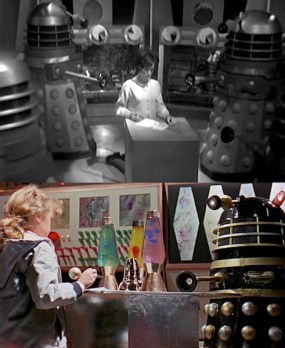 Whenever the series brings up past Doctors (and that’s surprisingly often, considering the “come on in, it’s brand new!” tone in 2005), Cushing isn’t among them. While he may once have been a prominent face associated with the show to non-fans, the ‘war’ has been ‘won’ — he’s become a footnote.
Maybe it will take a while for fans to stop being so stuck in their ways, but I hope they do and can embrace the Dalek movies as fun alternatives — they don’t replace the originals, but should stand proudly alongside them as symbols of Doctor Who’s success.
Next time… the Daleks invade Earth twice, as I compare the second Dalek serial to its big screen remake.
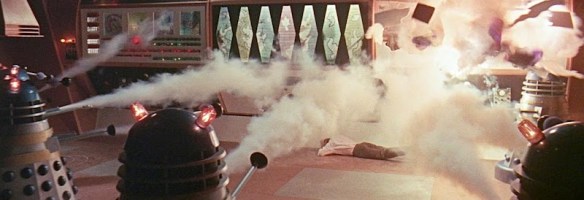
 Once, zombie auteur George A. Romero commented that he’d hoped to make one zombie film a decade — witness
 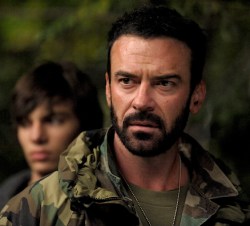 Well, that little gang of military types are back — and now they’re the heroes. Survival even takes the time to flashback to Diary, noting the release of the film-within-a-film led to the military gang’s leader, Sarge (Alan van Sprang), being recognised. It’s not a plot/character thread Romero chooses to develop further — there’s no about-turn in his values, or a desire to hide from said recognition — which is a shame, actually, because the plot supports such a move.
 It’s also here that they meet a character known only as Boy (Devon Bostick), who had been co-opted into the gang of hunters. Turns out he’s handy with a weapon himself, and resourceful and clever. What an intriguing mystery. But don’t get too caught up — Romero never again alludes to where such skills materialised from. In fact, he so doesn’t return to the Boy’s abilities that I wonder if we weren’t even really meant to notice. Which doesn’t make sense. Is he left over to be revisited in a third in this new zombie series? Romero doesn’t seem to be in any rush to produce one… but then, Survival was an almighty flop (it even went straight to DVD here), so I guess we’ll never know.
 also a definition of US foreign policy, is it not. And I’m sure it’s no coincidence that the islanders are Irish; and not just Irish in the way so many Americans claim to be “Irish” or “Italian” or whatever just because 200 years ago they had some relatives who emigrated, but properly, thickly-accented Irish. Which, yes, is kinda odd on an island off the coast of America, but hey, why not.
 I have no problem with CG blood splatter or what have you, and it’s as palatable here as it was there. There’s also a welcome return for his brand of humour, which went somewhat AWOL in the last couple of films. Those who criticise the film for being too comedic have, in my view, become too obsessed with modern cinema’s uber-serious tone. Lighten up folks, it’s a horror/sci-fi/fantasy movie.
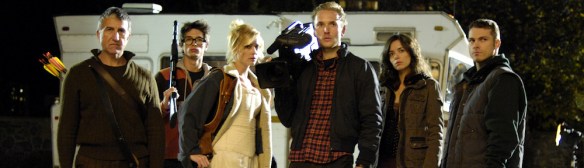
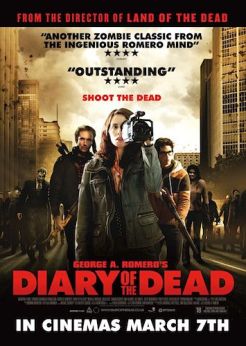 While making a horror movie in the woods, a group of friends hear news of the dead coming back to life. As they try to reach home, their aspiring documentary-maker director keeps his camera rolling, recording their encounters with the living dead…
 so goodness knows how it’ll look after even ten. Thing is, despite all that, Diary still has one ace up its sleeve: it’s written and directed by George A. Romero.
 That said, the thematic concerns feel less resonant than in Romero’s previous work. The found-footage has led him to frame this as a film-within-a-film — the first title card reads The Death of Death, followed by one noting it’s “a film by Jason Creed”, the aforementioned aspiring director — complete with montages of news footage and, at times, a voice over narration. This rather rams the point home at times, over-explaining features that previously Romero would have allowed us to spot for ourselves. In some respects you can’t blame him being more obvious in this day and age — it needs to be on the nose to get through to some people — but it’s less satisfying, the blunt information coming across as a statement rather than asking us for our own interpretation, which I feel can lead to a more insightful analysis.
 Such folks, and even genuine Romero fans, seem to have two major problems with Diary (aside from arguments about the acting, the storyline, or even the entire concept). First, the gore: where Land added CGI to the traditional mix, Diary’s almost exclusively courtesy of computer wizardry. That’s the age we live in: computer effects are so commonplace that they’re now the cheap and easy thing to achieve, rather than men with buckets of red food colouring and entrails from the local butcher. For me, it’s a mixed bag. I don’t think this is the worst CGI I’ve ever seen (unlike some commentators), but I do think it lacks the distinctive Romero feel — there’s none of his trademark eating of intestines, for instance, or the tearing a human in half that’s become a key visual in every film since Dawn. Perhaps that’s because of the realism angle? No one would film that; they’d turn away. Of course, when zombies get shot/beaten/etc, that’s different; that we can watch.
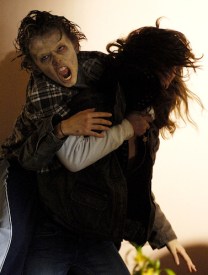 The other problem bemoaned by fans is that this is a reboot, of sorts. Romero’s previous zombie films feature no recurring characters and don’t sit properly within the same timeline, but they nonetheless feature an evolution of the zombie epidemic: it spreads from a one-night issue in Night to a dragging problem in Dawn, to an all-consuming one by Day, in which we see the zombies gaining in intelligence, to the point where they consciously form an invading force in Land. But Diary scraps all that, going back to the start of the epidemic. It doesn’t remake Night — in fact, it handles a few things notably differently (in Night the radio and TV report factual and helpful information; in Diary, they obscure the fact the outbreak is even happening) — but it does disregard the development Romero had taken the undead through.
 But, nonetheless, the epidemic did develop and evolve across Romero’s previous films, and that’s been lost here. Maybe there’s nowhere further to go with it? I’m not convinced of that. Perhaps Romero will have another idea and get to tell that story someday in the future, leaving Diary (and
 #84a Dr. Who and the Daleks (1965)
 #92 The Tale of Zatoichi, aka Zatôichi monogatari (1962)
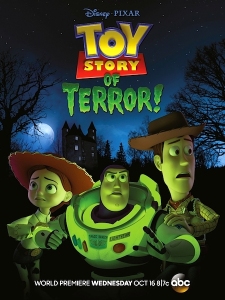 The fourth
 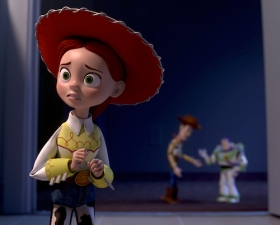 The second half is more familiar Toy Story stomping ground — indeed, if there’s one bum note, it’s that the villain and his ‘plot’ are almost a rehash of
 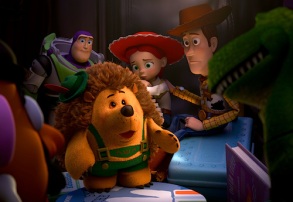 Apparently Toy Story of Terror! spent two years in development. While that might seem excessive for a mere under-half-hour animation, the time and effort have paid off handsomely: the result is a thoroughly entertaining short — and one that actually embraces its seasonal theme, rather than forcing it in as an afterthought. Terrific.
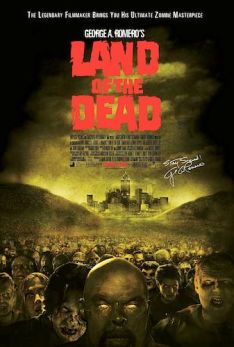 While the first three ‘Dead’ films (or “the original trilogy”, to put it in
 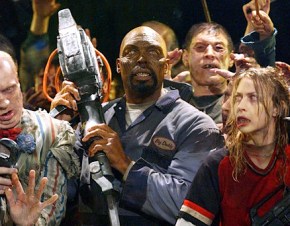 and then a desire for revenge, when he sees the glittering lights of the city in the distance. Lead he does, corralling the other zombies into a slow march towards their target.
 In the world of the humans, meanwhile, we also have an oppressed majority: the slum dwellers. Attempts at revolution there are soundly ignored, with the rich quietly taking the opposition out as ‘trash’ whenever able (which, I guess, is whenever they want). The people are controlled by drink, drugs, gambling, prostitution, and any other cheap entertainment you can imagine, all secretly managed from on-high to keep the general populace docile. And those entertainments are getting increasingly extreme, too: the zombie-on-zombie cage fights previously used cat or dog meat as motivation, but now they throw in Asia Argento. Again, Romero is holding a mirror up to present-day America, where the illusion of a ‘free society’ with easy social mobility is supported by the mega-rich in order to keep the poor down. It takes the zombie invasion for anything to change, which may be a case of Romero “following the story” rather than reflecting a political reality — who’s going to invade the US?
 Those commenters that do acknowledge these facets claim Romero’s just not as subtle as he used to be, which is also poppycock: Dawn’s criticism of consumerism is as blatant as anything listed here — perhaps even more so, because you can just watch Land as a near-future science-fiction humans-vs-humans-vs-zombies action flick, whereas I think Dawn’s ‘subtext’ is unmissable.
 If you want to see people getting ripped apart by zombies with their guts spilling out everywhere, in traditional Romero style, then… seriously, what’s wrong with you people?! But, erm, you should be satiated.
 Threequels, eh — who’d make ’em? It used to be received wisdom that sequels were poor, with only a few exceptions. That’s less often the case these days — indeed, it’s almost de rigueur that the first film in a potential franchise will exist to establish the world in preparation for a superior sequel. But how many great third films are there? There are some good ones, it’s true, but are there any that are the best film in their series? If there are, they’re certainly outweighed by the number that couldn’t live up to the quality of the two preceding parts.
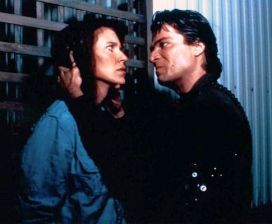 The same is true in Day’s criticism of science, especially vivisection. According to Romero (in the booklet that accompanies Arrow’s Blu-ray), he didn’t set out specifically to tackle that controversial area of scientific research. Instead, he developed a “next logical step” for what scientists would do to the undead. Of course, it’s horrific and criticism is implicit. Thankfully, Romero isn’t painting all science as bad: the lead character, our de facto hero, is also a scientist; but she’s not really interested in the vile work of her colleague, dubbed ‘Frankenstein’ by the soldiers.
 Bub salutes the Captain, an instinctive reaction the same as his shaving. That it leads to an ironic repetition at the film’s climax is perhaps satire, or perhaps just another cool moment. You have to hand it to Romero and co, though: it’s a great villain’s death scene.
 There’s probably an in-depth piece to be written on the evolving gender politics of the ‘Dead’ films, which I’m sure must reflect changes in society. Here, we have an unequivocal female lead, a scientist and voice of reason amongst the madness of both sides. She stands up for herself against the men, who belittle her as much as possible. Actress Lori Cardille has commented that she wanted to develop the woman’s role in these films, even beyond that of Fran in Dawn, who she saw as little more involved than the useless females of Night. Of course, as I noted last time, the role of Fran is considerably more involved and competent than that of Barbra or Judy, so it’s interesting that Cardille felt there was work still to be done. Not that she’s necessarily wrong; and the way the men treat her character in Day suggests that someone having a similar reflection on this film, nearly 30 years on, would find room for continued improvement.
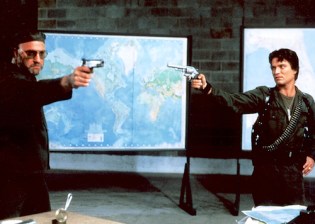 Romero’s critical stance evidenced here. I don’t even object to it being a bleak film, with little sense of hope for the future of humanity; in fact, there’s a lot to commend in that.
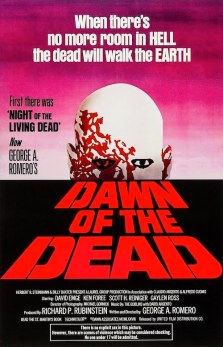 Dawn of the Dead is the
 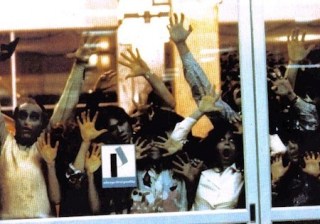 Romero has said he considers his zombie movies to be about the time they were made; a little snapshot of the world (or the US, at least) at the time. Thus consumerism is only one of Dawn’s targets, albeit the easiest to spot. Romero was ahead of his time here: gigantic out-of-town malls of this type were, apparently, new propositions at the time the film was made, and the one that stars here was amongst the country’s largest (it still exists, I believe, but now it’s considered a little’un). It’s not just the zombies who are critiqued either. Our protagonists choose to stay in the mall because it apparently has everything they could ever need, even though it also has the constant threat of the undead. On their first trip out for supplies, they’re as interested in expensive watches as food and tools. As time goes on it only gets worse: they turn their little attic apartment bit into a chic pad, with stylish chairs and all the mod-cons. In a world where the apocalypse has happened, they’re not fighting for their very survival, they’re living the high life. They even ‘rob’ the mall’s bank, “just in case” money is still worth something.
 The men, meanwhile, help shape a commentary on society’s desensitisation to violence. There’s disgust early on at having to shoot these human-like creatures in the head to get rid of them, but so unrelenting is such a task that it becomes everyday. This and the consumerism thread come together in the final act, when a gang of bikers invade the mall: declaring that the place is their possession, one of our ‘heroes’ has become so used to killing the living dead that he now has no trouble opening fire on the plain ol’ living.
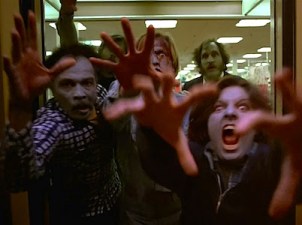 I also don’t hold much truck with that “the effects are bad” waffle. I mean, really, what do you expect? The film’s 35 years old! And y’know what, it’s not that bad. OK, the zombie’s skin tone is a little blatant — special effects maestro Tom Savini has said he was aiming for grey but it registered as rather blue on film. Then the blood is a vibrant red — well, loads of older films have that garish red blood, what of it? In fact, it was specifically requested by Romero, who wanted a comic-book-y colour to match what he saw as a comic-book tone to the violence. Then there’s all the flesh-eating gore, which is by turns heightened to the point of silliness and gorily realistic — the stuff with the guts towards the end… Savini was a war photographer in Vietnam and that in part inspired his effects work. You want to argue with a guy who’s seen the real thing that his work doesn’t look as ‘realistic’ as some post-millennial computer nerd’s hyper-CG version of things?
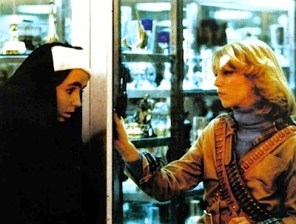 I have to say, the more I think and write about Dawn, the more I come to like it. It’s not really perfect — the biker climax comes almost out of nowhere, and I’m not convinced they were the most effective way to explore an ending. Perhaps this is where the “snapshot of the times” idea begins to fall down: distanced from the time in question, how resonant are those themes? Is that why modern viewers, coming to the film for the first time, miss them? (That’s not to discount the fact that most modern genre film viewers aren’t looking for grown-up viewing, but kids’ movie-style brightly-coloured action — with added gore and swearing to prove it’s actually for adults, despite the lack of adult thought or consideration required. Ironically, these once-B-movie cheap horror/thrillers are now, thanks to their political undertones, more suited to the art house crowd. I see why so many venerate ’70s cinema.) But (to get back to this paragraph’s point) there’s so much in Dawn, so much more than either a zombie kill-fest or a criticism of consumerism, that thoughtful reflection — and, I’m sure, future re-watches — are only to its benefit.
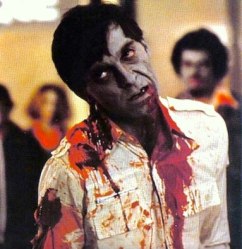 Immediately after viewing, I’d say I didn’t like Dawn as much as Night. Though it has many qualities I admire, it also felt a little less focused and more sprawling. The first I found tense and chilling — a Horror movie, albeit one with observable dramatic and thriller-ish elements. Dawn is, at heart, a Drama — it’s about the people in this situation, that situation happening to be an extreme horror one. But on reflection, the bits I was less sure of pale behind the things it does right.


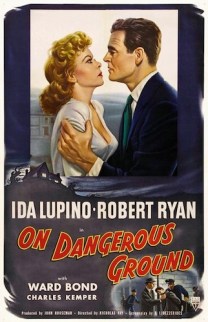 Helmed by acclaimed director Nicholas Ray (
 On the plus side, Bernard Herrmann’s score is unequivocally excellent, particularly the pulsating opening theme and the insistent action climax.
 100Films.co.uk