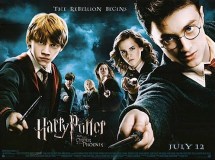
Harry Potter and the
Order of the Phoenix
2013 #45a
Original review
here.
.
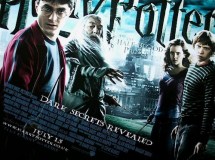
Harry Potter and the
Half-Blood Prince
2013 #47a
Original review
here.

.
Harry Potter and the
Deathly Hallows: Part 1
2013 #48a
Original review
here.

.
Harry Potter and the
Deathly Hallows: Part 2
2013 #52a
Original review
here.
2007-2011 | 568 mins | Blu-ray | 2.40:1 | UK & USA / English | 12 / PG-13
When David Yates joined the Harry Potter series halfway through, as the director of its fifth instalment, his main prior experience was in TV — quite a change from the series’ track record, which had included acclaimed or successful movie directors. But he seemed a wise choice nonetheless: one of his stand-out works on TV was State of Play, a complex conspiracy series that suggested he’d be the right man to handle Order of the Phoenix for two reasons. Firstly, the novel includes a significant ‘resistance thriller’ aspect, similar to the edgy underground-investigation style of State of Play. Secondly, the lengthy novel was to be condensed into a single reasonable-length film, necessitating an ability to tell a story clearly and concisely. State of Play may not have been concise (it’s a six-hour story, after all), but it was complicated and it was clear.
The resulting film is, arguably, one of the series’ strongest because it is so different to the others. If the much-discussed ‘darkening’ of the films really kicked in with Goblet of Fire and the death of Cedric Diggory, Phoenix only cements this tone. Our heroes are persecuted throughout — and not just the lead kids, but Dumbledore and the rest of the Hogwarts establishment too, as a Ministry of Magic in denial about the return of Voldemort seeks to crush the dissenting voices of Harry and his headmaster.
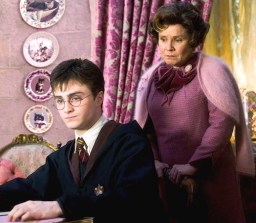 Their main weapon is Dolores Umbridge, perhaps the series’ most despicable villain, because she is so horrendously plausible. She seems to be all sweetness and light, but it masks a dangerous streak that sees her eliminate any fun from the school and, in one of the most sadistic sequences in either the novels or the films, she has Harry write lines with a magic quill that cuts each one into the skin of his left hand. The Potter series actually has its share of nuanced villains, but Umbridge is thoroughly unlikeable. Though she’s defeated and carted off at the end of Phoenix, she resurfaces in Deathly Hallows. I don’t recall if her final fate is expounded upon, on page or screen, but I’d quite like to see her ripped to shreds.
In one of the numerous special features on the Harry Potter Blu-rays, producer David Heyman notes that most directors finish a film of Potter’s scope and want a rest, or at least a change of pace. It’s why Alfonso Cuarón and Mike Newell only have one each to their name; it’s why the Bond films haven’t had two back-to-back entries from the same director since the ’80s; and so on. Not so Yates, however, who ended Phoenix hungry for more. Or hungry to establish a film career, take your pick. And so he also took on the next film, Half-Blood Prince.
It’s easy to accuse Half-Blood Prince of being all prelude to the climactic events of Deathly Hallows; it certainly feels that way first time through. There’s considerably more to it than that, even if the titular mystery is barely a subplot — especially in the film version where, once again, the sheer length of the novel necessitates massive cuts to the source text. But perhaps the most remarkable thing is how funny the film is. Between the return of Voldemort, the suspicion cast on Harry, and a devastating final battle, Phoenix is an incredibly gloomy film; as things roll towards the climax, packed with more deaths and villain victories, Deathly Hallows is too; and sandwiched in between, with one of the saga’s most gut-wrenching finales, you’d think Half-Blood Prince would be more of the same.
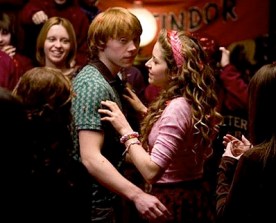 But not so. Yates approached his follow-up with a stated aim of introducing more comedy, believing the three leads to be talented in that area but not having had a chance to show it in his dour first film. So here we get a whole subplot given over to Ron’s attempts to join the Quidditch team, as well as much focus on the trio’s romantic entanglements — teenage love always being a good topic for humour. The film is not without its dark side, but peppered liberally throughout are those comedic subplots and scenes that are liable to see the viewer laugh perhaps more than in any other Potter film. It’s easy to miss this element — the main plot is, as always, getting darker and more serious — but once it’s been highlighted (as the makers do in the film’s special features) I think it becomes very noticeable.
Perhaps the other most notable aspect of Half-Blood Prince is the cinematography. Like most of cinema throughout the ’00s, the Harry Potter series shows a gradual shift from a very filmic look, to digital intermediates, to (in some cases) a wholly digital output. This is where it becomes most notable, I feel, with many sequences (especially those involving extensive CGI, like the Quidditch) graded and smoothed to the point where they look almost like a concept art painting rather than a real-life sequence. This is especially obvious if you watch any clip-laden series-spanning documentary, where Half-Blood Prince clips rub shoulders with any previous film and stand out like a sore thumb; but even in the movie itself, without that outside context, it’s sometimes highly noticeable.
The other thing it is is dark — not the story, but the visuals. This reaches its nadir in Deathly Hallows (both parts), which include some shots so dark it looks like some light-black shapes may, perhaps, if you squint and strain, be moving over some dark-black shapes. It’s ridiculous. I have no idea if it functioned OK in the cinema, but on a TV at home it most definitely does not. This seems to be a growing trend in films, though the Potter finale contains some of the worst examples I’ve yet seen. I don’t know the reason, but I presume it’s a tech thing — cameras that can function better in low light; 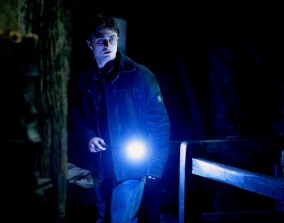 grading the film in perfectly-calibrated conditions so they can really push it to extremes, not considering how most end-users will view it; and, much like fast-cut action scenes, an over-familiarity with the material that means the director/editor/grader can see what’s going on because they’ve watched it dozens (or hundreds) of times, which doesn’t work for a first-time viewer in the middle of the film. As you may be able to guess, I’m not a fan.
By the time of these final two films, it seems Yates has moved from being a TV director skilled in complex plotting, to one very much at home with big effects-driven set pieces. The Battle of Hogwarts, which consumes around 90 minutes of the final film, is an epic and often jaw-dropping affair, though still laced through with the final plot developments and the completion of various character arcs. That said, it’s far from perfect, undermined by a pair of apparently opposing sets of decisions: on the one hand, to flesh out fan-favourite moments to give them too much emphasis (Mrs Weasley’s duel with Bellatrix is over-played; Harry and Voldemort’s final confrontation is amped up to the point it loses the book’s emotion); on the other, slavish faithfulness leaving some moments without enough emphasis.
The biggest crime of the latter is the very end: the battle over, Harry, Ron and Hermione stand outside Hogwarts, survey some of the damage, have a little chat… and then it abruptly cuts to a couple of decades later for the epilogue. For me, it doesn’t feel as if there’s enough space there, enough time to breathe, to consider the impact on the series’ supporting cast — many of them favourite characters, as vitally important to the viewer as they are to the lead trio. How will the Weasleys cope with their losses? What about those others who have lost almost everyone they hold dear? Where have the Malfoys gone? There are nods to this in a montage around the Great Hall / makeshift mortuary, but it feels underplayed; like we need a scene of life-goes-on normality set a few weeks or months later, 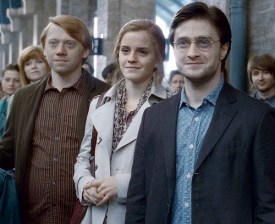 not a sudden smash-cut to a few decades on where we see how some characters’ lives have developed. I know some people complain about Lord of the Rings’ multitudinous endings but, one, they’re wrong, and two, Potter only has one and an epilogue — sure, the first completes the drive of the storyline and the second is a neat coda, but in between I feel we need more of a character-based resolution.
But hey-ho, it is what it is.
In the end, the TV director hired for a very specific filmmaking skill wound up in charge of exactly half the Harry Potter series. If there was a half to have a single voice in charge of, it’s this one, with one long narrative permeating the films in a way it doesn’t the first four. And yet, for that, each has a distinctive style and voice — well, apart from the two parts of Deathly Hallows, which are really one long film split into halves. Was it the right move, for the series? It clearly produced popular movies, but, thanks to the storyline, it’s already easy to regard the Potter series as four or five stories rather than seven, the last three books merging into one epic tale in three acts — a trilogy, if you will — rather than discrete stories, like the first four. By putting the same man behind the camera for them all, the films just emphasise this point. But maybe that doesn’t matter.
 It’s hard to offer a final summary of the Harry Potter series. Some people see them as mediocre and overblown; for others, they are their life. Personally, I think they develop from sometimes-uncertain roots in the early films, to a flourishing series of epic fantasy movies. There are often niggles of one kind or another, be it acting (I forgot to discuss Emma Watson’s eyebrows!), or cartoonish designs, or too-faithful adaptation, or abbreviated adaptation, or what have you — but none of these are ever-present. More importantly, every film offers something to enjoy, and the growing maturity — of not only the cast, but also the filmmaking — means their impact only increases when viewed as an entire eight-film saga.
One for the ages? Movie and genre fans of a certain age might say, “don’t be so daft”; but I wouldn’t be so certain.

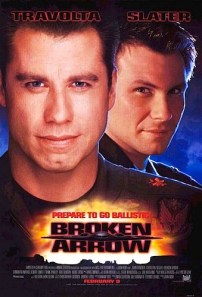 US Air Force pilot Jon Travolta crashes a plane, steals a nuke, and former friend and colleague Christian Slater must stop his dastardly plan in this ever so ’90s actioner.
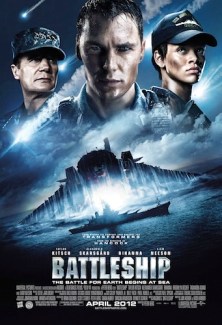 Battleship never sounded like a good idea. An adaptation of a board game that in no plausible way resembles real life? At least
 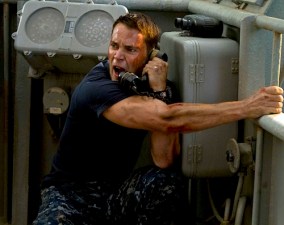 hobbling up a mountain on prosthetics to realise he’s still worth something as he saves the day. America, fuck yeah! And when the main battleship is ruined, our plucky heroes have no choice but to co-opt the museum piece (literally) WWII ship; and because most of their crew is dead, the museum guides — all of them septuagenarian WWII vets — have to man their ship once again. To defeat those invading scum, just like before!
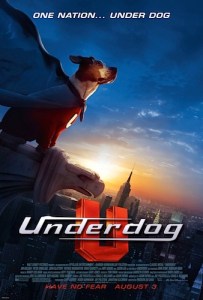 In this big screen live-action version of some old US cartoon, a dog gets superpowers and, naturally, becomes a superhero. That’s pretty much it.
 I have no idea if this is of use to anyone. Probably not. But it’s a slightly interesting, different way of looking at my review archive. For instance, compiling it threw up some odd things, such as James Hill. Who, you may ask? Indeed it’s no surprise I hadn’t noticed I’d watched two films directed by him. More interesting was what they were: lovely family animal movie
  June’s films
 Obvious, I know, but it really is the archetype. Burton delivered two Bat-films that were critical and commercial successes; Schumacher delivered one that didn’t go down so well but turned a healthy profit… and then this. A critical disaster, a box office flop, the series went down with it. It took others to revive the superhero genre, a seven-year gap, and a ground-up reboot to save the series.
 Six years after the TV series ended (was that all?), ’90s favourites Mulder and Scully returned. Hopes for a third film dealing with the series’ cliffhanger-ish ending were dashed by this low-key supernatural fable, released in a glaringly inappropriate summer slot, with none of the aliens casual viewers expected and too many incidental ties to the series. Some still whisper about a third movie, but 2012 was the perfect time and that’s long gone.
 The
The  The first
  “But there was a
  This fourth entry in the Death-defying horror franchise was due to be the series’ last — hence the definitive article title. In no small part due to being released in 3D in the immediate run-up to
  Final Destination 5 is the latest Final Destination film. Do you really need a plot description? They all have the same story.
 although on reflection it’s meaningless; a clever nod that isn’t really clever, but is neat. And perhaps means the series is finally going to rest.
 Andrew Garfield dons the webbed onesie for an unwarranted reboot of the only-one-decade-old Spider-Man film franchise, retelling his origins… but with a twist! Cos, y’know, the last version was only out about 10 minutes ago.
 some of the action sequences are alright. Mercifully, the much-trailed first-person segments are cut down to a minimum; kind of a “we made this so we ought to use it, but we’ve realised everyone was going to hate it”.
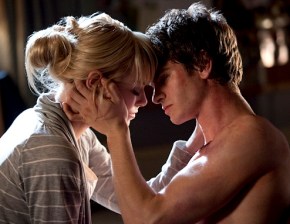 Not that it pays off — instead it just feels like the action scenes were bunged together because, hey, some of the fans want that stuff, right?
 Notorious (to me) for unjustly beating
  Remember
 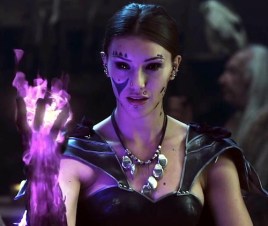 Director Gerry Lively helmed the preceding D&D movie and some stuff you’ve never heard of, as well as serving as DoP on such auspicious-sounding films as
  100Films.co.uk