2012 #61
David R. Ellis | 82 mins | Blu-ray | 2.40:1 | USA / English | 15 / R
 The best thing about The Final Destination is its title, because turning the series’ familiar name into a definitive article for the final entry is really quite a neat move. Sadly, it was a hit and they’ve made more. Why it was a hit… God only knows.
For starters, the story (such as it is) is a complete and utter rehash of the plot of every other film in the series. The only thing on its side is efficiency: it races through ‘plot’ scenes in a quest to find the next set piece. For example, the Rules are explained to this all-new cast because they Google “premonitions” and find out what happened in the previous movies. The overriding sense of familiarity makes for kind of depressing viewing. Previous films tried to find new twists on the rules, ways the cycle might genuinely be broken, etc, whereas this seems content to merely move from one death to the next. Aside from creative ways to kill people, literally the only new idea is that the premonition-haver sees two people die at almost exactly the same time and can’t remember who was first, meaning instead of traipsing to warn the next person they have to find two people. And that’s it.
Production values are low too, featuring very cheap CGI and very poor acting. I’d say both are below the standard of US network TV filler, so for the fourth entry in a fairly successful big-screen franchise that seems even more woeful. I know it’s only Final Destination, but still… The cast aren’t helped by the woeful screenplay, but I don’t think they could’ve enlivened a better one either. They’ve clearly been cast just for being Young and Pretty, but surely there are some Young, Pretty people who can act?
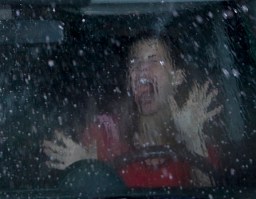 The focus is clearly on the deaths — at 11 it has the highest of the series, and with its short running time that means there’s a fatality every seven minutes. They’re also very gory, more so than in previous films I’d say, but they’re not commensurately more inventive. There’s a very thorough line in misdirection at times, but the whole enterprise feels painfully lacking in creativity. I’m not sure some of them even make sense. But then do they need to? Similarly, there’s some customary low-rent-horror-movie completely-gratuitous nudity too, which I’m sure delighted teenage boys even more in 3D.
None of the deaths matter because nothing is done to make us care about these characters, or even be broadly interested in them, unlike the best of the earlier entries. So there’s zero tension, zero emotion, just elaborate death after elaborate death. It’s one of the most hollow films I can think of. It may even have been better if they’d ditched the attempts at a plot and gone for a series of vignettes in which, unbeknownst to one another, the survivors were bumped off in order. That’s basically what this film wants to be anyway. At least it would’ve been something different. And shorter. And when you want an under-80-minutes (before credits) film to be shorter… oh dear.
The 3D factor was a large part of the film’s promotion, and it makes full use of stereo visuals in exactly the way you’d expect a schlocky horror to. Problem is, it’s so designed for 3D that some of it doesn’t work in 2D. It’s not just the usual array of stuff flying at the camera for no reason — 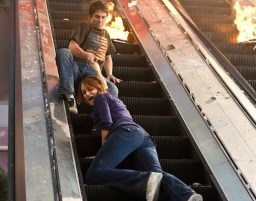 that’s a sure sign it was meant for cheap 3D thrills, but otherwise fine — here, stuff pokes straight out. That means in 2D you see, say, the flat end of a pole, with absolutely zero sense of depth. This happened with one trap in Saw 3D, but in The Final Destination it keeps coming up. It might not sound like a serious problem, but again and again it jars as you try to work out exactly what’s where in the very flat straight-on 2D rendering. Maybe it’s good that 3D films are so thoroughly designed for their intended medium, but I’m not convinced.
As mentioned, this was sold as the final Final Destination — hence the definitive-article title — but it was a surprise hit (thanks in no small part to the 3D, back in the Avatar-hype era when it guaranteed anything a significant boost) and so the series has continued. What’s perhaps most odd, however, is that it makes no serious attempt to bring the whole series to a close. Sure, #3 ditched any links to the first two with a brand-new cast as well, but you’d think, knowing this was The Last One, they’d try to bring it full circle somehow. But clearly not.
Then again, I’m not sure anyone involved could have if they wanted too. The evidence for that is on screen: some of it is unbelievably boneheaded. “Where’s Lori?” “I dunno, I’ve been calling and texting all afternoon, she won’t pick up her phone.” Oh, maybe she’s, I dunno, in the film she told you she was going to see in the scene before last! Dear God.
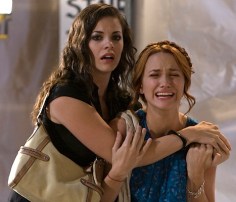 Elsewhere, one character starts talking about déjà vu before getting killed in the same way as the first film’s most famous death. I suppose it’s meant to be Meta and Funny, and maybe it kinda is, but again the CG is so cheap that the half-trained eye will spot an effect is about to happen, and the manner of death once again doesn’t really make sense. Later, we learn that shopping mall sprinklers can instantly extinguish all fires — handy!
I could go on. I have half a dozen more examples in my notes. But no. It’s so woeful that it’s kind of frustratingly bad — you want someone with half a brain to come along and make the film work.
There’s a somewhat amusing way to judge the Final Destination series: its posters and/or DVD covers; and, specifically, what they tell us about the decreasing importance of character to the franchise. You see, the first prominently features head shots of the central cast (albeit half turned into skulls). The second offers either blurry head shots or full body shots, reducing their recognisability. In the third, the cast are still there, but reduced to near-facelessness seated on a roller coaster, often upside down. And by the fourth, they’re not even there at all. It’s true that Final Destination has never really been about the characters — it’s about how they die — but it’s also true that the more attached you are to them, however superficially, the better (as it were) their deaths are. Perhaps it’s just a coincidence that the characters, deaths and films get weaker at about the same rate, or perhaps each really is connected to the others.
 There’s potential in the concept of the Final Destination films, but clearly it’s either limited or the people in charge don’t know how to exploit it, because after making two quite-good films they’ve turned it into a repetitive, stale, uncreative, formulaic disaster. And there’s now a fifth too, and a sixth hasn’t been ruled out — surely it/they can’t be any worse than this? Based on form, maybe they can…
The Final Destination is on Film4 and Film4 HD tonight at 11:05pm, and again on Friday 21st at 11:10pm. Because I’m sure you really want to see it now.
This review is part of the 100 Films Advent Calendar 2012. Read more here.
The Final Destination featured on my list of The Five Worst Films I Saw in 2012, which can be read in full here.

 16 years after they first swashed their buckles for director Richard Lester, Michael York, Oliver Reed, Frank Finlay and Richard Chamberlain return as the titular swordsmen in an adaptation of Alexandre Dumas’ Vingt ans après, aka Twenty Years After. As feats of sequalisation go, there’s something inherently pleasing about reassembling a cast and crew the best part of two decades later to adapt a tale set at a similar distance.
 Conan was created by Robert E. Howard in 1932, but is probably best known to most thanks to
  or the filmmakers ignored his work in favour of familiar bits and bobs from other sources. Visually it’s just as non-inventive, which is what you get when you hire the director of
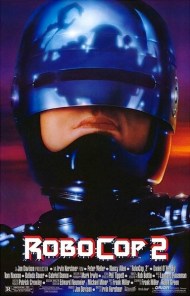 The consensus opinion seems to be that the RoboCop films exist on a steep downward trajectory of quality, starting with the pretty-good
 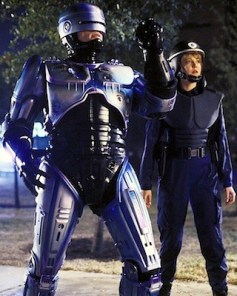 and though it was reportedly massively re-written after his work was done (to the extent that, decades later, there was a comic book miniseries that adapted his original version) I think his touch can still be felt at times.
 In a crime-addled future Detroit, cop Alex Murphy is gunned down by a gang of crooks, only to be resurrected by evil megacorporation OCP as the future of law enforcement: RoboCop. Obviously — that’s the title.
 Despite winning a bunch of Canadian film awards, this First World War drama seems to have been really poorly received by critics — the
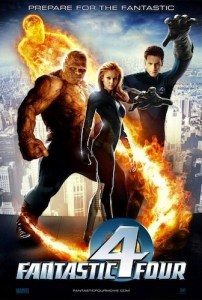 In the wake of highly successful franchise launches for
  which
which 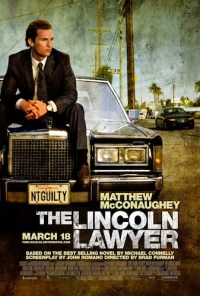 Adapted from a novel by best-selling author Michael Connelly, The Lincoln Lawyer seemed to appear out of nowhere and garner an uncommonly high amount of praise. I’m glad that intrigued me, because, while not a revelatory experience, it’s certainly worth your time.
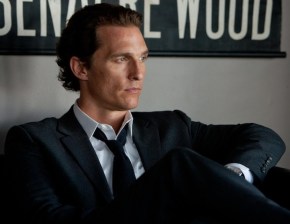 I’m not sure I’ve ever seen McConaughey in anything (nothing I remember, anyway), but my impression has been he’s not all that. Here, though, he nails the slightly-smarmy-but-kinda-likeable street-wise defence attorney Mick Haller. He’s buoyed by a quality cast: Ryan Phillippe is eminently plausible as a rich kid used to getting his own way, while the likes of William H. Macy, Marisa Tomei, John Leguizamo and Bob Gunton offer typically consummate support.
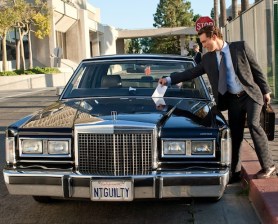 after languishing in development hell for 20 years, he recently paid Paramount $3 million for the rights to his most prolific character. With said character being the half-brother of Haller, and that Lincoln Laywer sequel in development, maybe Connelly’s work is destined to become the Marvel Cinematic Universe of crime/legal film adaptations. This could be the time to get in on the ground floor.
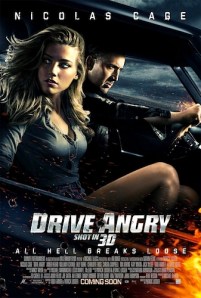 Nic Cage does the
  Only in that stuff flies at the camera and whatnot. You can indeed tell it was made for 3D, but that doesn’t mean it needs it. Indeed, the poke-the-audience stuff aside, none of it suggests it would look great in 3D — for all the pointlessness of cinema’s new money-spinning format, it can add something to the vistas in a film like
  As noted, director Lussier does not have an inspiring CV: he started with numerous straight-to-video sequels, then a big screen sequel-no-one-wanted (even with Nathan Fillion in it) in
  Some have been quick to call twenty-something writer-director-actress Lena Dunham “the voice of a generation”; usually older people who think this is how people that age are, because I’m part of Dunham’s generation and she certainly doesn’t speak for me, and you don’t have to go far or look hard on the ‘net to find similar views. But it’s turned out alright for her, as by whatever ridiculously young age she is she’s made this film, got a multi-season series on HBO (the critically divisive
  Trying to read Dunham’s intentions in these regards is complicated by the film being clearly autobiographical. And if it isn’t, it’s working overtime to suggest it is. Dunham writes, directs and stars as the lead character; said character’s mother and sister are played by Dunham’s real mother and sister; I wouldn’t be surprised to learn her friends are played by her friends. Her apparent status as ‘the voice of a generation’ and the little I’ve read about her HBO series suggests to me that this is, if not 100% true to her life experience, at least a fictionalised version of it. Which again begs the question, are we actually meant to like some of these people? To identify with them? It’s clear Dunham has no problem with putting herself down and presenting herself in a negative light, but it feels to be in an angsty, whiny, “you totally get this, yah right?” way.
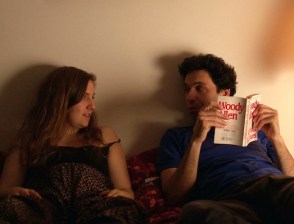 Many reviews cite Woody Allen as an influence, and it’s easy to see why: a small-scale autobiographical dialogue-driven New York-set study of specific people in a specific time. It falls short of such lofty aspirations on a few fronts, not least the evocation of the setting — there’s no trouble doubting this is set in New York, but you don’t feel the city the way you do in
  the hand is reaching out to you, but when you reach out to take it you find there’s actually nothing there; it was just an illusion.
 100Films.co.uk