Winnie the Pooh (2011)

2011 #99
Stephen J. Anderson & Don Hall | 63 mins | Blu-ray | 1.78:1 | USA / English | U / G

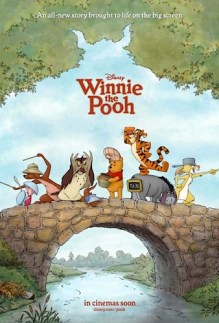
Winnie the PoohWinnie the Pooh, as many reviews on its release were keen to point out, is for small children. It doesn’t have the attempts to placate adults with their own jokes that elevate/plague most American animation; it’s only an attention-span-friendly hour long; and it has a lovely, genial, friendly tone, with brightly coloured characters, plinky-plonky songs and heartwarming moral messages.

The thing is, I don’t hold that this makes it “just for ickle kiddies”. Sure, it can, and when it’s done poorly it most certainly does, but that’s not Winnie the Pooh. Look back to A.A. Milne’s original stories and you see the same thing: ostensibly it’s just for the kids, but there’s actually all kinds of wordplay and (admittedly, gentle) subversion that’s clearly targeted at the adult reading the book. This new film captures that same effect. Naturally this means it won’t work on the cynical or black-hearted viewer, or the Mature type whose favour isn’t even curried by the adult-targeted jokes in a Pixar film, but for the rest of us it can make it a delight.

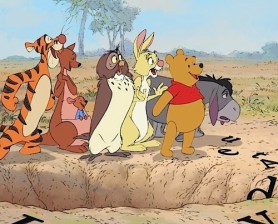
In few other films would you see the characters interact with the narrator; see them scramble across the words in the pages of the book their story comes from; indeed, see the presence of those tangible letters help along the plot — I won’t spoil how. You don’t have to love Winnie the Pooh in an ironic still-a-child-at-heart kind of way, even if the presence of real-life Manic Dream Pixie Girl Zooey Deschanel on vocals suggests you might — it’s clever and witty enough to transcend that.

Interacting with lettersThe majority of the film’s other elements click into place nicely too. The traditional animation is gorgeously executed, the voices are the ones we surely all know from growing up alongside Disney’s Pooh output, particularly Jim Cummings pulling double time as both Pooh and Tigger, as he has for decades. The exception I’d make is Bud Luckey’s Eeyore. I don’t know if he’s always sounded like that and I’d forgotten, but his voice didn’t work for me. It’s not the only problem: the songs can be a bit insipid; equally, a couple transcend that to work beautifully; and there’s no denying that it is a bit short; but then it doesn’t outstay its welcome, and hey, Dumbo’s no longer.

The American Academy have overlooked Winnie the Pooh in their nominations this weekend (not to mention Tintin, and probably some other stuff I’ve forgotten), I imagine writing it off as “just for little kids”. And that’s a shame, because I don’t think it is. I certainly loved it more than Rango and it’s definitely better than Kung Fu Panda 2, to pick on the two nominees I’ve seen. I struggle to believe I’ll find Puss in Boots more endearing.

Nonetheless, as much as I would dearly love to give a new Winnie the Pooh film full marks, there are a few niggles that hold me back — the songs, Eeyore’s voice, the length. But it is ever so lovely, and it came ever so close.

4 out of 5

The 2012 Oscars are on Monday at 1:30am on Sky Movies Premiere.

Winnie the Pooh merited an honourable mention on my list of The Best Films I Saw For the First Time in 2011, which can be read in full here.

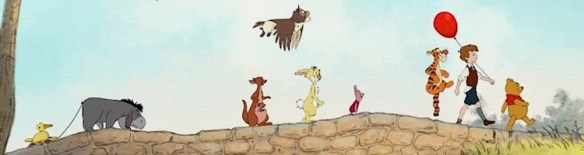
Marching

Ip Man (2008)

aka Yip Man

2011 #62
Wilson Yip | 106 mins | TV (HD) | 2.35:1 | Hong Kong & China / Cantonese, Mandarin & Japanese | 15 / R

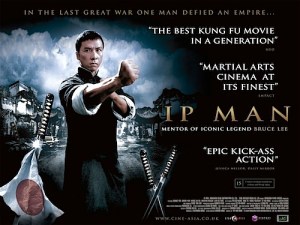
Ip ManI liked Ip Man, but as we know from experience there are times when I find myself with little to say about a film, or I fail to make any notes, and this was an example of both. So I’ve decided to try something a little different.

I’ve read several different reviews of the film, found by various means, and have compiled a selection of quotes from them below. These are all segments of those reviews that I agree with or found to be an interesting point — I’m not trying to accurately represent each reviewer’s opinion, but instead using their words to enlighten my own. Each quote is, of course, credited and linked, so if you want to know their full opinion you can click through.

They’re arranged in an order that I think makes sense, too — by which I mean, rather than just bundle a selection of quotes in any old order, I’ve sorted them so that if you read them through as presented they should form a structured (more or less) piece.

And so:

Biographical martial arts drama starring Donnie Yen. China in the 1930s: Ip Man’s reputation as a martial arts master has brought fame and fortune to the city of Foshan. But hard times are ahead, as the Japanese invasion brings the once prosperous city to its knees.

Donnie Yen plays the eponymous Wing Chun master, who stove off hunger, poverty and half the Japanese army during China’s WW2 occupation – by kicking ass!

– Matt Giasby, Total Film

Donnie YenThough that’s an amusing thought, the film’s not quite that simplistic:

As he rallies his people to stand up for themselves, Ip Man becomes about how war pushes a peaceful man into action, but also how he tries to maintain his faith in what it means to be civilized.

– Noel Murray, AV Club

Ip’s transformation from diffident bourgeois to symbolic man of the people is rendered as compelling period melodrama

– Andrew O’Hehir, Salon.com

There’s a pleasing playfulness about the opening scenes, which contrast… with the downbeat mood that follows during the occupation.

– Jamie Healy, Radio Times

Not everyone was so impressed:

In transforming a humble real-life martial artist into the type of the reluctant hero (and nationalist icon), screenwriter Edmond Wong has turned his subject not only into something that he was not, but also into an overfamiliar kung fu movie cliche. This is an impression not helped by the film’s desaturated period look (yet another cliche), and a drift in the second, war-set half towards melodrama

Film4

a shameless hagiography that only bears a passing resemblance to history.

– Dan Jolin, Empire

To elucidate:

The presence of young Zhun [Ip Man’s son] suggests an eyewitness veracity to the events as portrayed on-screen — after all, Zhun himself, now a much older man and a wing chun master in his own right, served as a consultant on Ip Man. The film, however, does not hesitate to sacrifice the truth to the demands of dramatic entertainment.

Film4

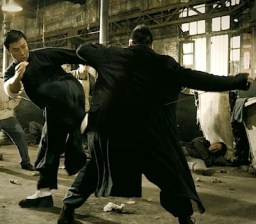
Everybody was kung fu fighting

almost none of what you see in Ip Man actually happened, and in some sense that’s too bad, because the real Ip sounds like a fascinating figure. He was a pre-revolutionary police officer, a reported opium addict, and a refugee who fled the Communist takeover in 1949 for a new life in British Hong Kong. But all those factors make him undesirable as the hero of a work of rousing nationalist agitprop. So instead we get Yen’s remarkable performance as a man of prodigious Buddhist-Confucian composure and tranquility, who goes from wealth to poverty to near-slave status, and finally must fight a public gladiatorial match against a sinister Japanese general

– Andrew O’Hehir, Salon.com

disappointingly simplistic. Yip, Wong, and Yen never develop any real tension between Ip’s true story and the exaggerated myth-making of a martial-arts movie. But as an exaggerated, myth-making martial-arts movie, Ip Man is often thrilling.

– Noel Murray, AV Club

True-to-life or not, action star Donnie Yen largely shines in the lead role:

Donnie Yen delivers a charismatic portrayal of Ip Man, the martial arts master of the title.

– Derek Adams, Time Out

Man is the role Yen was made to play: a stoic tough guy that everybody in the community knows is the best

– Simon Abrams, New York Press

Yen’s performance is also a bit one-dimensional as the modest wing chun expert, but at least he gives a good account of himself in the finely composed and inventive close-combat scenes — an impressive highlight being when he wipes the floor with ten soldiers with methodical precision.

– Jamie Healy, Radio Times

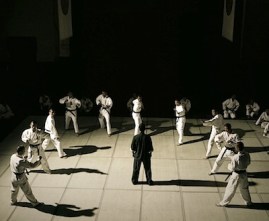
Eleven on oneIndeed, fighting is still what the film does best:

As a showcase for the distinctive moves of Wing Chun, or more generally for some formalised (if largely wire-free) chopsocky, Ip Man is exemplary, thanks to the action choreography of cult Hong Kong star Sammo Hung.

Film4

Hung’s fight choreography is clever and exciting, with sequences that have Ip felling a sword-wielding rival with a feather-duster, or holding off two men with a 10-foot pole.

– Noel Murray, AV Club

That final conflict between evil General Sanpo and Man — who of course still has to fight the biggest bad guy since the locals are too incompetent to even fight a group of disorganized bandits — is also curiously ruthless. Sanpo is likened to Man’s coat rack-like training apparatus, making the flurry of blows Man rains down on Sanpo’s head a vicious attack on a dehumanized piece of furniture. It’s a fittingly abstract and totally brutal finale.

– Simon Abrams, New York Press

There are definitely better kung-fu flicks in terms of pure action spectacle, but Ip Man delivers as tremendous entertainment even if you don’t much care about martial arts.

– Andrew O’Hehir, Salon.com

It’s not all rosy:

The film was a box office hit in China… That may have had less to do with the excellent fight sequences, directed by Sammo Hung with the help of one of Mr. Ip’s sons, than with the appeals to nationalism and, particularly, the heavy-handed depiction of the occupying Japanese as giggling sadists or implacable killing machines.

– Mike Hale, New York Times

The Japanese themselves couldn’t be more stereotyped in their presentation, with the honourable-but-brutal general and his cackling, sadistic henchman

– Jamie Healy, Radio Times

a sinister Japanese generalOn the other hand, as that “sinister Japanese general”:

Hiroyuki Ikeuchi… imbues what could have been a cardboard villain role with dignity and grace

– Andrew O’Hehir, Salon.com

To revisit Film4’s point about the “desaturated period look (yet another cliche)”:

Yip’s aesthetics are more muted and traditional than those of well-known florid imports Hero and Crouching Tiger, Hidden Dragon. Yet such modesty is in tune with his soft-spoken protagonist, and also provides clean, sharp views of Yen’s awe-inspiring skills

– Nick Schager, The Village Voice

But in conclusion:

a throwback to those chopsocky Hong Kong films of the 1970s – a period piece filmed on obvious but eye-pleasing studio sets with wall-to-wall kung fu and a simplistic, philosophical message.

– G. Allen Johnson, San Francisco Chronicle

I’m not qualified to judge whether [Ip Man] belongs among the top martial-arts films ever made, an opinion that’s been gaining credence as the movie bounced around the world… But there can be no doubt that director Wilson Yip has crafted a gripping, rousing, beautifully structured yarn, built around a calm but charismatic star performance by Donnie Yen and magnificent action sequences choreographed by the legendary Sammo Hung.

– Andrew O’Hehir, Salon.com

4 out of 5

Consulted sources (including some unquoted)

Glorious 39 (2009)

2011 #74
Stephen Poliakoff | 122 mins | TV (HD)* | 2.35:1 | UK / English | 12 / R

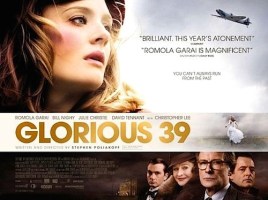
Glorious 39“This year’s Atonement,” proclaims the poster, and DVD cover, and probably much more of the marketing for Stephen Poliakoff’s first venture into the cinema for 12 years, in the process probably explaining why he’s made (or “how he found the funding to make”) the return-jump from exalted TV auteur to cinematic hopeful: the titular “39” means “1939”, the year World War II began. Throw in a plot that concerns the aristocracy and an ‘English rose’-type to stare thoughtfully open-mouthed into the distance on all the posters, and Poliakoff’s film is automatically lumped in the same ballpark as Joe Wright’s Ian McEwan adaptation. Only this one comes light on awards nominations.

I was going to add “light on star power” too, but whereas Atonement could only offer Keira Knightley and a still-rising James McAvoy, Glorious 39 offers a host of above-the-title names: trailing behind Atonement‘s own Romola Garai we find Bill Nighy, Julie Christie, David Tennant, Jenny Agutter, Jeremy Northam and Christopher Lee, not to mention a host of other recognisable British faces. If the combined cult might of Mr.s Tennant and Lee wasn’t enough to make this a hit, nothing could be. Some quite critical reviews obviously didn’t help.

Duplicitous 39I, however, thought it was rather good. I can see what turned some people off though. It’s a thriller, but it moves leisurely, especially early on. It’s also quite elliptical at times, not so much requiring you to pay attention as put the pieces together yourself. Plus it lacks a grand finale in which the hero triumphs, or at least loses in dramatic style — it’s quieter than that. Yet I liked the ending, finding it triumphant in a whole other way. But I won’t go spoiling that here.

It’s very much a Poliakoff work, I think. Perhaps that catches some film critics unawares: as noted, he worked solely in TV for over a decade before this, albeit in an auteur mode, writing and directing his own TV movies and miniseries, and perhaps this means he passed them by. But then that’s just about managing expectations. It’s not a melodramatic epic love story like Atonement, nor is it a pacey wartime thriller like… no example comes readily to mind, actually. Can someone please make a pacey wartime thriller? Or tell me which I’ve missed/forgotten?

By taking its time it creates a mood of creeping terror and dread; of an oppressive conspiracy that our hero, who’s just a fairly ordinary girl, has no chance of overturning — if it’s even real, and if she can find details about it if it is. And, by extension, by taking its time it’s being A Bit Different, and that means you can never be sure where it’s going to go; never be sure who’s on the side of the angels and who of the devils; of who is reliable and what is really happening; of who will survive. Suspicious 39What’s better in a thriller than not actually knowing what will come? There should be twists in this genre — genuine twists when possible, not a stock array of “small character played by famous actor turns out to be vitally important” or ” good guy is actually bad guy” or what have you — and Glorious 39, with its balanced uncertainty, pulls some of those off.

It’s also well written, prettily shot, and expertly performed by that array of quality performers. I don’t recall a weak link.

Ignore the critics, ignore the comparisons to Atonement, and give Glorious 39 a chance on its own terms. I very much liked it.

4 out of 5

* I own Glorious 39 on DVD, but watched it on TV when it premiered because it was shown (and available on iPlayer) in HD. There is no UK Blu-ray of the film, but I believe one is available in America. Such a fate seems to have befallen several British films of late — Easy Virtue is another example that quickly comes to mind. ^

Battle Los Angeles (2011)

aka Battle: Los Angeles

2011 #86
Jonathan Liebesman | 116 mins | Blu-ray | 2.40:1 | USA / English | 12 / PG-13

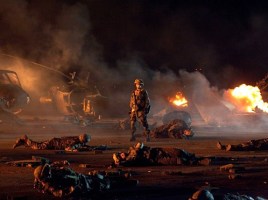
Battle Los AngelesBattle Los Angeles (on screen; Battle: Los Angeles on posters — c’mon, let’s have some consistency with punctuation! Punctuation matters) seemed to come in for a wall of criticism when it hit cinemas way back whenever. For my money, though, it wasn’t that bad.

Others have described it as “Independence Day meets Black Hawk Down”, and for once that formulaic “X meets Y” description is bang-on. Like ID4, there’s a worldwide alien invasion in progress by a superior species that dominates Earth’s forces pretty quickly. Unlike ID4 (and therefore more like Black Hawk Down) there’s no multiple perspectives or look at the command level; we just follow a small band of men on a very particular mission — head to a police station and extract civilians before the US Airforce bombs the area in three hours’ time — with only snatched glimpses of the wider conflict on news reports, Cloverfield style. It’s a different way of handling a military-focused big alien invasion movie, so that works.

For the most part, anyway. It’s thrown away at the end as our particular band of heroes wind up the only military presence left in LA and happen across the command & control centre of the enemy, promptly setting out to destroy it with laser-targeted missiles. Small scale “one force in a much larger battle” drama is exchanged for world-saving grandeur. Ah, America.

Somebody please think of the childrenThis kind of gung-ho militarism is laid on too thick. It seems fine for much of the film, but then as it heads into the second half and, especially, the third act, we have to suffer all manner of speeches and Emotional Moments that lack weight due to characterisation issues. The latter is badly handled for all kinds of reasons. All of the marines are entirely clichéd; so too are their story arcs; too much time is wasted trying to make us care about them — there are too many and they’re too shallowly drawn; things are worsened when a couple of civilians are added to the mix, who suffer from all the same problems… except they’re perhaps under- rather than over-developed. As we reach the third act, anything approaching plausible characterisation is jettisoned. Like the small-scale focus, what begins as naturalistic ends up with Big Speeches and all manner of Emotional Moments.

Where the film excels, however, is the other side of gung-ho militarism: action. I don’t hold with the criticism some levelled that it’s too reliant on ShakyCam, confusing the action to the point of incomprehensibility. Maybe that happened on the big screen, I couldn’t say, but while these aren’t the greatest or most clear sequences I’ve ever seen, they’re certainly not hard to follow. The film uses its gritty, handheld, Saving Private Ryan-borrowed style to good effect for much of its running time, Keep the home fires burningevoking the likes of the aforementioned as well as Black Hawk Down and The Hurt Locker in terms of conveyed realism. As I said, this is very effective for an alien invasion movie.

But, much like the early focus and characterisation, as things progress towards the climax this is slowly abandoned, showing a lack of the commitment to its world and story that Cloverfield or Monsters exhibited. There’s an increasing number of shots from the enemy’s perspective; the climax seems to abandon the earlier handheld style almost entirely for the sake of a grandstanding finale.

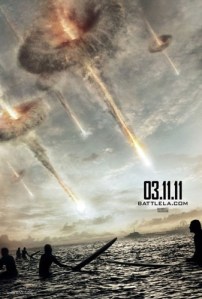
There is an even better film tucked away inside Battle Los Angeles. One brief dialogue scene discusses the similarities between the human soldiers and alien grunts, but the intriguing idea that they’re intelligent beings following orders just like us is sadly not built upon. There are obvious parallels with the invasions of Afghanistan and Iraq, but aside from the audience spotting shots that are reminiscent of news footage, the threads aren’t drawn out or commented on. Instead Battle LA does two things: military sycophancy, which is typically American and typically tiring or laughable (depending on your mood), and some stonkingly decent action sequences. The ending... and also the posterThey may take a little while to get to, but they’re relatively worth the wait.

What could have been a thought-provoking brain-switched-on commentary-on-the-world sci-fi film is instead a brain-switched-off gung-ho sci-fi action flick. I’ve seen better, I’ve seen worse, but treated as blokey weekend-evening entertainment this is fine.

3 out of 5

Hotel for Dogs (2009)

2011 #95
Thor Freudenthal | 92 mins | TV | 1.85:1 | USA / English | U / PG

Hotel for DogsHalf a decade ago I would surely have hated this film. I had no love for animals in general, certainly not pets. But in the past few years I’ve become a certified canine convert, and watching it now I loved it.

The story sees orphaned teen siblings Emma Roberts and Jake T. Austin accidentally set up a secret sanctuary for strays in a deserted hotel, with help from a couple of similarly aged pet store workers and a neighbourhood kid who wanders in halfway through. Layer in a couple of half-hearted subplots about the siblings’ quest for a new home, a romantic angle or two, and some evil dog wardens, and you have a whole movie.

Well, sort of. This is definitely one for kids or dog lovers. There’s plenty of varied action for the latter, and the story is too simplistic and implausible to be taken more seriously than as a kids’ film. Most of the subplots are mildly annoying — stock material on teen ‘love’, fitting in to a new school, comedy bad foster parents, etc — but at least they’re not given much screen time. It’s this kind of thing that led reviews like Empire’s to criticise the film for a lack of character development, Friday, the best thing in the filmbut to be honest I could’ve done without some of the meagre scenes we did get, never mind more of them. Supposedly character building stuff like the teeny party to get to know future classmates — bleurgh. Luckily, such things are brief. And someone wanted more of Lisa Kudrow and Kevin Dillon’s failed-rocker foster parent characters? I’d rather have had less, thanks.

So no, character and story aren’t the film’s strong points. There’s enough of a plot to keep it ticking over, to give it drama when appropriate and give it all a shape. Characters are perfunctory at best, and it’s impossible to buy squeaky clean Emma Roberts as a juvenile delinquent. But really all that’s there just to facilitate more doggy action (er, as it were). The four-legged cast members are the real stars, and several of them definitely have more personality than their human co-stars. My favourite was definitely the orphans’ pet, Friday, Friday, the best thing in the filma scruffy white terrier with an exceptional ability to sniff out food (featured in every picture, because… aww, just look at him!), but then he reminded me so much of my own dog that I may well be biased. There’s all sorts of mutts here for pretty much every kind of dog lover.

There’s also a good deal of inventiveness on display. Much like the boy from Lemony Snicket, Austin’s character has a flair for invention, and the dog-helping contraptions he magics up throughout the film are delightfully inventive. There’s also a lot of fun filmmaking with the dogs, like the opening sequence that depicts Friday’s ability to sniff out and acquire food with a selection of perfect visuals. This is partly why the animals have so much more personality than the two-legged stars.

Friday, the best thing in the filmJudged as simply a movie, on its story and its characters and all that regular palaver, I can see why Hotel for Dogs attracts so many poor scores (it has an exceptionally low 4.9 on IMDb). But as a kids’ film I think it works well enough, and as a delivery system for cute dogs I loved it. I don’t think I’ve ever “aww”ed so much in a single film. Yep, I’ve gone all soft. But if you’re neither a child nor a dog lover, don’t bother.

4 out of 5

The Spider Woman (1944)

2011 #96
1944 | Roy William Neill | 60 mins | DVD | U

It’s the second season finale of the brilliant Sherlock tonight, so what better time to post a review of another Holmes adaptation that’s based in part on the infamous The Final Problem

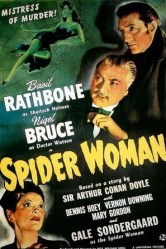
The Spider WomanThe seventh feature starring Basil Rathbone as Sherlock Holmes and Nigel Bruce as Dr John Watson is the first since Hound to drop Holmes’ name from the title and, at under an hour (59 minutes 33 seconds in PAL, to be precise), is the shortest yet.

It’s previously been asserted (in this blog’s comments) that The Spider Woman is “one of the best of the series”, and it’s certainly a strong effort. Screenwriter Bertram Millhauser (who also wrote the previous two films, and would go on to pen two more) skillfully mixes elements from various Conan Doyle tales — while I spotted two or three, Wikipedia says the full list includes The Sign of Four, The Final Problem, The Adventure of the Empty House, The Adventure of the Devil’s Foot and The Adventure of the Speckled Band.

As they’re combined here, the story sees Holmes fake his own death to help tackle the Irene Adler-esque titular woman, apparently his intellectual match, who’s somehow causing a spree of suicides. Several of these borrowed elements — the faked death and The Woman — lead to some delicious scenes, such as when Holmes reveals he’s alive to Dr Watson, offering one of those occasions where Bruce’s comedic rendition of the role actually works; or when an incognito Holmes meets the woman, who is actually aware of his true identity. Indeed the woman, played by Sherlock Holmes vs the Spider WomanGale Sondergaard, is so good that they crafted a sequel around her, albeit Holmes-less. I’ve not seen it and don’t own it, so I’ve no idea what that does for its quality.

The mystery itself is solid enough, but that’s not necessarily the point of these Holmes adventures. They’re not play-along puzzles like an Agatha Christie adaptation, where there’s a set of definite clues and a finite number of suspects, but rather exciting tales that whip you along their incredible path — adventures indeed. You can certainly see the (deliberate) tonal link between these ’40s films and the modern-set Sherlock, or indeed the pair of Robert Downey Jr. films.

At the halfway point of the Rathbone-Bruce films (it’s only taken me four years to get this far), the series is still producing exciting, good-quality re-arrangements of Conan Doyle’s works. And I’m assured there’s more to come. Fantastic.

4 out of 5

Centurion (2010)

2011 #82
Neil Marshall | 97 mins | Blu-ray | 2.35:1 | UK / English | 15 / R

Last week, as I’m sure you’re aware, I posted the top ten films I’d watched in 2011. Among them were three I’ve yet to post a review for… so what better way to begin finishing off my 2011 reviews than with those. So here’s the lowest, #9…

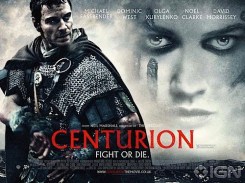
CenturionThe fourth feature from writer/director Neil Marshall (despite owning his first three on DVD, this BD rental is the first I’ve actually watched — story of my life) is a bit of a departure: where the first three were horror (or at least horror-leaning) flicks, Centurion is an action-adventure crossed with something a little more artsy. Only a little, mind. Think Seraphim Falls.

The story involves a Roman legion (a real one, in fact — the story is based in historical fact) venturing into Scotland to take on the natives. They get massacred, the survivors try to get home alive. The story moves quickly, keeping the momentum up. Indeed, at times it moves so fast that some characters seem to be given short shrift. There’s a “who will survive?” element to the plot — Marshall’s horror roots showing through, perhaps — but you can largely guess which order they’ll be shuffled off in based on, a) how much screen time the character has, and b) the good old deciding factor of “which actors are most recognisable”. Predictability doesn’t really matter though, because there are (perhaps) a couple of surprises in store, and it’s only one element of the story.

Run, Fassbender, runRegular readers may know that I have an ever-growing dislike for films that begin at or near the end for no good reason (and most of those that do have no good reason to do so). Centurion’s opening line notes that “this is neither the beginning nor the end” of the lead character’s story. Oh dear, thought I; though perhaps “nor the end” signifies we might reach this point suitably distant from the credits, maybe. Not meaning to spoil it, but we’re there just 10 minutes later. Nice work Mr Marshall.

And with the mention of credits, allow me to note that both the opening and closing credits are wonderful, reminiscent of Panic Room’s much-exalted titles without being a clone.

The characters who do get screen time are well built. Most of them conform to regular men-on-a-mission types, but in the hands of actors like Michael Fassbender and David Morrissey that doesn’t matter. This seems like an appropriate enough point to note that Fassbender is fast becoming, if he isn’t already, an actor where it’s worth watching something with him in even if it doesn’t otherwise appeal. His mixed choices of blockbusters/mainstream-skewing movies and acclaimed artier fare suggest pretty impeccable taste. (Or, at least, tastes that match my own.) Olga the ScotThe cast is packed with people who, even if you don’t know their names, there’s a fair chance you’ll know the faces (assuming you watch your share of British drama): in addition to Fassbender and Morrissey there’s Dominic West, JJ Field, Lee Ross, Paul Freeman, Liam Cunningham, Noel Clarke, Riz Ahmed, Imogen Poots, Rachael Stirling, Peter Guinness… not to mention Film Star Olga Kurylenko. Recognisability doesn’t guarantee quality, of course, but that’s a pretty good list.

On the action side, there’s a selection of excellently choreographed fights. Lots of blood and gore, but surprisingly not gratuitous considering we have all manner of limbs being lopped off, decapitations, heads being shorn in two, and so on. It’s unquestionably graphic, but it doesn’t linger — the battles are hectic, fast, a blur… but in a good way: you can see what’s going on, but it feels appropriately chaotic.

On the artsy side, the Scottish scenery is extraordinarily stunning. Helicopter shots are put to marvellous use. Think Lord of the Rings, only this was shot on our own fair island. The filmmakers went to extremes to achieve this — it’s entirely real location work, beyond the back of beyond in the depths of a snow-covered Scottish winter; no green screen, no CG enhancement — and their effort has paid off. It looks thoroughly gorgeous. I fear I’m overemphasising the point, but… nah.

Stunning sceneryI really enjoyed Centurion, appreciating its mix between brutally real action and stunning scenery, with a slightly more thoughtful side emerging in the final act. It’s also always pleasant to see a film that runs the length it wants to at a reasonable speed, rather than padding itself to reach two or even two-and-a-half hours. Splendid.

4 out of 5

Centurion placed 9th on my list of The Ten Best Films I Saw For the First Time in 2011, which can be read in full here.

2011 In Retrospect

A week into the new year, it’s time to wrap up 2011…


Introduction

Everyone has different criteria about what constitutes a Great Film. Some people despise Hollywood-produced mass-market action fare; other people it’s all they watch. Some people can’t stand a slow-paced meditative drama with subtitles; other people it’s all they watch. And, naturally, there are various less extreme opinions in between.

So choosing a best (or worst) films list is always a highly subjective and personal experience, and however acclaimed the critic or definitive the source it will always be so. There’s also arguably a difference between Favourite and Best, and I can never quite decide which my list is; never mind the initial hurdle that I have quite broad tastes. How do you qualify two vastly different films against each other?

But anyway, I’m sure you’ve heard such musings about the compilation of such lists before — I shan’t go on (for a change). Here’s some lists; they explain themselves. Through the cleverness of HTML, I shall provide a linked contents list:

(OK, they’re not all lists.)

As ever, all of these are selected from what I watched this year, so the full list of eligible titles is here.


The Five Worst Films I Saw in 2011

Cloak and Dagger
I think I’ve been quite generous with my scores this year — I was surprised upon reviewing my worst-of-the-year shortlist to find three stars on this review. Whether you’re looking at his German silents or Hollywood noirs, Fritz Lang is an exceptional director. But even exceptional people have off-days.
Valley of Fear
An easy one this, but hey-ho. It’s probably the least-well-regarded of the four Sherlock Holmes novels, and while it’s not the worst in this series of animated adaptations — the woefully misjudged version of The Hound of the Baskervilles takes that honour — it’s still not got much going for it.

Saw 3D
Some people write off Saw too readily — while at its worst it does sink to the risible depths of torture porn, at its best it’s an engrossing and complex thriller. This franchise-ender is a disappointment even to those of us who border on liking the series, though. Full of good ideas wasted. Shame.

Monkey Business
Here’s another one I gave three stars (there are several not here that scored lower), but my memory of it is worse. Despite some considerable talent — Cary Grant, Ginger Rogers, Marilyn Monroe, Howard Hawks — it doesn’t tie together into something particularly entertaining, in my mind. Passable.

Beyond the Pole
I didn’t hate Beyond the Pole, but there wasn’t a great deal I enjoyed about it either. It’s good when a comedy makes you laugh and, unlike Monkey Business even, this one doesn’t really. It’s a waste of a talented cast. Impressive production values for such a small British film though.


The Ten Best Films I Saw For the First Time in 2011

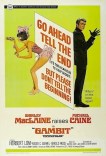
10) Gambit
“Go ahead tell the end… but please don’t tell the beginning!” Gambit is worth watching for its opening conceit alone, but once that’s done there’s tons of fun to be had with Caine and MacLaine, bumbling through a con in delicious fashion. Largely forgotten, it deserves to be remembered; perhaps the Colin Firth-starring Coens-penned remake will do it a favour.

9) Centurion
With Scottish landscape shots to rival Lord of the Rings‘ New Zealand, Centurion is breathtaking to look at. Underline that with a tense story and a fantastic cast (not the last time Michael Fassbender will appear in this top ten), not to mention some brutal but not excessive action, and I think you have a winner. A little blokey, but also a little more.
8) Easy Virtue
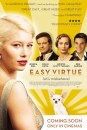
Looking at reviews and aggregate sites, Easy Virtue seems to be almost maligned. Shame. Adapted from a Noel Coward play, it’s very witty, surprisingly dramatic, and with an outrageously cheeky score. This changeability and irreverence is, I think, quite British. Perhaps it confuses some by not being easily pigeonholed. I adored it.
7) My Neighbour Totoro
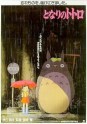
It’s hard to think of a film more gentle than Totoro, although some might find things like the cat-bus a bit creepy (me not entirely excluded). Gorgeously animated with a beautiful soundtrack, it lures you in to a world and tells you a thoroughly nice story, with no enforced peril or nasty characters. Refreshingly lovely.

6) Monsters
Made for next to nothing and with all the computer effects home crafted by director Gareth Edwards, Monsters is an amazing technical achievement. But it’s also a character drama about disaffected twenty-somethings and man’s destructive nature, amongst other things no doubt. Edwards is unquestionably a genre filmmaker to watch.
5) Super
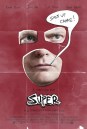
It may have the same subject matter as Kick-Ass, but Super scores bonus points for its low-budget very-real-world aesthetic… in spite of featuring some of the craziest anime-inspired CGI you’ll see from a US movie. Very funny, but with a kick too, while Kick-Ass slid into fantasy this remains reality (pretty much). They make a helluva pair.

4) Lupin the Third: The Castle of Cagliostro
The first film from anime master Hayao Miyazaki has been described by no less than Steven Spielberg as “one of the greatest adventure movies of all time”. Do you need higher recommendation? Exciting and funny, while it may lack the emotional resonance that made Miyazaki so acclaimed later, it appeals rather to my blockbuster sensibilities.

3) Let the Right One In
This is how you do a vampire love story (for everyone but teenage girls). Genuinely touching and emotional, with highly identifiable themes and characters despite the story’s genre subject matter, Tomas Alfredson’s film is an affecting drama as well as a creepy and horrific fantasy thriller. Genre movies don’t get much better than this.

2) X-Men: First Class
Some reviews spied flaws, attributed to First Class‘ hasty production, but I don’t hold with that. As young versions of McKellen and Stewart, Fassbender and McAvoy bring as much acting gravitas as can be had from their generation. Vaughn manages genuine cinematic spectacle, something I thought lost in the age of anything-is-possible CGI. Marvellous.
1) The Social Network
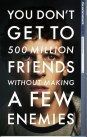
Some unlikeable brats sit at computers programming websites and argue amongst themselves. Sounds like a bloody awful film, but with dialogue by Aaron Sorkin and direction from David Fincher, not to mention a cast of fine young actors, it’s engrossing, exciting and exceptional. It may be The Movie About Facebook, but it’s about so much more. Like.


Special Mentions

Compiling this year’s top ten felt hard — I managed to get my typically long long list (42 titles this year) down to a short list of about 15, then set about re-reading my own reviews… but whichever film I last read about seemed an obvious contender. In the end I plumped for a couple that ‘needed the support’, as it were. Lingering just outside the ten — or perhaps simply unlucky on the day — were The Big Heat, Fritz Lang’s exceptional dark noir; How to Train Your Dragon, an exciting CG-animated movie that proves it isn’t all about Pixar; The Girl with the Dragon Tattoo, an effective procedural-ish thriller that gives the US remake a lot to live up to; The Three Musketeers, anarchic fun; and the new Winnie the Pooh, which was flawed but loveable.

As ever, I must also mention the 17 films that earned themselves 5-star ratings this year. Eight of them made it into the top ten, the most ever. The two that missed out were close too, but I think I may’ve got tougher as the year progressed: the last perfect score I handed out was in September, and before that July. Anyway, those in the top ten were Easy Virtue, Let the Right One In, Lupin the Third: The Castle of Cagliostro, Monsters, My Neighbour Totoro, The Social Network, Super and X-Men: First Class. From the handful that missed out, The Three Musketeers was also a five-star-er. The remaining eight were Breakfast at Tiffany’s, Dog Day Afternoon, An Education, Harry Brown, Holiday, The King’s Speech, Nanny McPhee & the Big Bang and Roman Holiday. Whenever I do this bit I always feel like there were some other films I should have given top marks, and maybe some that only deserved four, but here we are.
On top of those 17, David Fincher Week (I promise this is the last time I’ll mention it in these round-ups) furnished us with five-star reviews for two films I’d previously seen — namely, Se7en and Fight Club — and a third for the only-slightly-different Zodiac: Director’s Cut.


The Films I Didn’t See

To finish off, then, here’s my annual tradition: an alphabetical list of 50 films, that are listed as 2011 on IMDb, that I didn’t manage to see this year. These are chosen for a variety of reasons, from box office success to critical acclaim via simple notoriety.

As usual I’ve stuck to my rule of only including films that are listed as 2011 on IMDb, irrespective of their UK release date. So no Senna, no Submarine, no Brighton Rock, for just three British-made examples; but films that aren’t even out here for over a month are included. What can I say, it’s a flawed system. Maybe I’ll finally change it next year.

The list may show a bias towards my personal interests — I do use this as a checklist going forward after all — but then I have quite wide interests, and I had a look at Box Office Mojo’s account of the highest-grossing films in the US to include all I’d not seen from the top 15 (I drew the line at Rio and The Smurfs), and a Best Of list or two too, so it hits most of the major bases. Nonetheless, I’m certain Stuff You’ll Have Heard Of is missing, but that’s what a limit of 50 does. Maybe I should increase it to 100 — that’d be fitting.

But I digress. Here are some films:

The Adjustment Bureau
The Adventures of Tintin: The Secret of the Unicorn
The Artist
Attack the Block
Bridesmaids
Captain America: The First Avenger
Cars 2

Conan the Barbarian
Cowboys & Aliens
The Devil’s Double
Drive
Extremely Loud and Incredibly Close
Fast Five (aka Fast & Furious 5)
The Girl with the Dragon Tattoo
Gnomeo & Juliet
The Green Hornet
Green Lantern
The Hangover Part II
Hanna
Happy Feet Two
Harry Potter and the Deathly Hallows: Part 2
The Help
Hugo
The Inbetweeners Movie
The Iron Lady
Ironclad
Kill List
Kung Fu Panda 2
Melancholia
Midnight in Paris
Mission: Impossible – Ghost Protocol
The Muppets
Paul
Puss in Boots
Rango
Real Steel
Rise of the Planet of the Apes
Scream 4
Shame
Sherlock Holmes: A Game of Shadows
Super 8
Thor
The Three Musketeers
Tinker Tailor Soldier Spy
Transformers: Dark of the Moon
The Tree of Life
The Twilight Saga: Breaking Dawn – Part 1
War Horse
Warrior
Wuthering Heights


A Final Thought

That’s it for another year… well, apart from the 17 reviews I have left to post. Ought to get a wriggle on with those really.

With that, 100 Films is officially five years old. Oo-ooh! Originally I started it in February 2007, looking back on the first few weeks of the year to get it going (to this day I wonder if I forgot any films I watched in that period), and come the proper fifth birthday next month I may have a post or two to acknowledge the relative longevity of this enterprise.

But until then… well, I’ve got a lot more films still to watch…

2011: The Full List

For only the second time in the history of 100 Films in a Year, I have watched 100 films in a year.

As opposed to over-100, which I’ve done twice, or the obvious under-100, which I did once. And indeed this year I didn’t watch just 100: that’s 100 feature-length films that I’ve never seen before. But you knew that, because that’s what this blog is about. I still think no one’s going to have remembered the rules. Best to be clear, eh.

So, as we’ve reached the end, here’s the first of two summary posts. More on the second post later, but first there’s the complete list of everything I watched: the main list of 100, in numerical order of viewing again this year, followed by lists of other things I decided to review — this year, a couple of shorts and most of the contents of David Fincher Week.

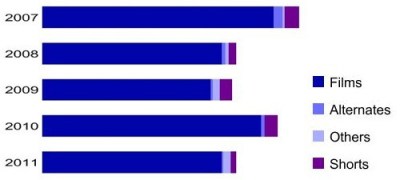
And then there’s the statistics. I love the statistics. There’s some interesting stuff in there this year — including graphs! — though the way things seem to be trending next year might be even more interesting. Only 52 weeks until we get to find out… But I’m getting ahead of myself. It may be 2012, but let’s luxuriate in the events of 2011 for just a moment longer.


The List

#1 Saw VI (2009)
#2 Exam (2009)
#3 Genevieve (1953)
#4 Synecdoche, New York (2008)
#5 Melinda and Melinda (2004)
#6 The Invention of Lying (2009)
#7 Heaven Knows, Mr. Allison (1957)
#8 The Big Heat (1953)
#9 Lupin the Third: The Castle of Cagliostro, aka Rupan sansei: Kariosutoro no shiro (1979)
#10 The Three Musketeers (1973)
#11 Bolt (2008)
#12 The Four Musketeers (1974)
#13 Harry Brown (2009)
#14 Alien³: Special Edition (1992/2003)
#15 Monkey Business (1952)
#16 True Grit (1969)
#17 The Curious Case of Benjamin Button (2008)
#18 The Social Network (2010)
#19 Easy Virtue (2008)
#20 Once (2006)
#21 Roman Holiday (1953)
#22 Sabrina (1954)
#23 Clash of the Titans (2010)
#24 Nanny McPhee & the Big Bang (2010)
#25 Up in the Air (2009)
#26 Breakfast at Tiffany’s (1961)
#27 Cloak and Dagger (1946)
#28 Unthinkable (2010)
#29 Let the Right One In, aka Låt den rätte komma in (2008)
#30 Let Me In (2010)
#31 The Damned (1963)
#32 Sorry, Wrong Number (1948)
#33 Death Race (2008)
#34 Night of the Demon (1957)
#35 The Girl with the Dragon Tattoo, aka Män som hatar kvinnor (2009)
#36 High Plains Drifter (1973)
#37 Young Guns (1988)
#38 The Day of the Locust (1975)
#39 The Girl Who Played with Fire, aka Flickan som lekte med elden (2009)
#40 Monsters (2010)
#41 My Neighbour Totoro (1988)
#42 The Girl Who Kicked the Hornets’ Nest, aka Luftslottet som sprängdes (2009)
#43 Dog Day Afternoon (1975)
#44 La Règle du jeu, aka The Rules of the Game (1939)
#45 Cameraman: The Life & Work of Jack Cardiff (2010)
#46 A Bunch of Amateurs (2008)
#47 Family Guy Presents Stewie Griffin: The Untold Story (2005)
#48 Funny Face (1957)
#49 Catfish (2010)
#50 Assault on Precinct 13 (1976)
#51 An Education (2009)
#52 (500) Days of Summer (2009)
#53 Salt: Director’s Cut (2010)
#54 The Princess and the Frog (2009)
#55 Assault on Precinct 13 (2005)
#56 Iron Man 2 (2010)
#57 The King’s Speech (2010)
#58 The Thief (1952)
#59 Jonah Hex (2010)
#60 X-Men: First Class (2011)
#61 Pirates of the Caribbean: On Stranger Tides (3D) (2011)
#62 Ip Man, aka Yip Man (2008)
#63 Law Abiding Citizen: Director’s Cut (2009)
#64 Valley of Fear (1983)
#65 Evangelion: 2.22 You Can (Not) Advance., aka Evangerion shin gekijôban: Ha (2009/2010)
#66 A Study in Terror (1965)
#67 Saw 3D (2D) (2010)
#68 The Locket (1946)
#69 Tangled (2010)
#70 Harry Potter and the Deathly Hallows: Part 1 (2010)
#71 Super (2010)
#72 Sucker Punch: Extended Cut (2011)
#73 Source Code (2011)
#74 Glorious 39 (2009)
#75 Nirvana (1997)
#76 The House on 92nd Street (1945)
#77 Browncoats: Redemption (2010)
#78 Bringing Up Baby (1938)
#79 Holiday (1938)
#80 How to Train Your Dragon (2010)
#81 Prince of Persia: The Sands of Time (2010)
#82 Centurion (2010)
#83 Magicians (2007)
#84 The Brothers Bloom (2008)
#85 Batman: Year One (2011)
#86 Battle Los Angeles (2011)
#87 That Touch of Mink (1962)
#88 RED (2010)
#89 Gambit (1966)
#90 Cars (2006)
#91 Beyond the Pole (2009)
#92 Cruise of the Gods (2002)
#93 Diner (1982)
#94 Nativity! (2009)
#95 Hotel for Dogs (2009)
#96 The Spider Woman (1944)
#97 Faintheart (2008)
#98 The Man from Earth (2007)
#99 Winnie the Pooh (2011)
#100 The A-Team: Explosive Extended Edition (2010)


Alternate Cuts
Zodiac: Director’s Cut (2007/2008)

Other Reviews
Fight Club (1999)
The Game (1997)
Panic Room (2002)
Se7en (1995)

Shorts
Catwoman (2011)
The Gruffalo’s Child (2011)
Lumet: Film Maker (1975)


The Statistics

As I said, for only the second time ever, I watched exactly 100 films in a year — appropriate for my fifth anniversary. (That’s just the new feature films, as ever. All are included in the stats that follow, even if there’s no review yet.)

I watched a single film I’d seen before that was extended or altered in some not-particularly-significant way. (There was also the special edition of Alien³, which I deemed suitably different to include in the main list.) I also reviewed four others just for the fun of it (well, for that David Fincher Week actually). All 105 films are included in the statistics that follow, unless otherwise indicated.

I also watched three shorts (none of which shall be counted in any statistics). That’s the smallest number ever. Considering I own quite a few shorts DVDs, both contemporary and from the silent era, I really should make more of an effort.

The total running time of new features (the 100) was 170 hours and 23 minutes — not the shortest I’ve had, but certainly not the longest either. The total running time of all films (including, for this stat only, shorts) was 182 hours and 13 minutes — not the shortest I’ve had, but… you get the idea.

I’ve already watched one film from this list again, specifically X-Men: First Class. I think a couple of others may at this point require re-viewing before I can review them, though.

This year’s format victor is TV, for the third year running: with 49 (including 16 in HD) it represents almost half my viewing. That said, last year it was over half, so… At least Blu-ray ran it a close race, totalling 42 this year — that’s 13 more than last time, which was 23 more than the year before. DVD continues its inexorable slide into oblivion (despite my massive unwatched collection) with just nine films viewed on that format, down from last year’s 22. Poor DVD — it feels like an under-loved former-champion to me now. (Oh, now I feel I’ve been cruel to it. Sorry DVD! I’ll watch more of you!) Finally, I watched three downloads (one in HD) and made just two trips to the cinema, half of them in 3D. That’s 33% fewer visits than last year. Or, another way, one less.

The most popular decade was the ’00s, as it has been every year since this blog began. Its hold is beginning to slip though: with just 37 films this year it accounts for 35.2% of films viewed, down on last year’s previous low of 48.4% (the first time it fell beneath 50%). Running a relatively close second was a decade just two years old, the 2010s, with 29 films (27.6%). Nothing else came close, with a scattering across most of the 20th century: three were made in the ’30s, five in the ’40s, nine in the ’50s, six in the ’60s and seven in the ’70s (neat), and four in the ’80s. Finally, with just five films the ’90s had its worst result by half — literally: the previous low was 10 in 2009.

I believe I’ve said in the past that I feel I’ve been more generous this year, and it would appear I have: the average score is 3.8, the highest it’s ever been. Readers with strong memories may recall the previous high was 3.7 so it might not look like much of an increase, but it’s a bit starker if we add a few more decimal points and consider percentages. The previous years’ average scores range 0.77%, from 3.629 to 3.657; this year comes to 3.838, a 4.95% increase from the next highest. Still looks small? The gap between the old highest and new highest is 543% bigger than the gap between the lowest and old highest. So there.

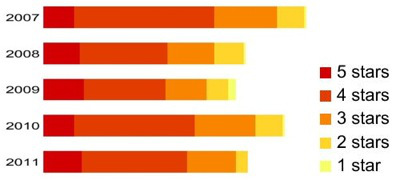
This is helped by 20 five-star films, the second-highest year for those (there were 21 in 2009), and, for the first time ever, no one-star films. As ever, the majority of films — 54 this year — scored four-stars. Rounding it out were 25 three-star films, which is about average, and six two-star films, about half the usual number. So with no single-star films, a drastically reduced number of two-stars-ers, and a pretty generous lot of five-stars, no wonder the average comes out so high. Must’ve been a good year.

Seven films appear on the IMDb Top 250 Films as of New Year’s Day 2012 — not the seven I’d’ve chosen, personally. That’s exactly the same as last year, which is about half the amount in the two previous years, and just a third of the first year! This year’s positions ranges from 129th (The King’s Speech) to 239th (Ip Man). Not that I’m giving IMDb’s user-voted list special treatment, but… well, I am, aren’t I. There are too many other such lists out there I could cross-reference all these films with, so I won’t do any of them. As usual.

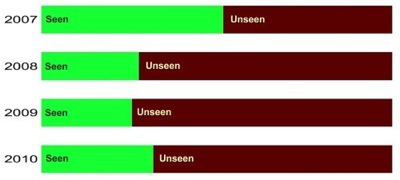
At the end of all previous years’ summaries I’ve included a list of 50 notable films I’d missed from that year’s releases. With 2011 over, I’ve managed to see one more from 2007 (bringing the total for that 50 to 26), one more from 2008’s list (bringing it to 14) and five more from 2009’s list (bringing that to 13). In the year since listing 2010’s 50 I’ve managed to see 16 of them — a bloody good start, as you can see from 2008 & 2009’s numbers! As ever, I hope further films from all four lists will appear during 2012 — and plenty from 2011’s too (coming soon).

A record-low 80 solo directors (previous: 87) and a record-high 11 directing partnerships (previous: 10) appear on this year’s list. Topping the list of those with multiple films is David Fincher, who has eight thanks to (of course) Fincher Week. Three of those counted for the main list, leaving him this year’s top director every which way. Seven others have two films apiece: Daniel Alfredson, Kevin Greutert, Henry Hathaway, Howard Hawks, Fritz Lang, Richard Lester and Hayao Miyazaki. For the curious, that leaves 72 directors (and all 11 partnerships) with just a single film.

Also, four directors from this year’s list have surnames beginning “Sch”: Schenkman, Scherfig, Schlesinger and Schwentke. Doesn’t mean anything, I just noticed it. Random.

Finally, 33 of the films (plus two of the shorts and all the Other Reviews) are currently in my DVD/Blu-ray collection, the smallest number yet.


Coming next…

Aren’t the statistics good? I love the statistics. I should save the statistics for last.

Oh, coming next? The bottom five, the top ten, and another list of fifty films from the last 12 months that I haven’t bothered to watch yet.

I better get writing…

December 2011

2011 is over. 2012 has just begun. But did I make it to 100 in time?


If you follow me on Twitter you know

I did! Just. Three films in the final 24 hours of the year, the last of them finishing just an hour before midnight, see me reach 100 exactly this year. Phew!

In addition to that, six of the finishing eight features listed below were watched in the final three days of the year. Not quite as close to the wire as I had it back in 2008 (11 films in six days, seven of them in the last three), but I didn’t think I was going to get there.


So, my closing salvo included…

#93 Diner (1982)
#94 Nativity! (2009)
#94a The Gruffalo’s Child (2011)
#95 Hotel for Dogs (2009)
#96 The Spider Woman (1944)
#97 Faintheart (2008)
#98 The Man from Earth (2007)
#99 Winnie the Pooh (2011)
#100 The A-Team: Explosive Extended Edition (2010)


Where does that leave us in the grand scheme of thi— well, this blog?

Thus, 2011 ties with 2008 as my third-best year. Hurrah! Though to put it another way, 2011 ties with 2008 as my second-worst year, so, y’know…

It does represent the greatest drop off in potential, though. At the halfway point of the year I was further ahead than I’d ever been — in my best-ever-year, 2007, I’d made it to #60; in my second-best-ever-year, 2010, I’d made it to #64; but this year I’d reached #68. In tied-with-this-year 2008 I’d only limped to #46. Clearly, I need to keep momentum up into the year’s back half.

But hey, 2012’s another year — who knows what’ll happen next time round!


But before all that…

Screw 2012, I’m not done with 2011 yet! There’s my great big long list of everything I’ve watched still to come, along with all those lovely statistics, and the list of films I didn’t see, and — best of all — the statistics.

Oh, I mentioned those? I love the statistics. But almost as good, my bottom five and top ten for the year.

And having to push hard to cross the finish line means I haven’t even made a start on any of that. This’ll be interesting… for me, anyway — you just have to sit tight ’til it all turns up. Probably not that much later than I usually get round to it.

Until then… Happy New Year!

2011’s summary posts are already available here and here.