The Wraith of Cobble Hill (2005)

2009 #4a
Adam Parrish King | 15 mins | DVD

Animation isn’t a genre, it’s a medium, as Brad Bird would be so keen to tell you. As such, there’s no reason that any story shouldn’t be told in animated form… but sometimes, you have to wonder if it’s the best choice for the job.

The Wraith of Cobble HillThe Wraith of Cobble Hill is a perfect example for this debate as its modern, urban story seems to clash with the cartoonish style employed to bring it to the screen. There are no flights of fantasy, few implausible shots, nothing that couldn’t be achieved in live action even on a low budget. Ultimately the only reason for it being animated is, why shouldn’t it be? Personally, I’m not convinced it works; at the very least, it distracted me enough to consider it.

Otherwise, the story is a bit slow paced and perhaps uncertain of what it wants to say. By the end, ignoring the question of if the right form was chosen, I was unsure what it did say — what had actually happened, what had changed. Without giving away the ending, obviously rather a lot changes for one peripheral character, but for the central character it seems to have minimal impact. Well, he acquires a dog…

In short (sorry), The Wraith of Cobble Hill is nicely animated, though you might wonder why. More importantly, you might wonder what it was trying to say.

2 out of 5

This short is available on the Cinema16: American Short Films DVD.

The Lunch Date (1990)

2009 #9a
Adam Davidson | 10 mins | DVD

Short films are paid minimal attention by most people, but a good one can launch a career. Take this, for example, which won the Short Film Palme d’Or at Cannes in 1990 and the Oscar for Best Live Action Short in 1991. Writer/director Davidson may not have had a significant film career since, but he has directed episodes of Dexter, Deadwood, Grey’s Anatomy, Law & Order, Lie to Me, Lost, Rome, Shark, Six Feet Under, True Blood, and more. Not all great TV, true, but there are some outstanding series in there and it makes for an impressive CV.

If any short were to kick-start a career it would be The Lunch Date. As with many shorts, to attempt to describe the plot would be to give too much away, which would be a mistake because this is a beautifully shot (in grainy black & white) and performed tale with a distinct, yet subtle, character arc and an important, but not over-egged, moral message. There’s virtually no dialogue, everything conveyed by what Davidson does (and, importantly, doesn’t) show and the performances, particularly that of Scotty Bloch as the central Lady.

Some of the film’s power rests in a neat twist, cunningly obscured by intelligent blocking and timing of other plot elements. Personally I saw it coming, but that didn’t diminish its point. It’s also worth nothing that none of the twenty-or-so others I was watching with spotted the twist ahead of time and they all seemed to find it even more effective.

Why short films are ignored is a discussion for another time, but The Lunch Date is an outstanding example of why they shouldn’t be.

5 out of 5

The Lunch Date is available on the Cinema16: American Short Films DVD.

In 2013 it was selected for preservation in the United States National Film Registry by the Library of Congress as being “culturally, historically, or aesthetically significant”.

Insomnia (2002)

2009 #33
Christopher Nolan | 113 mins | DVD | 15 / R

This review contains minor spoilers.

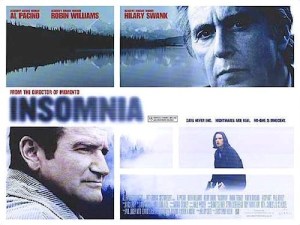
The Dark KnightBetween becoming a Geek God with Batman Begins and The Dark Knight and coming to everyone’s attention with a stunning more-or-less-debut that managed to elbow itself right up into the IMDb Top 10 (that’d be Memento — obviously, it’s slipped since), Christopher Nolan directed this: an American remake of a Norwegian police thriller, and the only one of Nolan’s five major films not to be on that be-all of film quality, the IMDb Top 250 (the fifth is of course The Prestige, while Begins is the lowest at #106.) So is Insomnia a forgotten classic robbed of a spot, or just a footnote to the rest of Nolan’s superb career?

These days, there’s a murder mystery/thriller on the TV most weeks — heck, most days thanks to the abundance of repeat-laden digital channels — and so a film attempting one can’t just settle for the usual array of clues, suspects, interviews and twists. Insomnia looks like it’s heading down this road early on — an interview with the victim’s boyfriend in particular could easily slot into any episode of Midsomer Murders or what have you — but soon does what’s required of any film entering this territory these days: it provides more. Most obviously, despite the early plot and stylistic conventions, this is not a “whodunnit”: the killer’s identity is revealed around the halfway mark (assuming you haven’t already guessed it from the opening credits) and from then on the film gradually moves into murky moral territory, quickly leaving behind those early trappings for a set of more complex noir-ish moral conundrums.

Al Pacino’s detective, for example, is a man under pressure — not just from the case, nor the usual clichés of a messy divorce or alcoholism, but from a pending Internal Affairs investigation that may or may not be justified, and an incurable bout of insomnia brought on by the Alaskan summer’s lack of night. The pressure mounts, he makes bad decisions (which I won’t spoil here), and even if the use of these plot points was merely that they occurred it would have offered something above the norm. Hillary Seitz’s screenplay pushes it further however, digging far deeper than usual for the genre into debates about the morals of police work, what seems acceptable and what is acceptable, and perhaps even what should be acceptable. The ending may seem to offer a Hollywoodised “everything’s set right then” denouement, but while it’s true that the plot is neatly resolved the considerations raised are not so easily ignored.

Cast-wise Insomnia fares pretty well. When it was released, around the same time as the excellent One Hour Photo, everyone was amazed at Robin Williams turning in a pair of non-comedic performances. The quality of them both makes it seem only natural now however, leaving that amazement as a distant memory. His turn as novelist Walter Finch here may owe something to Kevin Spacey’s John Doe in Se7en — indeed, Nolan seems to explicitly reference that film in locations such as the corridor of Finch’s apartment building — but isn’t as lowly as an impersonation. Hilary Swank offers able support as wide-eyed young cop Ellie Burr, while Pacino does a good job portraying the confusion induced by lack of sleep, aided by some effective camerawork, editing and sound design.

In the end, the main damage done to Insomnia is inadvertently by its director: while it is undoubtedly above average for a murder mystery/thriller, its relative straightforwardness pales in comparison to the work Nolan’s done before and since. However, as with every Nolan film so far, I found my perceived enjoyment increase the more I’ve thought about it since. It may not be objectionable that Insomnia hasn’t made it onto that IMDb list then, but if it is a footnote to Nolan’s career it’s a significant and enjoyable one.

4 out of 5

BBC One are showing Insomnia tonight at 10:45pm.

In Bruges (2008)

2009 #22
Martin McDonagh | 102 mins | TV | 18 / R

This review contains minor spoilers.

In BrugesIn Bruges has gathered quite a bit of indie-level praise and acclaim, culminating in wider recognition at the Oscars and other awards ceremonies at the start of this year. For those like me, finally getting round to seeing it in the wake of all this, it comes with quite a burden of expectation on its shoulders. Can it possibly be the modern classic many make it out to be? I mean, it is set in, y’know, Bruges…

First and (perhaps) foremost, In Bruges is hilariously funny, much more so than most by-the-numbers ‘comedy’ films can manage. The easily-offended might disagree, and some jokes are a tad too obvious (Americans are fat! Fat people can’t climb tight stairs!), but it’s nice to genuinely laugh at a film rather than force the odd smirk so as to at least get something from an otherwise wasted 90 minutes. It’s also dark and occasionally tragic though, and in this respect it’s unsurprising that writer/director McDonagh started out as an acclaimed and award-winning playwright, as stage plays mix humour and darkness more frequently (and with wider extremes) than films ever dare to. His theatrical roots also go some way to explaining the amount and ferocity of the swearing (again, something plays are more prepared to indulge in), but so too the brilliance of the dialogue. That it takes a playwright to craft such a good film is perhaps an irony, but not a troubling one.

Good dialogue is wasted without a good cast however, and thankfully everyone here gives a fantastic performance. The standout is Colin Farrell as hitman Ray. He initially seems a confident, cocky, experienced young hitman, and therefore verges dangerously close to stereotype, but we soon realise he’s actually twitchy, nervous, insecure, and genuinely sorry for the sole act of violence he committed. It might look like a Black Comedy With Nasty Violence to some — certainly, there are reviews that suggest some viewers are incapable of seeing anything beyond that — but there’s a lot more depth in the characters than the surface would suggest. Brendan Gleeson and Ralph Fiennes give consummate supporting performances, like Farrell chipping away at the stereotyped facades to find the hidden facets that the script is kind enough to reveal.

The quality of McDonagh’s writing (and direction) doesn’t stop with character and dialogue. The story is thematically considered, with a variety of paintings and associated imagery to occupy those who might be interested. Events are beautifully tied together and, best of all, none of the early scenes feel oddly inserted or have that nagging sense that they’re merely an excuse for something to be there later — everything works first time, and then has a seamless payoff too. Some viewers have criticised the ending, but I suspect they’re largely more used to mainstream fare and viewers who have ever enjoyed an indie film won’t bat an eyelid. All in, it’s easy to see why the screenplay has become the film’s prime awards nominee and winner.

Nominations, wins and buzz weigh heavy, but In Bruges has shoulders broad enough to carry such expectation with ease. “There’s never been a classic movie made in Bruges,” one character truthfully espouses, “until now.” It seems she couldn’t’ve been more right.

5 out of 5

In Bruges placed 2nd on my list of The Ten Best Films I Saw For the First Time in 2009, which can be read in full here.

Watchmen (2009)

2009 #9
Zack Snyder | 162 mins | cinema | 18 / R

This review contains major spoilers.
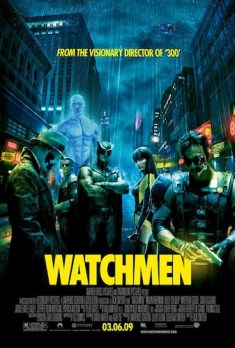
Watchmen didn’t flop. Let’s get that out of the way.

Did it do less business than expected? Yes. Were expectations unreasonably high? Unquestionably. After the barnstorming success of The Dark Knight I think some expected a repeat run, but they forgot that while TDK was dark, it still had clear heroes, clear villains, a massively popular franchise and — let’s be honest — a highly-publicised, highly-acclaimed final performance from a certain tragic young actor. Watchmen, by comparison, is densely plotted, morally ambiguous, a tad on the long side, with unknown characters, an unclear story (in the marketing at least) and no mass recognition. And it was rated R. All this considered, it did phenomenally well, and at the end of the day it’s WB’s fault for spending $150m on something that, realistically speaking, wasn’t going to make that back on opening weekend.

But this isn’t meant to be a rant about the box office. Now that the dust has settled somewhat from the initial flurry of reviews — which on the whole seemed to either hail it as an instant classic or an unrelenting mess (though some more reasonable ones found the middle ground) — and with the dubiously-featured UK DVD and Blu-ray releases just announced, it seems about time to add a few of my thoughts to the already-overflowing mix. In doing this I find it impossible to fully divorce myself from the fact that I’m a fan of the book, so can only really view this adaptation from that perspective; just as I think anyone who’s read the book can’t truly imagine quite how a non-reader will take this, whatever they may claim. The only people who can do that are people who haven’t read the book, and there have been plenty of those reviews around too.

But even as a fan, my opinions are not as predetermined as some might think. Watchmen is incredibly faithful to its source material (some notable tweaks and omissions aside), but while some have loved it for this, others have viewed it as weak or pointless. Perhaps some of the complaints about faithfulness stem from the fact that we’re actually unused to seeing faithful superhero adaptations — “adaptations” being the operative word. Across seven Batmans, five Supermans, four X-Mens, three Spider-Mans, two Hulks, and countless others, how many actually adapt a specific book? Most, if not all, develop their own story around the notion of the character(s), or take some degree of inspiration from various storylines, tailoring a new tale for the different medium (well, theoretically). In choosing to adapt the source rather than make a film starring the same characters, Watchmen places itself more in line with other literary adaptations than other superhero movies. Some would argue this context still renders it more of a Da Vinci Code than a Godfather, but it’s perhaps still appropriate to debate that rather than if it’s more a Hulk than a Dark Knight.

The consistent faithfulness is a bit of a mixed bag. For much of the film it’s a great story well re-told, and its climax actually manages to improve on the original’s to the extent that, if Alan Moore ever actually watched it (which he won’t), I’d like to think he’d be man enough to admit that this one change at least was an improvement. Similarly, in the novel I wasn’t convinced Rorschach’s final moments made sense — it seemed out of character. On screen, however, Jackie Earle Haley completely sells it, his final scream becoming one of the film’s most memorable moments. Other elements are retained with no thought, however: the intercutting of Dan and Laurie’s alley fight with Dr Manhattan’s press conference is an effective (if blunt) sequence in the novel, but on screen makes little sense — even though I know the story and know the events of both scenes, this choice left me struggling to follow events. Even worse, the sudden and unexplained presence of Ozymandias’ pet big cat is almost baffling to a viewer familiar with the source, and so I can only imagine how little sense Bubastis must make to a new viewer. Consequently, his demise has no emotional weight.

The final scene is a bit of a misstep as well. In the book it’s a perfect little coda, beautifully ambiguous and tied to several of the novel’s themes. On screen, Snyder overplays it, allowing it to drag on with pointless dialogue and leaving the point of the scene feeling forced — equally a fault of David Hayter and Alex Tse’s script, then. Part of the problem is that it’s lumbered with introducing a subplot and its characters for the sake of the payoff, both of which develop slowly and appropriately in the novel. The details of that particular subplot are not the only elements that are missed from the original: the novel contains a lot of details of street life in Manhattan, for example, which makes the city’s ultimate destruction more personal for the reader. Some of these scenes have been filmed and, knowing that an aptly-titled (for once) Director’s Cut is on the way, it’s at times hard not to view the theatrically-released Watchmen as an abridged version. While it is still more complex than some critics (both pro and fan) give it credit for, the missing nuances and subplots would strengthen the whole experience. We can but hope it’s these that the Director’s Cut will include, rather than just a collection of completist-pleasing trims.

It’s easy to complain about Watchmen — clearly — but, actually, I really enjoyed it. Snyder has arguably created a live-action version of the graphic novel rather than creating a film in its own right, but is that really a bad thing? It’s what many literary adaptations aspire to, the only difference here is there were already some pictures to directly transfer. Some will disagree, and if you do then this is a perfect argument for why Non-Fans should be in charge of film adaptions — Fans are too concerned with pleasing other Fans, in this case being rigorously faithful; Non-Fans often just want to make the best movie possible based on the source material, rather than making the best translation (or, perhaps, re-appropriation). Perhaps it’s too fine a line to walk; perhaps Snyder was too afraid to change anything; or perhaps it’s just a case of damned if you do (“it’s exactly the same, what’s the point?”) and damned if you don’t (“he changed too much, it’s not Watchmen!”).

In their faithfulness, Snyder, Hayter and Tse retain much of the story and character elements that made the original great. If the aim was to take the page and put it on screen, the screenplay is near flawless, embellishing some moments and even fixing others, while excising subplots so wisely I didn’t miss much. As stated, however, the definitive cut is surely the forthcoming one. As for Snyder’s direction, he mostly does a good job, recreating iconic panels — occasionally with too much reverence, true — but enlivening other sequences in his own way. In fact, for all the moans of reverence, some of the novel’s more filmic ‘cuts’ are actually abandoned (I’m thinking specifically of the ins & outs of flashbacks during the Comedian’s funeral). Photography wise, most of the film was far too dark, and I couldn’t help but wonder if it had been shot too much with DVD/Blu-ray in mind and suffered when projected. I suppose we’ll see later…

Snyder certainly left a clear directorial stamp on one element of the film: occasionally the action sequences smash into slowmo, sometimes to the point of freeze frame… exactly like they did for most of 300’s fights. Whereas there it looked kinda cool and felt like a stylistic tick unique to that film, here one can’t help but think time is being wasted that would be better spent on expanding the dense plot. And rather than being a stylstic quirk of 300, it now becomes one of Snyder’s; which means that, from the very first scene, “A Zack Snyder Film” is stamped all over this like a young boy with an abundance of name stickers. There’s nothing wrong with making it his own film, of course — I’m sure Gilliam’s or Greengrass’ versions would’ve slotted comfortably into their distinctive oeuvres — but it would be nice if it weren’t quite so intrusive. On the other hand, could it be that the expectation of this makes it seem worse than it is, and if any other director had pulled the same tricks it wouldn’t seem as apparent?

Similarly, the violence is incredibly brutal, gory and graphic — but that’s the point. Though they live in a heavily stylised world, these are ‘real’ superheroes, and real violence isn’t pretty. The level of brutality is appropriate to the theme but never lingered on more than is reasonable and rarely over-done. Those who aligned it with ‘torture porn’ flicks like Hostel in their criticism of the film were missing the point.

The film’s soundtrack has also come in for criticism in some quarters, where certain tracks have been accused of being entirely out of place and others have been suggested as replacements. However, the tracks lambasted and others put forth suggest that these particular critics (usually amongst fandom) have a rather narrow taste in music, with the suggestions often too obscure to suit. In fact, Watchmen’s soundtrack provides a nice variety of contemporary songs, spanning styles in order to quickly define an era rather than to evoke what a specific genre was doing at the time — so a 1970s riot is accompanied by disco, for example, rather than a niche rock track. It makes absolute sense from a filmmaking standpoint and, for those of us with broader tastes, is perfectly pleasant. Elsewhere, the choice of music references both the original text — Rorschach and Nite Owl’s arrival in Antarctica is set to Jimi Hendrix’s All Along the Watchtower (while the novel quotes Bob Dylan, here its use as an action cue means Hendrix fits better) — and other films — the Vietnam sequence is knowingly set to Ride of the Valkyries. There are some missteps — the use of Leonard Cohen’s Hallelujah over the sex scene is presumably meant to create a moment of euphoric triumph, but is instead laughably cheesy — but, most of the time, it’s a success.

The other major addition from the graphic novel is, of course, a cast. As already noted, Jackie Earle Haley is incredible in the default-lead role of Rorschach. He may’ve nicked Christian Bale’s Batman voice, but it’s much more suited here. Patrick Wilson’s Dan Dreiberg/Nite Owl II is also great, showing the benefit of hiring proper actors rather than stars. Jeffrey Dean Morgan and Matthew Goode hold their own in potentially challenging roles. Some didn’t — and don’t — think Goode was right for Adrian Veidt, but I preferred his portrayal so much that the more butch-looking Ozymandias of the novel now seems wrong to me. The female leads suffer more. Malin Akerman is about passable, but Carla Gugino is quite possibly miscast. It’s a tricky part to get right, having to be both young and sexy in the flashbacks but an old woman in the story’s present day, and so it may be more the fault of some poor old-age makeup than Gugino’s.

That’s not to mention Billy Crudup, who has the double challenge of playing a man who has become God-like, and of giving this performance underneath a big pile of CGI. And with a CG penis on show too. Personally I didn’t find the CG manhood as distracting as many others seem to have, and Crudup’s actual performance is captivating — there’s a thin line between aloof otherworldliness and reading dialogue aloud in a monotone, but Crudup managed to fall on the right side of it.

Surprisingly, I’ve made it through almost 2,000 words without mentioning the title sequence. There’s no need to describe it any more, it is simply brilliant. More dioramas were shot than made it into the final cut, so I can’t help but hope they’ll be reinstated in later versions.

In summary (if this ramble around Watchmen can be summarised), Zack Snyder’s Watchmen Film is not “the big screen equivalent of Alan Moore’s Watchmen” — that would be a movie, likely very different to the graphic novel, that examined and deconstructed representations of superheroes in cinema and television. Instead, Zack Snyder’s Watchmen Film is “Alan Moore’s Watchmen on the big screen”, a blisteringly faithful adaptation of the source. Crucially, however, it is not (always) blindly faithful — the ending being a case in point — but some will still ponder its relevance. Judged as an artistic work in its own right, then, it perhaps comes up lacking. Judged in comparison to other faithful adaptations of great literature, however, it’s arguably as good as many others. At the very least, it’s exposed a wider audience to the characters, themes and debates of the original, and, whether they like it or not, that can only be a good thing.

In closing, I’m reminded of a comment made by Danny Boyle when discussing his favourite film ever made: “it’s imperfect; which every film should be.”

5 out of 5

My review of Snyder’s preferred Director’s Cut can now be read here.

That version placed 3rd on my list of The Ten Best Films I Saw For the First Time in 2009, which can be read in full here.

La Antena (2007)

aka The Aerial

2009 #10
Esteban Sapir | 95 mins | TV | PG

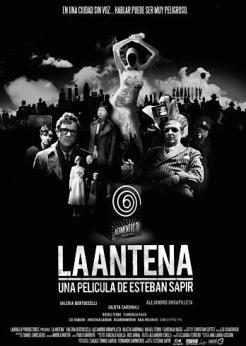
La AntenaLa Antena is a Silent Film. And by that I mean there is no dialogue, though there is music, and it’s in black and white with low-budget (looking, at least) effects, though it was made in the 21st Century — but it is entirely in the style of those films made in the era before sound was technically possible. It could sit comfortably alongside ‘real’ silent films to the extent that the uninitiated might reasonably be fooled into believing it was one.
In some respects this is neither here nor there, though it will undoubtedly put some viewers off. For those with a more open mind or who are fans of silent movies, however, it’s a joy. This is mainly because it’s incredibly imaginative, especially with its visuals, which are often pleasantly barmy. The setting is a dystopian future (or alternate reality) where people can no longer speak (thus justifying the silent film styling), and this world is wonderfully realised without a hint of realism or awkward attempts to explain why things are the way they are. These days it’s a rare filmmaker who doesn’t feel the need to explain everything and make it fit in relation to our world, but Sapir is one of the few who trusts us to accept what’s going on — much as the great silent film directors did.

Sadly it isn’t flawless. Some elements of the plot get forgotten as things roll on (what happened to Mr TV’s son, for example?), perhaps a victim of the 50 minutes of cuts they chose to make for pace. Most of the symbolism is also fairly heavy handed, though one could argue that’s in keeping with the style, and at least means it’s all nicely noticeable. Even then a few bits are unavoidably leaden — particularly, the use of the swastika and Star of David felt uncomfortably irreverent to me.

Ratings-wise, La Antena is borderline — the sort of film I give four stars to now but then beats most five-star films to a high place on my year-end top ten (like The Prestige or Hellboy II or the five others that have done it). In which case it seems only fair to run the risk of awarding it full marks.

5 out of 5

Oscar-winning modern silent movie The Artist is on BBC Two tonight, Saturday 24th January 2015, at 10pm, and is reviewed here.

Commentary! The Musical (2008)

2009 26a
Jed Whedon & Joss Whedon | 42 mins | DVD

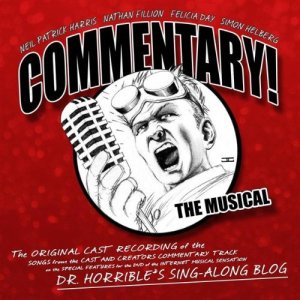
Commentary! The MusicalCommentary! The Musical falls somewhere between DVD extra, TV episode and short film. Whatever it should be classed as, it’s utter genius.
You’ve surely heard of Dr. Horrible’s Sing-Along Blog, the project Joss Whedon created during the infamous US Writers’ Strike. (That in itself you could debate the status of. Three-part miniseries? Short film? Feature film? (At 42 minutes it’s over the Academy’s boundary.) And endlessly on.) Well, on the Dr. Horrible DVD can be found this — an alternate audio track, on which the cast and crew discuss the making of the feature… except it’s all scripted and the majority is sung. Not your traditional audio commentary then.

As an audio commentary, it does little to illuminate the production of Dr Horrible — though, surprisingly, it does do some — but instead focuses its energy on spoofing commentary tracks, DVD extras, and the American film and TV industry in general. Specific targets include the Writers’ Strike and its lack of success, rivalry between lead actors, the importance of ensemble cast members, Asians in US TV and film, the dissection of art by DVD extras, and many more. It’s almost all incredibly funny — inevitably there are a few duff gags and dull songs, although they are uncommonly rare — and it moves at a rate of knots, meaning it rewards multiple listens to pick up every gag. Having already re-listened to a couple of tracks, I can attest to noticing funny lines that I was too busy laughing through before. In a spot of technical impressiveness, the commentary is often surprisingly scene-specific, sometimes even shot-specific. When you consider the effort that must’ve been involved to script and time both songs and spoken dialogue to make this happen, it’s even more impressive.

It’s this careful scripting and the sure-handed attentiveness to theme that marks Commentary! The Musical out as a fictional work in its own right, rather than ‘merely’ a DVD extra, in much the same way that Mystery Science Theater 3000 or the short-lived (and easily forgotten) Rob Brydon series Director’s Commentary are original works. With its well-targeted thematically-appropriate comedy and plentiful gags, it’s pure delight for fans of DVDs, or anyone else with a mind open to the concept.

5 out of 5

Flash Gordon (1980)

2009 #27a
Mike Hodges | 107 mins | DVD | PG / PG

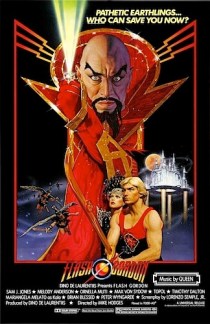
Flash GordonI hadn’t been intending to review Flash Gordon — it’s not as if I don’t have enough new films to review — but though I have seen it before it was a long time ago and I was very young, so watching it again now I wasn’t quite prepared for just how good it is.
Flash often seems to be dismissed as an unintentionally campy load of nonsense, perhaps with some ironic appeal. What this assessment misses is how knowing it is. Yes, it’s ridiculously camp, the dialogue is cheesy, the performances equally so, and it’s brighter and more colourful than any under-5s TV show ever produced. But it knows it is, and because it does it with nary a nod nor a wink I think that passes some viewers by.

The sheer volume of things there are to love in this film makes them hard to list without watching it and pointing them out as they appear, but I’m sure I can manage a few. For one, there’s the design work — the sets, the costumes, the spaceships — all huge, vibrant, retro and often ridiculous, and all wonderful for it. The special effects are truly special, creating skies full of swirling rainbow colours, rainbow clouds for the spaceships to float through, platforms that tilt over a rainbow vortex… Do some of them look primitive? Well, a bit — but they have more charm than CGI ever will, and they don’t get in the way either.

The plot is ludicrous, built from B-movie elements and predicated on cliffhangers — which is exactly as it should be. The dialogue is packed with quotable lines, many so patently ridiculous that it can only have been deliberate. There’s not a single bad performance — everyone’s either in on the joke or playing the straight man to it. Of particular note are Max von Sydow’s properly villainous villain (who, to be quite honest, still has more depth than too many nemeses we see today); Peter Wyngarde as his scheming right-hand-man, granted a fantastic death; Mariangela Melato as his right-hand-woman, granted some of the very best ‘bad’ lines; Topol as a somewhat loopy Dr Zarkov; and, of course, Brian Blessed — no more need be said.

The fights and assorted other action scenes are exciting, frequently epic, and tinged — like so much of the film — with a perfectly judged level of humour. Arguably the best is a harem-set tussle between between Dale Arden and Princess Aura, watched by sniggering servants as they wrestle on a giant bed. It’s beyond knowingly handled by Hodges, the brief cutaways to the servants indicating the deliberate commentary on such voyeuristic lesbian-lite wrestling matches in other films.

Then there’s the score by Queen. As with Brian Blessed, what more needs to be said? (Incidentally, I got a big laugh when Blessed screams, “who wants to live forever anyway?”, forgetting that Highlander was still six years off when this was made.)

So, in all that, what’s wrong with Flash Gordon? When I noticed how much I was enjoying it — about five minutes in — I began keeping my eyes open for flaws, any niggling thing that detracted from the experience Hodges created. I couldn’t find a single thing. Not one.

Which means I can now become known far and wide as the blog that only awarded Star Wars four stars, but gave Flash Gordon a perfect

5 out of 5

Predator (1987)

2009 #16a
John McTiernan | 102 mins | DVD | 18 / R

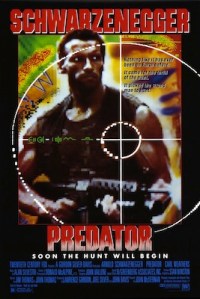
PredatorLet’s not pretend here: although the series have become intrinsically linked, Predator is Alien’s poorer cousin. Not that it’s a bad film — it’s an entertaining war flick that turns into a sci-fi/action/horror skirmish thingy — but it doesn’t have the same finesse that imbues Alien and its sequel.

In the lead role, Arnie does his usual macho posturing. Around him, a crack team of special-operations soldiers are characterised enough to be distinguishable but little more. There’s a girl because there should be a girl, not that she does much. Mainly, there are a couple of big fights and one seriously ugly alien.

The main reason for Predator’s success may well be the Predator itself. It’s a fantastic bit of design and animatronics that easily stands up today, its disgusting mouth perhaps not as iconic as the Alien’s phallic extra one but arguably more gruesome to look at. It works differently too: a solo intelligent hunter that is picking off our human heroes and is always one step ahead. Much of the same could be said of Alien’s Alien, but that was like a beast stalking its prey, while the Predator is more like a man hunting some rats. Where Aliens felt like a natural evolution of the former franchise’s concept — more of them! — Predators seems like a rather ill-conceived idea.

Still, there’s plenty of visceral enjoyment to be had from Predator’s straightforward approach, which is more than can be said for its sequel

4 out of 5

Alien: The Director’s Cut (1979/2003)

2009 #13a
Ridley Scott | 111 mins | DVD | 15 / R

Famously, Ridley Scott’s 2003 Director’s Cut re-release of Alien came in slightly shorter than the original version, an unusual state of affairs. This disparity isn’t just because Scott lopped a bit out (though, he did) — he also removed scenes and put others back, in the process creating a cut of the film as edited by an older version of the same filmmaker. Or, alternatively, creating a different version to help shift some extra tickets — it depends which quotes you want to believe.

Having only seen the original version once, and several years ago, I can’t offer any meaningful analysis of how Scott’s myriad nips and tucks impact on pace. It certainly doesn’t feel faster on the whole, still exhibiting the same slow-build tension that’s as reminiscent of 2001 as any other horror films. Coupling this with a very realist style of dialogue and action — minimal, overlapping, mundane, light on exposition — makes the film feel positively indie-like today. There’s no way a major effects-filled blockbuster would progress so slowly now, though recently Sunshine came close. In these respects, Alien: The Director’s Cut isn’t all that different from the Alien so many know and love — no surprises there — and all but the most die hard of die hard fans are unlikely to notice such minor changes.

However, Scott also reinserted four deleted scenes, which even I managed to spot. Only one makes a notable difference: during the climax, Ripley discovers Dallas and Brett in alien cocoons and burns them. The Aliens’ cocooning is intrinsic to the plot of later films in the franchise, in which respect it works well to see it first crop up here; taking the film on its own merits though, such an addition in the middle of the climax serves to slow it down and feel like an unnecessary aside, tidying up a loose end that most audience members wouldn’t even think was a loose end (I know I didn’t). Of course, this just goes to show that it was a sensible cut to make back in ’79.

These small moments aside, Alien feels unchanged. It’s been said many times before but, first and foremost, it’s a horror movie — it just happens to be one set in space with plenty of sci-fi trappings. Move it to an oil tanker in the middle of the ocean and a great deal of it would function just as well. Whatever effect Scott’s trims may have had, they haven’t made it any less effective in this regard, though second time round all the jump-scares failed on me, but that’s the nature of such a shock rather than a flaw of Alien in particular. Trying to look at it objectively, we all know that Ripley’s the only survivor and the franchise heroine now, but the film gives you no/few reason/s to presume she’s any more significant than any other character: she’s third in command, Weaver’s only second in the credits, and she doesn’t even go out on the initial mission. It’s an effective step in keeping the audience guessing who might survive.

Some of the effects look rather dated now, especially the ship’s computers, but that’s not really problematic. The design work on the ship is still exemplary, and of course often copied. It’s so grimy, industrial and (for want of a better word) ‘real’ that one wouldn’t even need to reshoot much to claim it was set on that oil tanker. The Alien is still the main consideration in design and effects terms, and it’s still barely seen. This was always a very sensible move, hiding any shortcomings in the design (most of the time at least) and also helping create menace — because it’s never seen in full, and only brief glimpses are snatched in the shadows, we always believe it could be anywhere. This all builds to the great escape pod ending, which cleverly uses a calm-after-the-storm feeling and the distraction of Ripley’s semi-strip to lull the viewer into a state of total unawareness. Even on re-watching when you know it’s coming, this sequence contains arguably the film’s most effective jump.

Alien is 30 this year and the Director’s Cut is now six years old, meaning most seriously interested viewers will have seen it by now. How different this version is from the original cut should be indicated by the fact I didn’t feel justified in giving this a new number, even with my poor memory. I can only imagine that to fans intimately familiar with the film the number of trims (there are rather a lot apparently) and new scenes (just four) make a huge difference, but for a more casual viewer they don’t significantly change how it feels as a whole. That said, even with my vague memory, I’d call the original as the superior cut.

5 out of 5